
Investing
The 7 Levels of Investing: What Changes at Every Stage

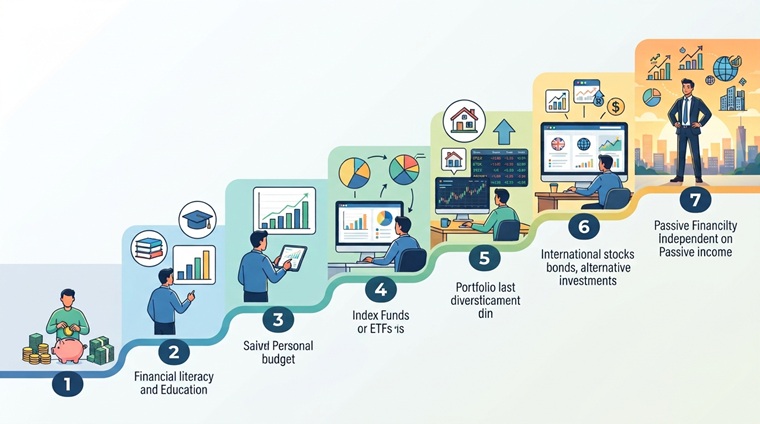
FINRA research: the Contemplating Stage is pivotal. The Finance Corner: Level 2 investors say ‘I’ve got this figured out’ at exactly the wrong moment. YouTube’s $0-$1M analysis: at $5,000, fees begin to matter. At $1,000,000, preservation joins creation. Most investing content assumes you already know where you are. It talks about index funds without asking whether you have your emergency fund sorted. It discusses portfolio rebalancing without checking whether you have a portfolio worth rebalancing. It talks about private equity before you have had your first real market correction. This article is different. It maps the seven levels of the investing journey from the moment before you start to the management of serious wealth, and explains specifically what changes at each stage — not just in portfolio size, but in mindset, strategy, the specific mistakes that cost investors at that level, and what actually moves you forward. The framework draws on the FINRA Investor Education Foundation’s new investor journey research, Barchart’s investor expertise analysis, The Finance Corner’s investor evolution model, Codie Sanchez’s documented investing stages, Michael Yardney’s five-level framework, and the YouTube-analysed $0 to $1,000,000 investor journey.
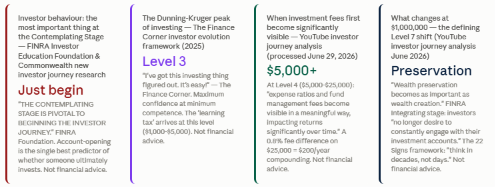
Waiting for perfect knowledge before you begin. The information needed to start is freely available; the information needed for certainty does not exist. Waiting for certainty is waiting for something that never arrives. The realisation that you do not need to understand everything before starting. You need to understand enough. Getting to enough is the task at Level 1. Open an account. You do not need to deposit money yet. The act of opening an account has been shown in research to be the single most effective predictor of whether someone will eventually invest. The FINRA report identifies account-opening as the tipping point between Contemplating and Starting.
Set up automatic recurring contributions. Even £25 or $25 per month. The automation removes the daily decision-making that produces emotional investing. The 22 Signs of Advanced Investor Status framework identifies DCA on autopilot as one of the most reliable markers of investing maturity.
The insight that simplicity at this level is not laziness — it is efficiency. A three-fund portfolio (domestic equity, international equity, bonds) at low cost, held consistently, beats most complex strategies over long periods. Calculate your actual after-fee, after-tax returns. Compare them to the index return for the same period. If your active choices have not beaten the index over 3-5 years, this is significant evidence that passive investing is the right strategy for you.
The discovery that the real work of portfolio management is not finding the best assets — it is building a structure where the assets you own do not all fall at the same time and for the same reasons. Fill your tax-advantaged accounts first before holding investments in taxable accounts. In the UK: maximise the £20,000 ISA allowance. In the US: maximise 401(k) and IRA contributions. The tax drag on a non-sheltered portfolio compounds against you every year.
Consider a fee-only financial adviser for a portfolio review. Not a commission-earning salesperson — a fiduciary who charges a flat fee to review your structure. At $100,000+, a single structural insight (tax location, withdrawal sequencing, correlation reduction) can be worth more than years of additional contributions.
Review estate planning, trust structures, and beneficiary designations. At this level, how your wealth is structured legally matters as much as how it is invested financially. In the UK: review pension pot IHT exposure (changing from 2027). In the US: review retirement account beneficiaries.
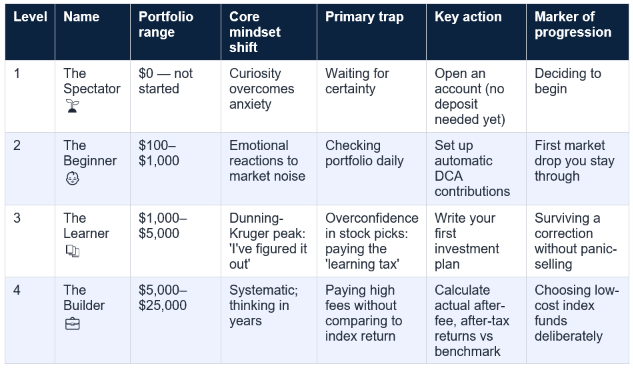
The levels in this framework are determined by mindset and knowledge as much as portfolio size. The portfolio ranges are anchors, not rigid definitions. You can hold $25,000 but still have a Level 2 mindset (checking daily, reacting emotionally to short-term moves). You can hold $5,000 but be applying Level 5 thinking (understanding correlation, thinking in decades, reviewing tax efficiency). A simple self-test: The Finance Corner's investor evolution framework identifies the Dunning-Kruger peak (Level 3) as the moment an investor thinks 'I've got this figured out. It's easy!' If that sounds familiar, you are at Level 3. The 22 Signs of Advanced Investor Status identifies 'thinking in decades, not days' as a reliable marker of Level 5 or 6 thinking.
What is the 'learning tax' in investing?
The YouTube investor journey analysis (processed June 2026) coined this phrase for the portfolio range of $1,000-$5,000. At this level, an investor has enough capital to make meaningful decisions and enough confidence (often overconfidence) to make wrong ones. The learning tax is the real-money cost of those wrong decisions — the stock picked because it seemed obvious, the sector concentrated into because the investor understood it, the portfolio sold during a correction because the investor lacked historical context. This cost is not avoidable in the conventional sense: most investors pay some version of it. But understanding that it is a normal part of progression removes its psychological sting and provides the context to learn from it rather than abandon investing altogether.
When should I move from index funds to individual stocks?
Codie Sanchez's documented investing framework (Yahoo Finance) places individual stock picking as Stage 3 — and explicitly qualifies it with 'only if you're a real pro.' Barchart's investor expertise analysis identifies individual stock picking and options trading as Advanced investor activities. The Finance Corner's investor evolution research shows that most investors believe they are ready for individual stocks earlier than they actually are — the Dunning-Kruger confidence peak typically coincides with the first interest in moving beyond index funds. The honest answer: most investors who move from index funds to individual stock picking do not beat the index return over five or more years. This does not mean you cannot — it means the burden of proof should be on the active strategy, and that burden should be applied with real data from your own returns versus the benchmark over multiple years, not months.
Is it worth getting a financial adviser at any of these levels?
The value of professional advice varies significantly by level. At Levels 1-3, free educational resources (FINRA Foundation, government financial literacy programmes) and low-cost robo-advisers typically provide sufficient guidance. At Level 4-5 ($5,000-$100,000), a fee-only financial adviser can add value through tax-efficient account structuring, portfolio review, and behavioural coaching during corrections. At Level 6+ ($100,000+), Barchart's investor expertise analysis specifically identifies tax optimisation as the most commonly overlooked area at the advanced level — where professional advice can pay for itself many times over in a single review. The critical distinction: a fee-only fiduciary adviser (paid a flat fee or hourly rate) versus a commission-based salesperson (whose recommendations may be influenced by compensation). The FINRA Foundation provides tools to identify qualified advisers.
How long does it take to reach Level 7?
There is no standard timeline, and the research reviewed for this article does not identify one. The YouTube investor journey analysis processed in June 2026 tracks the journey from $0 to $1,000,000 but does not attach a time estimate, because the pace depends on income, contribution rate, investment returns, and starting age. A 25-year-old who contributes $500 per month at a 7% average annual return reaches $1,000,000 in approximately 30 years at age 55. A 35-year-old who contributes $1,500 per month gets there in roughly 20 years at age 55. These are illustrative calculations, not projections. The FINRA research on new investors consistently shows that the biggest determinant of progression is not contribution size but consistency — investors who contribute regularly at any amount significantly outperform those who contribute larger amounts irregularly. Not financial advice. Verify calculations with a financial planning tool and consult a qualified adviser.
Table of Contents
- Why a Levels Framework Matters More Than Any Single Investment Tip
- Level 1 The Spectator — You know investing exists. You haven’t started.
- Level 2 The Beginner — First $100 to first $1,000. The emotional education begins.
- Level 3 The Learner — $1,000 to $5,000. The ‘learning tax’ arrives.
- Level 4 The Builder — $5,000 to $25,000. Fees become real. Strategy becomes necessary.
- Level 5 The Diversifier — $25,000 to $100,000. Asset classes beyond equities enter the picture.
- Level 6 The Strategist — $100,000 to $1,000,000. Tax, structure, and sequence of returns matter.
- Level 7 The Steward — $1,000,000+. Wealth preservation joins wealth creation.
- The Master Summary: All 7 Levels at a Glance
- Conclusion: Every Expert Was Once a Spectator
- Frequently Asked Questions
Why a Levels Framework Matters More Than Any Single Investment Tip
The investing content ecosystem is enormous, relentlessly produced, and mostly aimed at people who are already somewhere in the middle of the journey. Advanced investors are told to rebalance their portfolios. Beginners are told to open an index fund. But these are instructions without context — and context is everything in investing. An investor in Level 2 who reads a guide to individual stock picking is getting advice designed for Level 5 or 6. An investor in Level 5 who reads a beginner’s guide to index funds is reading something that no longer matches their actual situation. The seven-level framework in this article is built on published research from the FINRA Investor Education Foundation, investor evolution analyses from The Finance Corner and Barchart, Codie Sanchez’s documented investing stages framework, Michael Yardney’s five-level property investment model, and the YouTube-analysed $0 to $1,000,000 investor journey. The specific portfolio ranges are illustrative anchors, not rigid definitions — an investor’s level is determined by mindset and knowledge as much as by balance. But the structure matters because the most common investing errors are not random. They are predictable, level-specific, and largely avoidable if you know which level you are at.Level 1 The Spectator
You know investing exists. You haven’t started. Portfolio: $0 — pre-investment
Every investor starts here. You have heard of the stock market, you know people who invest, you have probably watched a YouTube video or read a headline and then closed the tab. The FINRA Investor Education Foundation and Commonwealth’s report on the new investor journey identifies this as the ‘Contemplating Stage’ and calls it ‘pivotal to beginning the investor journey.’ The barriers at this level are not usually financial. They are psychological. The FINRA research identifies them specifically: lack of knowledge, the perception that investing is complex, and distrust. In the Transtheoretical Model of behaviour change, cited by the Akron Legal News in September 2025 in its coverage of the FINRA report, this maps to the precontemplation and contemplation stages — you are aware of the behaviour but have not yet committed to it. What actually changes at this level is the internal permission to begin. Codie Sanchez, founder of Contrarian Thinking, advises that before you invest a dollar in the market, invest in yourself. On Jay Shetty’s podcast, she said: ‘If you have only a little bit of cash, the best returning asset class of all time is going to be you.’ Financial education, at this stage, is the investment.Waiting for perfect knowledge before you begin. The information needed to start is freely available; the information needed for certainty does not exist. Waiting for certainty is waiting for something that never arrives. The realisation that you do not need to understand everything before starting. You need to understand enough. Getting to enough is the task at Level 1. Open an account. You do not need to deposit money yet. The act of opening an account has been shown in research to be the single most effective predictor of whether someone will eventually invest. The FINRA report identifies account-opening as the tipping point between Contemplating and Starting.
Level 2 The Beginner
First $100 to first $1,000. The emotional education begins. Portfolio: $100–$1,000
The YouTube transcript analysis processed in June 2026 on the $0 to $1,000,000 investor journey captures this level precisely: ‘Starting with small deposits, users are new and the market is indifferent. Education begins with emotional reactions to minor gains and losses.’ At Level 2, the portfolio is small but the emotions are large. A 5% gain on $200 is $10 — and it feels like a revelation. A 5% loss on $200 is $10 — and it feels like a catastrophe. This emotional disproportionality is normal and important. Barchart’s analysis of investor expertise levels identifies beginners as characterised by a ‘restricted understanding of the stock market,’ a ‘simplified approach to investing,’ and ‘investment decisions made without a solid fundamental basis.’ The Finance Corner’s investor evolution framework identifies the Level 1 investor (what this article calls Level 2) as someone who focuses ‘solely on the share price and its past performance’ with ‘a tendency to follow the crowd.’ The crucial development at this level is not financial. It is the beginning of what the YouTube analysis calls ‘a personal data set of behaviour under pressure’ — the empirical record of what you actually do when the market moves against you, which is more valuable than any theory about what you would do. Checking the portfolio every day. At this level, daily checking converts normal market volatility into psychological distress, and psychological distress produces bad decisions. Advanced investors check periodically, not constantly. The discovery that the market's daily movements have nothing to do with your financial future — and that your own behaviour in response to those movements has everything to do with it.Set up automatic recurring contributions. Even £25 or $25 per month. The automation removes the daily decision-making that produces emotional investing. The 22 Signs of Advanced Investor Status framework identifies DCA on autopilot as one of the most reliable markers of investing maturity.
Level 3 The Learner
$1,000 to $5,000. The ‘learning tax’ arrives. Portfolio: $1,000–$5,000
The Finance Corner’s investor evolution framework describes the transition from Level 1 to Level 2 (mapped to Level 3 here) with memorable precision: the investor ‘has heard that there’s more to investing than just the share price. It comes with a confidence boost, and it is normal to think: ‘Ah, I’ve got this investing thing figured out. It’s easy!’’ This is the Dunning-Kruger peak of investing — maximum confidence, minimum competence. The YouTube investor journey analysis calls what happens next ‘the learning tax.’ At this portfolio size, common mistakes cost real money. The learner has enough invested to make meaningful decisions and enough confidence to make wrong ones. They might concentrate too heavily in a sector because they understand it, ignore diversification because they believe in their picks, or sell during a correction because they lack the historical context that corrections are normal. Codie Sanchez’s investing framework on Yahoo Finance specifically warns that individual stock picking is only appropriate for those who are ‘real pros’ — Level 3 investors almost never are. Michael Yardney’s investing framework notes that at this stage investors ‘must take responsibility for their financial future and become actively involved’ while simultaneously building financial literacy. The tension between those two requirements — acting and learning simultaneously — is what makes Level 3 the most turbulent stage of the journey. Believing that understanding a company or sector means you can time it better than the market. The Finance Corner's research notes the learner believes 'I've got this figured out' at exactly the moment they are most at risk. The first real market correction that you stay through. Every investor who has navigated a significant drawdown without selling has learned something no theory can teach about their own risk tolerance and emotional resilience. Read the fundamentals. Not stock tips. Not trading strategies. The foundational concepts: what a P/E ratio means, what diversification actually does, how compound interest works across different time frames. The 22 Signs framework identifies having a written investment plan as a key marker of progression past this level.Level 4 The Builder
$5,000 to $25,000. Fees become real. Strategy becomes necessary. Portfolio: $5,000–$25,000
The YouTube investor journey analysis identifies this portfolio range as the level where ‘investment fees like expense ratios and fund management fees become visible in a meaningful way, impacting returns significantly over time.’ At $5,000, a 1% annual management fee costs $50. That is easy to ignore. At $25,000, the same 1% fee costs $250 per year. Compounded across twenty years, the fee difference between a 0.2% index ETF and a 1.0% actively managed fund is tens of thousands of dollars. The Builder also develops something that the earlier levels lacked: a genuine investment strategy with a time horizon attached to it. The FINRA new investor journey research identifies the ‘Engaging’ stage as characterised by ‘continued learning and self-discovery based on how their investment decisions are playing out.’ Barchart’s investor expertise analysis notes that at the intermediate level, investors develop ‘deeper understanding’ but significant market changes ‘can still expose them to higher risk levels.’ Codie Sanchez’s framework places index fund investing as Stage 2 — and recommends staying here for most investors. ‘Invest in a diversified portfolio via Vanguard,’ is her documented Stage 2 advice. Not all investors need to progress past this. The Builder who consistently contributes to a low-cost diversified portfolio and leaves it alone for thirty years will statistically outperform the majority of people who proceed to more ‘advanced’ strategies. Paying 1%+ in management fees without scrutinising whether active management delivers commensurate value. Decades of evidence suggest it does not, on average. The difference between 0.2% and 1.0% annual fees over 30 years on a growing portfolio is enormous.The insight that simplicity at this level is not laziness — it is efficiency. A three-fund portfolio (domestic equity, international equity, bonds) at low cost, held consistently, beats most complex strategies over long periods. Calculate your actual after-fee, after-tax returns. Compare them to the index return for the same period. If your active choices have not beaten the index over 3-5 years, this is significant evidence that passive investing is the right strategy for you.
Level 5 The Diversifier
$25,000 to $100,000. Asset classes beyond equities enter the picture. Portfolio: $25,000–$100,000
At the Diversifier level, the portfolio is large enough that the mix of assets matters as much as the individual choices. The Barchart analysis of advanced investor characteristics identifies a diversified portfolio ‘comprising stocks, bonds, and alternatives’ as a key achievement. Property, as an asset class, enters serious consideration at this level for many investors. Michael Yardney’s five-level framework specifically identifies this transition: at Level 3 (his framework), investors ‘realise their superannuation won’t get them through retirement, so they learn about investment and accumulate assets.’ The 22 Signs of Advanced Investor Status framework from April 2026 provides one of the most telling markers of progression to this level: ‘You think in decades, not days — zooming out instead of reacting to daily noise.’ At the Diversifier stage, the investor has also begun to understand correlation — the principle that assets whose prices do not move together provide genuine risk reduction, while assets that look different but move identically provide almost none. The Diversifier is also the first level at which tax efficiency becomes a serious strategic consideration. At lower portfolio sizes, the tax efficiency difference between holding assets in an ISA (UK) or 401(k)/IRA (US) versus a taxable account was relatively small. At $50,000 or £40,000, the compound tax drag on a non-sheltered portfolio becomes meaningful. Confusing complexity with sophistication. A portfolio with twenty different funds, several property investments, a gold allocation, and an alternatives sleeve is not automatically better-diversified than a three-fund portfolio. Correlation determines diversification quality, not the number of assets.The discovery that the real work of portfolio management is not finding the best assets — it is building a structure where the assets you own do not all fall at the same time and for the same reasons. Fill your tax-advantaged accounts first before holding investments in taxable accounts. In the UK: maximise the £20,000 ISA allowance. In the US: maximise 401(k) and IRA contributions. The tax drag on a non-sheltered portfolio compounds against you every year.
Level 6 The Strategist
$100,000 to $1,000,000. Tax, structure, and sequence of returns matter. Portfolio: $100,000–$1,000,000
The Strategist level is where most investors discover what they did not know they did not know. At $100,000+, the portfolio is large enough that structural decisions — which accounts hold which assets, how withdrawals will be sequenced in retirement, how tax is optimised across the portfolio — produce meaningfully different outcomes. Barchart’s investor expertise analysis identifies the advanced investor as someone who ‘may engage in more sophisticated investment practices’ while also noting a common failure mode: ‘advanced investors might overlook tax considerations associated with their investments.’ This is the trap of the level. The 22 Signs of Advanced Investor Status framework identifies keeping an ‘investment journal or log explaining why you made each decision’ as a marker of this level. The reason this matters: at the Strategist level, the portfolio is large enough that a single error of commission — panic-selling at the wrong moment, misunderstanding a tax event, taking on inappropriate concentration risk — can set back progress by years. Documentation creates accountability to your own reasoning. Michael Yardney’s framework describes Level 4 as having ‘a substantial asset base to create passive income to pay for lifestyle costs’ and notes the investor ‘keeps growing their investment portfolio whether or not they work in a real job.’ The 22 Signs framework also identifies the Strategist’s mindset: ‘You focus on process over outcome — good decisions outweigh lucky results. Allowing a large portfolio to create complacency. At this level, sequence-of-returns risk (the danger that a large loss early in retirement depletes the base irreversibly) is the primary structural risk. Many investors only discover this during a correction, which is too late to address it structurally. The realisation that protecting what you have built is as important as continuing to build it. Asset allocation at the Strategist level is not just about growth — it is about the shape of the return sequence over time.Consider a fee-only financial adviser for a portfolio review. Not a commission-earning salesperson — a fiduciary who charges a flat fee to review your structure. At $100,000+, a single structural insight (tax location, withdrawal sequencing, correlation reduction) can be worth more than years of additional contributions.
Level 7 The Steward
$1,000,000+. Wealth preservation joins wealth creation. Portfolio: $1,000,000+
The $1 million threshold is not a destination. It is a transition — the point at which the psychology and strategy of investing fundamentally change. The YouTube investor journey analysis captured in June 2026 identifies Level 7 (the $1,000,000 level) by a specific characteristic: ‘Wealth preservation becomes as important as wealth creation.’ This is the defining mindset shift of the Steward level. Everything before this level was primarily about accumulation: contributing more, earning a reasonable return, and staying invested long enough for compounding to work. The Steward still does all of those things. But the risk calculus changes. At $1,000,000, a 30% drawdown is $300,000 — far more significant than a 30% drawdown on $10,000. The Steward’s primary investment questions shift from ‘how do I grow this?’ to ‘how do I structure this so that I cannot blow it up?’ The FINRA Integrating stage describes a parallel shift in investor psychology: investors at this level ‘no longer desire to constantly engage with their investment accounts’ and are ‘now in a position to start exploring whether different investment opportunities would align with their objectives and risk tolerance.’ Michael Yardney’s framework describes this as having ‘a substantial asset base to create passive income to pay for lifestyle costs’ that continues whether or not the investor is working. Codie Sanchez’s framework identifies private equity as Stage 4 — only accessible and appropriate at this level of capitalisation and sophistication. The Finance Corner’s investor evolution framework identifies the pinnacle of investing as where ‘intangibles come into play’ and ‘culture is an often-overlooked factor. Treating a £1M or $1M portfolio the same way you managed it at $100,000. The strategies that build the first million are not always the strategies that preserve and extend it. Risk tolerance, withdrawal planning, and estate considerations all require explicit review at this level. The compound interest of restraint. At $1M+, the most powerful investment decision is often what NOT to do — avoiding the sophisticated-sounding products, the alternative investments with high fees, and the concentration risks that periodically wipe out investors who have accumulated significant wealth.Review estate planning, trust structures, and beneficiary designations. At this level, how your wealth is structured legally matters as much as how it is invested financially. In the UK: review pension pot IHT exposure (changing from 2027). In the US: review retirement account beneficiaries.
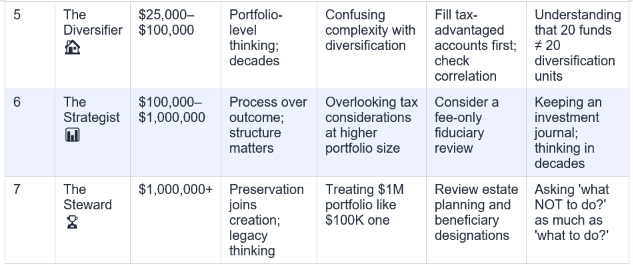
The Master Summary: All 7 Levels at a Glance
Sources: FINRA Investor Education Foundation; Barchart/Due; The Finance Corner; YouTube-transcript.ai; Codie Sanchez/Yahoo Finance; Michael Yardney/PropertyUpdate; AI-03629 Advanced Investor Framework. Not financial advice.
Conclusion
Michael Yardney’s investing framework puts it plainly: ‘You’ve got to go through the various stages to become financially independent.’ The Finance Corner’s investor evolution research echoes the same observation: every investor passes through the same progression, at their own pace, with their own version of each stage’s trap. The FINRA research identified the Contemplating Stage as the most pivotal — not because it is the hardest stage intellectually, but because it is the one that determines whether an investor ever begins at all. The 22 Signs of Advanced Investor Status framework identified one of the most reliable markers of genuine investing maturity: ‘You think in decades, not days.’ That insight is not available at Level 2. It is not even available at Level 3. It emerges slowly, through the accumulation of experience across multiple market cycles, through watching corrections happen and prices recover, through the discovery that the market’s daily noise and your financial future are largely unrelated to each other. Every investor who has reached Level 7 was once at Level 1, watching from the sidelines and waiting for certainty that never came. The difference is not intelligence or access or starting capital. The difference, consistently, is the decision to begin. Not financial, investment, or tax advice. Always consult a qualified financial adviser for personalised guidance.Frequently Asked Questions
How do I know which level I am at?The levels in this framework are determined by mindset and knowledge as much as portfolio size. The portfolio ranges are anchors, not rigid definitions. You can hold $25,000 but still have a Level 2 mindset (checking daily, reacting emotionally to short-term moves). You can hold $5,000 but be applying Level 5 thinking (understanding correlation, thinking in decades, reviewing tax efficiency). A simple self-test: The Finance Corner's investor evolution framework identifies the Dunning-Kruger peak (Level 3) as the moment an investor thinks 'I've got this figured out. It's easy!' If that sounds familiar, you are at Level 3. The 22 Signs of Advanced Investor Status identifies 'thinking in decades, not days' as a reliable marker of Level 5 or 6 thinking.
What is the 'learning tax' in investing?
The YouTube investor journey analysis (processed June 2026) coined this phrase for the portfolio range of $1,000-$5,000. At this level, an investor has enough capital to make meaningful decisions and enough confidence (often overconfidence) to make wrong ones. The learning tax is the real-money cost of those wrong decisions — the stock picked because it seemed obvious, the sector concentrated into because the investor understood it, the portfolio sold during a correction because the investor lacked historical context. This cost is not avoidable in the conventional sense: most investors pay some version of it. But understanding that it is a normal part of progression removes its psychological sting and provides the context to learn from it rather than abandon investing altogether.
When should I move from index funds to individual stocks?
Codie Sanchez's documented investing framework (Yahoo Finance) places individual stock picking as Stage 3 — and explicitly qualifies it with 'only if you're a real pro.' Barchart's investor expertise analysis identifies individual stock picking and options trading as Advanced investor activities. The Finance Corner's investor evolution research shows that most investors believe they are ready for individual stocks earlier than they actually are — the Dunning-Kruger confidence peak typically coincides with the first interest in moving beyond index funds. The honest answer: most investors who move from index funds to individual stock picking do not beat the index return over five or more years. This does not mean you cannot — it means the burden of proof should be on the active strategy, and that burden should be applied with real data from your own returns versus the benchmark over multiple years, not months.
Is it worth getting a financial adviser at any of these levels?
The value of professional advice varies significantly by level. At Levels 1-3, free educational resources (FINRA Foundation, government financial literacy programmes) and low-cost robo-advisers typically provide sufficient guidance. At Level 4-5 ($5,000-$100,000), a fee-only financial adviser can add value through tax-efficient account structuring, portfolio review, and behavioural coaching during corrections. At Level 6+ ($100,000+), Barchart's investor expertise analysis specifically identifies tax optimisation as the most commonly overlooked area at the advanced level — where professional advice can pay for itself many times over in a single review. The critical distinction: a fee-only fiduciary adviser (paid a flat fee or hourly rate) versus a commission-based salesperson (whose recommendations may be influenced by compensation). The FINRA Foundation provides tools to identify qualified advisers.
How long does it take to reach Level 7?
There is no standard timeline, and the research reviewed for this article does not identify one. The YouTube investor journey analysis processed in June 2026 tracks the journey from $0 to $1,000,000 but does not attach a time estimate, because the pace depends on income, contribution rate, investment returns, and starting age. A 25-year-old who contributes $500 per month at a 7% average annual return reaches $1,000,000 in approximately 30 years at age 55. A 35-year-old who contributes $1,500 per month gets there in roughly 20 years at age 55. These are illustrative calculations, not projections. The FINRA research on new investors consistently shows that the biggest determinant of progression is not contribution size but consistency — investors who contribute regularly at any amount significantly outperform those who contribute larger amounts irregularly. Not financial advice. Verify calculations with a financial planning tool and consult a qualified adviser.
0 Comments
Be the first to share your thoughts on this article.