

Investing
The Investing Decision That Matters More Than Picking

Miss just 4 of the best days in 2025 and a +17.88% return becomes a loss. The unluckiest investor who bought before every crash since 1997 still beat cash by 2026. The data is in. Consistency wins.
There is a conversation that repeats endlessly in investing communities. It sounds like a genuine question — ‘which fund should I choose?’ or ‘is now a good time to invest?’ — but it is usually a displacement activity. It is the intellectual equivalent of researching gym memberships instead of going to the gym. The research phase provides the feeling of progress without the commitment of action. And the longer it continues, the more it costs. Not because the fund you eventually choose is wrong. Because the time you spent not in the market while researching it is time the market was compounding without you. This article is not about which investment to choose. It is about the decision that the 40-year data consistently shows matters more: whether you stay in the market you chose, through the conditions that make most people want to leave it. The evidence comes from four independent research analyses published in 2025 and 2026: Ned Davis Research and Morningstar, WisdomTree, Vanguard UK, and Keytrade Bank. They use different time periods, different geographies, and different methodological approaches. They arrive at the same conclusion.
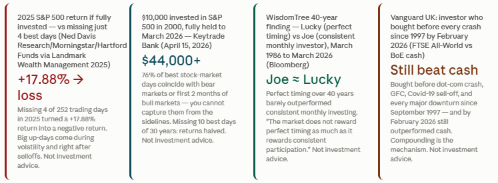
$10,000 invested in S&P 500 in 2000 and held = $44,000+ by March 2026 (Keytrade Bank April 2026). 76% of best stock-market days coincide with bear markets or early bull markets — you cannot capture them from the sidelines (Keytrade Bank April 2026). WisdomTree: 'the market does not reward perfect timing as much as it rewards consistent participation' (40-year analysis, April 2026). Vanguard UK: unluckiest investor who bought before every crash since 1997 still beat cash by February 2026.
2025 S&P 500 fully invested: +17.88%. Missing just 4 best days: negative return (Ned Davis Research/Morningstar/Hartford Funds via Landmark Wealth 2025). 76% of best days coincide with bear markets or early bull markets (Keytrade April 2026). Missing top 10 days (1988-2025): returns flipped to losses (Practical AI Investor / Hartford Funds). $1,000 in S&P 500 (2000-2025): 676% return. Missing top 50 days: 4.9% over 25 years (Rivkin research October 2025).
WisdomTree 40-year analysis (Bloomberg, March 1986 to March 2026): Lucky (perfect timing) only marginally outperformed Joe (consistent monthly investor). Murphy (worst timing) was far behind. 'Consistency removes the need to be right' (WisdomTree April 2026). 'The market does not reward perfect timing as much as it rewards consistent participation.
Vanguard UK (to February 2026): investor who bought before dot-com crash, GFC, Covid-19 sell-off, and all major downturns since 1997 still beat cash by February 2026. Compounding is the mechanism: returns earned on returns, not disrupted by selling. Keytrade Bank April 2026: 'volatility is the price you pay for long-term returns.
Practical AI Investor 1988-2025 analysis: staying fully invested outperformed any market-timing approach over the full period. WisdomTree April 2026: Joe's consistent monthly investment outperformed Murphy and nearly matched Lucky. Keytrade: frequent trading adds transaction costs on top of the timing cost.
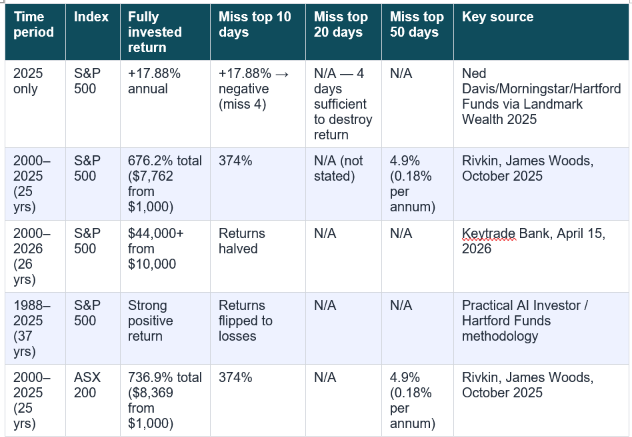
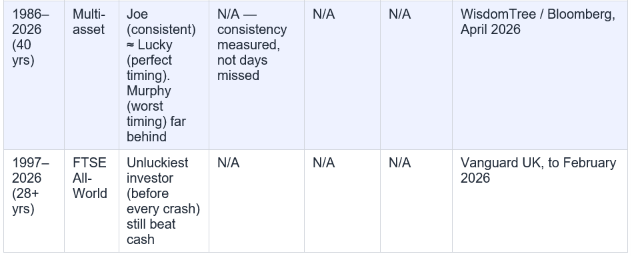
Note: Different studies use different methodologies — directly comparing the percentage figures across studies is not valid. The directional finding is identical across all of them: missing the best days dramatically reduces long-term returns. Not investment advice. Past performance does not guarantee future results.
The emotional experience of a market decline is not irrational — it is the normal human response to loss. The problem is that the rational response to the short-term emotional experience (sell) is the opposite of the rational response to the long-term evidence (stay). Building automatic systems removes the decision from the moment of maximum psychological pressure.
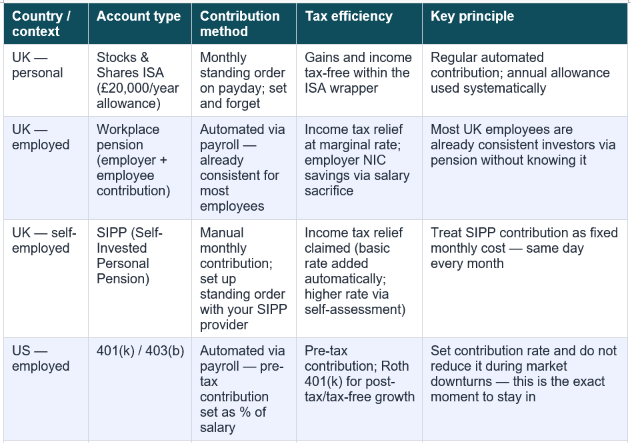
This is not financial, tax, or investment advice. Account types, contribution limits, and tax treatment depend on individual circumstances and are subject to change. Always verify with HMRC (UK) or the IRS (US), or consult a qualified financial adviser. ISA contribution limits and pension annual allowances are as of 2025/26.
Both matter, but in different proportions. The research cited in this article consistently shows that the most expensive investing mistake is not the choice of fund — it is market timing: selling during volatility and missing the recovery days that provide most of the long-term return. WisdomTree's April 2026 analysis shows that an investor with perfect timing barely outperformed a consistent investor over 40 years. Within the universe of broad, low-cost index funds tracking global or US markets, the differences between comparable options are generally small compared to the difference between staying invested and not. The practical priority: choose a broadly diversified, low-cost fund or ETF, automate the contribution, and stay in it. The fund choice matters at the margin. The consistency matters foundationally.
What if the market falls right after I invest?
Vanguard UK's research published to February 2026 answers this directly. Their hypothetical unluckiest investor put money in before the dot-com crash, the global financial crisis, the Covid-19 sell-off, and other major downturns — every significant crash since 1997. By February 2026, they were still ahead of cash despite experiencing every possible bad timing scenario. The mechanism is compounding: returns earned on previous returns through multiple market cycles accumulate to more than cash over long time periods. The Keytrade Bank April 2026 analysis frames it as a trade-off: 'volatility is the price you pay for long-term returns.' A market fall right after you invest is uncomfortable. It is not, on the long-term evidence, the disaster it feels like in the moment. Past performance does not guarantee future results.
Why do even professional investors fail at timing the market?
The Practical AI Investor's analysis of Hartford Funds data identifies the structural reason: 'even the pros — armed with PhDs, Bloomberg terminals, and full-time risk teams — routinely fail at timing the market.' The fundamental problem is that the best market days cluster around the worst market days. Keytrade Bank's April 2026 analysis confirms: 76% of the best stock-market days coincide with a bear market or the first two months of a bull market. A professional investor who reduces exposure during a bear market to limit losses is statistically likely to miss the recovery days that occur in exactly that period. Predicting the exit point requires also predicting the re-entry point — and both must be correct for the strategy to work. Over multiple market cycles, the probability of getting both right consistently is essentially zero.
Is Dollar Cost Averaging (DCA) / regular monthly investing always best?
Regular monthly investing (DCA) does not always produce the highest return compared to lump-sum investing at the right moment — by definition, a perfectly timed lump sum will outperform. The point is that the lump sum invested at exactly the right time is not a real option for most investors, and the cost of waiting for it (missing days, earning cash rates, avoiding the market) is consistently documented as greater than the cost of simply investing regularly regardless of market conditions. WisdomTree's Joe (consistent monthly investor) over 40 years illustrates the principle: he never needed to be right about timing, and his outcome was remarkably close to Lucky's perfect timing over the same period. For the vast majority of investors who do not have large lump sums available, regular investing is both the practical option and the evidentially supported one.
How often should I check my investments?
The research consistently suggests that the less frequently you check, the less likely you are to make emotional decisions that damage returns. WisdomTree's paper frames this through Murphy's behaviour: waiting for a better entry point creates hesitation, which creates missed days, which carries the return cost. Keytrade Bank's 2026 guidance is specific: 'staying invested doesn't mean you never have to look at your portfolio.' An annual review — checking that your asset allocation still matches your risk tolerance and time horizon, and adjusting contributions if your income has changed — is typically sufficient. Monthly or weekly checking during volatile periods introduces the emotional context that produces bad decisions at exactly the wrong moments.
There is a conversation that repeats endlessly in investing communities. It sounds like a genuine question — ‘which fund should I choose?’ or ‘is now a good time to invest?’ — but it is usually a displacement activity. It is the intellectual equivalent of researching gym memberships instead of going to the gym. The research phase provides the feeling of progress without the commitment of action. And the longer it continues, the more it costs. Not because the fund you eventually choose is wrong. Because the time you spent not in the market while researching it is time the market was compounding without you. This article is not about which investment to choose. It is about the decision that the 40-year data consistently shows matters more: whether you stay in the market you chose, through the conditions that make most people want to leave it. The evidence comes from four independent research analyses published in 2025 and 2026: Ned Davis Research and Morningstar, WisdomTree, Vanguard UK, and Keytrade Bank. They use different time periods, different geographies, and different methodological approaches. They arrive at the same conclusion.
Table of Contents
- The Question Everyone Asks and the Answer Nobody Wants
- The 2025 Data That Puts the Timing Question to Rest
- The Lucky, the Consistent, and the Unlucky: WisdomTree’s 40-Year Experiment
- What Happens to the ‘Unluckiest’ Investor: Vanguard’s UK Research
- What the Consistent Decision Actually Looks Like in Practice
- The Numbers: Missed Days, Missed Returns — At Every Time Horizon
- The Emotional Architecture of Bad Timing: Why Even Smart People Sell
- UK and US Application: Making Consistency Automatic
- Conclusion: The Boring Decision Is the Profitable One
- Frequently Asked Questions
- External References and Further Reading
The Question Everyone Asks and the Answer Nobody Wants
If you spend any time around personal finance content — YouTube, Reddit, podcasts, financial Instagram — you encounter some variation of the same question in an endless loop. Which index fund is best? Should I pick the S&P 500 or a global tracker? Is now a good time to start? Should I wait for the market to dip? Active or passive? These are reasonable questions asked by genuinely curious people who want to make a sensible decision. The problem is not the questions. The problem is the implicit assumption behind them: that the most important investing decision is the one you get right before you start. It is not. The most important investing decision is whether you stay in. Not what you picked. Not when you started. Not whether you invested in the S&P 500 or a global tracker or a dividend ETF. Whether you stayed invested, consistently, through the periods that made you want to leave. The data on this is unambiguous and has been reproduced across multiple time periods, market structures, and geographies. Keytrade Bank’s April 2026 analysis, published during the 2026 market turbulence, states it plainly: ‘Investing is less about making predictions and more about perseverance.’ WisdomTree’s April 2026 research paper summarises a 40-year analysis from March 1986 to March 2026: ‘The market does not reward perfect timing as much as it rewards consistent participation.’ Vanguard’s UK research, updated to February 2026, shows that a hypothetical investor who put money in at the worst possible moment before every major crash since 1997 still ended up ahead of cash by 2026. The investing decision that matters more than picking the right thing is the decision to stay in the thing you picked.$10,000 invested in S&P 500 in 2000 and held = $44,000+ by March 2026 (Keytrade Bank April 2026). 76% of best stock-market days coincide with bear markets or early bull markets — you cannot capture them from the sidelines (Keytrade Bank April 2026). WisdomTree: 'the market does not reward perfect timing as much as it rewards consistent participation' (40-year analysis, April 2026). Vanguard UK: unluckiest investor who bought before every crash since 1997 still beat cash by February 2026.
The 2025 Data That Puts the Timing Question to Rest
The 2025 S&P 500 data, analysed by Ned Davis Research, Morningstar, and Hartford Funds and cited by Landmark Wealth Management, provides one of the most direct single-year proofs of the missed-days cost available. In 2025, a fully invested S&P 500 position generated +17.88% average annual total return. Missing just four of the year’s best trading days turned that solid gain into a loss. Missing four days, out of approximately 252 trading days in a year. The probability of correctly predicting which four days not to be in the market — while also correctly predicting when to return — is functionally zero. Landmark Wealth Management’s commentary is specific: ‘Stock market returns are notoriously lumpy. Big up-days often come during periods of high volatility or right after sharp selloffs. In 2025, those monster rallies happened in concentrated bursts.’ This is not a 2025-specific anomaly. Keytrade Bank’s April 2026 analysis confirms that 76% of the best stock-market days coincide with a bear market or the first two months of a bull market. Practical AI Investor’s analysis of S&P 500 data from 1988 to 2025 demonstrates the same pattern: missing the 10 best days does not merely reduce returns — it flips them into losses. The reason is structural: the panic selling that takes investors out of the market during its worst moments is precisely what causes them to miss the recovery days that generate the long-term return. The decision to sell during a crash is almost always the decision to miss the bounce that follows.2025 S&P 500 fully invested: +17.88%. Missing just 4 best days: negative return (Ned Davis Research/Morningstar/Hartford Funds via Landmark Wealth 2025). 76% of best days coincide with bear markets or early bull markets (Keytrade April 2026). Missing top 10 days (1988-2025): returns flipped to losses (Practical AI Investor / Hartford Funds). $1,000 in S&P 500 (2000-2025): 676% return. Missing top 50 days: 4.9% over 25 years (Rivkin research October 2025).
The Lucky, the Consistent, and the Unlucky: WisdomTree’s 40-Year Thought Experiment
WisdomTree’s April 2026 research paper uses a three-investor thought experiment over 40 years (March 1986 to March 2026) that produces one of the most instructive comparisons in recent investing literature. Three hypothetical investors, each investing the same amount: Lucky, who achieves perfect market timing every month — always buying at the lowest point; Joe, who invests consistently every month without any attempt to time the market; and Murphy, who achieves the worst possible timing every month — always buying at the highest point. The result that surprises most people: Lucky’s advantage over Joe was far smaller than expected. Perfect timing, sustained over 40 years, did not dramatically outperform consistent, regular investing. The WisdomTree paper’s framing is memorable: ‘Consistency removes the need to be right: regular investing works not because it is clever, but because it keeps you participating when markets move on without you.’ The paper notes that ‘more often than we like to admit, attempts at timing the market turn us into Murphy, not Lucky’ — because the psychological pressure of timing creates hesitation, hesitation creates missed days, and missed days carry the return cost the data documents repeatedly. Murphy waits for a better entry point, misses time in the market, and ‘still ends up investing at unfavourable prices.’ Joe’s consistent monthly investment — without any special insight, conviction, or skill — kept him participating in the up-days that consistently make the difference.WisdomTree 40-year analysis (Bloomberg, March 1986 to March 2026): Lucky (perfect timing) only marginally outperformed Joe (consistent monthly investor). Murphy (worst timing) was far behind. 'Consistency removes the need to be right' (WisdomTree April 2026). 'The market does not reward perfect timing as much as it rewards consistent participation.
What Happens to the ‘Unluckiest’ Investor: Vanguard’s UK Research
Vanguard’s UK research arm published an analysis, updated to February 2026, that examines the ultimate test of the ‘stay invested’ thesis: what happens to an investor with genuinely terrible timing? Their hypothetical unluckiest investor put money into the stock market at the worst possible moment before each major downturn since 1997: before the dot-com crash, before the global financial crisis, before the Covid-19 sell-off, and before other major downturns across the period from 30 September 1997 to 27 February 2026. By February 2026, the conclusion: despite investing before every significant crash, the unluckiest investor’s portfolio still grew ahead of cash (benchmarked against Bank of England interest rates). Vanguard’s analysis identifies the mechanism: staying invested enables the full power of compounding. Returns earned on previous returns, compounding forward through multiple market cycles, accumulated to more than the alternative of sitting in cash waiting for a ‘better’ time to invest that never reliably arrives. The finding is not that market crashes do not matter. They matter in the short term and they are genuinely frightening during their worst moments. The finding is that for an investor who does not sell during a crash, the crash is a temporary drawdown on the path to a long-term gain that cash never provides. Keytrade Bank’s April 2026 analysis contextualises the broader principle: ‘Market uncertainty is not a temporary phenomenon that you can bypass. Staying invested doesn’t mean you never have to look at your portfolio — but it does mean accepting that volatility is the price you pay for long-term returns.Vanguard UK (to February 2026): investor who bought before dot-com crash, GFC, Covid-19 sell-off, and all major downturns since 1997 still beat cash by February 2026. Compounding is the mechanism: returns earned on returns, not disrupted by selling. Keytrade Bank April 2026: 'volatility is the price you pay for long-term returns.
What the Consistent Decision Actually Looks Like in Practice
The consistent investing decision is not glamorous. It is a standing order set on payday. It is the same amount, to the same fund, on the same day, every month, regardless of what the market did last week or what the news is saying this morning. It is the deliberate choice not to look at the value of the portfolio when headlines are alarming, because looking produces the urge to act, and acting during a correction is how most investors turn a temporary paper loss into a permanent realised one. WisdomTree’s description of their consistent investor Joe is precise: investing ‘$100 every month without waiting for better prices or clearer signals.’ The Practical AI Investor’s framing is equally clear: ‘You don’t need to be clever. You just need to be there when the market turns in your favour.’ Keytrade Bank adds the cost dimension that rarely appears in conversations about market timing: ‘Timing the market and frequent buy and sell orders also cost money’ — transaction costs, bid-offer spreads, and potentially capital gains tax events are all generated by trading activity that the data shows to be counterproductive anyway. The three elements of the consistent decision are simple and unremarkable: regular contribution on a fixed schedule, broad diversification so that the success of the strategy does not depend on any single company or sector performing, and a review process that is annual or less frequent rather than reactive to market movements. None of these requires skill, prediction, or financial expertise beyond understanding that the wealth-building mechanism is time and compounding, not selection and timing.Practical AI Investor 1988-2025 analysis: staying fully invested outperformed any market-timing approach over the full period. WisdomTree April 2026: Joe's consistent monthly investment outperformed Murphy and nearly matched Lucky. Keytrade: frequent trading adds transaction costs on top of the timing cost.
The Numbers: Missed Days, Missed Returns — At Every Time Horizon
The cost of missing the market’s best days has been measured across multiple time periods and geographies. The table below consolidates the key findings from the primary research sources cited in this article. The pattern is identical regardless of the starting date, the index, or the country. Not investment advice. Past performance does not guarantee future results.Note: Different studies use different methodologies — directly comparing the percentage figures across studies is not valid. The directional finding is identical across all of them: missing the best days dramatically reduces long-term returns. Not investment advice. Past performance does not guarantee future results.
The Emotional Architecture of Bad Timing: Why Even Smart People Sell
The data presented in this article is not secret. It is not new. The ‘time in the market beats timing the market’ finding has been published, cited, and discussed for decades. And yet every significant market decline is accompanied by a wave of retail investor selling that exactly replicates the behaviour the data shows to be most costly. Why? Because the data describes long-term outcomes and the emotional experience of a market decline is immediate, physical, and viscerally threatening. The logic of staying invested across a 30-year horizon is genuinely difficult to access when the portfolio is down 20% in four weeks and the financial news is predicting further losses. Keytrade Bank’s April 2026 analysis describes the mechanism with precision: ‘When the stock markets plunge, many investors’ first reflex is to limit the damage.’ The WisdomTree paper notes that Murphy ‘waits to invest, misses time in the market, and still ends up investing at unfavourable prices’ — the waiting that was meant to protect him costs him both the good days and the precise timing he waited for. Landmark Wealth Management’s 2025 analysis identifies the structural reason: ‘big up-days often come during periods of high volatility or right after sharp selloffs.’ The days you are most tempted to leave are statistically correlated with the days whose return will most determine your long-term outcome. The practical implication of this architecture is not that you should enjoy watching your portfolio fall. It is that you should build a portfolio and a contribution system that does not require you to make any active decisions during the periods that most tempt bad ones.The emotional experience of a market decline is not irrational — it is the normal human response to loss. The problem is that the rational response to the short-term emotional experience (sell) is the opposite of the rational response to the long-term evidence (stay). Building automatic systems removes the decision from the moment of maximum psychological pressure.
UK and US Application: Making Consistency Automatic
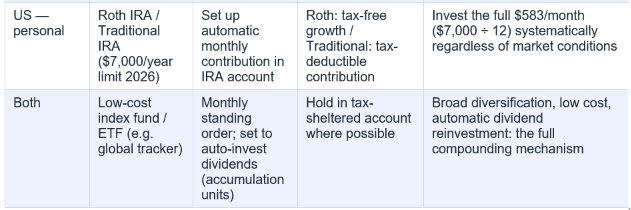
The consistent investing decision is most effective when it is automated rather than made month by month. Every time the decision to invest must be actively remade, it is vulnerable to the emotional context of that month’s market conditions, news headlines, and personal financial anxiety. A standing order removes that vulnerability. Not investment advice.This is not financial, tax, or investment advice. Account types, contribution limits, and tax treatment depend on individual circumstances and are subject to change. Always verify with HMRC (UK) or the IRS (US), or consult a qualified financial adviser. ISA contribution limits and pension annual allowances are as of 2025/26.
Conclusion
The investing content landscape rewards the novel, the specific, and the confident. Which stock will outperform this year? Which sector is hot? When will the market correct? These are more engaging questions than ‘keep investing the same amount every month regardless of what happens’ — but the evidence is not on their side. Landmark Wealth Management’s 2025 analysis of Ned Davis Research and Morningstar data showed that missing four days in 2025 turned a nearly 18% return into a loss. WisdomTree’s 40-year study showed that consistent Joe nearly matched Lucky despite never getting a single entry point right. Vanguard UK showed that buying before every crash since 1997 still produced more than cash by 2026. Keytrade Bank’s April 2026 analysis, written during the turbulence that opened that year, returned to the same conclusion: ‘Investing is less about making predictions and more about perseverance.’ The investing decision that matters more than picking the right thing is not a glamorous one. It is a standing order. It is the same amount on the same day regardless of the news. It is looking at the portfolio once a year rather than every time there is a headline. It is the willingness to accept that the price of long-term returns is short-term volatility, and that the alternative — staying in cash until you feel confident enough to invest — is a strategy that has never consistently beaten the market across any time period the researchers have tested. Not financial, investment, or tax advice. Always consult a qualified financial adviser for personalised guidance.Frequently Asked Questions
Does it really matter which fund I pick, or just that I stay invested?Both matter, but in different proportions. The research cited in this article consistently shows that the most expensive investing mistake is not the choice of fund — it is market timing: selling during volatility and missing the recovery days that provide most of the long-term return. WisdomTree's April 2026 analysis shows that an investor with perfect timing barely outperformed a consistent investor over 40 years. Within the universe of broad, low-cost index funds tracking global or US markets, the differences between comparable options are generally small compared to the difference between staying invested and not. The practical priority: choose a broadly diversified, low-cost fund or ETF, automate the contribution, and stay in it. The fund choice matters at the margin. The consistency matters foundationally.
What if the market falls right after I invest?
Vanguard UK's research published to February 2026 answers this directly. Their hypothetical unluckiest investor put money in before the dot-com crash, the global financial crisis, the Covid-19 sell-off, and other major downturns — every significant crash since 1997. By February 2026, they were still ahead of cash despite experiencing every possible bad timing scenario. The mechanism is compounding: returns earned on previous returns through multiple market cycles accumulate to more than cash over long time periods. The Keytrade Bank April 2026 analysis frames it as a trade-off: 'volatility is the price you pay for long-term returns.' A market fall right after you invest is uncomfortable. It is not, on the long-term evidence, the disaster it feels like in the moment. Past performance does not guarantee future results.
Why do even professional investors fail at timing the market?
The Practical AI Investor's analysis of Hartford Funds data identifies the structural reason: 'even the pros — armed with PhDs, Bloomberg terminals, and full-time risk teams — routinely fail at timing the market.' The fundamental problem is that the best market days cluster around the worst market days. Keytrade Bank's April 2026 analysis confirms: 76% of the best stock-market days coincide with a bear market or the first two months of a bull market. A professional investor who reduces exposure during a bear market to limit losses is statistically likely to miss the recovery days that occur in exactly that period. Predicting the exit point requires also predicting the re-entry point — and both must be correct for the strategy to work. Over multiple market cycles, the probability of getting both right consistently is essentially zero.
Is Dollar Cost Averaging (DCA) / regular monthly investing always best?
Regular monthly investing (DCA) does not always produce the highest return compared to lump-sum investing at the right moment — by definition, a perfectly timed lump sum will outperform. The point is that the lump sum invested at exactly the right time is not a real option for most investors, and the cost of waiting for it (missing days, earning cash rates, avoiding the market) is consistently documented as greater than the cost of simply investing regularly regardless of market conditions. WisdomTree's Joe (consistent monthly investor) over 40 years illustrates the principle: he never needed to be right about timing, and his outcome was remarkably close to Lucky's perfect timing over the same period. For the vast majority of investors who do not have large lump sums available, regular investing is both the practical option and the evidentially supported one.
How often should I check my investments?
The research consistently suggests that the less frequently you check, the less likely you are to make emotional decisions that damage returns. WisdomTree's paper frames this through Murphy's behaviour: waiting for a better entry point creates hesitation, which creates missed days, which carries the return cost. Keytrade Bank's 2026 guidance is specific: 'staying invested doesn't mean you never have to look at your portfolio.' An annual review — checking that your asset allocation still matches your risk tolerance and time horizon, and adjusting contributions if your income has changed — is typically sufficient. Monthly or weekly checking during volatile periods introduces the emotional context that produces bad decisions at exactly the wrong moments.
0 Comments
Be the first to share your thoughts on this article.