

Investing
How to Invest Money: A Step-by-Step Guide to Healthy Returns

Vanguard How America Saves 2026: average total savings rate 12.1% (record); average employee deferral 7.6%, median 6.6%; participation 94% with auto-enrollment vs 64% voluntary; average balance $167,970 (year-end 2025). S&P 500: about 10.26% average annual return 1928–2023 (best year +53.99%, worst −43.84%). DALBAR: average investor 6.8% vs index 10.2% over 30 years ending 2023. Costs: index funds 0.015%–0.04% a year vs 0.56% average active fund. On $500 a month for 30 years at 7%, that fee gap is about $58,500 (illustrative). October 2026 yields: 52-week T-bill 4.46%, best savings 4.34%–4.50%, 10-year Treasury about 5.24%; inflation 3.70%. 2026 limits: 401(k) $24,500; IRA $7,500 (plus $1,100 at 50+).
If you are new to investing, that can sound like a reason to wait. It is not. Nobody has reliably predicted where markets go next, and the sensible path has never depended on doing so. It depends on a handful of steps, done in order and repeated for years. Here they are, with the 2026 numbers that make each one concrete.
Stocks have historically done better over long periods, though not smoothly. The S&P 500 averaged about 10.26% a year from 1928 to 2023 with dividends reinvested, according to Gitnux, but the best single year was a 53.99% gain and the worst was a 43.84% loss. "Good returns" therefore means a decent real return, earned by accepting some volatility, and held long enough for the average to do its work. Anyone who promises a guaranteed high return is describing something else.
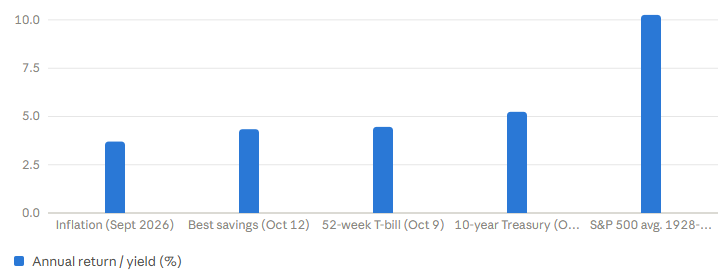
Inflation (Sept 2026): 3.70%. Best savings: 4.34%–4.50%. 52-week T-bill: 4.46%. 10-year Treasury: about 5.24%. S&P 500 long-run average (1928–2023): 10.26%, with a worst year of −43.84%.
Traditional and Roth accounts differ in when you pay tax: a traditional account usually gives a deduction now and taxes withdrawals later, while a Roth does the reverse. Which is better depends on your bracket today and your expectations for later, and a tax professional can help. Either way, these wrappers let money compound with less tax drag, so use them before a plain taxable account.
2026 limits: 401(k) $24,500 (+$8,000 at 50+, or +$11,250 at 60–63); IRA $7,500 (+$1,100 at 50+). Source: IRS announcement, November 2025.
Costs deserve more attention than they get. Top S&P 500 index funds charge 0.015% to 0.04% a year, according to Bankrate, versus 0.56% for the average actively managed fund, according to Vanguard. Using my own arithmetic on $500 a month for 30 years at a 7% gross return, that gap is worth about $58,500: roughly $605,000 at the low fee versus $547,000 at the higher one. The richest Americans are not immune either. Forbes data showed the 400 richest Americans lagged the S&P 500 in eight of the past ten years.
What is unusual in 2026 is that the steadier side pays more than it has in years. Treasury bills yield about 4.46% and the 10-year around 5.24%. That makes a bond or cash allocation less of a sacrifice than it has been for much of the last decade. It does not make stocks a bad choice for long horizons. It means you are being paid something for patience at every level of risk. If you want a simple default, a target-date fund makes the allocation decision for you.
How much should you save? Vanguard’s 2026 report put the average total savings rate, employee plus employer, at 12.1%, an all-time high, and the company recommends 12% to 15%. The average employee deferral was 7.6% and the median 6.6%. If that feels out of reach, start where you can and raise it each year, ideally whenever you get a raise. Nearly half of participants, 45%, increased their savings rate in 2025.
You will face a scary moment. Markets fall, headlines get loud and your balance dips. Decide now what you will do: nothing, for money you will not need for years. Automating contributions, using a broad index or target-date fund and checking your account less often all help. A plan you actually follow beats a clever one you abandon in a downturn. Keep in mind: A good plan does not eliminate losses. It prepares you to survive them. Money you may need soon should not be invested in a way that depends on a good year.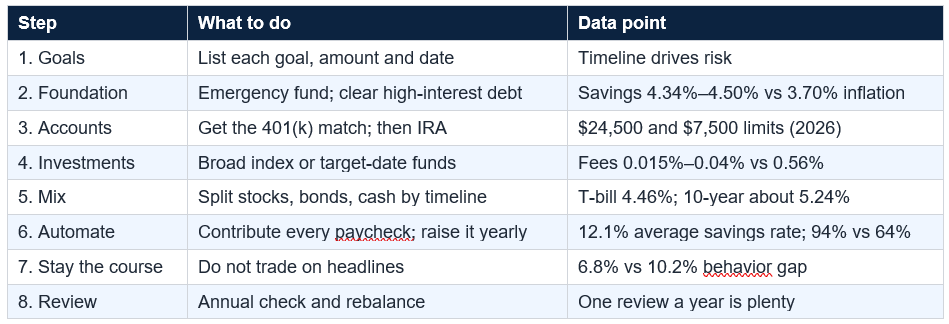
The lesson is not that you will earn 10%. Real returns vary, and the future may differ from the past. The lesson is that time and consistent contributions do most of the heavy lifting, and that small differences in return or cost, sustained for decades, become large sums.
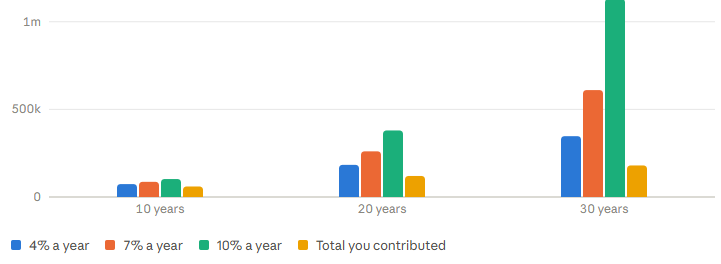
The numbers: $500 a month for 30 years: about $347,025 at 4%, $609,985 at 7%, $1,130,244 at 10% (contributions of $180,000 in each case). Illustrative constant-rate calculation; real returns vary and can be negative.
The Vanguard, DALBAR and fee data all point the same way: the winners are usually the people who started, kept going and kept costs low, not the ones with the cleverest forecasts. Start with the step you can do this week, whether that is capturing a 401(k) match or setting up an automatic transfer. A qualified adviser can help you apply this to your situation.
Less than most people think. Many brokerages let you buy fund shares with small amounts, and workplace plans start with a percentage of each paycheck. What matters more than the starting amount is starting and keeping going. Vanguard’s 2026 data shows workers who are automatically enrolled participate at 94%, compared with 64% when they must opt in.
What is a realistic return to expect?
No one can promise a return. The S&P 500 has averaged about 10.26% a year from 1928 to 2023 with dividends reinvested, but individual years ranged from a 53.99% gain to a 43.84% loss. Many planners use more conservative assumptions, such as 5% to 7%, to plan. Treat any figure as an illustration, not a forecast.
Should I invest or hold cash right now?
It depends on when you need the money. In October 2026 a 52-week Treasury bill paid about 4.46% and the best savings accounts about 4.34% to 4.50%, which beats inflation of 3.70% by a little. Money needed within a few years usually belongs in cash-like options. Money for goals many years away has historically needed stocks to grow faster than inflation.
Are index funds or target-date funds better for beginners?
Both are simple, diversified and low maintenance. An index fund tracks a market index at very low cost. A target-date fund holds a mix that becomes more conservative as the chosen year approaches. Vanguard reports that 98% of default investments in its plans are target-date funds, and that investors who hold them trade four to five times less often.
Is now a bad time to invest because rates are rising?
Nobody can reliably time markets. Stocks hit record highs in early October, then fell back from them as concerns about inflation and rate hikes grew, according to Bloomberg reporting. Spreading money over time through regular contributions reduces the risk of putting everything in right before a dip. This is general information, not advice.
Table of Contents
- Why This Is an Interesting Moment to Start
- What “Good Returns” Actually Means
- Step 1: Decide What the Money Is For
- Step 2: Build the Foundation First
- Step 3: Pick the Right Accounts
- Step 4: Choose Simple, Low-Cost Investments
- Step 5: Decide Your Mix of Stocks, Bonds and Cash
- Step 6: Automate, and Save More Over Time
- Step 7: Stay the Course
- Step 8: Review and Rebalance
- The Eight Steps at a Glance
- What Compounding Does With $500 a Month
- Conclusion
- Frequently Asked Questions
$500 a month: what it could grow to at different constant returns ($)
Portfolio value ($) by Years of investing (illustration only; real returns vary)
What are you chasing? Inflation vs. cash, Treasuries and stocks (%)
% per year by Benchmark
Why This Is an Interesting Moment to Start
Investing advice usually arrives wrapped in a market story, and this month the story is a strange one. Stocks climbed to record highs in early October, then slipped back as oil prices and rate-hike worries returned, according to Bloomberg reporting on October 8. At the same time, Treasury yields sit near their highest levels since 2002, with the 10-year around 5.24% in mid-October. One strategist told Bloomberg that equity markets face a genuine rival in bonds for the first time in decades.If you are new to investing, that can sound like a reason to wait. It is not. Nobody has reliably predicted where markets go next, and the sensible path has never depended on doing so. It depends on a handful of steps, done in order and repeated for years. Here they are, with the 2026 numbers that make each one concrete.
What “Good Returns” Actually Means
Before anything else, decide what you are chasing. A return only means something compared with inflation, which was 3.70% for September. A 52-week Treasury bill paying 4.46% beats that by about 0.7 percentage points. The best savings accounts, at 4.34% to 4.50%, do roughly the same. That is a decent, nearly risk-free result for money you will need soon. For money you will not touch for decades, the question is whether you can do better without taking on risks you cannot stomach.Stocks have historically done better over long periods, though not smoothly. The S&P 500 averaged about 10.26% a year from 1928 to 2023 with dividends reinvested, according to Gitnux, but the best single year was a 53.99% gain and the worst was a 43.84% loss. "Good returns" therefore means a decent real return, earned by accepting some volatility, and held long enough for the average to do its work. Anyone who promises a guaranteed high return is describing something else.
Inflation (Sept 2026): 3.70%. Best savings: 4.34%–4.50%. 52-week T-bill: 4.46%. 10-year Treasury: about 5.24%. S&P 500 long-run average (1928–2023): 10.26%, with a worst year of −43.84%.
Step 1: Decide What the Money Is For
Every investment decision flows from one question: when will you need this money? A down payment in three years, a child’s college in twelve and retirement in thirty are three different jobs. The farther away the goal, the more risk you can usually afford, because you have time to recover from a bad year. A common rule of thumb is that money needed within a few years should not depend on the stock market. Write down each goal, a rough amount and a date.Step 2: Build the Foundation First
Two things come before investing. The first is an emergency fund, often suggested at three to six months of essential expenses, held somewhere safe and accessible. With savings accounts paying more than inflation right now, that cushion also earns something. The second is paying off high-interest debt, which is like running up a down escalator. Without these two, a surprise bill can force you to sell investments at the worst possible time.Step 3: Pick the Right Accounts
Where you invest matters almost as much as what you buy. If your employer offers a 401(k) with matching contributions, capture the match first, since it is effectively an immediate return on your money. The 2026 employee limit is $24,500, with an $8,000 catch-up at 50 and older, or $11,250 at ages 60 to 63. Next, consider an IRA, with a 2026 limit of $7,500, plus $1,100 at 50 and older. Roth contributions phase out between $153,000 and $168,000 of income for single filers and $242,000 to $252,000 for joint filers.Traditional and Roth accounts differ in when you pay tax: a traditional account usually gives a deduction now and taxes withdrawals later, while a Roth does the reverse. Which is better depends on your bracket today and your expectations for later, and a tax professional can help. Either way, these wrappers let money compound with less tax drag, so use them before a plain taxable account.
2026 limits: 401(k) $24,500 (+$8,000 at 50+, or +$11,250 at 60–63); IRA $7,500 (+$1,100 at 50+). Source: IRS announcement, November 2025.
Step 4: Choose Simple, Low-Cost Investments
This is where many beginners overcomplicate things. For most long-term goals, two kinds of investment cover the job. A broad index fund tracks a whole market, such as the S&P 500, at very low cost. A target-date fund holds a diversified mix that gradually becomes more conservative as your chosen year approaches. Vanguard’s 2026 report found that 98% of the default investments in its retirement plans are target-date funds, and that people who hold them trade four to five times less often than other investors.Costs deserve more attention than they get. Top S&P 500 index funds charge 0.015% to 0.04% a year, according to Bankrate, versus 0.56% for the average actively managed fund, according to Vanguard. Using my own arithmetic on $500 a month for 30 years at a 7% gross return, that gap is worth about $58,500: roughly $605,000 at the low fee versus $547,000 at the higher one. The richest Americans are not immune either. Forbes data showed the 400 richest Americans lagged the S&P 500 in eight of the past ten years.
Step 5: Decide Your Mix of Stocks, Bonds and Cash
This step is called asset allocation: how you split money between growth assets, such as stocks, and steadier ones, such as bonds and cash. More stocks mean higher expected growth and bigger swings. More bonds and cash mean smoother rides and lower growth. The right mix depends on your timeline and, honestly, how you would feel when a portfolio drops 30%.What is unusual in 2026 is that the steadier side pays more than it has in years. Treasury bills yield about 4.46% and the 10-year around 5.24%. That makes a bond or cash allocation less of a sacrifice than it has been for much of the last decade. It does not make stocks a bad choice for long horizons. It means you are being paid something for patience at every level of risk. If you want a simple default, a target-date fund makes the allocation decision for you.
Step 6: Automate, and Save More Over Time
The most reliable investing habit is the one you do not have to remember. Set up automatic contributions from every paycheck, so investing happens before you can talk yourself out of it. Vanguard’s data shows how powerful this is: employees who were automatically enrolled participated at 94%, versus 64% when they had to opt in. Spreading contributions over time also means you buy more shares when prices are low and fewer when they are high, which softens the pain of a bad entry point.How much should you save? Vanguard’s 2026 report put the average total savings rate, employee plus employer, at 12.1%, an all-time high, and the company recommends 12% to 15%. The average employee deferral was 7.6% and the median 6.6%. If that feels out of reach, start where you can and raise it each year, ideally whenever you get a raise. Nearly half of participants, 45%, increased their savings rate in 2025.
Step 7: Stay the Course
Here is the step that decides most outcomes. DALBAR research, cited by MyETFJourney in June 2026, found that over the 30 years ending in 2023, the S&P 500 returned roughly 10.2% a year while the average equity fund investor earned about 6.8%. The gap came from behavior: buying after rallies and selling after drops. A 3.4-point annual difference compounds into a very large sum over three decades.You will face a scary moment. Markets fall, headlines get loud and your balance dips. Decide now what you will do: nothing, for money you will not need for years. Automating contributions, using a broad index or target-date fund and checking your account less often all help. A plan you actually follow beats a clever one you abandon in a downturn. Keep in mind: A good plan does not eliminate losses. It prepares you to survive them. Money you may need soon should not be invested in a way that depends on a good year.
Step 8: Review and Rebalance
Once a year is enough. Check that you are still saving what you planned, that your goals have not changed and that your mix still fits. If stocks have surged, they may now make up more of your portfolio than you intended, and rebalancing means trimming back to target. Use new contributions to rebalance when you can, since it avoids selling. Tinkering more often is where costs and mistakes creep in.The Eight Steps at a Glance
What Compounding Does With $500 a Month
To see why consistency matters, here is a simple illustration I calculated. Suppose you invest $500 every month. At a constant 4% a year, that becomes about $73,625 after ten years, $183,387 after twenty and $347,025 after thirty. At 7%, it becomes $86,542, $260,463 and $609,985. At 10%, it becomes $102,422, $379,684 and $1,130,244. Over thirty years you will have contributed $180,000 of your own money in every case. The rest is growth.The lesson is not that you will earn 10%. Real returns vary, and the future may differ from the past. The lesson is that time and consistent contributions do most of the heavy lifting, and that small differences in return or cost, sustained for decades, become large sums.
The numbers: $500 a month for 30 years: about $347,025 at 4%, $609,985 at 7%, $1,130,244 at 10% (contributions of $180,000 in each case). Illustrative constant-rate calculation; real returns vary and can be negative.
Conclusion
Investing well is less mysterious than the industry sometimes makes it sound. Decide what the money is for, build a cushion, use the right accounts, buy broad, low-cost funds, choose a mix that fits your timeline, automate your contributions and then mostly leave it alone. None of it requires predicting markets, and in a year like 2026, with record stock highs, 5% bond yields and plenty of rate-hike worry, that is a relief.The Vanguard, DALBAR and fee data all point the same way: the winners are usually the people who started, kept going and kept costs low, not the ones with the cleverest forecasts. Start with the step you can do this week, whether that is capturing a 401(k) match or setting up an automatic transfer. A qualified adviser can help you apply this to your situation.
Frequently Asked Questions
How much money do I need to start investing?Less than most people think. Many brokerages let you buy fund shares with small amounts, and workplace plans start with a percentage of each paycheck. What matters more than the starting amount is starting and keeping going. Vanguard’s 2026 data shows workers who are automatically enrolled participate at 94%, compared with 64% when they must opt in.
What is a realistic return to expect?
No one can promise a return. The S&P 500 has averaged about 10.26% a year from 1928 to 2023 with dividends reinvested, but individual years ranged from a 53.99% gain to a 43.84% loss. Many planners use more conservative assumptions, such as 5% to 7%, to plan. Treat any figure as an illustration, not a forecast.
Should I invest or hold cash right now?
It depends on when you need the money. In October 2026 a 52-week Treasury bill paid about 4.46% and the best savings accounts about 4.34% to 4.50%, which beats inflation of 3.70% by a little. Money needed within a few years usually belongs in cash-like options. Money for goals many years away has historically needed stocks to grow faster than inflation.
Are index funds or target-date funds better for beginners?
Both are simple, diversified and low maintenance. An index fund tracks a market index at very low cost. A target-date fund holds a mix that becomes more conservative as the chosen year approaches. Vanguard reports that 98% of default investments in its plans are target-date funds, and that investors who hold them trade four to five times less often.
Is now a bad time to invest because rates are rising?
Nobody can reliably time markets. Stocks hit record highs in early October, then fell back from them as concerns about inflation and rate hikes grew, according to Bloomberg reporting. Spreading money over time through regular contributions reduces the risk of putting everything in right before a dip. This is general information, not advice.
0 Comments
Be the first to share your thoughts on this article.