

Investing
What Are Stock Splits? How They Work and Why Companies Split

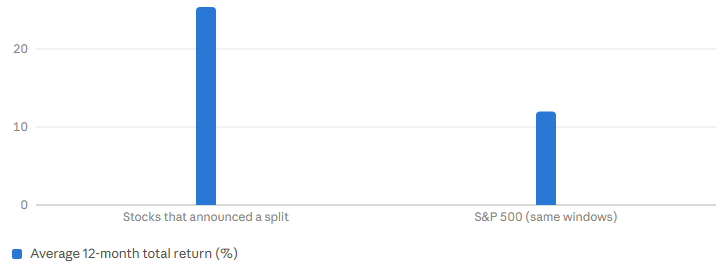
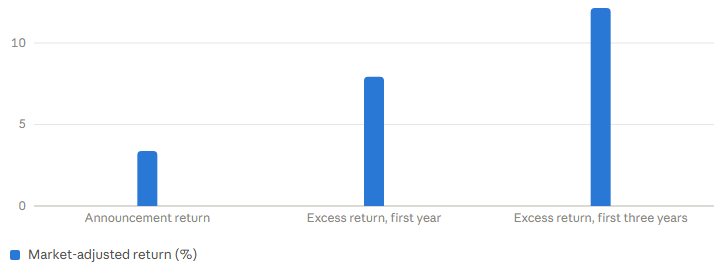
Bank of America: stocks that announced splits returned an average of 25.4% over the next 12 months, versus about 12% for the S&P 500 (40-year data); about 30% of split stocks fell in the following year. Ikenberry, Rankine and Stice (1996), 1,275 two-for-one splits: 3.38% announcement return, then 7.93% excess return in year one and 12.15% over three years. 2026 US examples: KLA Corporation 10-for-1 (announced May 7, effective June 12); CrowdStrike 4-for-1 (July 2). October 2026 calendar quiet for large US companies; Eli Lilly (price above $1,000) has not announced a split. Worked example: 10 shares at $600 ($6,000) become 20 at $300, 30 at $200 or 100 at $60 after 2-, 3- or 10-for-1 splits; total value unchanged.
Yet stock splits generate a surprising amount of excitement. Investors talk about buying before the split, and prices often jump on the news. Is that rational, or is it just the pizza being cut differently? This guide explains how splits work, why companies do them, what happened this year and, importantly, what the research says about whether splits make stocks go up.
Here is my own illustration using round numbers. Suppose you own 10 shares of a stock priced at $600, so your holding is worth $6,000. After a 2-for-1 split you own 20 shares at $300. After a 3-for-1 split, 30 shares at $200. After a 10-for-1 split, 100 shares at $60. In every case, you still have $6,000 of stock. The company has not earned an extra dollar, and its market value has not changed.

Other numbers adjust too. Dividends are quoted per share, so a 2-for-1 split halves the per-share dividend while your total dividend income stays the same. Chart history is typically adjusted so the past lines up with the present. None of this changes your economics.
Worth knowing: After a split, the right number to compare companies is market capitalization (share price times number of shares), not the price per share. A $60 stock can be far larger than a $600 stock.
Your broker normally handles everything automatically, and the new shares simply appear in your account. If the ratio would leave you with a fraction of a share, the company’s notice explains how that is handled, usually with cash or a fractional share, depending on the broker.
That context matters. Forward splits usually follow success, while reverse splits usually follow struggle. Commentary from Investing Daily notes that stocks undergoing reverse splits tend to underperform because the companies are trying to prop up a falling price. A reverse split does not fix whatever caused the decline, so treat it as a warning flag rather than good news.
There is a third reason, and it is the interesting one: signaling. The research by Ikenberry, Rankine and Stice suggests that managers choose to split when they expect future performance to be strong, so the split works a little like a confident gesture. One caveat: many brokers now offer fractional shares, so a high price per share is less of a barrier than it used to be, which weakens the accessibility argument. That is my reasoning, not a finding from the studies.
The October 2026 calendar is relatively quiet for large US companies, according to Investing Cube. One company people keep asking about is Eli Lilly, whose share price is above $1,000 but which has not announced a split. Some companies never split: Berkshire Hathaway’s Class A shares are famously priced in the hundreds of thousands of dollars. A high price per share is a choice, not a verdict on quality.
So do splits work? Not so fast. First, correlation is not causation. Companies tend to split after a strong run, which means splitters are often strong companies. The Motley Fool made this point years ago: they are outperforming on earnings, cash flow and revenue, so of course their stocks beat the market. Second, the outcome varies. MarketBeat, citing Bank of America, noted that about 30% of companies that announced splits saw their shares fall over the following year. Tesla dropped nearly 12% in the year after announcing its 2022 split, while the S&P 500 rose 8%.
There is a useful clue in the academic work. Ikenberry and colleagues found that a bigger run-up before the split was linked to lower returns afterward, which suggests the results are not simply momentum. That is interesting, but it is an average across many stocks decades ago, not a rule for any single company in 2026.
The numbers: Bank of America (40 years): 25.4% average 12-month return after a split announcement vs about 12% for the S&P 500; about 30% of split stocks fell the next year. Ikenberry, Rankine and Stice (1996): 7.93% excess return in year one, 12.15% over three years.
Your account will show more shares, a lower price and the same total value. Automatic investing and dividend reinvestment continue as normal, and if you hold the stock through an index fund, the fund adjusts automatically.
If you are considering buying a stock because of an announced split, ask whether you would own the business at today’s valuation with no split at all. If the answer is yes, the split is a harmless bonus. If the answer is no, a new share count will not rescue it.
So treat splits with curiosity, not excitement. Learn the ratio, check your account, compare companies by market value instead of price per share and judge the business on its merits. A reverse split deserves extra caution. And if you hold index funds, enjoy the fact that splits are happening in the background without any effort from you. This is general education, not personalized advice, and a tax professional can help with your specifics.
A stock split is when a company divides each existing share into several shares. In a 2-for-1 split, you receive two shares for each one you own, and each is priced at about half as much. The total value of your holding stays the same immediately after the split.
Does a stock split make me money?
Not by itself. The market value of your holding is essentially unchanged right after a split. Bank of America found that stocks averaged a 25.4% return in the 12 months after announcing a split, versus about 12% for the S&P 500, but companies tend to split after strong runs, and about 30% of split stocks fell the following year.
Are stock splits taxable?
In the US, a standard forward split is generally not a taxable event, because you own the same share of the company. Your cost basis is spread across more shares, so each share has a lower basis. Cash paid instead of a fractional share may be taxable. Check with a tax professional and your broker.
What is a reverse stock split?
A reverse split combines several shares into one. In a 1-for-10 reverse split, ten old shares become one new share at ten times the price. Companies often use them to lift a very low share price. Reverse splits tend to be a warning sign rather than a celebration.
Should I buy a stock before it splits?
A split alone is not a reason to buy. Evidence suggests the announcement itself carries information, but outcomes vary widely. Judge the business, its valuation and your time horizon rather than the ratio. If you own an index fund, splits happen inside the fund and require nothing from you.
Table of Contents
- The Pizza Slice Problem
- The Short Answer
- How a Forward Split Works
- The Dates That Matter
- Reverse Splits: The Opposite Move
- Why Companies Split Their Stock
- Splits in 2026
- Do Splits Make Stocks Go Up? What the Data Say
- Taxes and Your Account
- Common Misunderstandings
- What to Do When a Stock You Own Splits
- Conclusion
- Frequently Asked Questions
12 months after a split announcement vs. the S&P 500 (%, 40-year average)
Average total return (%) by Source: Bank of America Research Investment Committee
1,275 two-for-one splits: excess returns (Ikenberry, Rankine & Stice, 1996)
Return above the market (%) by Period (study of NYSE/AMEX splits, 1975-1990)
The Pizza Slice Problem
Imagine a pizza cut into four huge slices, each priced at $25. Now imagine the same pizza cut into eight slices, each priced at $12.50. You have not made the pizza bigger or the meal more valuable. You have just changed how many pieces there are. That is almost exactly what a stock split does. The company is the pizza. The shares are the slices. And the headline you saw, with a company announcing a 10-for-1 split, is mostly a change to the slicing.Yet stock splits generate a surprising amount of excitement. Investors talk about buying before the split, and prices often jump on the news. Is that rational, or is it just the pizza being cut differently? This guide explains how splits work, why companies do them, what happened this year and, importantly, what the research says about whether splits make stocks go up.
The Short Answer
A stock split is a corporate action in which a company divides its existing shares into a larger number of shares, lowering the price per share in proportion. A 2-for-1 split gives you two shares for each one you own, each worth about half as much. Your total investment is unchanged, and so is the company’s total value. A reverse split does the opposite, combining shares into fewer, higher-priced ones.How a Forward Split Works
The ratio tells you everything. In a 3-for-1 split, each old share becomes three; in a 10-for-1 split, each becomes ten. The share price falls to match, so the total value of your holding is the same immediately afterward. As Financer’s calendar puts it, a forward split increases the number of shares while reducing the price per share proportionally.Here is my own illustration using round numbers. Suppose you own 10 shares of a stock priced at $600, so your holding is worth $6,000. After a 2-for-1 split you own 20 shares at $300. After a 3-for-1 split, 30 shares at $200. After a 10-for-1 split, 100 shares at $60. In every case, you still have $6,000 of stock. The company has not earned an extra dollar, and its market value has not changed.
Other numbers adjust too. Dividends are quoted per share, so a 2-for-1 split halves the per-share dividend while your total dividend income stays the same. Chart history is typically adjusted so the past lines up with the present. None of this changes your economics.
Worth knowing: After a split, the right number to compare companies is market capitalization (share price times number of shares), not the price per share. A $60 stock can be far larger than a $600 stock.
The Dates That Matter
A split has a short timeline. The announcement date is when the company confirms the split and discloses the ratio. Next comes a record date, which determines who is entitled to the new shares, and a payable date when they are distributed. The ex-split date is when the stock begins trading at its adjusted price, the day you will notice the lower price on your screen. Dates can change, and the company’s own notice is the authoritative source.Your broker normally handles everything automatically, and the new shares simply appear in your account. If the ratio would leave you with a fraction of a share, the company’s notice explains how that is handled, usually with cash or a fractional share, depending on the broker.
Reverse Splits: The Opposite Move
A reverse split combines shares. In a 1-for-10 reverse split, ten old shares become one new share at roughly ten times the price. The total value is, again, unchanged. The motive is different, though. Companies typically use reverse splits to raise a very low share price, often to stay above an exchange’s minimum price requirement. Briefing.com’s June 2026 calendar, for example, listed small companies such as Aeries Technology (1-for-8) and 22nd Century Group (1-for-20) among the reverse splits.That context matters. Forward splits usually follow success, while reverse splits usually follow struggle. Commentary from Investing Daily notes that stocks undergoing reverse splits tend to underperform because the companies are trying to prop up a falling price. A reverse split does not fix whatever caused the decline, so treat it as a warning flag rather than good news.
Why Companies Split Their Stock
Companies give a few reasons. The first is accessibility. When Nvidia announced its 10-for-1 split in 2024 after its price had climbed from under $150 to about $1,150, it said the move was to make stock ownership more accessible to employees and investors. A lower price per share feels more approachable, and a wider base of small investors can add liquidity.There is a third reason, and it is the interesting one: signaling. The research by Ikenberry, Rankine and Stice suggests that managers choose to split when they expect future performance to be strong, so the split works a little like a confident gesture. One caveat: many brokers now offer fractional shares, so a high price per share is less of a barrier than it used to be, which weakens the accessibility argument. That is my reasoning, not a finding from the studies.
Splits in 2026
This year has had its share of big-name splits. KLA Corporation announced a 10-for-1 split on May 7, which took effect on June 12, according to Briefing.com. CrowdStrike carried out a 4-for-1 split on July 2, according to Axiory’s corporate action listing. Earlier waves included Nvidia’s 10-for-1 in 2024, along with Walmart and Chipotle that year.The October 2026 calendar is relatively quiet for large US companies, according to Investing Cube. One company people keep asking about is Eli Lilly, whose share price is above $1,000 but which has not announced a split. Some companies never split: Berkshire Hathaway’s Class A shares are famously priced in the hundreds of thousands of dollars. A high price per share is a choice, not a verdict on quality.
Do Splits Make Stocks Go Up? What the Data Say
Here is the part everyone wants. Bank of America’s Research Investment Committee found, using 40 years of data, that stocks averaged a 25.4% total return in the 12 months after announcing a split, more than double the S&P 500’s roughly 12% over the same windows. The classic academic study, by Ikenberry, Rankine and Stice in 1996, looked at 1,275 two-for-one splits and found a 3.38% announcement return, followed by excess returns of 7.93% in the first year and 12.15% over three years.So do splits work? Not so fast. First, correlation is not causation. Companies tend to split after a strong run, which means splitters are often strong companies. The Motley Fool made this point years ago: they are outperforming on earnings, cash flow and revenue, so of course their stocks beat the market. Second, the outcome varies. MarketBeat, citing Bank of America, noted that about 30% of companies that announced splits saw their shares fall over the following year. Tesla dropped nearly 12% in the year after announcing its 2022 split, while the S&P 500 rose 8%.
There is a useful clue in the academic work. Ikenberry and colleagues found that a bigger run-up before the split was linked to lower returns afterward, which suggests the results are not simply momentum. That is interesting, but it is an average across many stocks decades ago, not a rule for any single company in 2026.
The numbers: Bank of America (40 years): 25.4% average 12-month return after a split announcement vs about 12% for the S&P 500; about 30% of split stocks fell the next year. Ikenberry, Rankine and Stice (1996): 7.93% excess return in year one, 12.15% over three years.
Taxes and Your Account
In the US, a standard forward stock split is generally not a taxable event, because you own the same proportion of the company before and after. What changes is your cost basis per share: your total basis is spread across more shares, so each share has a proportionally lower basis. Your holding period also continues. If a company pays cash instead of a fractional share, that cash may be taxable. These are general principles, and a tax professional can confirm how they apply to you.Your account will show more shares, a lower price and the same total value. Automatic investing and dividend reinvestment continue as normal, and if you hold the stock through an index fund, the fund adjusts automatically.
Common Misunderstandings
The most common mistake is believing a split makes a stock cheaper in a meaningful way. A $60 stock is not cheaper than a $600 stock; it may simply have more shares. The second mistake is assuming that buying before a split locks in a gain. The announcement often lifts the price already, and the average effect that showed up in studies does not guarantee a result for the next company. The third mistake is treating a split as a recommendation. It is a corporate action, not an analyst’s opinion. A split does not change a company’s earnings, debt or competitive position. If the business was expensive before the split, it is just as expensive after.What to Do When a Stock You Own Splits
For most owners, the answer is nothing. Check that your broker has adjusted your position correctly, and revisit any limit or stop orders placed at old prices. Re-evaluate the company on its fundamentals, as you would have anyway, and resist selling because the price looks lower or buying more because of the headline. If you planned to hold for years, a split does not change the plan.If you are considering buying a stock because of an announced split, ask whether you would own the business at today’s valuation with no split at all. If the answer is yes, the split is a harmless bonus. If the answer is no, a new share count will not rescue it.
Conclusion
A stock split changes the slicing, not the pizza. Your holding is worth the same right after a forward split, the company is worth the same and the tax bill is generally unchanged. What the data add is a nuance: stocks that announce splits have historically beaten the market, with Bank of America reporting 25.4% versus about 12% over 12 months, yet that likely reflects the strength of the companies that split rather than magic in the ratio. About 30% of them still fell.So treat splits with curiosity, not excitement. Learn the ratio, check your account, compare companies by market value instead of price per share and judge the business on its merits. A reverse split deserves extra caution. And if you hold index funds, enjoy the fact that splits are happening in the background without any effort from you. This is general education, not personalized advice, and a tax professional can help with your specifics.
Frequently Asked Questions
What is a stock split in simple terms?A stock split is when a company divides each existing share into several shares. In a 2-for-1 split, you receive two shares for each one you own, and each is priced at about half as much. The total value of your holding stays the same immediately after the split.
Does a stock split make me money?
Not by itself. The market value of your holding is essentially unchanged right after a split. Bank of America found that stocks averaged a 25.4% return in the 12 months after announcing a split, versus about 12% for the S&P 500, but companies tend to split after strong runs, and about 30% of split stocks fell the following year.
Are stock splits taxable?
In the US, a standard forward split is generally not a taxable event, because you own the same share of the company. Your cost basis is spread across more shares, so each share has a lower basis. Cash paid instead of a fractional share may be taxable. Check with a tax professional and your broker.
What is a reverse stock split?
A reverse split combines several shares into one. In a 1-for-10 reverse split, ten old shares become one new share at ten times the price. Companies often use them to lift a very low share price. Reverse splits tend to be a warning sign rather than a celebration.
Should I buy a stock before it splits?
A split alone is not a reason to buy. Evidence suggests the announcement itself carries information, but outcomes vary widely. Judge the business, its valuation and your time horizon rather than the ratio. If you own an index fund, splits happen inside the fund and require nothing from you.
0 Comments
Be the first to share your thoughts on this article.