

Investing
What Is After-Hours Trading? How It Works and Who Can Use It

Sessions (ET): pre-market 4:00–9:30 a.m.; regular 9:30 a.m.–4:00 p.m.; after-hours 4:00–8:00 p.m.; overnight (some brokers) 8:00 p.m.–4:00 a.m. NYSE research: extended hours were over 11% of US equity volume in January 2025 (more than 1.7 billion shares a day), more than double early 2019; pre-market volume grew 15x since 2019 vs 2.3x for post-market. SEC staff (August 2026): overnight session was 0.9% of share volume and 0.8% of dollar volume; average daily overnight volume up 359% year over year to 144.6 million shares; foreign accounts 37% of overnight volume, institutions about 7%. Spreads: overnight quoted spreads averaged nearly 10 times wider than in regular hours (IOSCO, May 2026, as cited to FINRA). Coming: SIP market-data feeds expand to 23 hours x 5 days on December 6, 2026; 24X has temporary relief to begin overnight trading on January 24, 2027.
After-hours trading used to belong mostly to professionals. Today, many retail investors can use it through their brokers, and the hours keep stretching. That makes it worth understanding, both for the opportunity it seems to offer and for the risks that come with it.
That last part is the key. With fewer participants, there are fewer matching orders. A stock that normally has thousands of buyers and sellers within a penny of each other may have only a handful after the close. Nasdaq itself acknowledged in a January 2026 SEC filing that liquidity tends to be lower during extended hours and that spreads may be wider.
That is why after-hours prices are a clue, not a verdict. The price at 5:30 p.m. is the product of a few trades, and the next morning’s open, when large institutions return, can differ significantly. Treat extended-hours moves as a preview, not a guaranteed open.
Overnight is smaller but rising fast. SEC staff data presented at a September 17, 2026 roundtable showed that in August 2026, the overnight session accounted for 0.9% of total share volume and 0.8% of dollar volume. Average daily overnight volume rose 359% year over year to 144.6 million shares. Foreign accounts made up the largest share of overnight volume, at 37%, while institutions accounted for only about 7%. That mix is a hint about who is trading at 2 a.m. Eastern: investors in Asia and Europe reacting to US-listed stocks.
Extended hours: over 11% of US equity volume (NYSE, January 2025). Overnight: 0.9% of share volume in August 2026, up 359% year over year (SEC staff). Pre-market grew 15x since 2019; post-market grew 2.3x.
There is a concrete date for a new venue, too. The SEC granted 24X, the first 24-hour exchange approved in the US, temporary conditional relief to begin overnight trading on January 24, 2027, if the data feed expansion proceeds. Commissioner Hester Peirce said the market is moving decisively toward extended hours trading. Not everyone is cheering: major Wall Street banks have voiced concerns about liquidity and volatility, and Nasdaq itself says liquidity remains significantly lower outside regular hours.
Lower liquidity means it can be hard to buy or sell at the price you want, or at all. Wider spreads mean the gap between what buyers will pay and what sellers will accept grows, and that gap is a cost to you. Higher volatility means prices can swing sharply on small trades. Unlinked markets mean the price on one venue may differ from another, so what you see is not necessarily the best price. And the exaggerated effect of news means a headline can push a thin market much further than in regular hours.
The size of the spread problem is documented. A May 2026 IOSCO report, cited in a September 2026 comment letter to FINRA, found that quoted spreads in overnight hours were on average nearly ten times wider than during regular trading hours, and one study found pre-open spreads 33 times wider. There is also a participant mix issue: the proportion of professional traders to retail investors can be higher outside regular hours, which increases the risk that professionals take advantage of ordinary investors.
Keep in mind: Many brokers allow only limit orders in extended hours, and stop orders may not trigger as you expect. Prices recorded at the 4 p.m. close may also not match after-hours prices, as FINRA points out.
What does that cost? If you buy 500 shares at the $97.40 ask and then immediately sell at the $96.50 bid, you lose 90 cents a share, or $450, before the price moves at all. In regular hours, the same round trip at a 2-cent spread would cost $10. A StockAlarm guide gives a similar real-world pattern, with spreads that normally measure pennies widening to 50 cents or more after hours. A limit order helps you avoid paying the worst price, but it cannot remove the gap itself.

If you are tempted by dramatic after-hours moves, remember the participant mix. In SEC staff data, foreign accounts were the largest group in overnight volume at 37%, versus about 7% for institutions, and the best quotes may not be visible to you. A big percentage move on thin volume is not the same as a big opportunity.
The sensible approach is to understand it, use limit orders, keep positions small and be skeptical of dramatic moves on little volume. If you are a long-term investor, you may never need it. The clock is stretching, but the basics of good investing are not. This is general education, not personalized advice, and your broker can explain exactly what it offers.
In the US, after-hours trading typically runs from 4:00 p.m. to 8:00 p.m. Eastern Time on weekdays, after the regular session closes at 4:00 p.m. Pre-market trading runs from 4:00 a.m. to 9:30 a.m. Some brokers also offer overnight sessions, roughly 8:00 p.m. to 4:00 a.m., through alternative venues.
Can anyone trade after hours?
Not every investor or stock qualifies. FINRA notes that some brokerage firms may not offer extended-hours trading at all, and those that do may limit which securities you can trade. All brokers must give you a risk disclosure under FINRA Rule 2265 before you start.
Why are prices so different after hours?
Fewer people are trading, so there are fewer buyers and sellers at each price. That means wider bid-ask spreads and bigger price swings on smaller orders. News released after the close, such as earnings, can move prices sharply with little volume behind the move.
Should I use market orders or limit orders after hours?
Limit orders are generally the safer choice, because they set the most you will pay or the least you will accept. A market order in a thin market can fill at a surprisingly poor price. Many brokers require limit orders in extended hours, so check your broker’s rules.
Is 24-hour stock trading here yet?
Partly. Some brokers already offer overnight trading through alternative venues, and the SEC reported overnight sessions at 0.9% of share volume in August 2026. The data feeds that underpin broader trading are scheduled to expand to 23 hours a day, five days a week on December 6, 2026, and one new exchange has temporary relief to begin overnight trading on January 24, 2027.
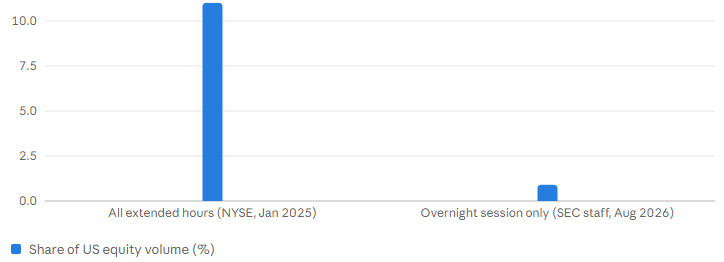
How much trading happens outside regular hours (% of volume)
% of share volume by Different measures and dates: not a direct comparison
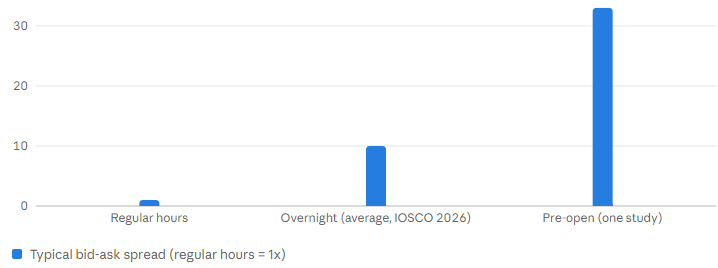
How much wider are spreads outside regular hours? (multiple of regular-hours spread)
Spread multiple (x) by Session (IOSCO May 2026, as cited in a FINRA comment letter)
Table of Contents
- The 4:01 p.m. Headline
- The Short Answer
- The Trading Sessions, Hour by Hour
- How After-Hours Trading Works
- Why It Matters: Earnings and News
- How Big Is After-Hours Trading?
- The Push Toward 24-Hour Trading
- The Risks, Explained
- A Worked Example: What a Wide Spread Costs
- How to Trade After Hours, Step by Step
- Who It Suits and Who Should Skip It
- Common Myths
- Conclusion
- Frequently Asked Questions
The 4:01 p.m. Headline
It is 4:01 on a Tuesday afternoon. The market has just closed, and a company you own releases quarterly earnings. The numbers beat expectations, and within minutes the stock is up 8% somewhere your usual trading screen does not show. Where did that move happen? In after-hours trading, the part of the day most investors never think about until a headline forces them to.After-hours trading used to belong mostly to professionals. Today, many retail investors can use it through their brokers, and the hours keep stretching. That makes it worth understanding, both for the opportunity it seems to offer and for the risks that come with it.
The Short Answer
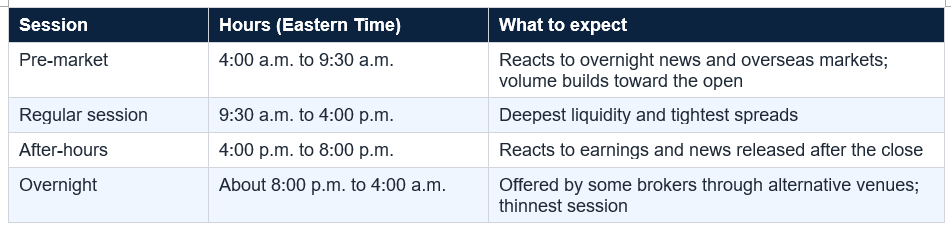
After-hours trading is buying and selling securities after the regular market closes. In the US, the regular session runs from 9:30 a.m. to 4:00 p.m. Eastern Time, and after-hours trading generally runs from 4:00 p.m. to 8:00 p.m. FINRA describes any activity outside regular hours, whether pre-market, after-hours or overnight, as extended-hours trading. It is real trading with real prices, but with fewer participants, so it behaves differently.The Trading Sessions, Hour by Hour
The trading day has more than one phase. Finance Magnates describes four distinct windows in today’s 24/5 environment, and the table shows them in Eastern Time. Not every broker offers every window, and not every stock is eligible.
How After-Hours Trading Works
During regular hours, many buyers and sellers meet on exchanges, supported by firms whose job is to keep markets liquid. After hours, trades are matched electronically, often through networks and alternative trading systems that pair buy and sell orders directly. Your broker sends the order to one of these venues, and it fills only if someone on the other side will take it at your price.That last part is the key. With fewer participants, there are fewer matching orders. A stock that normally has thousands of buyers and sellers within a penny of each other may have only a handful after the close. Nasdaq itself acknowledged in a January 2026 SEC filing that liquidity tends to be lower during extended hours and that spreads may be wider.
Why It Matters: Earnings and News
The main reason after-hours trading exists is that news does not wait for 9:30 a.m. Companies often report earnings after the market closes, precisely so that investors have time to digest the numbers. FINRA gives the textbook example: a company reporting disappointing earnings after the close might see a rapid decline in its price during after-hours trading. The sequence is common. Earnings arrive after 4:00 p.m., traders react until 8:00 p.m., more traders join in pre-market, and the stock opens at a price that may be different from either.That is why after-hours prices are a clue, not a verdict. The price at 5:30 p.m. is the product of a few trades, and the next morning’s open, when large institutions return, can differ significantly. Treat extended-hours moves as a preview, not a guaranteed open.
How Big Is After-Hours Trading?
Bigger than you might think, and growing. NYSE research found that as of January 2025, extended-hours trading accounted for more than 11% of all US equity volume, with more than 1.7 billion shares changing hands daily outside the core session. That was more than double the share recorded in early 2019. The growth is lopsided: pre-market volume expanded 15 times since 2019, versus 2.3 times for post-market and roughly double for the regular session. The pre-market session now accounts for more than 55% of extended-hours volume.Overnight is smaller but rising fast. SEC staff data presented at a September 17, 2026 roundtable showed that in August 2026, the overnight session accounted for 0.9% of total share volume and 0.8% of dollar volume. Average daily overnight volume rose 359% year over year to 144.6 million shares. Foreign accounts made up the largest share of overnight volume, at 37%, while institutions accounted for only about 7%. That mix is a hint about who is trading at 2 a.m. Eastern: investors in Asia and Europe reacting to US-listed stocks.
Extended hours: over 11% of US equity volume (NYSE, January 2025). Overnight: 0.9% of share volume in August 2026, up 359% year over year (SEC staff). Pre-market grew 15x since 2019; post-market grew 2.3x.
The Push Toward 24-Hour Trading
The trend is toward longer hours. The NYSE received initial SEC approval for 22-hour weekday trading on NYSE Arca. Nasdaq plans 24-hour, five-day-a-week trading, filed with the SEC in early 2026 and described as a daytime session from 4:00 a.m. to 8:00 p.m. and an overnight session from 9:00 p.m. to 4:00 a.m., with a short maintenance window. The first hurdle is the plumbing: the data feeds that distribute market prices are scheduled to expand to 23 hours a day, five days a week on December 6, 2026, according to the SEC’s September roundtable.There is a concrete date for a new venue, too. The SEC granted 24X, the first 24-hour exchange approved in the US, temporary conditional relief to begin overnight trading on January 24, 2027, if the data feed expansion proceeds. Commissioner Hester Peirce said the market is moving decisively toward extended hours trading. Not everyone is cheering: major Wall Street banks have voiced concerns about liquidity and volatility, and Nasdaq itself says liquidity remains significantly lower outside regular hours.
The Risks, Explained
FINRA’s Rule 2265 requires brokers to warn customers about the risks of extended-hours trading, and the risk disclosure lists six: lower liquidity, higher volatility, changing prices, unlinked markets, an exaggerated effect from news announcements and wider spreads. Here is what they mean in practice.Lower liquidity means it can be hard to buy or sell at the price you want, or at all. Wider spreads mean the gap between what buyers will pay and what sellers will accept grows, and that gap is a cost to you. Higher volatility means prices can swing sharply on small trades. Unlinked markets mean the price on one venue may differ from another, so what you see is not necessarily the best price. And the exaggerated effect of news means a headline can push a thin market much further than in regular hours.
The size of the spread problem is documented. A May 2026 IOSCO report, cited in a September 2026 comment letter to FINRA, found that quoted spreads in overnight hours were on average nearly ten times wider than during regular trading hours, and one study found pre-open spreads 33 times wider. There is also a participant mix issue: the proportion of professional traders to retail investors can be higher outside regular hours, which increases the risk that professionals take advantage of ordinary investors.
Keep in mind: Many brokers allow only limit orders in extended hours, and stop orders may not trigger as you expect. Prices recorded at the 4 p.m. close may also not match after-hours prices, as FINRA points out.
A Worked Example: What a Wide Spread Costs
Here is an illustration with made-up numbers. A stock closes at $100. During regular hours, its quotes are $99.99 to $100.01, a spread of 2 cents, or 0.02%. Then it reports disappointing earnings. After hours, buyers will pay only $96.50 and sellers want $97.40, a spread of 90 cents, or about 0.93% of the midpoint of $96.95. That is roughly 46 times wider in percentage terms.What does that cost? If you buy 500 shares at the $97.40 ask and then immediately sell at the $96.50 bid, you lose 90 cents a share, or $450, before the price moves at all. In regular hours, the same round trip at a 2-cent spread would cost $10. A StockAlarm guide gives a similar real-world pattern, with spreads that normally measure pennies widening to 50 cents or more after hours. A limit order helps you avoid paying the worst price, but it cannot remove the gap itself.
How to Trade After Hours, Step by Step
If you decide to participate, here is a sensible process. First, check whether your broker offers extended hours, which sessions and which stocks, and read the risk disclosure it must provide. Second, turn on the feature if needed. Third, use limit orders at a price you are comfortable with, rather than market orders. Fourth, look at volume and the bid-ask spread before you trade; few shares and a wide spread are warnings. Fifth, keep positions small, because a thin market can move against you quickly. Sixth, remember that an order may not fill and that the next day’s open may be very different.Who It Suits and Who Should Skip It
For long-term investors who hold index funds or buy and hold quality companies, after-hours trading is mostly unnecessary. Nothing in a retirement plan requires you to react to a 5 p.m. headline, and waiting for the regular session usually gets you tighter spreads. Extended hours can make sense for people who must act on genuinely important news affecting a position, or who live in a time zone where US market hours are impractical. Even then, thin liquidity is the price of convenience.If you are tempted by dramatic after-hours moves, remember the participant mix. In SEC staff data, foreign accounts were the largest group in overnight volume at 37%, versus about 7% for institutions, and the best quotes may not be visible to you. A big percentage move on thin volume is not the same as a big opportunity.
Common Myths
The first myth is that the after-hours price tells you where the stock will open. It might, or it might not, because volume at 9:30 a.m. is far larger and can reset prices. The second is that you can always trade when you want; orders may sit unfilled. The third is that after-hours trading has a special tax treatment. It does not; the same tax rules apply to gains whenever the trade occurs. The fourth is that 24-hour trading means the market never pauses. Even in the new regime there is a short maintenance window, and overnight liquidity is expected to stay thin for some time.Conclusion
After-hours trading is a genuine part of the market, but not a shortcut. It lets you react to news after 4:00 p.m., and it is growing quickly, with extended hours above 11% of US volume and overnight trading up 359% in a year. But thin liquidity, wide spreads and volatility are built into it, and overnight spreads have been measured at roughly ten times regular-hours levels.The sensible approach is to understand it, use limit orders, keep positions small and be skeptical of dramatic moves on little volume. If you are a long-term investor, you may never need it. The clock is stretching, but the basics of good investing are not. This is general education, not personalized advice, and your broker can explain exactly what it offers.
Frequently Asked Questions
What are the hours for after-hours trading?In the US, after-hours trading typically runs from 4:00 p.m. to 8:00 p.m. Eastern Time on weekdays, after the regular session closes at 4:00 p.m. Pre-market trading runs from 4:00 a.m. to 9:30 a.m. Some brokers also offer overnight sessions, roughly 8:00 p.m. to 4:00 a.m., through alternative venues.
Can anyone trade after hours?
Not every investor or stock qualifies. FINRA notes that some brokerage firms may not offer extended-hours trading at all, and those that do may limit which securities you can trade. All brokers must give you a risk disclosure under FINRA Rule 2265 before you start.
Why are prices so different after hours?
Fewer people are trading, so there are fewer buyers and sellers at each price. That means wider bid-ask spreads and bigger price swings on smaller orders. News released after the close, such as earnings, can move prices sharply with little volume behind the move.
Should I use market orders or limit orders after hours?
Limit orders are generally the safer choice, because they set the most you will pay or the least you will accept. A market order in a thin market can fill at a surprisingly poor price. Many brokers require limit orders in extended hours, so check your broker’s rules.
Is 24-hour stock trading here yet?
Partly. Some brokers already offer overnight trading through alternative venues, and the SEC reported overnight sessions at 0.9% of share volume in August 2026. The data feeds that underpin broader trading are scheduled to expand to 23 hours a day, five days a week on December 6, 2026, and one new exchange has temporary relief to begin overnight trading on January 24, 2027.
0 Comments
Be the first to share your thoughts on this article.