

Finance
How HENRYs Can Protect and Build Their Wealth

You are earning more than you ever expected. By any reasonable measure, you are doing well. Your salary puts you in the top 10% of earners in America. And yet, at the end of most months, the numbers are tighter than they should be. The lifestyle is right. The income is real. The wealth is… somewhere else. If that description fits, there is a name for your situation: HENRY. High Earner, Not Rich Yet. And you have company. A survey cited by Empower found that 51% of consumers earning $100,000 or more are living paycheck to paycheck — a figure that has risen 9% over the previous year. Goldman Sachs data cited by Experian found that 40% of high earners say they live paycheck to paycheck after covering bills. A $300,000-a-year earner in Manhattan, profiled by NBC Washington and CNBC, said she still does not feel rich. The HENRY problem is not an income problem. It is a gap between income and wealth-building — a gap that lifestyle creep, a punishing tax position, high living costs, and debt work together to widen every year. This article addresses the specific levers HENRYs can pull to protect and grow their wealth: tax efficiency, automated investing, debt management, insurance, net worth focus, and the estate planning steps that most HENRYs defer for far too long.
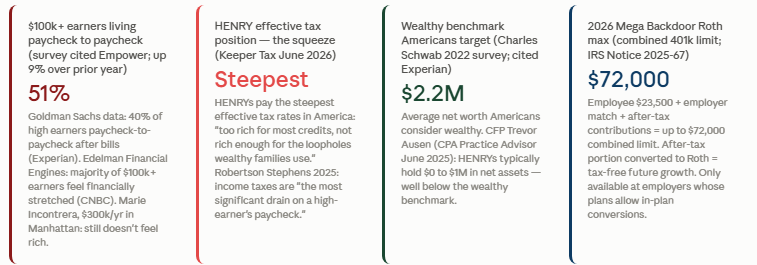
CFP Trevor Ausen, based in Minneapolis, told CPA Practice Advisor in June 2025 that HENRYs often have ‘somewhere between negative net worth, thanks to student loans or early career costs, to around $1 million in assets.’ For context, the average net worth Americans associate with being ‘wealthy’ is $2.2 million, according to a Charles Schwab survey cited by Experian. Many HENRYs live in high-cost urban areas — New York City, the San Francisco Bay Area, Los Angeles, Chicago — where even six-figure salaries are significantly compressed by housing, taxes, and living costs. Online communities like r/HENRYfinance on Reddit have emerged as meeting points for people navigating exactly these pressures, with discussions focused on lifestyle creep, career growth, investment strategies, and tax minimisation.
Who is a HENRY: top 10% of earners, typically 30s-40s, $100k-$500k income range, not yet accumulated significant wealth (ProjectionLab; Experian). Wealthy benchmark: $2.2 million average net worth (Charles Schwab 2022, cited Experian). 14% of US households earn $200,000+ (2023 Census data, NBC Washington/CNBC). CFP Trevor Ausen: HENRYs typically hold $0 to $1M in net assets (CPA Practice Advisor June 2025). Sources cited. Not financial advice.
NBC Washington and CNBC profiled Marie Incontrera, a 39-year-old based in Manhattan whose income rose from $15,000 to $300,000 per year through a career pivot. She still does not feel rich. Kamila Elliott, CEO of Collective Wealth Partners in Atlanta and a member of the CNBC Financial Advisor Council, explained the mechanism: ‘It can be pretty easy for someone to feel like, I’m making really good money, but I don’t have a lot of discretionary income.’ The paradox resolves once you understand what is happening to HENRY income before it becomes wealth: a punishing effective tax rate, high housing costs, debt service, lifestyle spending that expands with income, and undersaving relative to income level.
Kamila Elliott, CEO Collective Wealth Partners, CNBC Financial Advisor Council: 'It can be pretty easy for someone to feel like, I'm making really good money, but I don't have a lot of discretionary income.' Kelly O'Donnell, Chief Client Officer, Edelman Financial Engines: 'Market volatility over the past two years has taken a financial and emotional toll on individuals and families regardless of wealth.' CFP Trevor Ausen: 'Without that focus, it's easy to stay stuck living paycheck to paycheck despite a high income.' Sources: NBC Washington/CNBC; CPA Practice Advisor June 2025. Not financial advice.
Second: lifestyle creep. Experian defines it precisely: as income rises, HENRYs ‘get used to maintaining a certain lifestyle’ and fail to invest and save enough for the future. The average American carries a debt balance of $46,777 across credit cards, personal loans, and car loans (Empower), and for HENRYs the numbers are often higher because lifestyle upgrades — the apartment in a better neighbourhood, the car upgrade, the premium subscriptions, the annual holidays — are financed on a rolling basis rather than saved for. Third: high living costs in HENRY cities. As CFP Trevor Ausen noted, many HENRYs live in New York or the Bay Area ‘where it can be hard to accumulate wealth even with a high salary due to the high cost of living.’ A single person needs $84,026 after taxes for a comfortable lifestyle in San Francisco; $78,524 in New York City (Empower).
The three HENRY wealth drains: (1) Tax squeeze — paying steepest effective rates while too rich for credits, too modest for loopholes; (2) Lifestyle creep — spending rises as fast as or faster than income, preventing wealth accumulation; (3) High-cost living — HENRY cities charge a premium that devours take-home before it can compound. All three compound. Not addressing any one of them limits the effect of addressing the others. Sources: Keeper Tax June 2026; Experian; Empower; Robertson Stephens 2025. Not financial advice.
Max every tax-advantaged account. The 401(k) allows $23,500 in employee contributions in 2026 (plus $7,500 catch-up if over 50, or $11,250 for ages 60-63 under SECURE 2.0). Every pre-tax dollar contributed reduces current taxable income at the HENRY’s marginal rate. At 32%, a full $23,500 401(k) contribution saves approximately $7,520 in federal income tax in the year of contribution. The HSA is what Keeper Tax calls triple tax-advantaged: contributions are pre-tax, growth is tax-free, and withdrawals for qualifying medical expenses are tax-free. 2026 HSA limits: $4,300 for individuals, $8,550 for families. You need a high-deductible health plan (HDHP) to qualify.
The Mega Backdoor Roth is the most powerful HENRY tax tool many people have never heard of. It uses after-tax contributions to the 401(k) — up to the $72,000 combined employee-plus-employer limit in 2026 — and converts them to Roth status within the plan. The result: future growth and withdrawals are entirely tax-free. Available only at employers whose plans allow in-plan Roth conversions — check with your HR or plan administrator. Tax-loss harvesting — realising investment losses to offset capital gains — is a year-round strategy, not just a December exercise. Charitable bunching — consolidating multiple years’ charitable donations into a single year to exceed the standard deduction and itemise — is particularly useful for HENRYs who give regularly. Not financial or tax advice.
HENRY tax priority stack (2026): (1) Max 401(k): $23,500 reduces taxable income. (2) HSA (if HDHP-eligible): $8,550 family, triple tax-advantaged. (3) Mega Backdoor Roth: after-tax contributions up to $72k combined limit, convert to Roth for tax-free growth. (4) Tax-loss harvesting: offset capital gains year-round. (5) Charitable bunching: cluster donations to exceed standard deduction. (6) SALT planning: if in high-tax state, consider OBBBA impact. Source: Keeper Tax June 2026; IRS Notice 2025-67. Not financial or tax advice. Consult a CPA.
Robertson Stephens Wealth Management’s 2025 guide to HENRY financial planning identifies automating saving and investing as the first and most important action step. For HENRYs, automation means: 401(k) and HSA contributions set at maximum level via payroll deduction; a recurring transfer on payday to a taxable brokerage account funded with a specific dollar amount; and if self-employed, quarterly estimated tax payments and retirement account contributions (SEP-IRA or Solo 401(k)) on a calendar-triggered schedule. The discipline question — can I save consistently each month? — becomes irrelevant once the system is automated. The only decision required is the initial one. Not financial advice.
Automation stack for HENRYs: (1) 401(k) contribution set to maximum at payroll — comes out before take-home pay. (2) HSA contribution maxed via payroll deduction (if HDHP-eligible). (3) Recurring transfer to taxable brokerage on payday — specific dollar amount, not 'what's left.' (4) Roth IRA or backdoor Roth contribution scheduled at the start of each year. (5) Emergency fund (3-6 months) in high-yield savings — automate until target reached. Sources: Empower; Robertson Stephens 2025. Capital at risk. Not financial advice.
A HENRY who earns $250,000 per year but carries $100,000 in student loans, $50,000 in credit card and personal loan debt, rents (no home equity), and has $80,000 in retirement accounts has a net worth of approximately negative $70,000. A peer who earns $150,000, carries no debt, owns a home with $200,000 in equity, and has $300,000 in retirement accounts has a net worth of $500,000. The lower earner is significantly wealthier by every meaningful financial metric. Tracking net worth monthly — using a spreadsheet, a tool like Empower’s free dashboard, or a personal finance app — converts wealth-building from an abstraction into a measurable number that moves. Not financial advice.
The deliberate defeat of lifestyle creep requires a specific rule: every raise and bonus has a pre-committed allocation before you experience the money. A rule such as ‘50% of every raise goes directly to increased investment automation; the other 50% is available to improve lifestyle’ protects wealth-building without requiring austerity. Edelman Financial Engines’ report, cited by CNBC, identifies credit card debt as ‘the biggest threat to building wealth’ for high earners — and the mechanism is almost always lifestyle creep financed on credit. The specific HENRY debt categories most commonly cited: car loans (upgrading vehicles with every promotion), student loans that reduce monthly cash flow, and premium housing costs that stretch beyond what the savings-adjusted income supports. Not financial advice.
The raise trap: most HENRYs absorb 100% of each raise into lifestyle within 6 months. The fix is pre-commitment — decide before the raise arrives what percentage goes to increased investment automation. A 50/50 rule (50% to wealth, 50% to lifestyle) captures real-life improvement while compounding the wealth base. Without pre-commitment, Parkinson's Law of spending applies: expenditure rises to meet income. Not financial advice.
The HENRY insurance priority stack: disability income insurance (protects future earning capacity — the most important asset a HENRY has); term life insurance (essential if anyone is financially dependent on the HENRY’s income; premiums are low for healthy earners in their 30s and 40s); umbrella liability insurance (provides additional liability coverage above homeowners/renters and auto policies — particularly important as net worth grows and the HENRY becomes a more attractive litigation target); long-term care insurance (more commonly relevant at 40-50+ but worth modelling). What is typically not recommended for most HENRYs: whole life insurance as an investment vehicle — the insurance component is necessary, but the investment component of whole life rarely performs as well as the alternative of buying term and investing the difference. Not insurance or financial advice.
The invest-vs-pay-down-debt calculation for moderate-rate debt (5-8%): if your investment portfolio has a reasonable expectation of returning 7%+ over the long term, the mathematical case for investing over accelerating low-rate debt repayment is generally accepted. But the psychological case for paying debt down completely — and the reduced financial risk it creates — has real value that the pure arithmetic cannot capture. Titan Wealth Planning’s UK HENRY guide makes the point clearly: ‘Paying for debt when you’ve a high income might feel manageable, but carrying substantial amounts of high-interest debt could hamper your ability to accumulate wealth.’ For HENRYs with student loans, the SECURE 2.0 Act’s employer student loan match provision (where employers can match retirement contributions based on loan repayments) is worth checking with your plan administrator. Not financial advice.
The HENRY estate planning minimum: a will (without one, state intestacy laws determine who inherits, which may not reflect your wishes); a durable power of attorney (designates someone to manage financial affairs if incapacitated); a healthcare directive (advance directive or living will); and correctly updated beneficiary designations on all retirement accounts and insurance policies. For married HENRYs or those with children, a revocable living trust may simplify the transfer of assets and avoid probate. The 2026 annual gift exclusion is $19,000 per person ($38,000 per couple), which can be used to transfer wealth to children, grandchildren, or others tax-free. Not legal or financial advice. Consult an estate planning attorney.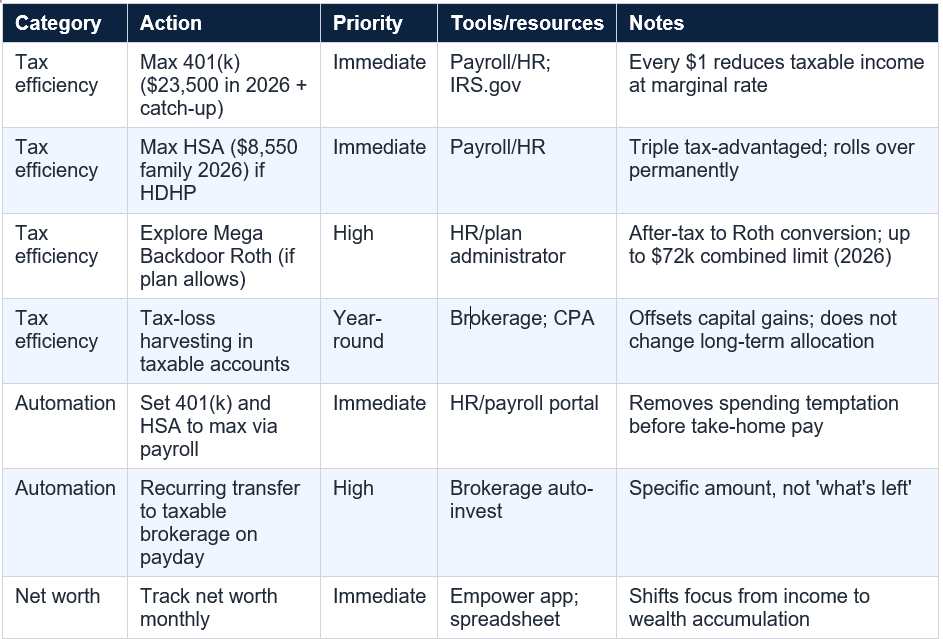
The seven protection strategies in this article are a system redesign. Fix the tax leak — because HENRYs face the steepest effective tax rates in America and most are leaving thousands on the table annually through under-utilised accounts and missed strategies. Automate investing before lifestyle takes the money. Track net worth, not income. Set rules around raises and bonuses before they arrive. Protect future earning capacity with disability insurance. Deal with debt by rate, not by emotion. Start estate planning before you feel wealthy enough to need it.
The Empower guide puts it clearly: ‘Income is just one source of wealth creation.’ The HENRY who earns $250,000 and builds no system will retire with the same modest net worth they have today, compressed by taxes and inflated by lifestyle. The HENRY who builds the system — and protects it — is on a path to becoming not a HENRY at all. Not financial advice. Consult a qualified fee-only CFP, CPA, and estate planning attorney for personalised guidance.
HENRY stands for High Earner, Not Rich Yet. The term describes individuals who earn a high income but have not accumulated proportionate wealth due to high expenses, debt, lifestyle choices, or a lack of systematic financial planning. Income ranges cited by different sources vary: Experian defines the range as $100,000 to $500,000 per year; ProjectionLab describes HENRYs as earning in the top 10% of all US earners. CFP Trevor Ausen, writing for CPA Practice Advisor in June 2025, characterises HENRY net worth as typically ranging from negative (due to student loans) to around $1 million in assets. The wealthy benchmark most Americans associate with being 'rich' is $2.2 million in net worth, according to a Charles Schwab survey cited by Experian. HENRYs are most commonly in their 30s and 40s, often in high-cost cities like New York or San Francisco, and may be the first in their families to earn at this level — which can bring additional financial pressures including supporting family members. Sources: Experian; CPA Practice Advisor June 2025; ProjectionLab. Not financial advice.
Why do so many HENRYs live paycheck to paycheck?
The paycheck-to-paycheck rate among high earners is striking: 51% of consumers earning $100,000+ live paycheck to paycheck (survey cited by Empower; up 9% over previous year), and Goldman Sachs data cited by Experian found 40% of high earners live paycheck to paycheck after bills. The mechanism has several components working in combination: lifestyle creep (expenses rise proportionally or faster than income, eliminating the financial surplus a high income should create); a punishing effective tax rate (Keeper Tax June 2026: HENRYs pay the steepest effective rates in America, too rich for credits, too modest for sophisticated loopholes); high housing costs in HENRY cities (a comfortable lifestyle in San Francisco requires $84,026 after taxes; NYC requires $78,524, per Empower); debt service (average American debt balance $46,777 across credit cards, personal loans, car loans); and undersaving relative to income (contributions to retirement and investment accounts that are low as a percentage of gross income). The result is a high earner who feels financially squeezed despite an objectively high salary. Sources: Empower; Experian; Keeper Tax June 2026; CNBC. Not financial advice.
What are the best tax strategies for HENRYs in 2026?
Keeper Tax's June 2026 guide to HENRY tax strategies identifies 12 legal approaches. The highest-impact strategies for most HENRYs: maximise pre-tax 401(k) contributions ($23,500 in 2026 + catch-up amounts), which reduce taxable income at the marginal rate; utilise an HSA if enrolled in a high-deductible health plan (HDHP) — $8,550 family limit in 2026, triple tax-advantaged: pre-tax, tax-free growth, tax-free medical withdrawal; explore the Mega Backdoor Roth, which allows after-tax 401(k) contributions converted to Roth up to the $72,000 combined limit (2026) — available only at employers whose plans allow in-plan Roth conversions; implement tax-loss harvesting in taxable accounts year-round to offset capital gains; and consider charitable bunching (consolidating multiple years' donations into one year to exceed the standard deduction and itemise). For HENRYs in high-tax states: SALT planning under the 2025 One Big Beautiful Bill Act may provide additional deductibility. Important caveat: the QBI deduction for business income (for consultants, doctors, lawyers, and other SSTB professionals) phases out at $241,950 single / $483,900 MFJ in 2025. Always consult a CPA for tax strategies specific to your income, filing status, and state. Sources: Keeper Tax June 2026; IRS Notice 2025-67. Not financial or tax advice.
How do HENRYs beat lifestyle creep?
Lifestyle creep is the predictable expansion of spending as income rises, and it is the primary reason HENRYs with high salaries accumulate little net worth. The most effective approach is pre-commitment: deciding before a raise or bonus arrives how much of the new income will be directed to increased investment automation, and setting up the automated transfer immediately when the higher paycheck arrives. A 50/50 rule — 50% of every raise goes to wealth-building; 50% improves lifestyle — allows real quality of life improvements while compounding the wealth base. Without this kind of pre-commitment rule, Parkinson's Law of spending applies: expenses naturally expand to absorb available income. Specific high-risk categories for HENRY lifestyle creep include housing upgrades (the most expensive lifestyle category and the hardest to reverse), car leases, premium subscriptions, and upgrading holidays and dining frequency. Robertson Stephens Wealth Management's 2025 HENRY guide identifies lifestyle creep alongside missed investment opportunities and unclear financial objectives as the primary obstacles to HENRY wealth accumulation. Sources: Experian; Robertson Stephens 2025; Empower. Not financial advice.
When should a HENRY start estate planning?
Earlier than most think necessary. Estate planning at the HENRY stage is not primarily about estate tax minimisation — the 2026 estate tax exemption is $15 million per person following the One Big Beautiful Bill Act 2025, well above most HENRY net worths. The HENRY estate planning minimum consists of: a will (without one, state intestacy laws determine inheritance, which may not reflect your wishes); a durable power of attorney (designates someone to manage financial affairs if incapacitated); a healthcare directive or living will; and correctly updated beneficiary designations on all retirement accounts and life insurance policies. Beneficiary designations on retirement accounts supersede the instructions in a will — a 401(k) with an ex-spouse still listed as beneficiary will pass to that ex-spouse regardless of what the will says. For HENRYs with children, a revocable living trust may simplify asset transfer and avoid probate. The 2026 annual gift exclusion is $19,000 per person ($38,000 per couple) — a tool for beginning intergenerational wealth transfer. Consult an estate planning attorney. Sources: IRS; gov.uk; estate planning practice general guidance. Not legal or financial advice.
Table of Contents
- What Is a HENRY — and Are You One?
- The Paycheck-to-Paycheck Paradox at High Income
- The Three Forces Working Against HENRY Wealth
- Protection Strategy #1: Fix the Tax Leak First
- Protection Strategy #2: Automate Investing Before Lifestyle Takes It
- Protection Strategy #3: Track Net Worth, Not Income
- Protection Strategy #4: Defeat Lifestyle Creep Deliberately
- Protection Strategy #5: Get the Right Insurance for a HENRY
- Protection Strategy #6: Deal With Debt Strategically
- Protection Strategy #7: Start Estate Planning Earlier Than You Think
- The Complete HENRY Wealth Protection Checklist
- Conclusion: The Income Is Not the Problem. The System Is.
- Frequently Asked Questions
What Is a HENRY — and Are You One?
The term HENRY — High Earner, Not Rich Yet — was coined to describe a specific and increasingly common financial profile: professionals with substantial income who have not converted that income into proportionate wealth. According to ProjectionLab’s financial glossary, HENRYs typically earn in the top 10% of all earners and are most commonly in their 30s and 40s, but have not accumulated significant wealth despite their income. Experian and CPA Practice Advisor define the income range broadly as $100,000 to $500,000 per year.CFP Trevor Ausen, based in Minneapolis, told CPA Practice Advisor in June 2025 that HENRYs often have ‘somewhere between negative net worth, thanks to student loans or early career costs, to around $1 million in assets.’ For context, the average net worth Americans associate with being ‘wealthy’ is $2.2 million, according to a Charles Schwab survey cited by Experian. Many HENRYs live in high-cost urban areas — New York City, the San Francisco Bay Area, Los Angeles, Chicago — where even six-figure salaries are significantly compressed by housing, taxes, and living costs. Online communities like r/HENRYfinance on Reddit have emerged as meeting points for people navigating exactly these pressures, with discussions focused on lifestyle creep, career growth, investment strategies, and tax minimisation.
Who is a HENRY: top 10% of earners, typically 30s-40s, $100k-$500k income range, not yet accumulated significant wealth (ProjectionLab; Experian). Wealthy benchmark: $2.2 million average net worth (Charles Schwab 2022, cited Experian). 14% of US households earn $200,000+ (2023 Census data, NBC Washington/CNBC). CFP Trevor Ausen: HENRYs typically hold $0 to $1M in net assets (CPA Practice Advisor June 2025). Sources cited. Not financial advice.
The Paycheck-to-Paycheck Paradox at High Income
The most counterintuitive HENRY data point is the paycheck-to-paycheck rate. A survey cited by Empower found that 51% of consumers earning $100,000 or more are living paycheck to paycheck — up 9% over the previous year. Goldman Sachs data cited by Experian found that 40% of high earners say they live paycheck to paycheck after covering their bills. Edelman Financial Engines’ research found more than half of Americans earning over $100,000 say they live paycheck to paycheck.NBC Washington and CNBC profiled Marie Incontrera, a 39-year-old based in Manhattan whose income rose from $15,000 to $300,000 per year through a career pivot. She still does not feel rich. Kamila Elliott, CEO of Collective Wealth Partners in Atlanta and a member of the CNBC Financial Advisor Council, explained the mechanism: ‘It can be pretty easy for someone to feel like, I’m making really good money, but I don’t have a lot of discretionary income.’ The paradox resolves once you understand what is happening to HENRY income before it becomes wealth: a punishing effective tax rate, high housing costs, debt service, lifestyle spending that expands with income, and undersaving relative to income level.
Kamila Elliott, CEO Collective Wealth Partners, CNBC Financial Advisor Council: 'It can be pretty easy for someone to feel like, I'm making really good money, but I don't have a lot of discretionary income.' Kelly O'Donnell, Chief Client Officer, Edelman Financial Engines: 'Market volatility over the past two years has taken a financial and emotional toll on individuals and families regardless of wealth.' CFP Trevor Ausen: 'Without that focus, it's easy to stay stuck living paycheck to paycheck despite a high income.' Sources: NBC Washington/CNBC; CPA Practice Advisor June 2025. Not financial advice.
The Three Forces Working Against HENRY Wealth
Understanding the HENRY predicament requires naming the three forces that systematically extract wealth from high earners before it can compound. First: taxation. Keeper Tax’s June 2026 guide to HENRY tax strategies opens with a clear statement: HENRYs and middle-class families pay the steepest effective tax rates in America. They are ‘too rich for most credits, not rich enough for the loopholes wealthy families use.’ The HENRY in the 32-37% federal bracket, in a high-tax state like California or New York, can see an effective marginal rate above 50% on additional income. Robertson Stephens Wealth Management’s 2025 guide confirms this: ‘Income taxes are usually one of the most significant drains on a high-earner’s paycheck, especially if you live in a high-tax state like New York or California.’Second: lifestyle creep. Experian defines it precisely: as income rises, HENRYs ‘get used to maintaining a certain lifestyle’ and fail to invest and save enough for the future. The average American carries a debt balance of $46,777 across credit cards, personal loans, and car loans (Empower), and for HENRYs the numbers are often higher because lifestyle upgrades — the apartment in a better neighbourhood, the car upgrade, the premium subscriptions, the annual holidays — are financed on a rolling basis rather than saved for. Third: high living costs in HENRY cities. As CFP Trevor Ausen noted, many HENRYs live in New York or the Bay Area ‘where it can be hard to accumulate wealth even with a high salary due to the high cost of living.’ A single person needs $84,026 after taxes for a comfortable lifestyle in San Francisco; $78,524 in New York City (Empower).
The three HENRY wealth drains: (1) Tax squeeze — paying steepest effective rates while too rich for credits, too modest for loopholes; (2) Lifestyle creep — spending rises as fast as or faster than income, preventing wealth accumulation; (3) High-cost living — HENRY cities charge a premium that devours take-home before it can compound. All three compound. Not addressing any one of them limits the effect of addressing the others. Sources: Keeper Tax June 2026; Experian; Empower; Robertson Stephens 2025. Not financial advice.
Protection Strategy #1: Fix the Tax Leak First
For HENRYs, tax planning is not a year-end activity. It is the highest-return financial discipline available to someone at their income level. Keeper Tax’s June 2026 guide to HENRY tax strategies identifies 12 legal approaches available to HENRYs and middle-class earners. The most impactful:Max every tax-advantaged account. The 401(k) allows $23,500 in employee contributions in 2026 (plus $7,500 catch-up if over 50, or $11,250 for ages 60-63 under SECURE 2.0). Every pre-tax dollar contributed reduces current taxable income at the HENRY’s marginal rate. At 32%, a full $23,500 401(k) contribution saves approximately $7,520 in federal income tax in the year of contribution. The HSA is what Keeper Tax calls triple tax-advantaged: contributions are pre-tax, growth is tax-free, and withdrawals for qualifying medical expenses are tax-free. 2026 HSA limits: $4,300 for individuals, $8,550 for families. You need a high-deductible health plan (HDHP) to qualify.
The Mega Backdoor Roth is the most powerful HENRY tax tool many people have never heard of. It uses after-tax contributions to the 401(k) — up to the $72,000 combined employee-plus-employer limit in 2026 — and converts them to Roth status within the plan. The result: future growth and withdrawals are entirely tax-free. Available only at employers whose plans allow in-plan Roth conversions — check with your HR or plan administrator. Tax-loss harvesting — realising investment losses to offset capital gains — is a year-round strategy, not just a December exercise. Charitable bunching — consolidating multiple years’ charitable donations into a single year to exceed the standard deduction and itemise — is particularly useful for HENRYs who give regularly. Not financial or tax advice.
HENRY tax priority stack (2026): (1) Max 401(k): $23,500 reduces taxable income. (2) HSA (if HDHP-eligible): $8,550 family, triple tax-advantaged. (3) Mega Backdoor Roth: after-tax contributions up to $72k combined limit, convert to Roth for tax-free growth. (4) Tax-loss harvesting: offset capital gains year-round. (5) Charitable bunching: cluster donations to exceed standard deduction. (6) SALT planning: if in high-tax state, consider OBBBA impact. Source: Keeper Tax June 2026; IRS Notice 2025-67. Not financial or tax advice. Consult a CPA.
Protection Strategy #2: Automate Investing Before Lifestyle Takes It
Empower’s HENRY wealth-building guide makes one of the clearest statements in personal finance: ‘If you don’t let your full paycheck hit your bank account, you can’t even consider spending it.’ This is the foundational mechanical change that separates HENRYs who build wealth from those who do not. The principle is pay yourself first, executed not as an aspiration but as an automatic transfer that occurs on payday, before discretionary spending is possible.Robertson Stephens Wealth Management’s 2025 guide to HENRY financial planning identifies automating saving and investing as the first and most important action step. For HENRYs, automation means: 401(k) and HSA contributions set at maximum level via payroll deduction; a recurring transfer on payday to a taxable brokerage account funded with a specific dollar amount; and if self-employed, quarterly estimated tax payments and retirement account contributions (SEP-IRA or Solo 401(k)) on a calendar-triggered schedule. The discipline question — can I save consistently each month? — becomes irrelevant once the system is automated. The only decision required is the initial one. Not financial advice.
Automation stack for HENRYs: (1) 401(k) contribution set to maximum at payroll — comes out before take-home pay. (2) HSA contribution maxed via payroll deduction (if HDHP-eligible). (3) Recurring transfer to taxable brokerage on payday — specific dollar amount, not 'what's left.' (4) Roth IRA or backdoor Roth contribution scheduled at the start of each year. (5) Emergency fund (3-6 months) in high-yield savings — automate until target reached. Sources: Empower; Robertson Stephens 2025. Capital at risk. Not financial advice.
Protection Strategy #3: Track Net Worth, Not Income
The psychological shift that matters most for HENRYs is moving the primary financial metric from income to net worth. Empower’s guide is explicit: ‘Income is just one source of wealth creation. Once you shift your eyes to your net worth, you can start developing multiple income streams through investing, optimizing your finances for taxes, considering estate planning, and thinking through advanced moves to get you further ahead.’ Net worth = total assets minus total liabilities. It is the number that actually measures wealth, not the number on your pay stub.A HENRY who earns $250,000 per year but carries $100,000 in student loans, $50,000 in credit card and personal loan debt, rents (no home equity), and has $80,000 in retirement accounts has a net worth of approximately negative $70,000. A peer who earns $150,000, carries no debt, owns a home with $200,000 in equity, and has $300,000 in retirement accounts has a net worth of $500,000. The lower earner is significantly wealthier by every meaningful financial metric. Tracking net worth monthly — using a spreadsheet, a tool like Empower’s free dashboard, or a personal finance app — converts wealth-building from an abstraction into a measurable number that moves. Not financial advice.
Protection Strategy #4: Defeat Lifestyle Creep Deliberately
Lifestyle creep is the mechanism by which income rises and savings stay flat. It is not a character flaw; it is a predictable human response to increased financial slack. The HENRY who earns $120,000 and saves 15% of gross income gets a promotion to $160,000. Three months later, lifestyle has expanded to fill the new income: a nicer apartment, the car lease upgrade, premium gym membership, more frequent restaurant spending. The savings rate stays at 15% nominally but the absolute gap between income and wealth-building has grown.The deliberate defeat of lifestyle creep requires a specific rule: every raise and bonus has a pre-committed allocation before you experience the money. A rule such as ‘50% of every raise goes directly to increased investment automation; the other 50% is available to improve lifestyle’ protects wealth-building without requiring austerity. Edelman Financial Engines’ report, cited by CNBC, identifies credit card debt as ‘the biggest threat to building wealth’ for high earners — and the mechanism is almost always lifestyle creep financed on credit. The specific HENRY debt categories most commonly cited: car loans (upgrading vehicles with every promotion), student loans that reduce monthly cash flow, and premium housing costs that stretch beyond what the savings-adjusted income supports. Not financial advice.
The raise trap: most HENRYs absorb 100% of each raise into lifestyle within 6 months. The fix is pre-commitment — decide before the raise arrives what percentage goes to increased investment automation. A 50/50 rule (50% to wealth, 50% to lifestyle) captures real-life improvement while compounding the wealth base. Without pre-commitment, Parkinson's Law of spending applies: expenditure rises to meet income. Not financial advice.
Protection Strategy #5: Get the Right Insurance for a HENRY
A HENRY’s wealth is almost entirely prospective. Their net worth today may be modest, but their future earning capacity — the present value of decades of six-figure income — is enormous. Disability income insurance protects that asset. If illness or injury prevents a $250,000-per-year professional from working for three years, the income loss is $750,000. If it is permanent, the loss is potentially several million dollars. Yet disability insurance is one of the most consistently undercarried products among high earners, despite being arguably more important than life insurance for working-age professionals with no dependants.The HENRY insurance priority stack: disability income insurance (protects future earning capacity — the most important asset a HENRY has); term life insurance (essential if anyone is financially dependent on the HENRY’s income; premiums are low for healthy earners in their 30s and 40s); umbrella liability insurance (provides additional liability coverage above homeowners/renters and auto policies — particularly important as net worth grows and the HENRY becomes a more attractive litigation target); long-term care insurance (more commonly relevant at 40-50+ but worth modelling). What is typically not recommended for most HENRYs: whole life insurance as an investment vehicle — the insurance component is necessary, but the investment component of whole life rarely performs as well as the alternative of buying term and investing the difference. Not insurance or financial advice.
Protection Strategy #6: Deal With Debt Strategically
Not all HENRY debt is equal, and the strategic approach depends on the type and rate. Student loans at federal rates (typically 5-8%) require a different approach than credit card debt at 23%+ APR. The mathematical priority order: eliminate any credit card and high-rate personal loan debt first (the guaranteed negative return of 23% APR is the most expensive financial position any HENRY can hold); then decide whether to accelerate lower-rate debt (mortgages, federal student loans) or invest the surplus.The invest-vs-pay-down-debt calculation for moderate-rate debt (5-8%): if your investment portfolio has a reasonable expectation of returning 7%+ over the long term, the mathematical case for investing over accelerating low-rate debt repayment is generally accepted. But the psychological case for paying debt down completely — and the reduced financial risk it creates — has real value that the pure arithmetic cannot capture. Titan Wealth Planning’s UK HENRY guide makes the point clearly: ‘Paying for debt when you’ve a high income might feel manageable, but carrying substantial amounts of high-interest debt could hamper your ability to accumulate wealth.’ For HENRYs with student loans, the SECURE 2.0 Act’s employer student loan match provision (where employers can match retirement contributions based on loan repayments) is worth checking with your plan administrator. Not financial advice.
Protection Strategy #7: Start Estate Planning Earlier Than You Think
Most HENRYs defer estate planning because they do not yet feel ‘wealthy enough’ to need it. This is a mistake that can be costly and in some cases irreversible. Estate planning at the HENRY stage is not primarily about estate tax minimisation (though the 2026 estate tax exemption is $15 million per person following the One Big Beautiful Bill Act 2025 — well above most HENRY net worths). It is about ensuring that whatever wealth has been accumulated goes to the right people, that someone can make decisions if the HENRY becomes incapacitated, and that beneficiary designations on retirement accounts and life insurance policies are correct.The HENRY estate planning minimum: a will (without one, state intestacy laws determine who inherits, which may not reflect your wishes); a durable power of attorney (designates someone to manage financial affairs if incapacitated); a healthcare directive (advance directive or living will); and correctly updated beneficiary designations on all retirement accounts and insurance policies. For married HENRYs or those with children, a revocable living trust may simplify the transfer of assets and avoid probate. The 2026 annual gift exclusion is $19,000 per person ($38,000 per couple), which can be used to transfer wealth to children, grandchildren, or others tax-free. Not legal or financial advice. Consult an estate planning attorney.
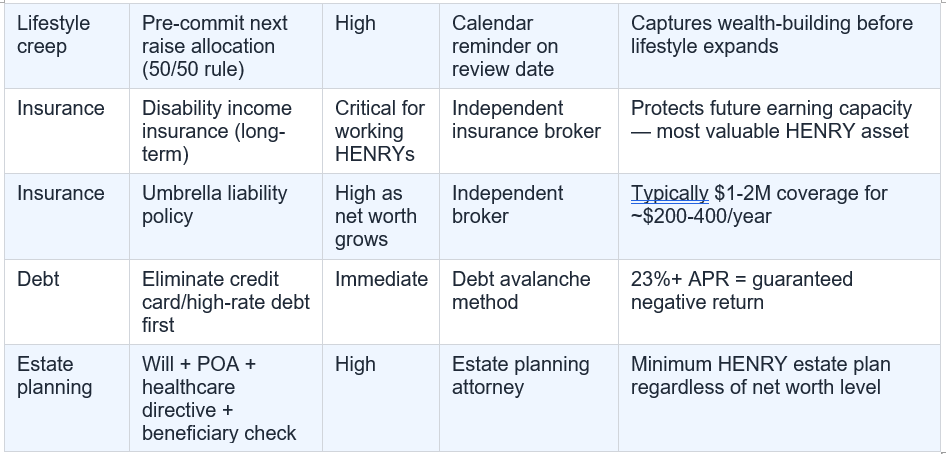
The Complete HENRY Wealth Protection Checklist
Conclusion
The HENRY paradox resolves the moment you understand what it actually is. It is not an income problem. HENRYs have income. It is not a knowledge problem — most HENRYs are educated, informed, and aware that they should be saving more. It is a systems problem: the default financial life of a high earner — with lifestyle expanding automatically, taxes extracted efficiently, and investment happening only with whatever is left — is a system specifically designed to produce a HENRY. Changing the outcome requires changing the system.The seven protection strategies in this article are a system redesign. Fix the tax leak — because HENRYs face the steepest effective tax rates in America and most are leaving thousands on the table annually through under-utilised accounts and missed strategies. Automate investing before lifestyle takes the money. Track net worth, not income. Set rules around raises and bonuses before they arrive. Protect future earning capacity with disability insurance. Deal with debt by rate, not by emotion. Start estate planning before you feel wealthy enough to need it.
The Empower guide puts it clearly: ‘Income is just one source of wealth creation.’ The HENRY who earns $250,000 and builds no system will retire with the same modest net worth they have today, compressed by taxes and inflated by lifestyle. The HENRY who builds the system — and protects it — is on a path to becoming not a HENRY at all. Not financial advice. Consult a qualified fee-only CFP, CPA, and estate planning attorney for personalised guidance.
Frequently Asked Questions
Who exactly is a HENRY and what income range defines it?HENRY stands for High Earner, Not Rich Yet. The term describes individuals who earn a high income but have not accumulated proportionate wealth due to high expenses, debt, lifestyle choices, or a lack of systematic financial planning. Income ranges cited by different sources vary: Experian defines the range as $100,000 to $500,000 per year; ProjectionLab describes HENRYs as earning in the top 10% of all US earners. CFP Trevor Ausen, writing for CPA Practice Advisor in June 2025, characterises HENRY net worth as typically ranging from negative (due to student loans) to around $1 million in assets. The wealthy benchmark most Americans associate with being 'rich' is $2.2 million in net worth, according to a Charles Schwab survey cited by Experian. HENRYs are most commonly in their 30s and 40s, often in high-cost cities like New York or San Francisco, and may be the first in their families to earn at this level — which can bring additional financial pressures including supporting family members. Sources: Experian; CPA Practice Advisor June 2025; ProjectionLab. Not financial advice.
Why do so many HENRYs live paycheck to paycheck?
The paycheck-to-paycheck rate among high earners is striking: 51% of consumers earning $100,000+ live paycheck to paycheck (survey cited by Empower; up 9% over previous year), and Goldman Sachs data cited by Experian found 40% of high earners live paycheck to paycheck after bills. The mechanism has several components working in combination: lifestyle creep (expenses rise proportionally or faster than income, eliminating the financial surplus a high income should create); a punishing effective tax rate (Keeper Tax June 2026: HENRYs pay the steepest effective rates in America, too rich for credits, too modest for sophisticated loopholes); high housing costs in HENRY cities (a comfortable lifestyle in San Francisco requires $84,026 after taxes; NYC requires $78,524, per Empower); debt service (average American debt balance $46,777 across credit cards, personal loans, car loans); and undersaving relative to income (contributions to retirement and investment accounts that are low as a percentage of gross income). The result is a high earner who feels financially squeezed despite an objectively high salary. Sources: Empower; Experian; Keeper Tax June 2026; CNBC. Not financial advice.
What are the best tax strategies for HENRYs in 2026?
Keeper Tax's June 2026 guide to HENRY tax strategies identifies 12 legal approaches. The highest-impact strategies for most HENRYs: maximise pre-tax 401(k) contributions ($23,500 in 2026 + catch-up amounts), which reduce taxable income at the marginal rate; utilise an HSA if enrolled in a high-deductible health plan (HDHP) — $8,550 family limit in 2026, triple tax-advantaged: pre-tax, tax-free growth, tax-free medical withdrawal; explore the Mega Backdoor Roth, which allows after-tax 401(k) contributions converted to Roth up to the $72,000 combined limit (2026) — available only at employers whose plans allow in-plan Roth conversions; implement tax-loss harvesting in taxable accounts year-round to offset capital gains; and consider charitable bunching (consolidating multiple years' donations into one year to exceed the standard deduction and itemise). For HENRYs in high-tax states: SALT planning under the 2025 One Big Beautiful Bill Act may provide additional deductibility. Important caveat: the QBI deduction for business income (for consultants, doctors, lawyers, and other SSTB professionals) phases out at $241,950 single / $483,900 MFJ in 2025. Always consult a CPA for tax strategies specific to your income, filing status, and state. Sources: Keeper Tax June 2026; IRS Notice 2025-67. Not financial or tax advice.
How do HENRYs beat lifestyle creep?
Lifestyle creep is the predictable expansion of spending as income rises, and it is the primary reason HENRYs with high salaries accumulate little net worth. The most effective approach is pre-commitment: deciding before a raise or bonus arrives how much of the new income will be directed to increased investment automation, and setting up the automated transfer immediately when the higher paycheck arrives. A 50/50 rule — 50% of every raise goes to wealth-building; 50% improves lifestyle — allows real quality of life improvements while compounding the wealth base. Without this kind of pre-commitment rule, Parkinson's Law of spending applies: expenses naturally expand to absorb available income. Specific high-risk categories for HENRY lifestyle creep include housing upgrades (the most expensive lifestyle category and the hardest to reverse), car leases, premium subscriptions, and upgrading holidays and dining frequency. Robertson Stephens Wealth Management's 2025 HENRY guide identifies lifestyle creep alongside missed investment opportunities and unclear financial objectives as the primary obstacles to HENRY wealth accumulation. Sources: Experian; Robertson Stephens 2025; Empower. Not financial advice.
When should a HENRY start estate planning?
Earlier than most think necessary. Estate planning at the HENRY stage is not primarily about estate tax minimisation — the 2026 estate tax exemption is $15 million per person following the One Big Beautiful Bill Act 2025, well above most HENRY net worths. The HENRY estate planning minimum consists of: a will (without one, state intestacy laws determine inheritance, which may not reflect your wishes); a durable power of attorney (designates someone to manage financial affairs if incapacitated); a healthcare directive or living will; and correctly updated beneficiary designations on all retirement accounts and life insurance policies. Beneficiary designations on retirement accounts supersede the instructions in a will — a 401(k) with an ex-spouse still listed as beneficiary will pass to that ex-spouse regardless of what the will says. For HENRYs with children, a revocable living trust may simplify asset transfer and avoid probate. The 2026 annual gift exclusion is $19,000 per person ($38,000 per couple) — a tool for beginning intergenerational wealth transfer. Consult an estate planning attorney. Sources: IRS; gov.uk; estate planning practice general guidance. Not legal or financial advice.
0 Comments
Be the first to share your thoughts on this article.