

Budgeting
How to Budget for a Vacation Fund While Paying Down Debt

1 in 3 travelers are still paying off credit card debt from their last trip (WalletHub 2025). 65% think about that debt while they’re on the vacation. The pre-funded vacation is the only one that actually lets you relax.
Here is the conversation that plays out in millions of households every spring. You are working through debt — credit cards, a car loan, a personal loan, student debt. You are making progress. You are proud of that progress. And then someone mentions a trip. Or you see a destination online. Or you simply feel the weight of twelve months of discipline and think: I deserve something to look forward to. You are right. You do. The question is how to have it without undoing the progress, without coming home to a financial hangover that takes twelve months to work through before the next trip is even on the horizon. WalletHub’s 2025 survey found that 65% of travelers think about their vacation debt while they are actually on the vacation. That is not a holiday. That is a financed obligation with a beach backdrop. This article is a practical, step-by-step guide to building a vacation sinking fund while staying committed to debt paydown — a framework that lets you do both without either suffering. The strategy comes from sources including WalletHub, Gerald.com, Crosswalk, NerdWallet, SoFi/Mintel, and Front Runner NJ.
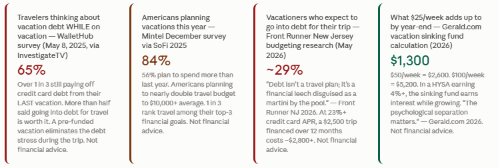
65% of travelers think about vacation debt while actually on vacation (WalletHub May 2025). Over 1 in 3 still paying off credit card debt from last vacation (WalletHub 2025). 84% of Americans planning at least one overnight vacation (Mintel via SoFi 2025). Americans planning to double travel budget to $10,000+ average (Fidelity National Financial unit via SoFi 2025). Nearly 29% expect to go into debt for their vacation (Front Runner NJ 2026).
Check debt minimum payments first — can you cover them all comfortably? If yes: check emergency fund status. If you have 1-3 months of expenses covered: you can begin a vacation sinking fund. If not: the emergency fund comes first, then the vacation fund.
The single most expensive vacation-budgeting mistake: booking first and budgeting second. WalletHub Managing Editor John Kiernan specifically identified this as a primary driver of vacation debt: 'Oftentimes you'll kind of get coaxed into spending more than you would like or you just don't think through it very well.' Decide on a total vacation budget before you look at a single booking.
Run your actual budget against both frameworks. On your after-tax monthly income: allocate 50% to needs, then 20% to debt + savings. Whatever is left in the 30% discretionary bucket is the maximum monthly contribution to your vacation fund. In the 70/10/10/10 model: 10% to personal goals is the maximum, with 10% still going to debt repayment. The 20% of 50/30/20 should cover BOTH savings and debt repayment. If your minimum debt payments already consume most of the 20%, the vacation fund will be small — and that is mathematically appropriate given your situation. The goal is to make progress on both, not to fund the vacation at the expense of debt repayment.
Vacation budget calculation: (flights + accommodation + food budget + activities + buffer 15%) = total trip cost. Total trip cost ÷ months until departure = monthly savings target. Monthly savings target ÷ paydays per month = per-payday automatic transfer amount. Set the transfer. Adjust the trip if the number is too large.
The NerdWallet case study identifies a critical note: also 'leave a cushion in that vacation budget for unforeseen expenses.' Most vacation overspending happens not on the fixed costs but on the variable ones — the restaurant that was better than expected, the activity that was not in the plan, the souvenir. Budget 10-15% above your estimated total.
After the vacation: redirect the exact same automatic transfer amount — same payday, same amount — from the vacation sinking fund account to your debt paydown strategy. If the transfer was $150/payday to the vacation fund, make it $150/payday to the highest-interest debt account. Same habit. Different destination. When you return from vacation, the single most expensive decision is to take a break from your debt paydown momentum. The month after a pre-funded vacation is psychologically the right time to accelerate, not pause. Maintain the transfer.
No — and this is the most important boundary in the whole framework. The vacation fund should come from the discretionary (wants) portion of your budget, never from the debt repayment or savings allocation. Gerald.com's 2026 framework is explicit: 'Travel is a want, not a need, and it should never crowd out debt repayment or emergency savings.' The NerdWallet case study of a couple with $64,000 in debt puts the decision framework clearly: understand how much you need to contribute monthly to meet your debt paydown deadline, then see if there is anything left for a vacation fund. If the numbers genuinely do not work, focusing only on debt is the right answer for now — not forever.
What is a sinking fund and how do I start one for a vacation?
A sinking fund is a dedicated savings account for a specific, planned future expense. Crosswalk's April 2026 guide defines it as: 'a dedicated savings account used to save for a specific event or large purchase that you know will happen in the future.' For a vacation: open a separate high-yield savings account, name it ('Summer 2027 Trip'), and set up an automatic transfer from your checking account on every payday. The amount is your vacation total divided by the number of months until the trip divided by your monthly paydays. Gerald.com notes: $25/week = $1,300 by year-end. $50/week = $2,600. Keep it separate from your emergency fund — they serve different purposes.
How much should I budget for a vacation while in debt?
The budget should come from your wants allocation only — never from debt repayment or savings. In the 50/30/20 framework, that means the vacation fund comes from the 30% discretionary allocation, after needs (50%) and debt/savings (20%) are fully funded. Front Runner New Jersey's 2026 guidance is clear: 'Set a vacation cap. What you don't do is force it with debt.' In the 70/10/10/10 framework, 10% of after-tax income is the maximum for personal goals including travel. The honest answer: if your discretionary budget after needs and debt service is very small, the vacation will be correspondingly modest — and that is the right answer, not a reason to add debt.
Is it worth going into debt for a vacation?
WalletHub's 2025 survey found that more than half of travelers said going into debt for travel is worth it. That is their assessment. The financial data complicates the feeling: 65% of those same travelers think about the debt while they are on the trip, and 1 in 3 are still paying off last year's vacation debt. Front Runner New Jersey's framing is blunt: 'Debt isn't a travel plan; it's a financial leech disguised as a martini by the pool.' The 23%+ average credit card APR in 2026 means a $2,500 trip charged to credit and paid off over 12 months costs approximately $2,800. The sinking fund approach costs the trip amount only, plus the minimal interest difference from earning 4%+ APY on the savings. The math strongly favours the sinking fund.
What should I do financially when I get back from vacation?
Crosswalk's April 2026 guide provides the most actionable post-vacation instruction: 'Immediately pivot and use those same automatic contributions to pay down the debt as quickly as you can.' The mechanism that built the vacation fund — automatic transfer, regular cadence, dedicated account — works identically for debt paydown. Direct the exact same payday transfer amount to your highest-interest debt. The month after a pre-funded vacation is the optimal moment to accelerate debt repayment: the habit is established, the emotional benefit of the trip is fresh, and there is no new travel debt creating psychological drag.
Here is the conversation that plays out in millions of households every spring. You are working through debt — credit cards, a car loan, a personal loan, student debt. You are making progress. You are proud of that progress. And then someone mentions a trip. Or you see a destination online. Or you simply feel the weight of twelve months of discipline and think: I deserve something to look forward to. You are right. You do. The question is how to have it without undoing the progress, without coming home to a financial hangover that takes twelve months to work through before the next trip is even on the horizon. WalletHub’s 2025 survey found that 65% of travelers think about their vacation debt while they are actually on the vacation. That is not a holiday. That is a financed obligation with a beach backdrop. This article is a practical, step-by-step guide to building a vacation sinking fund while staying committed to debt paydown — a framework that lets you do both without either suffering. The strategy comes from sources including WalletHub, Gerald.com, Crosswalk, NerdWallet, SoFi/Mintel, and Front Runner NJ.
Table of Contents
- Why Travel Debt Is the Vacation Ruiner Nobody Talks About
- Step 1 The Non-Negotiable First Move: Know Your Debt Minimums and Emergency Fund Status
- Step 2 Choose Your Budgeting Framework: 50/30/20 or 70/10/10/10
- Step 3 Open the Vacation Sinking Fund: The Psychological Separation That Works
- Step 4 Work Backwards from the Total Trip Cost to the Monthly Number
- Step 5 The Pivot: Using the Same Mechanism to Accelerate Debt Paydown
- The Complete Vacation Budget Builder: All the Numbers in One Place
- UK Readers: Adapting the Framework
- Conclusion: The Pre-Funded Vacation Is the Only One That Actually Relaxes You
- Frequently Asked Questions
Why Travel Debt Is the Vacation Ruiner Nobody Talks About
The travel industry is exceptionally good at selling the destination and quietly ignoring the financial aftermath. WalletHub’s 2025 survey data, published in May and covered by InvestigateTV and multiple local news stations, captures the scale of the problem with two statistics that belong together: 65% of travelers think about their vacation debt while they are actually travelling, and over one in three are still paying off credit card debt from their last vacation. The first number answers the second. If you funded your trip on credit and you are sitting on a beach working out how long it will take to pay down the card, you have not actually escaped. You have borrowed escape from your future self. Front Runner New Jersey’s May 2026 vacation savings guide frames it directly: ‘That’s 12 months of future income paying for a past vacation. Debt isn’t a travel plan; it’s a financial leech disguised as a martini by the pool.’ This matters especially for anyone on a debt payoff journey. SoFi’s 2025 travel survey found that 84% of Americans are planning at least one overnight vacation, and Americans are planning to nearly double their travel budget to an average of over $10,000. The pressure to travel is real. The financial cost of doing it on credit while already carrying debt is also real. This article gives you the framework to do both: make progress on debt and take a trip that does not undermine that progress.65% of travelers think about vacation debt while actually on vacation (WalletHub May 2025). Over 1 in 3 still paying off credit card debt from last vacation (WalletHub 2025). 84% of Americans planning at least one overnight vacation (Mintel via SoFi 2025). Americans planning to double travel budget to $10,000+ average (Fidelity National Financial unit via SoFi 2025). Nearly 29% expect to go into debt for their vacation (Front Runner NJ 2026).
Step 1 The Non-Negotiable First Move: Know Your Debt Minimums and Emergency Fund Status
Before a single dollar goes into a vacation sinking fund, two prior questions must be answered honestly. First: are you covering your minimum debt payments every month? Missing a minimum payment triggers penalty rates, damages your credit score, and is more expensive than any vacation will ever be. Second: do you have at least a starter emergency fund of one to three months of essential expenses? Without this, an unexpected car repair or medical bill will likely end up on a credit card at 23%+ APR — costing more than you would have saved. The NerdWallet case study of a Kansas City couple working through $64,000 in debt identifies this sequence directly: understand how much to contribute monthly to pay off debts by your deadline, build an emergency fund to prevent setbacks, then — and only then — see if it is also possible to start a vacation fund. This is not pessimism. It is arithmetic. A vacation financed on a 23% APR credit card while minimum debt payments are being made on other high-interest debt is not a vacation. It is an expensive postponement of the real financial problem.Check debt minimum payments first — can you cover them all comfortably? If yes: check emergency fund status. If you have 1-3 months of expenses covered: you can begin a vacation sinking fund. If not: the emergency fund comes first, then the vacation fund.
The single most expensive vacation-budgeting mistake: booking first and budgeting second. WalletHub Managing Editor John Kiernan specifically identified this as a primary driver of vacation debt: 'Oftentimes you'll kind of get coaxed into spending more than you would like or you just don't think through it very well.' Decide on a total vacation budget before you look at a single booking.
Step 2 Choose Your Budgeting Framework: 50/30/20 or 70/10/10/10
Two well-established budgeting frameworks apply cleanly to the debt-plus-vacation challenge. The 50/30/20 rule allocates 50% of after-tax income to needs, 30% to wants, and 20% to savings and debt repayment. Gerald.com’s 2026 travel budgeting guide identifies this as the baseline: travel is a ‘want’ and lives in the 30% bucket, never crowding out the 20% dedicated to savings and debt. For someone actively paying down significant debt, 70/10/10/10 is the stricter alternative: 70% to living expenses, 10% to savings, 10% to investments or debt repayment, and 10% to personal goals including a travel fund. Gerald.com identifies this explicitly as ‘better suited for people actively paying down debt’ because the reduced want allocation keeps debt repayment and savings funded before discretionary goals. The key principle common to both frameworks: travel is never taken from the debt repayment or savings allocation. It comes from the discretionary portion of the budget — whatever remains after needs, savings, and debt service are fully funded. If there is nothing left in the discretionary bucket, the honest answer is that the vacation needs to wait, or to be much smaller, rather than being funded on credit.Run your actual budget against both frameworks. On your after-tax monthly income: allocate 50% to needs, then 20% to debt + savings. Whatever is left in the 30% discretionary bucket is the maximum monthly contribution to your vacation fund. In the 70/10/10/10 model: 10% to personal goals is the maximum, with 10% still going to debt repayment. The 20% of 50/30/20 should cover BOTH savings and debt repayment. If your minimum debt payments already consume most of the 20%, the vacation fund will be small — and that is mathematically appropriate given your situation. The goal is to make progress on both, not to fund the vacation at the expense of debt repayment.
Step 3 Open the Vacation Sinking Fund: The Psychological Separation That Works
The sinking fund is the mechanism that transforms vacation budgeting from abstract intention to concrete accumulation. A sinking fund is a dedicated savings account used to save for a specific, known future expense. Crosswalk’s April 2026 financial guide defines it clearly: ‘A dedicated savings account used to save for a specific event or large purchase that you know will happen in the future. Here, that goal is your vacation.’ The implementation is straightforward. Open a separate high-yield savings account — separate from your emergency fund and separate from your main checking account. Name it something specific: ‘Summer 2026 Trip’ or ‘2027 Europe Fund.’ Gerald.com’s 2026 guide identifies why the naming matters: ‘The psychological separation matters.’ Money that has a name is money that is harder to accidentally spend. Set up an automatic transfer to this account on every payday. The automation is critical. Front Runner New Jersey’s vacation savings guide confirms: a HYSA earns higher interest than a traditional savings account and provides less temptation to spend due to the slight friction of accessing it. Gerald.com calculates: $25 per week in a dedicated travel fund adds up to $1,300 by year-end. $50 per week = $2,600. $100 per week = $5,200. Open a separate HYSA for the vacation fund — not a new tab in your existing bank, but a genuinely separate account. 2. Name it specifically ('Italy 2027 Fund'). 3. Calculate your payday contribution (total vacation target ÷ months until trip ÷ number of paydays per month). 4. Set up the automatic transfer for payday. Done. Do not keep your vacation sinking fund in the same account as your emergency fund. They serve different purposes and mixing them creates confusion about how much is available for each. Keep them in separate named accounts, ideally at a competitive online bank earning 4%+ APY.Step 4 Work Backwards from the Total Trip Cost to the Monthly Number
The most effective vacation budgeting approach starts with the total cost and works backwards to the monthly contribution. WalletHub Managing Editor John Kiernan stated this directly in InvestigateTV’s May 2025 coverage: once travelers know how much money they will need, they should work backwards to save up enough. The SoFi and Mintel research from 2025 found that Americans are planning to double their travel budget to an average of over $10,000. But the average masks enormous variation — a meaningful, enjoyable vacation does not require $10,000. The front runner NJ 2026 budgeting guide provides the framework: set a vacation cap that your income can support without debt, then break it down into fixed costs (flights, accommodation, travel insurance) and variable costs (dining, activities, shopping, incidentals). Build a buffer of 10-15% for unforeseen expenses — what Crosswalk’s April 2026 guide calls the ‘buffer fund’ for variable costs. Then divide the total by the number of months until departure to find the monthly target. If the monthly target exceeds what the discretionary portion of your budget allows, adjust the trip scope — shorter duration, different destination, off-peak timing — rather than reaching for credit.Vacation budget calculation: (flights + accommodation + food budget + activities + buffer 15%) = total trip cost. Total trip cost ÷ months until departure = monthly savings target. Monthly savings target ÷ paydays per month = per-payday automatic transfer amount. Set the transfer. Adjust the trip if the number is too large.
The NerdWallet case study identifies a critical note: also 'leave a cushion in that vacation budget for unforeseen expenses.' Most vacation overspending happens not on the fixed costs but on the variable ones — the restaurant that was better than expected, the activity that was not in the plan, the souvenir. Budget 10-15% above your estimated total.
Step 5 The Pivot: Using the Same Mechanism to Accelerate Debt Paydown
One of the most practically powerful insights in the vacation-while-in-debt conversation comes from Crosswalk’s April 2026 financial guide: ‘The same way you used the sinking fund to save for your vacation, immediately pivot and use those same automatic contributions to pay down the debt as quickly as you can.’ This matters because the sinking fund approach builds a behavioural habit as much as it builds a balance. By the time you return from the trip, you have already demonstrated that you can sustain a regular automatic contribution to a dedicated account. That same mechanism — automatic transfer, specific account, regular cadence — is exactly what accelerated debt repayment requires. The emotional dynamic also matters. Gerald.com identifies vacation debt as a ‘financial leech’ that persists after the trip ends. Coming home from a trip you actually paid for rather than financed on credit is qualitatively different: you start the post-vacation return to normal life with your financial position unchanged rather than worse. WalletHub’s data points to the cost of the alternative: 65% of travelers think about their vacation debt while they are actually on the trip. A pre-funded vacation is a vacation that can actually deliver the rest it is supposed to provide.After the vacation: redirect the exact same automatic transfer amount — same payday, same amount — from the vacation sinking fund account to your debt paydown strategy. If the transfer was $150/payday to the vacation fund, make it $150/payday to the highest-interest debt account. Same habit. Different destination. When you return from vacation, the single most expensive decision is to take a break from your debt paydown momentum. The month after a pre-funded vacation is psychologically the right time to accelerate, not pause. Maintain the transfer.
The Complete Vacation Budget Builder: All the Numbers in One Place
The following framework consolidates all five steps into a single practical table. Fill in your specific numbers to build your actual vacation savings plan. Not financial advice.| What to calculate | The formula | Example (illustrative) | Your number |
| Monthly after-tax income | Your take-home pay after all deductions | $4,000/month (illustrative) | $ __________ |
| 50/30/20 split — Needs (50%) | Monthly income × 50% | $2,000/month for rent, utilities, groceries, transport | $ __________ |
| 50/30/20 split — Debt + Savings (20%) | Monthly income × 20% | $800/month — covers minimum debt payments + any debt overpayment + emergency fund building | $ __________ |
| 50/30/20 split — Wants + Travel fund (30%) | Monthly income × 30% | $1,200/month — vacation fund comes from here, never from the 20% | $ __________ |
| Vacation total target | Flights + hotel + food budget + activities + 15% buffer | $2,500 trip total (illustrative, not $10,000 average if in debt paydown) | $ __________ |
| Monthly vacation savings needed | Vacation total ÷ months until trip | $2,500 ÷ 10 months = $250/month | $ __________ |
| Per-payday automatic transfer | Monthly vacation savings ÷ number of paydays/month | $250 ÷ 2 paydays = $125 per payday | $ __________ |
| What remains in wants (30%) after vacation savings | Wants budget minus monthly vacation savings | $1,200 - $250 = $950/month for all other wants | $ __________ |
| Post-trip pivot — redirect to debt | Same per-payday transfer → debt overpayment instead | $125/payday → highest-interest debt instead of vacation fund | $ __________ |
UK Readers: Adapting the Framework
The same strategy applies to UK readers with minor adjustments for different financial infrastructure. The sinking fund mechanism is identical: open a dedicated easy-access cash ISA or high-yield savings account for the vacation fund, name it specifically, and set up a standing order on payday. UK competitive easy-access savings and cash ISA rates in 2026 are 4.5%-5.0%+ from online providers — use these rather than a high-street savings account earning 0.5%-1.5%. The ISA wrapper means the interest is tax-free up to your £20,000 annual allowance, which is particularly relevant if you are also earning interest on emergency fund and debt-repayment savings. The UK credit card average APR in 2026 is approximately 23%+ — the same as the US, and equally expensive as a vacation funding mechanism. The 50/30/20 framework applies directly in GBP. The one UK-specific consideration: if you have a 0% balance transfer credit card as part of your debt management strategy, check whether there is a purchase facility as well and whether using it for travel bookings (flights, accommodation) would disrupt your 0% deal. In most cases, purchase and balance transfer are separate, but verify with your card provider before booking.Conclusion
WalletHub’s data is the most honest summary of why the pre-funded vacation matters: 65% of travelers are thinking about their vacation debt while they are on the vacation they funded with that debt. That is not rest. That is not restoration. That is a deferred financial problem with sunscreen on. The five-step framework in this article — debt minimums first, framework-based budgeting, the vacation sinking fund, backwards-calculated monthly targets, and the post-trip pivot — is not a complicated system. It is a specific sequence of decisions made once, automated, and then left to run. $25 per week, as Gerald.com’s 2026 guide notes, adds up to $1,300 by year-end. $50 per week: $2,600. These are real, meaningful trips for households who build toward them rather than charge them. Crosswalk’s April 2026 guidance captures the full arc: save for the trip in the sinking fund, take the trip without debt, come home and immediately redirect those same automatic transfers to debt paydown. The same habit, twice in sequence. The discipline that funded the vacation and the discipline that eliminates the debt are not different things. They are the same financial behaviour pointed at different targets.Frequently Asked Questions
Should I pause my debt repayment to save for a vacation?No — and this is the most important boundary in the whole framework. The vacation fund should come from the discretionary (wants) portion of your budget, never from the debt repayment or savings allocation. Gerald.com's 2026 framework is explicit: 'Travel is a want, not a need, and it should never crowd out debt repayment or emergency savings.' The NerdWallet case study of a couple with $64,000 in debt puts the decision framework clearly: understand how much you need to contribute monthly to meet your debt paydown deadline, then see if there is anything left for a vacation fund. If the numbers genuinely do not work, focusing only on debt is the right answer for now — not forever.
What is a sinking fund and how do I start one for a vacation?
A sinking fund is a dedicated savings account for a specific, planned future expense. Crosswalk's April 2026 guide defines it as: 'a dedicated savings account used to save for a specific event or large purchase that you know will happen in the future.' For a vacation: open a separate high-yield savings account, name it ('Summer 2027 Trip'), and set up an automatic transfer from your checking account on every payday. The amount is your vacation total divided by the number of months until the trip divided by your monthly paydays. Gerald.com notes: $25/week = $1,300 by year-end. $50/week = $2,600. Keep it separate from your emergency fund — they serve different purposes.
How much should I budget for a vacation while in debt?
The budget should come from your wants allocation only — never from debt repayment or savings. In the 50/30/20 framework, that means the vacation fund comes from the 30% discretionary allocation, after needs (50%) and debt/savings (20%) are fully funded. Front Runner New Jersey's 2026 guidance is clear: 'Set a vacation cap. What you don't do is force it with debt.' In the 70/10/10/10 framework, 10% of after-tax income is the maximum for personal goals including travel. The honest answer: if your discretionary budget after needs and debt service is very small, the vacation will be correspondingly modest — and that is the right answer, not a reason to add debt.
Is it worth going into debt for a vacation?
WalletHub's 2025 survey found that more than half of travelers said going into debt for travel is worth it. That is their assessment. The financial data complicates the feeling: 65% of those same travelers think about the debt while they are on the trip, and 1 in 3 are still paying off last year's vacation debt. Front Runner New Jersey's framing is blunt: 'Debt isn't a travel plan; it's a financial leech disguised as a martini by the pool.' The 23%+ average credit card APR in 2026 means a $2,500 trip charged to credit and paid off over 12 months costs approximately $2,800. The sinking fund approach costs the trip amount only, plus the minimal interest difference from earning 4%+ APY on the savings. The math strongly favours the sinking fund.
What should I do financially when I get back from vacation?
Crosswalk's April 2026 guide provides the most actionable post-vacation instruction: 'Immediately pivot and use those same automatic contributions to pay down the debt as quickly as you can.' The mechanism that built the vacation fund — automatic transfer, regular cadence, dedicated account — works identically for debt paydown. Direct the exact same payday transfer amount to your highest-interest debt. The month after a pre-funded vacation is the optimal moment to accelerate debt repayment: the habit is established, the emotional benefit of the trip is fresh, and there is no new travel debt creating psychological drag.
0 Comments
Be the first to share your thoughts on this article.