
Budgeting
What the Autumn Budget 2026 Means for 2027-28 and Beyond

Budget date: 28 October 2026. New Chancellor: John Healey. New PM: Andy Burnham (July 2026). Fiscal headroom almost gone. Tax-to-GDP already at record trajectory. The constraints are clear. The questions are not.
This article was written before the Autumn Budget on 28 October 2026. It covers the confirmed pre-Budget announcements already made by the Burnham government, the fiscal context Healey inherits, the legacy measures from Reeves’ 2025 Budget that are already in effect, and what the pre-Budget commentary from BDO, ii.co.uk, Coutts, Which.co.uk, London Loves Business, Cambridge Network, and others identifies as the most likely directions for 2027-28 and beyond. Andy Burnham became Prime Minister on 20 July 2026. John Healey was appointed Chancellor the same day. Within eleven days, the Budget date was set for 28 October — four weeks earlier in the year than the 2025 Budget. The government’s stated priority is ‘breathing space’ for households. The fiscal reality is that the room to provide it is very limited. That tension is what Budget 2026 will try to resolve.
Budget date: 28 October 2026 (confirmed, AccountingWeb July 31, 2026). PM: Andy Burnham, appointed 20 July 2026. Chancellor: John Healey, appointed 20 July 2026. Pre-Budget confirmed: VAT removed from electricity bills Oct 2026-Mar 2027 (~£45/year saving per household); £2 bus cap; 20% business rates cut for pubs/clubs/live music from April 2027; English mayors to receive income tax share from 2028 (Which.co.uk/AccountingWeb).
UK national debt at highest since the 1960s (Newsar July 2026). More than half of fiscal headroom gone since March 2026 (Cambridge Network October 2026). Tax as % of GDP on path to 38% by 2029-30 under Reeves measures (OBR). Burnham committed to no increase in income tax, NIC, or VAT headline rates (BDO; Coutts).
Reeves 2025 Budget (November 26, 2025): £26bn tax-raising; income tax thresholds frozen to 2030-31; CGT 10%→18% lower, 20%→24% higher; employer NIC 13.8%→15% from April 2025; BADR 14% (April 2025)→18% (April 2026); IHT pensions from April 2027; tax-to-GDP 38.3% by 2030-31 (OBR).
CGT: further alignment with income tax widely expected (ii.co.uk; London Loves Business October 2026). Personal allowance: potential revision flagged by Burnham during campaign (Which.co.uk). Welfare: cuts expected (Burnham signalling). Defence spending: near-certain increase (BDO October 2026). Regional devolution: £9bn on regional funding projects (BDO October 2026, expectation).
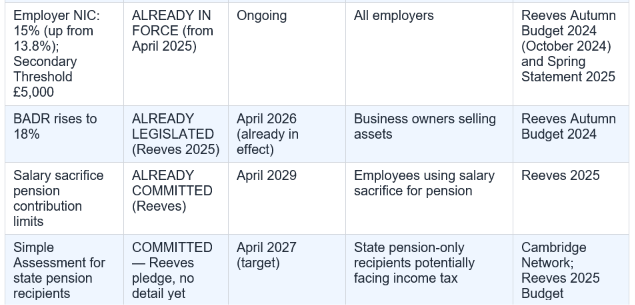
IHT on pension assets from April 2027 — already locked in from Reeves 2025 Budget. Salary sacrifice pension contribution limits from April 2029 — already committed. VAT removed from electricity bills: only confirmed October 2026 to March 2027 (AccountingWeb). Income tax thresholds frozen to 2030-31 (fiscal drag continues).
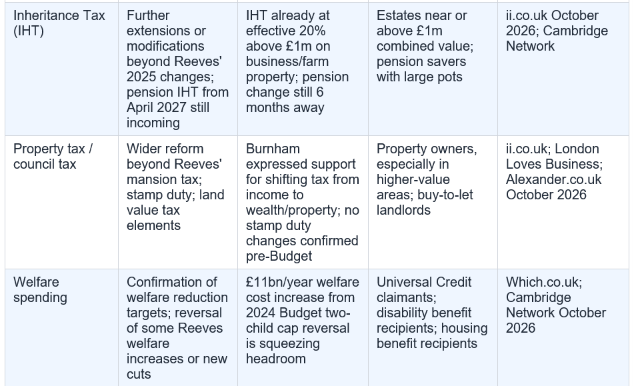
IMPORTANT: These are pre-Budget discussion areas identified in published commentary from named sources (BDO, ii.co.uk, London Loves Business, Which.co.uk, Cambridge Network, Coutts). They are not confirmed Budget announcements. Coutts specifically notes: 'Making rash decisions — like selling investments or making pension withdrawals — based on what might be announced on 28 October could backfire.
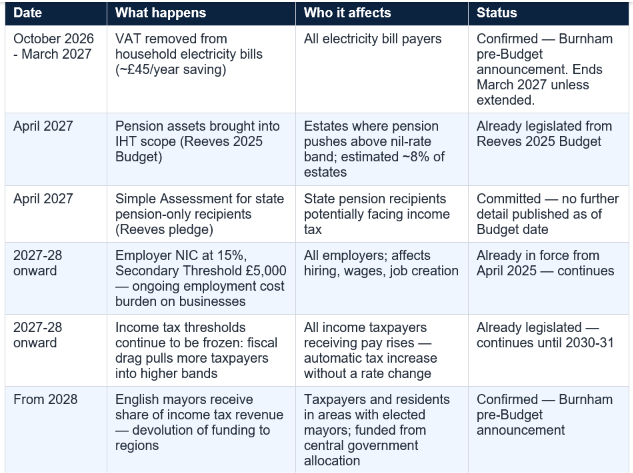
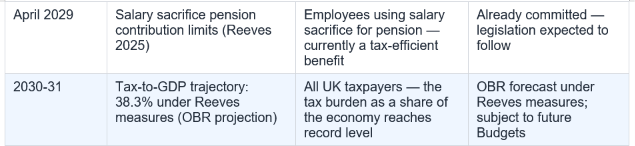
The Autumn Budget 2026 will be delivered by Chancellor John Healey on Wednesday 28 October 2026 — confirmed by Healey via video message on 31 July 2026. John Healey was appointed Chancellor on 20 July 2026 by Prime Minister Andy Burnham, who became PM on the same day after winning the Labour leadership election. This is Healey's first Budget as Chancellor. The Budget is about four weeks earlier than the 2025 Budget (26 November 2025). Sources: AccountingWeb July 31, 2026; Which.co.uk October 2026; Coutts October 2026.
What has the government already confirmed before Budget day?
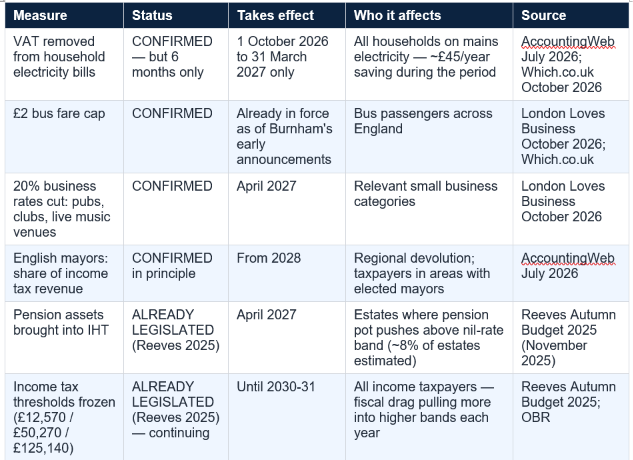
Several measures were announced before 28 October. Confirmed: VAT removed from household electricity bills from 1 October 2026 to 31 March 2027 (six months only — ~£45 per household saving; ends March 2027 unless Budget extends it); £2 bus fare cap retained; 20% business rates cut for pubs, clubs, and live music venues from April 2027; English mayors to receive a share of income tax revenue from 2028. Funded by redirecting money from 'unproductive or legacy programmes.' Sources: AccountingWeb July 2026; Which.co.uk October 2026; London Loves Business October 2026.
Will income tax, National Insurance, or VAT rates change?
Andy Burnham has committed to Labour's 2024 General Election manifesto pledge not to increase the headline rates of income tax, NIC, or VAT. Multiple sources confirm this commitment: BDO, Coutts, and Cambridge Network all note it as a binding constraint for Healey. However, this does not prevent fiscal drag from the frozen income tax thresholds (£12,570 / £50,270 / £125,140 frozen until 2030-31) from effectively increasing the tax burden each year. Source: BDO October 2026; Coutts October 2026; AccountingWeb.
What are the key tax changes already locked in for 2027-28?
Regardless of Budget 2026 outcomes, several measures from Reeves' 2025 Budget are already scheduled for 2027-28: (1) Pension assets brought into IHT scope from April 2027; (2) Simple Assessment for state pension-only recipients from April 2027 (no further detail published); (3) Employer NIC at 15% with £5,000 secondary threshold continues; (4) Income tax threshold freeze continues — fiscal drag pulling more taxpayers into higher bands; (5) From 2028 English mayors receive income tax revenue share. Not financial or tax advice — consult a qualified adviser for your specific situation.
Should I take any action before 28 October?
Coutts October 2026 is explicit: 'Making rash decisions — like selling investments or making pension withdrawals — based on what might be announced on 28 October could backfire.' ii.co.uk echoes this: 'The Budget, and all the tax talk that inevitably surrounds it, should instead be a timely reminder to focus on long-term tax planning.' The areas where pre-Budget review is widely suggested by advisers include: ensuring pension contributions are up to date given April 2027 IHT change; reviewing IHT planning if your estate is approaching or above £1m; reviewing CGT position if you hold assets with large unrealised gains; reviewing business ownership structure ahead of potential dividend tax or CGT changes.
This article was written before the Autumn Budget on 28 October 2026. It covers the confirmed pre-Budget announcements already made by the Burnham government, the fiscal context Healey inherits, the legacy measures from Reeves’ 2025 Budget that are already in effect, and what the pre-Budget commentary from BDO, ii.co.uk, Coutts, Which.co.uk, London Loves Business, Cambridge Network, and others identifies as the most likely directions for 2027-28 and beyond. Andy Burnham became Prime Minister on 20 July 2026. John Healey was appointed Chancellor the same day. Within eleven days, the Budget date was set for 28 October — four weeks earlier in the year than the 2025 Budget. The government’s stated priority is ‘breathing space’ for households. The fiscal reality is that the room to provide it is very limited. That tension is what Budget 2026 will try to resolve.
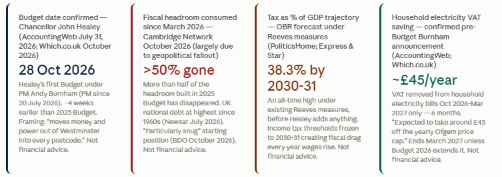
Table of Contents
- What Happened This Summer: The New Government and Its Starting Position
- The Fiscal Trap: Why Healey Has Almost No Room to Move
- What Reeves Already Changed: The Layer Healey Is Building On
- What Healey Is Expected to Announce: The Pre-Budget Intelligence
- What It Could Mean for Property, Pensions, and Savings in 2027-28
- The Pre-Budget Confirmed Changes: What You Already Know is Coming
- The Watch List: Six Tax Areas Closest to Movement
- Timeline: From Now to 2030-31 — What’s Already Locked In
- Conclusion: The Budget Nobody Has Easy Answers For
- Frequently Asked Questions
What Happened This Summer: The New Government and Its Starting Position
Before a single tax change can be understood, the political context of this Budget needs to be clear. Andy Burnham became Prime Minister on 20 July 2026, four days after being elected leader of the Labour Party. John Healey was appointed Chancellor of the Exchequer on the same day. Within eleven days, Healey had already confirmed the Budget date: Wednesday 28 October 2026, via a video message promising to ‘move money and power out of Westminster and into every postcode around Britain.’ That framing — devolution, regional power, breathing space for households — sets the tone for what Burnham and Healey want this Budget to communicate. The new government did not wait until 28 October to start spending. A handful of cost-of-living measures were announced immediately: VAT on household electricity bills removed from 1 October 2026 (for six months, October 2026 to March 2027, expected to save households around £45 per year on the Ofgem price cap); the £2 bus fare cap retained; and a 20% business rates cut for pubs, clubs, and live music venues from April 2027. From 2028, English mayors will receive a share of income tax revenue — one of Burnham’s defining constitutional commitments. These are the confirmed pre-Budget measures. They are funded, or at least committed. The challenge is that these announcements were made without confirmed revenue sources — which is exactly why 28 October matters.Budget date: 28 October 2026 (confirmed, AccountingWeb July 31, 2026). PM: Andy Burnham, appointed 20 July 2026. Chancellor: John Healey, appointed 20 July 2026. Pre-Budget confirmed: VAT removed from electricity bills Oct 2026-Mar 2027 (~£45/year saving per household); £2 bus cap; 20% business rates cut for pubs/clubs/live music from April 2027; English mayors to receive income tax share from 2028 (Which.co.uk/AccountingWeb).
The Fiscal Trap: Why Healey Has Almost No Room to Move
Every Chancellor operates within constraints. Healey’s constraints are particularly tight by recent historical standards. The UK national debt is at its highest point since the 1960s. Borrowing costs on global financial markets have risen sharply. According to Cambridge Network’s October 2026 budget preview, more than half of the fiscal headroom created in the 2025 Budget has already been consumed since March — largely due to the fallout from the Iran war. BDO’s pre-Budget analysis describes Healey’s starting position as ‘particularly snug,’ with the inherited Burnham government early announcements committing new spending without confirmed revenue. Tax as a share of GDP is already on a trajectory toward 38% by 2029-30 under the Reeves measures — an all-time high according to OBR forecasts made under the previous Chancellor. And Burnham has already committed to Labour’s 2024 General Election manifesto: no increase in income tax, NIC, or VAT headline rates. The manifesto pledge creates a tax-raising constraint at precisely the moment when the government needs revenue. This matters for 2027-28 and beyond because it means any revenue Healey raises must come from sources outside the three biggest taxes — CGT, IHT, dividend tax, property levies, wealth-adjacent taxes, and spending cuts. BDO sums it up: ‘Funding Andy Burnham’s early promises and longer-term ambitions while keeping the fiscal framework intact leaves little margin for error.UK national debt at highest since the 1960s (Newsar July 2026). More than half of fiscal headroom gone since March 2026 (Cambridge Network October 2026). Tax as % of GDP on path to 38% by 2029-30 under Reeves measures (OBR). Burnham committed to no increase in income tax, NIC, or VAT headline rates (BDO; Coutts).
What Reeves Already Changed: The Layer Healey Is Building On
John Healey’s Budget does not start from a blank page. Rachel Reeves delivered her 2025 Autumn Budget on 26 November 2025 — a £26 billion tax-raising event that the OBR described as taking tax as a share of GDP to an all-time high of 38.3% in 2030-31. Many of those changes are now baked in, already in effect, and forming the baseline from which Healey must work. The most significant carries on 2027-28 and beyond: income tax thresholds frozen until 2030-31 (personal allowance £12,570; higher rate £50,270; additional rate £125,140). This is fiscal drag in its purest form. Every year that wages rise but thresholds stay frozen, more taxpayers are pulled into higher bands without a single rate change. By 2030-31, the cumulative impact of this freeze alone will represent one of the largest stealth tax increases in recent UK history. Also carrying forward: employer NIC at 15% (up from 13.8%) with a lower secondary threshold of £5,000; CGT at 18%/24% (up from 10%/20%); BADR at 14% now and rising to 18% in April 2026; BPR changes from April 2026 capping full relief at £1m; and the pension IHT change taking effect April 2027. These inherited measures shape how 2027-28 will look regardless of what Healey announces on 28 October.Reeves 2025 Budget (November 26, 2025): £26bn tax-raising; income tax thresholds frozen to 2030-31; CGT 10%→18% lower, 20%→24% higher; employer NIC 13.8%→15% from April 2025; BADR 14% (April 2025)→18% (April 2026); IHT pensions from April 2027; tax-to-GDP 38.3% by 2030-31 (OBR).
What Healey Is Expected to Announce: The Pre-Budget Intelligence
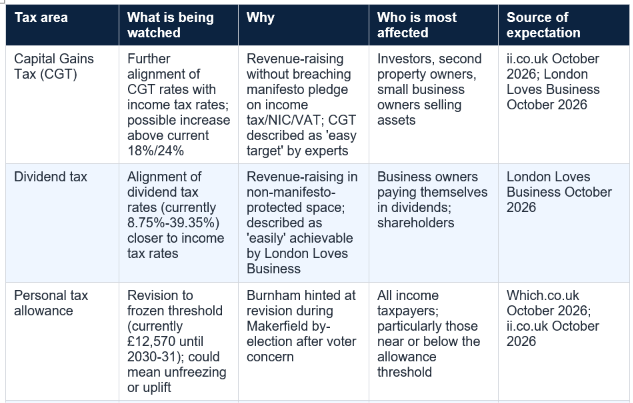
Multiple pre-Budget analyses — from BDO, ii.co.uk, London Loves Business, Coutts, and Which.co.uk — have identified the measures most widely expected or discussed ahead of 28 October. These are not confirmed. They are the product of government signalling, media reporting, and political logic. The clearest candidate for a new revenue measure is Capital Gains Tax. CGT rates were already raised by Reeves in October 2024 (10%→18% lower; 20%→24% higher), but further alignment with income tax rates has been discussed. Labour donor Dale Vince publicly called for equalisation of CGT with income tax ahead of the Budget (ii.co.uk October 2026); London Loves Business identified the current marginal dividend tax rate — 10.75% to 39.35% — as a candidate for realignment with income tax. The personal tax allowance is another area of speculation. Burnham hinted during the Makerfield by-election campaign at revising it after voters raised it as a key concern (Which.co.uk; ii.co.uk). Whether that means unfreezing from the 2030-31 horizon or a modest uplift is unknown. Welfare spending is the opposite side of the equation: Burnham has signalled cuts to the welfare bill, and Healey is expected to confirm targets. BDO also identified defence spending as a near-certainty for increase, given Healey’s background as former Defence Minister and the ongoing geopolitical context. These are pre-Budget expectations, not confirmed measures.CGT: further alignment with income tax widely expected (ii.co.uk; London Loves Business October 2026). Personal allowance: potential revision flagged by Burnham during campaign (Which.co.uk). Welfare: cuts expected (Burnham signalling). Defence spending: near-certain increase (BDO October 2026). Regional devolution: £9bn on regional funding projects (BDO October 2026, expectation).
What It Could Mean for Property, Pensions, and Savings in 2027-28
For households rather than headlines, the Budget’s impact will be felt most directly through four areas: property taxation, pensions, savings rates, and employment costs. On property: the Reeves mansion tax (high-value council tax surcharge on homes over £2 million) is already in place. Burnham has expressed support for shifting tax from income towards wealth and property, but has not confirmed specific new property measures. Council tax reform and stamp duty remain under active discussion (ii.co.uk October 2026). On pensions: the April 2027 IHT change on pension assets is already locked in from Reeves’ 2025 Budget. Anyone with a pension likely to push their estate above the nil-rate band — still frozen at £325,000 individual, £500,000 with residential nil-rate band, £1m with full spousal transfer — will be affected from April 2027 regardless of what Healey announces. The plan from 2025 to limit salary sacrifice benefits on pension contributions from April 2029 is also an existing commitment. On savings: the VAT removal on electricity bills saves around £45 per household per year, but only until March 2027. Households expecting that relief to continue beyond April 2027 should not assume it without a Budget extension. For employers: the Reeves NIC rate of 15% (from April 2025) continues. Healey would need a Budget measure specifically to reverse it, which is not expected.IHT on pension assets from April 2027 — already locked in from Reeves 2025 Budget. Salary sacrifice pension contribution limits from April 2029 — already committed. VAT removed from electricity bills: only confirmed October 2026 to March 2027 (AccountingWeb). Income tax thresholds frozen to 2030-31 (fiscal drag continues).
The Pre-Budget Confirmed Changes: What You Already Know is Coming
Some of what Budget 2026 will formalise is already in train. The following changes are either confirmed pre-Budget measures or already-legislated changes from the 2025 Budget that take effect in 2027 or later.
The Watch List: Six Tax Areas Closest to Movement on 28 October
Based on pre-Budget commentary from BDO, ii.co.uk, London Loves Business, Which.co.uk, Coutts, and others, these are the six tax areas most closely watched for Budget day announcements. These are expectations and analysis from named sources, not confirmed government plans.IMPORTANT: These are pre-Budget discussion areas identified in published commentary from named sources (BDO, ii.co.uk, London Loves Business, Which.co.uk, Cambridge Network, Coutts). They are not confirmed Budget announcements. Coutts specifically notes: 'Making rash decisions — like selling investments or making pension withdrawals — based on what might be announced on 28 October could backfire.
Timeline: From Now to 2030-31 — What’s Already Locked In
Regardless of what Healey announces on 28 October, the following measures from Reeves’ budgets are already scheduled. They affect 2027-28 and beyond regardless of Budget 2026 outcomes.
Conclusion
John Healey steps up to deliver his first Budget with less room than almost any recent Chancellor. The manifesto pledge against income tax, NIC, and VAT increases removes the three biggest revenue levers. The fiscal headroom built in the 2025 Budget has more than halved since March, partly consumed by geopolitical fallout. The government’s stated ambition — breathing space for households, power to the regions, long-term commitment on defence and social care — costs money that is genuinely difficult to find within the existing constraints. Pre-Budget commentary from BDO, ii.co.uk, London Loves Business, Cambridge Network, and Coutts converges on the same analysis: expect movement in the non-protected areas. Capital gains, dividends, property levies, and wealth-adjacent taxes are the most likely targets. Welfare spending cuts are the likely counterbalance. The personal tax allowance — frozen since 2021 in effective terms and scheduled to stay frozen until 2030-31 — has become a genuine political pressure point after Burnham raised it on the campaign trail. Whether Healey can move it while maintaining fiscal discipline is the Budget’s central tension. What is already certain, regardless of 28 October, is the landscape of 2027-28: pension IHT from April 2027, income tax threshold freeze continuing its compound fiscal drag, employer NIC at 15%, BADR at 18%. These are locked in. Budget 2026 will add to this picture, but the picture already exists. This is not financial, tax, or investment advice. Always consult a qualified UK financial adviser for guidance specific to your circumstances.Frequently Asked Questions
When is the Autumn Budget 2026 and who is delivering it?The Autumn Budget 2026 will be delivered by Chancellor John Healey on Wednesday 28 October 2026 — confirmed by Healey via video message on 31 July 2026. John Healey was appointed Chancellor on 20 July 2026 by Prime Minister Andy Burnham, who became PM on the same day after winning the Labour leadership election. This is Healey's first Budget as Chancellor. The Budget is about four weeks earlier than the 2025 Budget (26 November 2025). Sources: AccountingWeb July 31, 2026; Which.co.uk October 2026; Coutts October 2026.
What has the government already confirmed before Budget day?
Several measures were announced before 28 October. Confirmed: VAT removed from household electricity bills from 1 October 2026 to 31 March 2027 (six months only — ~£45 per household saving; ends March 2027 unless Budget extends it); £2 bus fare cap retained; 20% business rates cut for pubs, clubs, and live music venues from April 2027; English mayors to receive a share of income tax revenue from 2028. Funded by redirecting money from 'unproductive or legacy programmes.' Sources: AccountingWeb July 2026; Which.co.uk October 2026; London Loves Business October 2026.
Will income tax, National Insurance, or VAT rates change?
Andy Burnham has committed to Labour's 2024 General Election manifesto pledge not to increase the headline rates of income tax, NIC, or VAT. Multiple sources confirm this commitment: BDO, Coutts, and Cambridge Network all note it as a binding constraint for Healey. However, this does not prevent fiscal drag from the frozen income tax thresholds (£12,570 / £50,270 / £125,140 frozen until 2030-31) from effectively increasing the tax burden each year. Source: BDO October 2026; Coutts October 2026; AccountingWeb.
What are the key tax changes already locked in for 2027-28?
Regardless of Budget 2026 outcomes, several measures from Reeves' 2025 Budget are already scheduled for 2027-28: (1) Pension assets brought into IHT scope from April 2027; (2) Simple Assessment for state pension-only recipients from April 2027 (no further detail published); (3) Employer NIC at 15% with £5,000 secondary threshold continues; (4) Income tax threshold freeze continues — fiscal drag pulling more taxpayers into higher bands; (5) From 2028 English mayors receive income tax revenue share. Not financial or tax advice — consult a qualified adviser for your specific situation.
Should I take any action before 28 October?
Coutts October 2026 is explicit: 'Making rash decisions — like selling investments or making pension withdrawals — based on what might be announced on 28 October could backfire.' ii.co.uk echoes this: 'The Budget, and all the tax talk that inevitably surrounds it, should instead be a timely reminder to focus on long-term tax planning.' The areas where pre-Budget review is widely suggested by advisers include: ensuring pension contributions are up to date given April 2027 IHT change; reviewing IHT planning if your estate is approaching or above £1m; reviewing CGT position if you hold assets with large unrealised gains; reviewing business ownership structure ahead of potential dividend tax or CGT changes.
0 Comments
Be the first to share your thoughts on this article.