

Credits
How to Fix Errors in Your Credit Report: Explained

Here is a number worth sitting with: 44 million. That’s how many Americans have a verified error on at least one of their credit reports right now, according to FTC research. Not a typo somewhere buried in a footnote, but an error significant enough to affect their credit score, the interest rate they’ll pay on a car loan, whether they’ll be approved for a mortgage, or how much they’ll spend on insurance. Credit report errors are the single most common complaint filed with the Consumer Financial Protection Bureau, three years running. And yet most people have never actually looked at their report. If you’re one of them, this article is going to change that. Here’s how to get your reports for free, what to look for, how to file a dispute that actually works, and what to do when the bureau pushes back. This is Not a legal or credit advice. Please consult you leagl adviser.
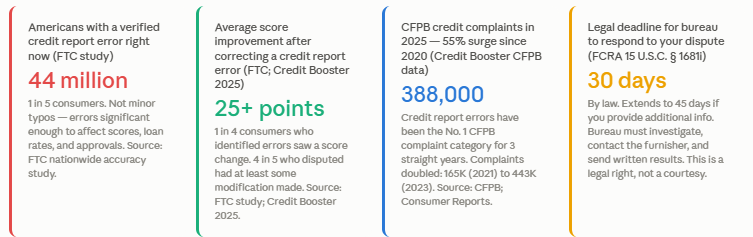
The FTC conducted one of the most comprehensive studies of credit report accuracy on record — following 1,001 nationally representative consumers as they examined their reports and navigated the dispute process. The findings were striking. One in four consumers found errors that might affect their credit scores. One in five had at least one error corrected after disputing it. Four out of five people who filed disputes had at least some modification made to their report. And 5% of consumers had errors serious enough to materially affect their credit risk classification — meaning the rate they’d be charged on a loan or whether they’d be approved at all.
The problem has grown worse, not better. Consumer complaints about credit report errors have been the No. 1 complaint to the CFPB for three consecutive years. Consumer Reports found the volume of complaints doubled from 165,129 in 2021 to 443,321 in 2023. And the bureaus have responded by increasingly using automated systems to screen disputes — meaning some people receive automated denials within hours of submitting a dispute, without any human ever reviewing their case (CFPB 2023 report, cited Consumer Reports / CLP Blog).
FTC credit report accuracy study (1,001 consumers, nationally representative): 1 in 5 consumers = 44 million Americans with at least one verified credit report error. 1 in 4 found errors that might affect their score. 4 in 5 who disputed saw some modification. 13% saw a score change. 5% had errors affecting credit terms. CFPB complaints: 388,000 credit-related in 2025 (55% surge since 2020). By bureau: Experian 142K, Equifax 128K, TransUnion 118K complaints (2025). Average score improvement after correction: 25+ points. Sources: FTC.gov; NBC News; Credit Booster/CFPB 2025 data; Consumer Reports / CLP Blog.
Consider a 30-year mortgage on a $350,000 home. The difference between a 720 credit score and a 745 score can be a quarter of a percentage point in interest rate — which translates to approximately $18,000 in additional interest over the life of the loan. On a car loan, the difference between a ‘good’ credit tier and a ‘very good’ tier can mean 2-3 percentage points in APR, adding thousands to the total cost. The 5% of consumers with errors serious enough to affect their credit risk classification are potentially paying higher rates on every credit product they carry — every month, year after year, until the error is fixed.
Errors also affect employment and housing. Many employers now run credit checks as part of hiring for positions involving financial responsibility. Landlords routinely check credit before approving rental applications. An error that makes your report look worse than it actually is can cost you a job offer or an apartment. The case for checking your report is not abstract or theoretical.
Originally, the law required one free report per bureau per year. Since the COVID-19 pandemic, AnnualCreditReport.com has offered free weekly reports from all three bureaus, and that policy has continued through 2026. This means you can pull all three reports every week for free if you choose. The practical strategy most financial advisers recommend: pull all three reports at once and compare them side by side. Because the bureaus operate independently, an error on one report may not appear on the others.
Get your free reports now: go to AnnualCreditReport.com (the ONLY federally authorized free credit report website — not credit karma, not experian.com's free tier, not any other site). Pull all three reports — Equifax, Experian, and TransUnion — at the same time. Download and save them as PDFs. You are entitled to free weekly reports from all three. This takes about 10 minutes and requires your name, address, Social Security number, and date of birth for identity verification. Source: CFPB; FTC; FCRA.
Your right: the Fair Credit Reporting Act (FCRA), 15 U.S.C. § 1681j, guarantees your right to one free credit report from each of the three major bureaus per year, regardless of any other circumstance. During and since COVID-19, AnnualCreditReport.com has expanded this to free weekly reports. You do not need to pay anything. You do not need a credit card. No company can charge you for what the law already guarantees you for free.
Personal information errors seem minor but matter more than people realise. If your Social Security number, date of birth, or address is listed incorrectly, it is a flag for potential mixed files — cases where two consumers’ credit data has been merged into a single report. Mixed files are one of the most serious types of credit report error and can result in someone else’s debt, delinquencies, or even criminal history appearing on your report. Verify every name variation, every address, and every SSN listed.
In the accounts section, go through every account listed and ask: is this mine? Is the balance correct? Is the payment history accurate? Is the account status correct (open vs closed, paid vs unpaid)? Are there duplicate entries for the same account? Is any negative information older than seven years — which under the FCRA means it should be removed? Each of these is a potential disputable error if it is wrong.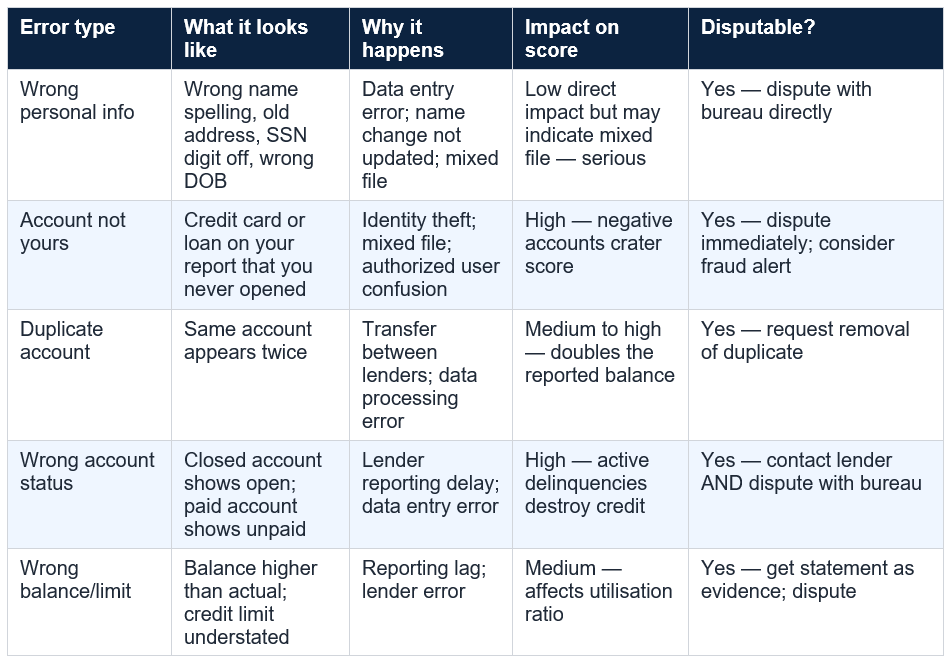
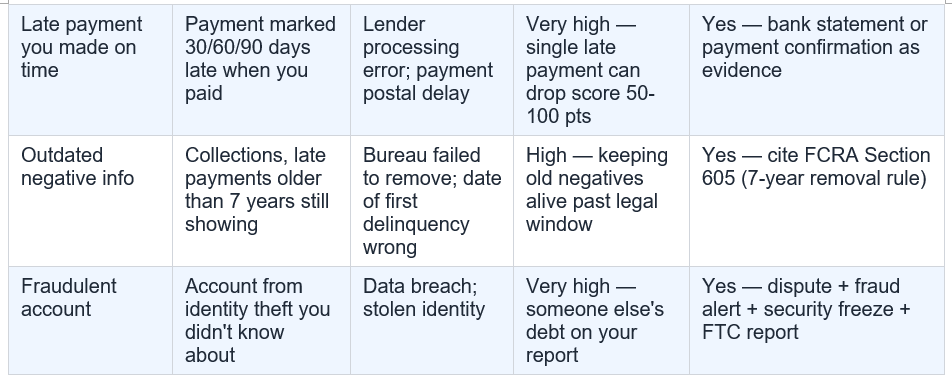
What counts as evidence depends on the type of error. For a wrong balance: a current account statement showing the correct balance. For a payment marked late: a bank statement, cancelled cheque, or electronic payment confirmation showing the payment date. For a closed account shown as open: a closure confirmation letter from the lender. For an account that isn’t yours: a written statement clearly identifying the account as not yours, combined with any supporting documentation such as your own credit card statements showing your actual accounts.
Keep copies of absolutely everything. Create a folder — physical or digital — with every document you submit and every response you receive. Date everything. If you are sending by mail, keep the postal receipt. The FCRA gives consumers legal rights in the dispute process, and if a bureau fails to meet its obligations, having a clear paper trail is what makes it possible to escalate or take legal action.
Evidence checklist by error type: Wrong balance → current account statement. Late payment dispute → bank statement + payment confirmation. Closed account shown as open → closure letter from lender. Account not yours → written statement of non-ownership + list of your actual accounts. Outdated negative item → calculate date of first delinquency; cite FCRA Section 605. Fraudulent account → FTC identity theft report (identitytheft.gov) + police report if applicable. Keep copies of everything, dated and organised.
Your dispute letter does not need to be long or complicated. It needs to clearly identify: who you are (full name, address, date of birth, last four digits of SSN); which account you are disputing and which bureau you are writing to; exactly what the error is; what the correct information is; and what you are asking the bureau to do (correct or remove the item). Attach copies — never originals — of your supporting evidence. Send by certified mail with return receipt requested. Keep your copy.
The three bureau dispute addresses you need: Equifax: Equifax Information Services LLC, P.O. Box 740256, Atlanta, GA 30374-0256. Experian: Experian, P.O. Box 4500, Allen, TX 75013. TransUnion: TransUnion LLC Consumer Dispute Center, P.O. Box 2000, Chester, PA 19016. Each has an online dispute portal too, but for significant errors, certified mail is recommended. Not legal advice.
When the bureau completes its investigation, it must send you a written notice of the results, a free updated copy of your credit report if any changes were made, and information about your right to add a consumer statement to your report if you disagree with the outcome. The average dispute resolution time at Experian has been cited as approximately 14 days (Experian PR, cited NBC News), though consumer complaint data suggests 27 days is a more common real-world average (Credit Booster 2025). Some disputes take the full 30 days.
The outcomes can be: (a) the error is confirmed and corrected or removed; (b) the bureau determines the information is accurate and the dispute is denied; (c) the information is modified but not in the way you requested. FTC data shows 4 in 5 consumers who disputed had at least some modification made. But 42% of those still had remaining errors on their report (FTC study, NBC News). Which is why the process often requires a second round. Not legal advice.
FCRA 30-day rule: under 15 U.S.C. § 1681i, a credit reporting agency must investigate your dispute within 30 days of receiving it (45 days if you provide additional information during the investigation period). It must send you written results. If the investigation results in a change, you receive a free updated credit report. If you disagree with the outcome, you have the right to add a 100-word consumer statement to your file explaining your position. These are legal rights, not courtesies. Source: FTC.gov; CFPB.
First, contact the information furnisher directly. The bureau gets its data from somewhere — a bank, a credit card company, a collection agency. That entity also has obligations under the FCRA (Section 1681s-2) to investigate disputes and correct inaccurate information. If the bureau denied your dispute because the furnisher ‘verified’ the wrong information, disputing directly with the furnisher puts the obligation back on the source.
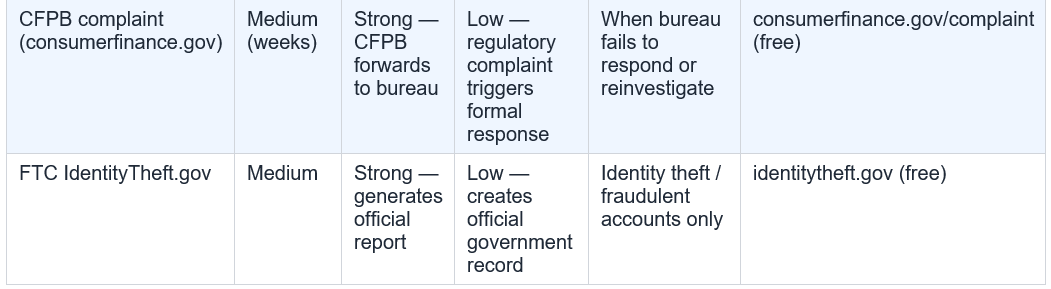
Second, file a complaint with the CFPB at consumerfinance.gov/complaint. The CFPB forwards your complaint to the bureau and requires a response, which is a qualitatively different kind of pressure than a consumer dispute. Third, consider consulting a consumer law attorney. Many handle FCRA violations on a contingency basis (no upfront cost to you) because the FCRA allows consumers to sue for actual damages, statutory damages, and attorney’s fees if a bureau wilfully fails to investigate a dispute. The threat of litigation is sometimes what finally gets a legitimate error corrected. Not legal advice.
Escalation ladder: (1) Dispute with credit bureau (certified mail, 30 days). If denied or inadequate response: (2) Dispute directly with the information furnisher (the lender/debt collector). (3) File CFPB complaint at consumerfinance.gov/complaint. (4) Add 100-word consumer statement to your file. (5) Consult a consumer law attorney (FCRA violations may be pursued on contingency — no upfront cost). (6) For identity theft: place a fraud alert and/or security freeze; file FTC report at identitytheft.gov. Source: FCRA; CFPB; FTC.
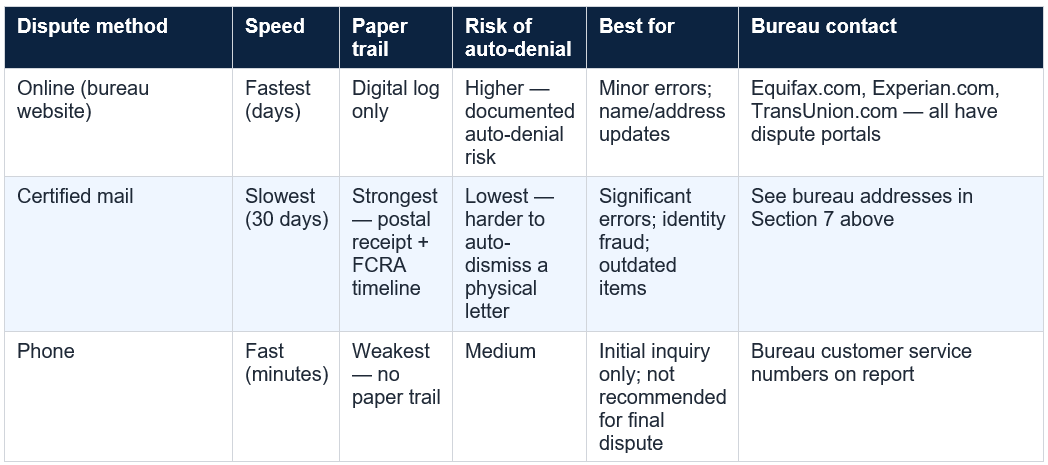
The certified mail approach creates a legal paper trail that is harder to auto-dismiss. When a dispute arrives by mail with attached documentation, it triggers the bureau’s legal obligation under the FCRA to investigate it. The 30-day clock starts when they receive it, and you have proof of delivery. For minor errors like a wrong address or name variation, the online portal is fine. For anything that materially affects your score — a fraudulent account, an erroneous late payment, an outdated derogatory item — certified mail is the right tool. The dispute method comparison table in Section 7 lays out the full picture.
The same error that exists on your Equifax report often exists on your Experian and TransUnion reports too, because the underlying data came from the same lender reporting to all three. Once you win a dispute at one bureau, repeat the same process with the other two immediately. Use the same evidence package. Cite your successful outcome with the first bureau as additional supporting context if you wish, but each bureau has to be disputed independently. Not legal advice.
One bureau does not fix all three: correcting an error at Equifax does NOT correct it at Experian or TransUnion. All three bureaus operate independently with separate databases. An error in your Equifax report typically also exists in your Experian and TransUnion reports (same lender reported to all three). After winning a dispute at one bureau, immediately file the same dispute with the other two. And once corrected, re-pull your reports in 30-45 days to confirm the correction stuck. Source: Credit Booster 2025 (bureau independence explanation); CFPB..
What you get for free: weekly credit reports from all three bureaus at AnnualCreditReport.com; the right to dispute any error directly with each bureau at no cost; the ability to file a CFPB complaint at consumerfinance.gov/complaint; an FTC identity theft report at identitytheft.gov; a free fraud alert placed with any bureau that must be forwarded to the other two; a free security freeze at each bureau. The only thing a credit repair company has that you don’t is time — and in many cases, they are simply filing the same dispute letters you could write yourself.
The red flags for credit repair scams: any company that asks for payment before providing services; any company that tells you to dispute accurate negative information; any company that creates a ‘new credit identity’ for you (this is illegal); any company that tells you not to contact the bureaus directly. If you want professional help with your credit, use a nonprofit credit counselling agency affiliated with the National Foundation for Credit Counseling (NFCC) — these services are free or low-cost and are regulated. Not legal advice.
Free tools you already have: (1) AnnualCreditReport.com — free weekly reports from all three bureaus. (2) Equifax.com, Experian.com, TransUnion.com — free online dispute portals. (3) consumerfinance.gov/complaint — free CFPB complaint filing. (4) identitytheft.gov — free FTC identity theft report. (5) Free fraud alert (contact any one bureau — must forward to other two under FCRA). (6) Free security freeze at each bureau (prevents new credit being opened in your name).
One in five Americans has a verified error on at least one credit report right now. The average score improvement after correcting an error is 25 points or more. Four in five people who dispute errors have at least some modification made. The process takes about 30 days and a few hours of your time. There is no good reason not to do it.
Start today: go to AnnualCreditReport.com, pull all three reports, go through each one carefully, and flag anything that doesn’t look right. If you find an error, gather your evidence and send a certified letter. If the bureau pushes back, escalate. Your credit report is the financial fingerprint that follows you through every major money decision of your life. It should be accurate. The law says it should be accurate. And you have every tool you need to make it so. Not legal or credit advice. Consult a nonprofit credit counsellor or consumer law attorney if you need additional help.
Go to AnnualCreditReport.com — this is the only federally authorized website for free credit reports, mandated by the Fair Credit Reporting Act. You can pull reports from all three bureaus (Equifax, Experian, and TransUnion) for free. Since COVID-19 pandemic relief measures, AnnualCreditReport.com has offered free weekly reports from all three bureaus, and this policy has continued through 2026. You will need to provide your name, address, Social Security number, and date of birth for identity verification. The process takes about 10 minutes. Download and save all three reports as PDFs. Do not use any other website claiming to offer free reports — many will sign you up for paid services or collect your data. Source: CFPB; FTC; FCRA 15 U.S.C. § 1681j. Not legal advice.
How long does a credit bureau have to respond to a dispute?
Under the Fair Credit Reporting Act (FCRA), 15 U.S.C. § 1681i, credit reporting agencies have 30 days from receipt of your dispute to investigate and respond. This extends to 45 days if you provide additional information during the investigation period. The bureau must contact the information furnisher (the lender or debt collector that reported the information), conduct a good-faith investigation, and send you written results. If any changes are made to your report, you receive a free updated credit report. If you disagree with the outcome, you have the right to add a 100-word consumer statement to your file. The average real-world resolution time is approximately 27 days per CFPB-based data (Credit Booster 2025), though Experian has cited approximately 14 days for simple disputes. Source: FTC.gov; CFPB; Credit Booster 2025. Not legal advice.
What happens if the credit bureau denies my dispute?
A denial is not the end of the road. You have several escalation options under the FCRA. (1) Dispute directly with the information furnisher (the lender, bank, or debt collector that reported the incorrect information) — they have separate FCRA obligations under Section 1681s-2. (2) File a CFPB complaint at consumerfinance.gov/complaint — the CFPB forwards this to the bureau and requires a formal response, which carries regulatory weight. (3) Add a 100-word consumer statement to your credit file explaining your position — this doesn't change the score but creates a record. (4) Consult a consumer law attorney — the FCRA allows consumers to sue for actual damages, statutory damages, and attorney's fees for wilful non-compliance. Many consumer attorneys take FCRA cases on contingency (no upfront cost). (5) Re-dispute with additional evidence. Source: FCRA; CFPB; FTC. Not legal advice.
Will fixing a credit report error actually improve my score?
It depends on the type and severity of the error, but the data shows significant outcomes are common. The FTC study found 1 in 4 consumers who identified errors saw a score change after correction. Credit Booster cites an average improvement of 25+ points when an error is corrected (citing FTC research). The most impactful errors to fix are: late payment errors (a single erroneous 30-day late mark can drop a score by 50-100 points); fraudulent or unrecognised accounts (these may show balances and delinquencies); accounts with incorrect high balances (which hurt your credit utilisation ratio); and outdated negative information that should have been removed after 7 years. Minor errors like a wrong address have minimal direct score impact. The type of error determines the magnitude of improvement. Sources: FTC study; Credit Booster 2025; CFPB. Not legal advice.
Can I dispute accurate negative information?
No — and this is an important distinction. The Fair Credit Reporting Act protects your right to accurate information, not the right to remove negative information that is accurate. If you genuinely missed a payment, that payment history belongs on your report for up to seven years. If you filed for bankruptcy, that event can remain on your report for up to ten years. Disputing accurate negative information is not only unlikely to succeed — it can be considered fraud in extreme cases, particularly if done through a credit repair company using deceptive tactics. What you CAN dispute: any information that is factually wrong (wrong dates, wrong amounts, wrong account status, accounts that aren't yours). What you cannot dispute away: accurate negative history. The FCRA is designed to ensure accuracy, not to allow removal of truthful information. Source: FCRA Section 605 (15 U.S.C. § 1681c); CFPB; FTC. Not legal advice.
Table of Contents
- Why Credit Report Errors Are More Common Than You Think
- What a Credit Report Error Actually Costs You
- Step 1: Get Your Free Credit Reports
- Step 2: Know What You’re Looking For
- The Eight Most Common Credit Report Errors
- Step 3: Gather Your Evidence
- Step 4: Write and Send Your Dispute
- Step 5: What Happens After You File
- When the Bureau Pushes Back: Escalating Your Dispute
- Dispute Method Comparison: Online vs Mail vs CFPB
- One Bureau Doesn’t Fix All Three
- What You Never Have to Pay For
- Conclusion: Your Credit Report Is Your Financial Fingerprint
- Frequently Asked Questions
Why Credit Report Errors Are More Common Than You Think
Your credit report is built from data supplied by thousands of separate lenders, debt collectors, court systems, and public record databases — all feeding information to three completely independent credit bureaus (Equifax, Experian, and TransUnion) that do not coordinate with each other. Each bureau collects data from different creditors, uses different systems to process it, and applies different algorithms to construct your report. This fragmented architecture is the fundamental reason errors are so common: no single entity owns the full picture, and mistakes in data entry, account transfers, identity mix-ups, and reporting lags accumulate over time.The FTC conducted one of the most comprehensive studies of credit report accuracy on record — following 1,001 nationally representative consumers as they examined their reports and navigated the dispute process. The findings were striking. One in four consumers found errors that might affect their credit scores. One in five had at least one error corrected after disputing it. Four out of five people who filed disputes had at least some modification made to their report. And 5% of consumers had errors serious enough to materially affect their credit risk classification — meaning the rate they’d be charged on a loan or whether they’d be approved at all.
The problem has grown worse, not better. Consumer complaints about credit report errors have been the No. 1 complaint to the CFPB for three consecutive years. Consumer Reports found the volume of complaints doubled from 165,129 in 2021 to 443,321 in 2023. And the bureaus have responded by increasingly using automated systems to screen disputes — meaning some people receive automated denials within hours of submitting a dispute, without any human ever reviewing their case (CFPB 2023 report, cited Consumer Reports / CLP Blog).
FTC credit report accuracy study (1,001 consumers, nationally representative): 1 in 5 consumers = 44 million Americans with at least one verified credit report error. 1 in 4 found errors that might affect their score. 4 in 5 who disputed saw some modification. 13% saw a score change. 5% had errors affecting credit terms. CFPB complaints: 388,000 credit-related in 2025 (55% surge since 2020). By bureau: Experian 142K, Equifax 128K, TransUnion 118K complaints (2025). Average score improvement after correction: 25+ points. Sources: FTC.gov; NBC News; Credit Booster/CFPB 2025 data; Consumer Reports / CLP Blog.
What a Credit Report Error Actually Costs You
An error on your credit report is not just an administrative inconvenience. It is a financial cost with a measurable dollar value. Credit scores determine the interest rates you are offered on mortgages, car loans, personal loans, and credit cards. A 25-point improvement in your credit score — the average result when an error is corrected, according to FTC research cited by Credit Booster — can move you from one credit tier to another, and the difference between tiers is real money.Consider a 30-year mortgage on a $350,000 home. The difference between a 720 credit score and a 745 score can be a quarter of a percentage point in interest rate — which translates to approximately $18,000 in additional interest over the life of the loan. On a car loan, the difference between a ‘good’ credit tier and a ‘very good’ tier can mean 2-3 percentage points in APR, adding thousands to the total cost. The 5% of consumers with errors serious enough to affect their credit risk classification are potentially paying higher rates on every credit product they carry — every month, year after year, until the error is fixed.
Errors also affect employment and housing. Many employers now run credit checks as part of hiring for positions involving financial responsibility. Landlords routinely check credit before approving rental applications. An error that makes your report look worse than it actually is can cost you a job offer or an apartment. The case for checking your report is not abstract or theoretical.
Step 1: Get Your Free Credit Reports
You are legally entitled to free credit reports from all three bureaus under the Fair Credit Reporting Act (FCRA). The only federally authorised website to get them is AnnualCreditReport.com. Do not use any other website that claims to offer free credit reports without strings attached — many of them sign you up for paid services or collect your personal data. AnnualCreditReport.com is the real one, mandated by federal law.Originally, the law required one free report per bureau per year. Since the COVID-19 pandemic, AnnualCreditReport.com has offered free weekly reports from all three bureaus, and that policy has continued through 2026. This means you can pull all three reports every week for free if you choose. The practical strategy most financial advisers recommend: pull all three reports at once and compare them side by side. Because the bureaus operate independently, an error on one report may not appear on the others.
Get your free reports now: go to AnnualCreditReport.com (the ONLY federally authorized free credit report website — not credit karma, not experian.com's free tier, not any other site). Pull all three reports — Equifax, Experian, and TransUnion — at the same time. Download and save them as PDFs. You are entitled to free weekly reports from all three. This takes about 10 minutes and requires your name, address, Social Security number, and date of birth for identity verification. Source: CFPB; FTC; FCRA.
Your right: the Fair Credit Reporting Act (FCRA), 15 U.S.C. § 1681j, guarantees your right to one free credit report from each of the three major bureaus per year, regardless of any other circumstance. During and since COVID-19, AnnualCreditReport.com has expanded this to free weekly reports. You do not need to pay anything. You do not need a credit card. No company can charge you for what the law already guarantees you for free.
Step 2: Know What You’re Looking For
Most people look at their credit reports the way they look at a utility bill — a wall of numbers and account references that they assume is probably correct. But your credit report is a complex document built from dozens of separate data feeds, and the only way to catch errors is to go through it methodically. There are four main sections to examine: personal information, accounts (both open and closed), public records, and inquiries.Personal information errors seem minor but matter more than people realise. If your Social Security number, date of birth, or address is listed incorrectly, it is a flag for potential mixed files — cases where two consumers’ credit data has been merged into a single report. Mixed files are one of the most serious types of credit report error and can result in someone else’s debt, delinquencies, or even criminal history appearing on your report. Verify every name variation, every address, and every SSN listed.
In the accounts section, go through every account listed and ask: is this mine? Is the balance correct? Is the payment history accurate? Is the account status correct (open vs closed, paid vs unpaid)? Are there duplicate entries for the same account? Is any negative information older than seven years — which under the FCRA means it should be removed? Each of these is a potential disputable error if it is wrong.
The Eight Most Common Credit Report Errors
Step 3: Gather Your Evidence
The single most important thing you can do to win a credit report dispute is to gather evidence before you file it. A dispute without evidence is easy for a bureau to dismiss in its automated system — and as documented by the CFPB’s 2023 report, some disputes are being denied within hours without meaningful human review. Evidence transforms your dispute from a bare assertion into a documented claim that requires a genuine response.What counts as evidence depends on the type of error. For a wrong balance: a current account statement showing the correct balance. For a payment marked late: a bank statement, cancelled cheque, or electronic payment confirmation showing the payment date. For a closed account shown as open: a closure confirmation letter from the lender. For an account that isn’t yours: a written statement clearly identifying the account as not yours, combined with any supporting documentation such as your own credit card statements showing your actual accounts.
Keep copies of absolutely everything. Create a folder — physical or digital — with every document you submit and every response you receive. Date everything. If you are sending by mail, keep the postal receipt. The FCRA gives consumers legal rights in the dispute process, and if a bureau fails to meet its obligations, having a clear paper trail is what makes it possible to escalate or take legal action.
Evidence checklist by error type: Wrong balance → current account statement. Late payment dispute → bank statement + payment confirmation. Closed account shown as open → closure letter from lender. Account not yours → written statement of non-ownership + list of your actual accounts. Outdated negative item → calculate date of first delinquency; cite FCRA Section 605. Fraudulent account → FTC identity theft report (identitytheft.gov) + police report if applicable. Keep copies of everything, dated and organised.
Step 4: Write and Send Your Dispute
You have three ways to dispute a credit report error: online through the bureau’s website, by mail, or by phone. Consumer attorneys and the CFPB both generally recommend certified mail for significant disputes, because it creates a paper trail that is legally harder to dismiss and provides proof of delivery. The automated systems that have been documented denying online disputes within hours are less likely to automatically dismiss a physical letter with attached documentation.Your dispute letter does not need to be long or complicated. It needs to clearly identify: who you are (full name, address, date of birth, last four digits of SSN); which account you are disputing and which bureau you are writing to; exactly what the error is; what the correct information is; and what you are asking the bureau to do (correct or remove the item). Attach copies — never originals — of your supporting evidence. Send by certified mail with return receipt requested. Keep your copy.
The three bureau dispute addresses you need: Equifax: Equifax Information Services LLC, P.O. Box 740256, Atlanta, GA 30374-0256. Experian: Experian, P.O. Box 4500, Allen, TX 75013. TransUnion: TransUnion LLC Consumer Dispute Center, P.O. Box 2000, Chester, PA 19016. Each has an online dispute portal too, but for significant errors, certified mail is recommended. Not legal advice.
Step 5: What Happens After You File
Under the Fair Credit Reporting Act (FCRA), credit bureaus have 30 days from receipt of your dispute to investigate and respond. The bureau must contact the information furnisher — the lender, debt collector, or other entity that reported the information — and ask them to verify it. The furnisher has a parallel obligation under the FCRA to respond truthfully and to correct inaccurate information.When the bureau completes its investigation, it must send you a written notice of the results, a free updated copy of your credit report if any changes were made, and information about your right to add a consumer statement to your report if you disagree with the outcome. The average dispute resolution time at Experian has been cited as approximately 14 days (Experian PR, cited NBC News), though consumer complaint data suggests 27 days is a more common real-world average (Credit Booster 2025). Some disputes take the full 30 days.
The outcomes can be: (a) the error is confirmed and corrected or removed; (b) the bureau determines the information is accurate and the dispute is denied; (c) the information is modified but not in the way you requested. FTC data shows 4 in 5 consumers who disputed had at least some modification made. But 42% of those still had remaining errors on their report (FTC study, NBC News). Which is why the process often requires a second round. Not legal advice.
FCRA 30-day rule: under 15 U.S.C. § 1681i, a credit reporting agency must investigate your dispute within 30 days of receiving it (45 days if you provide additional information during the investigation period). It must send you written results. If the investigation results in a change, you receive a free updated credit report. If you disagree with the outcome, you have the right to add a 100-word consumer statement to your file explaining your position. These are legal rights, not courtesies. Source: FTC.gov; CFPB.
When the Bureau Pushes Back: Escalating Your Dispute
What do you do when the bureau denies your dispute, or completes its investigation but the error is still there? You escalate. The dispute process does not end with the bureau’s first response, and the FCRA gives you specific tools for escalation.First, contact the information furnisher directly. The bureau gets its data from somewhere — a bank, a credit card company, a collection agency. That entity also has obligations under the FCRA (Section 1681s-2) to investigate disputes and correct inaccurate information. If the bureau denied your dispute because the furnisher ‘verified’ the wrong information, disputing directly with the furnisher puts the obligation back on the source.
Second, file a complaint with the CFPB at consumerfinance.gov/complaint. The CFPB forwards your complaint to the bureau and requires a response, which is a qualitatively different kind of pressure than a consumer dispute. Third, consider consulting a consumer law attorney. Many handle FCRA violations on a contingency basis (no upfront cost to you) because the FCRA allows consumers to sue for actual damages, statutory damages, and attorney’s fees if a bureau wilfully fails to investigate a dispute. The threat of litigation is sometimes what finally gets a legitimate error corrected. Not legal advice.
Escalation ladder: (1) Dispute with credit bureau (certified mail, 30 days). If denied or inadequate response: (2) Dispute directly with the information furnisher (the lender/debt collector). (3) File CFPB complaint at consumerfinance.gov/complaint. (4) Add 100-word consumer statement to your file. (5) Consult a consumer law attorney (FCRA violations may be pursued on contingency — no upfront cost). (6) For identity theft: place a fraud alert and/or security freeze; file FTC report at identitytheft.gov. Source: FCRA; CFPB; FTC.
Dispute Method Comparison: Online vs Mail vs CFPB
The method you use to dispute matters. Consumer advocates and the CFPB’s own reporting have documented that online dispute portals are increasingly processed through automated systems, and that some disputes are dismissed within hours without meaningful human review. This was confirmed in the CFPB’s 2023 report on credit report errors, cited extensively by Consumer Reports: ‘According to consumer complaints made to the CFPB, some people received automated denials of their disputes within hours.’The certified mail approach creates a legal paper trail that is harder to auto-dismiss. When a dispute arrives by mail with attached documentation, it triggers the bureau’s legal obligation under the FCRA to investigate it. The 30-day clock starts when they receive it, and you have proof of delivery. For minor errors like a wrong address or name variation, the online portal is fine. For anything that materially affects your score — a fraudulent account, an erroneous late payment, an outdated derogatory item — certified mail is the right tool. The dispute method comparison table in Section 7 lays out the full picture.
One Bureau Doesn’t Fix All Three
This is the mistake that costs people the most time and frustration. When you dispute an error with Equifax and it is corrected, that correction does not automatically carry over to Experian or TransUnion. The three bureaus operate completely independently — they collect data from different creditors, maintain separate databases, and do not share dispute outcomes.The same error that exists on your Equifax report often exists on your Experian and TransUnion reports too, because the underlying data came from the same lender reporting to all three. Once you win a dispute at one bureau, repeat the same process with the other two immediately. Use the same evidence package. Cite your successful outcome with the first bureau as additional supporting context if you wish, but each bureau has to be disputed independently. Not legal advice.
One bureau does not fix all three: correcting an error at Equifax does NOT correct it at Experian or TransUnion. All three bureaus operate independently with separate databases. An error in your Equifax report typically also exists in your Experian and TransUnion reports (same lender reported to all three). After winning a dispute at one bureau, immediately file the same dispute with the other two. And once corrected, re-pull your reports in 30-45 days to confirm the correction stuck. Source: Credit Booster 2025 (bureau independence explanation); CFPB..
What You Never Have to Pay For
Let’s be very clear about this, because a large industry exists to exploit the confusion. You do not need to pay a credit repair company to dispute errors on your credit report. Everything that a credit repair company does, you can do yourself, for free, using the tools the law already gives you. The FTC’s guidance is explicit on this, and the CFPB echoes it.What you get for free: weekly credit reports from all three bureaus at AnnualCreditReport.com; the right to dispute any error directly with each bureau at no cost; the ability to file a CFPB complaint at consumerfinance.gov/complaint; an FTC identity theft report at identitytheft.gov; a free fraud alert placed with any bureau that must be forwarded to the other two; a free security freeze at each bureau. The only thing a credit repair company has that you don’t is time — and in many cases, they are simply filing the same dispute letters you could write yourself.
The red flags for credit repair scams: any company that asks for payment before providing services; any company that tells you to dispute accurate negative information; any company that creates a ‘new credit identity’ for you (this is illegal); any company that tells you not to contact the bureaus directly. If you want professional help with your credit, use a nonprofit credit counselling agency affiliated with the National Foundation for Credit Counseling (NFCC) — these services are free or low-cost and are regulated. Not legal advice.
Free tools you already have: (1) AnnualCreditReport.com — free weekly reports from all three bureaus. (2) Equifax.com, Experian.com, TransUnion.com — free online dispute portals. (3) consumerfinance.gov/complaint — free CFPB complaint filing. (4) identitytheft.gov — free FTC identity theft report. (5) Free fraud alert (contact any one bureau — must forward to other two under FCRA). (6) Free security freeze at each bureau (prevents new credit being opened in your name).
Conclusion
You did not create the credit reporting system, you did not design its fragmented architecture, and you did not ask for the errors that end up in your file. But right now, your credit report is determining the interest rates you pay, the housing you can access, and the jobs you can apply for. The good news is that fixing it is genuinely within your power, it is free, and the law is firmly on your side.One in five Americans has a verified error on at least one credit report right now. The average score improvement after correcting an error is 25 points or more. Four in five people who dispute errors have at least some modification made. The process takes about 30 days and a few hours of your time. There is no good reason not to do it.
Start today: go to AnnualCreditReport.com, pull all three reports, go through each one carefully, and flag anything that doesn’t look right. If you find an error, gather your evidence and send a certified letter. If the bureau pushes back, escalate. Your credit report is the financial fingerprint that follows you through every major money decision of your life. It should be accurate. The law says it should be accurate. And you have every tool you need to make it so. Not legal or credit advice. Consult a nonprofit credit counsellor or consumer law attorney if you need additional help.
Frequently Asked Questions
How do I get my free credit reports?Go to AnnualCreditReport.com — this is the only federally authorized website for free credit reports, mandated by the Fair Credit Reporting Act. You can pull reports from all three bureaus (Equifax, Experian, and TransUnion) for free. Since COVID-19 pandemic relief measures, AnnualCreditReport.com has offered free weekly reports from all three bureaus, and this policy has continued through 2026. You will need to provide your name, address, Social Security number, and date of birth for identity verification. The process takes about 10 minutes. Download and save all three reports as PDFs. Do not use any other website claiming to offer free reports — many will sign you up for paid services or collect your data. Source: CFPB; FTC; FCRA 15 U.S.C. § 1681j. Not legal advice.
How long does a credit bureau have to respond to a dispute?
Under the Fair Credit Reporting Act (FCRA), 15 U.S.C. § 1681i, credit reporting agencies have 30 days from receipt of your dispute to investigate and respond. This extends to 45 days if you provide additional information during the investigation period. The bureau must contact the information furnisher (the lender or debt collector that reported the information), conduct a good-faith investigation, and send you written results. If any changes are made to your report, you receive a free updated credit report. If you disagree with the outcome, you have the right to add a 100-word consumer statement to your file. The average real-world resolution time is approximately 27 days per CFPB-based data (Credit Booster 2025), though Experian has cited approximately 14 days for simple disputes. Source: FTC.gov; CFPB; Credit Booster 2025. Not legal advice.
What happens if the credit bureau denies my dispute?
A denial is not the end of the road. You have several escalation options under the FCRA. (1) Dispute directly with the information furnisher (the lender, bank, or debt collector that reported the incorrect information) — they have separate FCRA obligations under Section 1681s-2. (2) File a CFPB complaint at consumerfinance.gov/complaint — the CFPB forwards this to the bureau and requires a formal response, which carries regulatory weight. (3) Add a 100-word consumer statement to your credit file explaining your position — this doesn't change the score but creates a record. (4) Consult a consumer law attorney — the FCRA allows consumers to sue for actual damages, statutory damages, and attorney's fees for wilful non-compliance. Many consumer attorneys take FCRA cases on contingency (no upfront cost). (5) Re-dispute with additional evidence. Source: FCRA; CFPB; FTC. Not legal advice.
Will fixing a credit report error actually improve my score?
It depends on the type and severity of the error, but the data shows significant outcomes are common. The FTC study found 1 in 4 consumers who identified errors saw a score change after correction. Credit Booster cites an average improvement of 25+ points when an error is corrected (citing FTC research). The most impactful errors to fix are: late payment errors (a single erroneous 30-day late mark can drop a score by 50-100 points); fraudulent or unrecognised accounts (these may show balances and delinquencies); accounts with incorrect high balances (which hurt your credit utilisation ratio); and outdated negative information that should have been removed after 7 years. Minor errors like a wrong address have minimal direct score impact. The type of error determines the magnitude of improvement. Sources: FTC study; Credit Booster 2025; CFPB. Not legal advice.
Can I dispute accurate negative information?
No — and this is an important distinction. The Fair Credit Reporting Act protects your right to accurate information, not the right to remove negative information that is accurate. If you genuinely missed a payment, that payment history belongs on your report for up to seven years. If you filed for bankruptcy, that event can remain on your report for up to ten years. Disputing accurate negative information is not only unlikely to succeed — it can be considered fraud in extreme cases, particularly if done through a credit repair company using deceptive tactics. What you CAN dispute: any information that is factually wrong (wrong dates, wrong amounts, wrong account status, accounts that aren't yours). What you cannot dispute away: accurate negative history. The FCRA is designed to ensure accuracy, not to allow removal of truthful information. Source: FCRA Section 605 (15 U.S.C. § 1681c); CFPB; FTC. Not legal advice.
0 Comments
Be the first to share your thoughts on this article.