

Insurance
How Your Financial Decisions Ripple Through Retirement

74% of Americans have at least one financial regret. The most common: not saving for retirement early enough. The second: too much credit card debt. But the thing most people miss is that these were not single bad decisions — they were small, repeated choices that compounded against them over decades. A $5 daily habit. A 1% contribution not made. A debt carried for three years instead of one. Each tiny ripple, set in motion in the 20s or 30s, becomes a financial wave felt in the 60s. This article shows exactly how those ripples work — and what you can do to make sure yours are moving in the right direction. Not financial advice.
The Last Paycheck Podcast (CFP Professionals Rob and Archie Hoxton, December 2025) frames this precisely: ‘Do tiny choices today really affect your finances in a big way in the future? The answer is yes. Really, it’s the butterfly effect, but for your finances. Compounding is not just while investing, but in every single financial choice you make in your life.’ The butterfly effect in physics describes how a small event in one place can trigger consequences of vastly disproportionate scale elsewhere. In personal finance, the small event is the daily or monthly financial decision; the disproportionate consequence arrives at retirement, three or four decades later, in the form of the retirement income you either have or do not have.
True Potential captures the generational dimension: ‘All of your financial choices will have a ripple effect that will shape the future of your finances — potentially for generations to come. Even the money invested towards the end of your career could still be growing even after you have passed.’ The ripple effect is not limited to a single lifetime. Not financial advice.
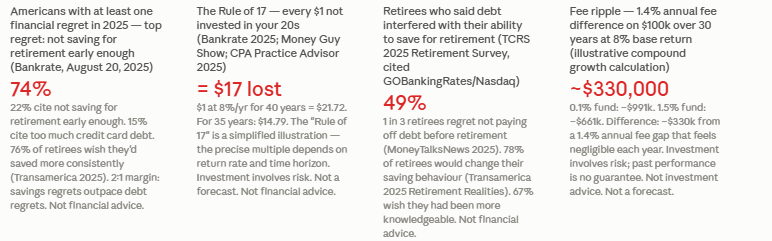
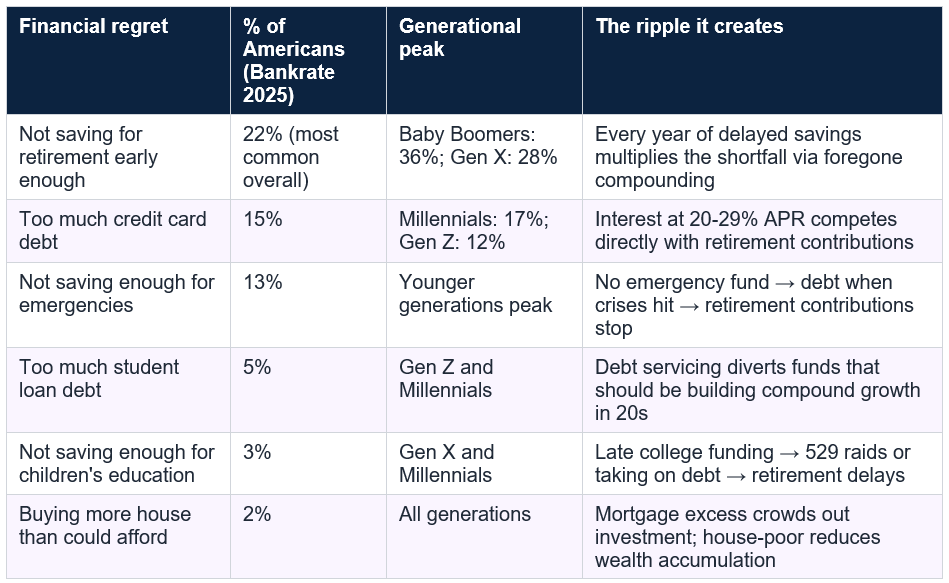
74% of Americans have a financial regret in 2025 (Bankrate Financial Regrets Survey, July 2025). Top regret: not saving for retirement early enough (22%). Second: too much credit card debt (15%). 76% of retirees wish they had saved more, done more consistently (Transamerica 2025 Retirement Realities). 78% would change their saving behaviour. 49% said debt interfered with their ability to save for retirement. 2/3 of retirees wish they had been more knowledgeable about financial planning. Sources: Bankrate August 20, 2025; Transamerica 2025 Retirement Realities (cited by MoneyTalksNews). Not financial advice.
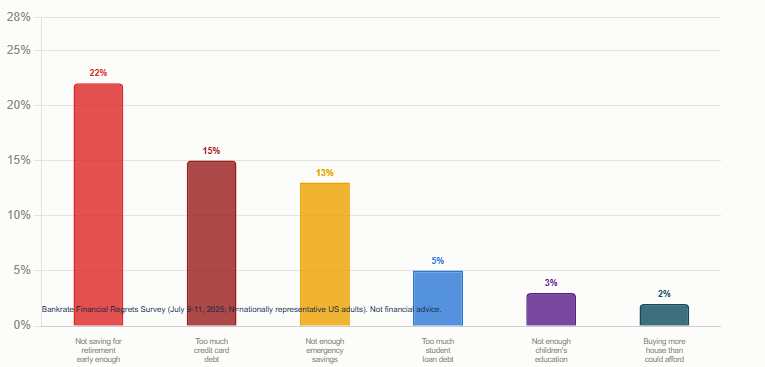
Not saving for retirement early enough leads (22%), followed by credit card debt (15%), insufficient emergency savings (13%), student loan debt (5%), children’s education savings (3%), and over-buying housing (2%). Americans are more likely to regret a lack of savings than too much debt by nearly 2 to 1 (38% vs 20%). The saving regret grows with age: it is the number one regret for both Baby Boomers (36%) and Gen Xers (28%), while Millennials and Gen Zers more evenly split their top regret between not saving early for retirement and credit card debt (both at 17% and 12% respectively).
Bankrate’s Stephen Kates (CFP) adds the practical note: ‘Having regrets doesn’t mean you can’t fix them or make improvements over time.’ The purpose of understanding the ripple effect is not to generate guilt about past decisions but to make the next decision with full awareness of its long-term shadow. Not financial advice.
The basis of the $17 multiplier: $1 invested at 8% annual growth for approximately 35–40 years produces approximately $15–22 (depending on the precise time horizon). The 8% figure reflects the approximate historical average annual real return of a diversified equity index fund after inflation. A 25-year-old who diverts $1,000 of retirement contributions into current spending does not lose $1,000 from their retirement fund. They lose $15,000–22,000, compounded over the 40 years between 25 and 65. Not a forecast; a mathematical illustration. Investment involves risk. Not financial advice.
Fritz Gilbert (The Retirement Manifesto, cited by Optimal Finance Daily, December 2024) makes the habit dimension explicit: ‘Recognize the impact your small purchases make when compounded over time. Do it long enough, aggressively enough, intentionally enough, and you will become a millionaire.’ The contribution ripple works in both directions: starting early creates a powerful positive ripple; starting late or pausing creates a negative one that arrives at retirement as a gap that no amount of catch-up contribution can fully close.
The Rule of 17 in practice: $1,000 not contributed at age 25 = $17,000 not available at retirement (illustrative, at ~8%/yr for 40 years). $5,000/year difference in contribution rate starting at 25 vs starting at 35: 10 fewer years of contributions on those dollars. Terminal value difference at 65 (8%/yr): approximately $108,000 per year of delay (FV of single sum applied to contribution). Total cost of the 10-year delay on $5,000/year: approximately $335,000 in terminal portfolio value. NOT a forecast. FV of single sum formula, illustrative. Investment involves risk. Not financial advice.
The Transamerica Center for Retirement Studies’ 2025 survey found that nearly half (49%) of respondents said debt interfered with their ability to save for retirement. One in three retirees specifically regret not paying off debt before retirement (MoneyTalksNews, citing Bankrate and Nationwide surveys 2025). The GOBankingRates/Nasdaq analysis of the Transamerica TCRS study notes: ‘Paying off debt early, and only then saving and investing, can actually result in a larger nest egg over time.’
The mathematics: the average US credit card balance is approximately $8,295 (New York Life 2025 Wealth Watch). At 22% APR, the annual interest cost is approximately $1,824. If that $1,824 per year were invested instead of paid in interest, at 8% annual growth for 20 years, it would grow to approximately $89,900. The credit card debt does not just cost $8,295; over 20 years of carrying the minimum-payment trap, the opportunity cost to retirement wealth approaches $90,000 for that single balance. This is the debt ripple. Not financial advice.
The minimum payment trap and the retirement ripple: paying only minimum payments on $8,295 of credit card debt at 22% APR extends the debt for approximately 25-30 years and generates approximately $8,000-$12,000 in total interest. All while NOT building compound retirement wealth with that annual cash flow. The dual cost: the interest paid AND the compound growth not earned. On $1,825/year (approximate interest on $8,295 at 22%) invested instead at 8%/yr for 20 years: approximately $89,900 in foregone retirement wealth. Pay off high-interest debt first -- guaranteed 22% return before any investment can match it. Not financial advice.
The daily coffee illustration is the most frequently cited version of this principle. A $5 daily coffee habit costs $1,825 per year. Invested at 8% annual growth from age 25 to age 65 (40 years), $1,825 per year produces approximately $543,000. This does not mean no-one should buy coffee. It means the real cost of that habit is not $5 per day; it is $5 per day plus its 40-year compound opportunity cost. Paul, the Finance Guy (Beehiiv), describes the hidden challenge: ‘Some expenses (like unnecessary luxuries) may feel harmless but quietly rob you of future financial flexibility.’
The PSG Financial / The 20s Trap article frames this as a generational pattern: ‘Choosing short-term gratification compromises long-term value. Not starting early means small problems can quietly compound into bigger ones.’ The antidote is not asceticism; it is intentionality. The question is not whether to spend money but whether each spending decision is made with full awareness of its compound shadow. Not financial advice.
The lifestyle ripple illustrated: $100/month in non-essential spending that could instead be invested: at 8%/yr for 40 years: approximately $349,000 in terminal value. That $100/month is not $48,000 over 40 years; it is $349,000 due to compound growth. Fritz Gilbert (Retirement Manifesto): 'Recognize the impact your small purchases make when compounded over time.' Not a forecast. FV of annuity formula. Not financial advice.
The calculation: every $100 extra per month in mortgage payment that could instead be invested at 8% annual growth for 30 years produces approximately $150,000 in foregone retirement wealth. A household that stretched to buy a house $50,000 more expensive than they needed — adding approximately $250–$300 per month to the mortgage — diverts approximately $450,000–$540,000 from their retirement portfolio over a 30-year mortgage. This is the housing ripple: not a single bad decision but a compounding monthly diversion of capital that arrives at retirement as a gap that looks unrelated to housing.
The housing ripple also affects retirement through a different mechanism: the house may be the largest asset, but it is not easily converted to income without downsizing or equity release. Many retirees are ‘house-rich and income-poor’ — holding a valuable property that does not generate the monthly income needed to support retirement. Not financial advice.
On a $100,000 portfolio at 8% base return for 30 years: the 0.1% fund (net return 7.9%) produces approximately $991,000. The 1.5% fund (net return 6.5%) produces approximately $661,000. The fee difference: approximately $330,000 in terminal portfolio value, from a 1.4% annual fee differential that felt negligible in any given year. This is the fee ripple: silent, invisible, compounding against the investor for the full duration of the investment.
The solution is simple and costs nothing: index funds with low expense ratios (Vanguard, Fidelity, iShares, Schwab all offer broad-market index funds with expense ratios of 0.03–0.20%) vs actively managed funds that typically charge 0.75–1.50%. The evidence on active vs passive management is consistent: most actively managed funds underperform their benchmark index after fees over any 10-year period. Not financial or investment advice. Individual fund selection involves individual risks.
The ripple of an unclaimed employer match: missing $1,500 per year in employer match (the approximate value of a 3% match on a $50,000 salary) at 8% annual growth for 30 years produces approximately $170,000 in foregone terminal retirement wealth. This is not investment risk; it is an administrative decision with permanent compounding consequences. The employer match was offered, the employee did not claim it, and the ripple of that decision continues to grow every year. Not financial advice.
The fix: confirm the specific matching formula with HR or payroll. Ensure your employee contribution rate is at least sufficient to trigger the full employer match. This single adjustment — often achievable by increasing contributions by 1–3% of salary — is the highest-return action available to most employed workers in any given month. Fidelity’s guideline: put at least 15% of pretax income (including employer contributions) toward retirement savings. Not financial advice.
The knowledge ripple is the meta-ripple: it is the ignorance of the other six ripples that allows them to operate undetected. The person who does not know about the fee ripple pays 1.5% in annual management fees for decades. The person who does not know about the contribution ripple delays starting their 401(k) for ten years. The person who does not know about the debt ripple carries a credit card balance at 22% APR while building a savings account at 4%. Financial illiteracy is not a moral failing; but its compound cost across a lifetime of financial decisions is, as the data shows, measured in decades of regret.
Paul, the Finance Guy (Beehiiv): ‘The tricky thing about compounding is that you often don’t know which decisions will compound and which won’t. The best strategy is to stack the odds in your favor by making consistently good decisions.’ The knowledge ripple is the one that makes all the other ripples visible in time to redirect them. Not financial advice.
PSG Financial ('The 20s Trap'): 'Not starting early means small problems can quietly compound into bigger ones. It is better to harness compound growth than to allow problems to compound. Choosing short-term gratification compromises long-term value. Building a strong foundation early on makes it far easier to manage or prevent small issues before they develop into more serious long-term challenges.' And: 'Just as maintaining your health involves making incremental changes over time, planning for a rewarding retirement starts now, even if only starting with a small amount.' Not financial advice.
The comparison below applies this framework to the seven ripples described in this article. Not financial advice. All figures illustrative; investment involves risk; not a forecast.
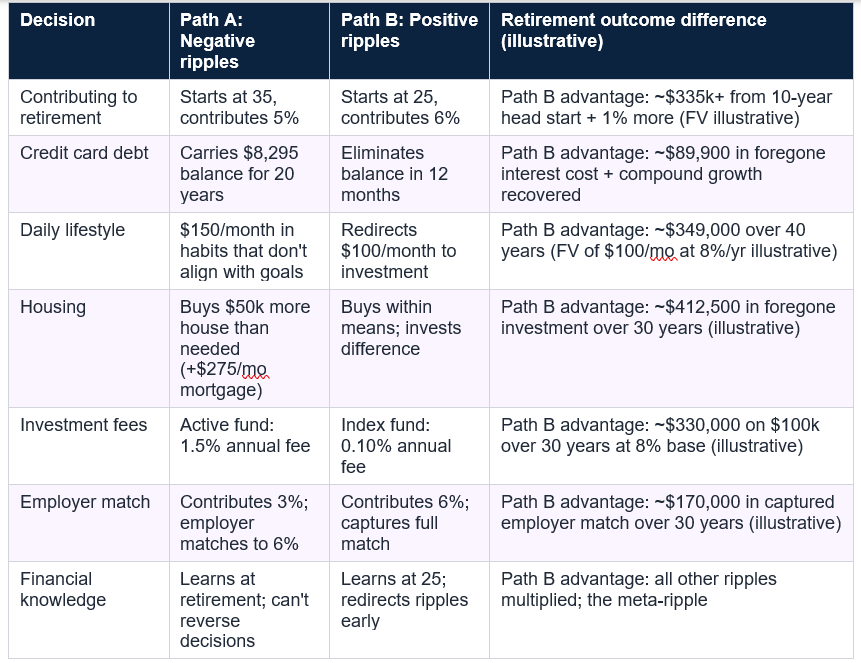
All figures are illustrative mathematical estimates using compound growth formulas at stated rates. Not forecasts or guarantees. Investment involves risk including possible loss of principal. Not financial advice.
The ripple effect is not a metaphor for carelessness. Most of the negative financial decisions reflected in Bankrate’s survey were made under pressure, without full information, or in circumstances that made the long-term consequence invisible. The purpose of understanding the ripple effect is not to generate regret about the past but to make the next decision differently. Every decision made from today forward will ripple forward. The question is: in which direction?
Fritz Gilbert (The Retirement Manifesto) captured it best: ‘One decision, early in life, compounded over many decades, has a profound impact on your long-term financial wealth.’ You cannot change the decisions already made. But every day is a new stone dropped into still water. Choose carefully. Not financial, investment, or tax advice. Consult a qualified financial adviser (CFP or FCA-registered IFA) for guidance specific to your circumstances.
The 'Rule of 17' (cited by Bankrate 2025 and the Money Guy Show) is a compound growth illustration: $1 invested at approximately 8% annual return for approximately 36-40 years grows to approximately $15-22. The commonly cited '$17' is based on specific assumptions about return rate and time horizon -- it is an illustrative multiplier, not a precise guarantee. The underlying principle is mathematically sound: compound growth exponentially magnifies the difference between money invested early and money invested late. $1,000 not contributed at age 25 (at 8%/yr to age 65) = approximately $21,720 not available at retirement -- not $1,000. Investment involves risk; returns vary and are not guaranteed. The 8% figure approximates historical average equity returns and is not a forecast. Not financial advice.
Which financial decision has the biggest ripple effect on retirement?
Based on the data, starting contributions early is the single highest-impact decision -- because time is the one input that cannot be recovered once lost. Bankrate 2025: not saving for retirement early enough is the number one financial regret (22% of all Americans; 36% of Baby Boomers). But the compound cost also depends on the size of the ripple: a high-interest debt carried for decades (credit card at 22% APR) or an unclaimed employer match (100% guaranteed return foregone) can also produce retirement gaps in the six figures. The biggest single ripple is typically the contribution decision, because it operates across the longest time horizon. Not financial advice.
Can I recover from a late start on retirement savings?
Yes -- starting late is better than not starting. The catch-up contribution provisions specifically address late starters: in 2026, US workers aged 50-59 and 63+ can contribute up to $32,000/year to a 401(k); those aged 60-63 can contribute up to $35,750 (SECURE 2.0 super catch-up). These limits allow meaningful acceleration in the final decades of a career. UK equivalent: the £60,000 annual pension allowance, plus carry-forward of unused allowance from the previous three tax years. Additionally: reducing current spending to maximise contributions during the remaining working years; eliminating any remaining debt; taking full advantage of employer matching at the current rate; and delaying retirement by two to three years (often produces significantly higher income in retirement due to additional savings AND shorter distribution period). Transamerica 2025 Retirement Realities: '78% of retirees would change their saving behavior.' Not financial advice. Consult a qualified financial adviser for a catch-up plan specific to your situation.
Does the fee ripple really matter that much?
Yes -- the fee ripple is one of the most controllable and most underestimated factors in retirement outcomes. A 1.4% annual fee difference (1.5% active fund vs 0.1% index fund) on a $100,000 portfolio growing at 8% gross for 30 years produces a $330,000 difference in terminal value. On $300,000 invested: the fee difference produces approximately $990,000 over 30 years. Fees are the most controllable variable in investment returns. Unlike market returns (which cannot be predicted), fees are known in advance and chosen by the investor. Most actively managed funds underperform their benchmark index over any 10-year period after fees (consistent finding across multiple academic studies). Low-cost index funds (expense ratios 0.03-0.20%) are the structural solution to the fee ripple. Not investment advice; individual fund selection involves individual risks.
What is the single most important financial decision someone in their 30s can make today?
Based on the ripple framework and the financial regret data: automate your retirement contribution to at least the level of the full employer match, today. This single decision: (1) starts the positive contribution ripple immediately; (2) captures the employer match (50-100% guaranteed return); (3) uses automation to make future non-contribution the active choice rather than the default; and (4) starts compounding growth with the longest remaining runway. Fidelity guideline: target 15% of pretax income total (employee + employer). If you have high-interest debt (above approximately 8-10% APR): pay that off before additional investment beyond the employer match, because the guaranteed return of debt elimination exceeds typical expected investment returns. Not financial advice. Consult a qualified financial adviser (CFP or FCA-registered IFA) for a strategy specific to your circumstances.
Table of Contents
- The Ripple Effect: Why Financial Decisions Echo Across Decades
- The Evidence: What Americans Regret Most About Their Financial Past
- Ripple #1 — The Contribution Ripple: Starting Late Has a $17 Multiplier
- Ripple #2 — The Debt Ripple: Carrying Debt Is an Invisible Tax on Retirement
- Ripple #3 — The Lifestyle Ripple: Small Spending Decisions Compound Into Millions
- Ripple #4 — The Housing Ripple: Buying Too Much House Crowds Out Retirement
- Ripple #5 — The Fee Ripple: Investment Costs Are Silent Wealth Destroyers
- Ripple #6 — The Employer Match Ripple: The Most Expensive Free Money Most People Leave Behind
- Ripple #7 — The Knowledge Ripple: Two-Thirds of Retirees Wish They Knew More
- The Two-Path Illustration: A Tale of Two Financial Journeys
- How to Create Positive Ripples: The Forward-Looking Framework
- Conclusion: Every Wave Starts with a Single Drop
- Frequently Asked Questions
Financial regrets — what Americans wish they'd done differently
The 7 ripples — what each decision costs at retirement
The ripple in action — same start, different choices
The Ripple Effect: Why Financial Decisions Echo Across Decades
Drop a stone into still water. The initial disturbance is small. But the rings spread outward, growing wider, carrying the energy of that single impact across a distance that bears no obvious relationship to the size of the stone. This is the structure of a financial decision. The decision itself — to contribute or not, to spend or save, to carry debt or eliminate it — is the stone. The compound growth, the foregone interest, the accumulated debt service, the missed employer match: these are the rings rippling outward across the years and decades between now and retirement.The Last Paycheck Podcast (CFP Professionals Rob and Archie Hoxton, December 2025) frames this precisely: ‘Do tiny choices today really affect your finances in a big way in the future? The answer is yes. Really, it’s the butterfly effect, but for your finances. Compounding is not just while investing, but in every single financial choice you make in your life.’ The butterfly effect in physics describes how a small event in one place can trigger consequences of vastly disproportionate scale elsewhere. In personal finance, the small event is the daily or monthly financial decision; the disproportionate consequence arrives at retirement, three or four decades later, in the form of the retirement income you either have or do not have.
True Potential captures the generational dimension: ‘All of your financial choices will have a ripple effect that will shape the future of your finances — potentially for generations to come. Even the money invested towards the end of your career could still be growing even after you have passed.’ The ripple effect is not limited to a single lifetime. Not financial advice.
74% of Americans have a financial regret in 2025 (Bankrate Financial Regrets Survey, July 2025). Top regret: not saving for retirement early enough (22%). Second: too much credit card debt (15%). 76% of retirees wish they had saved more, done more consistently (Transamerica 2025 Retirement Realities). 78% would change their saving behaviour. 49% said debt interfered with their ability to save for retirement. 2/3 of retirees wish they had been more knowledgeable about financial planning. Sources: Bankrate August 20, 2025; Transamerica 2025 Retirement Realities (cited by MoneyTalksNews). Not financial advice.
The Evidence: What Americans Regret Most About Their Financial Past
Bankrate’s 2025 Financial Regrets Survey (July 9–11, 2025, reported August 20, 2025) provides the largest nationally representative dataset on what Americans wish they had done differently with their money. 74% of Americans carry at least one financial regret — down from 77% in 2024, a modest improvement. The specific content of those regrets reveals exactly which financial ripples are doing the most damage to retirement outcomes.Not saving for retirement early enough leads (22%), followed by credit card debt (15%), insufficient emergency savings (13%), student loan debt (5%), children’s education savings (3%), and over-buying housing (2%). Americans are more likely to regret a lack of savings than too much debt by nearly 2 to 1 (38% vs 20%). The saving regret grows with age: it is the number one regret for both Baby Boomers (36%) and Gen Xers (28%), while Millennials and Gen Zers more evenly split their top regret between not saving early for retirement and credit card debt (both at 17% and 12% respectively).
Bankrate’s Stephen Kates (CFP) adds the practical note: ‘Having regrets doesn’t mean you can’t fix them or make improvements over time.’ The purpose of understanding the ripple effect is not to generate guilt about past decisions but to make the next decision with full awareness of its long-term shadow. Not financial advice.
Ripple #1 — The Contribution Ripple: Starting Late Has a $17 Multiplier
The most powerful ripple in personal finance is the one created by starting early — or not. Bankrate’s 2025 reporting, citing widely-used financial planning data, states what sounds like an exaggeration but is a compound growth mathematical reality: ‘Every dollar not invested during your 20s is $17 you won’t have in retirement.’ The Money Guy Show articulates the same principle: ‘How could investing 6% instead of 5% really impact my retirement? With the power of compounding growth, something as small as investing 1% more could make or break your financial independence.’The basis of the $17 multiplier: $1 invested at 8% annual growth for approximately 35–40 years produces approximately $15–22 (depending on the precise time horizon). The 8% figure reflects the approximate historical average annual real return of a diversified equity index fund after inflation. A 25-year-old who diverts $1,000 of retirement contributions into current spending does not lose $1,000 from their retirement fund. They lose $15,000–22,000, compounded over the 40 years between 25 and 65. Not a forecast; a mathematical illustration. Investment involves risk. Not financial advice.
Fritz Gilbert (The Retirement Manifesto, cited by Optimal Finance Daily, December 2024) makes the habit dimension explicit: ‘Recognize the impact your small purchases make when compounded over time. Do it long enough, aggressively enough, intentionally enough, and you will become a millionaire.’ The contribution ripple works in both directions: starting early creates a powerful positive ripple; starting late or pausing creates a negative one that arrives at retirement as a gap that no amount of catch-up contribution can fully close.
The Rule of 17 in practice: $1,000 not contributed at age 25 = $17,000 not available at retirement (illustrative, at ~8%/yr for 40 years). $5,000/year difference in contribution rate starting at 25 vs starting at 35: 10 fewer years of contributions on those dollars. Terminal value difference at 65 (8%/yr): approximately $108,000 per year of delay (FV of single sum applied to contribution). Total cost of the 10-year delay on $5,000/year: approximately $335,000 in terminal portfolio value. NOT a forecast. FV of single sum formula, illustrative. Investment involves risk. Not financial advice.
Ripple #2 — The Debt Ripple: Carrying Debt Is an Invisible Tax on Retirement
Credit card debt creates a dual ripple: it costs the interest rate charged on the balance (typically 20–29% APR in the current environment), and it simultaneously diverts the cash that could have been building compound retirement wealth. It is uniquely destructive because the interest is not a one-time cost; it is a recurring, compounding cost that mirrors compound growth in reverse.The Transamerica Center for Retirement Studies’ 2025 survey found that nearly half (49%) of respondents said debt interfered with their ability to save for retirement. One in three retirees specifically regret not paying off debt before retirement (MoneyTalksNews, citing Bankrate and Nationwide surveys 2025). The GOBankingRates/Nasdaq analysis of the Transamerica TCRS study notes: ‘Paying off debt early, and only then saving and investing, can actually result in a larger nest egg over time.’
The mathematics: the average US credit card balance is approximately $8,295 (New York Life 2025 Wealth Watch). At 22% APR, the annual interest cost is approximately $1,824. If that $1,824 per year were invested instead of paid in interest, at 8% annual growth for 20 years, it would grow to approximately $89,900. The credit card debt does not just cost $8,295; over 20 years of carrying the minimum-payment trap, the opportunity cost to retirement wealth approaches $90,000 for that single balance. This is the debt ripple. Not financial advice.
The minimum payment trap and the retirement ripple: paying only minimum payments on $8,295 of credit card debt at 22% APR extends the debt for approximately 25-30 years and generates approximately $8,000-$12,000 in total interest. All while NOT building compound retirement wealth with that annual cash flow. The dual cost: the interest paid AND the compound growth not earned. On $1,825/year (approximate interest on $8,295 at 22%) invested instead at 8%/yr for 20 years: approximately $89,900 in foregone retirement wealth. Pay off high-interest debt first -- guaranteed 22% return before any investment can match it. Not financial advice.
Ripple #3 — The Lifestyle Ripple: Small Spending Decisions Compound Into Millions
The Nasdaq’s ‘Butterfly Effect of Spent Money’ article makes the case with a specific example: a seemingly small $2,000 spending decision, when measured against the alternative of investing those funds at compound growth for 10 years, produces a $17,289 difference in wealth. The article concludes: ‘Hundreds of accumulated decisions will end up making a million-dollar impact on your wealth and vastly increase your financial freedom.’The daily coffee illustration is the most frequently cited version of this principle. A $5 daily coffee habit costs $1,825 per year. Invested at 8% annual growth from age 25 to age 65 (40 years), $1,825 per year produces approximately $543,000. This does not mean no-one should buy coffee. It means the real cost of that habit is not $5 per day; it is $5 per day plus its 40-year compound opportunity cost. Paul, the Finance Guy (Beehiiv), describes the hidden challenge: ‘Some expenses (like unnecessary luxuries) may feel harmless but quietly rob you of future financial flexibility.’
The PSG Financial / The 20s Trap article frames this as a generational pattern: ‘Choosing short-term gratification compromises long-term value. Not starting early means small problems can quietly compound into bigger ones.’ The antidote is not asceticism; it is intentionality. The question is not whether to spend money but whether each spending decision is made with full awareness of its compound shadow. Not financial advice.
The lifestyle ripple illustrated: $100/month in non-essential spending that could instead be invested: at 8%/yr for 40 years: approximately $349,000 in terminal value. That $100/month is not $48,000 over 40 years; it is $349,000 due to compound growth. Fritz Gilbert (Retirement Manifesto): 'Recognize the impact your small purchases make when compounded over time.' Not a forecast. FV of annuity formula. Not financial advice.
Ripple #4 — The Housing Ripple: Buying Too Much House Crowds Out Retirement
Buying more house than you can comfortably afford is 2% of Americans’ stated financial regrets (Bankrate 2025) — a small percentage that understates the actual financial damage, because many who over-bought housing do not recognise it as the direct cause of their retirement shortfall. The housing ripple is indirect but persistent: an over-sized mortgage payment diverts cash from retirement contributions every month for 20–30 years.The calculation: every $100 extra per month in mortgage payment that could instead be invested at 8% annual growth for 30 years produces approximately $150,000 in foregone retirement wealth. A household that stretched to buy a house $50,000 more expensive than they needed — adding approximately $250–$300 per month to the mortgage — diverts approximately $450,000–$540,000 from their retirement portfolio over a 30-year mortgage. This is the housing ripple: not a single bad decision but a compounding monthly diversion of capital that arrives at retirement as a gap that looks unrelated to housing.
The housing ripple also affects retirement through a different mechanism: the house may be the largest asset, but it is not easily converted to income without downsizing or equity release. Many retirees are ‘house-rich and income-poor’ — holding a valuable property that does not generate the monthly income needed to support retirement. Not financial advice.
Ripple #5 — The Fee Ripple: Investment Costs Are Silent Wealth Destroyers
Of all the ripples described in this article, the fee ripple is the most underappreciated and the hardest to see in real time. An investment fund charging 1.5% annually versus one charging 0.1% does not feel meaningfully different — the 1.4% difference does not generate a monthly statement line that says ‘cost: 1.4% of your wealth.’ But over decades, the compounding of that fee gap is catastrophic.On a $100,000 portfolio at 8% base return for 30 years: the 0.1% fund (net return 7.9%) produces approximately $991,000. The 1.5% fund (net return 6.5%) produces approximately $661,000. The fee difference: approximately $330,000 in terminal portfolio value, from a 1.4% annual fee differential that felt negligible in any given year. This is the fee ripple: silent, invisible, compounding against the investor for the full duration of the investment.
The solution is simple and costs nothing: index funds with low expense ratios (Vanguard, Fidelity, iShares, Schwab all offer broad-market index funds with expense ratios of 0.03–0.20%) vs actively managed funds that typically charge 0.75–1.50%. The evidence on active vs passive management is consistent: most actively managed funds underperform their benchmark index after fees over any 10-year period. Not financial or investment advice. Individual fund selection involves individual risks.
Ripple #6 — The Employer Match Ripple: The Most Expensive Free Money Most People Leave Behind
The employer pension or 401(k) match is a 100% guaranteed immediate return on the matched portion of every employee contribution. An employer who matches 50% of the first 6% of salary is offering a 50% guaranteed return on the employee’s first 3% of salary contributed. No investment reliably offers a guaranteed 50–100% return. And yet the Money Guy Show’s data confirms that significant numbers of employees fail to capture the full employer match — because they contribute below the threshold that triggers maximum matching.The ripple of an unclaimed employer match: missing $1,500 per year in employer match (the approximate value of a 3% match on a $50,000 salary) at 8% annual growth for 30 years produces approximately $170,000 in foregone terminal retirement wealth. This is not investment risk; it is an administrative decision with permanent compounding consequences. The employer match was offered, the employee did not claim it, and the ripple of that decision continues to grow every year. Not financial advice.
The fix: confirm the specific matching formula with HR or payroll. Ensure your employee contribution rate is at least sufficient to trigger the full employer match. This single adjustment — often achievable by increasing contributions by 1–3% of salary — is the highest-return action available to most employed workers in any given month. Fidelity’s guideline: put at least 15% of pretax income (including employer contributions) toward retirement savings. Not financial advice.
Ripple #7 — The Knowledge Ripple: Two-Thirds of Retirees Wish They Knew More
The Transamerica 2025 Retirement Realities report found that approximately two-thirds of retirees wish they had been more knowledgeable about financial planning (MoneyTalksNews, 2025). Participants in a 2025 retirement knowledge survey correctly answered just 49% of retirement-specific questions on six topics. Half of all retirement questions are being answered incorrectly by people who are actively planning for retirement.The knowledge ripple is the meta-ripple: it is the ignorance of the other six ripples that allows them to operate undetected. The person who does not know about the fee ripple pays 1.5% in annual management fees for decades. The person who does not know about the contribution ripple delays starting their 401(k) for ten years. The person who does not know about the debt ripple carries a credit card balance at 22% APR while building a savings account at 4%. Financial illiteracy is not a moral failing; but its compound cost across a lifetime of financial decisions is, as the data shows, measured in decades of regret.
Paul, the Finance Guy (Beehiiv): ‘The tricky thing about compounding is that you often don’t know which decisions will compound and which won’t. The best strategy is to stack the odds in your favor by making consistently good decisions.’ The knowledge ripple is the one that makes all the other ripples visible in time to redirect them. Not financial advice.
PSG Financial ('The 20s Trap'): 'Not starting early means small problems can quietly compound into bigger ones. It is better to harness compound growth than to allow problems to compound. Choosing short-term gratification compromises long-term value. Building a strong foundation early on makes it far easier to manage or prevent small issues before they develop into more serious long-term challenges.' And: 'Just as maintaining your health involves making incremental changes over time, planning for a rewarding retirement starts now, even if only starting with a small amount.' Not financial advice.
The Two-Path Illustration: A Tale of Two Financial Journeys
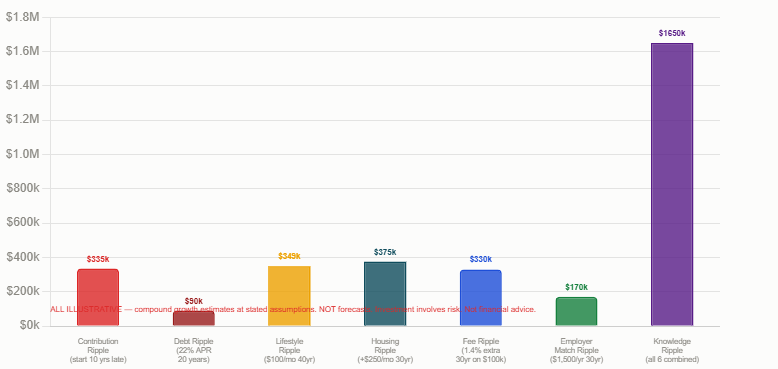
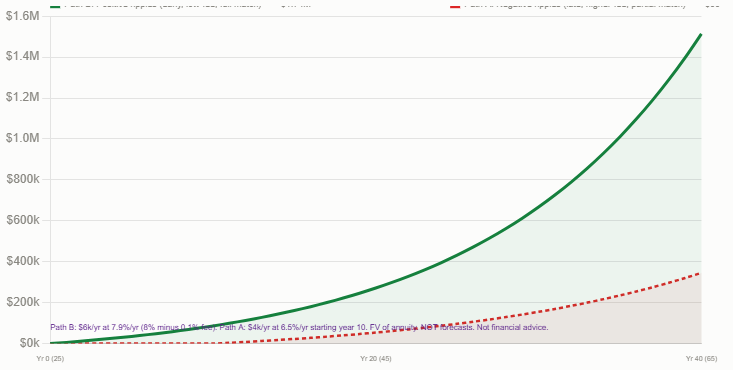
MoneyShow’s May 2025 session ‘A Tale of Two Plans: How Financial Decisions Shape Retirement Outcomes’ uses an identical-twin framework to illustrate how the same starting point produces vastly different retirement outcomes when different financial decisions are made across a career. The session describes it: ‘through a series of key decision points, one twin makes common financial planning mistakes, while the other takes a more strategic approach. By comparing their choices side-by-side, the presentation vividly illustrates how even small missteps can lead to significantly different retirement outcomes.’The comparison below applies this framework to the seven ripples described in this article. Not financial advice. All figures illustrative; investment involves risk; not a forecast.
All figures are illustrative mathematical estimates using compound growth formulas at stated rates. Not forecasts or guarantees. Investment involves risk including possible loss of principal. Not financial advice.
How to Create Positive Ripples: The Forward-Looking Framework
The seven negative ripples described in this article each have a corresponding positive ripple — a decision or set of decisions that, when made now, sets off a compounding chain of positive consequences that arrives at retirement as financial security rather than financial regret.- Start contributing immediately, at any rate, and automate the amount. The contribution ripple’s power is time. Even a small amount, started today, is worth more than a larger amount started five years from now. True Potential: ‘It is all about starting with small actions that you’ll eventually see expand into bigger outcomes.’ The simplest action: set a direct debit or automatic payroll deduction at the start of the month. Not financial advice.
- Pay off high-interest debt as the first investment. Before additional retirement contributions (beyond the employer match), before taxable investing, before holidays: eliminate credit card balances at 22% APR. The guaranteed 22% return of debt elimination outperforms any investment available. The debt snowball (smallest balance first) or debt avalanche (highest rate first) are both valid; the best method is the one that gets done. Not financial advice.
- Capture the full employer match before anything else. Check your contribution rate today. Confirm the employer’s matching formula. If your current contribution rate does not capture the maximum employer match: increase it this week. This is a 50–100% guaranteed return on the matched amount. Not financial advice.
- Move to low-cost index funds. If your 401(k) or ISA holds actively managed funds with annual management charges above 0.5%: compare lower-cost index fund alternatives. A 1% fee reduction on a $100,000 portfolio that grows for 30 years produces approximately $175,000 in additional terminal value. Check expense ratios on every fund you hold. Not investment advice; individual fund selection involves individual risks.
- Apply the pay-yourself-first principle. True Potential describes it: ‘Paying yourself first: adding to your long-term investments before any leisure spending takes place.’ Direct the first pounds or dollars of every paycheck to the retirement account and emergency fund before the rest reaches the current account. What reaches the current account gets spent; what never reaches it gets invested. Not financial advice.
- Learn one financial concept per month. The knowledge ripple is the meta-ripple. Compound interest, tax-advantaged accounts, employer match mechanics, index funds vs active management, inflation impact on real returns, the Rule of 17: each concept understood and applied creates a lifetime of better decisions. Bankrate’s Kates: ‘Having regrets doesn’t mean you can’t fix them or make improvements over time.’ Not financial advice.
Conclusion
74% of Americans carry a financial regret. The most common is not starting retirement savings early enough. The second is credit card debt. Both are ripples that began small — a contribution not made, a balance not paid down — and arrived at retirement as gaps that feel enormous precisely because compound growth spent decades working against rather than for. The mathematics is neutral: it will compound whatever direction the decisions point it.The ripple effect is not a metaphor for carelessness. Most of the negative financial decisions reflected in Bankrate’s survey were made under pressure, without full information, or in circumstances that made the long-term consequence invisible. The purpose of understanding the ripple effect is not to generate regret about the past but to make the next decision differently. Every decision made from today forward will ripple forward. The question is: in which direction?
Fritz Gilbert (The Retirement Manifesto) captured it best: ‘One decision, early in life, compounded over many decades, has a profound impact on your long-term financial wealth.’ You cannot change the decisions already made. But every day is a new stone dropped into still water. Choose carefully. Not financial, investment, or tax advice. Consult a qualified financial adviser (CFP or FCA-registered IFA) for guidance specific to your circumstances.
Frequently Asked Questions
What does it mean that every dollar not invested in your 20s is $17 at retirement?The 'Rule of 17' (cited by Bankrate 2025 and the Money Guy Show) is a compound growth illustration: $1 invested at approximately 8% annual return for approximately 36-40 years grows to approximately $15-22. The commonly cited '$17' is based on specific assumptions about return rate and time horizon -- it is an illustrative multiplier, not a precise guarantee. The underlying principle is mathematically sound: compound growth exponentially magnifies the difference between money invested early and money invested late. $1,000 not contributed at age 25 (at 8%/yr to age 65) = approximately $21,720 not available at retirement -- not $1,000. Investment involves risk; returns vary and are not guaranteed. The 8% figure approximates historical average equity returns and is not a forecast. Not financial advice.
Which financial decision has the biggest ripple effect on retirement?
Based on the data, starting contributions early is the single highest-impact decision -- because time is the one input that cannot be recovered once lost. Bankrate 2025: not saving for retirement early enough is the number one financial regret (22% of all Americans; 36% of Baby Boomers). But the compound cost also depends on the size of the ripple: a high-interest debt carried for decades (credit card at 22% APR) or an unclaimed employer match (100% guaranteed return foregone) can also produce retirement gaps in the six figures. The biggest single ripple is typically the contribution decision, because it operates across the longest time horizon. Not financial advice.
Can I recover from a late start on retirement savings?
Yes -- starting late is better than not starting. The catch-up contribution provisions specifically address late starters: in 2026, US workers aged 50-59 and 63+ can contribute up to $32,000/year to a 401(k); those aged 60-63 can contribute up to $35,750 (SECURE 2.0 super catch-up). These limits allow meaningful acceleration in the final decades of a career. UK equivalent: the £60,000 annual pension allowance, plus carry-forward of unused allowance from the previous three tax years. Additionally: reducing current spending to maximise contributions during the remaining working years; eliminating any remaining debt; taking full advantage of employer matching at the current rate; and delaying retirement by two to three years (often produces significantly higher income in retirement due to additional savings AND shorter distribution period). Transamerica 2025 Retirement Realities: '78% of retirees would change their saving behavior.' Not financial advice. Consult a qualified financial adviser for a catch-up plan specific to your situation.
Does the fee ripple really matter that much?
Yes -- the fee ripple is one of the most controllable and most underestimated factors in retirement outcomes. A 1.4% annual fee difference (1.5% active fund vs 0.1% index fund) on a $100,000 portfolio growing at 8% gross for 30 years produces a $330,000 difference in terminal value. On $300,000 invested: the fee difference produces approximately $990,000 over 30 years. Fees are the most controllable variable in investment returns. Unlike market returns (which cannot be predicted), fees are known in advance and chosen by the investor. Most actively managed funds underperform their benchmark index over any 10-year period after fees (consistent finding across multiple academic studies). Low-cost index funds (expense ratios 0.03-0.20%) are the structural solution to the fee ripple. Not investment advice; individual fund selection involves individual risks.
What is the single most important financial decision someone in their 30s can make today?
Based on the ripple framework and the financial regret data: automate your retirement contribution to at least the level of the full employer match, today. This single decision: (1) starts the positive contribution ripple immediately; (2) captures the employer match (50-100% guaranteed return); (3) uses automation to make future non-contribution the active choice rather than the default; and (4) starts compounding growth with the longest remaining runway. Fidelity guideline: target 15% of pretax income total (employee + employer). If you have high-interest debt (above approximately 8-10% APR): pay that off before additional investment beyond the employer match, because the guaranteed return of debt elimination exceeds typical expected investment returns. Not financial advice. Consult a qualified financial adviser (CFP or FCA-registered IFA) for a strategy specific to your circumstances.
0 Comments
Be the first to share your thoughts on this article.