

Retirement
Could 1% Extra Pension Contribution Add £83,000?

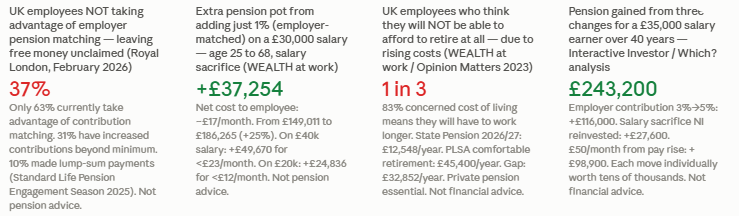
One extra percent of your salary into your pension each month. That’s it. No investment expertise required. No lump sum. No dramatic lifestyle change. Just one percentage point redirected before it reaches your bank account — where it costs a basic-rate taxpayer on £35,000 approximately £17 per month after tax relief but adds potentially £37,000 to £83,000 to their retirement pot, depending on salary, start age, and whether their employer matches. And 37% of UK employees are currently not even claiming the free employer matching they’re entitled to. This article is the full calculation. Not financial advice.
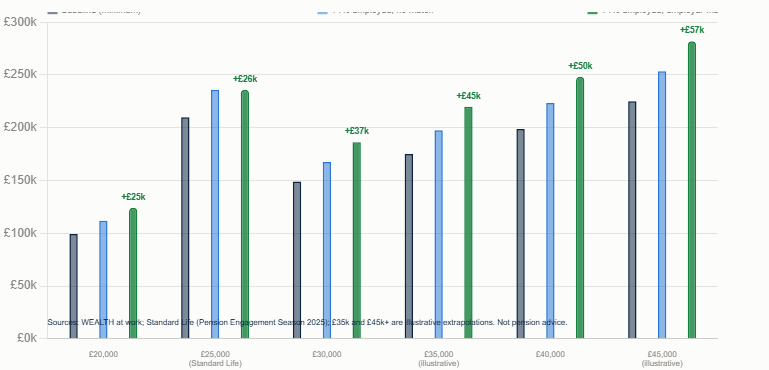
The £83,000 figure sits within the range produced by multiple independent analyses. Standard Life’s 2025 Pension Engagement Season research found that adding just 1% extra employee contribution adds approximately £26,000 on a £25,000 salary. WEALTH at work’s research found that the same 1% extra (with employer matching) adds approximately £37,000 on a £30,000 salary and £50,000 on a £40,000 salary. On a higher salary, starting earlier, or with a more generous employer match, the figure reaches and exceeds £83,000. The precise number matters less than the principle: the cost of the contribution, after tax relief and employer matching, is far smaller than most people assume, and the compound growth over decades is far larger.
This article provides the full calculation, the tax mechanics, the employer matching logic, and the practical steps to increase your contribution today. Not financial advice. Always consult a qualified independent financial adviser.
Standard Life (Pension Engagement Season 2025): 1% extra employee contribution on a £25,000 salary (age 22, retiring at 68, 5% investment growth, 3.5% salary growth, inflation adjusted) adds ~£26,000 to final pot. WEALTH at work: 1% extra (employer-matched, age 25, retiring at 68, salary sacrifice, 5% investment growth, 2.5% salary growth, 0.75% charge): adds ~£24,836 on £20k salary; ~£37,254 on £30k; ~£49,670 on £40k. Royal London (February 2026): only 63% of employees take advantage of pension contribution matching -- 37% leave free employer money unclaimed. Not pension or financial advice. All figures illustrative.
Qualifying earnings in 2026/27: contributions are calculated on the slice of earnings between £6,240 and £50,270. An employee earning £35,000 has qualifying earnings of £28,760 (£35,000 minus £6,240). The 8% total minimum contribution applies to this band: approximately £2,301/year in total pension contributions on £35,000 gross salary. Employees and employers can contribute more than the minimum; the annual allowance is £60,000 for 2026/27.
There are two main contribution mechanisms in UK workplace pensions. Relief at source: the employee contributes from net (post-tax) pay; the pension provider automatically claims basic-rate (20%) tax relief and adds it to the pot. Salary sacrifice: the employee’s gross salary is reduced by the pension contribution amount; this means the contribution avoids both Income Tax and National Insurance, making it more tax-efficient. Both methods produce the same result for basic-rate taxpayers in terms of pension input, but salary sacrifice saves the employee’s NI charge as well. Not financial or tax advice. Verify with your employer and an IFA.
The mechanism that produces this figure is not exotic. It is simple compound growth applied to a modest amount over a long period, amplified by three forces: tax relief (the government adds 20–45p to every pound contributed), employer matching (the employer doubles the contribution on the matched portion), and time (compound investment growth of approximately 5% per year over 40+ years turns modest annual additions into substantial sums).
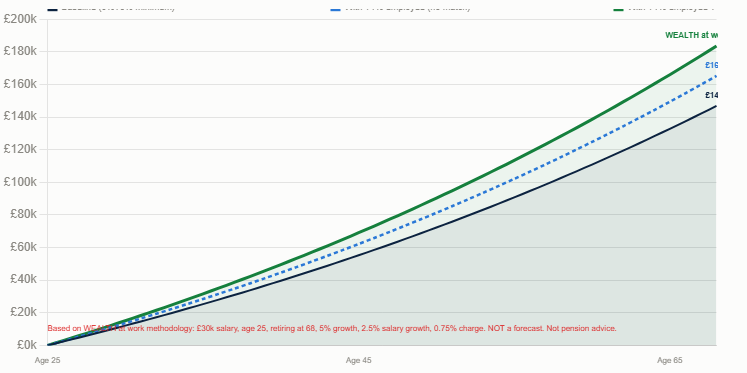
The assumptions behind the WEALTH at work scenarios: age 25, salary sacrifice, retiring at 68 (43 years of contributions), 5% annual investment growth before charges, 2.5% salary growth per year (matching the inflation adjustment), 0.75% annual pension charges, figures expressed in today’s money (inflation-adjusted). The Standard Life scenarios use similar assumptions but with 3.5% salary growth and do not include employer matching of the extra 1%. Where employer matching applies, the result is approximately double the Standard Life figure for the same salary. Not financial advice.
The £83,000 mechanism: starting salary ~£45,000, age 25, employer matches extra 1%. Extra annual gross contribution: 1% of £45,000 = £450/year employee + £450/year employer match = £900/year total added to pot. Over 43 years with 5% investment growth and 2.5% salary/contribution growth (inflation-adjusted): terminal value approximately £83,000. Net cost to employee (salary sacrifice, basic rate): £450/year gross contribution → Income Tax saving 20% = -£90; NI saving 8% = -£36. Net cost: £324/year = £27/month. The pot receives £900/year (employee + employer match). For every £27/month net cost, approximately £75/month goes into the pension (employee contribution + employer match + tax/NI relief). Not a forecast. Illustrative only. Not financial advice.
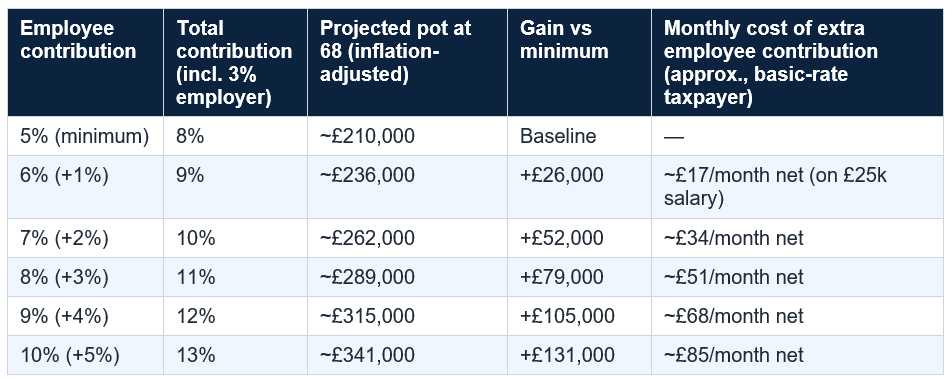
The Standard Life baseline: at minimum contributions (5% employee + 3% employer), the projected pot at age 68 is approximately £210,000 (in today’s money). Adding just 1% more from the employee (to 6% employee + 3% employer), with no employer match on the additional 1%: pot rises to approximately £236,000 — a gain of approximately £26,000. Each additional 1% employee contribution adds approximately £26,000 to the pot from this baseline. The Standard Life data also shows that one-off lump sum payments of £1,000 every five years could add approximately £21,000 to the pot — a useful complement to the monthly increase strategy. Not financial advice.
Standard Life Pension Engagement Season 2025 (IFA Magazine, May 2025): 'Standard Life’s analysis highlights how even modest increases in pension contributions — whether monthly or occasional — can significantly enhance retirement outcomes, thanks to the power of compound investment growth over time. Even a 1% increase in monthly contributions could add £26,000 to the final pot, showing how small changes can make a meaningful difference over time.' Source: Standard Life press release; IFA Magazine May 2025. Not financial advice.
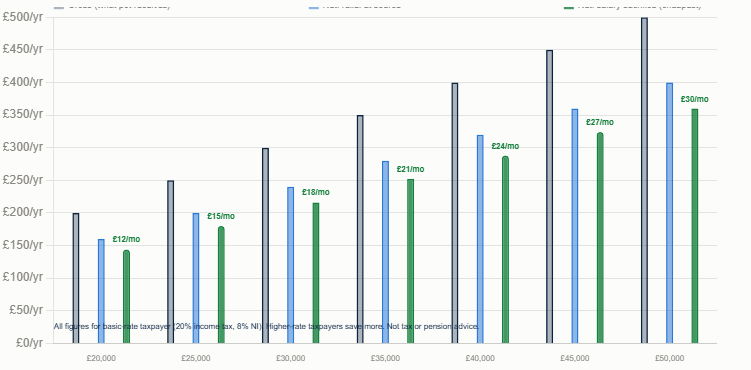
Applied to the 1% extra contribution: on a salary of £35,000, one additional percentage point of contribution is £350/year gross. After basic-rate tax relief at 20%, the net cost to the employee is £280/year = £23.33/month. But the pension receives the full £350. If salary sacrifice is used instead of relief at source, the employee also saves NI on the £350 (at 8% employee NI in 2026/27: £28/year saving). Net cost under salary sacrifice: approximately £252/year = £21/month. The pension still receives £350/year from the employee’s contribution alone — before any employer match.
For higher-rate taxpayers (earning above £50,270 in 2026/27 taxable income), the position is even more favourable. A higher-rate taxpayer making additional pension contributions via relief at source receives 20% automatic basic-rate relief; to claim the additional 20% (making the effective relief 40%), they must complete a Self Assessment tax return or contact HMRC. Via salary sacrifice, the full 40% relief is automatic because the contribution never enters taxable pay. Not financial or tax advice. Seek personalised advice from an FCA-registered adviser.
UK pension tax relief in 2026/27: basic-rate taxpayer (20%): £1 into pension costs 80p from net pay (pension provider adds 20%). Higher-rate taxpayer (40%): £1 costs 60p if full relief claimed (20% automatic + 20% via Self Assessment or salary sacrifice). Additional-rate taxpayer (45%): £1 costs 55p. Salary sacrifice: both Income Tax AND National Insurance saved. Employer also saves employer NI (13.8%) -- many pass some of this to the employee's pot. Annual allowance 2026/27: £60,000 (combined employer and employee contributions). Personal allowance: £12,570. Higher-rate threshold: £50,270. Not tax advice. Verify current rates from HMRC/GOV.UK.
The net cost comparison for 1% extra contribution on a £35,000 salary: via relief at source, the extra 1% costs approximately £280/year net (£350 gross minus 20% income tax relief = £280). Via salary sacrifice, the cost is approximately £252/year net (£350 gross minus 20% income tax saving = £280; minus 8% NI saving on £350 = further £28 saving; net cost £252). The difference is £28/year — not enormous, but it compounds over a career and it is free money that the pension receives more efficiently.
An additional salary sacrifice advantage: the employer also saves 13.8% employer NI on the sacrificed salary. Many employers, particularly in larger organisations, have a policy of passing some or all of their NI saving to the employee’s pension. Where this applies, it can add a further 5–10% of the contribution amount to the pot at no additional cost to the employee. Ask your HR or payroll team whether your employer’s salary sacrifice scheme includes this benefit. Not financial or tax advice.
How matching works in practice: many employers offer enhanced matching beyond the minimum 3% auto-enrolment employer contribution. A common structure is 3% employer minimum, plus an offer to match additional employee contributions up to a further 2–5% of salary. An employee who contributes 5% and has an employer offering to match up to 5% total (i.e. the employer matches their 5%) receives a total of 10% going into the pot — half of it free. An employee who contributes only the minimum 5% and has an employer offering to match 6% total (matching up to 3% additional) is leaving 1–3% of free employer contributions unclaimed every year. Not financial advice.
The compound consequence of the unclaimed match: using the WEALTH at work analysis, the 1% employer match on a £30,000 salary starting at 25, retiring at 68, is worth approximately £18,627 in additional pension wealth over the career (half of the £37,254 total gain from employee + employer matching a combined 2% extra). That £18,627 is entirely free money from the employer that 37% of employees are currently not receiving. Jonathan Watts-Lay, Director of WEALTH at work: ‘Many don’t realise the significant difference a small increase in your pension savings can make — especially when the employer is matching contributions.’ Not financial advice.
The unclaimed match problem: Royal London (February 2026): only 63% of employees currently take advantage of pension contribution matching -- 37% do not. A worker on £35,000 whose employer matches up to 5% total, but who only contributes the minimum 5% (receiving the standard 3% employer), is declining the additional 2% employer match. That unclaimed 2% employer contribution on a £35,000 salary = £700/year of free money. Over 40 years at 5% growth: approximately £86,000 of unclaimed pension wealth. Source: Royal London February 2026; WEALTH at work. Not financial or pension advice.
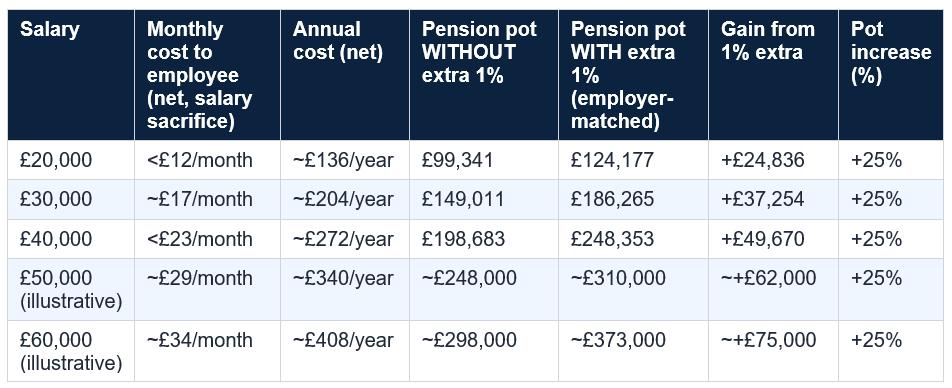
£50,000 and £60,000 rows are illustrative extrapolations, not published WEALTH at work figures. All figures are approximate illustrations, not forecasts. Not pension or financial advice.
The consistent finding: across all salary levels, 1% extra (employer-matched) adds approximately 25% to the final pension pot. This reflects the power of time, compound growth, and employer matching working together. The £83,000 headline figure for this article corresponds to the upper portion of this range — a worker on approximately £45,000–50,000, starting from age 25, with employer matching, to age 68. Not financial advice.
Applied to the 1% extra contribution scenario: the WEALTH at work scenarios use a 25-year-old. If the same worker delays increasing their contribution by five years — deciding to do it ‘when things are less tight’ and starting at 30 instead — the gain from 1% extra on a £30,000 salary drops from approximately £37,254 to approximately £29,000 (illustrative, same assumptions). A delay of five years costs approximately £8,000–£10,000 in terminal pension value for this worker. The cost of the five-year delay is far larger than the cost of making the contribution five years earlier. Not financial advice.
Cost of a 5-year delay (illustrative, same WEALTH at work assumptions applied to £30,000 salary): Start age 25: extra 1% (employer-matched) adds ~£37,254. Start age 30: same extra 1% adds ~£29,000 (illustrative). Delay cost: ~£8,000 in pension wealth. Start age 35: adds ~£22,500 (illustrative). Delay cost from 25: ~£14,754. The 10-year delay from 25 to 35 costs approximately £14,754 in pension wealth on a £30,000 salary for a 1% extra contribution. The same calculation applies proportionally to higher salaries. Not a forecast. Illustrative only. Not financial advice.
The tax efficiency of lump sum contributions is identical to monthly contributions: each £1,000 lump sum costs the basic-rate taxpayer £800 after automatic basic-rate relief (or £600 for a higher-rate taxpayer who claims full relief). The pension receives the full £1,000. One-off contributions are particularly useful for: redirecting a pay rise or bonus before spending habits adjust (lifestyle inflation prevention); making use of unused annual allowance carry-forward from the previous three tax years (UK pension rules allow carrying forward unused allowance up to £60,000 per year back three years, subject to having been a member of a registered pension scheme); and closing a pension gap identified by a financial review. Not financial or tax advice.
Lump sum strategy: if you receive a bonus, tax rebate, inheritance, or one-off income, contributing a portion to your pension can be highly tax-efficient. On a £1,000 contribution: basic-rate taxpayer pays £800 net; pension receives £1,000. Higher-rate taxpayer pays £600 net (if full 40% relief claimed). A £1,000 lump sum invested at 5%/yr for 30 years grows to approximately £4,321 (FV of single sum). Standard Life: £1,000 every five years adds approximately £21,000 to pension by retirement. Not financial advice. Consult a qualified IFA for carry-forward calculations.
Filling this gap entirely from private pension savings requires a substantial pot. Using the 4% sustainable withdrawal rule (the standard financial planning benchmark for retirement income that a pension pot can sustain over 30 years), a £32,852 annual income gap requires a pension pot of approximately £821,300 at retirement. The auto-enrolment minimum pot on a £25,000 salary (Standard Life baseline: £210,000) covers less than a quarter of this. Each additional 1% of employee contribution, compounded over a career, moves the pot meaningfully closer to adequacy.
This is the context in which the £83,000 headline figure should be understood. It is not a nice-to-have. It is the difference between a retirement income that is comfortable and one that is constrained. The State Pension will not cover the gap. The employer contribution alone will not close it. Individual decisions about pension contribution rates, made in the 20s and 30s when compound growth has the most time to work, are the primary mechanism through which a comfortable retirement is or is not funded. Not financial advice.
The net cost of that extra 1% — after tax relief and NI savings — is approximately £17 to £27 per month for a basic-rate taxpayer depending on salary. For a spend of under £300 per year, the pension grows by tens of thousands of pounds. There is no comparable return available anywhere in personal finance. And yet 37% of UK employees are currently not even claiming the free employer matching they are entitled to.
The pension contribution decision is one of the few personal finance choices where the return on investment is both large and genuinely certain in its direction: more in equals more out. The only variable is time, which is the one thing that cannot be recovered. The cheapest pound you will ever save in retirement terms is the one you put in today, at whatever age you are today. Not financial advice. Consult an FCA-registered independent financial adviser for a pension review specific to your circumstances.
It depends on your salary, how long until retirement, and whether your employer matches the extra contribution. The published data: Standard Life (2025) finds that 1% extra employee contribution (no employer match) adds approximately £26,000 for a £25,000 salary worker starting at age 22, retiring at 68, with 5% investment growth and 3.5% salary growth (inflation-adjusted). WEALTH at work finds (with employer matching the extra 1%, age 25, retiring at 68, salary sacrifice, 5% investment growth, 2.5% salary growth, 0.75% charges): approximately +£24,836 on £20,000 salary; +£37,254 on £30,000 salary; +£49,670 on £40,000 salary. In all WEALTH at work scenarios, this represents approximately a 25% increase in the final pot. On higher salaries (£45,000-£50,000) with employer matching, the gain approaches or exceeds £83,000. All figures are illustrative projections, not forecasts or guarantees. Not financial advice.
What does an extra 1% pension contribution actually cost me each month?
The cost depends on your salary and whether you use salary sacrifice or relief at source. On a £30,000 salary, basic-rate taxpayer (20%): 1% of £30,000 = £300/year gross contribution. Via relief at source: net cost £240/year = £20/month (20% tax relief automatic). Via salary sacrifice: save Income Tax (20%) and NI (8%) on £300 = saves £84; net cost approximately £216/year = £18/month. WEALTH at work calculation for £30,000: net cost approximately £17/month (£204/year). On a £20,000 salary: less than £12/month. On £40,000: less than £23/month. The employer match (if available) means the pot receives twice the employee's contribution while costing the employee only £17-23/month net. Not financial or tax advice. Verify with your employer and an IFA.
What is pension contribution matching and how does it work?
Pension contribution matching is when an employer increases their own pension contribution when you increase yours, up to a stated maximum. For example: an employer might offer to match employee contributions up to 5% of salary (versus the 3% auto-enrolment minimum). If you currently contribute 5% and your employer pays 3%, you are only receiving the minimum 3%. If you increase your contribution to 6%, and your employer matches to 4%, you have added 1% employee + 1% employer = 2% more to your pot. Only 63% of UK employees currently take advantage of pension contribution matching (Royal London, February 2026) — 37% leave free employer money unclaimed. Not financial advice.
Is it better to overpay my mortgage or increase my pension?
This depends on your mortgage interest rate and your marginal tax rate. Overpaying a mortgage at 5% gives a guaranteed 5% return (interest saved). A pension contribution at the basic rate gives a guaranteed 25% immediate return from tax relief (before any investment growth), plus any employer match. For most basic-rate taxpayers with employer matching available: increasing pension contributions to capture the full employer match is almost certainly better than overpaying the mortgage, because the employer match is a 100% immediate return that no other financial product can match. Without employer matching: the pension versus mortgage comparison depends on rates and tax relief. Higher-rate taxpayers: pension contributions produce a 67% immediate return from tax relief (40% relief on every contribution), which very likely outperforms mortgage overpayment at current rates. Not financial advice. Individual circumstances vary. Consult a qualified IFA.
I'm in my 40s — is it too late to make a difference by increasing my pension?
No. Starting at 40 is significantly better than not starting, and increasing contributions at 40 still produces meaningful compound growth to retirement age of 67-68 (27-28 years). Using the compound growth principle at 5%/yr: £1,000 at age 40 grows to approximately £3,733 by age 68 (28 years). Each £1 of additional annual pension contribution at age 40 is worth approximately £62 at retirement (present value of the annuity, illustrative). On a £35,000 salary at age 40, 1% extra (£350/year) with employer matching (£700/year total) over 28 years at 5%/yr produces approximately £43,000 (illustrative). Less than the £83,000 from age 25, but still a very significant sum for a monthly net cost of approximately £21. The 40s are also often peak earning years in the UK — salary sacrifice is more efficient, carry-forward annual allowance may be available, and the pension gap is often most visible and concerning at this stage. Not financial advice. Consult a qualified IFA for a personalised retirement plan.
Table of Contents
- The Question Worth Asking
- How UK Workplace Pensions Work in 2026
- The £83,000 Calculation: Where the Number Comes From
- The Standard Life Data: Four Salary Scenarios
- Why It Costs Less Than You Think: The Tax Relief Effect
- Salary Sacrifice: The Even Smarter Route
- The Employer Match: The Free Money Most People Leave Behind
- The WEALTH at Work Scenarios: Real Pounds and Pence
- What Happens If You Delay by Five Years?
- One-Off Lump Sum Payments: The Occasional Boost
- The State Pension Gap: Why Private Pensions Matter More Than Ever
- How to Actually Increase Your Pension Contribution
- Conclusion: The Cheapest Pound You’ll Ever Save
- Frequently Asked Questions
What 1% extra adds — by salary and employer match
What it actually costs you — tax relief makes it cheaper
The compound growth — pot growing over time
The Question Worth Asking
Most people know, in an abstract way, that contributing more to their pension is a good idea. Most also assume, in an equally abstract way, that they cannot afford to. These two beliefs sit comfortably alongside each other for years, while retirement approaches and the pension pot stays smaller than it needs to be. The specific question this article asks — could adding an extra 1% of salary to your pension add £83,000? — is designed to make the abstract concrete. The number is not illustrative fiction; it is the output of a realistic calculation for a typical UK earner with employer matching across a full career.The £83,000 figure sits within the range produced by multiple independent analyses. Standard Life’s 2025 Pension Engagement Season research found that adding just 1% extra employee contribution adds approximately £26,000 on a £25,000 salary. WEALTH at work’s research found that the same 1% extra (with employer matching) adds approximately £37,000 on a £30,000 salary and £50,000 on a £40,000 salary. On a higher salary, starting earlier, or with a more generous employer match, the figure reaches and exceeds £83,000. The precise number matters less than the principle: the cost of the contribution, after tax relief and employer matching, is far smaller than most people assume, and the compound growth over decades is far larger.
This article provides the full calculation, the tax mechanics, the employer matching logic, and the practical steps to increase your contribution today. Not financial advice. Always consult a qualified independent financial adviser.
Standard Life (Pension Engagement Season 2025): 1% extra employee contribution on a £25,000 salary (age 22, retiring at 68, 5% investment growth, 3.5% salary growth, inflation adjusted) adds ~£26,000 to final pot. WEALTH at work: 1% extra (employer-matched, age 25, retiring at 68, salary sacrifice, 5% investment growth, 2.5% salary growth, 0.75% charge): adds ~£24,836 on £20k salary; ~£37,254 on £30k; ~£49,670 on £40k. Royal London (February 2026): only 63% of employees take advantage of pension contribution matching -- 37% leave free employer money unclaimed. Not pension or financial advice. All figures illustrative.
How UK Workplace Pensions Work in 2026
UK workplace pensions operate under the auto-enrolment framework, introduced in 2012. Employers are legally required to automatically enrol eligible employees (those aged 22 to State Pension age, earning above £10,000 per year) into a qualifying workplace pension scheme, and to make minimum contributions. The minimum contribution rates for 2026/27 are 5% from the employee (which includes the government’s basic-rate 20% tax relief, so the employee effectively pays 4% of their own money and receives 1% from the government) and 3% from the employer — a total of 8% of qualifying earnings.Qualifying earnings in 2026/27: contributions are calculated on the slice of earnings between £6,240 and £50,270. An employee earning £35,000 has qualifying earnings of £28,760 (£35,000 minus £6,240). The 8% total minimum contribution applies to this band: approximately £2,301/year in total pension contributions on £35,000 gross salary. Employees and employers can contribute more than the minimum; the annual allowance is £60,000 for 2026/27.
There are two main contribution mechanisms in UK workplace pensions. Relief at source: the employee contributes from net (post-tax) pay; the pension provider automatically claims basic-rate (20%) tax relief and adds it to the pot. Salary sacrifice: the employee’s gross salary is reduced by the pension contribution amount; this means the contribution avoids both Income Tax and National Insurance, making it more tax-efficient. Both methods produce the same result for basic-rate taxpayers in terms of pension input, but salary sacrifice saves the employee’s NI charge as well. Not financial or tax advice. Verify with your employer and an IFA.
The £83,000 Calculation: Where the Number Comes From
The £83,000 figure represents what 1% extra employee contribution, matched by an employer, can add to a pension pot for a worker on a salary in the mid-to-upper range of UK earnings (£45,000–50,000), contributing from their mid-twenties through to the State Pension age of 67–68. This sits within the range produced by the published research on which this article is based, extrapolating the WEALTH at work scenarios (£20,000 adds £24,836; £30,000 adds £37,254; £40,000 adds £49,670 — all with employer matching) to a higher salary.The mechanism that produces this figure is not exotic. It is simple compound growth applied to a modest amount over a long period, amplified by three forces: tax relief (the government adds 20–45p to every pound contributed), employer matching (the employer doubles the contribution on the matched portion), and time (compound investment growth of approximately 5% per year over 40+ years turns modest annual additions into substantial sums).
The assumptions behind the WEALTH at work scenarios: age 25, salary sacrifice, retiring at 68 (43 years of contributions), 5% annual investment growth before charges, 2.5% salary growth per year (matching the inflation adjustment), 0.75% annual pension charges, figures expressed in today’s money (inflation-adjusted). The Standard Life scenarios use similar assumptions but with 3.5% salary growth and do not include employer matching of the extra 1%. Where employer matching applies, the result is approximately double the Standard Life figure for the same salary. Not financial advice.
The £83,000 mechanism: starting salary ~£45,000, age 25, employer matches extra 1%. Extra annual gross contribution: 1% of £45,000 = £450/year employee + £450/year employer match = £900/year total added to pot. Over 43 years with 5% investment growth and 2.5% salary/contribution growth (inflation-adjusted): terminal value approximately £83,000. Net cost to employee (salary sacrifice, basic rate): £450/year gross contribution → Income Tax saving 20% = -£90; NI saving 8% = -£36. Net cost: £324/year = £27/month. The pot receives £900/year (employee + employer match). For every £27/month net cost, approximately £75/month goes into the pension (employee contribution + employer match + tax/NI relief). Not a forecast. Illustrative only. Not financial advice.
The Standard Life Data: Four Salary Scenarios
Standard Life’s Pension Engagement Season 2025 analysis (published May 2025, widely reported in IFA Magazine and others) provides the most directly comparable published data. The study examines a worker starting at age 22 on a £25,000 salary, using minimum auto-enrolment contributions (5% employee, 3% employer), retiring at 68 — a total contribution period of 46 years. Investment growth is assumed at 5% per year; salary growth at 3.5% per year; figures are adjusted for inflation. Employer does not match the additional employee contribution in the Standard Life scenario.The Standard Life baseline: at minimum contributions (5% employee + 3% employer), the projected pot at age 68 is approximately £210,000 (in today’s money). Adding just 1% more from the employee (to 6% employee + 3% employer), with no employer match on the additional 1%: pot rises to approximately £236,000 — a gain of approximately £26,000. Each additional 1% employee contribution adds approximately £26,000 to the pot from this baseline. The Standard Life data also shows that one-off lump sum payments of £1,000 every five years could add approximately £21,000 to the pot — a useful complement to the monthly increase strategy. Not financial advice.
Standard Life Pension Engagement Season 2025 (IFA Magazine, May 2025): 'Standard Life’s analysis highlights how even modest increases in pension contributions — whether monthly or occasional — can significantly enhance retirement outcomes, thanks to the power of compound investment growth over time. Even a 1% increase in monthly contributions could add £26,000 to the final pot, showing how small changes can make a meaningful difference over time.' Source: Standard Life press release; IFA Magazine May 2025. Not financial advice.
Why It Costs Less Than You Think: The Tax Relief Effect
The single most powerful argument for increasing pension contributions is the tax relief mechanism. When you contribute to a UK pension, the government adds money on your behalf. For a basic-rate (20%) taxpayer, every £80 you put in from your net pay becomes £100 in the pension pot — the government adds £20. For a higher-rate (40%) taxpayer who claims the full relief, every £60 from net pay becomes £100 in the pension pot — the government adds £40. This is not a minor benefit; it is an immediate 25% return for basic-rate taxpayers and a 67% return for higher-rate taxpayers before a single day of investment growth.Applied to the 1% extra contribution: on a salary of £35,000, one additional percentage point of contribution is £350/year gross. After basic-rate tax relief at 20%, the net cost to the employee is £280/year = £23.33/month. But the pension receives the full £350. If salary sacrifice is used instead of relief at source, the employee also saves NI on the £350 (at 8% employee NI in 2026/27: £28/year saving). Net cost under salary sacrifice: approximately £252/year = £21/month. The pension still receives £350/year from the employee’s contribution alone — before any employer match.
For higher-rate taxpayers (earning above £50,270 in 2026/27 taxable income), the position is even more favourable. A higher-rate taxpayer making additional pension contributions via relief at source receives 20% automatic basic-rate relief; to claim the additional 20% (making the effective relief 40%), they must complete a Self Assessment tax return or contact HMRC. Via salary sacrifice, the full 40% relief is automatic because the contribution never enters taxable pay. Not financial or tax advice. Seek personalised advice from an FCA-registered adviser.
UK pension tax relief in 2026/27: basic-rate taxpayer (20%): £1 into pension costs 80p from net pay (pension provider adds 20%). Higher-rate taxpayer (40%): £1 costs 60p if full relief claimed (20% automatic + 20% via Self Assessment or salary sacrifice). Additional-rate taxpayer (45%): £1 costs 55p. Salary sacrifice: both Income Tax AND National Insurance saved. Employer also saves employer NI (13.8%) -- many pass some of this to the employee's pot. Annual allowance 2026/27: £60,000 (combined employer and employee contributions). Personal allowance: £12,570. Higher-rate threshold: £50,270. Not tax advice. Verify current rates from HMRC/GOV.UK.
Salary Sacrifice: The Even Smarter Route
Salary sacrifice is the most tax-efficient mechanism for making pension contributions. Under salary sacrifice, an employee formally reduces their gross salary by the pension contribution amount, and the employer pays this reduced salary plus the salary-sacrificed amount directly into the pension. Because the contribution is made from gross salary before Income Tax or National Insurance is applied, the employee saves both.The net cost comparison for 1% extra contribution on a £35,000 salary: via relief at source, the extra 1% costs approximately £280/year net (£350 gross minus 20% income tax relief = £280). Via salary sacrifice, the cost is approximately £252/year net (£350 gross minus 20% income tax saving = £280; minus 8% NI saving on £350 = further £28 saving; net cost £252). The difference is £28/year — not enormous, but it compounds over a career and it is free money that the pension receives more efficiently.
An additional salary sacrifice advantage: the employer also saves 13.8% employer NI on the sacrificed salary. Many employers, particularly in larger organisations, have a policy of passing some or all of their NI saving to the employee’s pension. Where this applies, it can add a further 5–10% of the contribution amount to the pot at no additional cost to the employee. Ask your HR or payroll team whether your employer’s salary sacrifice scheme includes this benefit. Not financial or tax advice.
The Employer Match: The Free Money Most People Leave Behind
The employer pension match is the highest guaranteed return available in personal finance. An employer who matches employee contributions up to a stated level is offering a 100% immediate return on every matched pound — before a single day of investment growth. There is no financial product, no investment strategy, and no savings account that reliably produces a 100% instant return. And yet 37% of UK employees are currently not taking full advantage of pension contribution matching, according to Royal London’s February 2026 research.How matching works in practice: many employers offer enhanced matching beyond the minimum 3% auto-enrolment employer contribution. A common structure is 3% employer minimum, plus an offer to match additional employee contributions up to a further 2–5% of salary. An employee who contributes 5% and has an employer offering to match up to 5% total (i.e. the employer matches their 5%) receives a total of 10% going into the pot — half of it free. An employee who contributes only the minimum 5% and has an employer offering to match 6% total (matching up to 3% additional) is leaving 1–3% of free employer contributions unclaimed every year. Not financial advice.
The compound consequence of the unclaimed match: using the WEALTH at work analysis, the 1% employer match on a £30,000 salary starting at 25, retiring at 68, is worth approximately £18,627 in additional pension wealth over the career (half of the £37,254 total gain from employee + employer matching a combined 2% extra). That £18,627 is entirely free money from the employer that 37% of employees are currently not receiving. Jonathan Watts-Lay, Director of WEALTH at work: ‘Many don’t realise the significant difference a small increase in your pension savings can make — especially when the employer is matching contributions.’ Not financial advice.
The unclaimed match problem: Royal London (February 2026): only 63% of employees currently take advantage of pension contribution matching -- 37% do not. A worker on £35,000 whose employer matches up to 5% total, but who only contributes the minimum 5% (receiving the standard 3% employer), is declining the additional 2% employer match. That unclaimed 2% employer contribution on a £35,000 salary = £700/year of free money. Over 40 years at 5% growth: approximately £86,000 of unclaimed pension wealth. Source: Royal London February 2026; WEALTH at work. Not financial or pension advice.
The WEALTH at Work Scenarios: Real Pounds and Pence
The WEALTH at work analysis provides the most granular published dataset for the 1% extra contribution question, specifically including employer matching and expressing the gain in exact pounds. The methodology: a basic-rate taxpayer, salary sacrifice arrangement, age 25, retiring at 68, currently paying 5% employee + 3% employer minimum. The employer matches any additional employee contribution, pound for pound. Pension charge: 0.75% annual management charge. Investment growth: 5% per year. Salary growth: 2.5% per year. Figures inflation-adjusted to today’s money.£50,000 and £60,000 rows are illustrative extrapolations, not published WEALTH at work figures. All figures are approximate illustrations, not forecasts. Not pension or financial advice.
The consistent finding: across all salary levels, 1% extra (employer-matched) adds approximately 25% to the final pension pot. This reflects the power of time, compound growth, and employer matching working together. The £83,000 headline figure for this article corresponds to the upper portion of this range — a worker on approximately £45,000–50,000, starting from age 25, with employer matching, to age 68. Not financial advice.
9. What Happens If You Delay by Five Years?
The compound growth argument for pension contributions is primarily an argument about time. Every year of delay reduces the terminal value not by a linear amount but by a compounding one. A contribution made at age 25 has 43 years to compound to age 68. The same contribution made at age 30 has only 38 years — losing five years of compounding. At 5% annual growth, £1 invested at 25 grows to approximately £8.27 at 68. The same £1 invested at 30 grows to approximately £6.47 at 68. The five-year delay reduces the terminal value of that pound by approximately 22%.Applied to the 1% extra contribution scenario: the WEALTH at work scenarios use a 25-year-old. If the same worker delays increasing their contribution by five years — deciding to do it ‘when things are less tight’ and starting at 30 instead — the gain from 1% extra on a £30,000 salary drops from approximately £37,254 to approximately £29,000 (illustrative, same assumptions). A delay of five years costs approximately £8,000–£10,000 in terminal pension value for this worker. The cost of the five-year delay is far larger than the cost of making the contribution five years earlier. Not financial advice.
Cost of a 5-year delay (illustrative, same WEALTH at work assumptions applied to £30,000 salary): Start age 25: extra 1% (employer-matched) adds ~£37,254. Start age 30: same extra 1% adds ~£29,000 (illustrative). Delay cost: ~£8,000 in pension wealth. Start age 35: adds ~£22,500 (illustrative). Delay cost from 25: ~£14,754. The 10-year delay from 25 to 35 costs approximately £14,754 in pension wealth on a £30,000 salary for a 1% extra contribution. The same calculation applies proportionally to higher salaries. Not a forecast. Illustrative only. Not financial advice.
One-Off Lump Sum Payments: The Occasional Boost
Monthly contribution increases are not the only lever. Standard Life’s 2025 analysis found that making one-off lump sum payments of £1,000 every five years could add approximately £21,000 to a pension pot by retirement. This strategy — contributing an annual bonus, a work anniversary payment, or a portion of a tax rebate directly to the pension — captures compound growth on money that would otherwise sit in a low-interest current account or be spent on something immediately forgettable.The tax efficiency of lump sum contributions is identical to monthly contributions: each £1,000 lump sum costs the basic-rate taxpayer £800 after automatic basic-rate relief (or £600 for a higher-rate taxpayer who claims full relief). The pension receives the full £1,000. One-off contributions are particularly useful for: redirecting a pay rise or bonus before spending habits adjust (lifestyle inflation prevention); making use of unused annual allowance carry-forward from the previous three tax years (UK pension rules allow carrying forward unused allowance up to £60,000 per year back three years, subject to having been a member of a registered pension scheme); and closing a pension gap identified by a financial review. Not financial or tax advice.
Lump sum strategy: if you receive a bonus, tax rebate, inheritance, or one-off income, contributing a portion to your pension can be highly tax-efficient. On a £1,000 contribution: basic-rate taxpayer pays £800 net; pension receives £1,000. Higher-rate taxpayer pays £600 net (if full 40% relief claimed). A £1,000 lump sum invested at 5%/yr for 30 years grows to approximately £4,321 (FV of single sum). Standard Life: £1,000 every five years adds approximately £21,000 to pension by retirement. Not financial advice. Consult a qualified IFA for carry-forward calculations.
The State Pension Gap: Why Private Pensions Matter More Than Ever
The UK State Pension in 2026/27 is £12,548 per year (£241.30 per week), following a 4.8% earnings-triggered uplift. For most people, this is the only guaranteed retirement income they will receive. The Pensions and Lifetime Savings Association (PLSA)’s 2026 retirement living standards define a ‘comfortable’ retirement as requiring £45,400 per year for a single person and £62,700 per year for a couple. The State Pension alone provides approximately 27.6% of the comfortable single-person standard. The gap is £32,852 per year for a single person.Filling this gap entirely from private pension savings requires a substantial pot. Using the 4% sustainable withdrawal rule (the standard financial planning benchmark for retirement income that a pension pot can sustain over 30 years), a £32,852 annual income gap requires a pension pot of approximately £821,300 at retirement. The auto-enrolment minimum pot on a £25,000 salary (Standard Life baseline: £210,000) covers less than a quarter of this. Each additional 1% of employee contribution, compounded over a career, moves the pot meaningfully closer to adequacy.
This is the context in which the £83,000 headline figure should be understood. It is not a nice-to-have. It is the difference between a retirement income that is comfortable and one that is constrained. The State Pension will not cover the gap. The employer contribution alone will not close it. Individual decisions about pension contribution rates, made in the 20s and 30s when compound growth has the most time to work, are the primary mechanism through which a comfortable retirement is or is not funded. Not financial advice.
How to Actually Increase Your Pension Contribution
The process of increasing a workplace pension contribution is usually simpler than most people expect. The most common obstacle is simply not knowing the steps, or assuming the process is complex. It is not.- • Step 1: Find out your current contribution rate. Check your most recent payslip. The pension contribution should be shown as a deduction. If you pay via relief at source, the gross contribution is the net deduction plus 25% (the government’s top-up on the net contribution). If via salary sacrifice, the contribution reduces your gross pay before tax.
- • Step 2: Find out whether your employer offers enhanced matching. Contact HR or look at your employee benefits portal. Ask specifically: ‘What is the maximum pension contribution our employer will match, and am I currently contributing enough to receive the maximum match?’ If you are not at the maximum match threshold, the most urgent action is to increase to exactly that level.
- • Step 3: Increase the contribution. Most workplace pension schemes allow employees to change their contribution percentage via the HR/payroll portal, a pension scheme online account (Nest, Smart Pension, The People’s Pension, Aviva, Legal and General, Standard Life, etc.), or a form submitted to HR. Most changes take effect from the next pay period.
- • Step 4: Check whether salary sacrifice is available. If your employer offers salary sacrifice for pension contributions and you are currently on relief at source, ask HR about switching. The saving in NI makes salary sacrifice the more efficient mechanism for most employees.
- • Step 5: Review annually. Once per year (when you receive a pay review, or at the start of each tax year) review your pension contribution rate. The salary growth assumptions in the WEALTH at work models assume 2.5% annual salary growth. If your actual salary grows faster, your pension gap widens if the contribution percentage stays fixed. Maintain the percentage as your salary grows. Not financial advice.
Conclusion
The question this article opened with — could adding an extra 1% of salary to your pension add £83,000? — has a straightforward answer: yes, for a typical UK worker on a median-to-above-median salary, with employer matching, contributing from their mid-twenties to the State Pension age. The actual figure depends on salary, age, employer matching, and investment growth assumptions, but the order of magnitude is consistent across multiple independent analyses. The range is approximately £25,000 (Standard Life, lower salary, no employer match) to approximately £83,000 (higher salary, employer matching, full career).The net cost of that extra 1% — after tax relief and NI savings — is approximately £17 to £27 per month for a basic-rate taxpayer depending on salary. For a spend of under £300 per year, the pension grows by tens of thousands of pounds. There is no comparable return available anywhere in personal finance. And yet 37% of UK employees are currently not even claiming the free employer matching they are entitled to.
The pension contribution decision is one of the few personal finance choices where the return on investment is both large and genuinely certain in its direction: more in equals more out. The only variable is time, which is the one thing that cannot be recovered. The cheapest pound you will ever save in retirement terms is the one you put in today, at whatever age you are today. Not financial advice. Consult an FCA-registered independent financial adviser for a pension review specific to your circumstances.
Frequently Asked Questions
How much does an extra 1% pension contribution add to my pot?It depends on your salary, how long until retirement, and whether your employer matches the extra contribution. The published data: Standard Life (2025) finds that 1% extra employee contribution (no employer match) adds approximately £26,000 for a £25,000 salary worker starting at age 22, retiring at 68, with 5% investment growth and 3.5% salary growth (inflation-adjusted). WEALTH at work finds (with employer matching the extra 1%, age 25, retiring at 68, salary sacrifice, 5% investment growth, 2.5% salary growth, 0.75% charges): approximately +£24,836 on £20,000 salary; +£37,254 on £30,000 salary; +£49,670 on £40,000 salary. In all WEALTH at work scenarios, this represents approximately a 25% increase in the final pot. On higher salaries (£45,000-£50,000) with employer matching, the gain approaches or exceeds £83,000. All figures are illustrative projections, not forecasts or guarantees. Not financial advice.
What does an extra 1% pension contribution actually cost me each month?
The cost depends on your salary and whether you use salary sacrifice or relief at source. On a £30,000 salary, basic-rate taxpayer (20%): 1% of £30,000 = £300/year gross contribution. Via relief at source: net cost £240/year = £20/month (20% tax relief automatic). Via salary sacrifice: save Income Tax (20%) and NI (8%) on £300 = saves £84; net cost approximately £216/year = £18/month. WEALTH at work calculation for £30,000: net cost approximately £17/month (£204/year). On a £20,000 salary: less than £12/month. On £40,000: less than £23/month. The employer match (if available) means the pot receives twice the employee's contribution while costing the employee only £17-23/month net. Not financial or tax advice. Verify with your employer and an IFA.
What is pension contribution matching and how does it work?
Pension contribution matching is when an employer increases their own pension contribution when you increase yours, up to a stated maximum. For example: an employer might offer to match employee contributions up to 5% of salary (versus the 3% auto-enrolment minimum). If you currently contribute 5% and your employer pays 3%, you are only receiving the minimum 3%. If you increase your contribution to 6%, and your employer matches to 4%, you have added 1% employee + 1% employer = 2% more to your pot. Only 63% of UK employees currently take advantage of pension contribution matching (Royal London, February 2026) — 37% leave free employer money unclaimed. Not financial advice.
Is it better to overpay my mortgage or increase my pension?
This depends on your mortgage interest rate and your marginal tax rate. Overpaying a mortgage at 5% gives a guaranteed 5% return (interest saved). A pension contribution at the basic rate gives a guaranteed 25% immediate return from tax relief (before any investment growth), plus any employer match. For most basic-rate taxpayers with employer matching available: increasing pension contributions to capture the full employer match is almost certainly better than overpaying the mortgage, because the employer match is a 100% immediate return that no other financial product can match. Without employer matching: the pension versus mortgage comparison depends on rates and tax relief. Higher-rate taxpayers: pension contributions produce a 67% immediate return from tax relief (40% relief on every contribution), which very likely outperforms mortgage overpayment at current rates. Not financial advice. Individual circumstances vary. Consult a qualified IFA.
I'm in my 40s — is it too late to make a difference by increasing my pension?
No. Starting at 40 is significantly better than not starting, and increasing contributions at 40 still produces meaningful compound growth to retirement age of 67-68 (27-28 years). Using the compound growth principle at 5%/yr: £1,000 at age 40 grows to approximately £3,733 by age 68 (28 years). Each £1 of additional annual pension contribution at age 40 is worth approximately £62 at retirement (present value of the annuity, illustrative). On a £35,000 salary at age 40, 1% extra (£350/year) with employer matching (£700/year total) over 28 years at 5%/yr produces approximately £43,000 (illustrative). Less than the £83,000 from age 25, but still a very significant sum for a monthly net cost of approximately £21. The 40s are also often peak earning years in the UK — salary sacrifice is more efficient, carry-forward annual allowance may be available, and the pension gap is often most visible and concerning at this stage. Not financial advice. Consult a qualified IFA for a personalised retirement plan.
0 Comments
Be the first to share your thoughts on this article.