

Retirement
Here's What It's Like to Retire to a Low-Tax State
Sixty per cent of retirees who move go to a more affordable area and pocket capital gains from their house — and can typically unlock around $100,000 in home equity doing so, according to a 2023 Vanguard study. A Wall Street Journal article published yesterday (September 12, 2026) put the real-world experience of retiring to a low-tax state on the front page. For some, total spending remains almost the same, or even rises — but funds shift toward upgraded amenities or travel. For others, hidden costs in 'no-income-tax' states erase the headline savings entirely. This guide examines the full picture: the genuine tax savings, the hidden costs, the standout states — and the questions every retiree should ask before deciding to move.
The Wall Street Journal published an article on exactly this subject just yesterday — September 12, 2026 — under the headline 'Here's What It's Like to Retire to a Low-Tax State.' Its central finding, drawn from a 2023 Vanguard study, captures the nuance that the headline tax saving misses: about 60% of retirees who move after retiring go to a more affordable area, pocketing capital gains from their house and unlocking around $100,000 in home equity. For some, total spending remains almost the same, or even rises — but the funds shift toward upgraded amenities or travel. The saving exists. But it is not always what the income tax number alone suggests.
Meanwhile, Kiplinger published a CFP-authored guide two weeks ago titled 'Is Retiring to a Low-Tax State Really Worth It?' with a frank conclusion: 'Unexpected costs could outweigh your tax savings, so it could be smarter to explore tax planning strategies that would let you stay right where you are.' And 247wallst.com ran an account three weeks ago of retirees who moved to Florida for zero income tax — only to find that property insurance and special assessments consumed the entire tax saving and then some.
The reality, in 2026, is more textured than the headline. This guide provides the complete picture.
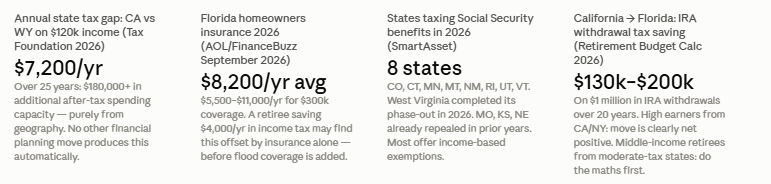
WSJ / Spritzler Report: 'Here's What It's Like to Retire to a Low-Tax State' — published September 12, 2026 (yesterday). 60% of retirees who move go to a more affordable area (2023 Vanguard study). Average home equity unlocked: ~$100,000. 9 states with no income tax: AK, FL, NV, NH, SD, TN, TX, WA, WY. 41 states do not tax Social Security; only 8 states still tax it in 2026. $130k–$200k: state tax saving from moving CA → FL on $1M in IRA withdrawals over 20 years. Florida home insurance: $5,500–$11,000/year for $300k coverage (~$8,200 avg, FinanceBuzz 2026). Realtor.com April 2026: hidden housing costs 'routinely erase' headline tax savings in no-income-tax states.
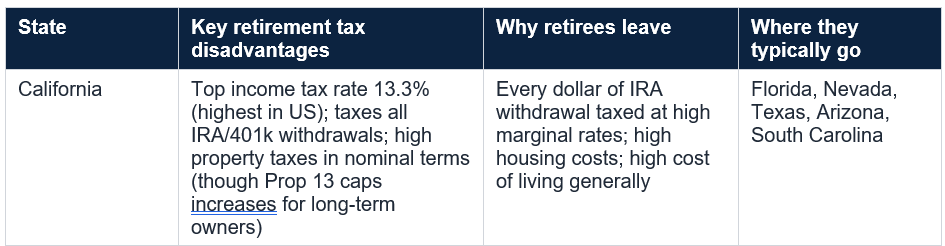
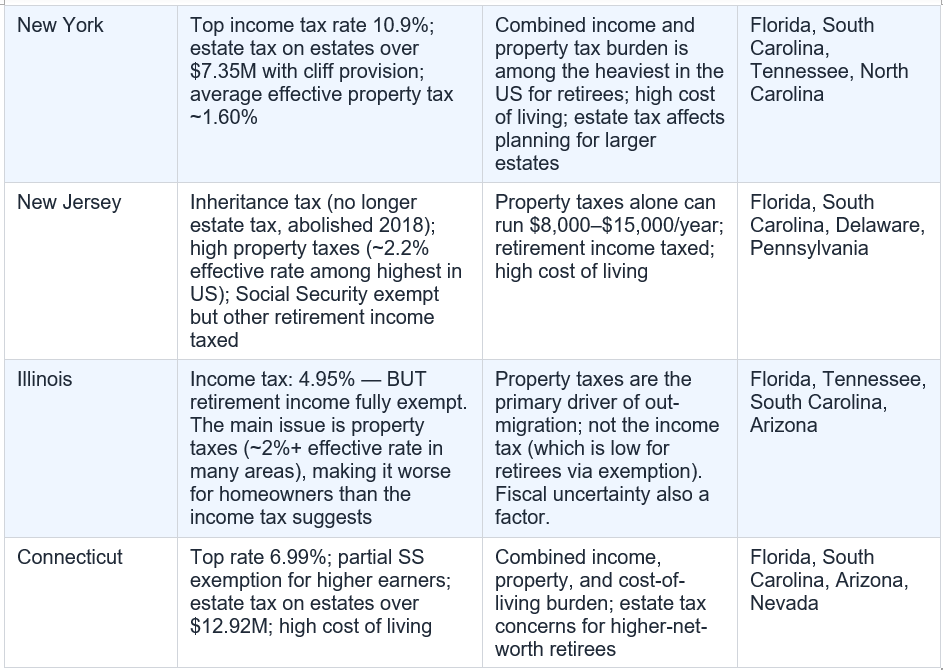
The states people are leaving: New York, California, New Jersey, Illinois, and Michigan consistently appear as the top origin states for retirees who relocate. All five combine high state income taxes with high property taxes, high housing costs, and — for New York, New Jersey, and Connecticut — estate or inheritance taxes that can affect what heirs eventually receive.
The Vanguard study, cited by the WSJ/Spritzler Report published yesterday, adds a dimension that most relocation analyses miss: the capital gains and equity extraction from selling a high-value home in a high-cost state before moving to a lower-cost one. A retiree selling a New Jersey home worth $650,000 and buying in South Carolina for $400,000 does not simply save on state income tax — they bank $250,000 in unlocked equity, which then generates its own investment income in retirement. The income tax saving is real but it may be secondary to the housing arbitrage.
The WSJ September 12, 2026 finding is not simply 'moving saves money.' It is more nuanced: moving tends to change the spending pattern, not just the tax bill. Some retirees who move to a no-income-tax state spend more on housing amenities, healthcare, travel, and leisure — because the state tax saving gives them permission to spend more elsewhere. The net financial benefit of the move varies significantly by individual spending priorities and lifestyle choices, not just by state income tax rates.
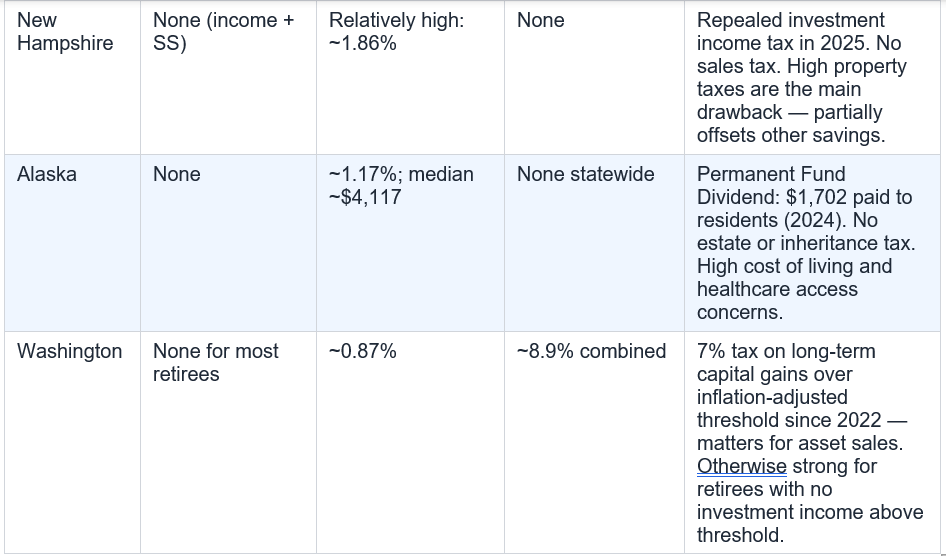
But within these nine states, the overall tax and cost picture varies considerably. The no-income-tax designation solves one problem while others remain — property taxes, sales taxes, and especially insurance costs create meaningful differences in total annual outgoings even within this group.
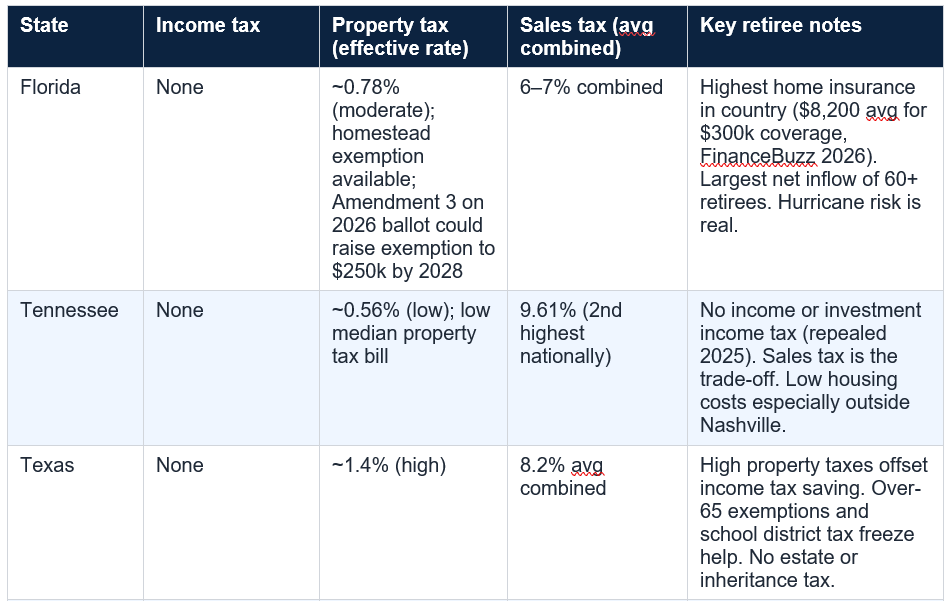
State Snapshot: Tennessee — Low Costs, High Sales Tax Tennessee ranks as one of the strongest overall retirement tax states. It has no income tax (and repealed its final investment income tax in 2025), no estate or inheritance tax, low property taxes, and low housing costs — especially outside the Nashville metropolitan area. For retirees not concentrated in urban centres, the total tax picture is genuinely attractive. The trade-off is visible every time a Tennessee resident goes to the shop: the average Tennessean pays 9.61% in sales tax — the second-highest combined rate in the country behind Louisiana (Motley Fool, Feb 2026). For retirees on a fixed income who spend heavily on goods and services, this partially offsets the income tax saving. Healthcare retirees and prescription-medication users benefit from the fact that most states, including Tennessee, exempt medications from sales tax. The real experience: Tennessee offers a genuinely lower cost of living alongside the tax benefits — making it one of the stronger all-in financial cases for relocation.
State Snapshot: South Carolina — High In-Migration for a Reason South Carolina's 1.97 in-to-out migration ratio (moveBuddha 2025) tells the story: nearly twice as many people are moving in as moving out. The state costs approximately 9% less to live in than the national average (RentCafe Sep 2025), with housing costs more than 14% below the national average. The median home value of $381,400 compares favourably to the national median of $435,285 (Redfin Sep 2025). On taxes: South Carolina exempts Social Security from state income tax and provides a $15,000 deduction on other retirement income for those 65 and older. It is not a no-income-tax state, but the combination of low cost of living, tax exemptions for retirees, warm climate, and housing affordability makes it one of the most compelling overall retirement destinations. Cities like Charleston, Greenville, and Beaufort offer cultural richness alongside the financial advantages — which is why planners at GOBankingRates/Yahoo Finance consistently rank it among the best balanced retirement choices.
State Snapshot: Nevada — Desert Calm, Low Total Tax Burden Nevada's retirement tax picture is among the cleanest: no income tax, no estate or inheritance taxes, very low property taxes (effective rate 0.49%, median annual bill just $1,937), and groceries and prescriptions exempt from sales tax. The combination produces a genuinely low total tax burden for retirees across virtually all income sources. The practical limitation is concentration: the two main metropolitan markets — Las Vegas and Reno — have seen significant housing cost increases, which can partially offset the tax saving for retirees buying in those markets. For retirees moving from high-cost coastal areas, the housing arbitrage still likely works. For those moving from mid-cost interior states, the housing savings may be less dramatic. Nevada's healthcare access is a consistent concern in more rural areas — a significant consideration for retirees who prioritise proximity to specialist medical care.
State Snapshot: Pennsylvania — The Unexpected Retirement-Friendly State Pennsylvania is the state that most surprises retirees from high-tax states: despite a 3.07% nominal income tax rate, the state provides a complete exemption on all retirement income — pensions, IRAs, 401(k)s, and Social Security are all fully exempt. The effective state income tax on a typical retiree's income is zero, even though the nominal rate is not. The trade-off is the inheritance tax: Pennsylvania charges 4.5% on assets passing to direct descendants, 12% to siblings, and 15% to others. For retirees with significant assets to pass on, this is the key drawback. On the positive side: Pennsylvania offers access to strong healthcare systems (Philadelphia, Pittsburgh, Hershey Medical Centre), four seasons, proximity to family for retirees whose children remain in the Northeast, and diverse communities. CFP Lynn Toomey notes (Yahoo Finance 2026): 'The best retirement state depends on how income, health, housing and lifestyle actually work together in real life' — and for many retirees, Pennsylvania's combination of practical proximity to healthcare and family, alongside its full retirement income exemption, scores well on that balanced test.
Realtor.com reported in April 2026 that hidden housing costs in no-income-tax states routinely erase the headline tax savings for retirees. FinanceBuzz (one week ago) puts the insurance reality in direct terms: a retiree saving $4,000 in income tax annually may find that quickly offset by the cost of property insurance alone — before adding flood coverage. A 2026 insurance estimate puts annual Florida flood coverage at $700–$900, with high-risk coastal properties costing much more. Homeowners insurance for $300,000 in coverage: $5,500–$11,000 annually in Florida.
The RetirementBudget.org May 2026 analysis provides the most dramatic example of the potential upside: a retiree moving from California to Florida before taking $1 million in IRA withdrawals over 20 years can save $130,000 to $200,000 in cumulative state taxes. At 5% of total IRA withdrawals, this is a meaningful but not overwhelming lifetime saving — and it must be set against: moving costs, estate planning update costs, insurance cost differential (Florida vs California homeowners insurance), property tax comparison, and the intangible costs of leaving established healthcare providers, family networks, and community.
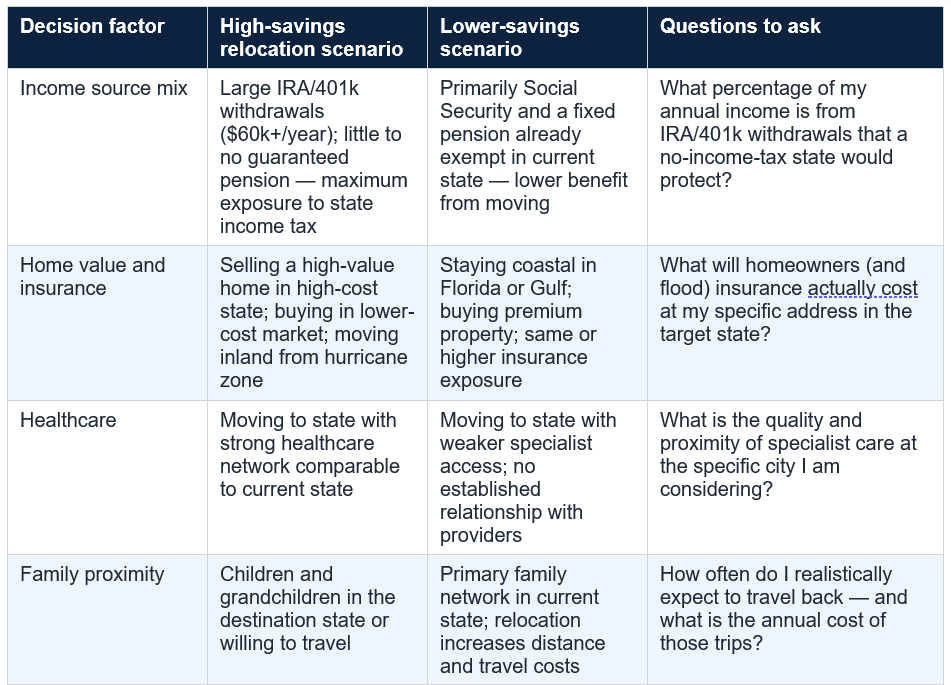
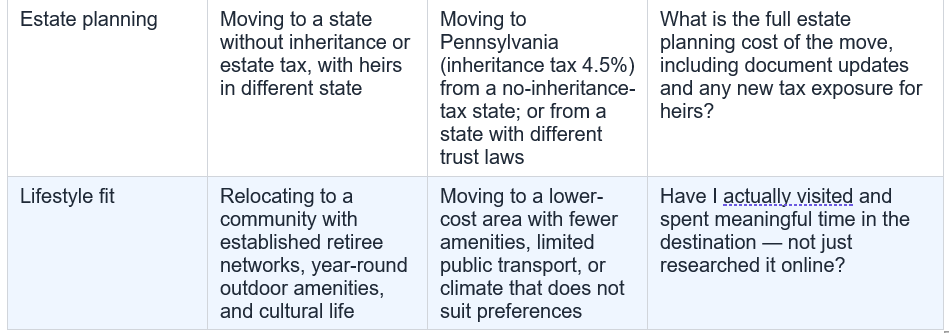
The following questions are the practical implementation of that advice:
The states with genuinely strong all-in retirement tax pictures in 2026 are Florida, Tennessee, Nevada, Wyoming, and South Dakota — all no-income-tax states with manageable total cost profiles for the right buyer in the right location. The hidden cost warnings are most acute for Florida specifically: insurance costs have risen nearly 50%, the cost-of-living index is above the national average, and Realtor.com reported in April 2026 that hidden housing costs in no-income-tax states routinely erase the headline tax savings.
The surprise strong performers — Pennsylvania, Mississippi, and Iowa — offer effective zero retirement income tax through exemptions rather than nominal zero rates, paired with healthcare access and lifestyle factors that matter more than the tax rate alone for many retirees.
The right approach is the one CFPs like Christopher Stroup and Lynn Toomey recommend: model the full picture — income, health, housing, and lifestyle — before the tax saving makes the decision for you. In the right circumstances, retiring to a low-tax state is one of the most powerful financial moves available in retirement planning. In the wrong circumstances, it is an expensive and disruptive way to break even.
Nine states have no state income tax in 2026: Alaska, Florida, Nevada, New Hampshire, South Dakota, Tennessee, Texas, Washington, and Wyoming. For retirees drawing from IRAs, 401(k)s, or pensions in these states, there is no state-level tax on those withdrawals. However, 'no income tax' is not the complete story — property taxes, sales taxes, insurance costs, and estate or inheritance taxes vary significantly within this group and can partially or fully offset the income tax saving. Washington state also imposes a 7% tax on long-term capital gains above an inflation-adjusted threshold, which can matter for retirees selling appreciated investments.
Which states do not tax Social Security in 2026?
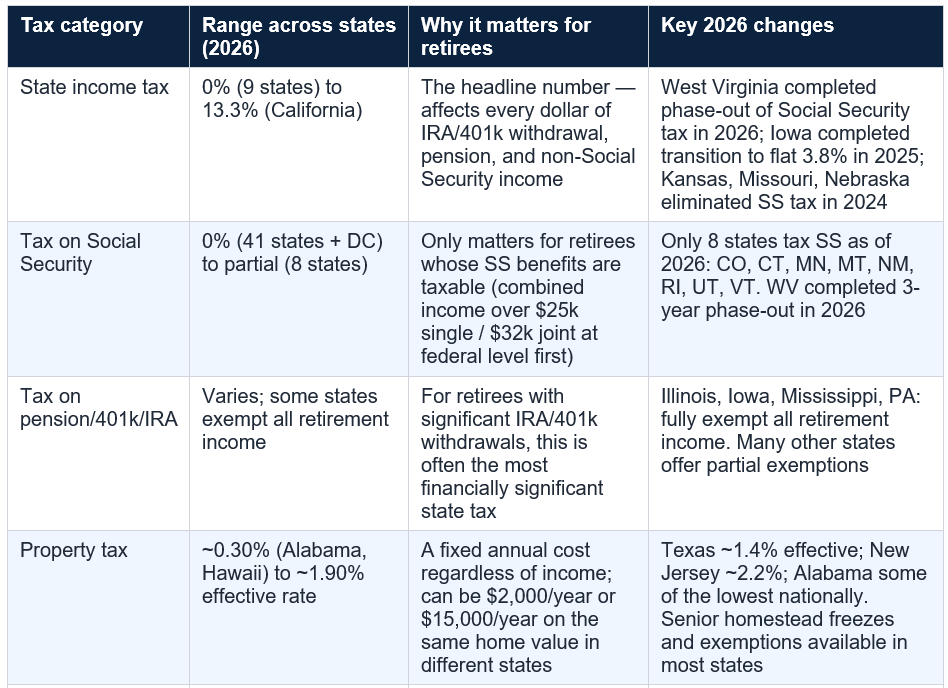
As of 2026, 41 states and the District of Columbia do not tax Social Security benefits. Only 8 states still tax Social Security in some form: Colorado, Connecticut, Minnesota, Montana, New Mexico, Rhode Island, Utah, and Vermont. Most of these offer income-based exemptions for lower-income retirees. West Virginia completed its three-year phase-out of Social Security taxation in 2026. Kansas, Missouri, and Nebraska also fully eliminated their Social Security taxes in 2024. Note: this is separate from federal taxation of Social Security, which applies in all states for beneficiaries with combined income above $25,000 (single) or $32,000 (joint).
How much can moving to a no-income-tax state actually save a retiree?
The saving depends almost entirely on your income sources and the tax rate in your origin state. RetirementBudget.org's May 2026 analysis estimates that a retiree moving from California to Florida before taking $1 million in IRA withdrawals over 20 years can save $130,000 to $200,000 in cumulative state taxes. For a retiree withdrawing $60,000 annually in a state with a 5–9% income tax, the annual saving from moving to a no-income-tax state is roughly $3,000 to $6,000. However, these figures must be weighed against: homeowners insurance costs (especially in Florida), property tax differences, sales tax costs, and moving expenses. The 2023 Vanguard study cited by the WSJ (September 12, 2026) found that 60% of retirees who move go to more affordable areas and unlock around $100,000 in home equity — often a larger financial benefit than the annual income tax saving alone.
Are there good low-tax retirement states that are not on the 'no income tax' list?
Yes — several states with nominal income tax rates offer complete exemptions on retirement income that produce an effective zero tax rate for typical retirees. Pennsylvania (3.07% rate) fully exempts all pensions, IRAs, 401(k)s, and Social Security — making it financially similar to a no-income-tax state for retirees drawing from retirement accounts. Mississippi fully exempts all retirement income. Illinois fully exempts retirement income (though high property taxes are a significant offset). Iowa (flat 3.8% since 2025) exempts retirement income for residents aged 55 and over. These states often provide additional benefits — lower insurance costs, stronger healthcare access, proximity to family — that make them compelling alternatives to the headline no-income-tax destinations.
What are the biggest hidden costs of retiring to Florida that can offset the tax savings?
Florida's income-tax saving is real, but several costs partially or fully offset it depending on individual circumstances. The most significant: (1) Homeowners insurance has risen nearly 50% due to hurricane risk, litigation history, and reinsurance costs — FinanceBuzz's 2026 estimate puts annual premiums at $5,500–$11,000 for $300,000 in coverage, averaging ~$8,200; a retiree saving $4,000 in income tax may pay an additional $3,000–$5,000 in insurance versus a lower-risk state. (2) Property taxes reset at purchase price — the Save Our Homes 3% cap protects existing owners but new buyers face assessment at their purchase price. (3) Florida's BEA cost-of-living index is 103.4, above the national average, meaning groceries, gas, and services typically cost more than in many 'high-tax' states. (4) Flood insurance adds $700–$900/year in many areas, significantly more in coastal high-risk zones. Realtor.com reported in April 2026 that hidden housing costs in no-income-tax states 'routinely erase' the headline tax savings for retirees.
Should I consult a financial adviser before moving to a low-tax state for retirement?
Strongly yes — and specifically a fee-only fiduciary CFP who is familiar with both your current state and the destination state. Kiplinger's CFP author (article published two weeks ago) notes that after walking clients through taxes, income, healthcare, housing, estate planning, and family considerations, 'the answer usually gets a lot clearer — and it isn't always the one they expected when they first asked about moving to Florida.' Key questions a CFP can help model: the specific annual income tax saving based on your actual income sources; the full-year cost comparison including insurance, property tax, and sales tax; the estate planning implications including will updates and any new inheritance tax exposure; and whether Roth conversion strategies in your current state might achieve similar financial outcomes without the disruption of moving. The CFP's fee for this analysis is almost always recovered many times over in the clarity it provides.
Table of Contents
- The Low-Tax State Dream — and the Reality
- What the 2026 Data Actually Shows About Retiree Relocation
- The Tax Landscape: What Each State Actually Takes
- The Nine No-Income-Tax States: Who Wins for Retirees?
- State Snapshots: The Real Experience in Five Top States
- The Hidden Costs That Can Erase the Tax Savings
- The States That Are Surprisingly Good Without Zero Income Tax
- The High-Tax States Retirees Are Leaving — and Why
- The Full Calculation: Tax Savings vs Total Cost of Move
- Before You Move: The Questions Every Retiree Should Ask
- Conclusion: Tax Is One Factor, Not the Only One
- Frequently Asked Questions
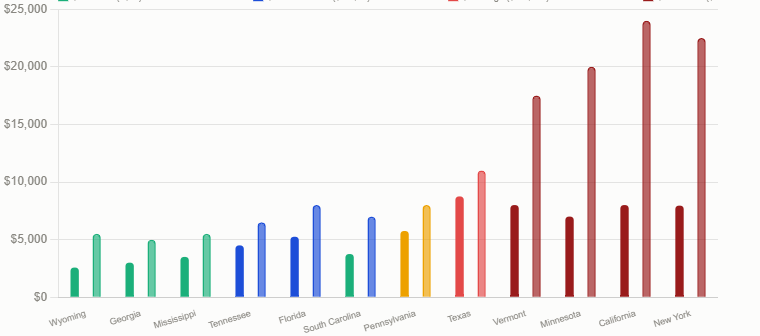
Total State Tax Burden: 12 States At $60k and $120k
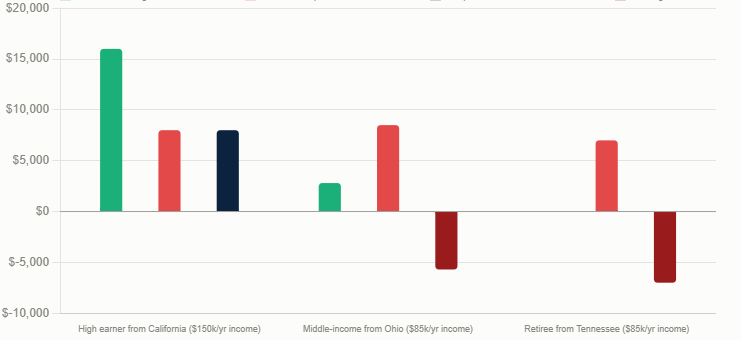
The Florida Equation: Income Tax Savings vs Hidden Cost
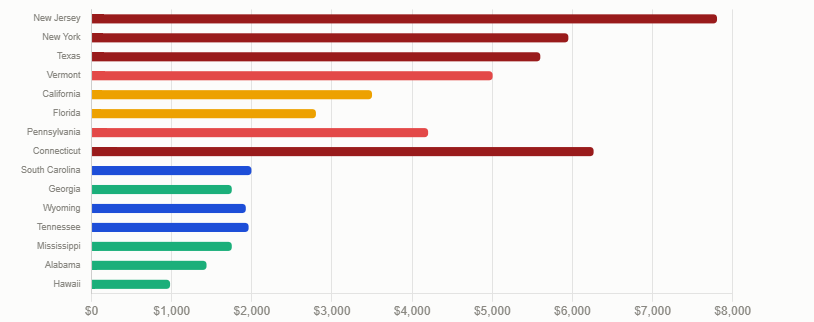
Property tax: The Rate That Often Undoes The Income Tax Savings
The Low-Tax State Dream — and the Reality
The dream is simple: retire from a high-tax state like New York, California, or Illinois; move to Florida, Tennessee, or Nevada; stop paying state income tax on your Social Security, pension, and IRA withdrawals; and stretch your nest egg by thousands of dollars every year. The maths, on paper, are compelling. A retiree drawing $60,000 annually from a 401(k) in California — subject to the state's up-to-13.3% income tax — could save between $3,000 and $6,000 per year by moving to a no-income-tax state. Over 20 years, at $130,000 to $200,000 in cumulative state tax saved on $1 million in IRA withdrawals, the financial case for moving looks unambiguous.The Wall Street Journal published an article on exactly this subject just yesterday — September 12, 2026 — under the headline 'Here's What It's Like to Retire to a Low-Tax State.' Its central finding, drawn from a 2023 Vanguard study, captures the nuance that the headline tax saving misses: about 60% of retirees who move after retiring go to a more affordable area, pocketing capital gains from their house and unlocking around $100,000 in home equity. For some, total spending remains almost the same, or even rises — but the funds shift toward upgraded amenities or travel. The saving exists. But it is not always what the income tax number alone suggests.
Meanwhile, Kiplinger published a CFP-authored guide two weeks ago titled 'Is Retiring to a Low-Tax State Really Worth It?' with a frank conclusion: 'Unexpected costs could outweigh your tax savings, so it could be smarter to explore tax planning strategies that would let you stay right where you are.' And 247wallst.com ran an account three weeks ago of retirees who moved to Florida for zero income tax — only to find that property insurance and special assessments consumed the entire tax saving and then some.
The reality, in 2026, is more textured than the headline. This guide provides the complete picture.
WSJ / Spritzler Report: 'Here's What It's Like to Retire to a Low-Tax State' — published September 12, 2026 (yesterday). 60% of retirees who move go to a more affordable area (2023 Vanguard study). Average home equity unlocked: ~$100,000. 9 states with no income tax: AK, FL, NV, NH, SD, TN, TX, WA, WY. 41 states do not tax Social Security; only 8 states still tax it in 2026. $130k–$200k: state tax saving from moving CA → FL on $1M in IRA withdrawals over 20 years. Florida home insurance: $5,500–$11,000/year for $300k coverage (~$8,200 avg, FinanceBuzz 2026). Realtor.com April 2026: hidden housing costs 'routinely erase' headline tax savings in no-income-tax states.
What the 2026 Data Actually Shows About Retiree Relocation
The data on retiree migration in 2025–2026 shows sustained movement toward low-tax, lower-cost Sun Belt states. Florida continues to attract the largest net inflow of residents aged 60 and older among all states. South Carolina recorded a 1.97 in-to-out migration ratio in moveBuddha's 2025 report — nearly double the arrivals versus departures — capturing 13.7% of net move-related searches. Texas saw a 5.3% increase in retiree moves in recent data. Arizona increased retiree moves by 18% compared to pre-recession baselines.The states people are leaving: New York, California, New Jersey, Illinois, and Michigan consistently appear as the top origin states for retirees who relocate. All five combine high state income taxes with high property taxes, high housing costs, and — for New York, New Jersey, and Connecticut — estate or inheritance taxes that can affect what heirs eventually receive.
The Vanguard study, cited by the WSJ/Spritzler Report published yesterday, adds a dimension that most relocation analyses miss: the capital gains and equity extraction from selling a high-value home in a high-cost state before moving to a lower-cost one. A retiree selling a New Jersey home worth $650,000 and buying in South Carolina for $400,000 does not simply save on state income tax — they bank $250,000 in unlocked equity, which then generates its own investment income in retirement. The income tax saving is real but it may be secondary to the housing arbitrage.
The WSJ September 12, 2026 finding is not simply 'moving saves money.' It is more nuanced: moving tends to change the spending pattern, not just the tax bill. Some retirees who move to a no-income-tax state spend more on housing amenities, healthcare, travel, and leisure — because the state tax saving gives them permission to spend more elsewhere. The net financial benefit of the move varies significantly by individual spending priorities and lifestyle choices, not just by state income tax rates.
The Tax Landscape: What Each State Actually Takes
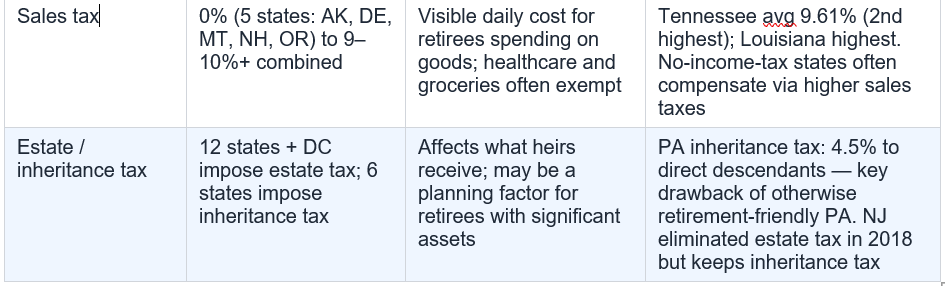
State taxes in retirement fall into six categories, each of which affects different retirees differently. Understanding the full matrix — not just the income tax rate — is the starting point for an honest relocation analysis.
4. The Nine No-Income-Tax States: Who Wins for Retirees?
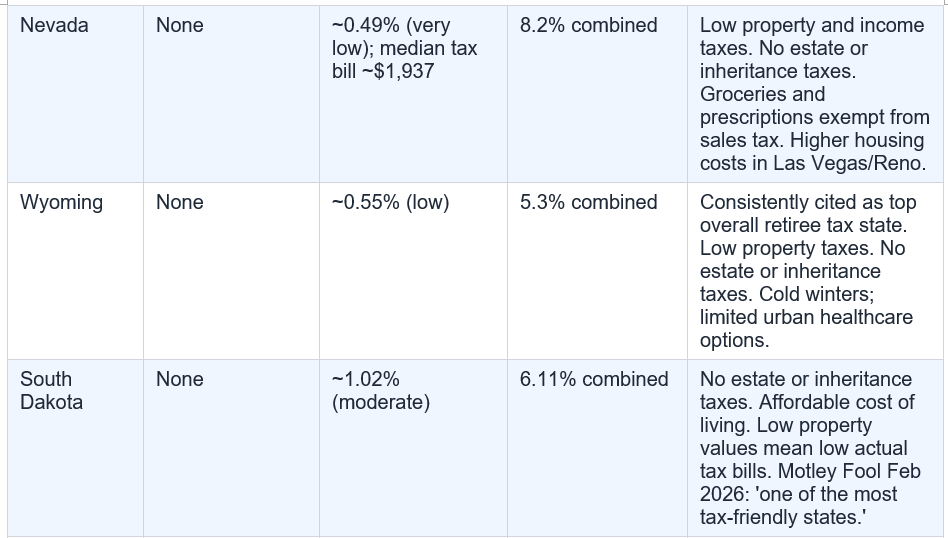
Nine states impose no income tax at all — Alaska, Florida, Nevada, New Hampshire, South Dakota, Tennessee, Texas, Washington, and Wyoming. For a retiree drawing primarily from an IRA or 401(k), this is the most straightforward financial benefit available from state selection: every dollar of withdrawal avoids state income tax entirely, with no phase-outs, no exemptions to apply for, and no complexity.But within these nine states, the overall tax and cost picture varies considerably. The no-income-tax designation solves one problem while others remain — property taxes, sales taxes, and especially insurance costs create meaningful differences in total annual outgoings even within this group.
State Snapshots: The Real Experience in Five Top States
State Snapshot: Florida — The Dream and the Trade-Off Florida consistently attracts the largest net inflow of 60+ retirees. The no-income-tax benefit is immediate and real: a retiree withdrawing $60,000 annually from an IRA saves between $3,000 and $6,000 per year compared to living in a state with a 5–9% income tax. The homestead exemption — $50,722 in 2026, now indexed to inflation following Amendment 5 — reduces the taxable property value, and Florida voters will decide in November 2026 whether to raise it further to $150,000 (in 2027) and $250,000 (in 2028) for qualifying properties. The real experience: 247wallst.com (three weeks ago) documented retirees who moved to Florida for zero income tax — only to find property insurance and special assessments consumed the tax saving entirely. Home insurance for $300,000 in coverage runs $5,500–$11,000 annually (averaging ~$8,200 per FinanceBuzz's 2026 estimate), up nearly 50% due to hurricane risks. Florida's BEA cost-of-living index is 103.4 — slightly above the national average. Groceries, gas, and services cost more than advertised. The honest assessment: Florida works exceptionally well for retirees who plan housing and insurance carefully, especially those choosing inland or secondary markets over premium coastal locations. It does not work as a cost-saving guarantee for retirees who rely solely on the income tax saving without stress-testing their total budget.State Snapshot: Tennessee — Low Costs, High Sales Tax Tennessee ranks as one of the strongest overall retirement tax states. It has no income tax (and repealed its final investment income tax in 2025), no estate or inheritance tax, low property taxes, and low housing costs — especially outside the Nashville metropolitan area. For retirees not concentrated in urban centres, the total tax picture is genuinely attractive. The trade-off is visible every time a Tennessee resident goes to the shop: the average Tennessean pays 9.61% in sales tax — the second-highest combined rate in the country behind Louisiana (Motley Fool, Feb 2026). For retirees on a fixed income who spend heavily on goods and services, this partially offsets the income tax saving. Healthcare retirees and prescription-medication users benefit from the fact that most states, including Tennessee, exempt medications from sales tax. The real experience: Tennessee offers a genuinely lower cost of living alongside the tax benefits — making it one of the stronger all-in financial cases for relocation.
State Snapshot: South Carolina — High In-Migration for a Reason South Carolina's 1.97 in-to-out migration ratio (moveBuddha 2025) tells the story: nearly twice as many people are moving in as moving out. The state costs approximately 9% less to live in than the national average (RentCafe Sep 2025), with housing costs more than 14% below the national average. The median home value of $381,400 compares favourably to the national median of $435,285 (Redfin Sep 2025). On taxes: South Carolina exempts Social Security from state income tax and provides a $15,000 deduction on other retirement income for those 65 and older. It is not a no-income-tax state, but the combination of low cost of living, tax exemptions for retirees, warm climate, and housing affordability makes it one of the most compelling overall retirement destinations. Cities like Charleston, Greenville, and Beaufort offer cultural richness alongside the financial advantages — which is why planners at GOBankingRates/Yahoo Finance consistently rank it among the best balanced retirement choices.
State Snapshot: Nevada — Desert Calm, Low Total Tax Burden Nevada's retirement tax picture is among the cleanest: no income tax, no estate or inheritance taxes, very low property taxes (effective rate 0.49%, median annual bill just $1,937), and groceries and prescriptions exempt from sales tax. The combination produces a genuinely low total tax burden for retirees across virtually all income sources. The practical limitation is concentration: the two main metropolitan markets — Las Vegas and Reno — have seen significant housing cost increases, which can partially offset the tax saving for retirees buying in those markets. For retirees moving from high-cost coastal areas, the housing arbitrage still likely works. For those moving from mid-cost interior states, the housing savings may be less dramatic. Nevada's healthcare access is a consistent concern in more rural areas — a significant consideration for retirees who prioritise proximity to specialist medical care.
State Snapshot: Pennsylvania — The Unexpected Retirement-Friendly State Pennsylvania is the state that most surprises retirees from high-tax states: despite a 3.07% nominal income tax rate, the state provides a complete exemption on all retirement income — pensions, IRAs, 401(k)s, and Social Security are all fully exempt. The effective state income tax on a typical retiree's income is zero, even though the nominal rate is not. The trade-off is the inheritance tax: Pennsylvania charges 4.5% on assets passing to direct descendants, 12% to siblings, and 15% to others. For retirees with significant assets to pass on, this is the key drawback. On the positive side: Pennsylvania offers access to strong healthcare systems (Philadelphia, Pittsburgh, Hershey Medical Centre), four seasons, proximity to family for retirees whose children remain in the Northeast, and diverse communities. CFP Lynn Toomey notes (Yahoo Finance 2026): 'The best retirement state depends on how income, health, housing and lifestyle actually work together in real life' — and for many retirees, Pennsylvania's combination of practical proximity to healthcare and family, alongside its full retirement income exemption, scores well on that balanced test.
The Hidden Costs That Can Erase the Tax Savings
The Kiplinger article published two weeks ago asks the most important question in the retirement relocation debate: 'Is Retiring to a Low-Tax State Really Worth It?' The article's CFP author — drawing on 20 years of advising clients — answers with a qualified 'sometimes.' The hidden costs that can undermine the financial case are specific and measurable.Realtor.com reported in April 2026 that hidden housing costs in no-income-tax states routinely erase the headline tax savings for retirees. FinanceBuzz (one week ago) puts the insurance reality in direct terms: a retiree saving $4,000 in income tax annually may find that quickly offset by the cost of property insurance alone — before adding flood coverage. A 2026 insurance estimate puts annual Florida flood coverage at $700–$900, with high-risk coastal properties costing much more. Homeowners insurance for $300,000 in coverage: $5,500–$11,000 annually in Florida.
- Homeowners insurance: Florida's insurance costs have risen nearly 50% due to hurricane risk, litigation history, and reinsurance costs (Kiplinger May 2026). A $4,000 annual income tax saving can be entirely consumed by the insurance premium gap between Florida and a lower-risk state like Georgia or the Carolinas.
- Property taxes reset on purchase: the previous owner's property tax bill is not your own. A home that was assessed years ago at a much lower value will be reassessed at your purchase price. Florida's Save Our Homes cap (3% annual assessed value growth) protects existing owners but does not protect new buyers until they file for homestead exemption.
- Sales tax accumulation: in Tennessee (9.61%) or Texas (8.2% combined), the cumulative sales tax cost on a typical retiree's annual spending can reach $1,500–$3,000 per year — partially offsetting the income tax saving for retirees coming from low-sales-tax states.
- Healthcare access and costs: Kiplinger's Delaware vs Florida comparison (published two weeks ago) notes that for some retirees, the appeal of a retirement state is not the lowest income tax rate — it is what happens when all smaller pieces of the budget add up. Access to major medical centres, specialist care, and familiar healthcare networks has an economic value that does not appear in a tax comparison.
- Moving costs: a long-distance interstate move can cost $5,000–$15,000 or more. For retirees considering a move purely for the income tax saving of $3,000–$6,000 per year, the break-even period before the move pays for itself is 1–5 years — during which any lifestyle disruption, care costs, or unexpected expenses can delay or eliminate the realised saving.
- Estate planning costs: moving to a new state requires updating every legal document — will, power of attorney, healthcare directive — to reflect the new state's laws. Legal fees for this update can run $1,000–$5,000, depending on estate complexity. Some states also require re-titling of vehicles, property, and trust documents.
The States That Are Surprisingly Good Without Zero Income Tax
The instinct to focus only on the nine no-income-tax states misses several states that produce excellent retirement tax outcomes through a different route: generous exemptions for retirement income specifically, which can produce an effective zero state income tax on a typical retiree's income despite a nominal tax rate.- Pennsylvania (3.07% nominal rate, zero effective rate on retirement income): full exemption on pensions, IRAs, 401(k)s, and Social Security. The only significant drawback is the inheritance tax on wealth transfer. For retirees drawing entirely from retirement accounts, the effective state tax is the same as Florida — zero — while offering far lower homeowners insurance costs, strong healthcare access, and proximity to Northeast family networks.
- Mississippi (full retirement income exemption, 4.7% top rate for other income): all retirement income — pensions, IRAs, Social Security, 401(k)s — is completely exempt. Low cost of living and among the lowest property taxes nationally. Healthcare quality is a concern in more rural areas — but for retirement income tax purposes, Mississippi is functionally equivalent to a no-income-tax state.
- Illinois (flat 4.95% rate, full retirement income exemption): all retirement income exempt from state income tax. The significant trade-off is property taxes — among the highest effective rates in the country, typically 2.0–2.5% in suburban areas. The property tax burden can substantially offset the income tax exemption for homeowners in higher-value areas, but renters benefit cleanly from the retirement income exemption without the property tax exposure.
- Iowa (flat 3.8% rate effective 2025, no tax on retirement income for 55+): completed transition to a flat income tax in 2025, eliminated inheritance tax, and residents aged 55 and older pay no income tax on retirement income. Property taxes are on the higher end but lower property values offset the median bill. A state in transition that has significantly improved its retirement tax profile.
The High-Tax States Retirees Are Leaving — and Why
The states consistently losing retirees to out-migration are those that combine high income taxes on retirement income with high property taxes, high cost of living, and no meaningful exemptions for retirees.
The Full Calculation: Tax Savings vs Total Cost of Move
The Kiplinger Delaware vs Florida comparison (published two weeks ago) provides a useful framework for the total-cost calculation that every prospective relocating retiree should complete. The article assumes a $500,000 primary residence, $500,000 in homeowners insurance dwelling coverage, and $20,000 in annual taxable purchases. It notes: 'Before choosing a retirement destination, consider the sometimes seemingly hidden costs that follow you into retirement — including how retirement income is taxed, what you'll pay to own a home, and how much you plan to spend each year.'The RetirementBudget.org May 2026 analysis provides the most dramatic example of the potential upside: a retiree moving from California to Florida before taking $1 million in IRA withdrawals over 20 years can save $130,000 to $200,000 in cumulative state taxes. At 5% of total IRA withdrawals, this is a meaningful but not overwhelming lifetime saving — and it must be set against: moving costs, estate planning update costs, insurance cost differential (Florida vs California homeowners insurance), property tax comparison, and the intangible costs of leaving established healthcare providers, family networks, and community.
Before You Move: The Questions Every Retiree Should Ask
CFP Christopher Stroup's advice to Yahoo Finance (2026) is the best single-sentence framework for the relocation decision: balance savings 'alongside access to family, healthcare quality, transportation and community engagement.' His colleague Lynn Toomey adds the most important reality check: 'The best retirement state depends on how income, health, housing and lifestyle actually work together in real life.'The following questions are the practical implementation of that advice:
- • Get a specific, addressed insurance quote — not a state average: homeowners insurance in Florida varies enormously by county, carrier, roof age, and elevation. A statewide average means little for your specific property. Quote your address before making any financial projections.
- • Calculate your TOTAL tax burden, not just income tax: take your anticipated annual retirement income, apply each state's full tax framework — income tax, property tax, sales tax — and compare the totals. A no-income-tax state with a 9.61% sales tax and 1.4% property tax may produce a higher total tax burden for some retirees than a moderate-income-tax state with low property and sales taxes.
- • Account for the Roth IRA alternative: Kiplinger's CFP author notes that before relocating, retirees should consider whether Roth conversions in their current state — paying state income tax now to avoid it in retirement — might produce a better outcome than moving. In some high-tax states, a Roth conversion strategy combined with staying put can approach the financial benefit of relocating.
- • Visit in the summer, not just the winter: a retirement destination that feels perfect in January may feel very different in August. Florida's heat and humidity, Tennessee's summers, and Texas's heat are real quality-of-life variables that matter for daily comfort across a 25-to-30-year retirement.
- • Check healthcare access specifically: 'Retirees also underestimate future care costs and mobility needs, which can quickly offset initial savings' (Christopher Stroup, GOBankingRates/Yahoo Finance 2026). Access to a major medical centre, specialist care networks, and familiar insurance coverage in the destination state has financial and quality-of-life value that the income tax comparison does not capture.
- • Talk to a CFP who is licensed in both your current and destination state: a financial planner who practices in only one state may not know the full tax picture in the other. A fee-only fiduciary planner who works with interstate relocations can model your specific income, assets, and projected spending across both states.
Conclusion
The WSJ's September 12, 2026 article on what it is actually like to retire to a low-tax state lands on a conclusion that resonates with everything the data shows: for about 60% of retirees who move, the financial outcome is genuinely positive — they moved to a more affordable area, freed up home equity, and reduced their annual tax bill. For others, total spending stayed roughly the same, but the composition shifted toward better amenities, more travel, and more choice.The states with genuinely strong all-in retirement tax pictures in 2026 are Florida, Tennessee, Nevada, Wyoming, and South Dakota — all no-income-tax states with manageable total cost profiles for the right buyer in the right location. The hidden cost warnings are most acute for Florida specifically: insurance costs have risen nearly 50%, the cost-of-living index is above the national average, and Realtor.com reported in April 2026 that hidden housing costs in no-income-tax states routinely erase the headline tax savings.
The surprise strong performers — Pennsylvania, Mississippi, and Iowa — offer effective zero retirement income tax through exemptions rather than nominal zero rates, paired with healthcare access and lifestyle factors that matter more than the tax rate alone for many retirees.
The right approach is the one CFPs like Christopher Stroup and Lynn Toomey recommend: model the full picture — income, health, housing, and lifestyle — before the tax saving makes the decision for you. In the right circumstances, retiring to a low-tax state is one of the most powerful financial moves available in retirement planning. In the wrong circumstances, it is an expensive and disruptive way to break even.
Frequently Asked Questions
Which states have no income tax in 2026?Nine states have no state income tax in 2026: Alaska, Florida, Nevada, New Hampshire, South Dakota, Tennessee, Texas, Washington, and Wyoming. For retirees drawing from IRAs, 401(k)s, or pensions in these states, there is no state-level tax on those withdrawals. However, 'no income tax' is not the complete story — property taxes, sales taxes, insurance costs, and estate or inheritance taxes vary significantly within this group and can partially or fully offset the income tax saving. Washington state also imposes a 7% tax on long-term capital gains above an inflation-adjusted threshold, which can matter for retirees selling appreciated investments.
Which states do not tax Social Security in 2026?
As of 2026, 41 states and the District of Columbia do not tax Social Security benefits. Only 8 states still tax Social Security in some form: Colorado, Connecticut, Minnesota, Montana, New Mexico, Rhode Island, Utah, and Vermont. Most of these offer income-based exemptions for lower-income retirees. West Virginia completed its three-year phase-out of Social Security taxation in 2026. Kansas, Missouri, and Nebraska also fully eliminated their Social Security taxes in 2024. Note: this is separate from federal taxation of Social Security, which applies in all states for beneficiaries with combined income above $25,000 (single) or $32,000 (joint).
How much can moving to a no-income-tax state actually save a retiree?
The saving depends almost entirely on your income sources and the tax rate in your origin state. RetirementBudget.org's May 2026 analysis estimates that a retiree moving from California to Florida before taking $1 million in IRA withdrawals over 20 years can save $130,000 to $200,000 in cumulative state taxes. For a retiree withdrawing $60,000 annually in a state with a 5–9% income tax, the annual saving from moving to a no-income-tax state is roughly $3,000 to $6,000. However, these figures must be weighed against: homeowners insurance costs (especially in Florida), property tax differences, sales tax costs, and moving expenses. The 2023 Vanguard study cited by the WSJ (September 12, 2026) found that 60% of retirees who move go to more affordable areas and unlock around $100,000 in home equity — often a larger financial benefit than the annual income tax saving alone.
Are there good low-tax retirement states that are not on the 'no income tax' list?
Yes — several states with nominal income tax rates offer complete exemptions on retirement income that produce an effective zero tax rate for typical retirees. Pennsylvania (3.07% rate) fully exempts all pensions, IRAs, 401(k)s, and Social Security — making it financially similar to a no-income-tax state for retirees drawing from retirement accounts. Mississippi fully exempts all retirement income. Illinois fully exempts retirement income (though high property taxes are a significant offset). Iowa (flat 3.8% since 2025) exempts retirement income for residents aged 55 and over. These states often provide additional benefits — lower insurance costs, stronger healthcare access, proximity to family — that make them compelling alternatives to the headline no-income-tax destinations.
What are the biggest hidden costs of retiring to Florida that can offset the tax savings?
Florida's income-tax saving is real, but several costs partially or fully offset it depending on individual circumstances. The most significant: (1) Homeowners insurance has risen nearly 50% due to hurricane risk, litigation history, and reinsurance costs — FinanceBuzz's 2026 estimate puts annual premiums at $5,500–$11,000 for $300,000 in coverage, averaging ~$8,200; a retiree saving $4,000 in income tax may pay an additional $3,000–$5,000 in insurance versus a lower-risk state. (2) Property taxes reset at purchase price — the Save Our Homes 3% cap protects existing owners but new buyers face assessment at their purchase price. (3) Florida's BEA cost-of-living index is 103.4, above the national average, meaning groceries, gas, and services typically cost more than in many 'high-tax' states. (4) Flood insurance adds $700–$900/year in many areas, significantly more in coastal high-risk zones. Realtor.com reported in April 2026 that hidden housing costs in no-income-tax states 'routinely erase' the headline tax savings for retirees.
Should I consult a financial adviser before moving to a low-tax state for retirement?
Strongly yes — and specifically a fee-only fiduciary CFP who is familiar with both your current state and the destination state. Kiplinger's CFP author (article published two weeks ago) notes that after walking clients through taxes, income, healthcare, housing, estate planning, and family considerations, 'the answer usually gets a lot clearer — and it isn't always the one they expected when they first asked about moving to Florida.' Key questions a CFP can help model: the specific annual income tax saving based on your actual income sources; the full-year cost comparison including insurance, property tax, and sales tax; the estate planning implications including will updates and any new inheritance tax exposure; and whether Roth conversion strategies in your current state might achieve similar financial outcomes without the disruption of moving. The CFP's fee for this analysis is almost always recovered many times over in the clarity it provides.

0 Comments Comments