

Retirement
Pension Mistakes That Could Cost You Tens of Thousands
£31.1 billion sits in lost pension pots. Millions of workers stay on minimum contributions for their entire careers. A single investment strategy error in the decade before retirement can cost £163,000. These are not edge cases — they are the default outcomes for people who never engage with their pension. This guide names the eight most costly pension mistakes, puts a price tag on each one, and tells you exactly what to do instead.

The scale of the problem is significant. The Pensions Policy Institute estimates that £31.1 billion sits in an estimated 3.3 million lost and unclaimed UK pension pots — up from £26 billion two years ago (cited Hargreaves Lansdown and Delphina.money, August 2026). The Investors Centre (July 2026) estimates that 43% of working-age people — approximately 14.6 million — are currently undersaving for retirement against target replacement rates. The median pension pot for someone aged 55–64 is £137,800, which at a 4% withdrawal rate produces only £5,512 per year. Combined with the full State Pension of £12,547.60, the typical pre-retirement household is looking at approximately £18,000 a year — below the PLSA's minimum retirement standard for a single person outside London.
None of this is inevitable. The eight mistakes in this guide are all avoidable. Most are reversible if caught early enough. And the financial difference between making them and avoiding them can run to tens — sometimes hundreds — of thousands of pounds.
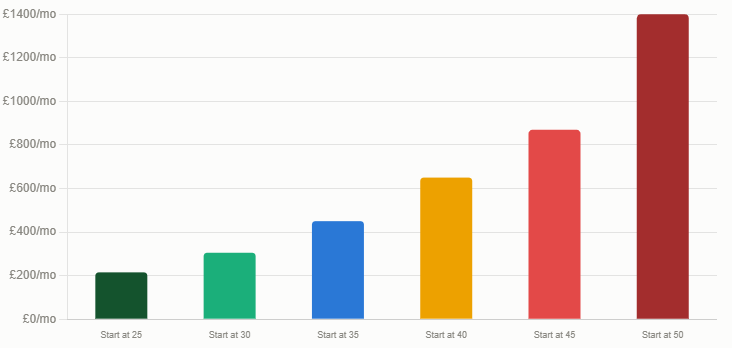
£31.1bn in 3.3 million lost/unclaimed pension pots (PPI, cited HL/Delphina Aug 2026). 43% of working-age people undersaving (14.6m; The Investors Centre, Jul 2026). Median pot aged 55–64: £137,800 = £5,512/yr at 4% withdrawal. Lifestyling mistake alone: can cost £163,000 on median auto-enrolment contributions (GB News, Aug 2026). Delaying from age 25 to 45: cost of same retirement income rises from £215/month to £870/month — 4× more expensive (The Investors Centre, Apr 2026).
The average UK worker changes jobs 11 times during their career. Each job change is an opportunity to leave behind a workplace pension — and the evidence shows that millions do exactly that. The Pensions Policy Institute now estimates 3.3 million lost or unclaimed pension pots worth £31.1 billion in total. The average lost pot size for those aged 55–75 — the generation most likely to have accumulated multiple old pots — is £13,620 (Hargreaves Lansdown). That is not a trivial sum to have simply misplaced.
The mechanism is straightforward: auto-enrolment creates a new pension for you with each employer, but when you leave, the pot becomes a deferred pension. If you move address or change name and do not update the pension provider, the paper trail breaks. Pensions cannot normally be accessed until age 57 from 2028, meaning they genuinely do fall to the back of people's minds for years or decades.
The cost of this mistake: Lost pots are not just sitting idle — many are quietly being eroded by annual management charges. A small deferred pot of £2,000 with a 1.5% annual management charge loses £30 per year to fees, even if no contributions are being made. Over 20 years of deferral with no growth, the charge alone could eliminate a significant portion of the pot. The Pensions Policy Institute noted that a £100 pot with a flat fee combination can be depleted to zero within six years.
Use the government's free Pension Tracing Service at gov.uk/find-pension-contact-details. It searches the database of all registered UK pension schemes and provides contact details for old providers. Also check: old payslips, P60s, and letters from former employers. Once found, consider consolidating small pots into your current scheme or a personal SIPP — but check for protected benefits (guaranteed annuity rates, final salary links) before transferring, as these can be valuable and are lost on transfer.
Auto-enrolment was one of the most successful behavioural policy interventions in UK financial history — it brought millions of workers into pension saving who had never saved before. But its success in getting people enrolled has obscured a critical limitation: the minimum contribution rate of 8% of qualifying earnings is not enough.
The Investors Centre (July 2026) makes the arithmetic explicit: 'The most important number in this whole page is £215 a month — the cost of a moderate single retirement if you start at age 25, versus £870 if you start at 45. Four times the monthly cost for the same outcome.' For most workers, 8% of qualifying earnings falls well short of £215 a month when they are young — meaning the default already puts them behind the minimum rate required for a moderate retirement.
GB News (August 11, 2026) puts a specific figure on the cost of staying minimum: a worker on median earnings contributing the minimum 8% (approximately £132.80 per month, adjusted for 3% wage inflation) over a 40-year career at 6% annual return accumulates close to £395,500. That is a reasonable outcome. The mistake is not the minimum contribution per se — it is never reviewing or increasing it as income rises, career progresses, and retirement approaches.
The experts are consistent on this point. GB News (June 18, 2026) quoted pension expert Robinson: 'A third significant mistake sees employees remaining on minimum auto-enrolment contribution levels for their entire working lives without ever reassessing them.'
The minimum contribution is a starting point, not a destination. Increasing contributions by just 1% of salary per year — a sum most workers barely notice in take-home pay — compounds into a dramatically larger pot over a 30–40 year career. For a worker earning £35,000 contributing an extra 2% (£700/year), the additional pot at retirement at 6% growth over 30 years is approximately £55,000. That is £55,000 for an increase that costs around £58/month after basic-rate tax relief.
Log in to your workplace pension provider's online portal today. Find your current contribution rate. If it is at the auto-enrolment minimum (5% employee), increase it by 1–2% now and set a reminder to review it again in 12 months. If your employer offers enhanced matching above the minimum (e.g., matches up to 6% if you contribute 6%), increase your contributions to at least the match threshold — see Mistake 3.
The auto-enrolment minimum requires employers to contribute at least 3% of qualifying earnings. But many employers — particularly larger organisations and those competing for talent — offer enhanced matching. A typical enhanced arrangement might offer: 'We will match your contributions up to 8% of salary.' If you contribute only 5% (the minimum), the employer contributes 3%. If you contribute 8%, the employer contributes 8%. The difference — 5% of salary — is additional compensation that costs the employee nothing beyond their own increased contribution.
For a worker earning £40,000, the difference between capturing and not capturing a 5% employer match is £2,000 per year of additional employer pension contributions. Over 20 years at 6% annual growth, that uncaptured employer match grows to approximately £73,000 in additional pension wealth. For most employees, capturing the full employer match is the single highest-return action available — it produces an instant 100% return on the matched portion of contributions before any investment growth.
Money tip: Call or email your HR department this week and ask: 'Does our pension scheme offer any matching above the statutory minimum, and at what contribution level is it maximised?' Many employees have never asked this question and do not know the answer. If enhanced matching exists, calculate the contribution level required to capture it and set that as your minimum. Every pound of uncaptured employer match is deferred salary you are declining.
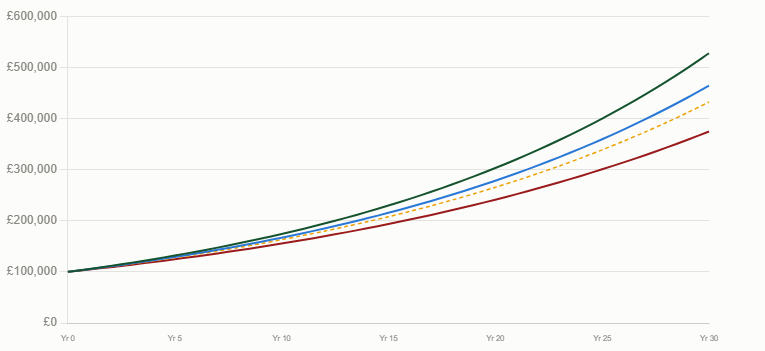
Pension charges are expressed as a percentage of your fund value taken annually — typically as an Annual Management Charge (AMC) or Total Expense Ratio (TER). The government's default fund charge cap for auto-enrolment schemes is 0.75%, but charges vary widely, particularly for older, deferred, or legacy pension pots.
NOW:Pensions research, submitted to Parliament, demonstrated the impact clearly: an average earner on a starting salary of £26,000 can have 30% more in their pot at retirement if charges are 0.3% rather than 1.5%. On a final pot of £395,500 (the median auto-enrolment outcome modelled by GB News, August 2026), the difference between a 0.3% and 1.5% charge over a 40-year career amounts to approximately £118,000 — nearly a third of the total pot.
The problem is particularly acute for small, deferred pension pots left with former employers. As GB News (June 2026) reported Robinson saying: 'Small pension pots with high charges can quietly eat away at your retirement savings over the years.' Consolidating multiple old pots into a single low-cost provider — such as a modern SIPP with a 0.15–0.35% annual charge — can recover a significant portion of this drag going forward.
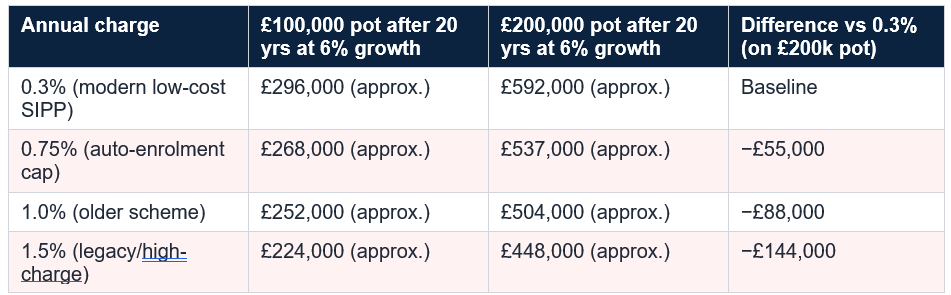
Figures are illustrative, assuming a single lump sum invested at outset growing at 6% annually, with charges deducted annually. Actual outcomes depend on contributions, market returns, and timing. Not financial advice.
Find the annual management charge on every pension you hold. Check your annual pension statement, your provider's online portal, or call the scheme. If any deferred pot is charging above 0.75%, investigate consolidation. For large pots, a difference of even 0.5% in annual charges is worth reviewing with a financial adviser — the long-term compound saving can significantly exceed any one-off advice cost.
When you are auto-enrolled into a workplace pension, you are placed into a default investment fund. The DWP reports that over 80% of members opt into the default fund and typically stay there — because pensions are complex, default inertia is powerful, and people assume that 'default' means 'correct for me.'
The reality is more nuanced. Default funds are designed to be broadly suitable for the average scheme member — which may mean a blended equity/bond approach calibrated to an assumed retirement age that may not match yours. If your planned retirement date differs from the scheme's assumed date, the fund allocation may be investing too conservatively (if you plan to retire later than assumed) or too aggressively (if earlier).
Additionally, if you plan to use pension drawdown in retirement rather than buying an annuity — which the majority of retirees now do under pension freedoms — the default fund's design may be optimised for annuity purchase, not drawdown. Baroness Ros Altmann, cited in PensionPolicyInternational (July 2026), argues that this mismatch affects millions of savers.
The right question is not 'is my default fund good?' — it is 'does this fund match my planned retirement date, my planned retirement method (drawdown or annuity), and my risk tolerance?' A global equity index fund with a 0.1–0.2% charge may significantly outperform a managed default fund over a 20–30 year horizon, particularly in the growth phase. Reviewing your fund allocation takes 20 minutes and could make a meaningful difference to your final pot.
Lifestyling is an automatic investment strategy built into many default pension funds. As you approach your target retirement date — typically 5 to 15 years before — the fund automatically shifts your investments from equities (higher return, higher volatility) into bonds and cash (lower return, lower volatility). The intention is to protect your pot from a market crash just before you retire.
The problem: with the advent of pension freedoms in 2015, the majority of retirees no longer buy annuities — they stay invested in drawdown and withdraw gradually over a retirement that may last 20–30 years. For those in drawdown, shifting entirely to bonds and cash at 55 or 60 is too conservative for a 30-year retirement horizon and may mean the fund fails to keep pace with inflation.
The numbers are striking. GB News (August 11, 2026) reported analysis showing that a worker contributing the minimum auto-enrolment amount over a 40-year career at 6% annual return would accumulate close to £395,500. If the lifestyling strategy drops returns to 2% for the final decade, the pot shrinks to £232,500 — a difference of £163,000. For those contributing £500/month, the gap is even more dramatic: nearly £1 million invested versus £558,000 after the lifestyling drag.
PensionPolicyInternational (July 20, 2026), citing CAPAdata analysis, found that five-year pre-retirement returns vary from 17.9% to 31.1% among major default lifestyle funds. A £200,000 pot could reach £262,200 in a top-performing fund versus £235,800 in a lower-returning one over the same five years — a difference of £26,400 from the fund choice alone, in just five years.
The cost of this mistake: Lifestyling is not automatically bad — for those who plan to buy an annuity at a fixed retirement date, it makes sense to reduce volatility near that date. The trap is when: (1) the glide path starts too early (some begin de-risking from age 55, even for those planning to retire at 67); (2) the target retirement date in the system is wrong; or (3) you plan to use drawdown but your fund is optimised for annuity. Check your pension's lifestyling glide path and whether it matches your actual plans.
Log in to your pension provider's portal and find: (1) your target retirement date — is it correct? (2) whether your fund is a lifestyling or target-date fund — if so, when does de-risking begin and what does the final allocation look like? (3) whether you can switch to a self-select fund that remains more heavily invested in equities if you plan to use drawdown. If you are unsure, speak to a financial adviser — this is exactly the kind of decision where professional guidance pays for itself many times over.
The State Pension is the bedrock of retirement income for most UK households — currently £241.30 per week (£12,547.60 per year) at the full 2026/27 rate. But receiving the full amount requires 35 qualifying years of National Insurance contributions or credits, and a minimum of 10 qualifying years to receive any amount at all. Each qualifying year adds approximately £6.89 per week (£358 per year) to your entitlement.
Career breaks, periods of low earnings, self-employment gaps, time abroad, or periods of ill health can all create gaps in the NI record. The costly mistake is failing to check the record until retirement is imminent — and then discovering gaps that could have been filled cheaply years earlier. Voluntary Class 3 NI contributions cost approximately £824 per gap year in 2026/27. The payback period for filling a missing year is approximately 2.3 years of State Pension receipt — making it one of the highest-return financial decisions available to most people with gaps.
Kay Dee Properties (October 2025) and pension experts consistently note: 'Many retirees don't check their records until after they've started claiming, only to find gaps that reduce their weekly payments.' The window for filling gaps may also be time-limited — only gaps going back to April 2006 can currently be filled with voluntary contributions, and the deadline for certain historical years has been extended but applies.
Go to gov.uk/check-state-pension and gov.uk/check-national-insurance-record. Note your current projected weekly State Pension amount and how many qualifying years you have. Identify any gaps in your NI record. For each gap year available to fill: the cost is approximately £824; the annual State Pension gain is approximately £358; you break even after approximately 2.3 years of claiming. Any retiree in reasonable health who expects to live beyond their mid-70s should strongly consider filling available gaps. Consult a financial adviser or use the government's online tool to calculate the exact payback for your specific record.
Career breaks are a normal part of working life, particularly for those with caring responsibilities. But they create a double pension problem: contributions stop (or reduce), and NI credits may not be earned if the break is not managed correctly. The Investors Centre (July 2026) estimates that women face an average 10-year career gap costing approximately £39,000 in lost pension savings — a figure that compounds further because those contributions, had they been made, would have grown for decades.
The gender pension gap data is stark: women retire with average pension savings of £69,000 versus men's £205,000 — a gap of £136,000. The PPI and NOW:Pensions estimate that women would need to work an extra 19 years to close this gap (The Investors Centre, July 2026). The structural drivers include career breaks, part-time work, the gender pay gap, and auto-enrolment contributions tied to lower earnings — all of which compound across a working lifetime.
The NI credits piece is particularly important and widely overlooked. Parents claiming Child Benefit — even if the High Income Child Benefit Charge means the payment is clawed back — earn NI credits during their career break. These credits count toward the 35-year qualifying NI total for the full State Pension. Failing to claim Child Benefit during a career break can cost years of State Pension entitlement worth thousands of pounds in lifetime income.
Before taking a career break: (1) calculate the pension contribution shortfall over the break period and model whether you can increase contributions before or after the break to partially offset it; (2) claim Child Benefit (if applicable) to protect NI credits — you can elect not to receive the payment if the HICBC applies, but still earn the credits; (3) consider making personal pension contributions during the break if you have any earned income — even £2,880/year net (grossed up to £3,600 with 20% basic-rate relief) can be contributed by a non-earner; (4) check gov.uk/check-national-insurance-record for both partners annually.
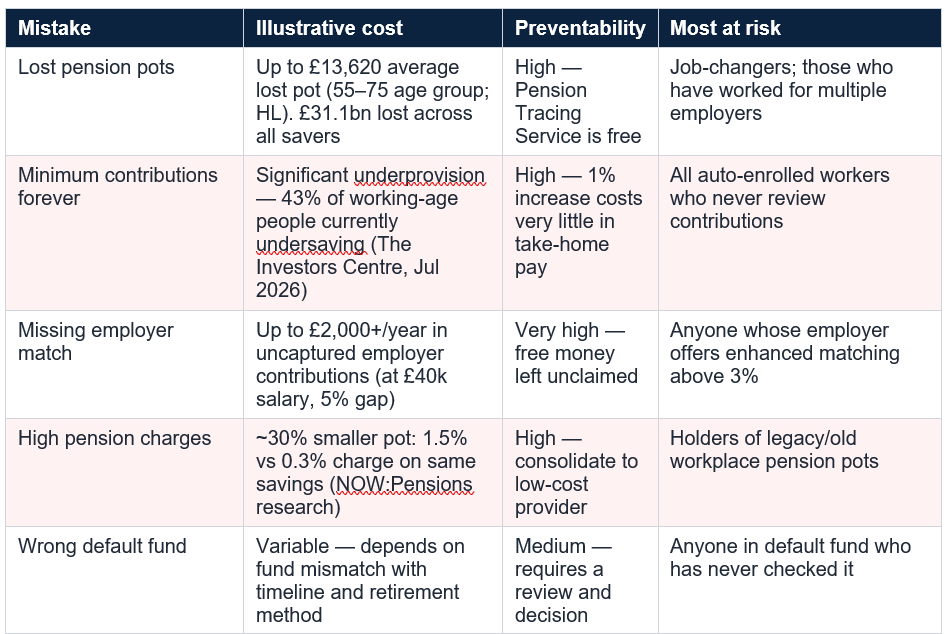
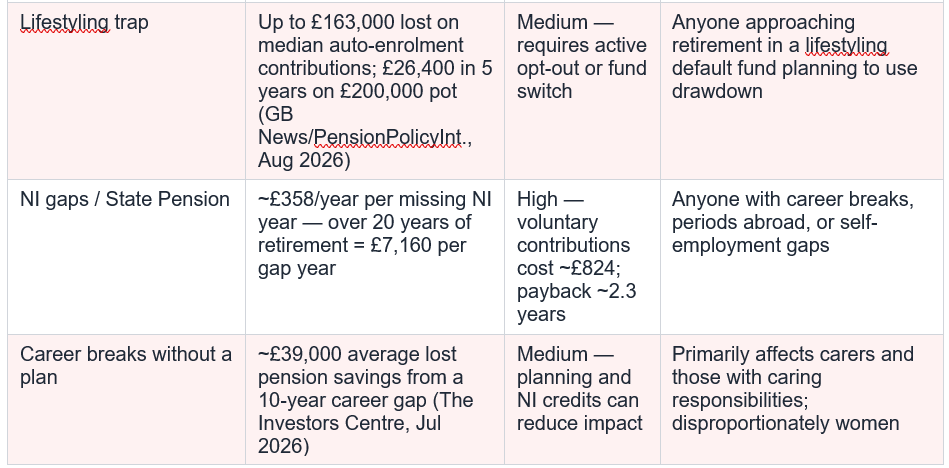
All figures are illustrative estimates based on published research. Individual costs vary significantly based on salary, contribution rate, provider, investment returns, and career history. Not financial advice.
Find your old pots. Increase contributions by 1% this year and again next year. Capture your full employer match. Consolidate high-charge legacy pots. Check your default fund. Understand your lifestyling strategy. Fill NI gaps before the window closes. Plan any career break before it happens. Each action, taken individually, is straightforward. Together, they represent the difference between the median retirement — £18,000 a year in a financially constrained old age — and the moderate retirement most people want.
The compound cost of pension mistakes is merciless precisely because it works in silence over decades. The compound benefit of pension engagement is equally powerful. The question is simply which compounding effect you allow to work on your behalf.
Use the government's free Pension Tracing Service at gov.uk/find-pension-contact-details. This searches the database of all registered UK pension schemes. You will need the name of your previous employer and, if known, the approximate dates of employment. The service provides contact details for the pension scheme — you then contact the scheme directly to re-establish your record. Also check old paperwork, P60s, and payslips — annual pension statements should have been sent to your last known address. If you have moved without updating your details, the provider may not have been able to reach you. The Pensions Policy Institute estimates that 3.3 million lost or unclaimed pots worth £31.1 billion are currently outstanding (cited Hargreaves Lansdown and Delphina.money, August 2026).
What is the minimum I should contribute to my pension?
The statutory minimum under auto-enrolment is 8% of qualifying earnings total — 3% from your employer and 5% from you (including tax relief). However, the evidence strongly suggests this is insufficient for most workers to achieve a comfortable retirement. The Investors Centre (July 2026) calculates that achieving a moderate single retirement costs £215/month if you start contributing at age 25, rising to £870/month if you start at 45. For most workers, the minimum 5% employee contribution on qualifying earnings falls below £215/month in early career. The practical target is to contribute as much as you can above the minimum — increasing by 1% of salary per year — while always at minimum capturing any enhanced employer match your scheme offers.
What is lifestyling and should I opt out?
Lifestyling is an automatic investment strategy that shifts your pension from equities (higher growth, higher volatility) into bonds and cash (lower growth, lower volatility) as you approach your target retirement date — typically over 5 to 15 years. It was designed for savers who plan to buy an annuity at a fixed retirement date. If you plan to use pension drawdown in retirement — keeping your pot invested and withdrawing gradually — lifestyling may be too conservative and could cost you significant growth. GB News (August 11, 2026) estimated the cost of an unsuitable lifestyling strategy at up to £163,000 on median auto-enrolment contributions. Whether to opt out depends on your specific retirement plans, risk tolerance, and investment horizon. This is a decision where professional financial advice is particularly valuable.
How much do pension charges actually matter?
They matter enormously, compounded over decades. NOW:Pensions research submitted to Parliament found that a saver with a 0.3% annual management charge can have 30% more in their pot at retirement than one paying 1.5% — on identical contributions and investment returns. On a final pot of £400,000, the difference is approximately £120,000. The FCA's charge cap for auto-enrolment default funds is 0.75%, but many legacy pension pots from older schemes charge above this. If you hold deferred pots from previous employers, checking the charge is one of the most straightforward and potentially high-value actions you can take. Modern personal pensions and SIPPs from major providers typically charge 0.15–0.35%.
Can I fill gaps in my National Insurance record?
Yes — the government allows voluntary Class 3 NI contributions to fill gaps in your record going back to April 2006. In 2026/27, filling one gap year costs approximately £824. Each additional qualifying year adds approximately £358 per year to your State Pension (£6.89 per week), giving a payback period of approximately 2.3 years. Anyone in reasonable health who expects to live beyond their late 60s will typically profit from filling available gaps. Check your NI record at gov.uk/check-national-insurance-record and your State Pension forecast at gov.uk/check-state-pension. Note that deadlines apply for filling historical gaps — the window for older years is limited. Act before the opportunity closes.
What is the gender pension gap and how can women reduce it?
The gender pension gap in the UK is substantial: women retire with average pension savings of £69,000 versus men's £205,000 — a gap of £136,000 (The Investors Centre, July 2026, citing DWP and ONS). The causes are structural: career breaks, part-time work, the gender pay gap, and auto-enrolment contributions tied to lower earnings (1.9 million women earn below the £10,000 auto-enrolment trigger). The PPI and NOW:Pensions estimate women would need to work an extra 19 years to close the gap on current trends. Actions that help: (1) claim Child Benefit during career breaks to earn NI credits even if not receiving the payment; (2) make voluntary pension contributions during career breaks if you have any earned income; (3) maximise contributions during working years; (4) fill NI gaps through voluntary Class 3 contributions; (5) consolidate old pots and reduce charges. The structural causes require policy solutions, but individual planning can significantly reduce the personal impact.
Table of Contents
- The Pension Engagement Gap
- Mistake 1: Losing Track of Old Pension Pots
- Mistake 2: Staying on Minimum Auto-Enrolment Contributions
- Mistake 3: Not Capturing Your Full Employer Match
- Mistake 4: Ignoring Pension Charges and Fees
- Mistake 5: Never Checking Your Default Investment Fund
- Mistake 6: Getting Caught by the Lifestyling Trap
- Mistake 7: Overlooking NI Gaps and the State Pension
- Mistake 8: Taking a Career Break Without a Plan
- The Compounding Cost: What All Eight Mistakes Together Can Cost
- How to Audit Your Pension in Six Steps
- Conclusion: Engagement Is the Difference
- Frequently Asked Questions
The Charge Trap: How fees Compound Over 30 years
The Delay Trap: The Cost of Starting Pension Later
The Pension Engagement Gap
Most pension mistakes are not made deliberately. They are made by omission — by never logging in, never increasing contributions, never checking the fund, never looking for old pots. Pensions are long-horizon products that sit quietly in the background while life happens in the foreground, and the cost of that quietness is only revealed decades later, when changing course has become expensive or impossible.The scale of the problem is significant. The Pensions Policy Institute estimates that £31.1 billion sits in an estimated 3.3 million lost and unclaimed UK pension pots — up from £26 billion two years ago (cited Hargreaves Lansdown and Delphina.money, August 2026). The Investors Centre (July 2026) estimates that 43% of working-age people — approximately 14.6 million — are currently undersaving for retirement against target replacement rates. The median pension pot for someone aged 55–64 is £137,800, which at a 4% withdrawal rate produces only £5,512 per year. Combined with the full State Pension of £12,547.60, the typical pre-retirement household is looking at approximately £18,000 a year — below the PLSA's minimum retirement standard for a single person outside London.
None of this is inevitable. The eight mistakes in this guide are all avoidable. Most are reversible if caught early enough. And the financial difference between making them and avoiding them can run to tens — sometimes hundreds — of thousands of pounds.
£31.1bn in 3.3 million lost/unclaimed pension pots (PPI, cited HL/Delphina Aug 2026). 43% of working-age people undersaving (14.6m; The Investors Centre, Jul 2026). Median pot aged 55–64: £137,800 = £5,512/yr at 4% withdrawal. Lifestyling mistake alone: can cost £163,000 on median auto-enrolment contributions (GB News, Aug 2026). Delaying from age 25 to 45: cost of same retirement income rises from £215/month to £870/month — 4× more expensive (The Investors Centre, Apr 2026).
Mistake 1: Losing Track of Old Pension Pots
MISTAKE 1: Losing Track of Old Pension Pots Changing jobs is the most common trigger for losing a pension. Auto-enrolment means you receive a pension from every employer — but you must actively manage those pots or they can sit untouched, unclaimed, and slowly eroded by charges for decades.The average UK worker changes jobs 11 times during their career. Each job change is an opportunity to leave behind a workplace pension — and the evidence shows that millions do exactly that. The Pensions Policy Institute now estimates 3.3 million lost or unclaimed pension pots worth £31.1 billion in total. The average lost pot size for those aged 55–75 — the generation most likely to have accumulated multiple old pots — is £13,620 (Hargreaves Lansdown). That is not a trivial sum to have simply misplaced.
The mechanism is straightforward: auto-enrolment creates a new pension for you with each employer, but when you leave, the pot becomes a deferred pension. If you move address or change name and do not update the pension provider, the paper trail breaks. Pensions cannot normally be accessed until age 57 from 2028, meaning they genuinely do fall to the back of people's minds for years or decades.
The cost of this mistake: Lost pots are not just sitting idle — many are quietly being eroded by annual management charges. A small deferred pot of £2,000 with a 1.5% annual management charge loses £30 per year to fees, even if no contributions are being made. Over 20 years of deferral with no growth, the charge alone could eliminate a significant portion of the pot. The Pensions Policy Institute noted that a £100 pot with a flat fee combination can be depleted to zero within six years.
Use the government's free Pension Tracing Service at gov.uk/find-pension-contact-details. It searches the database of all registered UK pension schemes and provides contact details for old providers. Also check: old payslips, P60s, and letters from former employers. Once found, consider consolidating small pots into your current scheme or a personal SIPP — but check for protected benefits (guaranteed annuity rates, final salary links) before transferring, as these can be valuable and are lost on transfer.
Mistake 2: Staying on Minimum Auto-Enrolment Contributions
MISTAKE 2: Staying on Minimum Auto-Enrolment Contributions Forever Auto-enrolment defaults are a floor, not a target. The current minimum of 8% total contributions (3% employer + 5% employee) is widely acknowledged to be insufficient for most people to achieve a comfortable retirement.Auto-enrolment was one of the most successful behavioural policy interventions in UK financial history — it brought millions of workers into pension saving who had never saved before. But its success in getting people enrolled has obscured a critical limitation: the minimum contribution rate of 8% of qualifying earnings is not enough.
The Investors Centre (July 2026) makes the arithmetic explicit: 'The most important number in this whole page is £215 a month — the cost of a moderate single retirement if you start at age 25, versus £870 if you start at 45. Four times the monthly cost for the same outcome.' For most workers, 8% of qualifying earnings falls well short of £215 a month when they are young — meaning the default already puts them behind the minimum rate required for a moderate retirement.
GB News (August 11, 2026) puts a specific figure on the cost of staying minimum: a worker on median earnings contributing the minimum 8% (approximately £132.80 per month, adjusted for 3% wage inflation) over a 40-year career at 6% annual return accumulates close to £395,500. That is a reasonable outcome. The mistake is not the minimum contribution per se — it is never reviewing or increasing it as income rises, career progresses, and retirement approaches.
The experts are consistent on this point. GB News (June 18, 2026) quoted pension expert Robinson: 'A third significant mistake sees employees remaining on minimum auto-enrolment contribution levels for their entire working lives without ever reassessing them.'
The minimum contribution is a starting point, not a destination. Increasing contributions by just 1% of salary per year — a sum most workers barely notice in take-home pay — compounds into a dramatically larger pot over a 30–40 year career. For a worker earning £35,000 contributing an extra 2% (£700/year), the additional pot at retirement at 6% growth over 30 years is approximately £55,000. That is £55,000 for an increase that costs around £58/month after basic-rate tax relief.
Log in to your workplace pension provider's online portal today. Find your current contribution rate. If it is at the auto-enrolment minimum (5% employee), increase it by 1–2% now and set a reminder to review it again in 12 months. If your employer offers enhanced matching above the minimum (e.g., matches up to 6% if you contribute 6%), increase your contributions to at least the match threshold — see Mistake 3.
Mistake 3: Not Capturing Your Full Employer Match
MISTAKE 3: Not Capturing Your Full Employer Match Many employers offer to match pension contributions above the statutory minimum — but only if the employee contributes enough to trigger the match. Failing to do so is leaving part of your salary on the table.The auto-enrolment minimum requires employers to contribute at least 3% of qualifying earnings. But many employers — particularly larger organisations and those competing for talent — offer enhanced matching. A typical enhanced arrangement might offer: 'We will match your contributions up to 8% of salary.' If you contribute only 5% (the minimum), the employer contributes 3%. If you contribute 8%, the employer contributes 8%. The difference — 5% of salary — is additional compensation that costs the employee nothing beyond their own increased contribution.
For a worker earning £40,000, the difference between capturing and not capturing a 5% employer match is £2,000 per year of additional employer pension contributions. Over 20 years at 6% annual growth, that uncaptured employer match grows to approximately £73,000 in additional pension wealth. For most employees, capturing the full employer match is the single highest-return action available — it produces an instant 100% return on the matched portion of contributions before any investment growth.
Money tip: Call or email your HR department this week and ask: 'Does our pension scheme offer any matching above the statutory minimum, and at what contribution level is it maximised?' Many employees have never asked this question and do not know the answer. If enhanced matching exists, calculate the contribution level required to capture it and set that as your minimum. Every pound of uncaptured employer match is deferred salary you are declining.
Mistake 4: Ignoring Pension Charges and Fees
MISTAKE 4: Ignoring Pension Charges and Fees Annual management charges vary enormously between pension providers and fund choices. The difference between a 0.3% and a 1.5% charge sounds small but produces a 30% smaller pension pot at retirement.Pension charges are expressed as a percentage of your fund value taken annually — typically as an Annual Management Charge (AMC) or Total Expense Ratio (TER). The government's default fund charge cap for auto-enrolment schemes is 0.75%, but charges vary widely, particularly for older, deferred, or legacy pension pots.
NOW:Pensions research, submitted to Parliament, demonstrated the impact clearly: an average earner on a starting salary of £26,000 can have 30% more in their pot at retirement if charges are 0.3% rather than 1.5%. On a final pot of £395,500 (the median auto-enrolment outcome modelled by GB News, August 2026), the difference between a 0.3% and 1.5% charge over a 40-year career amounts to approximately £118,000 — nearly a third of the total pot.
The problem is particularly acute for small, deferred pension pots left with former employers. As GB News (June 2026) reported Robinson saying: 'Small pension pots with high charges can quietly eat away at your retirement savings over the years.' Consolidating multiple old pots into a single low-cost provider — such as a modern SIPP with a 0.15–0.35% annual charge — can recover a significant portion of this drag going forward.
Figures are illustrative, assuming a single lump sum invested at outset growing at 6% annually, with charges deducted annually. Actual outcomes depend on contributions, market returns, and timing. Not financial advice.
Find the annual management charge on every pension you hold. Check your annual pension statement, your provider's online portal, or call the scheme. If any deferred pot is charging above 0.75%, investigate consolidation. For large pots, a difference of even 0.5% in annual charges is worth reviewing with a financial adviser — the long-term compound saving can significantly exceed any one-off advice cost.
Mistake 5: Never Checking Your Default Investment Fund
MISTAKE 5: Never Checking Your Default Investment Fund Over 80% of workplace pension members are in their scheme's default fund and stay there indefinitely. The default is designed for the average member — which means it may not suit you, your timeline, or your intended retirement method.When you are auto-enrolled into a workplace pension, you are placed into a default investment fund. The DWP reports that over 80% of members opt into the default fund and typically stay there — because pensions are complex, default inertia is powerful, and people assume that 'default' means 'correct for me.'
The reality is more nuanced. Default funds are designed to be broadly suitable for the average scheme member — which may mean a blended equity/bond approach calibrated to an assumed retirement age that may not match yours. If your planned retirement date differs from the scheme's assumed date, the fund allocation may be investing too conservatively (if you plan to retire later than assumed) or too aggressively (if earlier).
Additionally, if you plan to use pension drawdown in retirement rather than buying an annuity — which the majority of retirees now do under pension freedoms — the default fund's design may be optimised for annuity purchase, not drawdown. Baroness Ros Altmann, cited in PensionPolicyInternational (July 2026), argues that this mismatch affects millions of savers.
The right question is not 'is my default fund good?' — it is 'does this fund match my planned retirement date, my planned retirement method (drawdown or annuity), and my risk tolerance?' A global equity index fund with a 0.1–0.2% charge may significantly outperform a managed default fund over a 20–30 year horizon, particularly in the growth phase. Reviewing your fund allocation takes 20 minutes and could make a meaningful difference to your final pot.
Mistake 6: Getting Caught by the Lifestyling Trap
MISTAKE 6: Getting Caught by the Lifestyling Trap Automatic de-risking (lifestyling) can cost savers up to £163,000 by shifting pension savings from equities into bonds and cash too early — often without the saver realising it has happened.Lifestyling is an automatic investment strategy built into many default pension funds. As you approach your target retirement date — typically 5 to 15 years before — the fund automatically shifts your investments from equities (higher return, higher volatility) into bonds and cash (lower return, lower volatility). The intention is to protect your pot from a market crash just before you retire.
The problem: with the advent of pension freedoms in 2015, the majority of retirees no longer buy annuities — they stay invested in drawdown and withdraw gradually over a retirement that may last 20–30 years. For those in drawdown, shifting entirely to bonds and cash at 55 or 60 is too conservative for a 30-year retirement horizon and may mean the fund fails to keep pace with inflation.
The numbers are striking. GB News (August 11, 2026) reported analysis showing that a worker contributing the minimum auto-enrolment amount over a 40-year career at 6% annual return would accumulate close to £395,500. If the lifestyling strategy drops returns to 2% for the final decade, the pot shrinks to £232,500 — a difference of £163,000. For those contributing £500/month, the gap is even more dramatic: nearly £1 million invested versus £558,000 after the lifestyling drag.
PensionPolicyInternational (July 20, 2026), citing CAPAdata analysis, found that five-year pre-retirement returns vary from 17.9% to 31.1% among major default lifestyle funds. A £200,000 pot could reach £262,200 in a top-performing fund versus £235,800 in a lower-returning one over the same five years — a difference of £26,400 from the fund choice alone, in just five years.
The cost of this mistake: Lifestyling is not automatically bad — for those who plan to buy an annuity at a fixed retirement date, it makes sense to reduce volatility near that date. The trap is when: (1) the glide path starts too early (some begin de-risking from age 55, even for those planning to retire at 67); (2) the target retirement date in the system is wrong; or (3) you plan to use drawdown but your fund is optimised for annuity. Check your pension's lifestyling glide path and whether it matches your actual plans.
Log in to your pension provider's portal and find: (1) your target retirement date — is it correct? (2) whether your fund is a lifestyling or target-date fund — if so, when does de-risking begin and what does the final allocation look like? (3) whether you can switch to a self-select fund that remains more heavily invested in equities if you plan to use drawdown. If you are unsure, speak to a financial adviser — this is exactly the kind of decision where professional guidance pays for itself many times over.
Mistake 7: Overlooking NI Gaps and the State Pension
MISTAKE 7: Overlooking NI Gaps and the State Pension The full new State Pension requires 35 qualifying National Insurance years. Gaps reduce your entitlement by approximately £364 per year for each missing year — and many people only discover these gaps after they have started claiming.The State Pension is the bedrock of retirement income for most UK households — currently £241.30 per week (£12,547.60 per year) at the full 2026/27 rate. But receiving the full amount requires 35 qualifying years of National Insurance contributions or credits, and a minimum of 10 qualifying years to receive any amount at all. Each qualifying year adds approximately £6.89 per week (£358 per year) to your entitlement.
Career breaks, periods of low earnings, self-employment gaps, time abroad, or periods of ill health can all create gaps in the NI record. The costly mistake is failing to check the record until retirement is imminent — and then discovering gaps that could have been filled cheaply years earlier. Voluntary Class 3 NI contributions cost approximately £824 per gap year in 2026/27. The payback period for filling a missing year is approximately 2.3 years of State Pension receipt — making it one of the highest-return financial decisions available to most people with gaps.
Kay Dee Properties (October 2025) and pension experts consistently note: 'Many retirees don't check their records until after they've started claiming, only to find gaps that reduce their weekly payments.' The window for filling gaps may also be time-limited — only gaps going back to April 2006 can currently be filled with voluntary contributions, and the deadline for certain historical years has been extended but applies.
Go to gov.uk/check-state-pension and gov.uk/check-national-insurance-record. Note your current projected weekly State Pension amount and how many qualifying years you have. Identify any gaps in your NI record. For each gap year available to fill: the cost is approximately £824; the annual State Pension gain is approximately £358; you break even after approximately 2.3 years of claiming. Any retiree in reasonable health who expects to live beyond their mid-70s should strongly consider filling available gaps. Consult a financial adviser or use the government's online tool to calculate the exact payback for your specific record.
Mistake 8: Taking a Career Break Without a Plan
MISTAKE 8: Taking a Career Break Without a Plan Career breaks — for childcare, caring responsibilities, illness, or travel — can create compounding pension damage: lower lifetime contributions, NI gaps, and lost employer match. Women face an average 10-year career gap costing approximately £39,000 in lost pension savings (The Investors Centre, July 2026).Career breaks are a normal part of working life, particularly for those with caring responsibilities. But they create a double pension problem: contributions stop (or reduce), and NI credits may not be earned if the break is not managed correctly. The Investors Centre (July 2026) estimates that women face an average 10-year career gap costing approximately £39,000 in lost pension savings — a figure that compounds further because those contributions, had they been made, would have grown for decades.
The gender pension gap data is stark: women retire with average pension savings of £69,000 versus men's £205,000 — a gap of £136,000. The PPI and NOW:Pensions estimate that women would need to work an extra 19 years to close this gap (The Investors Centre, July 2026). The structural drivers include career breaks, part-time work, the gender pay gap, and auto-enrolment contributions tied to lower earnings — all of which compound across a working lifetime.
The NI credits piece is particularly important and widely overlooked. Parents claiming Child Benefit — even if the High Income Child Benefit Charge means the payment is clawed back — earn NI credits during their career break. These credits count toward the 35-year qualifying NI total for the full State Pension. Failing to claim Child Benefit during a career break can cost years of State Pension entitlement worth thousands of pounds in lifetime income.
Before taking a career break: (1) calculate the pension contribution shortfall over the break period and model whether you can increase contributions before or after the break to partially offset it; (2) claim Child Benefit (if applicable) to protect NI credits — you can elect not to receive the payment if the HICBC applies, but still earn the credits; (3) consider making personal pension contributions during the break if you have any earned income — even £2,880/year net (grossed up to £3,600 with 20% basic-rate relief) can be contributed by a non-earner; (4) check gov.uk/check-national-insurance-record for both partners annually.
The Compounding Cost: What All Eight Mistakes Together Can Cost
Each of the eight mistakes above has an individual cost. Together, they represent the difference between a comfortable retirement and a financially constrained one. The table below illustrates the illustrative cost of each mistake for a worker on median earnings with a 35-year career:All figures are illustrative estimates based on published research. Individual costs vary significantly based on salary, contribution rate, provider, investment returns, and career history. Not financial advice.
How to Audit Your Pension in Six Steps
A comprehensive pension audit takes approximately two to three hours and should be done annually. Here is the framework:- Step 1 — Find everything: list every pension you have ever held (current employer, all previous employers, any personal pensions or SIPPs). Use the Pension Tracing Service (gov.uk/find-pension-contact-details) for any you have lost contact with.
- Step 2 — Check the State Pension: go to gov.uk/check-state-pension and gov.uk/check-national-insurance-record. Note your projected weekly amount, your qualifying years, and any gaps worth filling.
- Step 3 — Check contribution rates: for your current workplace pension, confirm your contribution rate, your employer's rate, and whether enhanced matching is available above the statutory minimum.
- Step 4 — Check charges: find the annual management charge on every pension you hold. Any deferred pot charging above 0.75% is a candidate for consolidation review.
- Step 5 — Check your fund: log in and find what fund you are invested in. If it is a lifestyling or default fund, find when de-risking begins and whether the target retirement date is correct. If you plan to use drawdown, confirm the fund's glide path is appropriate.
- Step 6 — Project your income: use your provider's retirement income calculator (or MoneyHelper's pension calculator at moneyhelper.org.uk) to project what income your pot will generate at your target retirement date. Compare this to the PLSA Retirement Living Standards (minimum: ~£14,400/year single; moderate: ~£31,300/year; comfortable: ~£43,100/year) to identify any gap.
Conclusion
The eight pension mistakes in this guide share a common root cause: disengagement. Pensions are long-horizon products that reward consistent attention and penalise neglect. The good news is that none of these mistakes requires financial expertise to avoid — they require only a small number of deliberate actions, most of which take less than an hour.Find your old pots. Increase contributions by 1% this year and again next year. Capture your full employer match. Consolidate high-charge legacy pots. Check your default fund. Understand your lifestyling strategy. Fill NI gaps before the window closes. Plan any career break before it happens. Each action, taken individually, is straightforward. Together, they represent the difference between the median retirement — £18,000 a year in a financially constrained old age — and the moderate retirement most people want.
The compound cost of pension mistakes is merciless precisely because it works in silence over decades. The compound benefit of pension engagement is equally powerful. The question is simply which compounding effect you allow to work on your behalf.
Frequently Asked Questions
How do I find a lost pension from a previous employer?Use the government's free Pension Tracing Service at gov.uk/find-pension-contact-details. This searches the database of all registered UK pension schemes. You will need the name of your previous employer and, if known, the approximate dates of employment. The service provides contact details for the pension scheme — you then contact the scheme directly to re-establish your record. Also check old paperwork, P60s, and payslips — annual pension statements should have been sent to your last known address. If you have moved without updating your details, the provider may not have been able to reach you. The Pensions Policy Institute estimates that 3.3 million lost or unclaimed pots worth £31.1 billion are currently outstanding (cited Hargreaves Lansdown and Delphina.money, August 2026).
What is the minimum I should contribute to my pension?
The statutory minimum under auto-enrolment is 8% of qualifying earnings total — 3% from your employer and 5% from you (including tax relief). However, the evidence strongly suggests this is insufficient for most workers to achieve a comfortable retirement. The Investors Centre (July 2026) calculates that achieving a moderate single retirement costs £215/month if you start contributing at age 25, rising to £870/month if you start at 45. For most workers, the minimum 5% employee contribution on qualifying earnings falls below £215/month in early career. The practical target is to contribute as much as you can above the minimum — increasing by 1% of salary per year — while always at minimum capturing any enhanced employer match your scheme offers.
What is lifestyling and should I opt out?
Lifestyling is an automatic investment strategy that shifts your pension from equities (higher growth, higher volatility) into bonds and cash (lower growth, lower volatility) as you approach your target retirement date — typically over 5 to 15 years. It was designed for savers who plan to buy an annuity at a fixed retirement date. If you plan to use pension drawdown in retirement — keeping your pot invested and withdrawing gradually — lifestyling may be too conservative and could cost you significant growth. GB News (August 11, 2026) estimated the cost of an unsuitable lifestyling strategy at up to £163,000 on median auto-enrolment contributions. Whether to opt out depends on your specific retirement plans, risk tolerance, and investment horizon. This is a decision where professional financial advice is particularly valuable.
How much do pension charges actually matter?
They matter enormously, compounded over decades. NOW:Pensions research submitted to Parliament found that a saver with a 0.3% annual management charge can have 30% more in their pot at retirement than one paying 1.5% — on identical contributions and investment returns. On a final pot of £400,000, the difference is approximately £120,000. The FCA's charge cap for auto-enrolment default funds is 0.75%, but many legacy pension pots from older schemes charge above this. If you hold deferred pots from previous employers, checking the charge is one of the most straightforward and potentially high-value actions you can take. Modern personal pensions and SIPPs from major providers typically charge 0.15–0.35%.
Can I fill gaps in my National Insurance record?
Yes — the government allows voluntary Class 3 NI contributions to fill gaps in your record going back to April 2006. In 2026/27, filling one gap year costs approximately £824. Each additional qualifying year adds approximately £358 per year to your State Pension (£6.89 per week), giving a payback period of approximately 2.3 years. Anyone in reasonable health who expects to live beyond their late 60s will typically profit from filling available gaps. Check your NI record at gov.uk/check-national-insurance-record and your State Pension forecast at gov.uk/check-state-pension. Note that deadlines apply for filling historical gaps — the window for older years is limited. Act before the opportunity closes.
What is the gender pension gap and how can women reduce it?
The gender pension gap in the UK is substantial: women retire with average pension savings of £69,000 versus men's £205,000 — a gap of £136,000 (The Investors Centre, July 2026, citing DWP and ONS). The causes are structural: career breaks, part-time work, the gender pay gap, and auto-enrolment contributions tied to lower earnings (1.9 million women earn below the £10,000 auto-enrolment trigger). The PPI and NOW:Pensions estimate women would need to work an extra 19 years to close the gap on current trends. Actions that help: (1) claim Child Benefit during career breaks to earn NI credits even if not receiving the payment; (2) make voluntary pension contributions during career breaks if you have any earned income; (3) maximise contributions during working years; (4) fill NI gaps through voluntary Class 3 contributions; (5) consolidate old pots and reduce charges. The structural causes require policy solutions, but individual planning can significantly reduce the personal impact.

0 Comments Comments