

Retirement
Retirement Income Sources That Still Trigger Taxes
Many retirees are surprised to learn that their retirement income is still taxed — sometimes heavily. Social Security, 401(k) and IRA withdrawals, pensions, dividends, capital gains, and even annuity payments can all generate federal tax liability in retirement. Understanding which sources are taxed, at what rates, and — critically — how one income source can make another more taxable is the foundation of tax-efficient retirement planning. This guide covers every major taxable retirement income source for 2026, with the thresholds, rates, and worked examples you need.

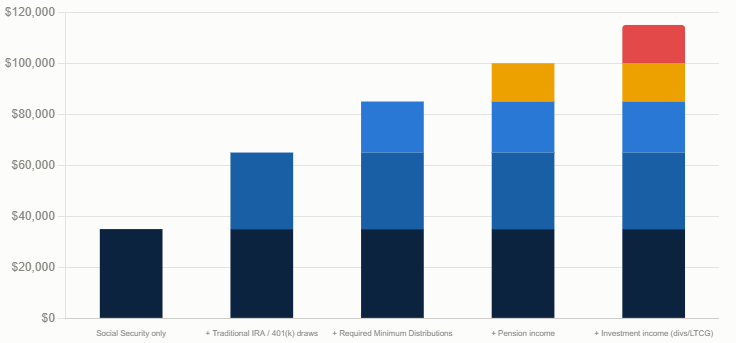
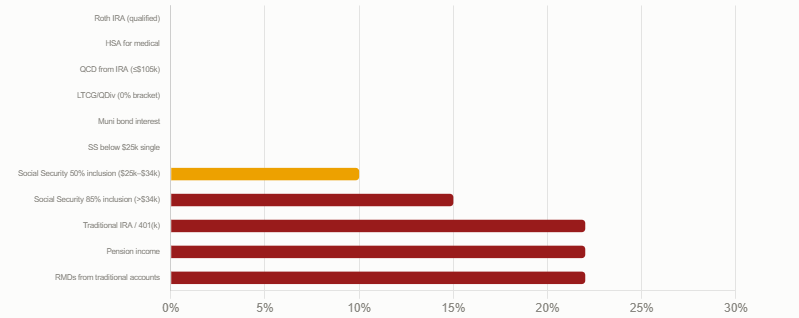
The 2026 tax year brings updated brackets, a new One Big Beautiful Bill Act (OBBBA) senior deduction, and updated standard deductions — but the fundamental structure that taxes Social Security, retirement account withdrawals, pensions, capital gains, dividends, and interest has not changed. Up to 85% of Social Security benefits can be subject to federal income tax. Traditional IRA and 401(k) withdrawals are fully taxable as ordinary income. Pensions are generally fully taxable. A $40,000 IRA withdrawal can pull more than $40,000 into taxable income if it simultaneously makes a portion of your Social Security taxable.
This guide covers every major retirement income source that triggers federal tax liability in 2026, with the specific thresholds, rates, and mechanisms for each. It also covers the interaction effects that create what financial planners call the ‘tax torpedo’ — and the planning strategies that manage it. All figures are 2026 federal tax year unless otherwise stated. State income taxes vary significantly and are not covered in this guide.
2026 standard deduction: $15,750 (single), $32,200 (MFJ). Additional deduction age 65+: +$1,550 per qualifying person. OBBBA senior deduction: up to $6,000 per qualifying individual age 65+. SS thresholds: $25K/$32K (0% taxable), $34K/$44K (up to 85% taxable). RMD excise tax for missed RMD: 25% (10% if corrected in window). NIIT: 3.8% over $200K single/$250K MFJ. IRMAA surcharge: up to $5,873/year per person (CMS 2026).
Combined income for this purpose is calculated as: adjusted gross income (excluding Social Security) + nontaxable interest + 50% of your annual Social Security benefit. The resulting figure is compared against two sets of thresholds:
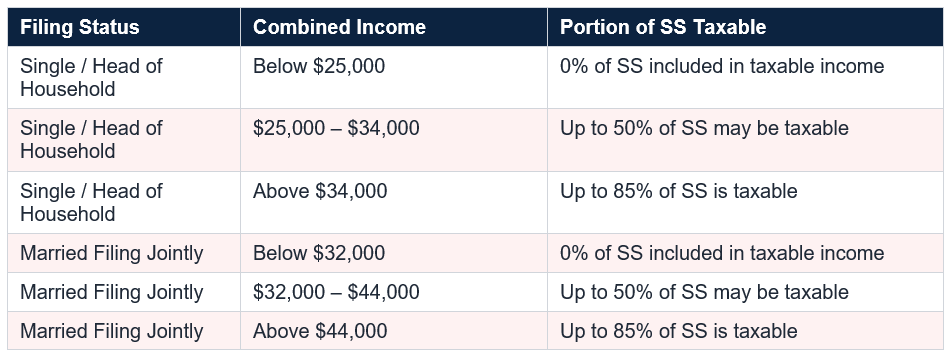
Important clarification: these percentages represent the share of SS income that is included in taxable income, not the tax rate applied. A retiree who includes 85% of their Social Security in taxable income then pays tax on that 85% at their marginal income tax rate. If that rate is 22%, they pay 22% on 85% of SS — an effective SS tax rate of 18.7%.
Example: Married couple, both age 68, with $40,000 from a traditional IRA withdrawal and $60,000 in Social Security (SmartAsset July 2026, 2026 figures): Combined income = $40,000 (IRA) + $30,000 (50% of SS) = $70,000. Exceeds $44,000 threshold → up to 85% of SS is taxable. Taxable SS = $51,000 (85% × $60,000). Total AGI = $40,000 + $51,000 = $91,000. Standard deduction (MFJ, both 65+) = $32,200 + $3,100 (two additional deductions) = $35,300. Taxable income = $91,000 − $35,300 = $55,700. The IRA withdrawal of $40,000 triggered $51,000 of Social Security taxability — adding $11,000 more to taxable income than the IRA itself. This is the tax torpedo effect. Not tax advice; consult a CPA.
Planning strategy: Roth IRA withdrawals do not count as income in the combined income calculation. Substituting Roth withdrawals for traditional IRA withdrawals in years when your combined income approaches the SS tax thresholds can reduce or eliminate SS taxability. Qualified Charitable Distributions (QCDs) from an IRA also satisfy RMDs without increasing AGI, reducing exposure.
For 2026, the ordinary income tax brackets applying to retirement account withdrawals are: 10% up to $11,925 (single) / $23,850 (MFJ) of taxable income; 12% from $11,926 to $48,475 (single) / $23,851 to $96,950 (MFJ); 22% from $48,476 to $103,350 (single) / $96,951 to $206,700 (MFJ); 24%, 32%, 35%, and 37% at higher thresholds. Note: verify current 2026 brackets directly with IRS.gov as OBBBA adjustments may have modified specific thresholds from prior-year projections.
The tax on traditional withdrawals is not withheld automatically at the full amount — you will need to elect withholding at the custodian or make estimated tax payments. Most custodians default to 10% withholding on IRA distributions, which may substantially understate the actual liability if you are in a higher bracket or if the withdrawal triggers additional SS taxability.
The default 10% IRA withholding is almost always wrong. A retiree in the 22% bracket who receives a $50,000 traditional IRA distribution and withholds only 10% ($5,000) will owe approximately $11,000 in federal tax on that distribution — plus any state tax — and will face an underpayment penalty if they do not make up the difference through estimated tax payments before year-end. Review your withholding election at the start of each tax year.
If you have made non-deductible (after-tax) contributions to a traditional IRA, a portion of each withdrawal is tax-free under the exclusion ratio. File IRS Form 8606 in every year you make a non-deductible contribution, and in every year you take a distribution, to track the taxable and non-taxable portions. Without Form 8606, the IRS will treat the entire withdrawal as taxable. Keep a copy of all Forms 8606 indefinitely.
The RMD amount for each account is calculated by dividing the prior December 31 balance of that account by the applicable life expectancy factor from the IRS Uniform Lifetime Table (or the Joint and Last Survivor Table if the sole beneficiary is a spouse more than 10 years younger). For most 73-year-olds, the initial life expectancy factor is approximately 26.5, meaning the first RMD is approximately 1/26.5 or about 3.77% of the account balance.
RMD distributions are fully taxable as ordinary income (for pre-tax accounts). Because they are mandatory, they cannot be avoided or deferred — but they can be managed:
The exception arises if you made after-tax contributions to the pension plan — a common situation in some government and union plans. In this case, an exclusion ratio applies: a portion of each payment represents the after-tax contributions, which are returned tax-free; the remaining portion representing the employer’s contributions and all earnings is taxable. Your plan administrator should provide the information needed to calculate this, and the IRS Simplified Method (described in IRS Publication 575) is used to determine the non-taxable monthly amount.
403(b) and 457(b) plans for public employees and nonprofit workers follow similar rules: distributions are generally fully taxable as ordinary income from pre-tax accounts, and partially taxable under the exclusion ratio if after-tax contributions were made.
Many retirees underestimate pension income because they think of it as a benefit rather than income. From the IRS's perspective, it is ordinary income subject to federal income tax in the same way as wages. A retiree receiving a $36,000 annual pension combined with $24,000 in Social Security could have a federal tax liability well above zero — depending on other income sources and the standard deduction — even though both feel like retirement 'benefits.'
Short-term capital gains (assets held one year or less) are taxed at ordinary income rates — the same rates as wages and traditional IRA withdrawals. This is why holding investments for at least one year before selling is critical in taxable accounts.
Long-term capital gains (assets held more than one year) are taxed at preferential rates in 2026: 0% for taxable income up to $48,350 (single) / $96,700 (married filing jointly); 15% from those thresholds up to $533,400 (single) / $600,050 (MFJ); 20% above those amounts. Verify these specific thresholds with IRS for 2026 as OBBBA may have modified them.
The Net Investment Income Tax (NIIT) applies an additional 3.8% tax on net investment income (which includes capital gains, dividends, and interest) for single filers with modified AGI above $200,000 or MFJ above $250,000. For most moderate-income retirees, this additional tax does not apply — but it is relevant for those with significant investment portfolios or real estate gains.
In a taxable account, qualified dividends from high-quality dividend-paying stocks receive preferential tax treatment and can be a very tax-efficient income source for moderate-income retirees who fall in the 0% long-term capital gains bracket. For retirees in the 22%+ bracket where the 15% capital gains rate applies, qualified dividends are still taxed at 15% — significantly lower than the ordinary income rate on the same amount from a traditional IRA withdrawal.
Key distinctions:
The critical tax planning issue: taking large distributions from an inherited IRA in high-income years dramatically increases the tax cost. A beneficiary who inherits a $500,000 traditional IRA and waits to take distributions until years 9 and 10 may face large income spikes in those years, potentially pushing income into higher brackets, triggering SS tax thresholds, or triggering IRMAA. Spreading distributions over all 10 years is generally more tax-efficient than backloading.
Non-designated beneficiaries (estates, charities) and certain trusts face different rules — in some cases the 5-year rule. Surviving spouses have the most flexibility: they can treat the inherited IRA as their own, continuing to defer distributions until their own RMD age.
Inherited Roth IRA distributions are generally tax-free (if the original account met the 5-year holding period). However, non-spouse beneficiaries are still subject to the 10-year depletion rule — they must fully distribute the inherited Roth IRA within 10 years of the original owner's death. The distributions are tax-free but the account cannot be kept growing indefinitely. This is a significant post-SECURE Act change that many beneficiaries do not know about.
Here is how it works in 2026: a single filer in the 22% bracket who takes an extra $1,000 IRA distribution above the $34,000 combined income threshold simultaneously makes 85% of any additional Social Security benefit taxable. The effective marginal rate on that $1,000 is therefore: 22% on the $1,000 itself = $220, plus 22% on $850 of additional SS income made taxable (85% of the additional income flows to SS taxability) = $187. Total additional tax: $407 on $1,000 of income = effective marginal rate of 40.7%.
This torpedo effect is most severe for retirees in the $25,000–$50,000 combined income range (single) or $32,000–$62,000 range (MFJ) — precisely the range where Social Security taxability is being phased in. It can create effective marginal rates significantly above the statutory rate in a given bracket.
The torpedo is managed through a combination of strategies: converting traditional IRA assets to Roth before reaching RMD age (reducing future mandatory taxable withdrawals); using QCDs to satisfy RMDs without increasing AGI; drawing from Roth accounts instead of traditional accounts in years when combined income approaches the SS thresholds; and timing Social Security claiming to manage when these interactions occur.
2026 IRMAA thresholds are based on 2024 MAGI. The first surcharge applies at $106,000 (single) / $212,000 (MFJ). Maximum annual IRMAA surcharges reach up to $5,873/year per person above the base premium (CMS 2026 data; financial-advisors-for-retirees.com, August 2026). A couple in Tier 2 (MFJ MAGI $280,000) pays $5,770/year extra combined.
The IRMAA cliff effect: IRMAA applies in discrete tiers, not as a smooth progression. A single dollar of income above a tier threshold can trigger a jump of $700–$1,200 per year in additional Medicare premiums. A Roth conversion or large RMD that pushes MAGI just above a tier threshold can cost thousands in Medicare premiums. Staying just below these thresholds — through careful withdrawal sequencing, QCDs, or deferring income — can produce substantial savings.
IRMAA is calculated on MAGI from two years prior — meaning a large Roth conversion or capital gains event in 2026 will affect 2028 Medicare premiums. You may not feel the consequence for two years, which is one reason IRMAA is often missed in planning. If you anticipate a one-time large income event (business sale, large Roth conversion, property sale), calculate the potential IRMAA impact before executing.
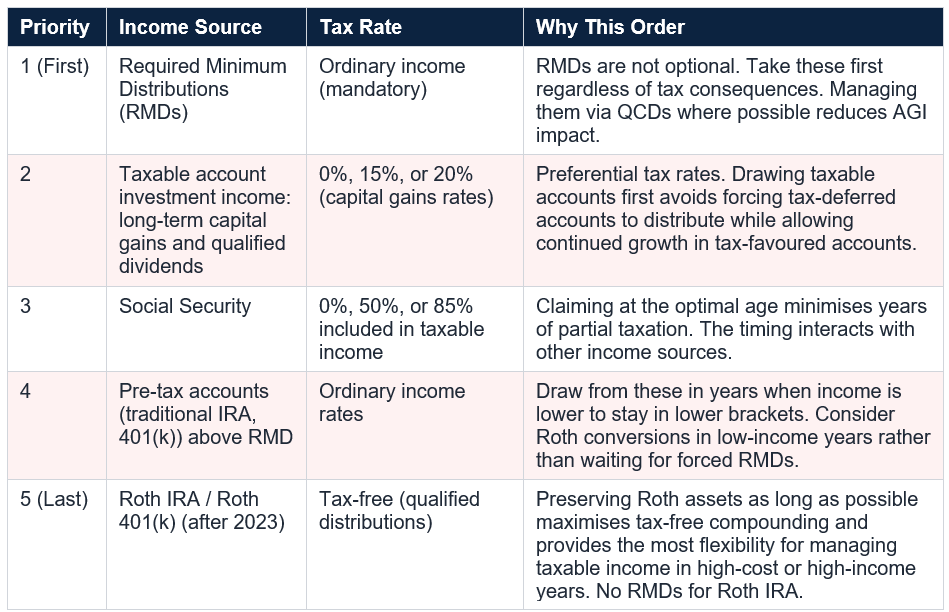
SmartAsset (July 2026) and MoneyInstructor (June 2026) both note that this sequence — taxable accounts first, pre-tax accounts second, Roth last — ‘minimises lifetime taxes, but optimal strategy depends on your specific income sources, RMD amounts, and estate planning goals.’ Consulting a financial planner before starting a systematic withdrawal strategy is often worth the cost.
The 2026 tax year brings some relief through updated standard deductions, the additional age 65+ deduction, and the new OBBBA senior deduction. But the fundamental structure that taxes most retirement income has not changed: know what each source triggers, understand how sources interact (particularly the SS/IRA withdrawal combination), manage withdrawals strategically, and use the tools available — QCDs, Roth conversions, strategic capital gains harvesting, and IRMAA management — to reduce lifetime tax liability.
The difference between an uncoordinated and a well-coordinated retirement tax strategy is often measured in six figures of lifetime tax liability. The retirement income tax landscape is navigable — but it requires knowledge, planning, and in most cases, professional guidance.
Yes, for many retirees. Up to 85% of Social Security benefits can be subject to federal income tax depending on your 'combined income' — your adjusted gross income (excluding Social Security) plus nontaxable interest plus 50% of your annual SS benefit. For single filers: if combined income is below $25,000, SS is not taxable; between $25,000 and $34,000, up to 50% may be taxable; above $34,000, up to 85% is taxable. For married filing jointly: below $32,000 = not taxable; $32,000–$44,000 = up to 50% taxable; above $44,000 = up to 85% taxable. These thresholds have not been adjusted for inflation since 1993. The 85% figure refers to the share of SS income included in taxable income, not the tax rate applied. Your actual tax on SS depends on your marginal income tax bracket. Roth IRA withdrawals do not count as income in the combined income calculation, making Roth accounts valuable for managing SS taxability.
Are 401(k) and IRA withdrawals taxed in retirement?
Yes — traditional (pre-tax) 401(k) and IRA withdrawals are fully taxable as ordinary income at your marginal federal income tax rate in the year of withdrawal. This is the deferred tax that was avoided when contributions were made. The same brackets that apply to wages apply to these withdrawals. Roth 401(k) and Roth IRA qualified distributions are tax-free (provided the account is at least 5 years old and you are age 59½ or older). If you made after-tax (non-deductible) contributions to a traditional IRA, a portion of each withdrawal is tax-free under the exclusion ratio — tracked on IRS Form 8606. Required minimum distributions (RMDs) from traditional accounts must begin at age 73 (age 75 for those born 1960 or later, under SECURE 2.0) and are taxable as ordinary income. A missed RMD triggers an excise tax of 25% of the shortfall (10% if corrected in the Correction Window).
What is the 'tax torpedo' in retirement?
The tax torpedo is the effective marginal tax rate spike that occurs when additional retirement income — particularly a traditional IRA withdrawal or pension payment — pushes 'combined income' above the Social Security taxability thresholds. Each additional dollar of income above the threshold simultaneously triggers tax on that dollar AND makes 85 cents of Social Security income taxable, effectively creating a marginal rate significantly higher than the statutory bracket rate. In the 22% bracket, the effective marginal rate within the torpedo zone can exceed 40%. The torpedo is most severe in the $25,000–$50,000 combined income range for single filers and $32,000–$62,000 for married filers. Key management strategies: Roth conversions before RMD age to reduce future mandatory taxable income; Qualified Charitable Distributions (QCDs) to satisfy RMDs without increasing AGI; and substituting Roth withdrawals for traditional IRA withdrawals in years when combined income approaches the SS thresholds.
What is IRMAA and how does it affect retirement income?
IRMAA (Income-Related Monthly Adjustment Amount) is a surcharge on Medicare Part B and Part D premiums that applies when a beneficiary's modified adjusted gross income (MAGI) from two years prior exceeds certain thresholds. The 2026 IRMAA thresholds (based on 2024 MAGI) begin at $106,000 (single) and $212,000 (married filing jointly). Maximum surcharges can reach up to $5,873/year per person above the base Medicare Part B premium of $202.90/month (CMS 2026). Because IRMAA applies in discrete tiers, a single dollar of income above a threshold can trigger hundreds or thousands of dollars in additional Medicare costs — the 'IRMAA cliff.' Since IRMAA is based on income from two years prior, a large Roth conversion or capital gains event in 2026 will affect 2028 Medicare premiums. Strategic management — staying just below IRMAA thresholds through QCDs, careful Roth conversion sizing, and withdrawal sequencing — can save thousands per year.
How are pension payments taxed in retirement?
Most pension payments from employer-funded defined benefit plans are fully taxable as ordinary income in the year received, because the contributions were made pre-tax by the employer. From the IRS's perspective, pension income is treated the same as wages — subject to federal income tax at your marginal rate. Federal withholding is typically elected when you set up your pension payment; review the amount withheld each year to avoid underpayment penalties. The exception: if you made after-tax contributions to the pension (common in some government and union plans), an exclusion ratio applies — a portion of each payment representing the return of your after-tax contributions is tax-free. Your plan administrator should provide the information needed for this calculation. IRS Publication 575 and the IRS Simplified Method explain the calculation.
What retirement income is tax-free?
True tax-free retirement income sources are limited at the federal level. Qualified Roth IRA and Roth 401(k) distributions are tax-free (account at least 5 years old, age 59½ or older). Municipal bond interest is generally exempt from federal income tax (though it may count in Social Security combined income calculations if classified as nontaxable interest). Qualified Charitable Distributions (QCDs) from an IRA are not included in income and satisfy RMDs, making them effectively tax-free for amounts that would otherwise be taxable RMDs. Social Security is tax-free at the federal level if combined income remains below $25,000 (single) / $32,000 (MFJ) — which many retirees with multiple income sources cannot achieve. Health Savings Account (HSA) withdrawals for qualified medical expenses are tax-free at any age. Life insurance death benefits received by beneficiaries are generally income-tax-free. Veterans' benefits and most workers' compensation are federally tax-free.
Table of Contents
- The Retirement Tax Surprise
- Social Security: Up to 85% Can Be Taxable
- Traditional 401(k) and IRA Withdrawals
- Required Minimum Distributions (RMDs)
- Pension and Defined Benefit Income
- Annuity Income
- Capital Gains on Investments
- Dividend Income
- Interest Income
- Inherited IRAs and Retirement Accounts
- The Tax Torpedo: When Multiple Sources Interact
- IRMAA: The Hidden Medicare Tax on Retirement Income
- The OBBBA Senior Deduction and 2026 Updates
- Tax-Efficient Withdrawal Sequencing
- Conclusion: Knowing Is Half the Battle
- Frequently Asked Questions
Retirement Income Stacking: How Tax Triggers Layer Up
Tax Treament By Income Source
The Retirement Tax Surprise
The most common financial misconception about retirement is that it comes with a tax holiday. Many people assume that once they stop working, they stop paying significant taxes. The reality is more complicated: most retirement income sources are taxable, often at rates not substantially different from working years, and the interaction between multiple sources can create tax situations more complex than anything most working individuals experience.The 2026 tax year brings updated brackets, a new One Big Beautiful Bill Act (OBBBA) senior deduction, and updated standard deductions — but the fundamental structure that taxes Social Security, retirement account withdrawals, pensions, capital gains, dividends, and interest has not changed. Up to 85% of Social Security benefits can be subject to federal income tax. Traditional IRA and 401(k) withdrawals are fully taxable as ordinary income. Pensions are generally fully taxable. A $40,000 IRA withdrawal can pull more than $40,000 into taxable income if it simultaneously makes a portion of your Social Security taxable.
This guide covers every major retirement income source that triggers federal tax liability in 2026, with the specific thresholds, rates, and mechanisms for each. It also covers the interaction effects that create what financial planners call the ‘tax torpedo’ — and the planning strategies that manage it. All figures are 2026 federal tax year unless otherwise stated. State income taxes vary significantly and are not covered in this guide.
2026 standard deduction: $15,750 (single), $32,200 (MFJ). Additional deduction age 65+: +$1,550 per qualifying person. OBBBA senior deduction: up to $6,000 per qualifying individual age 65+. SS thresholds: $25K/$32K (0% taxable), $34K/$44K (up to 85% taxable). RMD excise tax for missed RMD: 25% (10% if corrected in window). NIIT: 3.8% over $200K single/$250K MFJ. IRMAA surcharge: up to $5,873/year per person (CMS 2026).
Social Security: Up to 85% Can Be Taxable
Social Security benefits are not tax-free. Depending on your ‘combined income’ — a term of art in the tax code — between 0% and 85% of your benefits can be included in your federal taxable income. The thresholds that determine this have not been adjusted for inflation since 1993, meaning an ever-larger proportion of Social Security recipients pay tax on their benefits with each passing year.Combined income for this purpose is calculated as: adjusted gross income (excluding Social Security) + nontaxable interest + 50% of your annual Social Security benefit. The resulting figure is compared against two sets of thresholds:
Important clarification: these percentages represent the share of SS income that is included in taxable income, not the tax rate applied. A retiree who includes 85% of their Social Security in taxable income then pays tax on that 85% at their marginal income tax rate. If that rate is 22%, they pay 22% on 85% of SS — an effective SS tax rate of 18.7%.
Example: Married couple, both age 68, with $40,000 from a traditional IRA withdrawal and $60,000 in Social Security (SmartAsset July 2026, 2026 figures): Combined income = $40,000 (IRA) + $30,000 (50% of SS) = $70,000. Exceeds $44,000 threshold → up to 85% of SS is taxable. Taxable SS = $51,000 (85% × $60,000). Total AGI = $40,000 + $51,000 = $91,000. Standard deduction (MFJ, both 65+) = $32,200 + $3,100 (two additional deductions) = $35,300. Taxable income = $91,000 − $35,300 = $55,700. The IRA withdrawal of $40,000 triggered $51,000 of Social Security taxability — adding $11,000 more to taxable income than the IRA itself. This is the tax torpedo effect. Not tax advice; consult a CPA.
Planning strategy: Roth IRA withdrawals do not count as income in the combined income calculation. Substituting Roth withdrawals for traditional IRA withdrawals in years when your combined income approaches the SS tax thresholds can reduce or eliminate SS taxability. Qualified Charitable Distributions (QCDs) from an IRA also satisfy RMDs without increasing AGI, reducing exposure.
Traditional 401(k) and IRA Withdrawals
Withdrawals from traditional pre-tax retirement accounts — 401(k), 403(b), 457(b), traditional IRA, SEP IRA, and SIMPLE IRA — are taxable as ordinary income at your marginal federal income tax rate in the year of withdrawal. This is the deferred tax that was avoided when the money was contributed pre-tax.For 2026, the ordinary income tax brackets applying to retirement account withdrawals are: 10% up to $11,925 (single) / $23,850 (MFJ) of taxable income; 12% from $11,926 to $48,475 (single) / $23,851 to $96,950 (MFJ); 22% from $48,476 to $103,350 (single) / $96,951 to $206,700 (MFJ); 24%, 32%, 35%, and 37% at higher thresholds. Note: verify current 2026 brackets directly with IRS.gov as OBBBA adjustments may have modified specific thresholds from prior-year projections.
The tax on traditional withdrawals is not withheld automatically at the full amount — you will need to elect withholding at the custodian or make estimated tax payments. Most custodians default to 10% withholding on IRA distributions, which may substantially understate the actual liability if you are in a higher bracket or if the withdrawal triggers additional SS taxability.
The default 10% IRA withholding is almost always wrong. A retiree in the 22% bracket who receives a $50,000 traditional IRA distribution and withholds only 10% ($5,000) will owe approximately $11,000 in federal tax on that distribution — plus any state tax — and will face an underpayment penalty if they do not make up the difference through estimated tax payments before year-end. Review your withholding election at the start of each tax year.
If you have made non-deductible (after-tax) contributions to a traditional IRA, a portion of each withdrawal is tax-free under the exclusion ratio. File IRS Form 8606 in every year you make a non-deductible contribution, and in every year you take a distribution, to track the taxable and non-taxable portions. Without Form 8606, the IRS will treat the entire withdrawal as taxable. Keep a copy of all Forms 8606 indefinitely.
Required Minimum Distributions (RMDs)
Required minimum distributions are the annual mandatory withdrawals the IRS requires from most pre-tax retirement accounts beginning at age 73 (for those born before 1960; age 75 for those born in 1960 or later, effective 2033 per SECURE 2.0). RMDs apply to traditional IRAs, SEP IRAs, SIMPLE IRAs, 401(k), 403(b), and most other employer-sponsored defined contribution plans. Roth IRAs are exempt from RMDs during the original owner’s lifetime. Roth 401(k)s were subject to RMDs prior to SECURE 2.0; the rules for Roth 401(k)s have been updated — consult your plan administrator.The RMD amount for each account is calculated by dividing the prior December 31 balance of that account by the applicable life expectancy factor from the IRS Uniform Lifetime Table (or the Joint and Last Survivor Table if the sole beneficiary is a spouse more than 10 years younger). For most 73-year-olds, the initial life expectancy factor is approximately 26.5, meaning the first RMD is approximately 1/26.5 or about 3.77% of the account balance.
RMD distributions are fully taxable as ordinary income (for pre-tax accounts). Because they are mandatory, they cannot be avoided or deferred — but they can be managed:
- Qualified Charitable Distributions (QCDs): taxpayers aged 70½ or older can direct up to $105,000 (2026 indexed amount) from an IRA directly to a qualified charity. The distribution does not count as income, satisfies the RMD obligation for that amount, and does not increase AGI.
- Roth conversions before RMD age: converting traditional IRA or 401(k) funds to Roth while income is temporarily low (particularly in the gap years between retirement and when Social Security or RMDs begin) reduces future RMD amounts and the associated taxable income.
- Still-working exception: if you are still working, you may be able to delay 401(k) RMDs from your current employer’s plan (but not from traditional IRAs or old employer plans).
Pension and Defined Benefit Income
Pension payments from traditional employer-funded defined benefit plans are generally fully taxable as ordinary income in the year received. Because contributions to most employer-funded pension plans were made on a pre-tax basis by the employer, the entire payment stream is typically subject to tax when received. This is the same rule as traditional IRA and 401(k) withdrawals.The exception arises if you made after-tax contributions to the pension plan — a common situation in some government and union plans. In this case, an exclusion ratio applies: a portion of each payment represents the after-tax contributions, which are returned tax-free; the remaining portion representing the employer’s contributions and all earnings is taxable. Your plan administrator should provide the information needed to calculate this, and the IRS Simplified Method (described in IRS Publication 575) is used to determine the non-taxable monthly amount.
403(b) and 457(b) plans for public employees and nonprofit workers follow similar rules: distributions are generally fully taxable as ordinary income from pre-tax accounts, and partially taxable under the exclusion ratio if after-tax contributions were made.
Many retirees underestimate pension income because they think of it as a benefit rather than income. From the IRS's perspective, it is ordinary income subject to federal income tax in the same way as wages. A retiree receiving a $36,000 annual pension combined with $24,000 in Social Security could have a federal tax liability well above zero — depending on other income sources and the standard deduction — even though both feel like retirement 'benefits.'
Annuity Income
The tax treatment of annuity income depends on whether the annuity was purchased with pre-tax or after-tax dollars:- Annuity funded with pre-tax dollars (inside a traditional IRA or 401(k)): withdrawals are fully taxable as ordinary income. The same rules that apply to IRA and 401(k) withdrawals apply here.
- Annuity funded with after-tax dollars (non-qualified annuity): the exclusion ratio applies. Each payment consists of a return-of-premium portion (tax-free, representing your after-tax cost basis) and an earnings portion (taxable as ordinary income). The exclusion ratio is calculated by dividing the investment in the contract by the expected return. Once the cost basis is fully recovered, all remaining payments are fully taxable.
- Variable annuity gains: gains inside a variable annuity grow tax-deferred, but when distributed, the earnings are taxed as ordinary income — not at long-term capital gains rates. This is one of the tax disadvantages of variable annuities relative to taxable investment accounts for long-term equity growth, since the same gains in a taxable account would qualify for the lower long-term capital gains rates if held over one year.
Capital Gains on Investments
Retirees holding stocks, bonds, mutual funds, ETFs, or real estate in taxable (non-retirement) accounts will owe capital gains tax when they sell those assets for a profit. The rate depends on how long the asset was held and the taxpayer’s total income:Short-term capital gains (assets held one year or less) are taxed at ordinary income rates — the same rates as wages and traditional IRA withdrawals. This is why holding investments for at least one year before selling is critical in taxable accounts.
Long-term capital gains (assets held more than one year) are taxed at preferential rates in 2026: 0% for taxable income up to $48,350 (single) / $96,700 (married filing jointly); 15% from those thresholds up to $533,400 (single) / $600,050 (MFJ); 20% above those amounts. Verify these specific thresholds with IRS for 2026 as OBBBA may have modified them.
The Net Investment Income Tax (NIIT) applies an additional 3.8% tax on net investment income (which includes capital gains, dividends, and interest) for single filers with modified AGI above $200,000 or MFJ above $250,000. For most moderate-income retirees, this additional tax does not apply — but it is relevant for those with significant investment portfolios or real estate gains.
8. Dividend Income
Dividends received from stocks, mutual funds, and ETFs held in taxable accounts are taxable in the year received. The rate depends on whether they are qualified or non-qualified:- Qualified dividends: paid by US corporations and certain foreign corporations, held for the required holding period. Taxed at long-term capital gains rates (0%, 15%, or 20% in 2026 based on income thresholds). This is the most tax-efficient form of investment income.
- Non-qualified (ordinary) dividends: paid by REITs, money market funds, and some foreign corporations, or dividends not meeting the holding period requirement. Taxed at ordinary income rates — the same as wages and traditional IRA withdrawals.
In a taxable account, qualified dividends from high-quality dividend-paying stocks receive preferential tax treatment and can be a very tax-efficient income source for moderate-income retirees who fall in the 0% long-term capital gains bracket. For retirees in the 22%+ bracket where the 15% capital gains rate applies, qualified dividends are still taxed at 15% — significantly lower than the ordinary income rate on the same amount from a traditional IRA withdrawal.
Interest Income
Interest income from bank savings accounts, CDs, Treasury securities (except state income tax), and most bond holdings is taxed at ordinary income rates in the year received. For retirees holding significant cash in high-yield savings accounts (currently yielding approximately 4% APY), the interest generated in a year can be a meaningful tax obligation.Key distinctions:
- US Treasury interest: exempt from state income tax in most states, but fully taxable at the federal level.
- Municipal bond interest: generally exempt from federal income tax (and often from state income tax in the issuing state). The trade-off: lower yields. Relevant for those in higher federal brackets.
- US Savings Bonds (Series EE, Series I): interest is taxable at the federal level but can be deferred until redemption (or maturity). May be partially or fully excludable if used for qualified education expenses.
- CD (Certificate of Deposit) interest: taxable in the year the interest is credited, even for multi-year CDs where the cash is not actually received until maturity (constructive receipt doctrine).
Inherited IRAs and Retirement Accounts
Inheriting an IRA or retirement account triggers specific tax rules that changed significantly under the SECURE Act (2019) and SECURE 2.0 (2022). Non-spouse beneficiaries who inherit a traditional IRA or 401(k) generally must deplete the account within 10 years of the original owner’s death (the 10-Year Rule). Distributions from inherited traditional IRAs are taxable as ordinary income in the year taken.The critical tax planning issue: taking large distributions from an inherited IRA in high-income years dramatically increases the tax cost. A beneficiary who inherits a $500,000 traditional IRA and waits to take distributions until years 9 and 10 may face large income spikes in those years, potentially pushing income into higher brackets, triggering SS tax thresholds, or triggering IRMAA. Spreading distributions over all 10 years is generally more tax-efficient than backloading.
Non-designated beneficiaries (estates, charities) and certain trusts face different rules — in some cases the 5-year rule. Surviving spouses have the most flexibility: they can treat the inherited IRA as their own, continuing to defer distributions until their own RMD age.
Inherited Roth IRA distributions are generally tax-free (if the original account met the 5-year holding period). However, non-spouse beneficiaries are still subject to the 10-year depletion rule — they must fully distribute the inherited Roth IRA within 10 years of the original owner's death. The distributions are tax-free but the account cannot be kept growing indefinitely. This is a significant post-SECURE Act change that many beneficiaries do not know about.
The Tax Torpedo: When Multiple Sources Interact
The ‘tax torpedo’ is the name financial planners give to the interaction between traditional IRA withdrawals (or other income increases) and Social Security taxability in retirement. The torpedo arises in a specific income range where each additional dollar of retirement income effectively taxes at a higher rate than the statutory bracket suggests.Here is how it works in 2026: a single filer in the 22% bracket who takes an extra $1,000 IRA distribution above the $34,000 combined income threshold simultaneously makes 85% of any additional Social Security benefit taxable. The effective marginal rate on that $1,000 is therefore: 22% on the $1,000 itself = $220, plus 22% on $850 of additional SS income made taxable (85% of the additional income flows to SS taxability) = $187. Total additional tax: $407 on $1,000 of income = effective marginal rate of 40.7%.
This torpedo effect is most severe for retirees in the $25,000–$50,000 combined income range (single) or $32,000–$62,000 range (MFJ) — precisely the range where Social Security taxability is being phased in. It can create effective marginal rates significantly above the statutory rate in a given bracket.
The torpedo is managed through a combination of strategies: converting traditional IRA assets to Roth before reaching RMD age (reducing future mandatory taxable withdrawals); using QCDs to satisfy RMDs without increasing AGI; drawing from Roth accounts instead of traditional accounts in years when combined income approaches the SS thresholds; and timing Social Security claiming to manage when these interactions occur.
IRMAA: The Hidden Medicare Tax on Retirement Income
IRMAA (Income-Related Monthly Adjustment Amount) is one of the less-discussed but financially significant consequences of higher retirement income. Most Medicare beneficiaries pay the standard Part B premium of $202.90/month in 2026. But those whose modified adjusted gross income (MAGI) from two years prior exceeds certain thresholds pay substantially more.2026 IRMAA thresholds are based on 2024 MAGI. The first surcharge applies at $106,000 (single) / $212,000 (MFJ). Maximum annual IRMAA surcharges reach up to $5,873/year per person above the base premium (CMS 2026 data; financial-advisors-for-retirees.com, August 2026). A couple in Tier 2 (MFJ MAGI $280,000) pays $5,770/year extra combined.
The IRMAA cliff effect: IRMAA applies in discrete tiers, not as a smooth progression. A single dollar of income above a tier threshold can trigger a jump of $700–$1,200 per year in additional Medicare premiums. A Roth conversion or large RMD that pushes MAGI just above a tier threshold can cost thousands in Medicare premiums. Staying just below these thresholds — through careful withdrawal sequencing, QCDs, or deferring income — can produce substantial savings.
IRMAA is calculated on MAGI from two years prior — meaning a large Roth conversion or capital gains event in 2026 will affect 2028 Medicare premiums. You may not feel the consequence for two years, which is one reason IRMAA is often missed in planning. If you anticipate a one-time large income event (business sale, large Roth conversion, property sale), calculate the potential IRMAA impact before executing.
The OBBBA Senior Deduction and 2026 Updates
The One Big Beautiful Bill Act (OBBBA), signed July 4, 2025, introduced several provisions relevant to retirees in the 2026 tax year:- Senior deduction: qualifying individuals aged 65 or older may be eligible for an above-the-line deduction of up to $6,000 per person, reducing adjusted gross income before the standard deduction is applied. This is in addition to the extra standard deduction for those 65+. Check IRS Schedule 1-A and current IRS guidance for eligibility requirements and phase-out rules, as these provisions are subject to interpretation and further regulatory guidance.
- Updated standard deductions (2026): $15,750 single; $32,200 MFJ; $23,625 head of household. The additional age 65+ standard deduction is $1,550 per qualifying person (so a married couple where both spouses are 65+ receive an additional $3,100 total).
- No tax on tips and no tax on overtime: these provisions primarily affect working individuals but can affect retirees who continue part-time work. Review IRS Schedule 1-A if you receive tip or overtime income in retirement.
Tax-Efficient Withdrawal Sequencing
The order in which retirees draw from their different income sources and accounts has a significant impact on lifetime tax liability. The widely accepted general sequence — adapted from multiple financial planning sources — is:SmartAsset (July 2026) and MoneyInstructor (June 2026) both note that this sequence — taxable accounts first, pre-tax accounts second, Roth last — ‘minimises lifetime taxes, but optimal strategy depends on your specific income sources, RMD amounts, and estate planning goals.’ Consulting a financial planner before starting a systematic withdrawal strategy is often worth the cost.
Conclusion
Retirement does not end your tax life. It often reorganises it in ways that are more complex than during working years: Social Security has thresholds that interact with IRA withdrawals; RMDs are mandatory and taxable; pensions and annuities often add fully taxable income; dividends and capital gains in taxable accounts add layers of rate optimisation; and IRMAA can add thousands in effective Medicare costs for those with higher incomes.The 2026 tax year brings some relief through updated standard deductions, the additional age 65+ deduction, and the new OBBBA senior deduction. But the fundamental structure that taxes most retirement income has not changed: know what each source triggers, understand how sources interact (particularly the SS/IRA withdrawal combination), manage withdrawals strategically, and use the tools available — QCDs, Roth conversions, strategic capital gains harvesting, and IRMAA management — to reduce lifetime tax liability.
The difference between an uncoordinated and a well-coordinated retirement tax strategy is often measured in six figures of lifetime tax liability. The retirement income tax landscape is navigable — but it requires knowledge, planning, and in most cases, professional guidance.
Frequently Asked Questions
Is Social Security income taxable in retirement?Yes, for many retirees. Up to 85% of Social Security benefits can be subject to federal income tax depending on your 'combined income' — your adjusted gross income (excluding Social Security) plus nontaxable interest plus 50% of your annual SS benefit. For single filers: if combined income is below $25,000, SS is not taxable; between $25,000 and $34,000, up to 50% may be taxable; above $34,000, up to 85% is taxable. For married filing jointly: below $32,000 = not taxable; $32,000–$44,000 = up to 50% taxable; above $44,000 = up to 85% taxable. These thresholds have not been adjusted for inflation since 1993. The 85% figure refers to the share of SS income included in taxable income, not the tax rate applied. Your actual tax on SS depends on your marginal income tax bracket. Roth IRA withdrawals do not count as income in the combined income calculation, making Roth accounts valuable for managing SS taxability.
Are 401(k) and IRA withdrawals taxed in retirement?
Yes — traditional (pre-tax) 401(k) and IRA withdrawals are fully taxable as ordinary income at your marginal federal income tax rate in the year of withdrawal. This is the deferred tax that was avoided when contributions were made. The same brackets that apply to wages apply to these withdrawals. Roth 401(k) and Roth IRA qualified distributions are tax-free (provided the account is at least 5 years old and you are age 59½ or older). If you made after-tax (non-deductible) contributions to a traditional IRA, a portion of each withdrawal is tax-free under the exclusion ratio — tracked on IRS Form 8606. Required minimum distributions (RMDs) from traditional accounts must begin at age 73 (age 75 for those born 1960 or later, under SECURE 2.0) and are taxable as ordinary income. A missed RMD triggers an excise tax of 25% of the shortfall (10% if corrected in the Correction Window).
What is the 'tax torpedo' in retirement?
The tax torpedo is the effective marginal tax rate spike that occurs when additional retirement income — particularly a traditional IRA withdrawal or pension payment — pushes 'combined income' above the Social Security taxability thresholds. Each additional dollar of income above the threshold simultaneously triggers tax on that dollar AND makes 85 cents of Social Security income taxable, effectively creating a marginal rate significantly higher than the statutory bracket rate. In the 22% bracket, the effective marginal rate within the torpedo zone can exceed 40%. The torpedo is most severe in the $25,000–$50,000 combined income range for single filers and $32,000–$62,000 for married filers. Key management strategies: Roth conversions before RMD age to reduce future mandatory taxable income; Qualified Charitable Distributions (QCDs) to satisfy RMDs without increasing AGI; and substituting Roth withdrawals for traditional IRA withdrawals in years when combined income approaches the SS thresholds.
What is IRMAA and how does it affect retirement income?
IRMAA (Income-Related Monthly Adjustment Amount) is a surcharge on Medicare Part B and Part D premiums that applies when a beneficiary's modified adjusted gross income (MAGI) from two years prior exceeds certain thresholds. The 2026 IRMAA thresholds (based on 2024 MAGI) begin at $106,000 (single) and $212,000 (married filing jointly). Maximum surcharges can reach up to $5,873/year per person above the base Medicare Part B premium of $202.90/month (CMS 2026). Because IRMAA applies in discrete tiers, a single dollar of income above a threshold can trigger hundreds or thousands of dollars in additional Medicare costs — the 'IRMAA cliff.' Since IRMAA is based on income from two years prior, a large Roth conversion or capital gains event in 2026 will affect 2028 Medicare premiums. Strategic management — staying just below IRMAA thresholds through QCDs, careful Roth conversion sizing, and withdrawal sequencing — can save thousands per year.
How are pension payments taxed in retirement?
Most pension payments from employer-funded defined benefit plans are fully taxable as ordinary income in the year received, because the contributions were made pre-tax by the employer. From the IRS's perspective, pension income is treated the same as wages — subject to federal income tax at your marginal rate. Federal withholding is typically elected when you set up your pension payment; review the amount withheld each year to avoid underpayment penalties. The exception: if you made after-tax contributions to the pension (common in some government and union plans), an exclusion ratio applies — a portion of each payment representing the return of your after-tax contributions is tax-free. Your plan administrator should provide the information needed for this calculation. IRS Publication 575 and the IRS Simplified Method explain the calculation.
What retirement income is tax-free?
True tax-free retirement income sources are limited at the federal level. Qualified Roth IRA and Roth 401(k) distributions are tax-free (account at least 5 years old, age 59½ or older). Municipal bond interest is generally exempt from federal income tax (though it may count in Social Security combined income calculations if classified as nontaxable interest). Qualified Charitable Distributions (QCDs) from an IRA are not included in income and satisfy RMDs, making them effectively tax-free for amounts that would otherwise be taxable RMDs. Social Security is tax-free at the federal level if combined income remains below $25,000 (single) / $32,000 (MFJ) — which many retirees with multiple income sources cannot achieve. Health Savings Account (HSA) withdrawals for qualified medical expenses are tax-free at any age. Life insurance death benefits received by beneficiaries are generally income-tax-free. Veterans' benefits and most workers' compensation are federally tax-free.

0 Comments Comments