

Retirement
Which 50-Somethings Must Wait Longer for Their Pension?
The UK State Pension age is rising. From May 2026, people in their mid-to-late 60s began waiting longer. But the change also casts a long shadow over those in their 50s today — and the decisions made now will determine whether they have enough to bridge the gap. This guide explains exactly who is affected, by how much, and what to do about it.

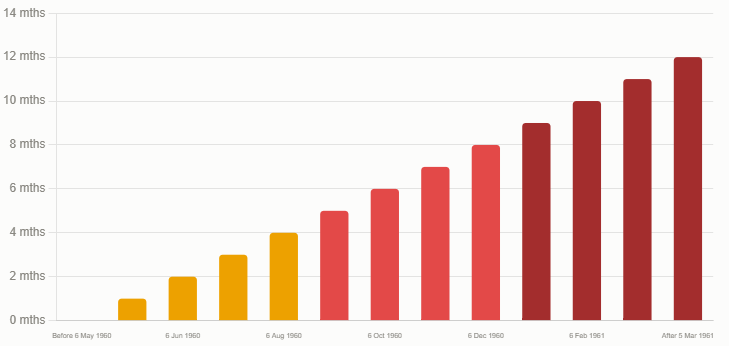
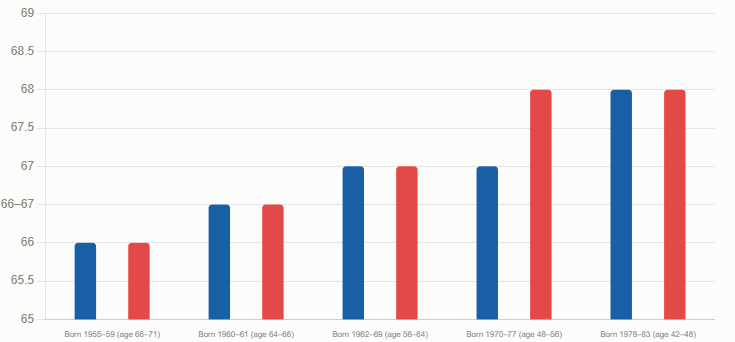
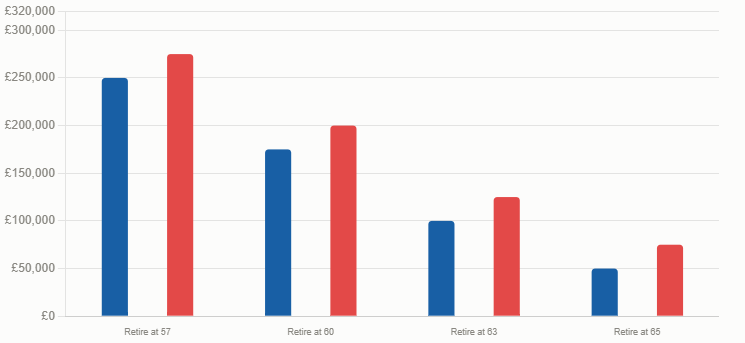
For people currently in their 50s, this matters enormously. Your exact date of birth will determine not only when you can claim the State Pension, but how large the gap is between any age you might hope to retire and the date the government will begin sending you £241.30 a week. That gap — measured in months or years — represents real money that must come from somewhere. This guide explains precisely which 50-somethings are affected, by how much, and what to do about it.
State Pension 2026/27: £241.30/week (£12,547.60/year). Rise from 66 to 67: confirmed in law, begins 6 May 2026, completes 6 April 2028. First affected: born 6 May 1960 (waits 1 extra month). Born after 5 March 1961: State Pension age is 67 in full. Rise to 68: legislated for 2044–2046; contested reviews propose 2037–2039 or 2041–2043. Third review underway July 2025; outcome expected late 2020s.
Tom Selby, director of public policy at AJ Bell, described the change plainly: 'The state pension is the bedrock upon which millions of Brits build their retirement plans. However, the sands are shifting, with a long-trailed hike in the state pension age to 67 kicking off from April this year and completing in 2028.' The key points:
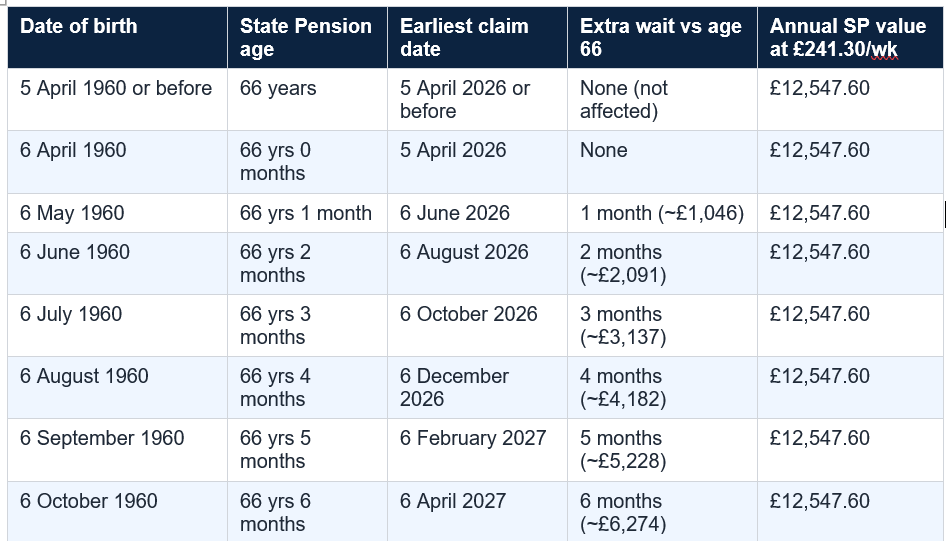
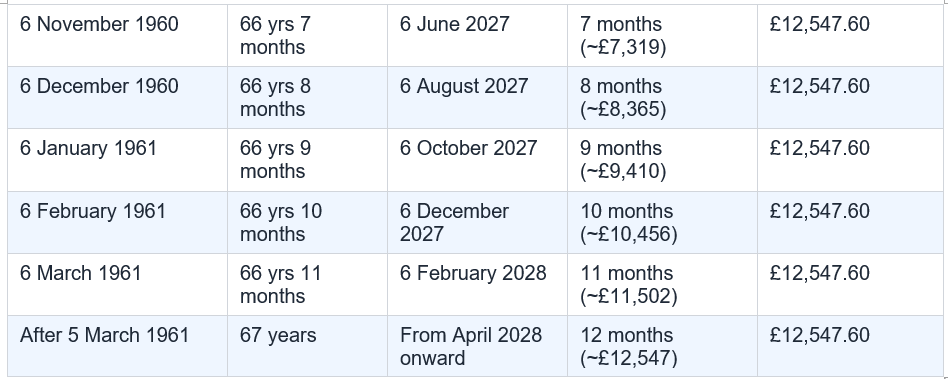
Sources: Yahoo Finance/pension.co.uk (April 4, 2026); pensionbible.co.uk (April 9, 2026); nationalherald.co.uk (April 3, 2026); moneytothemasses.com (April 10, 2026). Extra wait values are illustrative, calculated at £241.30/week × number of months × 4.33 weeks. Not personalised financial advice.
These are the earliest dates you can CLAIM — they are not dates when you are compelled to stop working. You can continue working past your State Pension age. Equally, you can retire before your State Pension age — but you will need to fund that gap from personal savings, a workplace pension, or other income. The State Pension cannot be drawn before the legislated age.
Three reviews have reached different conclusions:
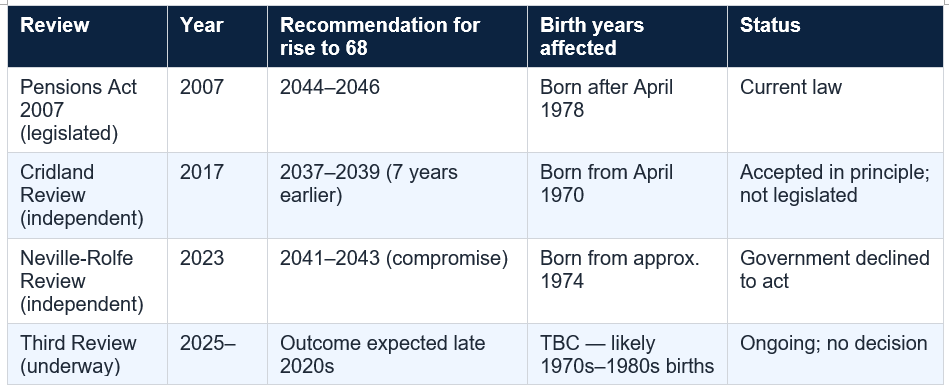
As of 15 July 2026, a government spokesperson stated: 'The previous government publicly committed to raising the State Pension age to 68 between 2037 and 2039, and the OBR has reflected that position for years. The State Pension age Review... is currently underway and we cannot pre-empt the outcome.' (pensionplain.co.uk, July 28, 2026). This is a significant signal: the OBR (Office for Budget Responsibility) has been using 2037–2039 in its public finance forecasts for years. If that timetable is adopted in legislation, it would affect everyone born from approximately April 1970 — people who are currently in their mid-50s.
People currently aged 50–56 (born roughly 1970–1976) face the greatest uncertainty. Under current law, their State Pension age is 67. Under the 2017 Cridland recommendation — which the OBR has been using in its forecasts — it would be 68. The difference is an additional year of State Pension income foregone: approximately £12,548. Prudent planning means treating 68 as a realistic worst-case scenario rather than assuming the legislated 67 is safe. The ten-year notice rule (Cridland's own recommendation) means any change to affect those born in 1970 would need to be legislated by 2027.
The ten-year notice principle matters: the Cridland Review itself recommended that at least ten years' notice should be given of any increase in State Pension age. People born in 1970 are already 55–56. If the 2037–2039 timetable is adopted and becomes law, those born in 1970 would receive only around 11 years of notice. The window for legislation is closing. Anyone born in the early 1970s who is planning on a State Pension age of 67 should be aware that this could change — and should not build a retirement plan that only works at 67.
Born 1960 (currently aged 65–66): You are the first cohort being directly affected by the 66-to-67 transition right now. Your State Pension age is between 66 and 66 years 11 months depending on your birth month. You may be waiting months longer than you expected. If you turned 66 in early 2026 and assumed you could claim immediately, check your exact date — the transition started from May 2026 birth cohorts. If you were born on or before 5 April 1960, you are not affected and your State Pension age is 66.
Born 1961 to 1969 (currently aged 56–64): Your State Pension age is 67, confirmed in law. You will wait one full year longer than the pre-2026 cohort. At current rates (£241.30/week), the deferred year is worth approximately £12,548 in State Pension income you will not receive at 66. Your planning horizon is 3–11 years. The priority now is maximising your pension pot, filling any NI gaps, and modelling what your income will look like in the gap years between any private retirement date and age 67.
Born 1970 to 1978 (currently aged 47–55): Your confirmed State Pension age is 67 (legislated). However, the ongoing State Pension age review — and the OBR's working assumption of a 2037–2039 rise to 68 — means your actual State Pension age could be 68. This is not confirmed in law, but it is a live and actively considered possibility. A one-year change from 67 to 68 at this income level costs approximately £12,548. Treat 68 as your planning assumption, not 67.
Born after 5 April 1978 (currently under 48): Under current law, your State Pension age is already 68, timetabled 2044–2046. No further rise to 69 is currently legislated. However, mandatory reviews every six years mean the picture will continue to evolve. For planning at this stage, 68 is the baseline and personal pension saving is essential.
The Pensions Act 1995 began raising women's State Pension age from 60 to 65, with the process to complete by 2020. The Pensions Act 2011 then accelerated the timetable further, and also raised both men's and women's pension age to 66 by October 2020. Many women born in the 1950s were not informed of these changes in time to adjust their retirement plans — some received no personal notification until one year before they expected to claim.
The Parliamentary and Health Service Ombudsman found that the Department for Work and Pensions committed maladministration in failing to adequately communicate the pension age changes between 2005 and 2007 (ukcalculator.com, April 2026). The Ombudsman recommended compensation of £1,000 to £2,950 per affected woman. Some women lost up to £50,000 in State Pension income as a result of waiting up to six extra years without adequate warning. As of March 2026, the government's response on financial redress remained under consideration (ukstartupmagazine.co.uk).
The WASPI precedent is directly relevant to those in their 50s today: it demonstrates that pension age changes can arrive faster than announced and with less notice than felt fair. The lesson is not to assume that today's legislated timetable is the final word — and to plan for a worst-case scenario that is at least one year later than current law specifies.
In absolute terms, £241.30 a week is a meaningful income — but it is not sufficient to sustain most people's pre-retirement standard of living without supplementary income. The Pensions and Lifetime Savings Association's Retirement Living Standards for 2026 suggest a 'moderate' retirement for a single person requires approximately £31,300 per year and a 'comfortable' retirement approximately £43,100 per year. The State Pension of £12,548 covers 40% of the moderate standard and 29% of the comfortable standard.
Every year by which the State Pension age rises represents one year of that £12,548 that does not arrive — and must be replaced from other sources. For a 50-something in the 1961–1969 cohort, the one-year delay from 66 to 67 creates a £12,548 gap. For those in the 1970–1977 cohort who may face a rise to 68, the cumulative gap versus the original expectation of 66 could be £25,095.
State Pension 2026/27: £241.30/week = £1,045/month = £12,547.60/year. Requires: 35 qualifying NI years (full amount); 10 qualifying years (any amount). Value of one year's delay: ~£12,548. Value of two years' delay (age 66 to 68): ~£25,095. At age 50, expected years of receipt: ~17 years (men), ~20 years (women) under current legislation (IFS, May 2026). At age 50 with 68 SPA: ~15 years (men), ~18 years (women).
The value of filling a gap year is significant: one qualifying year of State Pension adds approximately £6.99 per week (£364 per year) to your full new State Pension entitlement, based on the £241.30 weekly rate divided by 35 qualifying years. A Class 3 voluntary contribution costs approximately £824 per gap year in 2026/27. The payback period is approximately 2.3 years — meaning anyone who lives at least two and a half years after State Pension age will profit from filling gaps.
Check your NI record now at gov.uk/check-national-insurance-record. Then check your State Pension forecast at gov.uk/check-state-pension. If you have gaps, use the government's online service to identify which years are worth filling and at what cost. Gaps from 2006–2016 may be available to fill at a lower 'voluntary Class 3' rate. The government has extended deadlines for filling historical gaps — but deadlines do apply. Act before the window closes for years approaching the six-year limit. Filling just two missing years could be worth £12,800 or more in lifetime State Pension income for someone living to average life expectancy.
Note: not all gap years are worth filling — if you already have 35 qualifying years, filling further gaps will not increase your State Pension. Check your forecast first before buying contributions. Also note that if you have years of auto-enrollment workplace pension but gaps in NI, the two are separate: workplace pension does not substitute for State Pension NI contributions.
Workplace and personal pensions: from April 2028, the minimum age at which most people can access their defined contribution pension is rising from 55 to 57 (the normal minimum pension age, or NMPA). This means a 52-year-old today who wants to retire at 57 will need to fund five years before the State Pension arrives at 67 — a total of ten years of non-State-Pension income. Pension drawdown, an annuity, or a combination can provide this bridge. The key planning question: does your pension pot — plus any employer contributions in the remaining years of work — produce enough income from 57 to sustain you until 67 without exhausting the fund?
ISAs (Individual Savings Accounts): ISA withdrawals are free of income tax at any age, making them a flexible bridge between early retirement and State Pension age. Annual ISA allowance: £20,000 (2026/27). A stocks and shares ISA started in your early 50s with ten years of £20,000 contributions could accumulate a substantial sum (though investment returns are not guaranteed). Unlike pensions, ISA funds are accessible immediately — no minimum age — making them ideal for the very early years of retirement before pension access.
Deferring the State Pension: if you continue working past your State Pension age, you can defer claiming. Deferring by one year increases the weekly State Pension by approximately 1% for every nine weeks deferred — approximately 5.8% per year. A one-year deferral adds approximately £14 per week to your pension permanently. This can be worth considering if you are still earning well at State Pension age and do not need the income immediately.
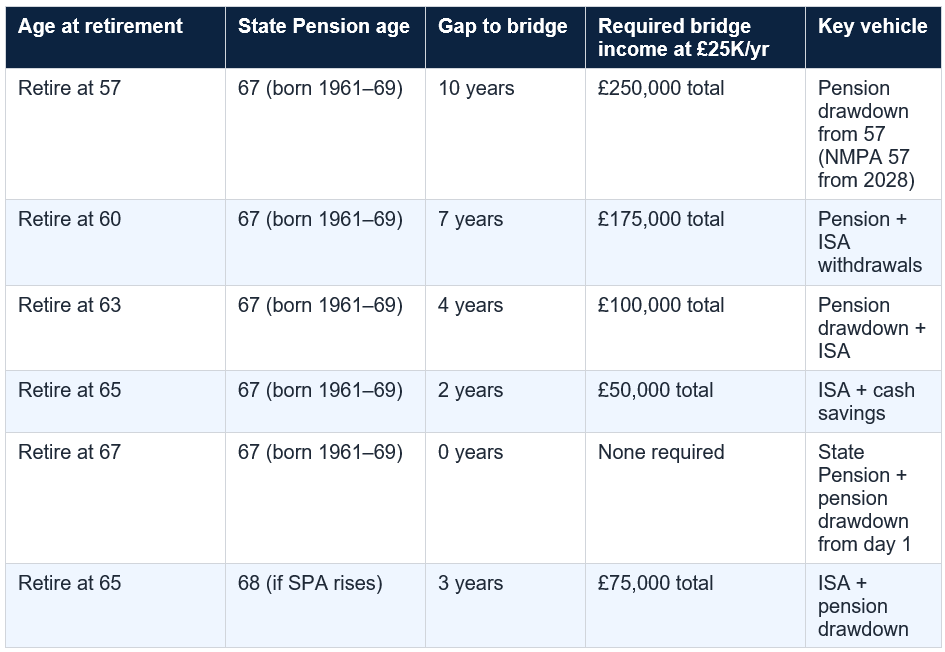
All bridge income figures are illustrative, based on £25,000/year required income and do not include tax, investment returns, or inflation. Not financial advice. Consult an independent financial adviser for projections specific to your pension, ISA, and savings position.
The challenge for 50-somethings is time. A 52-year-old with 15 years to a State Pension age of 67 has a meaningful runway — but only if contributions are maximised now. The pension Annual Allowance for 2026/27 is £60,000 (including employer contributions); few people reach this limit, but it is worth knowing the ceiling. Salary sacrifice into a pension reduces National Insurance as well as income tax, making it particularly efficient for those in their 50s who are still in employment.
Request a pension statement from your workplace pension provider and from any previous workplace pensions you may have accumulated. Locate and consolidate any lost or old pensions using the government's Pension Tracing Service at gov.uk/find-pension-contact-details. Consider whether increasing your workplace pension contribution — even by 2–3% of salary — would meaningfully change your retirement income projection. Remember that employer contributions are effectively free money: if your employer matches contributions above the minimum, not contributing up to the match is leaving salary on the table.
Do these three things this week: (1) Go to gov.uk/check-state-pension and note your forecast weekly amount and State Pension age. (2) Go to gov.uk/check-national-insurance-record and count your qualifying years and identify gaps. (3) If you have gaps before 2019, consider whether buying voluntary contributions is cost-effective. Four steps then: write down the gap between your intended retirement age and your State Pension age; estimate the annual income you need in those gap years; work out whether your pension, ISA, and savings will cover it; if not, identify how much more you need to save per month to close that gap. This is the foundation of a retirement plan for any 50-something in the UK today.
The WASPI generation learned the hard way that pension age changes can arrive faster than expected and with less notice than felt fair. The lesson for 50-somethings today is to plan for the worst-case timetable, not the best-case one — to assume 68 if you were born in the early 1970s, and to treat your State Pension forecast as a floor, not a guarantee of timing.
The practical response is straightforward: check your State Pension forecast, fill NI gaps that are still open, maximise your workplace and personal pension contributions in the years remaining, build an ISA bridge for the gap years, and model your retirement income across all scenarios. The longer wait is manageable — but only for those who see it coming and plan accordingly.
If you were born on 6 October 1960, your State Pension age is 66 years and 6 months — meaning you can claim from 6 April 2027. You are in the middle of the 66-to-67 transitional cohort. You will wait 6 months longer than someone born on 5 April 1960 (who claimed at exactly 66). At current rates of £241.30 per week, those 6 months represent approximately £6,274 in State Pension income that arrives later. Verify your exact date at gov.uk/state-pension-age — the government's calculator uses your precise birth date.
Will the State Pension age definitely rise to 68, and when?
Under current law (the Pensions Act 2007 as amended), the State Pension age is timetabled to rise from 67 to 68 between 2044 and 2046. However, a third independent review launched in July 2025 is currently underway, and both the 2017 Cridland Review (which recommended 2037–2039) and the OBR's public finance forecasts use an earlier timetable. As of July 2026, the government confirmed the review is ongoing and stated it cannot pre-empt the outcome. No change has been legislated. However, given that the OBR has used 2037–2039 as its working assumption and the government has not distanced itself from that figure, people born from approximately 1970 should treat 68 as a realistic planning scenario, not just a remote possibility.
What is the WASPI campaign and is it relevant to me?
WASPI (Women Against State Pension Inequality) represents approximately 3.8 million women born in the 1950s whose State Pension age was raised from 60 to 66 with, they argue, inadequate notice. The Parliamentary Ombudsman found DWP committed maladministration in failing to communicate the changes adequately between 2005 and 2007. As of March 2026, the question of financial compensation (recommended at £1,000–£2,950 per woman by the Ombudsman) was still under government consideration. The WASPI case is directly relevant to everyone in their 50s today: it demonstrates that State Pension age changes can happen faster than announced, with less notice than expected. The lesson is to plan proactively for a later pension age than current law specifies, rather than assuming today's timetable is the final word.
How many qualifying NI years do I need for the full State Pension?
You need 35 qualifying years of National Insurance contributions or credits to receive the full new flat-rate State Pension of £241.30 per week (2026/27). You need a minimum of 10 qualifying years to receive any State Pension. If you have between 10 and 35 qualifying years, you receive a proportional amount. Check your NI record at gov.uk/check-national-insurance-record to see how many qualifying years you have and whether any gaps can be filled by buying voluntary Class 3 contributions. Note: people with NI records before April 2016 (when the new State Pension was introduced) may need a different number of qualifying years depending on their individual history — the online forecast tool accounts for this.
Can I retire before my State Pension age?
Yes — there is no legal requirement to work until State Pension age. However, you cannot claim the State Pension before your legislated State Pension age, regardless of when you stop working. Retiring at, say, 63 with a State Pension age of 67 means funding four years of retirement income from other sources — personal or workplace pension, ISA withdrawals, savings, or other income. From April 2028, the minimum age at which most people can access defined contribution pension savings rises from 55 to 57 (the normal minimum pension age). If you intend to retire before 57, you will need other income sources (ISA, savings, spouse's income) for the period before pension access opens.
What happens if I defer my State Pension past my State Pension age?
If you reach your State Pension age but do not claim immediately — because you are still working, for example — your State Pension will increase for every week you defer. The rate is 1% for every 9 weeks deferred, equivalent to approximately 5.8% per year of deferral. So deferring for one year beyond State Pension age at the current £241.30/week rate would add approximately £14 per week to your pension permanently — taking it to approximately £255 per week. Deferral can be worth considering if you are still earning well at State Pension age, do not need the income, and expect to live well beyond average life expectancy. However, if you die before the break-even point (typically 10–15 years after deferral), deferral may not have been beneficial in financial terms.
Table of Contents
- A Retirement Date That Keeps Moving
- The Confirmed Change: 66 to 67 (May 2026 to April 2028)
- Birth Date Timetable: Exactly Who Waits and How Long
- The Uncertain Future: Will It Rise to 68 — and When?
- Who in Their 50s Is Most Affected Right Now
- WASPI: The Warning From the Generation Before
- What £241.30 a Week Actually Means for Your Retirement
- Filling NI Gaps: The Deadline Most People Miss
- How to Bridge the Gap: Pension, ISA, and Savings Strategies
- Workplace Pensions and Auto-Enrolment: The Other Clock Ticking
- The Tax Implications of Retiring Before State Pension Age
- Checking Your State Pension Forecast
- Conclusion: The Longer Wait Is Coming — Plan Now
- Frequently Asked Questions
66 --> 67 Timetable: Who Waits And How Long?
The Rise To 68: Which Birthday Year Faces The Uncertainty?
The Pension Gap: Cash Cost of Retiring Before State Pension Age
A Retirement Date That Keeps Moving
For most of the 20th century, the UK State Pension age was fixed and straightforward: 60 for women, 65 for men. Those days are gone. The State Pension age has been rising steadily since 2010, and the process is accelerating. From 6 May 2026, the age at which UK residents can begin claiming the State Pension started rising from 66 toward 67 — a change that will complete by April 2028. A further rise to 68 is on the horizon, with its timing actively contested.For people currently in their 50s, this matters enormously. Your exact date of birth will determine not only when you can claim the State Pension, but how large the gap is between any age you might hope to retire and the date the government will begin sending you £241.30 a week. That gap — measured in months or years — represents real money that must come from somewhere. This guide explains precisely which 50-somethings are affected, by how much, and what to do about it.
State Pension 2026/27: £241.30/week (£12,547.60/year). Rise from 66 to 67: confirmed in law, begins 6 May 2026, completes 6 April 2028. First affected: born 6 May 1960 (waits 1 extra month). Born after 5 March 1961: State Pension age is 67 in full. Rise to 68: legislated for 2044–2046; contested reviews propose 2037–2039 or 2041–2043. Third review underway July 2025; outcome expected late 2020s.
The Confirmed Change: 66 to 67 (May 2026 to April 2028)
The rise from 66 to 67 is not a proposal or a rumour. It is law, legislated under Section 26 of the Pensions Act 2014. There is no realistic prospect of it being reversed. The transition began on 6 May 2026 and will complete on 6 April 2028 — a two-year phased increase in which the State Pension age rises by one month for each monthly birth cohort.Tom Selby, director of public policy at AJ Bell, described the change plainly: 'The state pension is the bedrock upon which millions of Brits build their retirement plans. However, the sands are shifting, with a long-trailed hike in the state pension age to 67 kicking off from April this year and completing in 2028.' The key points:
- Men and women are affected equally — there is no longer a different State Pension age for the two sexes.
- The rise applies to the new flat-rate State Pension (introduced April 2016) and to those with entitlements under the old basic State Pension system equally.
- People born on or before 5 April 1960 are not affected — their State Pension age remains 66 and they have already reached, or will reach, that age before the transition begins.
- People born from 6 April 1960 are affected — how much depends on their exact birth date.
- People born from 6 March 1961 onward have a State Pension age of 67 in full (moneytothemasses.com, April 2026).
Birth Date Timetable: Exactly Who Waits and How Long
The following table shows State Pension ages and claim dates for the cohorts affected by the 66-to-67 transition (pensionbible.co.uk; nationalherald.co.uk; Yahoo Finance/pension.co.uk). All dates are the earliest date from which State Pension can be claimed — claiming before this date is not possible.Sources: Yahoo Finance/pension.co.uk (April 4, 2026); pensionbible.co.uk (April 9, 2026); nationalherald.co.uk (April 3, 2026); moneytothemasses.com (April 10, 2026). Extra wait values are illustrative, calculated at £241.30/week × number of months × 4.33 weeks. Not personalised financial advice.
These are the earliest dates you can CLAIM — they are not dates when you are compelled to stop working. You can continue working past your State Pension age. Equally, you can retire before your State Pension age — but you will need to fund that gap from personal savings, a workplace pension, or other income. The State Pension cannot be drawn before the legislated age.
The Uncertain Future: Will It Rise to 68 — and When?
The State Pension age story does not end at 67. Under current legislation (Schedule 4 to the Pensions Act 1995, as amended by the Pensions Act 2007), the State Pension age is timetabled to rise from 67 to 68 between 2044 and 2046. Under that timetable, anyone born after 5 April 1978 would have a State Pension age of 68 (pensionplain.co.uk, July 28, 2026). But this timetable has been under sustained pressure to accelerate.Three reviews have reached different conclusions:
As of 15 July 2026, a government spokesperson stated: 'The previous government publicly committed to raising the State Pension age to 68 between 2037 and 2039, and the OBR has reflected that position for years. The State Pension age Review... is currently underway and we cannot pre-empt the outcome.' (pensionplain.co.uk, July 28, 2026). This is a significant signal: the OBR (Office for Budget Responsibility) has been using 2037–2039 in its public finance forecasts for years. If that timetable is adopted in legislation, it would affect everyone born from approximately April 1970 — people who are currently in their mid-50s.
People currently aged 50–56 (born roughly 1970–1976) face the greatest uncertainty. Under current law, their State Pension age is 67. Under the 2017 Cridland recommendation — which the OBR has been using in its forecasts — it would be 68. The difference is an additional year of State Pension income foregone: approximately £12,548. Prudent planning means treating 68 as a realistic worst-case scenario rather than assuming the legislated 67 is safe. The ten-year notice rule (Cridland's own recommendation) means any change to affect those born in 1970 would need to be legislated by 2027.
The ten-year notice principle matters: the Cridland Review itself recommended that at least ten years' notice should be given of any increase in State Pension age. People born in 1970 are already 55–56. If the 2037–2039 timetable is adopted and becomes law, those born in 1970 would receive only around 11 years of notice. The window for legislation is closing. Anyone born in the early 1970s who is planning on a State Pension age of 67 should be aware that this could change — and should not build a retirement plan that only works at 67.
Who in Their 50s Is Most Affected Right Now
'People in their 50s' is not a monolithic group. The State Pension age changes affect them in very different ways depending on their exact birth year. Here is how the picture breaks down:Born 1960 (currently aged 65–66): You are the first cohort being directly affected by the 66-to-67 transition right now. Your State Pension age is between 66 and 66 years 11 months depending on your birth month. You may be waiting months longer than you expected. If you turned 66 in early 2026 and assumed you could claim immediately, check your exact date — the transition started from May 2026 birth cohorts. If you were born on or before 5 April 1960, you are not affected and your State Pension age is 66.
Born 1961 to 1969 (currently aged 56–64): Your State Pension age is 67, confirmed in law. You will wait one full year longer than the pre-2026 cohort. At current rates (£241.30/week), the deferred year is worth approximately £12,548 in State Pension income you will not receive at 66. Your planning horizon is 3–11 years. The priority now is maximising your pension pot, filling any NI gaps, and modelling what your income will look like in the gap years between any private retirement date and age 67.
Born 1970 to 1978 (currently aged 47–55): Your confirmed State Pension age is 67 (legislated). However, the ongoing State Pension age review — and the OBR's working assumption of a 2037–2039 rise to 68 — means your actual State Pension age could be 68. This is not confirmed in law, but it is a live and actively considered possibility. A one-year change from 67 to 68 at this income level costs approximately £12,548. Treat 68 as your planning assumption, not 67.
Born after 5 April 1978 (currently under 48): Under current law, your State Pension age is already 68, timetabled 2044–2046. No further rise to 69 is currently legislated. However, mandatory reviews every six years mean the picture will continue to evolve. For planning at this stage, 68 is the baseline and personal pension saving is essential.
WASPI: The Warning From the Generation Before
The WASPI campaign — Women Against State Pension Inequality — represents approximately 3.8 million women born in the 1950s who experienced a rapid and, many argue, poorly communicated acceleration in their State Pension age. Their experience is the most important lesson for anyone currently in their 50s navigating today's changes.The Pensions Act 1995 began raising women's State Pension age from 60 to 65, with the process to complete by 2020. The Pensions Act 2011 then accelerated the timetable further, and also raised both men's and women's pension age to 66 by October 2020. Many women born in the 1950s were not informed of these changes in time to adjust their retirement plans — some received no personal notification until one year before they expected to claim.
The Parliamentary and Health Service Ombudsman found that the Department for Work and Pensions committed maladministration in failing to adequately communicate the pension age changes between 2005 and 2007 (ukcalculator.com, April 2026). The Ombudsman recommended compensation of £1,000 to £2,950 per affected woman. Some women lost up to £50,000 in State Pension income as a result of waiting up to six extra years without adequate warning. As of March 2026, the government's response on financial redress remained under consideration (ukstartupmagazine.co.uk).
The WASPI precedent is directly relevant to those in their 50s today: it demonstrates that pension age changes can arrive faster than announced and with less notice than felt fair. The lesson is not to assume that today's legislated timetable is the final word — and to plan for a worst-case scenario that is at least one year later than current law specifies.
What £241.30 a Week Actually Means for Your Retirement
The new flat-rate State Pension for 2026/27 is £241.30 per week — equivalent to £12,547.60 per year, or approximately £1,045 per month. To receive the full amount you need 35 qualifying years of National Insurance contributions or credits. You need a minimum of 10 qualifying years to receive any State Pension at all (Fidelity UK, July 16, 2026).In absolute terms, £241.30 a week is a meaningful income — but it is not sufficient to sustain most people's pre-retirement standard of living without supplementary income. The Pensions and Lifetime Savings Association's Retirement Living Standards for 2026 suggest a 'moderate' retirement for a single person requires approximately £31,300 per year and a 'comfortable' retirement approximately £43,100 per year. The State Pension of £12,548 covers 40% of the moderate standard and 29% of the comfortable standard.
Every year by which the State Pension age rises represents one year of that £12,548 that does not arrive — and must be replaced from other sources. For a 50-something in the 1961–1969 cohort, the one-year delay from 66 to 67 creates a £12,548 gap. For those in the 1970–1977 cohort who may face a rise to 68, the cumulative gap versus the original expectation of 66 could be £25,095.
State Pension 2026/27: £241.30/week = £1,045/month = £12,547.60/year. Requires: 35 qualifying NI years (full amount); 10 qualifying years (any amount). Value of one year's delay: ~£12,548. Value of two years' delay (age 66 to 68): ~£25,095. At age 50, expected years of receipt: ~17 years (men), ~20 years (women) under current legislation (IFS, May 2026). At age 50 with 68 SPA: ~15 years (men), ~18 years (women).
Filling NI Gaps: The Deadline Most People Miss
One of the highest-return actions available to most people in their 50s with an incomplete National Insurance record is buying voluntary Class 3 NI contributions to fill gaps. The government allows voluntary contributions to fill gaps in your NI record going back to April 2006, meaning that years you may have missed — due to career breaks, periods abroad, self-employment gaps, or low earnings — can often be purchased.The value of filling a gap year is significant: one qualifying year of State Pension adds approximately £6.99 per week (£364 per year) to your full new State Pension entitlement, based on the £241.30 weekly rate divided by 35 qualifying years. A Class 3 voluntary contribution costs approximately £824 per gap year in 2026/27. The payback period is approximately 2.3 years — meaning anyone who lives at least two and a half years after State Pension age will profit from filling gaps.
Check your NI record now at gov.uk/check-national-insurance-record. Then check your State Pension forecast at gov.uk/check-state-pension. If you have gaps, use the government's online service to identify which years are worth filling and at what cost. Gaps from 2006–2016 may be available to fill at a lower 'voluntary Class 3' rate. The government has extended deadlines for filling historical gaps — but deadlines do apply. Act before the window closes for years approaching the six-year limit. Filling just two missing years could be worth £12,800 or more in lifetime State Pension income for someone living to average life expectancy.
Note: not all gap years are worth filling — if you already have 35 qualifying years, filling further gaps will not increase your State Pension. Check your forecast first before buying contributions. Also note that if you have years of auto-enrollment workplace pension but gaps in NI, the two are separate: workplace pension does not substitute for State Pension NI contributions.
How to Bridge the Gap: Pension, ISA, and Savings Strategies
If your State Pension age is 67 or higher but you intend to retire at 60 or 65, you face a gap of two to seven years with no State Pension income. Bridging this gap requires deliberate planning in your 50s. The three main vehicles are:Workplace and personal pensions: from April 2028, the minimum age at which most people can access their defined contribution pension is rising from 55 to 57 (the normal minimum pension age, or NMPA). This means a 52-year-old today who wants to retire at 57 will need to fund five years before the State Pension arrives at 67 — a total of ten years of non-State-Pension income. Pension drawdown, an annuity, or a combination can provide this bridge. The key planning question: does your pension pot — plus any employer contributions in the remaining years of work — produce enough income from 57 to sustain you until 67 without exhausting the fund?
ISAs (Individual Savings Accounts): ISA withdrawals are free of income tax at any age, making them a flexible bridge between early retirement and State Pension age. Annual ISA allowance: £20,000 (2026/27). A stocks and shares ISA started in your early 50s with ten years of £20,000 contributions could accumulate a substantial sum (though investment returns are not guaranteed). Unlike pensions, ISA funds are accessible immediately — no minimum age — making them ideal for the very early years of retirement before pension access.
Deferring the State Pension: if you continue working past your State Pension age, you can defer claiming. Deferring by one year increases the weekly State Pension by approximately 1% for every nine weeks deferred — approximately 5.8% per year. A one-year deferral adds approximately £14 per week to your pension permanently. This can be worth considering if you are still earning well at State Pension age and do not need the income immediately.
All bridge income figures are illustrative, based on £25,000/year required income and do not include tax, investment returns, or inflation. Not financial advice. Consult an independent financial adviser for projections specific to your pension, ISA, and savings position.
Workplace Pensions and Auto-Enrolment: The Other Clock Ticking
Auto-enrolment has transformed UK retirement savings since 2012. Anyone aged 22 to State Pension age who earns above £10,000 per year and is not already in a workplace pension is automatically enrolled. The minimum total contribution rate is 8% of qualifying earnings — at least 3% from the employer and 5% from the employee (including tax relief). For most people in their 50s, the combination of auto-enrolment contributions and investment growth in the years remaining to retirement will be the single largest driver of retirement income beyond the State Pension.The challenge for 50-somethings is time. A 52-year-old with 15 years to a State Pension age of 67 has a meaningful runway — but only if contributions are maximised now. The pension Annual Allowance for 2026/27 is £60,000 (including employer contributions); few people reach this limit, but it is worth knowing the ceiling. Salary sacrifice into a pension reduces National Insurance as well as income tax, making it particularly efficient for those in their 50s who are still in employment.
Request a pension statement from your workplace pension provider and from any previous workplace pensions you may have accumulated. Locate and consolidate any lost or old pensions using the government's Pension Tracing Service at gov.uk/find-pension-contact-details. Consider whether increasing your workplace pension contribution — even by 2–3% of salary — would meaningfully change your retirement income projection. Remember that employer contributions are effectively free money: if your employer matches contributions above the minimum, not contributing up to the match is leaving salary on the table.
The Tax Implications of Retiring Before State Pension Age
Retiring before your State Pension age has specific tax implications that are frequently overlooked in retirement planning:- Income tax in early retirement: if you retire at 60 with no State Pension and draw from your pension pot, you will pay income tax on pension withdrawals above the Personal Allowance (£12,570 for 2026/27, frozen until 2031). But if your only income is pension drawdown below £12,570 per year, you pay no income tax at all in those early years.
- The interaction with State Pension: when your State Pension begins (at 67 or 68), it counts as taxable income. At £241.30 per week (£12,547.60 per year), it nearly fills the entire Personal Allowance. Any pension drawdown or other income on top of the State Pension will then be taxed from the first pound above £12,570. For people in drawdown who are also taking the State Pension, tax planning becomes significantly more complex.
- National Insurance in retirement: you stop paying National Insurance contributions once you reach State Pension age. Retiring before State Pension age means you continue paying Class 1 NI (if employed) or Class 4 NI (if self-employed). Retiring before State Pension age removes this obligation for those who stop working.
- 25% tax-free cash (pension commencement lump sum): taking the 25% tax-free element of your pension before State Pension age can be a tax-efficient way to build a cash bridge. However, from April 2024, the lifetime limit on the total tax-free cash amount is £268,275. This is not affected by State Pension age — you can take it as soon as you access your pension from age 57 (from 2028).
Checking Your State Pension Forecast
The most important single action for anyone in their 50s is to check their personal State Pension forecast. The government provides two free online tools:- Check your State Pension forecast: gov.uk/check-state-pension — this shows your current projected weekly State Pension amount, how many qualifying NI years you have, and your personal State Pension age. It is updated in real time when your NI record changes.
- Check your NI record: gov.uk/check-national-insurance-record — this shows every year of your record, whether each year is 'full', 'partial', or a gap, and which gap years can be voluntarily filled and at what cost.
- State Pension age calculator: gov.uk/state-pension-age — enter your date of birth to receive your confirmed State Pension age and the specific date from which you can claim. This is the definitive government source; third-party calculators may not reflect recent legislative changes.
Do these three things this week: (1) Go to gov.uk/check-state-pension and note your forecast weekly amount and State Pension age. (2) Go to gov.uk/check-national-insurance-record and count your qualifying years and identify gaps. (3) If you have gaps before 2019, consider whether buying voluntary contributions is cost-effective. Four steps then: write down the gap between your intended retirement age and your State Pension age; estimate the annual income you need in those gap years; work out whether your pension, ISA, and savings will cover it; if not, identify how much more you need to save per month to close that gap. This is the foundation of a retirement plan for any 50-something in the UK today.
Conclusion
The UK State Pension age is rising, and for most people currently in their 50s the new reality is either 67 (confirmed by law) or potentially 68 (if the OBR's working assumption of a 2037–2039 rise is legislated). The transition from 66 to 67 began in May 2026 and is affecting the 1960–1961 birth cohorts right now. Those born from March 1961 onward will wait until 67 as a minimum, with the prospect of 68 sitting over those born from around 1970.The WASPI generation learned the hard way that pension age changes can arrive faster than expected and with less notice than felt fair. The lesson for 50-somethings today is to plan for the worst-case timetable, not the best-case one — to assume 68 if you were born in the early 1970s, and to treat your State Pension forecast as a floor, not a guarantee of timing.
The practical response is straightforward: check your State Pension forecast, fill NI gaps that are still open, maximise your workplace and personal pension contributions in the years remaining, build an ISA bridge for the gap years, and model your retirement income across all scenarios. The longer wait is manageable — but only for those who see it coming and plan accordingly.
Frequently Asked Questions
I was born in October 1960. When can I claim my State Pension?If you were born on 6 October 1960, your State Pension age is 66 years and 6 months — meaning you can claim from 6 April 2027. You are in the middle of the 66-to-67 transitional cohort. You will wait 6 months longer than someone born on 5 April 1960 (who claimed at exactly 66). At current rates of £241.30 per week, those 6 months represent approximately £6,274 in State Pension income that arrives later. Verify your exact date at gov.uk/state-pension-age — the government's calculator uses your precise birth date.
Will the State Pension age definitely rise to 68, and when?
Under current law (the Pensions Act 2007 as amended), the State Pension age is timetabled to rise from 67 to 68 between 2044 and 2046. However, a third independent review launched in July 2025 is currently underway, and both the 2017 Cridland Review (which recommended 2037–2039) and the OBR's public finance forecasts use an earlier timetable. As of July 2026, the government confirmed the review is ongoing and stated it cannot pre-empt the outcome. No change has been legislated. However, given that the OBR has used 2037–2039 as its working assumption and the government has not distanced itself from that figure, people born from approximately 1970 should treat 68 as a realistic planning scenario, not just a remote possibility.
What is the WASPI campaign and is it relevant to me?
WASPI (Women Against State Pension Inequality) represents approximately 3.8 million women born in the 1950s whose State Pension age was raised from 60 to 66 with, they argue, inadequate notice. The Parliamentary Ombudsman found DWP committed maladministration in failing to communicate the changes adequately between 2005 and 2007. As of March 2026, the question of financial compensation (recommended at £1,000–£2,950 per woman by the Ombudsman) was still under government consideration. The WASPI case is directly relevant to everyone in their 50s today: it demonstrates that State Pension age changes can happen faster than announced, with less notice than expected. The lesson is to plan proactively for a later pension age than current law specifies, rather than assuming today's timetable is the final word.
How many qualifying NI years do I need for the full State Pension?
You need 35 qualifying years of National Insurance contributions or credits to receive the full new flat-rate State Pension of £241.30 per week (2026/27). You need a minimum of 10 qualifying years to receive any State Pension. If you have between 10 and 35 qualifying years, you receive a proportional amount. Check your NI record at gov.uk/check-national-insurance-record to see how many qualifying years you have and whether any gaps can be filled by buying voluntary Class 3 contributions. Note: people with NI records before April 2016 (when the new State Pension was introduced) may need a different number of qualifying years depending on their individual history — the online forecast tool accounts for this.
Can I retire before my State Pension age?
Yes — there is no legal requirement to work until State Pension age. However, you cannot claim the State Pension before your legislated State Pension age, regardless of when you stop working. Retiring at, say, 63 with a State Pension age of 67 means funding four years of retirement income from other sources — personal or workplace pension, ISA withdrawals, savings, or other income. From April 2028, the minimum age at which most people can access defined contribution pension savings rises from 55 to 57 (the normal minimum pension age). If you intend to retire before 57, you will need other income sources (ISA, savings, spouse's income) for the period before pension access opens.
What happens if I defer my State Pension past my State Pension age?
If you reach your State Pension age but do not claim immediately — because you are still working, for example — your State Pension will increase for every week you defer. The rate is 1% for every 9 weeks deferred, equivalent to approximately 5.8% per year of deferral. So deferring for one year beyond State Pension age at the current £241.30/week rate would add approximately £14 per week to your pension permanently — taking it to approximately £255 per week. Deferral can be worth considering if you are still earning well at State Pension age, do not need the income, and expect to live well beyond average life expectancy. However, if you die before the break-even point (typically 10–15 years after deferral), deferral may not have been beneficial in financial terms.

0 Comments Comments