

Retirement
Seven Reasons to NOT Top Up Your State Pension
Topping up your State Pension by paying voluntary Class 3 NI contributions is usually described as one of the best financial decisions a UK retiree can make. At around £824 per gap year and a 2.3-year payback period, the maths look compelling. But the case for topping up is not universal — and for a significant number of people, paying could be money wasted, misallocated, or even result in no benefit at all. This guide sets out seven specific situations where paying voluntary NI contributions is not the right call — and what to do instead.

The full new State Pension in 2026/27 is £241.30 per week, or £12,547.60 per year — increased by approximately £575 from the previous year under the triple lock (GOV.UK, April 2026). It requires 35 qualifying NI years for the full amount, and a minimum of 10 qualifying years to receive anything. People with gaps in their NI record — from career breaks, self-employment, periods abroad, or low earnings — can fill those gaps by paying voluntary Class 3 contributions.
Since April 2024, the government's Check Your State Pension Forecast tool has been used by 3.7 million people (GOV.UK). 51% of online top-up payments were for just one year. The average payment was £1,193. The scheme has been widely promoted as a near-certain financial win.
But that promotion has a significant caveat: paying voluntary NI contributions will not always increase the State Pension. The government's own press release states this explicitly. And for a meaningful number of people, the contribution will either produce zero benefit, be cancelled out by benefit adjustments, or be a poor use of money compared with alternatives. This guide identifies the seven situations where topping up is the wrong call.
Full State Pension 2026/27: £241.30/week (£12,547.60/year). Each NI qualifying year: adds ~£6.89/week (£358/year). Class 3 voluntary NI cost 2026/27: ~£824 per gap year. Break-even: 2.3 years. 35 qualifying years needed for full amount; minimum 10 for any payment. Six-year look-back only (post April 2025): can fill gaps in 2020/21 to 2025/26 only. Pension Credit guarantee 2026/27: £218.15/week (single); £332.95/week (couple).
Voluntary Class 3 NI contributions allow you to fill gaps in your NI record for years where you were not automatically credited with a qualifying year — for example, years when you were employed but earned below the Lower Earnings Limit, were unemployed and not claiming qualifying benefits, were self-employed with profits below the Small Profits Threshold (£6,845 in 2024/25), or were living outside the UK.
Since 5 April 2025, the special extended window that allowed people to fill gaps going back to 2006 has closed. From 2026/27 onward, you can fill gaps only in the previous six tax years: 2020/21, 2021/22, 2022/23, 2023/24, 2024/25, and 2025/26. The gap year you fill must be one where a payment would actually increase your entitlement — not a year where you are already receiving credits, and not a year where your qualifying year count already equals or exceeds 35.
The critical first step — before paying anything — is to check your State Pension forecast and NI record at gov.uk/check-state-pension and gov.uk/check-national-insurance-record. The online service will show you which gaps exist and which are worth filling. This check is free, takes around 15 minutes, and is the essential prerequisite for any decision about voluntary contributions.
Check your State Pension forecast and NI record BEFORE considering any payment. Go to gov.uk/check-state-pension to see your projected weekly amount and State Pension age. Go to gov.uk/check-national-insurance-record to identify gaps. Use the online voluntary NI payment service at gov.uk to see whether specific gap years would actually increase your State Pension — and by how much. The service will tell you the cost of filling each gap and the projected increase. Only then should you consider payment.
This is the most straightforward reason not to top up — and it catches more people than you might expect. Many workers who have had long continuous employment careers have accumulated 35 or more qualifying years by their mid-50s. They may have gaps in specific years that appear on their NI record, but if their total qualifying years already equals or exceeds 35, those gaps are financially irrelevant.
The gov.uk NI record tool shows whether filling each specific gap would increase your State Pension forecast. If the tool shows no increase from a particular year, the year is already in excess of your 35-year entitlement — or there is another reason the contribution would not count. Either way: do not pay.
The confusion often arises because people see a gap year on their NI record and assume it needs to be filled. A gap is not the same as a deficiency in entitlement. If you have 36 qualifying years and a gap in 2022/23, the gap is irrelevant — your entitlement is already capped at the maximum. The online service makes this clear, but many people pay for gap years without checking this first.
Always use the government's online tool to check whether filling a specific gap year would actually increase your projected State Pension before paying. The answer is sometimes no — because you already have sufficient qualifying years for the full amount, because you are receiving credits for that year, or because of transitional rules in the new State Pension calculation. The check is free; the mistake of paying unnecessarily is not refundable.
The mechanism works as follows. Suppose your State Pension is currently £200 per week and your only income. The Pension Credit guarantee tops you up to £218.15 — adding £18.15 per week from the benefit. If you pay £824 to add £6.89 per week to your State Pension, bringing it to £206.89 per week, your Pension Credit entitlement falls to £11.26 per week (£218.15 − £206.89). Your total income is still £218.15. The £824 payment has produced zero net gain in weekly income.
Furthermore, Pension Credit is not just a cash payment. Receiving it opens the door to a cascade of additional entitlements: a free television licence for those aged over 75 (worth £174.50 in 2026/27), eligibility for council tax reduction, cold weather payment eligibility, help with NHS dental costs, and other means-tested support. Increasing the State Pension to a level that pushes someone just above the Pension Credit threshold could cost them access to benefits worth significantly more than the gain in State Pension income.
Pension Credit uptake is notoriously low — DWP estimates suggest that only around 60–65% of eligible pensioners claim it. Many people do not know they are entitled to it. If you are considering a voluntary NI top-up, you should first check whether you currently receive or would be eligible for Pension Credit by using the calculator at gov.uk/pension-credit/eligibility.
The Pension Credit trap is particularly relevant for: women with broken employment histories; self-employed people with low pension savings; those who took long career breaks; and anyone whose State Pension forecast is below approximately £218/week single or £333/week as a couple. If you are in or near this territory, paying for a voluntary NI top-up could cost you money — or cost you access to cascade benefits — for zero net improvement in your retirement income. Get a Pension Credit eligibility check FIRST.
NI credits are available for a wide range of circumstances, and many people are unaware of their entitlement. The most significant categories:
Before paying for any gap year, check the full list of NI credit categories at gov.uk/national-insurance-credits. If you were the lower-earning parent who claimed Child Benefit, cared for someone on Carer's Allowance, claimed any qualifying benefit, or a family member cared for your child: you may be entitled to free NI credits. Apply for any applicable credits first, then reassess your NI record and remaining genuine gaps before paying any voluntary contributions.
The break-even calculation is simple: paying £824 to add £358 per year to your State Pension takes 2.3 years to recover. This looks excellent for someone in good health expecting to claim the pension for 20 or more years. But it looks different for someone with a terminal or serious diagnosis. If a medical prognosis suggests a life expectancy of two years or less from the point of claiming the State Pension, the contribution may produce less in pension income than the £824 paid.
It is important to be clear that for most people with health challenges — but not terminal illness — the break-even of 2.3 years still makes the contribution worthwhile. A person who is 66 with type 2 diabetes or managed heart disease and a reasonable expectation of living into their mid-70s should still find the mathematics compelling. The concern applies specifically to those with significantly reduced life expectancy — typically those with a terminal diagnosis, major organ failure, or other condition with a prognosis of two to three years or fewer.
Additionally: if a spouse or civil partner would inherit some of the State Pension income, the calculation changes. The State Pension is not directly inheritable in the way a private pension is — a surviving partner cannot inherit a deceased partner's State Pension in full. However, in some circumstances, some additional pension entitlement may be inheritable. This is an area of complexity that warrants specific advice.
If you are in poor health, the better use of £824 may be to take the money as cash — or to use it to fund a private pension drawdown that can be inherited by family members. Unlike the State Pension (which generally dies with the recipient), a defined contribution pension pot in drawdown can pass to beneficiaries. Before paying for a voluntary NI top-up in a poor health situation, model the alternatives: the £824 in an ISA or pension, the inheritance implications, and whether enhanced annuity rates might be more relevant to your retirement planning.
The arithmetic: a voluntary NI contribution of £824 produces £358 per year, a return of approximately 43% over the first year — but spread over many years, the effective annual return on the £824 is approximately 4–5% (assuming a 20-year retirement horizon). A credit card charging 25% APR, paid off with the same £824, saves £206 in interest in the first year alone — a guaranteed 25% return. This unambiguously beats the State Pension contribution as a financial priority.
The same principle applies to other high-priority uses of the money. For someone approaching retirement with insufficient liquid savings (an emergency fund below three months of expenses), £824 deployed into an accessible savings account provides immediate financial resilience that a State Pension top-up — which does not begin paying back for 2.3 years — does not. For a self-employed person with no private pension, contributing £824 to a SIPP (Self-Invested Personal Pension) would attract basic-rate tax relief, converting £824 into £1,030 gross in the pension — a 25% immediate boost, versus no immediate boost from a voluntary NI payment.
None of this means voluntary NI top-ups are a bad financial decision in the abstract. They are not. For someone with no high-interest debt, an adequate emergency fund, and a workplace or personal pension in place, the NI top-up is often the best available financial decision. The point is that it should be evaluated in the context of the full financial picture — not treated as an unconditional priority regardless of other obligations.
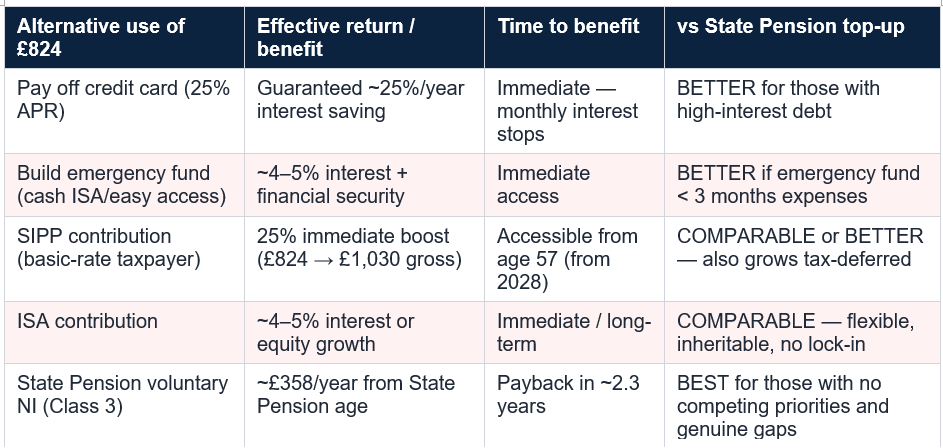
Illustrative only. Returns on ISA and SIPP depend on investment performance and are not guaranteed. Not financial advice. Individual circumstances vary significantly.
The comparison: a higher-rate taxpayer pays £824 in Class 3 NI for a £358/year State Pension addition. The same £824 contributed net to a personal pension or SIPP attracts 20% basic-rate relief automatically (converting £824 to £1,030 gross), and the remaining 20% higher-rate relief is claimed through Self Assessment — bringing the effective net cost to approximately £494 for a £1,030 gross pension contribution. At a 6% annual return over ten years, that £1,030 grows to approximately £1,844 inside the pension.
Additionally, for higher earners approaching the £100,000 adjusted net income threshold (where the 60% effective marginal rate applies through Personal Allowance tapering), pension contributions are particularly efficient — reducing adjusted net income and eliminating the 60% trap. Voluntary NI payments, by contrast, do nothing to reduce adjusted net income and produce no income tax relief at any rate.
The State Pension also becomes taxable income on receipt — adding to total income in retirement and potentially bringing more of it into the higher-rate band. Private pension contributions, by contrast, can be timed in drawdown to stay within the basic-rate band. The tax-efficiency of private pension contributions over voluntary NI payments is significantly higher for taxpayers above the basic rate.
This does not mean higher-rate taxpayers should never top up their State Pension — particularly if they have genuine gaps and are close to retirement with insufficient qualifying years. But it does mean the comparison should be made explicitly. The first question for a higher-rate taxpayer with £824 available should be: 'Have I maximised my private pension contribution this year?' If the answer is no — if there is unused Annual Allowance and employer matching available — the pension contribution should come first.
A Daily Mail / Money Mail investigation (published in the Scottish Daily Mail) uncovered the problem in detail. 'Some savers in their 60s claim to have been misled by officials who told them they could buy extra National Insurance (NI) years to increase their state pension. Some have spent thousands from their life savings to do so, only to fall foul of a quirk in the rules which means their pension does not rise after all. And even worse, they have been denied a refund from the taxman.'
The DWP confirmed to Money Mail: 'We cannot provide advice. The Future Pension Centre gives an estimate of the impact on someone's pension by paying voluntary NI contributions. It can guide that paying X years may impact the pension by Y.' The operative word is 'estimate' and 'may.' No guarantee is given. No refund is available if the estimate proves wrong.
This situation arises most commonly from transitional rules in the new State Pension. People who were contracted out of the Additional State Pension (SERPS or S2P) — typically those with defined benefit (final salary) pension schemes from employers, or who were self-employed in certain periods — may have a 'starting amount' under the new State Pension that is less than their full entitlement. The rules for those in this position are complex. In some cases, additional NI years do not increase the State Pension past the contracted-out deduction. The calculation can only be fully verified by HMRC and DWP together — and only after the fact.
Before paying any voluntary NI contribution, use the government's own online checking tool at gov.uk/check-national-insurance-record. This now shows, for most gap years, whether filling the gap would increase your State Pension forecast and by how much. If the tool shows no increase — or if you have any history of contracted-out pension membership (final salary, career average, or any occupational DB scheme) — seek free guidance from the Pension Wise service (moneyhelper.org.uk/en/pensions-and-retirement/pension-wise) before paying. Pension Wise appointments are free and can be booked via gov.uk.
The GOV.UK press releases promoting the voluntary contributions scheme consistently include language such as: 'Paying voluntary contributions will not always increase their State Pension but everyone can use the new service to check whether they could be better off in retirement before making any voluntary NI payments.' This caveat is important and should be read carefully by anyone considering payment.
The new digital service (launched April 2024) has significantly improved this situation for most straightforward cases — it now shows the projected impact of filling each gap year before payment is made, and allows people to pay through the same service and receive confirmation. For the 3.7 million people who have used the tool since April 2024, this represents a genuine improvement in transparency.
However, the digital service cannot fully account for: contracted-out deductions; complex transitional arrangements for those who built up entitlement under both the old and new State Pension systems; international pension entitlements; or unusual employment histories. If your situation is not straightforward, the online tool's estimate should be treated as indicative, not guaranteed. The right additional step is a call to the Future Pension Centre (0800 731 0175) — or a Pension Wise appointment — before payment.
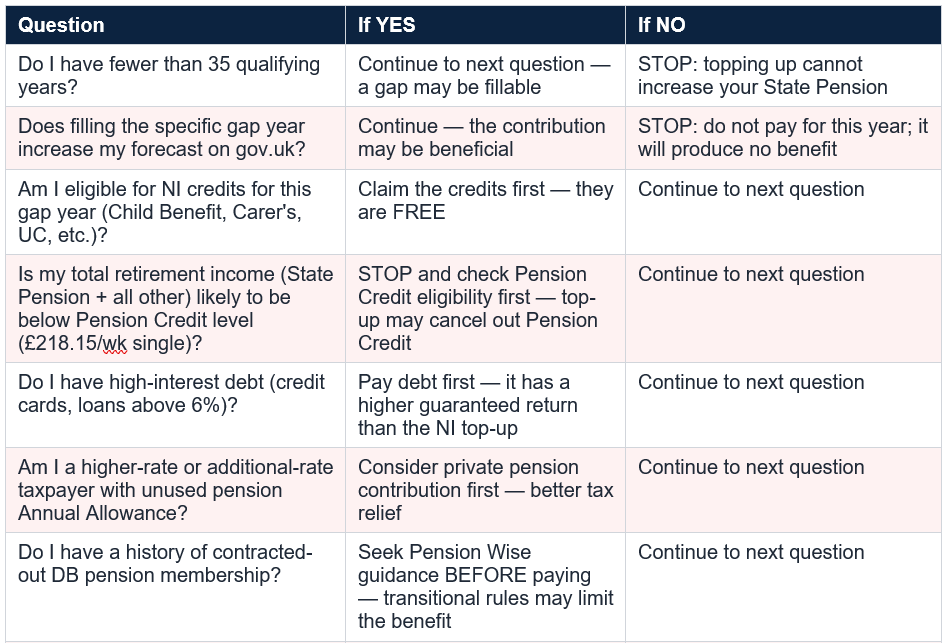
This framework is a decision-support tool, not financial advice. Individual circumstances vary. If any question produces uncertainty, seek free guidance from Pension Wise (moneyhelper.org.uk) or a qualified independent financial adviser.
But the same promotion has left many people confused about who actually benefits. Those with 35 or more qualifying years; those on or eligible for Pension Credit; those who could claim free NI credits; those with high-interest debt; higher-rate taxpayers with unused pension allowances; those in poor health; and those who have not checked whether the payment will work — for all of these groups, the decision to top up requires significantly more analysis than the headline payback figure suggests.
The seven reasons in this guide are not arguments against the State Pension top-up scheme. They are arguments for informed decision-making. Use the gov.uk checking tool. Check your Pension Credit eligibility. Claim any NI credits you are entitled to. Pay off high-interest debt first. If you are a higher-rate taxpayer, maximise your pension allowance first. And if you have any history of contracted-out DB membership, speak to Pension Wise before paying. The check costs nothing. The mistake can cost thousands — and the DWP itself cannot guarantee a refund.
Voluntary Class 3 NI contributions in 2026/27 cost approximately £824 per gap year. This adds approximately £6.89 per week (£358 per year) to your State Pension for life, at the current 2026/27 State Pension rate of £241.30 per week (£12,547.60 per year). The break-even period is approximately 2.3 years (£824 ÷ £358). Since 5 April 2025, you can only fill gaps in the previous six tax years: 2020/21, 2021/22, 2022/23, 2023/24, 2024/25, and 2025/26. The special extended window to fill gaps from April 2006 to April 2018 is now closed. Before paying, use the free checking tool at gov.uk/check-national-insurance-record to confirm which gap years would increase your State Pension and by how much.
Will topping up my State Pension affect my Pension Credit?
Yes — potentially significantly. Pension Credit is a means-tested benefit that tops up weekly income to a guaranteed minimum (£218.15 per week for a single person in 2026/27). If your State Pension and other income is below this level, Pension Credit pays the difference. If you top up your State Pension, your Pension Credit entitlement reduces by £1 for every extra £1 of State Pension income — meaning the net gain in weekly income is zero. Additionally, losing Pension Credit eligibility can mean losing access to cascade benefits including the free TV licence for over-75s (£174.50 in 2026/27), council tax reduction, cold weather payments, and NHS cost help. Always check whether you are currently receiving Pension Credit, or whether you would be eligible without the top-up, before paying. Check eligibility at gov.uk/pension-credit.
What are NI credits and how do I claim them?
NI credits are free qualifying years awarded by the government for specific activities — they have the same effect on your State Pension as a year of paid NI contributions, but cost nothing. Key categories: claiming Child Benefit (even without receiving the payment), claiming Carer's Allowance, claiming Universal Credit or other qualifying benefits, and Specified Adult Childcare credits (for grandparents or others who cared for a child under 12 while the parent was working and claiming Child Benefit — must be applied for separately). Credits are not automatic in all cases: Specified Adult Childcare credits in particular must be actively applied for via HMRC. Check whether you are entitled to credits for any gap years BEFORE considering a voluntary NI payment. Credits are free; Class 3 NI contributions are approximately £824 per year. The government's own guidance states: 'Customers should check if they can get National Insurance credits before they look into paying voluntary contributions.'
I was in a contracted-out pension scheme — should I still top up?
Contracted-out membership (typically in defined benefit final salary pension schemes, or occupational defined benefit schemes prior to the end of contracting out in 2016) is one of the most complex factors in the State Pension top-up decision. People who were contracted out paid lower NI contributions in exchange for a lower State Pension. Under the transitional rules for the new State Pension, contracted-out deductions may cap your State Pension at a level below the full £241.30 even if you later accumulate 35 qualifying years. In some cases, additional voluntary NI contributions do not increase the State Pension past the contracted-out deduction. This is one of the situations where the DWP's Future Pension Centre gives an 'estimate' that may not be accurate — and where people have paid contributions that produced no benefit. If you have any history of contracted-out membership, book a free Pension Wise appointment at moneyhelper.org.uk/en/pensions-and-retirement/pension-wise before paying any voluntary NI contribution.
Can I get a refund if a voluntary NI contribution doesn't increase my State Pension?
In most cases, no. The Daily Mail / Money Mail investigation revealed that people who paid voluntary NI contributions that did not increase their State Pension were denied refunds by HMRC. HMRC collects the money; DWP adjusts the State Pension. The two systems are separate. HMRC does not have access to State Pension forecast information and cannot tell savers whether their contribution will produce a benefit before payment. The new digital service launched in April 2024 has significantly improved this by showing the projected impact before payment, but the gov.uk tool explicitly states that voluntary contributions 'will not always increase their State Pension.' If the payment is made and produces no benefit, HMRC's standard position is that it cannot be refunded. This is a powerful reason to use the online checking tool — and Pension Wise guidance for complex cases — before making any payment.
Is it better to top up my State Pension or contribute to a private pension?
This depends on your tax rate and financial situation. For basic-rate taxpayers with no high-interest debt, a genuine State Pension gap, and no better competing use for the money, the voluntary NI top-up is often the better choice — it offers a guaranteed, inflation-protected, lifelong income at a 2.3-year payback. For higher-rate or additional-rate taxpayers, private pension contributions attract 40% or 45% tax relief — making £824 net become £1,373 or £1,498 gross in the pension respectively. This significantly better tax efficiency may make private pension contributions the priority, particularly if there is unused Annual Allowance (up to £60,000 in 2026/27) and available employer matching. Seek independent advice for a comparison specific to your income, tax position, and retirement income projections.
Table of Contents
- The Case FOR Topping Up — and Why It Isn't Universal
- The Mechanics: How Voluntary NI Top-Ups Work
- Reason 1: You Already Have 35 or More Qualifying Years
- Reason 2: You're Eligible for Pension Credit
- Reason 3: You Can Earn Free NI Credits Instead
- Reason 4: Poor Health or Significantly Reduced Life Expectancy
- Reason 5: You Have High-Interest Debt or Better Uses for the Money
- Reason 6: You're a Higher or Additional Rate Taxpayer
- Reason 7: You Haven't Checked Whether the Top-Up Will Actually Work
- The DWP's Own Admission: They Can't Guarantee It Will Help
- What to Do Instead: A Decision Framework
- The Situations Where Topping Up IS Worth It
- Conclusion: Check First, Pay Second
- Frequently Asked Questions
- External References and Further Reading
The Case FOR Topping Up — and Why It Isn't Universal
The standard advice on State Pension top-ups is enthusiastic, and for good reason. For a cost of approximately £824 per gap year (the Class 3 voluntary NI contribution rate in 2026/27), you can add approximately £6.89 per week — £358 per year — to your State Pension for life. The break-even point is just 2.3 years of pension receipt. For anyone in reasonable health who expects to claim the State Pension for a decade or more, the arithmetic is compelling.The full new State Pension in 2026/27 is £241.30 per week, or £12,547.60 per year — increased by approximately £575 from the previous year under the triple lock (GOV.UK, April 2026). It requires 35 qualifying NI years for the full amount, and a minimum of 10 qualifying years to receive anything. People with gaps in their NI record — from career breaks, self-employment, periods abroad, or low earnings — can fill those gaps by paying voluntary Class 3 contributions.
Since April 2024, the government's Check Your State Pension Forecast tool has been used by 3.7 million people (GOV.UK). 51% of online top-up payments were for just one year. The average payment was £1,193. The scheme has been widely promoted as a near-certain financial win.
But that promotion has a significant caveat: paying voluntary NI contributions will not always increase the State Pension. The government's own press release states this explicitly. And for a meaningful number of people, the contribution will either produce zero benefit, be cancelled out by benefit adjustments, or be a poor use of money compared with alternatives. This guide identifies the seven situations where topping up is the wrong call.
Full State Pension 2026/27: £241.30/week (£12,547.60/year). Each NI qualifying year: adds ~£6.89/week (£358/year). Class 3 voluntary NI cost 2026/27: ~£824 per gap year. Break-even: 2.3 years. 35 qualifying years needed for full amount; minimum 10 for any payment. Six-year look-back only (post April 2025): can fill gaps in 2020/21 to 2025/26 only. Pension Credit guarantee 2026/27: £218.15/week (single); £332.95/week (couple).
The Mechanics: How Voluntary NI Top-Ups Work
Before identifying when not to top up, it is important to understand how the system works. The new flat-rate State Pension (applicable to those reaching State Pension age on or after 6 April 2016) is calculated by dividing the full weekly amount (£241.30) by 35 qualifying years. Each qualifying year you have adds 1/35th of the full State Pension to your entitlement — approximately £6.89 per week.Voluntary Class 3 NI contributions allow you to fill gaps in your NI record for years where you were not automatically credited with a qualifying year — for example, years when you were employed but earned below the Lower Earnings Limit, were unemployed and not claiming qualifying benefits, were self-employed with profits below the Small Profits Threshold (£6,845 in 2024/25), or were living outside the UK.
Since 5 April 2025, the special extended window that allowed people to fill gaps going back to 2006 has closed. From 2026/27 onward, you can fill gaps only in the previous six tax years: 2020/21, 2021/22, 2022/23, 2023/24, 2024/25, and 2025/26. The gap year you fill must be one where a payment would actually increase your entitlement — not a year where you are already receiving credits, and not a year where your qualifying year count already equals or exceeds 35.
The critical first step — before paying anything — is to check your State Pension forecast and NI record at gov.uk/check-state-pension and gov.uk/check-national-insurance-record. The online service will show you which gaps exist and which are worth filling. This check is free, takes around 15 minutes, and is the essential prerequisite for any decision about voluntary contributions.
Check your State Pension forecast and NI record BEFORE considering any payment. Go to gov.uk/check-state-pension to see your projected weekly amount and State Pension age. Go to gov.uk/check-national-insurance-record to identify gaps. Use the online voluntary NI payment service at gov.uk to see whether specific gap years would actually increase your State Pension — and by how much. The service will tell you the cost of filling each gap and the projected increase. Only then should you consider payment.
Reason 1: You Already Have 35 or More Qualifying Years
REASON 1: You Already Have 35 or More Qualifying Years The full new State Pension requires exactly 35 qualifying years. If you already have 35 or more qualifying years, filling additional gap years will not increase your State Pension by a single penny. Each extra qualifying year beyond 35 adds nothing to the entitlement.This is the most straightforward reason not to top up — and it catches more people than you might expect. Many workers who have had long continuous employment careers have accumulated 35 or more qualifying years by their mid-50s. They may have gaps in specific years that appear on their NI record, but if their total qualifying years already equals or exceeds 35, those gaps are financially irrelevant.
The gov.uk NI record tool shows whether filling each specific gap would increase your State Pension forecast. If the tool shows no increase from a particular year, the year is already in excess of your 35-year entitlement — or there is another reason the contribution would not count. Either way: do not pay.
The confusion often arises because people see a gap year on their NI record and assume it needs to be filled. A gap is not the same as a deficiency in entitlement. If you have 36 qualifying years and a gap in 2022/23, the gap is irrelevant — your entitlement is already capped at the maximum. The online service makes this clear, but many people pay for gap years without checking this first.
Always use the government's online tool to check whether filling a specific gap year would actually increase your projected State Pension before paying. The answer is sometimes no — because you already have sufficient qualifying years for the full amount, because you are receiving credits for that year, or because of transitional rules in the new State Pension calculation. The check is free; the mistake of paying unnecessarily is not refundable.
Reason 2: You're Eligible for Pension Credit
REASON 2: You're Eligible for Pension Credit — the Top-Up May Produce Zero Net Gain Pension Credit is a means-tested benefit that tops up weekly income to a guaranteed minimum: £218.15 per week (single person) or £332.95 per week (couple) in 2026/27. If your total income — State Pension plus any other income — is below these levels, Pension Credit makes up the difference. A State Pension top-up that brings you closer to the Pension Credit threshold but still leaves you eligible reduces your Pension Credit entitlement pound for pound.The mechanism works as follows. Suppose your State Pension is currently £200 per week and your only income. The Pension Credit guarantee tops you up to £218.15 — adding £18.15 per week from the benefit. If you pay £824 to add £6.89 per week to your State Pension, bringing it to £206.89 per week, your Pension Credit entitlement falls to £11.26 per week (£218.15 − £206.89). Your total income is still £218.15. The £824 payment has produced zero net gain in weekly income.
Furthermore, Pension Credit is not just a cash payment. Receiving it opens the door to a cascade of additional entitlements: a free television licence for those aged over 75 (worth £174.50 in 2026/27), eligibility for council tax reduction, cold weather payment eligibility, help with NHS dental costs, and other means-tested support. Increasing the State Pension to a level that pushes someone just above the Pension Credit threshold could cost them access to benefits worth significantly more than the gain in State Pension income.
Pension Credit uptake is notoriously low — DWP estimates suggest that only around 60–65% of eligible pensioners claim it. Many people do not know they are entitled to it. If you are considering a voluntary NI top-up, you should first check whether you currently receive or would be eligible for Pension Credit by using the calculator at gov.uk/pension-credit/eligibility.
The Pension Credit trap is particularly relevant for: women with broken employment histories; self-employed people with low pension savings; those who took long career breaks; and anyone whose State Pension forecast is below approximately £218/week single or £333/week as a couple. If you are in or near this territory, paying for a voluntary NI top-up could cost you money — or cost you access to cascade benefits — for zero net improvement in your retirement income. Get a Pension Credit eligibility check FIRST.
Reason 3: You Can Earn Free NI Credits Instead
REASON 3: You Can Earn Free NI Credits Instead of Paying — and Haven't Checked NI credits are free qualifying years awarded by the government for specific activities and circumstances. If you are eligible for NI credits for a gap year — but have not claimed them — paying £824 for a voluntary Class 3 contribution for that year is completely unnecessary. You can get the same qualifying year for free.NI credits are available for a wide range of circumstances, and many people are unaware of their entitlement. The most significant categories:
- Child Benefit: claiming Child Benefit (even without receiving the payment, to avoid the High Income Child Benefit Charge) earns NI credits for the parent who claims it. This protects State Pension entitlement during the years of childcare. Parents who claimed Child Benefit for children born after 2003 and stopped working should have received credits — but these are only earned if Child Benefit was actively claimed.
- Universal Credit, Employment and Support Allowance, and Jobseeker's Allowance: claiming these benefits typically earns NI credits for the period of claim. Years when you were unemployed and claiming qualifying benefits should already appear as credited years in your NI record.
- Carer's Allowance: claiming Carer's Allowance for caring for someone with a disability or illness earns NI credits. Those providing substantial unpaid care who claimed Carer's Allowance should have credited years.
- Specified Adult Childcare credits: if a grandparent or other family member cared for a child under 12 while the child's parent was working (and the parent was receiving Child Benefit), the carer may be eligible for Specified Adult Childcare credits going back to 2011. These must be applied for separately via HMRC — they are not automatic.
- Statutory Sick Pay or statutory parental pay: periods on these payments may have earned credits depending on earnings.
Before paying for any gap year, check the full list of NI credit categories at gov.uk/national-insurance-credits. If you were the lower-earning parent who claimed Child Benefit, cared for someone on Carer's Allowance, claimed any qualifying benefit, or a family member cared for your child: you may be entitled to free NI credits. Apply for any applicable credits first, then reassess your NI record and remaining genuine gaps before paying any voluntary contributions.
Reason 4: Poor Health or Significantly Reduced Life Expectancy
REASON 4: You Have Poor Health or Significantly Reduced Life Expectancy The State Pension top-up is an investment that pays back over time. The payback period on a £824 contribution is approximately 2.3 years (£824 ÷ £358/year). But if your life expectancy is significantly below average — due to serious illness, terminal diagnosis, or other health factors — you may not live long enough to recover the cost of the contribution.The break-even calculation is simple: paying £824 to add £358 per year to your State Pension takes 2.3 years to recover. This looks excellent for someone in good health expecting to claim the pension for 20 or more years. But it looks different for someone with a terminal or serious diagnosis. If a medical prognosis suggests a life expectancy of two years or less from the point of claiming the State Pension, the contribution may produce less in pension income than the £824 paid.
It is important to be clear that for most people with health challenges — but not terminal illness — the break-even of 2.3 years still makes the contribution worthwhile. A person who is 66 with type 2 diabetes or managed heart disease and a reasonable expectation of living into their mid-70s should still find the mathematics compelling. The concern applies specifically to those with significantly reduced life expectancy — typically those with a terminal diagnosis, major organ failure, or other condition with a prognosis of two to three years or fewer.
Additionally: if a spouse or civil partner would inherit some of the State Pension income, the calculation changes. The State Pension is not directly inheritable in the way a private pension is — a surviving partner cannot inherit a deceased partner's State Pension in full. However, in some circumstances, some additional pension entitlement may be inheritable. This is an area of complexity that warrants specific advice.
If you are in poor health, the better use of £824 may be to take the money as cash — or to use it to fund a private pension drawdown that can be inherited by family members. Unlike the State Pension (which generally dies with the recipient), a defined contribution pension pot in drawdown can pass to beneficiaries. Before paying for a voluntary NI top-up in a poor health situation, model the alternatives: the £824 in an ISA or pension, the inheritance implications, and whether enhanced annuity rates might be more relevant to your retirement planning.
Reason 5: You Have High-Interest Debt or Better Uses for the Money
REASON 5: You Have High-Interest Debt or Better Competing Uses for £824 The standard payback argument assumes the £824 has no better use. For most people in retirement, that assumption is fair. But for those with high-interest debt — credit cards, personal loans, overdrafts — paying off that debt first produces a guaranteed, immediate, and higher return than the State Pension top-up.The arithmetic: a voluntary NI contribution of £824 produces £358 per year, a return of approximately 43% over the first year — but spread over many years, the effective annual return on the £824 is approximately 4–5% (assuming a 20-year retirement horizon). A credit card charging 25% APR, paid off with the same £824, saves £206 in interest in the first year alone — a guaranteed 25% return. This unambiguously beats the State Pension contribution as a financial priority.
The same principle applies to other high-priority uses of the money. For someone approaching retirement with insufficient liquid savings (an emergency fund below three months of expenses), £824 deployed into an accessible savings account provides immediate financial resilience that a State Pension top-up — which does not begin paying back for 2.3 years — does not. For a self-employed person with no private pension, contributing £824 to a SIPP (Self-Invested Personal Pension) would attract basic-rate tax relief, converting £824 into £1,030 gross in the pension — a 25% immediate boost, versus no immediate boost from a voluntary NI payment.
None of this means voluntary NI top-ups are a bad financial decision in the abstract. They are not. For someone with no high-interest debt, an adequate emergency fund, and a workplace or personal pension in place, the NI top-up is often the best available financial decision. The point is that it should be evaluated in the context of the full financial picture — not treated as an unconditional priority regardless of other obligations.
Illustrative only. Returns on ISA and SIPP depend on investment performance and are not guaranteed. Not financial advice. Individual circumstances vary significantly.
Reason 6: You're a Higher or Additional Rate Taxpayer
REASON 6: You're a Higher or Additional Rate Taxpayer and Private Pension Contributions Offer Far Better Relief Voluntary Class 3 NI contributions receive no income tax relief. The £824 is paid from post-tax income. By contrast, contributions to a personal pension or SIPP attract income tax relief at your marginal rate — 40% for higher-rate taxpayers and 45% for additional-rate taxpayers. This makes private pension contributions significantly more tax-efficient than voluntary NI top-ups for higher earners.The comparison: a higher-rate taxpayer pays £824 in Class 3 NI for a £358/year State Pension addition. The same £824 contributed net to a personal pension or SIPP attracts 20% basic-rate relief automatically (converting £824 to £1,030 gross), and the remaining 20% higher-rate relief is claimed through Self Assessment — bringing the effective net cost to approximately £494 for a £1,030 gross pension contribution. At a 6% annual return over ten years, that £1,030 grows to approximately £1,844 inside the pension.
Additionally, for higher earners approaching the £100,000 adjusted net income threshold (where the 60% effective marginal rate applies through Personal Allowance tapering), pension contributions are particularly efficient — reducing adjusted net income and eliminating the 60% trap. Voluntary NI payments, by contrast, do nothing to reduce adjusted net income and produce no income tax relief at any rate.
The State Pension also becomes taxable income on receipt — adding to total income in retirement and potentially bringing more of it into the higher-rate band. Private pension contributions, by contrast, can be timed in drawdown to stay within the basic-rate band. The tax-efficiency of private pension contributions over voluntary NI payments is significantly higher for taxpayers above the basic rate.
This does not mean higher-rate taxpayers should never top up their State Pension — particularly if they have genuine gaps and are close to retirement with insufficient qualifying years. But it does mean the comparison should be made explicitly. The first question for a higher-rate taxpayer with £824 available should be: 'Have I maximised my private pension contribution this year?' If the answer is no — if there is unused Annual Allowance and employer matching available — the pension contribution should come first.
Reason 7: You Haven't Checked Whether the Top-Up Will Actually Work
REASON 7: You Haven't Verified That the Payment Will Actually Increase Your State Pension This is the most critical — and most disturbing — reason on the list. The UK government itself has acknowledged that officials cannot confirm whether a voluntary NI top-up will increase a saver's State Pension until after the payment has been made. People have paid thousands of pounds for gap years that produced no benefit — and been denied refunds.A Daily Mail / Money Mail investigation (published in the Scottish Daily Mail) uncovered the problem in detail. 'Some savers in their 60s claim to have been misled by officials who told them they could buy extra National Insurance (NI) years to increase their state pension. Some have spent thousands from their life savings to do so, only to fall foul of a quirk in the rules which means their pension does not rise after all. And even worse, they have been denied a refund from the taxman.'
The DWP confirmed to Money Mail: 'We cannot provide advice. The Future Pension Centre gives an estimate of the impact on someone's pension by paying voluntary NI contributions. It can guide that paying X years may impact the pension by Y.' The operative word is 'estimate' and 'may.' No guarantee is given. No refund is available if the estimate proves wrong.
This situation arises most commonly from transitional rules in the new State Pension. People who were contracted out of the Additional State Pension (SERPS or S2P) — typically those with defined benefit (final salary) pension schemes from employers, or who were self-employed in certain periods — may have a 'starting amount' under the new State Pension that is less than their full entitlement. The rules for those in this position are complex. In some cases, additional NI years do not increase the State Pension past the contracted-out deduction. The calculation can only be fully verified by HMRC and DWP together — and only after the fact.
Before paying any voluntary NI contribution, use the government's own online checking tool at gov.uk/check-national-insurance-record. This now shows, for most gap years, whether filling the gap would increase your State Pension forecast and by how much. If the tool shows no increase — or if you have any history of contracted-out pension membership (final salary, career average, or any occupational DB scheme) — seek free guidance from the Pension Wise service (moneyhelper.org.uk/en/pensions-and-retirement/pension-wise) before paying. Pension Wise appointments are free and can be booked via gov.uk.
The DWP's Own Admission: They Can't Guarantee It Will Help
The finding from the Daily Mail investigation is worth restating clearly because it is so frequently overlooked in enthusiastic coverage of the top-up scheme. The Future Pension Centre — the DWP unit specifically set up to help people with State Pension queries — has formally confirmed that it cannot tell savers whether a voluntary NI contribution will increase their pension until after the payment has been made.The GOV.UK press releases promoting the voluntary contributions scheme consistently include language such as: 'Paying voluntary contributions will not always increase their State Pension but everyone can use the new service to check whether they could be better off in retirement before making any voluntary NI payments.' This caveat is important and should be read carefully by anyone considering payment.
The new digital service (launched April 2024) has significantly improved this situation for most straightforward cases — it now shows the projected impact of filling each gap year before payment is made, and allows people to pay through the same service and receive confirmation. For the 3.7 million people who have used the tool since April 2024, this represents a genuine improvement in transparency.
However, the digital service cannot fully account for: contracted-out deductions; complex transitional arrangements for those who built up entitlement under both the old and new State Pension systems; international pension entitlements; or unusual employment histories. If your situation is not straightforward, the online tool's estimate should be treated as indicative, not guaranteed. The right additional step is a call to the Future Pension Centre (0800 731 0175) — or a Pension Wise appointment — before payment.
What to Do Instead: A Decision Framework
Before making any voluntary NI contribution, work through this framework:This framework is a decision-support tool, not financial advice. Individual circumstances vary. If any question produces uncertainty, seek free guidance from Pension Wise (moneyhelper.org.uk) or a qualified independent financial adviser.
The Situations Where Topping Up IS Worth It
In the interests of balance, the situations where a voluntary NI top-up is almost certainly worthwhile:- You have fewer than 35 qualifying years, the gov.uk tool confirms the contribution would increase your State Pension, you are in reasonable health, and you have no high-interest debt or higher-priority financial needs. In this situation, the 2.3-year payback on a £358/year lifetime income is one of the best financial returns available.
- You are self-employed with low profits (below the Small Profits Threshold, £6,845 in 2025/26) and cannot earn NI credits through employment or qualifying benefits. Voluntary Class 2 contributions (if still available) cost significantly less than Class 3 and achieve the same result for self-employed individuals — check gov.uk for current eligibility.
- You are approaching State Pension age with a small number of gap years that would take you from below 35 qualifying years to the full 35. Each gap year in this situation is worth exactly £358/year for life, confirmed at a cost of £824, with a 2.3-year payback.
- You lived or worked outside the UK for periods of your career and have international pension considerations. The decision framework is more complex in these cases — seek specialist advice — but voluntary contributions may be important for maintaining State Pension qualification.
- You are a basic-rate taxpayer with no private pension and no high-interest debt, and your State Pension forecast is below the full £241.30 per week. In this situation, the voluntary contribution is likely to be the most straightforward high-return financial decision available.
Conclusion
The widespread promotion of State Pension top-ups as an unconditional financial win is understandable — for the majority of people with genuine gaps, below the full entitlement, in reasonable health, and without better competing uses for their money, the contribution is excellent value. A £824 payment producing £358 per year for life is a powerful compound of longevity insurance and guaranteed income.But the same promotion has left many people confused about who actually benefits. Those with 35 or more qualifying years; those on or eligible for Pension Credit; those who could claim free NI credits; those with high-interest debt; higher-rate taxpayers with unused pension allowances; those in poor health; and those who have not checked whether the payment will work — for all of these groups, the decision to top up requires significantly more analysis than the headline payback figure suggests.
The seven reasons in this guide are not arguments against the State Pension top-up scheme. They are arguments for informed decision-making. Use the gov.uk checking tool. Check your Pension Credit eligibility. Claim any NI credits you are entitled to. Pay off high-interest debt first. If you are a higher-rate taxpayer, maximise your pension allowance first. And if you have any history of contracted-out DB membership, speak to Pension Wise before paying. The check costs nothing. The mistake can cost thousands — and the DWP itself cannot guarantee a refund.
Frequently Asked Questions
How much does it cost to top up the State Pension in 2026/27?Voluntary Class 3 NI contributions in 2026/27 cost approximately £824 per gap year. This adds approximately £6.89 per week (£358 per year) to your State Pension for life, at the current 2026/27 State Pension rate of £241.30 per week (£12,547.60 per year). The break-even period is approximately 2.3 years (£824 ÷ £358). Since 5 April 2025, you can only fill gaps in the previous six tax years: 2020/21, 2021/22, 2022/23, 2023/24, 2024/25, and 2025/26. The special extended window to fill gaps from April 2006 to April 2018 is now closed. Before paying, use the free checking tool at gov.uk/check-national-insurance-record to confirm which gap years would increase your State Pension and by how much.
Will topping up my State Pension affect my Pension Credit?
Yes — potentially significantly. Pension Credit is a means-tested benefit that tops up weekly income to a guaranteed minimum (£218.15 per week for a single person in 2026/27). If your State Pension and other income is below this level, Pension Credit pays the difference. If you top up your State Pension, your Pension Credit entitlement reduces by £1 for every extra £1 of State Pension income — meaning the net gain in weekly income is zero. Additionally, losing Pension Credit eligibility can mean losing access to cascade benefits including the free TV licence for over-75s (£174.50 in 2026/27), council tax reduction, cold weather payments, and NHS cost help. Always check whether you are currently receiving Pension Credit, or whether you would be eligible without the top-up, before paying. Check eligibility at gov.uk/pension-credit.
What are NI credits and how do I claim them?
NI credits are free qualifying years awarded by the government for specific activities — they have the same effect on your State Pension as a year of paid NI contributions, but cost nothing. Key categories: claiming Child Benefit (even without receiving the payment), claiming Carer's Allowance, claiming Universal Credit or other qualifying benefits, and Specified Adult Childcare credits (for grandparents or others who cared for a child under 12 while the parent was working and claiming Child Benefit — must be applied for separately). Credits are not automatic in all cases: Specified Adult Childcare credits in particular must be actively applied for via HMRC. Check whether you are entitled to credits for any gap years BEFORE considering a voluntary NI payment. Credits are free; Class 3 NI contributions are approximately £824 per year. The government's own guidance states: 'Customers should check if they can get National Insurance credits before they look into paying voluntary contributions.'
I was in a contracted-out pension scheme — should I still top up?
Contracted-out membership (typically in defined benefit final salary pension schemes, or occupational defined benefit schemes prior to the end of contracting out in 2016) is one of the most complex factors in the State Pension top-up decision. People who were contracted out paid lower NI contributions in exchange for a lower State Pension. Under the transitional rules for the new State Pension, contracted-out deductions may cap your State Pension at a level below the full £241.30 even if you later accumulate 35 qualifying years. In some cases, additional voluntary NI contributions do not increase the State Pension past the contracted-out deduction. This is one of the situations where the DWP's Future Pension Centre gives an 'estimate' that may not be accurate — and where people have paid contributions that produced no benefit. If you have any history of contracted-out membership, book a free Pension Wise appointment at moneyhelper.org.uk/en/pensions-and-retirement/pension-wise before paying any voluntary NI contribution.
Can I get a refund if a voluntary NI contribution doesn't increase my State Pension?
In most cases, no. The Daily Mail / Money Mail investigation revealed that people who paid voluntary NI contributions that did not increase their State Pension were denied refunds by HMRC. HMRC collects the money; DWP adjusts the State Pension. The two systems are separate. HMRC does not have access to State Pension forecast information and cannot tell savers whether their contribution will produce a benefit before payment. The new digital service launched in April 2024 has significantly improved this by showing the projected impact before payment, but the gov.uk tool explicitly states that voluntary contributions 'will not always increase their State Pension.' If the payment is made and produces no benefit, HMRC's standard position is that it cannot be refunded. This is a powerful reason to use the online checking tool — and Pension Wise guidance for complex cases — before making any payment.
Is it better to top up my State Pension or contribute to a private pension?
This depends on your tax rate and financial situation. For basic-rate taxpayers with no high-interest debt, a genuine State Pension gap, and no better competing use for the money, the voluntary NI top-up is often the better choice — it offers a guaranteed, inflation-protected, lifelong income at a 2.3-year payback. For higher-rate or additional-rate taxpayers, private pension contributions attract 40% or 45% tax relief — making £824 net become £1,373 or £1,498 gross in the pension respectively. This significantly better tax efficiency may make private pension contributions the priority, particularly if there is unused Annual Allowance (up to £60,000 in 2026/27) and available employer matching. Seek independent advice for a comparison specific to your income, tax position, and retirement income projections.

0 Comments Comments