

Retirement
How to Protect Your Nest Egg When Inflation Balloons
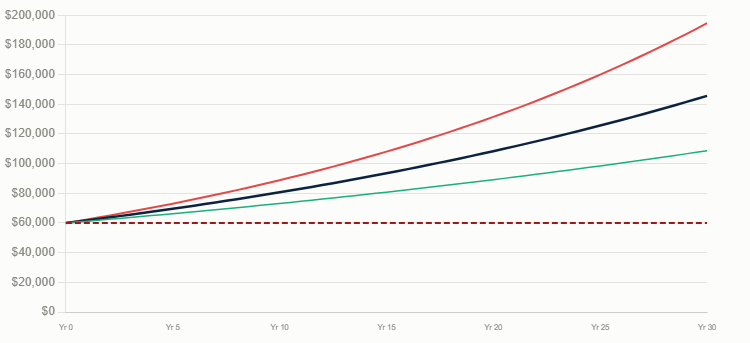
Social Security's 2.8% COLA for 2026 looked like relief until the CPI-W hit 3.4% in July — meaning retirees are already falling behind inflation again. Benefits have lost 13.7% of purchasing power since 2016. At 3% average inflation, a $60,000 lifestyle today requires over $120,000 in 30 years. And the TIPS, REITs, gold, and dividend strategies most often recommended as inflation hedges have very different performance profiles — some protecting in specific environments, none protecting in all. This guide explains what inflation actually does to a retirement nest egg, what the evidence says about each major inflation hedge, and how to build a portfolio that doesn't just survive inflation — but is designed for it.
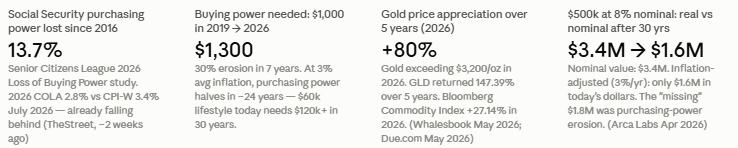
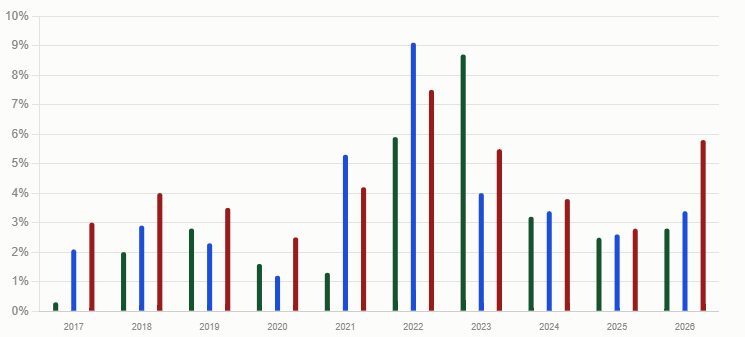
The data in 2026 makes this concrete and immediate. The CPI-W reached 3.4% year-over-year in July 2026 (BLS, cited TheStreet, published approximately two weeks ago). Social Security's 2026 COLA was 2.8% — already behind current inflation by more than half a percentage point. Benefits have shed 13.7% of their purchasing power since 2016, according to the Senior Citizens League's 2026 Loss of Buying Power study. And the provisional income thresholds that determine whether Social Security benefits are taxable — $25,000 for single filers, $32,000 for joint filers — have not been updated since 1984. Every COLA increase drags more retirees into taxable-benefit territory. The raise that was meant to keep pace with inflation partially pays for the additional tax it creates.
This guide is about the specific, practical tools that protect a retirement nest egg from inflation — not in theory, but based on the evidence of what has and has not worked. TIPS, I-Bonds, dividend-growth stocks, REITs, commodities, and equity allocation are all on the menu. Cohen & Steers' July 2026 analysis identifies the core challenge: over the past five years, actual headline CPI of 4.44% exceeded prior market-implied inflation expectations of 2.39% by 2.05% per year. Inflation surprises are 'by definition, unforecastable.' The only reliable response is a portfolio designed from the outset to withstand it.
CPI-W July 2026: 3.4% year-over-year (BLS; TheStreet ~2 weeks ago). Social Security 2026 COLA: 2.8% — already behind July inflation. SS benefits lost 13.7% purchasing power since 2016 (Senior Citizens League 2026). Medicare Part B 2026: $202.90/month (up from $185 in 2025) — consumed much of the COLA raise. At 3% inflation: purchasing power halves in ~24 years. $1,000 in 2019 = $1,300 buying power needed in 2026 (BLS). Gold 2026: >$3,200/oz; +80% over 5 years. Bloomberg Commodity Index: +27.14% in 2026. REITs current dividend yield: 4.1% (Due.com May 2026).
Arca Labs' April 2026 inflation strategy guide provides the portfolio-level illustration: a $500,000 portfolio earning 8% nominally grows to approximately $3.4 million over 30 years. But in real, inflation-adjusted terms, that $3.4 million is worth only approximately $1.6 million in today's dollars — assuming 3% annual inflation. The 'missing' $1.8 million did not vanish in a crash. It was eroded by purchasing-power loss that no brokerage statement itemises. This is why institutional investors — pension funds, endowments, sovereign wealth funds — devote substantial resources to inflation-hedging strategies.
The erosion is not uniform. Different categories of spending inflate at different rates — and retirees do not have the same spending basket as working-age consumers. Older Americans spend more on healthcare, housing, and food as a proportion of income than their working-age counterparts. Healthcare inflation in 2026 has been significantly higher than overall CPI: outpatient hospital care costs rose 5.8% year-over-year through July 2026 (BLS, cited TheStreet). The CPI index that sets Social Security's COLA (CPI-W) tracks working-age spending, not retiree spending — systematically undercounting the costs that matter most to older households.
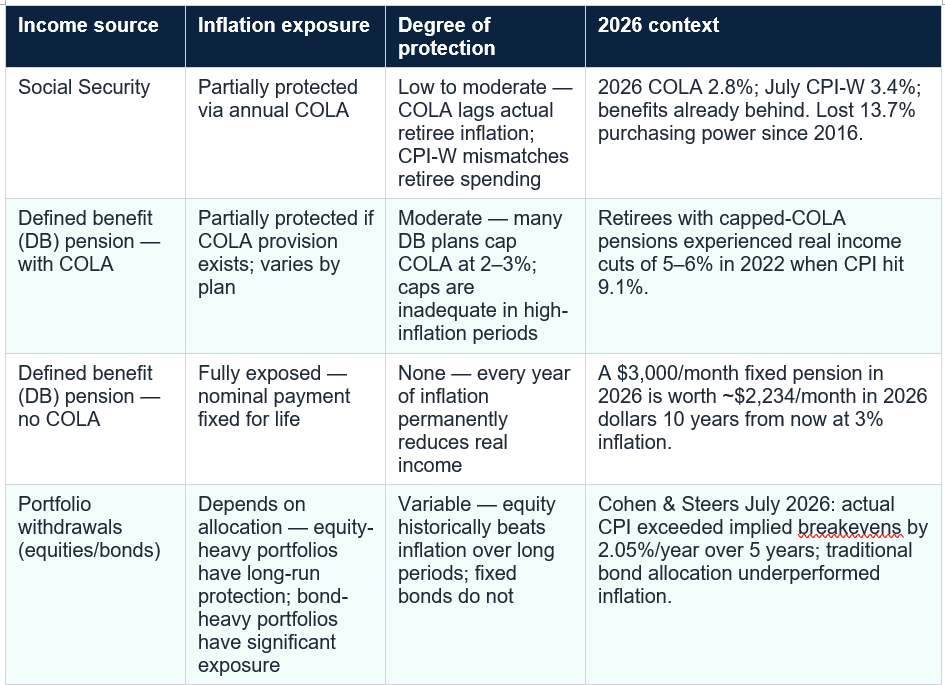
Inflation erodes the real value of every fixed-income stream in a retirement portfolio. A fixed pension paying $3,000 per month today pays the same $3,000 in 10 years — but at 3% average inflation, that $3,000 has the purchasing power of approximately $2,234 in today's dollars. A nominal bond paying 4% in a 3% inflation environment produces a real return of only 1% — and in a 4.44% inflation environment (the actual 5-year average through February 2026 per Cohen & Steers), that same 4% bond produces a negative real return. Every fixed-income position in a retirement portfolio has this exposure. The risk is not visible quarter by quarter. It is catastrophic across decades.
The Medicare Part B premium complicates the picture further. The 2026 increase from $185 to $202.90 per month — an increase of $17.90 per month, or $214.80 per year — was deducted directly from Social Security payments. For many retirees, the higher Medicare premium consumed a substantial portion of the annual COLA increase before benefits were even received. A retiree whose COLA added $56 per month found that $17.90 of it immediately disappeared into the Medicare premium increase. The net gain: approximately $38 per month. Against inflation running at 3.4%, the practical protection is minimal.
The structural problem is deeper than any single year's arithmetic. AOL's analysis — published approximately 15 hours ago — identifies two compounding mechanisms: the CPI-W index tracks working-age spending patterns that don't match retiree costs (particularly healthcare and housing), systematically setting COLA below actual retiree inflation; and the unchanged provisional income thresholds from 1984 pull progressively more of each COLA increase into taxable income. The Senior Citizens League's 2026 Loss of Buying Power study concludes that Social Security benefits have lost 13.7% of real purchasing power since 2016. For retirees who depend primarily on Social Security, this is not a data point. It is a decade-long income cut that compounds forward.
Social Security is still the most valuable inflation-protected asset most retirees own — the annual COLA adjustment is guaranteed by law, backed by the federal government, and requires no management effort. The strategy implication is to maximise this asset by delaying claiming as long as possible. Delaying Social Security from 62 to 70 increases the monthly benefit by approximately 76% — and that larger benefit then receives all future COLAs on a larger base. Every dollar of maximised Social Security benefit reduces reliance on the portfolio, reducing inflation exposure from the most vulnerable part of the retirement income system.
The honest performance caveat: the iShares 0-5 Year TIPS Bond ETF (STIP) averaged only +0.31% over the past five years (Whalesbook, May 2026). TIPS return their real yield (which can be low or even negative in some environments) plus inflation compensation — they do not provide real capital growth. The Arca Labs April 2026 inflation strategy framework specifies the role clearly: TIPS are not a growth asset; they are a purchasing-power preservation asset. Their value is in maintaining a specific dollar's worth of real spending power, not in growing wealth above inflation.
For retired investors: TIPS belong in tax-advantaged accounts (IRA, 401(k)) because the inflation adjustment to principal is taxed annually as ordinary income even though it is not received in cash until maturity — a tax drag known as 'phantom income' that is eliminated when the TIPS are held in a tax-sheltered account.
TIPS strategy for retirees: hold TIPS in a tax-advantaged account (IRA or 401(k)) to avoid phantom income taxation. Consider short-to-medium term TIPS (1–10 years) rather than long-dated, as long-dated TIPS carry significant interest-rate duration risk. Buy I-Bonds up to the $10,000/year limit for each person in the household — they earn a competitive composite rate when inflation is elevated, and cannot be redeemed in the first 12 months (minor liquidity constraint). Allocate 20–25% of the inflation-protection portion of the portfolio to TIPS and I-Bonds combined (Arca Labs framework). Use TIPS ladders — specific maturity tranches aligned with known future spending needs — for retirees with predictable large expenses in specific future years (major medical costs, care costs, or property needs).
Due.com's May 2026 analysis of inflation-resistant portfolios identifies dividend-growth stocks as the largest single allocation in a well-constructed inflation-resistant portfolio: 35–40% of the portfolio. Winthrop Partners' guide recommends 'companies with a track record of raising dividends, like utilities or consumer staples, that can provide income that tends to keep pace with inflation.' Plootus confirms the long-run evidence: 'stocks historically outpace inflation by 4–5% per year over long periods.'
The critical distinction is between dividend-growth stocks and high-yield stocks. A company paying a very high dividend yield may not be growing that dividend — and a static high yield in a 4% inflation environment is losing real value annually. The focus should be on dividend growth rate (how fast the dividend is increasing) rather than dividend yield (the absolute level of the current dividend relative to the share price).
Focus on companies with at least 10 years of consecutive dividend growth (the S&P 500 Dividend Aristocrats index requires 25 consecutive years of increases; the S&P 500 Dividend Achievers requires 10). Use a dividend-growth ETF or fund (rather than individual stocks) to diversify sector and company risk within the dividend-growth category. In an inflation environment, prioritise sectors with strong pricing power: consumer staples, healthcare, energy infrastructure (pipelines), utilities with inflation-adjusted rate structures. Avoid 'dividend yield traps' — very high-yield stocks that are paying out of capital rather than growing earnings, which cannot sustain the dividend in the long run.
The historical evidence on REITs as inflation hedges is positive but nuanced. Due.com's May 2026 analysis notes that 'historically, REIT dividends have beaten CPI in most years over the last two decades.' Whalesbook's May 2026 analysis adds the caveat: 'REITs' ability to hedge inflation is debated, with some studies showing only partial protection and high volatility.' The partial protection finding reflects that REITs are also sensitive to interest-rate movements — when central banks raise rates aggressively to fight inflation (as they did in 2022), rising yields push REIT valuations down even as the underlying properties may be appreciating. REITs are not a pure inflation hedge; they are a real asset with inflation-protection characteristics combined with interest-rate sensitivity.
For retirement inflation protection: use broad REIT index funds (such as Vanguard Real Estate ETF, VNQ) rather than individual REITs, for diversification across sectors. Weight toward REITs with explicit CPI-linked lease structures: self-storage, industrial/logistics, and healthcare sectors. Hold REIT income in tax-advantaged accounts where possible — REIT dividends are mostly ordinary income, which is taxed at the highest rate in a taxable account. Allocate 10–15% of the total portfolio to REITs (Due.com May 2026 framework). Monitor the interest-rate environment — in a rising-rate cycle, REIT valuations can fall significantly even when underlying asset values are rising. Longer-term investors benefit from the full inflation-property cycle; shorter-term retirees with concentrated REIT exposure face rate-sensitivity risk.
The historical evidence on gold specifically is clear over very long periods: gold has maintained its purchasing power across centuries. Over shorter periods, gold's relationship with inflation is less consistent — it can underperform during periods of moderate, well-controlled inflation and overperform during inflation shocks and geopolitical uncertainty. Cedar Gold Group's June 2026 retirement portfolio strategy guide notes that 'physical gold has historically demonstrated low correlation to equities over long time horizons' — meaning it adds genuine diversification benefit beyond its inflation-hedging properties.
Commodity exposure for most individual investors is best accessed through ETFs: physically backed gold ETFs (GLD, IAU), broad commodity ETFs (tracking the Bloomberg Commodity Index or S&P GSCI), or natural resource equity funds that hold companies with commodity-linked revenues. Commodity futures funds carry roll costs and tax complexity that make them less suitable for most retirement portfolios.
Allocate 5–10% of the total portfolio to commodities and gold (Due.com framework). Use physically backed gold ETFs (GLD or IAU) rather than commodity futures ETFs for the gold portion — lower costs and no roll-yield drag. For broader commodity exposure, a diversified commodity index ETF provides exposure across energy, metals, and agricultural commodities without concentration in any single commodity. Hold commodity allocations in tax-advantaged accounts where possible — commodity ETFs can generate ordinary income or short-term capital gains that are tax-inefficient in taxable accounts. Do not hold commodities as a short-term tactical allocation — they can underperform for extended periods during moderate, well-controlled inflation. They provide crisis insurance and long-run real asset exposure, not consistent annual income.
This does not mean full equity concentration in retirement, which carries the sequence of returns risk covered in the previous guide in this series. But it does mean that the traditional 60/40 stock-bond allocation may need rethinking for inflation periods, and that the equity proportion of a retirement portfolio should not be reduced to zero or near-zero simply because of age. Cedar Gold Group's June 2026 retirement portfolio protection guide frames the debate: some researchers argue for significant equity exposure throughout retirement to outpace inflation over 20–30 years; others prioritise capital preservation in early retirement when sequence risk is highest. The resolution: a floor-and-upside approach — cover essential expenses with guaranteed or near-guaranteed income (Social Security, TIPS, annuity), and maintain equity exposure for growth above that floor.
The floor-and-upside framework: (1) Identify essential expenses (housing, food, healthcare, utilities). (2) Cover essential expenses with inflation-adjusted guaranteed income — maximised Social Security, TIPS, I-Bonds, CPI-linked annuity. (3) Maintain equity exposure for growth — dividend-growth stocks, broad equity index funds — to fund discretionary spending (travel, hobbies, gifts) and to outpace inflation on the growing portion of the portfolio. (4) Hold a 12–24 month cash buffer for near-term spending needs, eliminating the need to sell equities during market downturns. This framework isolates equity risk to the 'upside' portion of retirement spending, where time horizon is longest and inflation protection is most valuable.
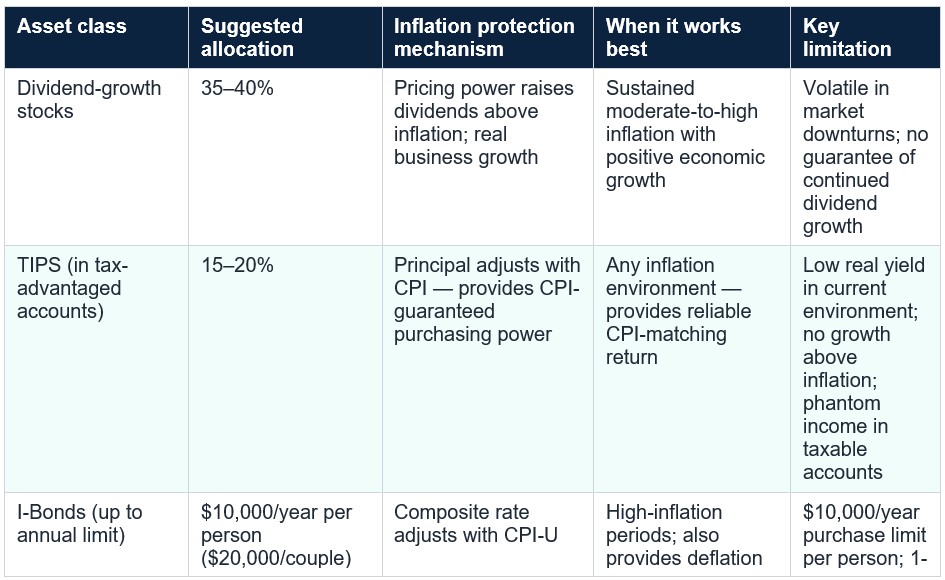
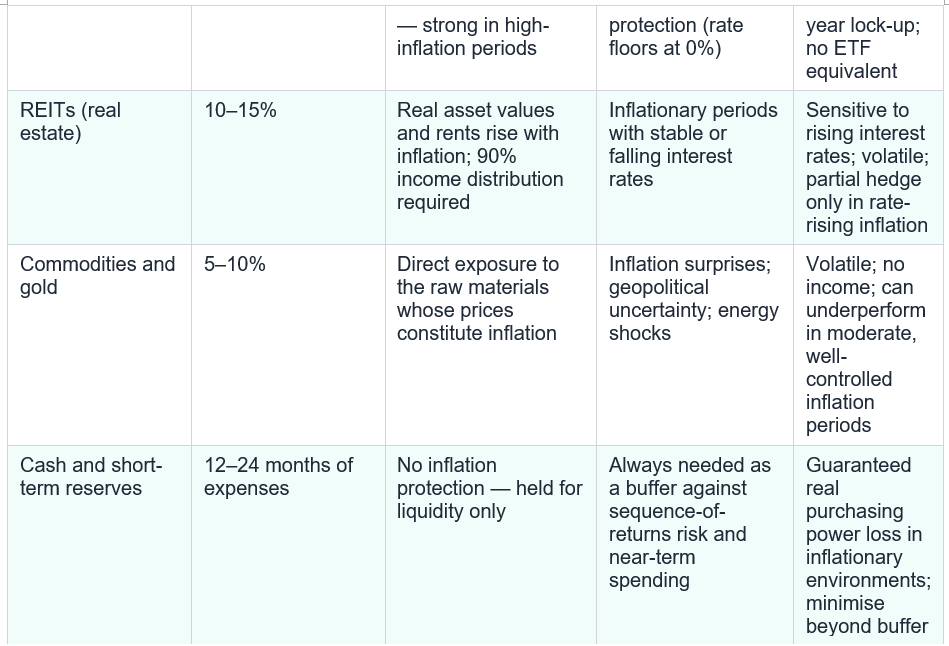
Sources: Due.com (May 2026); Arca Labs (April 2026); Cohen & Steers (July 2026); Winthrop Partners (November 2025); Whalesbook (May 2026). Allocation ranges are indicative frameworks from published sources — not personalised financial advice. Individual allocation should reflect age, risk tolerance, income sources, health, and specific financial circumstances. Consult a qualified financial adviser.
The most important behavioural insight from Winthrop Partners' 2025 guide: 'Even when inflation cools, prices don't fall — they simply rise more slowly.' This means that periods of high inflation create a permanent step-change in the spending level required to maintain a lifestyle. A retiree whose spending requirements jumped by 9% in 2022 does not return to the previous spending level when inflation cools to 3% — they remain at the higher level and continue rising from there. The planning implication is to build 3% annual withdrawal increases into the retirement model from the outset, rather than assuming a static withdrawal amount.
The defences against it are also slow. TIPS protect methodically, year by year, as principal adjusts with CPI. Dividend-growth stocks compound their inflation-adjusted income over years and decades. REITs raise rents gradually as leases reset. Gold holds its purchasing power across time horizons that no individual can fully perceive. Equities compound above inflation across market cycles that include multiple recessions and recoveries.
No single hedge is sufficient. No single year's market return proves or disproves any strategy. The inflation-resistant retirement portfolio is a combination: TIPS and I-Bonds for the guaranteed CPI-matching layer; dividend-growth stocks for pricing-power income growth; REITs for real asset exposure; commodities and gold for inflation-surprise protection; and broad equity for the long-run real return that no other asset class reliably matches. Combined with a maximised Social Security delay strategy, a floor-and-upside income structure, and annual inflation-adjusted withdrawals, this combination is the most complete defence available to an individual investor.
The retiree who plans for 2% average inflation and experiences 4% average inflation over 30 years does not simply miss a projection. They arrive in their 90s with half the expected purchasing power, no remaining options to earn more, and the full weight of decades of compounded erosion to bear alone. The time to build the defence is before inflation arrives — not after it has already taken a decade of purchasing power and called it a COLA.
The damage is cumulative and compounding. At 3% average annual inflation — the long-run CPI average and a conservative baseline for retirement planning — purchasing power halves in approximately 24 years. A lifestyle costing $60,000 per year today requires more than $120,000 per year in 30 years. The Arca Labs April 2026 framework illustrates the portfolio dimension: a $500,000 portfolio earning 8% nominally grows to $3.4 million in 30 years — but its inflation-adjusted value in today's dollars is only approximately $1.6 million at 3% inflation. The 'missing' $1.8 million was eroded by purchasing-power loss that never appears as a loss on a brokerage statement. Additionally, BLS data shows that $1,000 in 2019 now requires approximately $1,300 in buying power in 2026 — 30% erosion in just seven years (David Lerner Associates, July 2026).
Are TIPS the best inflation hedge for retirement?
TIPS are the best guaranteed inflation-matching instrument for the portion of a portfolio where capital preservation is the priority — but they are not a growth asset, and they are not the best inflation hedge for the portion of the portfolio intended to grow above inflation. The iShares 0-5 Year TIPS Bond ETF averaged only +0.31% over five years (Whalesbook, May 2026). TIPS match CPI — they do not beat it. For a 30-year retirement where purchasing power needs to be both preserved and grown, a portfolio that combines TIPS (20–25% of the inflation-hedging allocation) with dividend-growth stocks, REITs, commodities, and equity exposure provides both the stability of CPI-matching and the growth potential to outpace inflation over the long run. Hold TIPS in tax-advantaged accounts to avoid 'phantom income' taxation on annual principal adjustments.
Is Social Security enough to protect against inflation in retirement?
Social Security provides partial and imperfect inflation protection. The annual COLA adjustment is guaranteed by law and automatic — which makes it the best guaranteed inflation-adjusted income source most retirees have. But the 2026 data makes the limitations clear: the 2026 COLA of 2.8% was already behind the July 2026 CPI-W of 3.4%. Medicare Part B premium increases consumed a significant portion of the COLA before retirees received it. And Social Security benefits have lost 13.7% of purchasing power since 2016 (Senior Citizens League 2026). The most effective Social Security inflation strategy is to maximise the benefit before claiming: delaying from 62 to 70 increases the monthly benefit by approximately 76%, and every future COLA is applied to a larger base. But even maximised Social Security needs to be supplemented with inflation-hedging portfolio assets to maintain full purchasing power over a 30-year retirement.
What is the best portfolio allocation to protect against inflation in 2026?
Due.com's May 2026 analysis provides a consensus framework from professional financial planners: 35–40% in dividend-growth stocks (pricing power income); 20–25% in TIPS and I-Bonds (guaranteed CPI matching); 10–15% in REITs (real asset exposure with income); 5–10% in commodities and gold (inflation-surprise protection and diversification); and the remainder in traditional bonds and cash for near-term spending needs. Cohen & Steers' July 2026 analysis recommends adding REITs, commodities, and real asset multi-strategy solutions alongside TIPS, arguing that the combination 'mitigates the impact of inflation on savings but provides higher potential upside performance in inflationary environments.' This framework should be adapted to individual circumstances — age, existing income sources, risk tolerance, and health — with professional financial planning advice.
How does gold protect against inflation?
Gold has maintained its purchasing power over very long time horizons and tends to perform well during inflationary periods — particularly during inflation surprises or geopolitical uncertainty. In 2026, gold prices exceeded $3,200 per ounce, with the metal appreciating approximately 80% over five years (far outpacing cumulative CPI), and the SPDR Gold Trust (GLD) returning 147.39% over five years (Whalesbook, May 2026). The mechanism: gold is a real asset with limited supply that holds its value relative to a depreciating currency. However, gold's inflation-hedging properties are strongest during inflation shocks and uncertainty rather than during periods of moderate, well-controlled inflation. Physical gold ETFs (GLD, IAU) are the most practical vehicle for individual investors. Allocate 5–10% of the total portfolio to gold and broader commodities — enough to provide meaningful protection during inflation episodes without the volatility risk of a larger concentration.
Should I delay taking Social Security to protect against inflation?
Yes, delaying Social Security is one of the most powerful inflation protection strategies available — and it is permanent, guaranteed, and backed by the US federal government. Delaying Social Security from age 62 to age 70 increases the monthly benefit by approximately 76%. More importantly, every future COLA is applied to this larger base — so the larger the starting benefit, the larger the absolute dollar increase from each annual COLA adjustment. For a couple, the strategy is typically for the higher-earning spouse to delay as long as possible (ideally to 70) to maximise the surviving spouse's benefit — because the survivor will receive the higher of the two benefits for the rest of their life. The break-even point for Social Security delay (the age at which the larger delayed benefit outweighs the foregone early benefits) is typically age 78–80 for most individuals — and given that 75% of women over 70 expect to live at least another 10 years, most retirees will exceed the break-even point.
Table of Contents
- Inflation Is the Slow Leak in Every Retirement Plan
- What Inflation Actually Does to a Nest Egg
- The Social Security Purchasing Power Crisis in 2026
- The Three Tiers of Retirement Income: Which Are Exposed?
- Hedge 1: Treasury Inflation-Protected Securities (TIPS) and I-Bonds
- Hedge 2: Dividend-Growth Stocks — Income That Rises With Prices
- Hedge 3: Real Estate Investment Trusts (REITs)
- Hedge 4: Commodities and Gold
- Hedge 5: Staying in Equities Longer — The Long-Run Inflation Beater
- Putting It Together: The Inflation-Resistant Portfolio Framework
- Withdrawal Strategy: The Behavioural Layer of Inflation Protection
- What Not to Do: The Most Common Inflation Mistakes in Retirement
- Conclusion: Inflation Is a Marathon, Not a Sprint
- Frequently Asked Questions
Purchasing Power Erosion: Nominal vs Real Over 30 years
Social Security COLA vs Actual Inflation 2016 - 2026
Inflation Is the Slow Leak in Every Retirement Plan
Inflation does not announce itself with a market crash. It does not appear in a quarterly brokerage statement as a line-item loss. It works slowly, silently, and cumulatively — and by the time most retirees notice the erosion, years of compounding damage have already occurred. A single year at 9.1% inflation — which the US experienced in June 2022 — erodes purchasing power more than four years of 2% gains can restore. For a retiree on a fixed pension or a portfolio drawing fixed amounts, that kind of spike is not a temporary inconvenience. It is a permanent reduction in real income.The data in 2026 makes this concrete and immediate. The CPI-W reached 3.4% year-over-year in July 2026 (BLS, cited TheStreet, published approximately two weeks ago). Social Security's 2026 COLA was 2.8% — already behind current inflation by more than half a percentage point. Benefits have shed 13.7% of their purchasing power since 2016, according to the Senior Citizens League's 2026 Loss of Buying Power study. And the provisional income thresholds that determine whether Social Security benefits are taxable — $25,000 for single filers, $32,000 for joint filers — have not been updated since 1984. Every COLA increase drags more retirees into taxable-benefit territory. The raise that was meant to keep pace with inflation partially pays for the additional tax it creates.
This guide is about the specific, practical tools that protect a retirement nest egg from inflation — not in theory, but based on the evidence of what has and has not worked. TIPS, I-Bonds, dividend-growth stocks, REITs, commodities, and equity allocation are all on the menu. Cohen & Steers' July 2026 analysis identifies the core challenge: over the past five years, actual headline CPI of 4.44% exceeded prior market-implied inflation expectations of 2.39% by 2.05% per year. Inflation surprises are 'by definition, unforecastable.' The only reliable response is a portfolio designed from the outset to withstand it.
CPI-W July 2026: 3.4% year-over-year (BLS; TheStreet ~2 weeks ago). Social Security 2026 COLA: 2.8% — already behind July inflation. SS benefits lost 13.7% purchasing power since 2016 (Senior Citizens League 2026). Medicare Part B 2026: $202.90/month (up from $185 in 2025) — consumed much of the COLA raise. At 3% inflation: purchasing power halves in ~24 years. $1,000 in 2019 = $1,300 buying power needed in 2026 (BLS). Gold 2026: >$3,200/oz; +80% over 5 years. Bloomberg Commodity Index: +27.14% in 2026. REITs current dividend yield: 4.1% (Due.com May 2026).
What Inflation Actually Does to a Nest Egg
The mechanism of inflation's damage to a retirement portfolio is straightforward but its cumulative scale is psychologically difficult to internalise. At 3% average annual inflation — the approximate long-run CPI average and the figure most retirement planners now use as a baseline — purchasing power halves in approximately 24 years. A retiree who needs $60,000 per year today will need more than $120,000 per year to maintain the same standard of living 30 years into retirement.Arca Labs' April 2026 inflation strategy guide provides the portfolio-level illustration: a $500,000 portfolio earning 8% nominally grows to approximately $3.4 million over 30 years. But in real, inflation-adjusted terms, that $3.4 million is worth only approximately $1.6 million in today's dollars — assuming 3% annual inflation. The 'missing' $1.8 million did not vanish in a crash. It was eroded by purchasing-power loss that no brokerage statement itemises. This is why institutional investors — pension funds, endowments, sovereign wealth funds — devote substantial resources to inflation-hedging strategies.
The erosion is not uniform. Different categories of spending inflate at different rates — and retirees do not have the same spending basket as working-age consumers. Older Americans spend more on healthcare, housing, and food as a proportion of income than their working-age counterparts. Healthcare inflation in 2026 has been significantly higher than overall CPI: outpatient hospital care costs rose 5.8% year-over-year through July 2026 (BLS, cited TheStreet). The CPI index that sets Social Security's COLA (CPI-W) tracks working-age spending, not retiree spending — systematically undercounting the costs that matter most to older households.
Inflation erodes the real value of every fixed-income stream in a retirement portfolio. A fixed pension paying $3,000 per month today pays the same $3,000 in 10 years — but at 3% average inflation, that $3,000 has the purchasing power of approximately $2,234 in today's dollars. A nominal bond paying 4% in a 3% inflation environment produces a real return of only 1% — and in a 4.44% inflation environment (the actual 5-year average through February 2026 per Cohen & Steers), that same 4% bond produces a negative real return. Every fixed-income position in a retirement portfolio has this exposure. The risk is not visible quarter by quarter. It is catastrophic across decades.
The Social Security Purchasing Power Crisis in 2026
Social Security is the inflation-adjusted income source that most retirees rely on most heavily — and in 2026, the adjustment mechanism is demonstrably failing to keep pace with actual retiree costs. The 2026 COLA of 2.8% was calculated using CPI-W data from the third quarter of 2025. By May 2026, the CPI-W had already risen to 3.9% year-over-year. By July 2026, it reached 3.4%. At multiple points in 2026, inflation has been running materially faster than the COLA that was meant to protect against it.The Medicare Part B premium complicates the picture further. The 2026 increase from $185 to $202.90 per month — an increase of $17.90 per month, or $214.80 per year — was deducted directly from Social Security payments. For many retirees, the higher Medicare premium consumed a substantial portion of the annual COLA increase before benefits were even received. A retiree whose COLA added $56 per month found that $17.90 of it immediately disappeared into the Medicare premium increase. The net gain: approximately $38 per month. Against inflation running at 3.4%, the practical protection is minimal.
The structural problem is deeper than any single year's arithmetic. AOL's analysis — published approximately 15 hours ago — identifies two compounding mechanisms: the CPI-W index tracks working-age spending patterns that don't match retiree costs (particularly healthcare and housing), systematically setting COLA below actual retiree inflation; and the unchanged provisional income thresholds from 1984 pull progressively more of each COLA increase into taxable income. The Senior Citizens League's 2026 Loss of Buying Power study concludes that Social Security benefits have lost 13.7% of real purchasing power since 2016. For retirees who depend primarily on Social Security, this is not a data point. It is a decade-long income cut that compounds forward.
Social Security is still the most valuable inflation-protected asset most retirees own — the annual COLA adjustment is guaranteed by law, backed by the federal government, and requires no management effort. The strategy implication is to maximise this asset by delaying claiming as long as possible. Delaying Social Security from 62 to 70 increases the monthly benefit by approximately 76% — and that larger benefit then receives all future COLAs on a larger base. Every dollar of maximised Social Security benefit reduces reliance on the portfolio, reducing inflation exposure from the most vulnerable part of the retirement income system.
The Three Tiers of Retirement Income: Which Are Exposed?
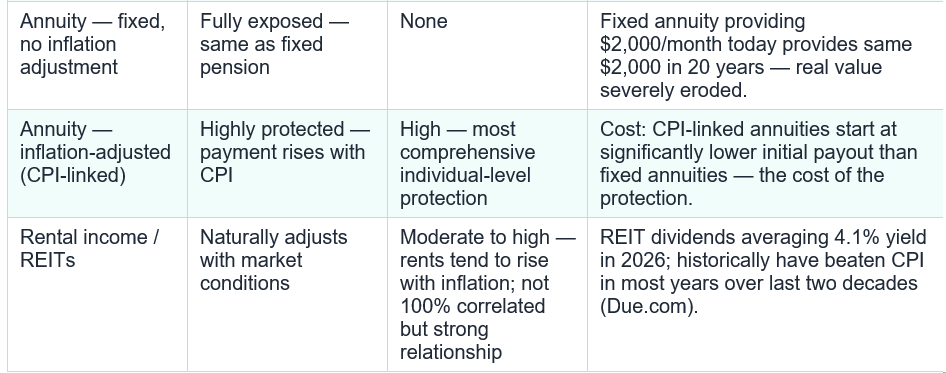
Not all retirement income is equally exposed to inflation. Understanding the exposure profile of each source is the foundation of an effective inflation defence.
Hedge 1: Treasury Inflation-Protected Securities (TIPS) and I-Bonds
HEDGE 1: TIPS and I-Bonds — Government-Guaranteed Inflation Adjustment The most direct and reliable short-run inflation hedge available to individual investors
I-Bonds are a complementary product — savings bonds issued by the US Treasury whose interest rate is composed of a fixed rate and an inflation-adjustment component tied to CPI-U. In periods of high inflation (2022–2023), I-Bonds became enormously popular, briefly paying over 9% composite rates. The key limitation: the annual purchase limit is $10,000 per person (plus up to $5,000 from a tax refund). They cannot be purchased in large enough quantities to anchor a substantial retirement portfolio, but they are an excellent supplement within the limit.The honest performance caveat: the iShares 0-5 Year TIPS Bond ETF (STIP) averaged only +0.31% over the past five years (Whalesbook, May 2026). TIPS return their real yield (which can be low or even negative in some environments) plus inflation compensation — they do not provide real capital growth. The Arca Labs April 2026 inflation strategy framework specifies the role clearly: TIPS are not a growth asset; they are a purchasing-power preservation asset. Their value is in maintaining a specific dollar's worth of real spending power, not in growing wealth above inflation.
For retired investors: TIPS belong in tax-advantaged accounts (IRA, 401(k)) because the inflation adjustment to principal is taxed annually as ordinary income even though it is not received in cash until maturity — a tax drag known as 'phantom income' that is eliminated when the TIPS are held in a tax-sheltered account.
TIPS strategy for retirees: hold TIPS in a tax-advantaged account (IRA or 401(k)) to avoid phantom income taxation. Consider short-to-medium term TIPS (1–10 years) rather than long-dated, as long-dated TIPS carry significant interest-rate duration risk. Buy I-Bonds up to the $10,000/year limit for each person in the household — they earn a competitive composite rate when inflation is elevated, and cannot be redeemed in the first 12 months (minor liquidity constraint). Allocate 20–25% of the inflation-protection portion of the portfolio to TIPS and I-Bonds combined (Arca Labs framework). Use TIPS ladders — specific maturity tranches aligned with known future spending needs — for retirees with predictable large expenses in specific future years (major medical costs, care costs, or property needs).
6. Hedge 2: Dividend-Growth Stocks — Income That Rises With Prices
HEDGE 2: Dividend-Growth Stocks — Pricing Power Passed to Shareholders Income that compounds faster than inflation when companies have pricing power
The inflation-protection mechanism is the pricing power underlying the dividend growth. A company that can raise its prices by 4–5% per year without losing customers can sustain dividend growth above inflation even as its costs rise. The dividend stream itself becomes an inflation-adjusted income source — not by government guarantee (as TIPS and Social Security are), but by the economic reality of the business. This makes dividend-growth stocks a higher-risk but potentially higher-return inflation hedge than TIPS.Due.com's May 2026 analysis of inflation-resistant portfolios identifies dividend-growth stocks as the largest single allocation in a well-constructed inflation-resistant portfolio: 35–40% of the portfolio. Winthrop Partners' guide recommends 'companies with a track record of raising dividends, like utilities or consumer staples, that can provide income that tends to keep pace with inflation.' Plootus confirms the long-run evidence: 'stocks historically outpace inflation by 4–5% per year over long periods.'
The critical distinction is between dividend-growth stocks and high-yield stocks. A company paying a very high dividend yield may not be growing that dividend — and a static high yield in a 4% inflation environment is losing real value annually. The focus should be on dividend growth rate (how fast the dividend is increasing) rather than dividend yield (the absolute level of the current dividend relative to the share price).
Focus on companies with at least 10 years of consecutive dividend growth (the S&P 500 Dividend Aristocrats index requires 25 consecutive years of increases; the S&P 500 Dividend Achievers requires 10). Use a dividend-growth ETF or fund (rather than individual stocks) to diversify sector and company risk within the dividend-growth category. In an inflation environment, prioritise sectors with strong pricing power: consumer staples, healthcare, energy infrastructure (pipelines), utilities with inflation-adjusted rate structures. Avoid 'dividend yield traps' — very high-yield stocks that are paying out of capital rather than growing earnings, which cannot sustain the dividend in the long run.
Hedge 3: Real Estate Investment Trusts (REITs)
HEDGE 3: REITs — Real Asset Income With Inflation Passthrough Rents and property values tend to rise with inflation — REITs give portfolio access without property management
The inflation-protection mechanism is the real asset base: physical property holds value relative to a depreciating currency, and lease structures in many commercial categories include annual rent escalators explicitly tied to CPI. Apartment REITs can adjust rents annually to reflect market conditions. Industrial REITs — which hold logistics and e-commerce distribution facilities — benefit from strong demand dynamics that support rent growth above general inflation. Healthcare REITs benefit from the healthcare cost inflation that is outrunning general CPI in 2026.The historical evidence on REITs as inflation hedges is positive but nuanced. Due.com's May 2026 analysis notes that 'historically, REIT dividends have beaten CPI in most years over the last two decades.' Whalesbook's May 2026 analysis adds the caveat: 'REITs' ability to hedge inflation is debated, with some studies showing only partial protection and high volatility.' The partial protection finding reflects that REITs are also sensitive to interest-rate movements — when central banks raise rates aggressively to fight inflation (as they did in 2022), rising yields push REIT valuations down even as the underlying properties may be appreciating. REITs are not a pure inflation hedge; they are a real asset with inflation-protection characteristics combined with interest-rate sensitivity.
For retirement inflation protection: use broad REIT index funds (such as Vanguard Real Estate ETF, VNQ) rather than individual REITs, for diversification across sectors. Weight toward REITs with explicit CPI-linked lease structures: self-storage, industrial/logistics, and healthcare sectors. Hold REIT income in tax-advantaged accounts where possible — REIT dividends are mostly ordinary income, which is taxed at the highest rate in a taxable account. Allocate 10–15% of the total portfolio to REITs (Due.com May 2026 framework). Monitor the interest-rate environment — in a rising-rate cycle, REIT valuations can fall significantly even when underlying asset values are rising. Longer-term investors benefit from the full inflation-property cycle; shorter-term retirees with concentrated REIT exposure face rate-sensitivity risk.
Hedge 4: Commodities and Gold
HEDGE 4: Commodities and Gold — Raw Material Prices Drive CPI Commodities are inflation — owning them provides a direct hedge against the prices that inflate
Gold occupies a special position within commodities as a store of value and safe-haven asset. Due.com's May 2026 analysis notes that gold prices exceeded $3,200 per ounce in 2026, with the metal appreciating approximately 80% over five years — far outpacing cumulative CPI. The SPDR Gold Trust (GLD) returned 147.39% over five years (Whalesbook, May 2026). The Bloomberg Commodity Index is up 27.14% in 2026 (Whalesbook). For retirees who lived through the 2022 inflation shock, these numbers are not abstract — they represent the real purchasing power preserved by holding a commodity allocation when fixed income was being severely punished.The historical evidence on gold specifically is clear over very long periods: gold has maintained its purchasing power across centuries. Over shorter periods, gold's relationship with inflation is less consistent — it can underperform during periods of moderate, well-controlled inflation and overperform during inflation shocks and geopolitical uncertainty. Cedar Gold Group's June 2026 retirement portfolio strategy guide notes that 'physical gold has historically demonstrated low correlation to equities over long time horizons' — meaning it adds genuine diversification benefit beyond its inflation-hedging properties.
Commodity exposure for most individual investors is best accessed through ETFs: physically backed gold ETFs (GLD, IAU), broad commodity ETFs (tracking the Bloomberg Commodity Index or S&P GSCI), or natural resource equity funds that hold companies with commodity-linked revenues. Commodity futures funds carry roll costs and tax complexity that make them less suitable for most retirement portfolios.
Allocate 5–10% of the total portfolio to commodities and gold (Due.com framework). Use physically backed gold ETFs (GLD or IAU) rather than commodity futures ETFs for the gold portion — lower costs and no roll-yield drag. For broader commodity exposure, a diversified commodity index ETF provides exposure across energy, metals, and agricultural commodities without concentration in any single commodity. Hold commodity allocations in tax-advantaged accounts where possible — commodity ETFs can generate ordinary income or short-term capital gains that are tax-inefficient in taxable accounts. Do not hold commodities as a short-term tactical allocation — they can underperform for extended periods during moderate, well-controlled inflation. They provide crisis insurance and long-run real asset exposure, not consistent annual income.
Hedge 5: Staying in Equities Longer — The Long-Run Inflation Beater
HEDGE 5: Maintaining Equity Exposure — The Most Powerful Long-Run Inflation Hedge The compounding growth of equity returns has historically beaten inflation more reliably than any other asset class over 20+ year horizons
Winthrop Partners' November 2025 analysis is direct: 'A better approach is to keep 12-24 months of expenses in cash or short-term reserves, while investing the rest in assets designed to grow or adjust with inflation.' The implication is that a retired investor should not have the majority of their portfolio in bonds and cash — because over a 30-year retirement, bonds and cash provide inadequate real return, and the 'safety' of fixed income is an illusion in an inflationary environment.This does not mean full equity concentration in retirement, which carries the sequence of returns risk covered in the previous guide in this series. But it does mean that the traditional 60/40 stock-bond allocation may need rethinking for inflation periods, and that the equity proportion of a retirement portfolio should not be reduced to zero or near-zero simply because of age. Cedar Gold Group's June 2026 retirement portfolio protection guide frames the debate: some researchers argue for significant equity exposure throughout retirement to outpace inflation over 20–30 years; others prioritise capital preservation in early retirement when sequence risk is highest. The resolution: a floor-and-upside approach — cover essential expenses with guaranteed or near-guaranteed income (Social Security, TIPS, annuity), and maintain equity exposure for growth above that floor.
The floor-and-upside framework: (1) Identify essential expenses (housing, food, healthcare, utilities). (2) Cover essential expenses with inflation-adjusted guaranteed income — maximised Social Security, TIPS, I-Bonds, CPI-linked annuity. (3) Maintain equity exposure for growth — dividend-growth stocks, broad equity index funds — to fund discretionary spending (travel, hobbies, gifts) and to outpace inflation on the growing portion of the portfolio. (4) Hold a 12–24 month cash buffer for near-term spending needs, eliminating the need to sell equities during market downturns. This framework isolates equity risk to the 'upside' portion of retirement spending, where time horizon is longest and inflation protection is most valuable.
Putting It Together: The Inflation-Resistant Portfolio Framework
The five hedges described above work best in combination. No single inflation hedge performs well in all inflationary environments — TIPS protect against expected inflation; commodities protect against inflation surprises; dividend-growth stocks provide inflation-adjusted income over time; REITs provide real asset exposure; and broad equities provide the best long-run real return. A portfolio that combines all five is more robust than one relying on any single hedge.Sources: Due.com (May 2026); Arca Labs (April 2026); Cohen & Steers (July 2026); Winthrop Partners (November 2025); Whalesbook (May 2026). Allocation ranges are indicative frameworks from published sources — not personalised financial advice. Individual allocation should reflect age, risk tolerance, income sources, health, and specific financial circumstances. Consult a qualified financial adviser.
Withdrawal Strategy: The Behavioural Layer of Inflation Protection
Portfolio construction is the structural layer of inflation protection. Withdrawal strategy is the behavioural layer — how you actually extract money from the portfolio during inflationary periods determines whether the structural defences work as designed.The most important behavioural insight from Winthrop Partners' 2025 guide: 'Even when inflation cools, prices don't fall — they simply rise more slowly.' This means that periods of high inflation create a permanent step-change in the spending level required to maintain a lifestyle. A retiree whose spending requirements jumped by 9% in 2022 does not return to the previous spending level when inflation cools to 3% — they remain at the higher level and continue rising from there. The planning implication is to build 3% annual withdrawal increases into the retirement model from the outset, rather than assuming a static withdrawal amount.
- Inflation-adjust withdrawals annually: increase your baseline withdrawal amount by the CPI increase each year. Most retirement planning tools allow you to specify an inflation-adjustment rate. Use 3% as a baseline; consider 4% for healthcare-heavy later retirement years.
- Withdraw strategically from different account types: in high-inflation years, consider withdrawing more from tax-advantaged accounts (where TIPS, REITs, and commodities should be held) rather than from taxable accounts. This preserves the tax-advantaged compounding of equities in the taxable account.
- Do not over-reduce withdrawals in high-inflation years: the temptation in high-inflation periods is to cut spending aggressively. This can damage quality of life in ways that are not subsequently recovered. The better approach is to ensure the portfolio is positioned to withstand inflation before it arrives, rather than reacting to it by cutting spending after it has already occurred.
- Flexible spending in poor market years, inflation-adjusted in good years: combine the inflation-adjustment approach (for normal years) with withdrawal flexibility (reducing to the essential floor in years when markets are down significantly). This manages both inflation risk and sequence-of-returns risk simultaneously.
What Not to Do: The Most Common Inflation Mistakes in Retirement
The evidence from 2022–2026 reveals several consistent errors that retirees make when faced with inflation:- Holding too much cash: Winthrop Partners' 2025 analysis names this explicitly: 'Every dollar sitting idle loses value as prices rise.' Cash feels safe in inflation — it is not. A cash holding in a 3.4% inflation environment loses 3.4% of real value annually. The solution is to keep only 12–24 months of expenses in cash and invest the rest in assets that can outpace or match inflation.
- Over-concentrating in nominal bonds: Whalesbook's May 2026 analysis: 'Relying on fixed-rate bonds can lead to significant loss of real capital as yields lag price hikes.' A nominal bond paying 4% in a 4.44% average CPI environment (the actual 5-year average through February 2026) produces a negative real return every year. Traditional fixed-income concentration is the most common and most damaging inflation error in retirement portfolios.
- Underestimating medical inflation: 'A major oversight is medical inflation, which often spikes much higher than overall CPI and is an unavoidable expense for retirees' (Whalesbook May 2026). Planning for 2.5% general inflation while healthcare inflates at 5–6% systematically under-allocates to the largest and most volatile retirement expense category.
- Assuming the COLA makes Social Security inflation-proof: as the 2026 data shows, the COLA is calculated from a working-age index, is already behind 2026 inflation, and is partially offset by Medicare premium increases. Do not treat Social Security as providing complete inflation protection — supplement it with inflation-hedging assets.
- Ignoring the long run in favour of short-run safety: moving entirely out of equities at retirement to 'be safe' is one of the most reliably harmful decisions a long-lived retiree can make. Over a 30-year retirement, the inflation erosion of a bond-and-cash portfolio is a near-certainty. Equities are volatile in the short run but essential for real purchasing power preservation over decades.
Conclusion: Inflation Is a Marathon, Not a Sprint
The CPI-W reaching 3.4% in July 2026 while Social Security's COLA stands at 2.8% is not the story. The story is that Social Security benefits have lost 13.7% of purchasing power since 2016 — a decade of cumulative erosion that was not visible in any single year's COLA announcement. Inflation is slow. It is patient. And it is certain.The defences against it are also slow. TIPS protect methodically, year by year, as principal adjusts with CPI. Dividend-growth stocks compound their inflation-adjusted income over years and decades. REITs raise rents gradually as leases reset. Gold holds its purchasing power across time horizons that no individual can fully perceive. Equities compound above inflation across market cycles that include multiple recessions and recoveries.
No single hedge is sufficient. No single year's market return proves or disproves any strategy. The inflation-resistant retirement portfolio is a combination: TIPS and I-Bonds for the guaranteed CPI-matching layer; dividend-growth stocks for pricing-power income growth; REITs for real asset exposure; commodities and gold for inflation-surprise protection; and broad equity for the long-run real return that no other asset class reliably matches. Combined with a maximised Social Security delay strategy, a floor-and-upside income structure, and annual inflation-adjusted withdrawals, this combination is the most complete defence available to an individual investor.
The retiree who plans for 2% average inflation and experiences 4% average inflation over 30 years does not simply miss a projection. They arrive in their 90s with half the expected purchasing power, no remaining options to earn more, and the full weight of decades of compounded erosion to bear alone. The time to build the defence is before inflation arrives — not after it has already taken a decade of purchasing power and called it a COLA.
Frequently Asked Questions
How much purchasing power does inflation erode from a retirement portfolio?The damage is cumulative and compounding. At 3% average annual inflation — the long-run CPI average and a conservative baseline for retirement planning — purchasing power halves in approximately 24 years. A lifestyle costing $60,000 per year today requires more than $120,000 per year in 30 years. The Arca Labs April 2026 framework illustrates the portfolio dimension: a $500,000 portfolio earning 8% nominally grows to $3.4 million in 30 years — but its inflation-adjusted value in today's dollars is only approximately $1.6 million at 3% inflation. The 'missing' $1.8 million was eroded by purchasing-power loss that never appears as a loss on a brokerage statement. Additionally, BLS data shows that $1,000 in 2019 now requires approximately $1,300 in buying power in 2026 — 30% erosion in just seven years (David Lerner Associates, July 2026).
Are TIPS the best inflation hedge for retirement?
TIPS are the best guaranteed inflation-matching instrument for the portion of a portfolio where capital preservation is the priority — but they are not a growth asset, and they are not the best inflation hedge for the portion of the portfolio intended to grow above inflation. The iShares 0-5 Year TIPS Bond ETF averaged only +0.31% over five years (Whalesbook, May 2026). TIPS match CPI — they do not beat it. For a 30-year retirement where purchasing power needs to be both preserved and grown, a portfolio that combines TIPS (20–25% of the inflation-hedging allocation) with dividend-growth stocks, REITs, commodities, and equity exposure provides both the stability of CPI-matching and the growth potential to outpace inflation over the long run. Hold TIPS in tax-advantaged accounts to avoid 'phantom income' taxation on annual principal adjustments.
Is Social Security enough to protect against inflation in retirement?
Social Security provides partial and imperfect inflation protection. The annual COLA adjustment is guaranteed by law and automatic — which makes it the best guaranteed inflation-adjusted income source most retirees have. But the 2026 data makes the limitations clear: the 2026 COLA of 2.8% was already behind the July 2026 CPI-W of 3.4%. Medicare Part B premium increases consumed a significant portion of the COLA before retirees received it. And Social Security benefits have lost 13.7% of purchasing power since 2016 (Senior Citizens League 2026). The most effective Social Security inflation strategy is to maximise the benefit before claiming: delaying from 62 to 70 increases the monthly benefit by approximately 76%, and every future COLA is applied to a larger base. But even maximised Social Security needs to be supplemented with inflation-hedging portfolio assets to maintain full purchasing power over a 30-year retirement.
What is the best portfolio allocation to protect against inflation in 2026?
Due.com's May 2026 analysis provides a consensus framework from professional financial planners: 35–40% in dividend-growth stocks (pricing power income); 20–25% in TIPS and I-Bonds (guaranteed CPI matching); 10–15% in REITs (real asset exposure with income); 5–10% in commodities and gold (inflation-surprise protection and diversification); and the remainder in traditional bonds and cash for near-term spending needs. Cohen & Steers' July 2026 analysis recommends adding REITs, commodities, and real asset multi-strategy solutions alongside TIPS, arguing that the combination 'mitigates the impact of inflation on savings but provides higher potential upside performance in inflationary environments.' This framework should be adapted to individual circumstances — age, existing income sources, risk tolerance, and health — with professional financial planning advice.
How does gold protect against inflation?
Gold has maintained its purchasing power over very long time horizons and tends to perform well during inflationary periods — particularly during inflation surprises or geopolitical uncertainty. In 2026, gold prices exceeded $3,200 per ounce, with the metal appreciating approximately 80% over five years (far outpacing cumulative CPI), and the SPDR Gold Trust (GLD) returning 147.39% over five years (Whalesbook, May 2026). The mechanism: gold is a real asset with limited supply that holds its value relative to a depreciating currency. However, gold's inflation-hedging properties are strongest during inflation shocks and uncertainty rather than during periods of moderate, well-controlled inflation. Physical gold ETFs (GLD, IAU) are the most practical vehicle for individual investors. Allocate 5–10% of the total portfolio to gold and broader commodities — enough to provide meaningful protection during inflation episodes without the volatility risk of a larger concentration.
Should I delay taking Social Security to protect against inflation?
Yes, delaying Social Security is one of the most powerful inflation protection strategies available — and it is permanent, guaranteed, and backed by the US federal government. Delaying Social Security from age 62 to age 70 increases the monthly benefit by approximately 76%. More importantly, every future COLA is applied to this larger base — so the larger the starting benefit, the larger the absolute dollar increase from each annual COLA adjustment. For a couple, the strategy is typically for the higher-earning spouse to delay as long as possible (ideally to 70) to maximise the surviving spouse's benefit — because the survivor will receive the higher of the two benefits for the rest of their life. The break-even point for Social Security delay (the age at which the larger delayed benefit outweighs the foregone early benefits) is typically age 78–80 for most individuals — and given that 75% of women over 70 expect to live at least another 10 years, most retirees will exceed the break-even point.

0 Comments Comments