

Retirement
The Retirement Risk Most People Never Plan For
Most people preparing for retirement focus on one risk: running out of money because they did not save enough. It is a real risk. But the Financial Planning Association's Journal of Financial Planning identified four retirement risks in June 2026 — and the one most people consistently fail to plan for is not the size of their pot. It is the sequence of returns: the devastating combination of early-retirement market losses and mandatory portfolio withdrawals that can deplete even a well-funded retirement irreversibly. This guide names all four risks, explains how they interact, and provides concrete defences for each.
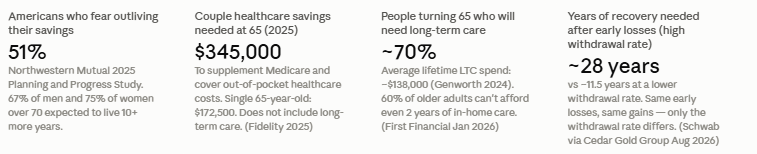
The mental model most people use when planning for retirement goes roughly like this: save enough money during your working years, invest it sensibly, spend it down gradually in retirement, and hope it lasts as long as you do. It is a reasonable model. And its central preoccupation — whether the pot is large enough — is a legitimate concern. Northwestern Mutual's 2025 Planning and Progress Study found that 51% of Americans believe they will outlive their savings.
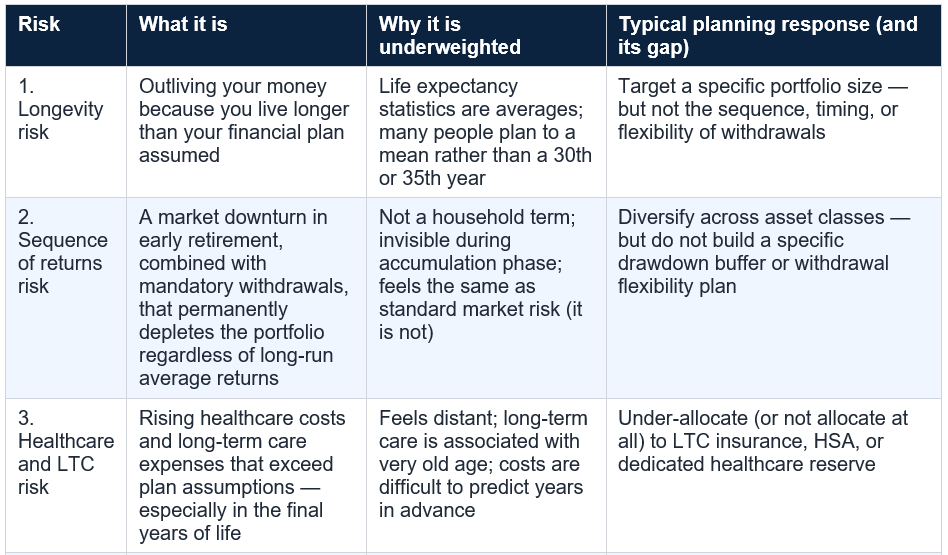
But this model misidentifies the primary threats. The size of the retirement pot, while important, is not the main variable that determines whether a retirement succeeds or fails. The Financial Planning Association's June 2026 Journal of Financial Planning identified four retirement risks that are frequently underweighted relative to their actual impact: longevity risk, income and market risk (specifically what is called sequence of returns risk), health and long-term care risk, and cognitive and decision risk.
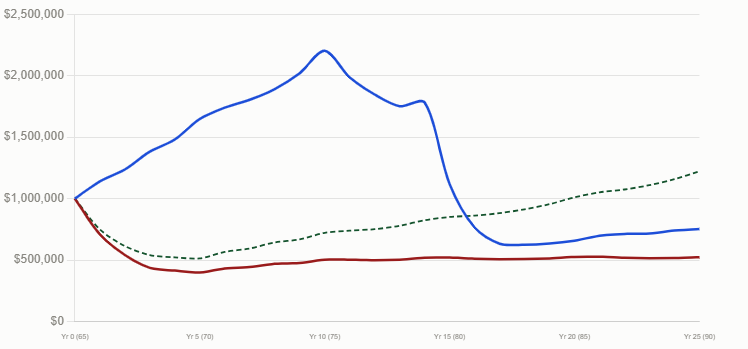
Of these four, sequence of returns risk is the one most consistently absent from ordinary retirement planning conversations. It is not a household term. It is not on the standard retirement planning checklist. And yet Morningstar's 2026 retirement income research found that retirees who experienced poor returns in their first five years and did not cut spending were far more likely to run out of money than those who got positive early returns — even with identical long-run average performance. Two portfolios can post the exact same 20-year average return and produce radically different retirement outcomes, depending entirely on when the bad years arrived.
This guide explains all four risks, their interactions, and what to do about each one — starting with the one most people never plan for.
51% of Americans believe they will outlive their savings (Northwestern Mutual 2025 Planning and Progress Study). Average US life expectancy 2025: 79.4 years. If you reach 65: men expected to live to 83+; women to 85+. By 2060: 95 million Americans aged 65+. Fidelity 2025: a couple retiring at 65 may need $345,000 in current savings for healthcare alone. Nearly 70% of people turning 65 today will need some form of long-term care. FPA Journal June 2026: cognitive and decision risk 'no longer a peripheral concern.'
In 2025, the average US life expectancy reached 79.4 years. But the more relevant number for retirement planning is conditional life expectancy — how long you can expect to live if you have already reached retirement age. For a 65-year-old, men can expect to live to approximately 83 years, women to approximately 85 years (First Financial Consulting, January 2026). Northwestern Mutual's 2025 study finds that 67% of men and 75% of women over age 70 are expected to live at least another 10 years. And the fastest-growing demographic in the US is people over 85: the population above that age is projected to double within 20 years. By 2060, 95 million Americans will be aged 65 or older, up from 56 million in 2020.
What this means in practice: a person retiring at 65 today should plan for a 25- to 35-year retirement. A standard retirement planning model that assumes a 20-year retirement is systematically underestimating the financial challenge for a significant proportion of retirees. Legacy Bridge Wealth frames the compounding: 'With 35-year retirements, the probability of experiencing damaging early-year losses increases significantly. Living longer means more years of potential healthcare expenses, and the probability of needing expensive medical interventions or long-term care increases dramatically with age.'
Longevity risk interacts with all three other risks. A longer retirement means more years of potential sequence-of-returns exposure, more healthcare expense accumulation, and more years in which cognitive decline may impair financial decision-making. It is the multiplier that amplifies everything else.
Longevity risk is not just about saving more money. It is about the design of the retirement income system: how much comes from guaranteed sources (Social Security, pension, annuity) versus market-dependent sources (portfolio withdrawals), and how flexible the system is when circumstances change. A retirement income plan that relies entirely on portfolio withdrawals is fully exposed to all four risks simultaneously. A plan that covers essential expenses with guaranteed income sources — Social Security optimised for longevity, a lifetime annuity for a portion of the portfolio — eliminates the longevity exposure from those income streams at the cost of flexibility.
The concept is this: during the accumulation phase of life, the order in which your investment returns arrive does not matter. If you invest $500 per month over 30 years and the market produces a 7% average annual return, the sequencing of good years and bad years does not affect your ending balance — what matters is the average. But the moment you begin withdrawing money from the portfolio, the order matters enormously. A bad year early in retirement, when your portfolio is at its largest and you are selling assets to fund living expenses, does permanent and irreversible damage. A bad year late in retirement, when the portfolio is smaller and fewer years remain, is far less consequential.
CNBC's April 2026 report on sequence risk brings it to life with a concrete historical example from Fidelity CFP Frank Maltais: 'If a 65-year-old retired around 1972, right ahead of them was the 1973-1974 bear market, when the S&P dropped 48%. That was a time when you had really high inflation, we had an oil crisis and we had a lot of political instability.' Retiring one year earlier, into a portfolio that had not yet been depleted by withdrawals during the crash, produced dramatically different 20-year outcomes than retiring at the wrong moment. The retiree who got the bear market in years 1 and 2 never recovered.
The mechanism, explained by Cedar Gold Group's August 2026 sequence risk guide: 'A market drop in year one or year two forces you to sell more shares to raise the same amount of cash, depleting your holdings faster than your withdrawal rate alone would suggest. The portfolio never fully rebuilds because fewer shares remain to participate in the rebound.' Every share sold at a depressed price during a bear market is a share that will never compound during the subsequent recovery. This is why the sequence, not the size, of returns is what determines whether a portfolio survives a 30-year retirement.
Two retirees can have identical $1 million portfolios and identical $40,000 annual withdrawal rates. If one experiences poor returns in years 1–5 of retirement while the other experiences the same poor returns in years 15–20, the first retiree's portfolio will likely be exhausted while the second remains financially secure (Legacy Bridge Wealth). The long-run average returns are the same. The asset allocation is the same. The withdrawal rate is the same. The only difference is when the bad years arrived. This is what sequence of returns risk means — and why it is so important to plan for.
First: it is invisible during accumulation. For the 30 or 40 years during which most people build their retirement savings, sequence risk does not exist. The order of market returns during the saving phase is irrelevant to the final balance. Investors who experienced the 2000 dot-com crash, the 2008 financial crisis, and the 2020 COVID crash while still saving did not face sequence risk — they benefited from dollar-cost averaging (buying more shares at lower prices). The risk only materialises at the exact moment of retirement — a moment that arrives suddenly and permanently. People arrive at retirement with no personal experience of the risk and no intuition for its consequences.
Second: recent real-world examples are vivid and recent. The Madison Partners analysis (May 2026) provides a case study that is only 18 months old: 'The index dropped nearly 19% in the first half of 2025 before recovering to finish well in the green. Anyone who retired in March of [2025] and started drawing income immediately got the bad half first.' A person who retired in March 2025 with a $1 million portfolio and began withdrawing $40,000 per year immediately faced the worst first six months available — selling shares at the bottom before the recovery. A person who retired in September 2025, after the recovery, began from a higher base. Same portfolio size, same fund, same withdrawal rate — different outcome, determined entirely by timing.
Third: the standard defence is insufficient. Most retirement planning advice addresses market risk through diversification — holding bonds alongside stocks, so that when stocks fall, bonds hold or rise. Diversification is necessary and valuable. But it does not eliminate sequence risk. Even a well-diversified portfolio can fall significantly in a market downturn — and during that fall, withdrawals continue. The specific defence against sequence risk requires more targeted tools: a cash buffer, a bucket strategy, or withdrawal rate flexibility — not just asset allocation.
Example: Charles Schwab's modelling, cited by Cedar Gold Group's August 2026 guide, quantifies the withdrawal rate effect: at a lower withdrawal rate after early losses, approximately 11.5 consecutive years of 6% annual gains are needed to fully recover. At a higher withdrawal rate during the same scenario, approximately 28 consecutive years of the same gains are needed. The difference between needing 11.5 years versus 28 years of recovery gains is entirely determined by the withdrawal rate decision — not the asset allocation, not the fund selection, not the investment returns themselves. This is the most practical and actionable aspect of sequence risk management.
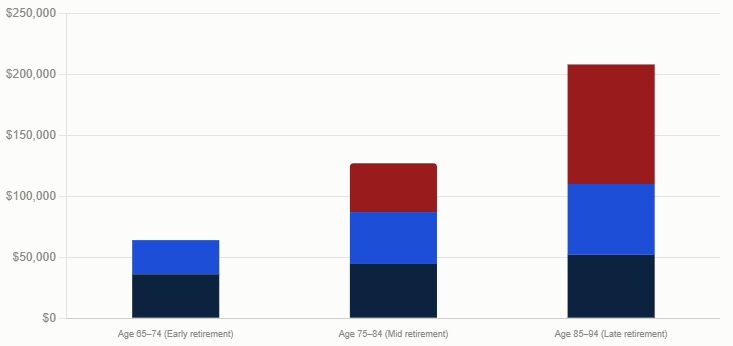
The headline numbers are significant. Fidelity's 2025 Retiree Health Care Cost Estimate puts the savings a couple retiring at 65 in 2025 may need at approximately $345,000 to supplement Medicare and cover out-of-pocket healthcare costs in retirement. For a single 65-year-old, the comparable estimate is $172,500 (cited David Lerner Associates, July 2026). These figures do not include long-term care costs — they are healthcare costs alone.
Long-term care adds a separate and often larger risk layer. Nearly 70% of people turning 65 today will need some form of long-term care during their lifetime (First Financial Consulting, January 2026). The average American spends approximately $138,000 on long-term care over their lifetime (Genworth 2024). But the distribution is heavily skewed: most people spend much less, and a significant minority spend dramatically more — with multi-year nursing home stays costing $100,000 or more per year in many markets. Around 60% of older adults cannot afford even two years of in-home care (First Financial Consulting, January 2026).
The compounding problem is healthcare inflation. Healthcare costs have historically risen faster than general inflation: up 7.5% from 2022 to 2023 alone (Wealth Enhancement Group). HBK Wealth's August 2026 analysis of retirement risks notes: 'Healthcare inflation has historically risen faster than general inflation, which means these costs may increase substantially over time. Long-term care is especially overlooked.' Over a 35-year retirement, healthcare expense inflation could outpace portfolio growth, creating a combination of rising costs and declining resources precisely when the retiree is least able to return to the workforce.
Healthcare cost defence strategies for retirement planning: (1) Health Savings Account (HSA) — if you have access to an HSA through a high-deductible health plan, maximise contributions every year before retirement. HSA contributions are pre-tax; growth is tax-deferred; withdrawals for qualified medical expenses are completely tax-free. An HSA can be used in retirement for Medicare premiums, dental, vision, and most out-of-pocket medical costs. (2) Long-term care insurance or hybrid life/LTC policy — evaluate while in your 50s, when premiums are most affordable; waiting until 65 or 70 significantly increases cost and reduces insurability. (3) Dedicated healthcare reserve — allocate a specific portion of the portfolio (the $172,500/$345,000 Fidelity benchmark is a useful starting point) to a conservative, dedicated healthcare fund. (4) Medicaid planning — for families with limited assets, an elder law attorney can help structure assets to qualify for Medicaid-funded long-term care without depleting everything first. Consult a qualified financial adviser or estate planning attorney for strategies appropriate to your specific situation.
The FPA's June 2026 article is explicit: 'Market volatility and fluctuating income streams do not just affect portfolios, they influence behaviors. Anxiety, overconfidence, and impulsive decision-making can undermine strategies that are technically sound but difficult to sustain over time.' A retirement income plan that is technically sound — the right asset allocation, the right withdrawal rate, the right insurance coverage — can be entirely undermined if its executor becomes fearful in a market downturn and sells equities at the bottom, becomes overconfident in a bull market and concentrates risk, or is unable to navigate the complexity of Required Minimum Distribution calculations, Medicare enrollment decisions, or portfolio rebalancing in later life.
An NBER Working Paper published in 2026 (Li, NBER Working Paper No. 34659, 'Dementia and Long-run Trajectories in Household Finances') documents the financial consequences of dementia specifically — finding significant long-run disruption to household finances following dementia onset. But cognitive decline does not have to reach clinical dementia to create financial risk. Mild cognitive impairment — estimated to affect 10–20% of adults over 65 — can impair the ability to detect financial fraud, manage complex investment decisions, or recognise when a previously appropriate investment strategy no longer fits changed circumstances.
The financial planning profession has historically treated cognitive decline as a medical issue rather than a planning issue. The FPA's June 2026 framing changes this: 'Retirement is not a one-time optimization problem. It is an extended sequence of decisions made under uncertainty across all four dimensions. Focusing primarily on longevity and income risk while underweighting health and decision risk is no longer a complete or responsible framework for retirement planning.'
Building a financial infrastructure for cognitive resilience: (1) Simplify the financial structure NOW, while decision-making capacity is full. Consolidate accounts, eliminate complexity, and build a system that can be managed by someone else if necessary. (2) Designate a trusted financial decision-maker — either a trusted family member (through a durable power of attorney) or a professional fiduciary — before cognitive decline begins. (3) Install a trusted contact with your financial institutions — most brokerages allow a 'trusted contact' designation who can be reached if the account holder shows signs of financial exploitation or confusion. (4) Automate the financial plan as much as possible: automatic portfolio rebalancing, automatic Required Minimum Distributions, automatic bill payment, and automatic tax withholding remove decision-making from the risk zone. (5) Consider a professional fee-only fiduciary adviser who can maintain oversight of the financial plan as cognitive capacity changes — not just during the transition to retirement but through the full duration of it.
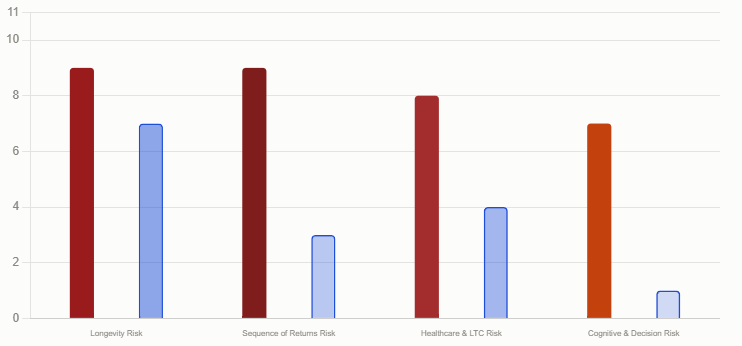
Longevity risk multiplies every other risk: a longer retirement means more years of sequence-of-returns exposure, more years of healthcare cost accumulation, and more years in which cognitive decline may impair decision-making. A 35-year retirement beginning at 65 produces three times as many years of potential sequence risk as a 12-year retirement ending at 77.
Sequence of returns risk amplifies healthcare cost risk: a bad market sequence in early retirement depletes the portfolio precisely at the time when it should be growing to fund later-life healthcare costs. A retiree who loses 30% of their portfolio value in years 1–3 has not only a smaller portfolio — they have a smaller healthcare reserve, a smaller long-term care buffer, and reduced flexibility for all subsequent decisions.
Healthcare cost risk intersects with cognitive risk: cognitive decline increases the probability of needing formal care — assisted living, memory care, or nursing facilities — at costs far higher than home-based care. The person least able to manage the financial consequences of long-term care is often the person most likely to need it.
Cognitive risk undermines all three other defences: the strategies for managing longevity risk (Social Security optimisation, annuity decisions), sequence risk (withdrawal rate flexibility, cash buffer management), and healthcare cost risk (insurance coordination, Medicaid planning) all require ongoing, complex decision-making. A retiree with significant cognitive impairment cannot reliably execute any of them — which is why cognitive infrastructure planning is not optional.
Morningstar's 2026 retirement income research — cited by Madison Partners (May 2026) and Bluebird Advisory (June 2026) — takes a more flexible position than a single fixed rule. The key finding: retirees who hit poor returns in their first five years and did not cut spending were far more likely to run out of money. The implication is that the 4% rule works on average — but 'on average' conceals enormous variation based on sequence. A retiree who gets excellent returns in their first five years can often sustain 4% or more indefinitely; a retiree who gets a bad early sequence may need to cut to 3% or even 2.5% temporarily to avoid permanent depletion.
David Lerner Associates (July 2026) summarises the practitioner consensus: 'The most widely underestimated risk in retirement planning is not losing money in the market. It is losing money in the market when you actually need it. Withdrawing from a declining portfolio can lock in losses, permanently reducing what remains to recover. The sequence, not the size, of the loss is what does the damage.'
For 2026 specifically: the S&P 500 dropped approximately 19% in the first half of 2025 before recovering. Anyone who retired in early 2025 and began withdrawals immediately experienced their sequence risk event in real time. For those who had a cash buffer — 12–24 months of living expenses in cash or short-term bonds, outside the equity portfolio — the bear market was an inconvenience. For those who did not, it was a permanent reduction in their retirement portfolio's long-run capacity.
The 4% rule is a starting point, not a guarantee. In 2026, most retirement income specialists recommend treating it as a guideline within a flexible framework: start at 3.5–4% in a favourable sequence, be prepared to cut to 3% or lower in an unfavourable early sequence, and review annually against actual portfolio performance and remaining life expectancy. The combination of sequence risk awareness and withdrawal flexibility is the most effective defence — more so than any specific asset allocation decision.

This table is a general framework; not financial, legal, or insurance advice. Individual circumstances vary significantly. Consult a qualified financial adviser, elder law attorney, and/or insurance specialist for strategies appropriate to your situation.
Example: Scenario A — The Unguarded Retirement: Robert and Jane retire at 65 in early 2025 with a $1 million portfolio, 100% in diversified equity funds. They begin withdrawing $50,000 per year (5% withdrawal rate). The S&P 500 falls 19% in H1 2025. Their portfolio drops to approximately $810,000 before the recovery. They continue withdrawing $50,000/year throughout the decline. By the time the market recovers, their portfolio is reduced to approximately $720,000 — despite the market returning to its previous level. They need to sell more shares at lower prices to maintain withdrawals, so fewer shares participate in the recovery. They have not made any investment mistakes. They have simply experienced sequence of returns risk with no defences in place. Their portfolio is now 28% smaller than it was at retirement, before the first year is complete.
Example: Scenario B — The Defended Retirement: Same $1 million portfolio. Same 2025 retirement date. Same market downturn. Different plan. Patricia and Michael retire with: $1 million in a diversified portfolio (70% equities, 30% bonds); plus a separate $100,000 cash buffer (12 months of living expenses at $50,000/year) in a high-yield savings account or short-term Treasury bills; plus a flexible withdrawal agreement: they will draw from cash when the equity portfolio falls more than 15%, allowing the equity portfolio to recover without selling at depressed prices. In H1 2025: they draw from their cash buffer instead of the portfolio. Their equity portfolio falls from $1 million to $810,000 — but they have not sold a single equity share during the decline. When the market recovers, their equity portfolio recovers with it. They have used 6 months of cash buffer, which they begin replenishing when the portfolio recovers. Their retirement is not impaired.
Example: Scenario C — The Healthcare Risk Scenario: Both couples above discover at age 78 that one partner needs memory care at $108,000 per year (national median for memory care, 2025). Patricia and Michael had purchased a hybrid life/LTC policy in their late 50s that covers $150,000 in LTC benefits. The policy covers most of the memory care cost. Robert and Jane had no LTC planning. The full $108,000 per year comes from their already-depleted portfolio. Within 3 years, they have spent $324,000 on memory care — on top of their regular living expenses. Their retirement plan has collapsed. The risk they never planned for was not the market. It was the combination of sequence risk (which depleted the portfolio) and healthcare cost risk (which delivered the final blow).
What makes these risks difficult to plan for is not their complexity. It is their distance. Sequence risk feels abstract during the accumulation phase when the order of returns does not matter. Healthcare costs feel manageable when you are 55 and healthy. Cognitive decline feels like something that happens to other people. And a 35-year retirement feels impossibly far away when you are planning one at 40.
The FPA Journal's June 2026 conclusion is the right one: 'Retirement is not a one-time optimization problem. It is an extended sequence of decisions made under uncertainty across all four dimensions. Focusing primarily on longevity and income risk while underweighting health and decision risk is no longer a complete or responsible framework for retirement planning.' A complete retirement plan addresses all four risks — not just the size of the pot — and builds specific defences for each one before the risks arrive. By the time they are visible from where you stand, it is often too late to build the defences.
Sequence of returns risk is the danger that poor investment returns early in retirement, combined with ongoing portfolio withdrawals, permanently depletes a portfolio even if the long-run average return is adequate. During the accumulation phase (when you are saving), the order of investment returns does not matter — only the average. But in the withdrawal phase (when you are living off the portfolio), a bad year in years 1–3 forces you to sell more shares to raise the same cash, leaving fewer shares to participate in the recovery. The portfolio never fully rebuilds. The sequence of losses — not the size of the portfolio or the asset allocation — determines whether a retirement plan succeeds or fails. Cedar Gold Group's August 2026 guide quantifies the difference: at a lower withdrawal rate, roughly 11.5 consecutive years of 6% annual gains are needed to recover from early losses; at a higher withdrawal rate, approximately 28 consecutive years are needed. The practical defence is a combination of a cash buffer (12–24 months of living expenses outside the equity portfolio) and withdrawal rate flexibility (reducing withdrawals in down years).
How much should I budget for healthcare costs in retirement?
Fidelity's 2025 Retiree Health Care Cost Estimate puts the figure at approximately $345,000 in current savings for a couple retiring at 65 in 2025 to supplement Medicare and cover out-of-pocket healthcare costs in retirement. For a single 65-year-old, the comparable estimate is $172,500. These figures cover healthcare costs only — they do not include long-term care. Nearly 70% of people turning 65 today will need some form of long-term care, with average lifetime LTC spending of approximately $138,000 (Genworth 2024). Healthcare inflation has historically risen faster than general inflation — 7.5% from 2022 to 2023 alone. The practical implication: build a dedicated healthcare reserve into your retirement plan (the Fidelity figures are a useful benchmark), maximise Health Savings Account contributions before retirement, evaluate long-term care insurance in your 50s when premiums are most affordable, and build healthcare cost inflation into your long-term spending projections.
Is the 4% withdrawal rule still safe in 2026?
The 4% rule — withdrawing 4% of your portfolio annually — remains a widely used guideline, but in 2026 it is increasingly treated as a flexible starting point rather than a guaranteed safe rate. Morningstar's 2026 retirement income research, cited by Madison Partners (May 2026), found that retirees who hit poor returns in their first five years and did not cut spending were far more likely to run out of money. The key variable is sequence: a 4% withdrawal from a portfolio that immediately experiences a 20–30% downturn is very different from 4% withdrawn from a portfolio that starts with strong returns. The practical consensus in 2026: start at 3.5–4% if you have flexibility; be prepared to reduce to 3% or lower in the first 2–5 years if markets are unfavourable; maintain a cash buffer to avoid selling equities at depressed prices; and review the rate annually against actual portfolio performance and remaining life expectancy.
What can I do to protect my retirement from cognitive decline?
Building a financial infrastructure for cognitive resilience requires action before cognitive decline begins — which means the time to do it is now, regardless of age. The key steps: (1) create a durable power of attorney designating someone you trust to manage financial decisions if you become unable to; (2) register a trusted contact with all financial institutions — most brokerages now allow this designation; (3) simplify your financial structure — consolidate accounts, eliminate unnecessary complexity, and build a system that can be managed by someone else; (4) automate the financial plan wherever possible — automatic rebalancing, automatic Required Minimum Distributions, automatic bill payment; (5) consider a fee-only fiduciary financial adviser who will maintain ongoing oversight of the financial plan through the full duration of retirement, not just at the point of retirement. The FPA Journal June 2026 specifically identifies cognitive and decision risk as requiring proactive infrastructure planning rather than reactive response after the fact.
How long should I plan for my retirement to last?
Plan for a long retirement — longer than average life expectancy suggests. The average US life expectancy in 2025 was 79.4 years. But a 65-year-old man can expect to live to approximately 83 and a 65-year-old woman to approximately 85 — and those are averages. For a couple aged 65, there is a high probability that at least one partner will live into their late 80s or 90s. Northwestern Mutual's 2025 study finds that 67% of men and 75% of women over age 70 are expected to live at least another 10 years. Planning to the mean life expectancy means a meaningful proportion of retirees will outlive their financial plan. Retirement income specialists typically recommend planning to age 90 or beyond for conservative planning, and considering that a 35-year retirement (from 65 to 100) is not an unrealistic scenario for those who are currently in good health.
What is the best way to protect against sequence of returns risk?
The most effective defences against sequence of returns risk are: (1) Cash buffer — maintain 12–24 months of living expenses in cash or short-term bonds outside the equity portfolio, specifically to avoid selling equities during early-retirement market downturns; (2) Bucket strategy — divide the portfolio into short-term (cash/bonds, 2–5 years of expenses), medium-term (balanced portfolio, 5–10 years), and long-term (equity growth) buckets, drawing from the short-term bucket in down years; (3) Withdrawal rate flexibility — commit in advance to reducing withdrawals in years when the portfolio falls more than a specific threshold (e.g., 10% or 15%); (4) Guaranteed income floor — cover essential living expenses with guaranteed income sources (Social Security, pension, or a lifetime annuity) so that the equity portfolio's performance does not determine whether basic needs are met; (5) Delay retirement or partial retirement if the first year of retirement coincides with a significant market downturn — a year or two of continued employment can provide the time for the portfolio to recover before withdrawals begin.
Table of Contents
- Why Most Retirement Plans Miss the Real Threats
- The Four Retirement Risks — A Framework
- Risk 1: Longevity Risk — Outliving Your Money in a Longer Life
- Risk 2: Sequence of Returns Risk — The Retirement Risk Most People Never Plan For
- Why Sequence Risk Is the Most Dangerous — and Most Overlooked
- Risk 3: Healthcare and Long-Term Care Cost Risk
- Risk 4: Cognitive and Decision Risk — The Risk Nobody Talks About
- How the Four Risks Interact and Compound
- The 4% Rule in 2026: Is It Still Safe?
- Concrete Defences: What to Do About Each Risk
- Retirement Planning Scenarios: The Same Pot, Different Outcomes
- Conclusion: Planning for Risks You Cannot See From Here
- Frequently Asked Questions
Sequence of Return Risk: Early vs Late Losses On $1M Portfolio.
Four retirement Risks: How they Interact.
HealthCare Cost Accumulation Over A 30 - Year Retirement
Why Most Retirement Plans Miss the Real Threats
The mental model most people use when planning for retirement goes roughly like this: save enough money during your working years, invest it sensibly, spend it down gradually in retirement, and hope it lasts as long as you do. It is a reasonable model. And its central preoccupation — whether the pot is large enough — is a legitimate concern. Northwestern Mutual's 2025 Planning and Progress Study found that 51% of Americans believe they will outlive their savings.But this model misidentifies the primary threats. The size of the retirement pot, while important, is not the main variable that determines whether a retirement succeeds or fails. The Financial Planning Association's June 2026 Journal of Financial Planning identified four retirement risks that are frequently underweighted relative to their actual impact: longevity risk, income and market risk (specifically what is called sequence of returns risk), health and long-term care risk, and cognitive and decision risk.
Of these four, sequence of returns risk is the one most consistently absent from ordinary retirement planning conversations. It is not a household term. It is not on the standard retirement planning checklist. And yet Morningstar's 2026 retirement income research found that retirees who experienced poor returns in their first five years and did not cut spending were far more likely to run out of money than those who got positive early returns — even with identical long-run average performance. Two portfolios can post the exact same 20-year average return and produce radically different retirement outcomes, depending entirely on when the bad years arrived.
This guide explains all four risks, their interactions, and what to do about each one — starting with the one most people never plan for.
51% of Americans believe they will outlive their savings (Northwestern Mutual 2025 Planning and Progress Study). Average US life expectancy 2025: 79.4 years. If you reach 65: men expected to live to 83+; women to 85+. By 2060: 95 million Americans aged 65+. Fidelity 2025: a couple retiring at 65 may need $345,000 in current savings for healthcare alone. Nearly 70% of people turning 65 today will need some form of long-term care. FPA Journal June 2026: cognitive and decision risk 'no longer a peripheral concern.'
The Four Retirement Risks — A Framework
The Financial Planning Association's June 2026 Journal of Financial Planning, written by Dr Chris Heye, founder of Whealthcare Planning, frames retirement planning around four distinct and interacting risks. This framework moves beyond the single-variable 'did you save enough' question to address the full complexity of a 25–35 year retirement:
Risk 1: Longevity Risk — Outliving Your Money in a Longer Life
Longevity risk is the best-known of the four — the fear that retirement savings will run out before life does. It is the fear behind the 51% of Americans who believe they will outlive their savings. It is real, and it is growing.In 2025, the average US life expectancy reached 79.4 years. But the more relevant number for retirement planning is conditional life expectancy — how long you can expect to live if you have already reached retirement age. For a 65-year-old, men can expect to live to approximately 83 years, women to approximately 85 years (First Financial Consulting, January 2026). Northwestern Mutual's 2025 study finds that 67% of men and 75% of women over age 70 are expected to live at least another 10 years. And the fastest-growing demographic in the US is people over 85: the population above that age is projected to double within 20 years. By 2060, 95 million Americans will be aged 65 or older, up from 56 million in 2020.
What this means in practice: a person retiring at 65 today should plan for a 25- to 35-year retirement. A standard retirement planning model that assumes a 20-year retirement is systematically underestimating the financial challenge for a significant proportion of retirees. Legacy Bridge Wealth frames the compounding: 'With 35-year retirements, the probability of experiencing damaging early-year losses increases significantly. Living longer means more years of potential healthcare expenses, and the probability of needing expensive medical interventions or long-term care increases dramatically with age.'
Longevity risk interacts with all three other risks. A longer retirement means more years of potential sequence-of-returns exposure, more healthcare expense accumulation, and more years in which cognitive decline may impair financial decision-making. It is the multiplier that amplifies everything else.
Longevity risk is not just about saving more money. It is about the design of the retirement income system: how much comes from guaranteed sources (Social Security, pension, annuity) versus market-dependent sources (portfolio withdrawals), and how flexible the system is when circumstances change. A retirement income plan that relies entirely on portfolio withdrawals is fully exposed to all four risks simultaneously. A plan that covers essential expenses with guaranteed income sources — Social Security optimised for longevity, a lifetime annuity for a portion of the portfolio — eliminates the longevity exposure from those income streams at the cost of flexibility.
Risk 2: Sequence of Returns Risk — The Retirement Risk Most People Never Plan For
Sequence of returns risk is the risk that most people have never heard of, that most retirement plans do not address, and that can destroy a financially adequate retirement without the retiree ever making a bad investment decision.The concept is this: during the accumulation phase of life, the order in which your investment returns arrive does not matter. If you invest $500 per month over 30 years and the market produces a 7% average annual return, the sequencing of good years and bad years does not affect your ending balance — what matters is the average. But the moment you begin withdrawing money from the portfolio, the order matters enormously. A bad year early in retirement, when your portfolio is at its largest and you are selling assets to fund living expenses, does permanent and irreversible damage. A bad year late in retirement, when the portfolio is smaller and fewer years remain, is far less consequential.
CNBC's April 2026 report on sequence risk brings it to life with a concrete historical example from Fidelity CFP Frank Maltais: 'If a 65-year-old retired around 1972, right ahead of them was the 1973-1974 bear market, when the S&P dropped 48%. That was a time when you had really high inflation, we had an oil crisis and we had a lot of political instability.' Retiring one year earlier, into a portfolio that had not yet been depleted by withdrawals during the crash, produced dramatically different 20-year outcomes than retiring at the wrong moment. The retiree who got the bear market in years 1 and 2 never recovered.
The mechanism, explained by Cedar Gold Group's August 2026 sequence risk guide: 'A market drop in year one or year two forces you to sell more shares to raise the same amount of cash, depleting your holdings faster than your withdrawal rate alone would suggest. The portfolio never fully rebuilds because fewer shares remain to participate in the rebound.' Every share sold at a depressed price during a bear market is a share that will never compound during the subsequent recovery. This is why the sequence, not the size, of returns is what determines whether a portfolio survives a 30-year retirement.
Two retirees can have identical $1 million portfolios and identical $40,000 annual withdrawal rates. If one experiences poor returns in years 1–5 of retirement while the other experiences the same poor returns in years 15–20, the first retiree's portfolio will likely be exhausted while the second remains financially secure (Legacy Bridge Wealth). The long-run average returns are the same. The asset allocation is the same. The withdrawal rate is the same. The only difference is when the bad years arrived. This is what sequence of returns risk means — and why it is so important to plan for.
Why Sequence Risk Is the Most Dangerous — and Most Overlooked
There are three specific reasons why sequence of returns risk is the most dangerous retirement risk and the one most consistently absent from planning conversations.First: it is invisible during accumulation. For the 30 or 40 years during which most people build their retirement savings, sequence risk does not exist. The order of market returns during the saving phase is irrelevant to the final balance. Investors who experienced the 2000 dot-com crash, the 2008 financial crisis, and the 2020 COVID crash while still saving did not face sequence risk — they benefited from dollar-cost averaging (buying more shares at lower prices). The risk only materialises at the exact moment of retirement — a moment that arrives suddenly and permanently. People arrive at retirement with no personal experience of the risk and no intuition for its consequences.
Second: recent real-world examples are vivid and recent. The Madison Partners analysis (May 2026) provides a case study that is only 18 months old: 'The index dropped nearly 19% in the first half of 2025 before recovering to finish well in the green. Anyone who retired in March of [2025] and started drawing income immediately got the bad half first.' A person who retired in March 2025 with a $1 million portfolio and began withdrawing $40,000 per year immediately faced the worst first six months available — selling shares at the bottom before the recovery. A person who retired in September 2025, after the recovery, began from a higher base. Same portfolio size, same fund, same withdrawal rate — different outcome, determined entirely by timing.
Third: the standard defence is insufficient. Most retirement planning advice addresses market risk through diversification — holding bonds alongside stocks, so that when stocks fall, bonds hold or rise. Diversification is necessary and valuable. But it does not eliminate sequence risk. Even a well-diversified portfolio can fall significantly in a market downturn — and during that fall, withdrawals continue. The specific defence against sequence risk requires more targeted tools: a cash buffer, a bucket strategy, or withdrawal rate flexibility — not just asset allocation.
Example: Charles Schwab's modelling, cited by Cedar Gold Group's August 2026 guide, quantifies the withdrawal rate effect: at a lower withdrawal rate after early losses, approximately 11.5 consecutive years of 6% annual gains are needed to fully recover. At a higher withdrawal rate during the same scenario, approximately 28 consecutive years of the same gains are needed. The difference between needing 11.5 years versus 28 years of recovery gains is entirely determined by the withdrawal rate decision — not the asset allocation, not the fund selection, not the investment returns themselves. This is the most practical and actionable aspect of sequence risk management.
Risk 3: Healthcare and Long-Term Care Cost Risk
Healthcare and long-term care cost risk has moved from the periphery to the centre of retirement planning, as the FPA Journal of Financial Planning's June 2026 article observes: 'Because of their growing consequences for personal income, savings, and spending, health-related risks have moved from the periphery to the center of retirement planning. Population-level health data show that suffering from a chronic illness is not a rare event in later life but rather the norm.'The headline numbers are significant. Fidelity's 2025 Retiree Health Care Cost Estimate puts the savings a couple retiring at 65 in 2025 may need at approximately $345,000 to supplement Medicare and cover out-of-pocket healthcare costs in retirement. For a single 65-year-old, the comparable estimate is $172,500 (cited David Lerner Associates, July 2026). These figures do not include long-term care costs — they are healthcare costs alone.
Long-term care adds a separate and often larger risk layer. Nearly 70% of people turning 65 today will need some form of long-term care during their lifetime (First Financial Consulting, January 2026). The average American spends approximately $138,000 on long-term care over their lifetime (Genworth 2024). But the distribution is heavily skewed: most people spend much less, and a significant minority spend dramatically more — with multi-year nursing home stays costing $100,000 or more per year in many markets. Around 60% of older adults cannot afford even two years of in-home care (First Financial Consulting, January 2026).
The compounding problem is healthcare inflation. Healthcare costs have historically risen faster than general inflation: up 7.5% from 2022 to 2023 alone (Wealth Enhancement Group). HBK Wealth's August 2026 analysis of retirement risks notes: 'Healthcare inflation has historically risen faster than general inflation, which means these costs may increase substantially over time. Long-term care is especially overlooked.' Over a 35-year retirement, healthcare expense inflation could outpace portfolio growth, creating a combination of rising costs and declining resources precisely when the retiree is least able to return to the workforce.
Healthcare cost defence strategies for retirement planning: (1) Health Savings Account (HSA) — if you have access to an HSA through a high-deductible health plan, maximise contributions every year before retirement. HSA contributions are pre-tax; growth is tax-deferred; withdrawals for qualified medical expenses are completely tax-free. An HSA can be used in retirement for Medicare premiums, dental, vision, and most out-of-pocket medical costs. (2) Long-term care insurance or hybrid life/LTC policy — evaluate while in your 50s, when premiums are most affordable; waiting until 65 or 70 significantly increases cost and reduces insurability. (3) Dedicated healthcare reserve — allocate a specific portion of the portfolio (the $172,500/$345,000 Fidelity benchmark is a useful starting point) to a conservative, dedicated healthcare fund. (4) Medicaid planning — for families with limited assets, an elder law attorney can help structure assets to qualify for Medicaid-funded long-term care without depleting everything first. Consult a qualified financial adviser or estate planning attorney for strategies appropriate to your specific situation.
Risk 4: Cognitive and Decision Risk — The Risk Nobody Talks About
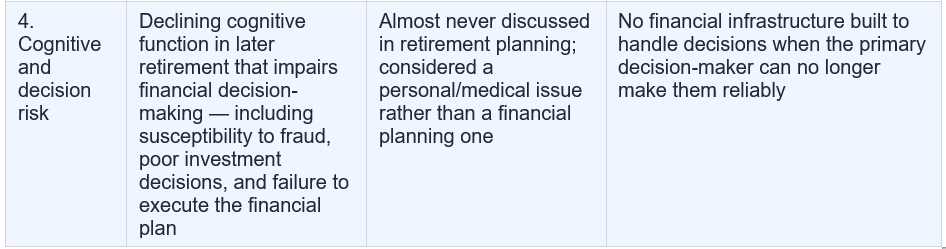
The fourth retirement risk identified by the FPA Journal of Financial Planning is the one that receives the least attention in mainstream financial planning — and may have the most inevitable trajectory: cognitive and decision risk. This is the risk that declining cognitive function in later retirement impairs the financial decision-making that a retirement plan depends on for successful execution.The FPA's June 2026 article is explicit: 'Market volatility and fluctuating income streams do not just affect portfolios, they influence behaviors. Anxiety, overconfidence, and impulsive decision-making can undermine strategies that are technically sound but difficult to sustain over time.' A retirement income plan that is technically sound — the right asset allocation, the right withdrawal rate, the right insurance coverage — can be entirely undermined if its executor becomes fearful in a market downturn and sells equities at the bottom, becomes overconfident in a bull market and concentrates risk, or is unable to navigate the complexity of Required Minimum Distribution calculations, Medicare enrollment decisions, or portfolio rebalancing in later life.
An NBER Working Paper published in 2026 (Li, NBER Working Paper No. 34659, 'Dementia and Long-run Trajectories in Household Finances') documents the financial consequences of dementia specifically — finding significant long-run disruption to household finances following dementia onset. But cognitive decline does not have to reach clinical dementia to create financial risk. Mild cognitive impairment — estimated to affect 10–20% of adults over 65 — can impair the ability to detect financial fraud, manage complex investment decisions, or recognise when a previously appropriate investment strategy no longer fits changed circumstances.
The financial planning profession has historically treated cognitive decline as a medical issue rather than a planning issue. The FPA's June 2026 framing changes this: 'Retirement is not a one-time optimization problem. It is an extended sequence of decisions made under uncertainty across all four dimensions. Focusing primarily on longevity and income risk while underweighting health and decision risk is no longer a complete or responsible framework for retirement planning.'
Building a financial infrastructure for cognitive resilience: (1) Simplify the financial structure NOW, while decision-making capacity is full. Consolidate accounts, eliminate complexity, and build a system that can be managed by someone else if necessary. (2) Designate a trusted financial decision-maker — either a trusted family member (through a durable power of attorney) or a professional fiduciary — before cognitive decline begins. (3) Install a trusted contact with your financial institutions — most brokerages allow a 'trusted contact' designation who can be reached if the account holder shows signs of financial exploitation or confusion. (4) Automate the financial plan as much as possible: automatic portfolio rebalancing, automatic Required Minimum Distributions, automatic bill payment, and automatic tax withholding remove decision-making from the risk zone. (5) Consider a professional fee-only fiduciary adviser who can maintain oversight of the financial plan as cognitive capacity changes — not just during the transition to retirement but through the full duration of it.
How the Four Risks Interact and Compound
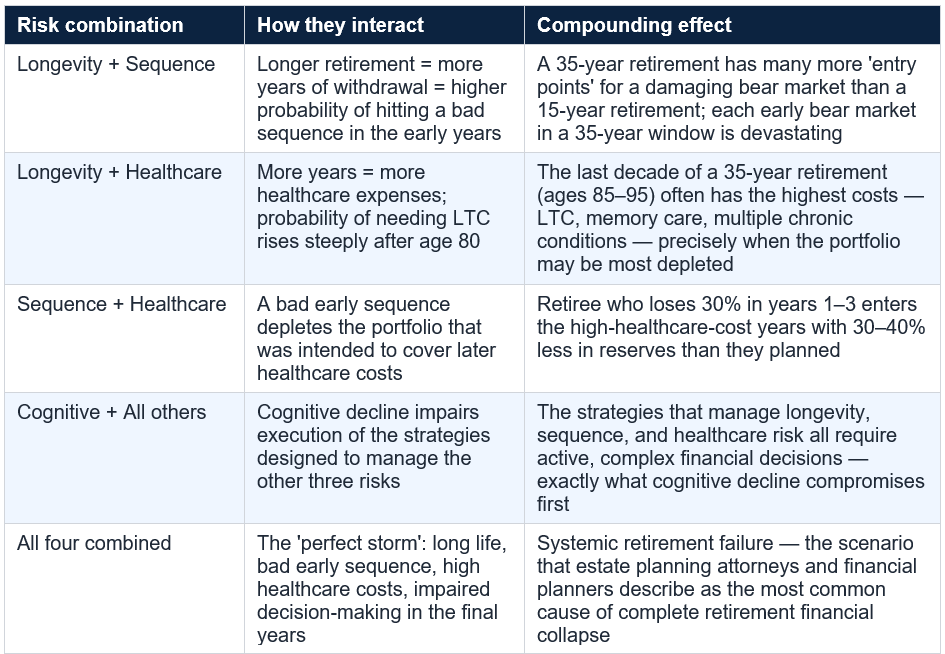
The four retirement risks are not independent. They interact and amplify each other in ways that make the combined exposure significantly greater than the sum of the parts.Longevity risk multiplies every other risk: a longer retirement means more years of sequence-of-returns exposure, more years of healthcare cost accumulation, and more years in which cognitive decline may impair decision-making. A 35-year retirement beginning at 65 produces three times as many years of potential sequence risk as a 12-year retirement ending at 77.
Sequence of returns risk amplifies healthcare cost risk: a bad market sequence in early retirement depletes the portfolio precisely at the time when it should be growing to fund later-life healthcare costs. A retiree who loses 30% of their portfolio value in years 1–3 has not only a smaller portfolio — they have a smaller healthcare reserve, a smaller long-term care buffer, and reduced flexibility for all subsequent decisions.
Healthcare cost risk intersects with cognitive risk: cognitive decline increases the probability of needing formal care — assisted living, memory care, or nursing facilities — at costs far higher than home-based care. The person least able to manage the financial consequences of long-term care is often the person most likely to need it.
Cognitive risk undermines all three other defences: the strategies for managing longevity risk (Social Security optimisation, annuity decisions), sequence risk (withdrawal rate flexibility, cash buffer management), and healthcare cost risk (insurance coordination, Medicaid planning) all require ongoing, complex decision-making. A retiree with significant cognitive impairment cannot reliably execute any of them — which is why cognitive infrastructure planning is not optional.
The 4% Rule in 2026: Is It Still Safe?
The 4% safe withdrawal rate — the rule of thumb suggesting that retirees can safely withdraw 4% of their portfolio per year without exhausting it over a 30-year retirement — has been the dominant withdrawal rate framework in retirement planning since William Bengen introduced it in 1994. In 2026, its applicability is increasingly contested.Morningstar's 2026 retirement income research — cited by Madison Partners (May 2026) and Bluebird Advisory (June 2026) — takes a more flexible position than a single fixed rule. The key finding: retirees who hit poor returns in their first five years and did not cut spending were far more likely to run out of money. The implication is that the 4% rule works on average — but 'on average' conceals enormous variation based on sequence. A retiree who gets excellent returns in their first five years can often sustain 4% or more indefinitely; a retiree who gets a bad early sequence may need to cut to 3% or even 2.5% temporarily to avoid permanent depletion.
David Lerner Associates (July 2026) summarises the practitioner consensus: 'The most widely underestimated risk in retirement planning is not losing money in the market. It is losing money in the market when you actually need it. Withdrawing from a declining portfolio can lock in losses, permanently reducing what remains to recover. The sequence, not the size, of the loss is what does the damage.'
For 2026 specifically: the S&P 500 dropped approximately 19% in the first half of 2025 before recovering. Anyone who retired in early 2025 and began withdrawals immediately experienced their sequence risk event in real time. For those who had a cash buffer — 12–24 months of living expenses in cash or short-term bonds, outside the equity portfolio — the bear market was an inconvenience. For those who did not, it was a permanent reduction in their retirement portfolio's long-run capacity.
The 4% rule is a starting point, not a guarantee. In 2026, most retirement income specialists recommend treating it as a guideline within a flexible framework: start at 3.5–4% in a favourable sequence, be prepared to cut to 3% or lower in an unfavourable early sequence, and review annually against actual portfolio performance and remaining life expectancy. The combination of sequence risk awareness and withdrawal flexibility is the most effective defence — more so than any specific asset allocation decision.
Concrete Defences: What to Do About Each Risk
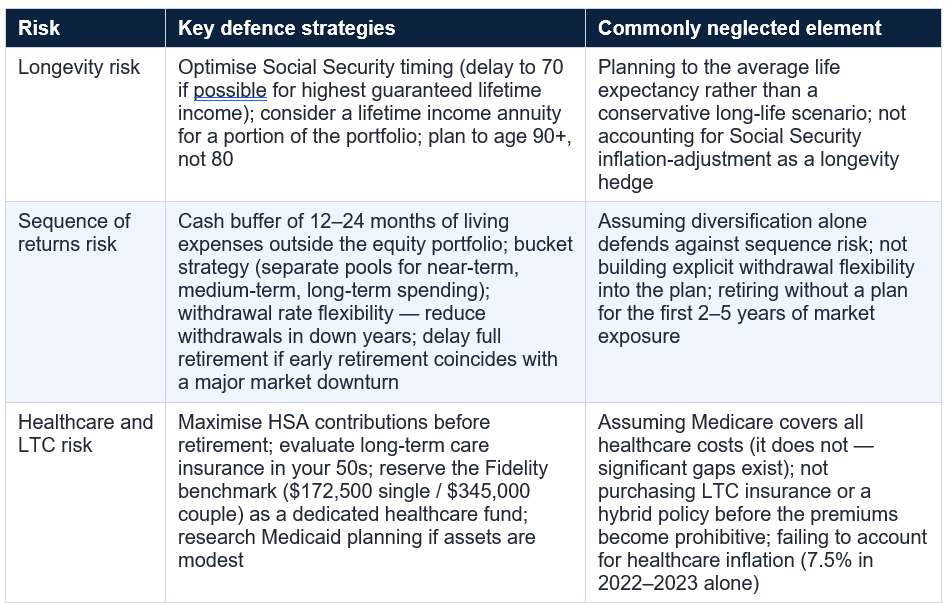
Each of the four risks has specific, actionable defences. The following checklist draws on the published recommendations from the sources cited in this article:This table is a general framework; not financial, legal, or insurance advice. Individual circumstances vary significantly. Consult a qualified financial adviser, elder law attorney, and/or insurance specialist for strategies appropriate to your situation.
Retirement Planning Scenarios: The Same Pot, Different Outcomes
The following illustrative scenarios demonstrate how the same retirement savings can produce dramatically different outcomes based on risk management decisions.Example: Scenario A — The Unguarded Retirement: Robert and Jane retire at 65 in early 2025 with a $1 million portfolio, 100% in diversified equity funds. They begin withdrawing $50,000 per year (5% withdrawal rate). The S&P 500 falls 19% in H1 2025. Their portfolio drops to approximately $810,000 before the recovery. They continue withdrawing $50,000/year throughout the decline. By the time the market recovers, their portfolio is reduced to approximately $720,000 — despite the market returning to its previous level. They need to sell more shares at lower prices to maintain withdrawals, so fewer shares participate in the recovery. They have not made any investment mistakes. They have simply experienced sequence of returns risk with no defences in place. Their portfolio is now 28% smaller than it was at retirement, before the first year is complete.
Example: Scenario B — The Defended Retirement: Same $1 million portfolio. Same 2025 retirement date. Same market downturn. Different plan. Patricia and Michael retire with: $1 million in a diversified portfolio (70% equities, 30% bonds); plus a separate $100,000 cash buffer (12 months of living expenses at $50,000/year) in a high-yield savings account or short-term Treasury bills; plus a flexible withdrawal agreement: they will draw from cash when the equity portfolio falls more than 15%, allowing the equity portfolio to recover without selling at depressed prices. In H1 2025: they draw from their cash buffer instead of the portfolio. Their equity portfolio falls from $1 million to $810,000 — but they have not sold a single equity share during the decline. When the market recovers, their equity portfolio recovers with it. They have used 6 months of cash buffer, which they begin replenishing when the portfolio recovers. Their retirement is not impaired.
Example: Scenario C — The Healthcare Risk Scenario: Both couples above discover at age 78 that one partner needs memory care at $108,000 per year (national median for memory care, 2025). Patricia and Michael had purchased a hybrid life/LTC policy in their late 50s that covers $150,000 in LTC benefits. The policy covers most of the memory care cost. Robert and Jane had no LTC planning. The full $108,000 per year comes from their already-depleted portfolio. Within 3 years, they have spent $324,000 on memory care — on top of their regular living expenses. Their retirement plan has collapsed. The risk they never planned for was not the market. It was the combination of sequence risk (which depleted the portfolio) and healthcare cost risk (which delivered the final blow).
Conclusion
The retirement risks most people never plan for are not exotic or unusual. Sequence of returns risk is a mathematical certainty for any retiree who holds equity investments and needs to make withdrawals from them — the only question is whether the bad years arrive early or late. Healthcare and long-term care costs will affect nearly 70% of people turning 65 today in some form. Cognitive decline affects a significant proportion of people in their 80s and 90s. And longevity risk — the simple fact of living longer than the financial plan assumed — is the multiplier that makes all the others worse.What makes these risks difficult to plan for is not their complexity. It is their distance. Sequence risk feels abstract during the accumulation phase when the order of returns does not matter. Healthcare costs feel manageable when you are 55 and healthy. Cognitive decline feels like something that happens to other people. And a 35-year retirement feels impossibly far away when you are planning one at 40.
The FPA Journal's June 2026 conclusion is the right one: 'Retirement is not a one-time optimization problem. It is an extended sequence of decisions made under uncertainty across all four dimensions. Focusing primarily on longevity and income risk while underweighting health and decision risk is no longer a complete or responsible framework for retirement planning.' A complete retirement plan addresses all four risks — not just the size of the pot — and builds specific defences for each one before the risks arrive. By the time they are visible from where you stand, it is often too late to build the defences.
Frequently Asked Questions
What is sequence of returns risk and why does it matter?Sequence of returns risk is the danger that poor investment returns early in retirement, combined with ongoing portfolio withdrawals, permanently depletes a portfolio even if the long-run average return is adequate. During the accumulation phase (when you are saving), the order of investment returns does not matter — only the average. But in the withdrawal phase (when you are living off the portfolio), a bad year in years 1–3 forces you to sell more shares to raise the same cash, leaving fewer shares to participate in the recovery. The portfolio never fully rebuilds. The sequence of losses — not the size of the portfolio or the asset allocation — determines whether a retirement plan succeeds or fails. Cedar Gold Group's August 2026 guide quantifies the difference: at a lower withdrawal rate, roughly 11.5 consecutive years of 6% annual gains are needed to recover from early losses; at a higher withdrawal rate, approximately 28 consecutive years are needed. The practical defence is a combination of a cash buffer (12–24 months of living expenses outside the equity portfolio) and withdrawal rate flexibility (reducing withdrawals in down years).
How much should I budget for healthcare costs in retirement?
Fidelity's 2025 Retiree Health Care Cost Estimate puts the figure at approximately $345,000 in current savings for a couple retiring at 65 in 2025 to supplement Medicare and cover out-of-pocket healthcare costs in retirement. For a single 65-year-old, the comparable estimate is $172,500. These figures cover healthcare costs only — they do not include long-term care. Nearly 70% of people turning 65 today will need some form of long-term care, with average lifetime LTC spending of approximately $138,000 (Genworth 2024). Healthcare inflation has historically risen faster than general inflation — 7.5% from 2022 to 2023 alone. The practical implication: build a dedicated healthcare reserve into your retirement plan (the Fidelity figures are a useful benchmark), maximise Health Savings Account contributions before retirement, evaluate long-term care insurance in your 50s when premiums are most affordable, and build healthcare cost inflation into your long-term spending projections.
Is the 4% withdrawal rule still safe in 2026?
The 4% rule — withdrawing 4% of your portfolio annually — remains a widely used guideline, but in 2026 it is increasingly treated as a flexible starting point rather than a guaranteed safe rate. Morningstar's 2026 retirement income research, cited by Madison Partners (May 2026), found that retirees who hit poor returns in their first five years and did not cut spending were far more likely to run out of money. The key variable is sequence: a 4% withdrawal from a portfolio that immediately experiences a 20–30% downturn is very different from 4% withdrawn from a portfolio that starts with strong returns. The practical consensus in 2026: start at 3.5–4% if you have flexibility; be prepared to reduce to 3% or lower in the first 2–5 years if markets are unfavourable; maintain a cash buffer to avoid selling equities at depressed prices; and review the rate annually against actual portfolio performance and remaining life expectancy.
What can I do to protect my retirement from cognitive decline?
Building a financial infrastructure for cognitive resilience requires action before cognitive decline begins — which means the time to do it is now, regardless of age. The key steps: (1) create a durable power of attorney designating someone you trust to manage financial decisions if you become unable to; (2) register a trusted contact with all financial institutions — most brokerages now allow this designation; (3) simplify your financial structure — consolidate accounts, eliminate unnecessary complexity, and build a system that can be managed by someone else; (4) automate the financial plan wherever possible — automatic rebalancing, automatic Required Minimum Distributions, automatic bill payment; (5) consider a fee-only fiduciary financial adviser who will maintain ongoing oversight of the financial plan through the full duration of retirement, not just at the point of retirement. The FPA Journal June 2026 specifically identifies cognitive and decision risk as requiring proactive infrastructure planning rather than reactive response after the fact.
How long should I plan for my retirement to last?
Plan for a long retirement — longer than average life expectancy suggests. The average US life expectancy in 2025 was 79.4 years. But a 65-year-old man can expect to live to approximately 83 and a 65-year-old woman to approximately 85 — and those are averages. For a couple aged 65, there is a high probability that at least one partner will live into their late 80s or 90s. Northwestern Mutual's 2025 study finds that 67% of men and 75% of women over age 70 are expected to live at least another 10 years. Planning to the mean life expectancy means a meaningful proportion of retirees will outlive their financial plan. Retirement income specialists typically recommend planning to age 90 or beyond for conservative planning, and considering that a 35-year retirement (from 65 to 100) is not an unrealistic scenario for those who are currently in good health.
What is the best way to protect against sequence of returns risk?
The most effective defences against sequence of returns risk are: (1) Cash buffer — maintain 12–24 months of living expenses in cash or short-term bonds outside the equity portfolio, specifically to avoid selling equities during early-retirement market downturns; (2) Bucket strategy — divide the portfolio into short-term (cash/bonds, 2–5 years of expenses), medium-term (balanced portfolio, 5–10 years), and long-term (equity growth) buckets, drawing from the short-term bucket in down years; (3) Withdrawal rate flexibility — commit in advance to reducing withdrawals in years when the portfolio falls more than a specific threshold (e.g., 10% or 15%); (4) Guaranteed income floor — cover essential living expenses with guaranteed income sources (Social Security, pension, or a lifetime annuity) so that the equity portfolio's performance does not determine whether basic needs are met; (5) Delay retirement or partial retirement if the first year of retirement coincides with a significant market downturn — a year or two of continued employment can provide the time for the portfolio to recover before withdrawals begin.

0 Comments Comments