

Retirement
How to Create a Retirement Salary: Explained
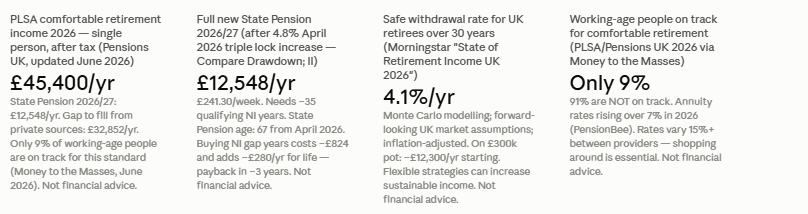
Only 9% of working-age people are currently on track for a ‘comfortable’ retirement. A comfortable retirement for a single person now requires £45,400 a year after tax, yet the State Pension provides only £12,548. The gap — over £32,000 per year — has to come from somewhere. This guide shows you the seven income sources that fill it, how to combine them into a reliable monthly salary you can budget against, and what the maths actually looks like for different pot sizes.
This is the retirement salary problem. A pension pot is not income. It is a reservoir of accumulated savings that will produce income only if you have a plan to draw from it deliberately, tax-efficiently, and sustainably. Most people spend decades focusing on accumulation — how much to save, which fund to choose, whether to increase contributions — and spend very little time thinking about distribution. The result is that many arrive at retirement with a pot of money and no clear strategy for turning it into a salary.
The 2026 data from the Pensions and Lifetime Savings Association makes the problem concrete: only 9% of working-age people are currently on track for a comfortable retirement, defined by the PLSA as £45,400 per year after tax for a single person. The full State Pension provides £12,548 per year in 2026/27. The gap of approximately £32,852 per year between a comfortable retirement income and the State Pension has to come from private savings, ISAs, annuities, drawdown, part-time work, or other income sources. This guide shows you how to build a plan that fills it.
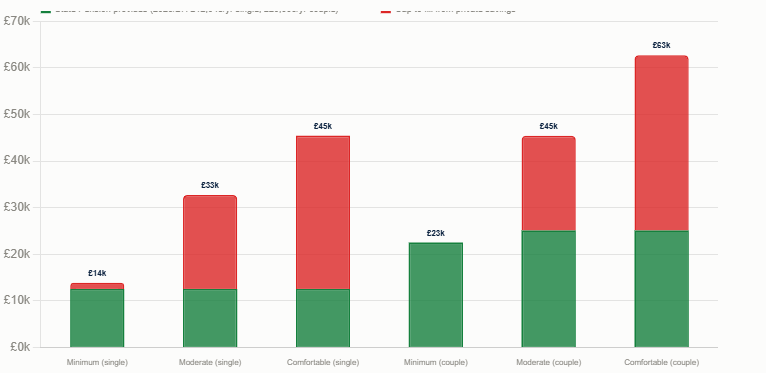
PLSA Retirement Living Standards 2026 (updated June 2026, Pensions UK): Comfortable retirement income: £45,400/year single; £62,700/year couple. Moderate: £32,700/year single; £45,400/year couple. Minimum: £13,900/year single; £22,500/year couple. Only 9% of working-age people are on track for a comfortable retirement (Money to the Masses, June 2026). Full new State Pension 2026/27: £12,548/year (after 4.8% April 2026 triple lock increase). Safe withdrawal rate: 4.1% starting rate for UK retirees over 30 years (Morningstar 'The State of Retirement Income UK 2026'). Annuity rates rising over 7% in 2026 (PensionBee). Not financial advice.
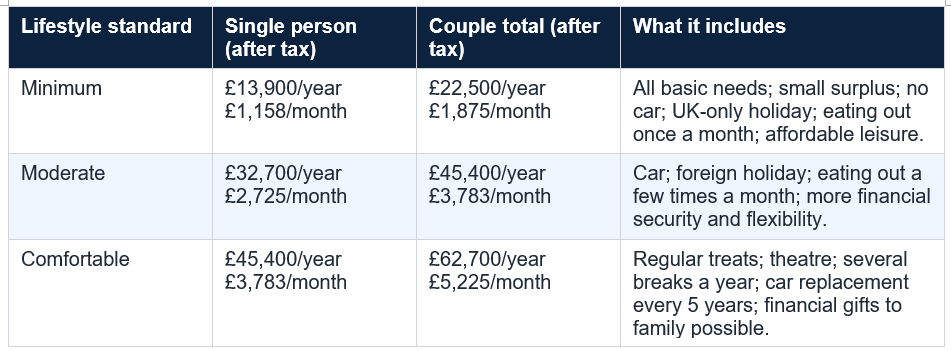
The minimum standard of £13,900 per year for a single person covers all basic needs with a small surplus for modest enjoyment: a UK self-catering holiday, eating out once a month, affordable leisure activities. It assumes no car. The moderate standard of £32,700 adds financial security and flexibility — a car, more spending on food and groceries, a foreign holiday, and eating out a few times a month. The comfortable standard of £45,400 includes regular treats, theatre trips, several breaks a year, and the ability to replace a car every five years.
These figures apply to people living in their own home without a mortgage or rent payment. If you are still paying a mortgage in retirement or living in rented accommodation, you will need more income than these figures suggest. Housing costs are explicitly stripped out of the PLSA benchmarks.
The couple figures (£22,500 minimum, £45,400 moderate, £62,700 comfortable) represent the total for both partners. The economies of scale in a couple’s household mean that two people sharing costs need less than twice what a single person needs. This is one reason each partner in a couple typically needs a smaller pension pot than a single person targeting the same lifestyle standard.
To receive the full State Pension, you generally need approximately 35 qualifying years of National Insurance contributions or credits. If you have gaps in your NI record — perhaps due to career breaks, time abroad, or self-employment periods when you did not pay Class 2 NI — you may be able to buy voluntary NI credits to top up your record. This is one of the highest-return investments available: a gap year of NI costs approximately £824 (Class 3 voluntary contributions at 2026 rates) and provides approximately £280 per year in additional State Pension for life. That pays back in approximately three years.
The State Pension age rose to 67 from April 2026. If you retire before 67, you will need to fund your entire income from private sources until the State Pension kicks in. This is the ‘bridge’ period, and its cost is often underestimated: funding an additional £12,548 per year for three years (retiring at 64) costs approximately £37,644 in additional pension pot. Many people do not account for this in their retirement planning.
State Pension 2026/27: £241.30/week = £12,548/year. Requires approximately 35 qualifying NI years. State Pension age: 67 from April 2026. Triple lock guarantee: rises annually by highest of earnings growth, CPI, or 2.5%. Buy voluntary NI credits at ~£824/year to fill gaps (each gap year adds ~£280/year to State Pension for life). Check your State Pension forecast at gov.uk/check-state-pension. Sources: Compare Drawdown; Interactive Investor; SJP. Not financial advice.
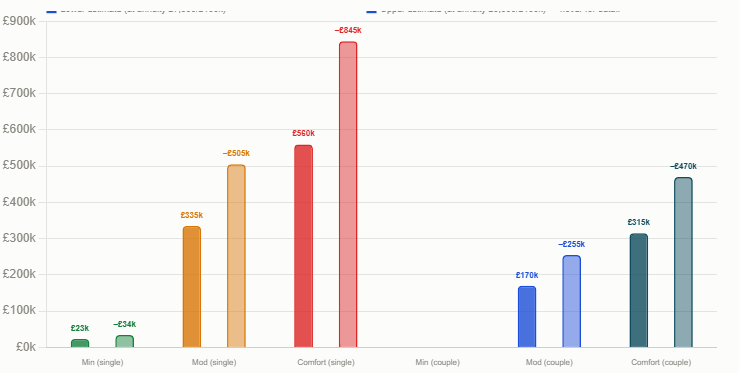
Example: Income gap calculation (single person targeting comfortable retirement in 2026): Target income: £45,400 after tax (PLSA comfortable standard). State Pension: approximately £12,548 after tax (gross received; sits mostly within personal allowance). Income gap to fill from private sources: £45,400 - £12,548 = £32,852 per year. Monthly equivalent: £2,738 per month. Pot size required (based on annuity rates £5,000-£7,500 per £100,000): £560,000-£845,000 (Interactive Investor; Pensions UK 2026). Note: if part of the gap is filled by ISA income, other pensions, part-time work, or rental income, the required pension pot falls accordingly. Not financial advice.
The interactive investor / Pensions UK 2026 table provides specific pot size estimates for each living standard, based on annuity rates of £5,000–£7,500 per £100,000 of savings. These are benchmark figures for planning purposes; drawdown can offer higher income in good years but carries investment risk, while annuities provide certainty at a fixed rate. The right approach depends on your risk tolerance, health, other income sources, and whether you have dependants.
For couples, the income gap per person is significantly smaller because the PLSA couple figures are total not per-person, and because two full State Pensions together provide approximately £25,096 per year — already covering the moderate standard for a couple (£45,400 - £25,096 = £20,304 gap) and well above the minimum standard. A couple with two full State Pensions targeting a moderate retirement needs to find approximately £10,152 per person per year from private savings — a much more achievable target than a single person’s £32,852 gap.
The flexibility of drawdown is its defining advantage. You can take £2,000 one month and nothing the next. You can increase withdrawals in years when you need more — perhaps for a holiday or home repair — and reduce them when you need less. You can leave the pot invested in growth assets in your early retirement years when you have other income, and then draw it down more aggressively in later years. And if you die with money left in the pot, it passes to your nominated beneficiaries — though from April 2027, unused pension pots will be subject to inheritance tax.
The risk of drawdown is sequencing risk: the danger that poor investment returns in the early years of retirement, combined with regular withdrawals, can deplete a portfolio faster than good long-term average returns would suggest. A pension that falls 20% in its first retirement year, while simultaneously paying out 5% annual income, starts from a significantly lower base for any subsequent recovery. This is why many advisers recommend maintaining 1–2 years of income in cash or low-risk assets within a drawdown portfolio, to avoid being forced to sell investments at the worst time.
Drawdown cash buffer strategy: keep 12–24 months of planned withdrawals in cash or a money market fund within your drawdown portfolio. This means you never need to sell investments during a market downturn to fund your income — you draw from the cash buffer, which is then refilled from the invested portion when markets recover. This simple structure reduces sequencing risk without significantly reducing long-term returns. Not financial advice. Consult a qualified IFA.
The current annuity market provides approximately £5,000–£7,500 of annual income per £100,000 of pension savings (Interactive Investor; Pensions UK 2026). The wide range reflects the significant variation between providers — PensionBee notes that annuity rates can vary by over 15% between providers. Over a 20–30 year retirement, a 15% difference in annuity rate translates to thousands of pounds in additional income. Shopping around is not optional; it is essential.
Several factors affect the annuity rate offered to any individual: age (older buyers get better rates because the payments are spread over fewer years); health and lifestyle (enhanced or impaired-life annuities pay more to people with health conditions that may reduce life expectancy); the size of the pension pot (larger pots often get better rates); and the type of annuity chosen. A level annuity pays the same amount every year regardless of inflation — it will feel significantly smaller in real terms after 20 years. An inflation-linked annuity starts lower but maintains purchasing power. A joint-life annuity continues to pay to a surviving partner after death.
The BNY Investments Retirement Guide (May 2026) confirms the key factors: pot size, age, and health all determine the annuity income offered. Enhanced annuities are available for people with serious medical conditions that could potentially limit lifespan — in some cases these pay 20–40% more than standard rates, so declaring health conditions honestly is financially significant.
Never accept the annuity rate offered by your existing pension provider without comparing the open market. Your pension provider is legally required to tell you that you have the right to buy an annuity on the open market (the 'open market option'). Using a whole-of-market annuity broker or comparison service can add thousands of pounds of lifetime income. The difference in rates between providers can exceed 15% (PensionBee 2026). Sources: PensionBee; BNY Investments Retirement Guide May 2026. Not financial advice.
The logic behind blending is straightforward. An annuity provides a guaranteed income floor that covers essential expenses — you know these bills will always be paid regardless of what markets do or how long you live. Drawdown provides the flexible layer above the floor — income you can adjust based on needs, goals, and market conditions. Each compensates for the other’s weakness: the annuity eliminates longevity risk but sacrifices flexibility; the drawdown provides flexibility but exposes you to investment and longevity risk.
Compare Drawdown describes a practical blending example for Sarah (2026/2027 tax year): a £300,000 pension pot, essential monthly expenses of £1,000 (£12,000 per year). She takes her 25% PCLS (£75,000 tax-free), leaving £225,000. She uses £150,000 to purchase a lifetime annuity providing £12,000 per year to cover essential costs. The remaining £75,000 goes into flexi-access drawdown for flexible income, discretionary spending, and as a legacy or care cost reserve. This structure ensures the heating bill is always covered regardless of markets or longevity, while maintaining flexibility for everything else.
Example: The blended strategy in practice (2026/27): State Pension: £12,548/year (guaranteed, inflation-linked, from age 67). Annuity (purchased with £150,000): approximately £7,500-£11,250/year (at current rates of £5,000-£7,500 per £100,000). Total guaranteed income: approximately £20,000-£23,798/year. Drawdown (from remaining £150,000+): £6,000-£10,000/year (depending on investment growth and desired withdrawal rate). Total retirement salary: approximately £26,000-£33,798/year. This produces an income in the moderate-to-comfortable range. ISA savings, part-time income, or a partner's income can top this up further. Figures illustrative only. Not financial advice.
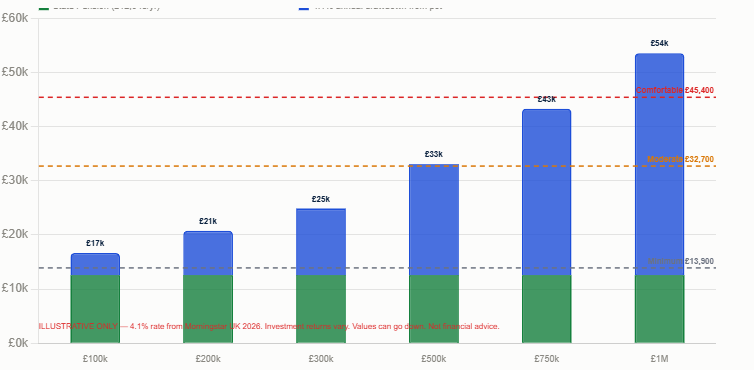
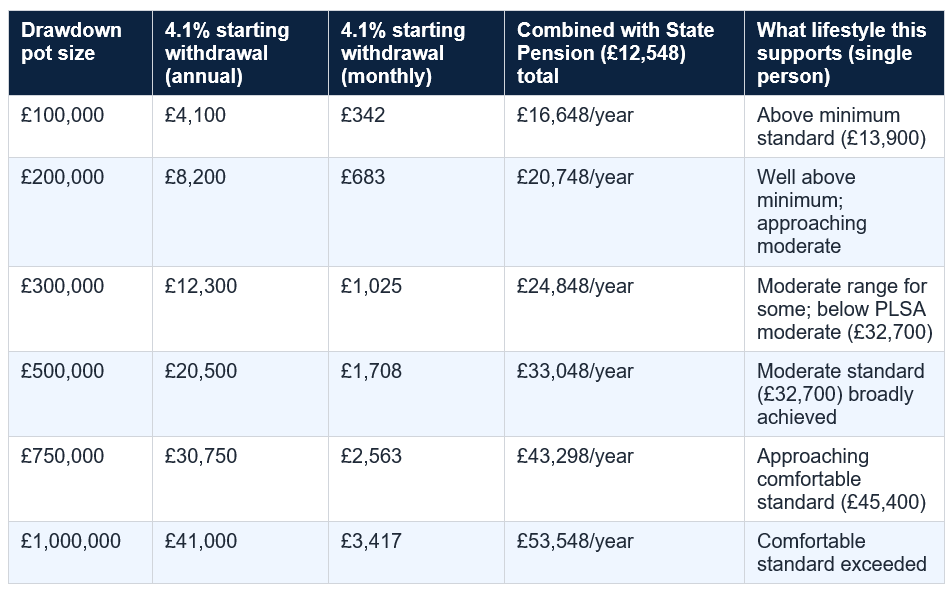
The 4.1% rule means that on a £300,000 drawdown pot, the starting annual withdrawal is approximately £12,300. On a £500,000 pot, it is £20,500. This figure is then increased each year in line with inflation to maintain purchasing power. The 30-year horizon reflects planning for a retirement beginning at 65 and running to 95 — a reasonable planning horizon given increasing longevity in the UK.
The Morningstar report notes that flexible withdrawal strategies — reducing withdrawals in years when markets fall and increasing them in years of strong growth — can increase sustainable income above the 4.1% base case. The trade-off is that income becomes less predictable from year to year. For retirees with a secure guaranteed income floor (State Pension plus annuity) that covers essential costs, the flexibility to vary drawdown withdrawals is a real advantage rather than an inconvenience.
It is important to note that the 4.1% figure applies to the drawdown element of the portfolio only, not to the whole pot if part of it has been used to buy an annuity. A retiree who uses £150,000 to buy an annuity and retains £150,000 in drawdown applies the 4.1% rule only to the £150,000 drawdown portion, producing approximately £6,150 per year in additional flexible income, on top of the guaranteed annuity and State Pension income.
The process is straightforward: list every income source, the gross amount, the tax treatment, and the net (after-tax) monthly figure. Then total the net monthly income and compare it against your target monthly spend (derived from the PLSA standard or your personal budget calculation). If the total is below the target, you know exactly how large the gap is and which additional income sources or pot adjustments could close it.
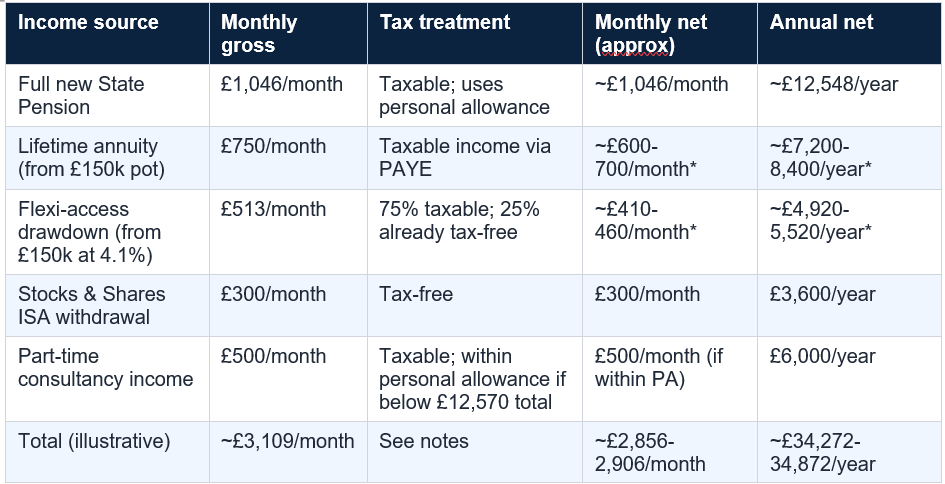
*Tax on annuity and drawdown income depends on total taxable income in the year. The personal allowance (£12,570) largely covers State Pension, leaving remaining income taxed at 20% basic rate for most retirees. This example is illustrative only and does not account for individual circumstances. The total net income of approximately £34,000-£35,000/year places this example in the moderate-to-comfortable range (PLSA moderate: £32,700). Not financial advice. Consult a qualified IFA or MoneyHelper for a calculation specific to your situation.
The uncomfortable implication is that the majority of UK workers will reach retirement with an income gap they did not plan for. The solution is not to despair but to plan: to understand the gap early, to increase contributions if there is any capacity to do so, to maximise employer matching (which is among the highest guaranteed returns available), to fill NI gaps for State Pension, and to build supplementary income sources through ISAs, property, and potentially part-time retirement work.
The most powerful lever available is time. A 45-year-old who increases their pension contribution by £200 per month has 22 years of compound investment growth before retirement. At 5% annual growth, that additional £200 per month produces approximately £104,000 in additional pension savings by age 67. The cost of inaction is not simply £200 per month — it is £104,000 in future retirement income capacity. Not financial advice — always consult a qualified IFA.
Priority action list for retirement salary planning: (1) Check your State Pension forecast at gov.uk/check-state-pension; buy NI credits to fill gaps if cost-effective. (2) Locate all pension pots, including old employer schemes (Pension Tracing Service: 0800 731 0193 or gov.uk/find-pension-contact-details). (3) Calculate your income gap using the PLSA standards or your own lifestyle cost estimate. (4) Maximise employer pension matching if you are not already doing so. (5) Build ISA savings alongside pension for tax-free retirement income. (6) Book a Pension Wise appointment (free, MoneyHelper: 0800 138 3944) as you approach retirement. (7) Consult a qualified IFA for a personalised retirement income plan. Not financial advice.
The building blocks of a retirement salary are knowable and plannable: the State Pension (£12,548 in 2026/27), which provides the foundation; the pension pot, which can be drawn flexibly or converted to a guaranteed annuity or blended between the two; ISA savings, which provide tax-free income on top; part-time work, property, defined benefit pensions, and savings interest, which can supplement as needed. The PLSA Retirement Living Standards give a clear target: £45,400 for a comfortable single retirement, £62,700 for a comfortable couple. The Morningstar 4.1% safe withdrawal rate gives a clear draw-down framework. The tools exist; the missing element for most people is the plan.
Not financial, investment, tax, or pension advice. Always consult a qualified independent financial adviser (IFA) regulated by the FCA. Free regulated guidance from Pension Wise (MoneyHelper): moneyhelper.org.uk or 0800 138 3944.
The Pensions and Lifetime Savings Association (PLSA) / Pensions UK Retirement Living Standards 2026 define a comfortable retirement income as £45,400 per year after tax for a single person, and £62,700 per year after tax for a couple. This includes regular treats, theatre trips, several breaks a year, and the ability to replace a car every five years. It excludes housing costs — if you are still paying rent or a mortgage, you will need more. The moderate standard is £32,700 (single) or £45,400 (couple). The minimum is £13,900 (single) or £22,500 (couple). The full new State Pension in 2026/27 provides £12,548 per year, leaving a gap of approximately £32,852 per year for a single person targeting the comfortable standard. Only 9% of working-age people are currently on track for a comfortable retirement (Money to the Masses, June 2026). Source: PLSA/Pensions UK 2026; Interactive Investor; Money to the Masses June 5, 2026. Not financial advice.
What is the State Pension in 2026?
The full new State Pension in 2026/27 is £241.30 per week, equating to approximately £12,548 per year. This follows a 4.8% increase in April 2026 under the triple lock guarantee. To receive the full amount, you generally need approximately 35 qualifying years of National Insurance contributions or credits. The State Pension age rose to 67 from April 2026. You can check your State Pension forecast and NI record at gov.uk/check-state-pension. Voluntary NI contributions to fill gaps cost approximately £824 per gap year and add approximately £280 per year to the State Pension for life — one of the highest-return investments available. Sources: Compare Drawdown; Interactive Investor; SJP. Not financial advice.
What is the safe withdrawal rate from a pension in the UK?
Morningstar's 'The State of Retirement Income UK 2026' report, using forward-looking market assumptions and Monte Carlo modelling, found that a 4.1% starting withdrawal rate remains a strong base case for UK retirees seeking stable, inflation-adjusted income over a 30-year retirement. This means that on a £300,000 drawdown pot, the starting annual withdrawal is approximately £12,300, increased in line with inflation each year. Flexible withdrawal strategies — reducing withdrawals in years when markets fall and increasing them in good years — can increase sustainable income above the 4.1% base case, at the cost of less predictable annual income. The 4.1% applies to the drawdown portion only, not to any pot used to purchase an annuity. Not financial advice.
Should I choose drawdown or an annuity in 2026?
Both have distinct advantages, and the evidence from Standard Life's analysis (January 2025) supports a combined strategy: for a saver with £150,000 at age 65, a combined phased annuity plus drawdown strategy produced £259,115 in total income by age 90, outperforming both level annuity only (£253,775) and inflation-linked annuity only (£255,706). Annuity rates in 2026 are rising over 7% (PensionBee; BNY Investments), making annuities more attractive than they have been in years. A practical blend: use a portion of the pot to buy a lifetime annuity covering essential monthly costs (food, bills, housing), and keep the rest in flexi-access drawdown for flexible income. PensionBee notes that annuity rates vary by over 15% between providers, so shopping around on the open market is essential. Sources: PensionBee; Standard Life/Professional Paraplanner January 2025; BNY Investments May 2026. Not financial advice. Consult a qualified IFA.
How much pension pot do I need to retire in the UK in 2026?
It depends on your lifestyle target, whether you are single or in a couple, and what other income sources you have. Using PLSA 2026 figures and annuity rates of £5,000–£7,500 per £100,000 of savings (Interactive Investor; Pensions UK 2026): Single person comfortable retirement (£45,400/year): estimated DC pot £560,000–£845,000 (after allowing for State Pension of £12,548). Single person moderate (£32,700/year): pot £335,000–£505,000. Single person minimum (£13,900/year): pot £23,000–£34,000. Couple comfortable (£62,700/year total): per person pot £315,000–£470,000. Couple moderate (£45,400/year total): per person pot £170,000–£255,000. These figures assume annuity purchase; drawdown can produce higher income in good years but with investment risk. Not financial advice. Free guidance: MoneyHelper 0800 138 3944.
Table of Contents
- The Retirement Salary Problem: Why a Pension Pot Is Not Enough
- Step One: Know Your Target — The PLSA Retirement Living Standards 2026
- Step Two: Start With What the State Gives You
- Step Three: Calculate Your Personal Income Gap
- Step Four: The Four Ways to Turn a Pension Pot Into Income
- Flexi-Access Drawdown: The Flexible Income Layer
- Annuities in 2026: Why Rates Have Improved
- The Blended Strategy: Securing Essentials, Flexing the Rest
- The 4.1% Rule: How Much Can You Safely Withdraw?
- Step Five: Add Your Other Income Sources
- Step Six: Build Your Monthly Budget — The Retirement Payslip
- Managing Tax in Retirement: Keep More of What You Earn
- The 91% Problem: Why Most People Need to Act Now
- Conclusion: A Retirement Salary Is Built, Not Received
- Frequently Asked Questions
Income target vs State Pension — the gap to fill
Pot size needed — by lifestyle standard
The 4.1% rule — what different pot sizes produce
The Retirement Salary Problem: Why a Pension Pot Is Not Enough
For most of a working life, income arrives automatically. Your employer pays a salary into your bank account each month, and you build a life around it. Retirement removes that automatic mechanism and replaces it with a question: how do you turn an accumulated pot of savings into a reliable monthly income that arrives in your account, pays your bills, funds your hobbies, and lasts as long as you do?This is the retirement salary problem. A pension pot is not income. It is a reservoir of accumulated savings that will produce income only if you have a plan to draw from it deliberately, tax-efficiently, and sustainably. Most people spend decades focusing on accumulation — how much to save, which fund to choose, whether to increase contributions — and spend very little time thinking about distribution. The result is that many arrive at retirement with a pot of money and no clear strategy for turning it into a salary.
The 2026 data from the Pensions and Lifetime Savings Association makes the problem concrete: only 9% of working-age people are currently on track for a comfortable retirement, defined by the PLSA as £45,400 per year after tax for a single person. The full State Pension provides £12,548 per year in 2026/27. The gap of approximately £32,852 per year between a comfortable retirement income and the State Pension has to come from private savings, ISAs, annuities, drawdown, part-time work, or other income sources. This guide shows you how to build a plan that fills it.
PLSA Retirement Living Standards 2026 (updated June 2026, Pensions UK): Comfortable retirement income: £45,400/year single; £62,700/year couple. Moderate: £32,700/year single; £45,400/year couple. Minimum: £13,900/year single; £22,500/year couple. Only 9% of working-age people are on track for a comfortable retirement (Money to the Masses, June 2026). Full new State Pension 2026/27: £12,548/year (after 4.8% April 2026 triple lock increase). Safe withdrawal rate: 4.1% starting rate for UK retirees over 30 years (Morningstar 'The State of Retirement Income UK 2026'). Annuity rates rising over 7% in 2026 (PensionBee). Not financial advice.
Step One: Know Your Target — The PLSA Retirement Living Standards 2026
The Pensions and Lifetime Savings Association’s Retirement Living Standards are the most widely used national benchmark for retirement income planning in the UK. Updated annually by PLSA (rebranded as Pensions UK), the 2026 figures reflect current household costs including food, essential bills, transport, and social activities. Money to the Masses (5 June 2026) reported the latest update, noting that both moderate and comfortable standards have risen significantly.The minimum standard of £13,900 per year for a single person covers all basic needs with a small surplus for modest enjoyment: a UK self-catering holiday, eating out once a month, affordable leisure activities. It assumes no car. The moderate standard of £32,700 adds financial security and flexibility — a car, more spending on food and groceries, a foreign holiday, and eating out a few times a month. The comfortable standard of £45,400 includes regular treats, theatre trips, several breaks a year, and the ability to replace a car every five years.
These figures apply to people living in their own home without a mortgage or rent payment. If you are still paying a mortgage in retirement or living in rented accommodation, you will need more income than these figures suggest. Housing costs are explicitly stripped out of the PLSA benchmarks.
The couple figures (£22,500 minimum, £45,400 moderate, £62,700 comfortable) represent the total for both partners. The economies of scale in a couple’s household mean that two people sharing costs need less than twice what a single person needs. This is one reason each partner in a couple typically needs a smaller pension pot than a single person targeting the same lifestyle standard.
Step Two: Start With What the State Gives You
Before you plan what your pension needs to provide, subtract what the State will provide. The full new State Pension in 2026/27 is £241.30 per week, equating to approximately £12,548 per year. This followed a 4.8% increase in April 2026 under the triple lock, which guarantees the State Pension rises each year by whichever is highest among wage growth, CPI inflation, and 2.5%. The State Pension is taxable income, but because it is received gross (before tax), it uses most or all of the personal allowance (£12,570 in 2026/27) before any tax is due. For most retirees, the State Pension itself generates no income tax liability.To receive the full State Pension, you generally need approximately 35 qualifying years of National Insurance contributions or credits. If you have gaps in your NI record — perhaps due to career breaks, time abroad, or self-employment periods when you did not pay Class 2 NI — you may be able to buy voluntary NI credits to top up your record. This is one of the highest-return investments available: a gap year of NI costs approximately £824 (Class 3 voluntary contributions at 2026 rates) and provides approximately £280 per year in additional State Pension for life. That pays back in approximately three years.
The State Pension age rose to 67 from April 2026. If you retire before 67, you will need to fund your entire income from private sources until the State Pension kicks in. This is the ‘bridge’ period, and its cost is often underestimated: funding an additional £12,548 per year for three years (retiring at 64) costs approximately £37,644 in additional pension pot. Many people do not account for this in their retirement planning.
State Pension 2026/27: £241.30/week = £12,548/year. Requires approximately 35 qualifying NI years. State Pension age: 67 from April 2026. Triple lock guarantee: rises annually by highest of earnings growth, CPI, or 2.5%. Buy voluntary NI credits at ~£824/year to fill gaps (each gap year adds ~£280/year to State Pension for life). Check your State Pension forecast at gov.uk/check-state-pension. Sources: Compare Drawdown; Interactive Investor; SJP. Not financial advice.
Step Three: Calculate Your Personal Income Gap
Once you know your target income (from the PLSA standards, or your own calculation of what your lifestyle costs) and you know what the State Pension will provide, the gap is simple arithmetic. This gap is what your private pension, ISAs, investments, and other income sources need to fill.Example: Income gap calculation (single person targeting comfortable retirement in 2026): Target income: £45,400 after tax (PLSA comfortable standard). State Pension: approximately £12,548 after tax (gross received; sits mostly within personal allowance). Income gap to fill from private sources: £45,400 - £12,548 = £32,852 per year. Monthly equivalent: £2,738 per month. Pot size required (based on annuity rates £5,000-£7,500 per £100,000): £560,000-£845,000 (Interactive Investor; Pensions UK 2026). Note: if part of the gap is filled by ISA income, other pensions, part-time work, or rental income, the required pension pot falls accordingly. Not financial advice.
The interactive investor / Pensions UK 2026 table provides specific pot size estimates for each living standard, based on annuity rates of £5,000–£7,500 per £100,000 of savings. These are benchmark figures for planning purposes; drawdown can offer higher income in good years but carries investment risk, while annuities provide certainty at a fixed rate. The right approach depends on your risk tolerance, health, other income sources, and whether you have dependants.
For couples, the income gap per person is significantly smaller because the PLSA couple figures are total not per-person, and because two full State Pensions together provide approximately £25,096 per year — already covering the moderate standard for a couple (£45,400 - £25,096 = £20,304 gap) and well above the minimum standard. A couple with two full State Pensions targeting a moderate retirement needs to find approximately £10,152 per person per year from private savings — a much more achievable target than a single person’s £32,852 gap.
Step Four: The Four Ways to Turn a Pension Pot Into Income
Once you know the gap you need to fill, the next question is how. There are four primary mechanisms for converting a defined contribution pension pot into retirement income, and they are not mutually exclusive. Understanding the characteristics of each allows you to combine them to produce an income that is both reliable and flexible.- Flexi-access drawdown: keep the pension invested while withdrawing an income as needed. Maximum flexibility; maintains investment growth potential; income can vary year by year. Risk: running out of money if withdrawals are too high or investment returns disappoint. Increasingly popular, particularly for people with larger pots and other income sources.
- Lifetime annuity: exchange a lump sum for a guaranteed income for life, regardless of how long you live. Eliminates longevity risk — you cannot outlive the income. Rates have improved significantly in 2026 (rising over 7%). Less flexible; once purchased, cannot usually be reversed.
- Fixed-term annuity: provides guaranteed income for a fixed period (typically 5–30 years) with a maturity value returned at the end. Useful as a bridge (e.g., from retirement to State Pension age) or as part of a phased strategy.
- Uncrystallised Fund Pension Lump Sums (UFPLS): take lump sums from the pension pot at any time, with 25% of each withdrawal tax-free and 75% taxed as income. Useful for one-off expenditure needs or as an alternative to full crystallisation.
Flexi-Access Drawdown: The Flexible Income Layer
Flexi-access drawdown has become the most popular retirement income mechanism in the UK. It allows you to keep your pension invested while drawing a regular income from it — the WeCovr team describes it as ‘managing a reservoir yourself: you decide how much water to take and when, leaving the rest invested.’ From age 55 (rising to 57 in April 2028), you can usually take up to 25% of your pension pot as tax-free cash, leaving the remaining 75% invested in drawdown. You then decide how much income to take from the 75%, and when.The flexibility of drawdown is its defining advantage. You can take £2,000 one month and nothing the next. You can increase withdrawals in years when you need more — perhaps for a holiday or home repair — and reduce them when you need less. You can leave the pot invested in growth assets in your early retirement years when you have other income, and then draw it down more aggressively in later years. And if you die with money left in the pot, it passes to your nominated beneficiaries — though from April 2027, unused pension pots will be subject to inheritance tax.
The risk of drawdown is sequencing risk: the danger that poor investment returns in the early years of retirement, combined with regular withdrawals, can deplete a portfolio faster than good long-term average returns would suggest. A pension that falls 20% in its first retirement year, while simultaneously paying out 5% annual income, starts from a significantly lower base for any subsequent recovery. This is why many advisers recommend maintaining 1–2 years of income in cash or low-risk assets within a drawdown portfolio, to avoid being forced to sell investments at the worst time.
Drawdown cash buffer strategy: keep 12–24 months of planned withdrawals in cash or a money market fund within your drawdown portfolio. This means you never need to sell investments during a market downturn to fund your income — you draw from the cash buffer, which is then refilled from the invested portion when markets recover. This simple structure reduces sequencing risk without significantly reducing long-term returns. Not financial advice. Consult a qualified IFA.
Annuities in 2026: Why Rates Have Improved
Annuities fell dramatically out of fashion after pension freedoms legislation was introduced in 2015, which allowed retirees to keep their pension invested rather than being effectively compelled to buy an annuity. But the higher interest rate environment of 2023–2026 has substantially improved annuity rates, and 2026 is seeing some of the most competitive annuity pricing in over a decade. PensionBee notes that annuity rates are rising over 7% in 2026 — meaning better value for money for those converting pension pots to guaranteed income.The current annuity market provides approximately £5,000–£7,500 of annual income per £100,000 of pension savings (Interactive Investor; Pensions UK 2026). The wide range reflects the significant variation between providers — PensionBee notes that annuity rates can vary by over 15% between providers. Over a 20–30 year retirement, a 15% difference in annuity rate translates to thousands of pounds in additional income. Shopping around is not optional; it is essential.
Several factors affect the annuity rate offered to any individual: age (older buyers get better rates because the payments are spread over fewer years); health and lifestyle (enhanced or impaired-life annuities pay more to people with health conditions that may reduce life expectancy); the size of the pension pot (larger pots often get better rates); and the type of annuity chosen. A level annuity pays the same amount every year regardless of inflation — it will feel significantly smaller in real terms after 20 years. An inflation-linked annuity starts lower but maintains purchasing power. A joint-life annuity continues to pay to a surviving partner after death.
The BNY Investments Retirement Guide (May 2026) confirms the key factors: pot size, age, and health all determine the annuity income offered. Enhanced annuities are available for people with serious medical conditions that could potentially limit lifespan — in some cases these pay 20–40% more than standard rates, so declaring health conditions honestly is financially significant.
Never accept the annuity rate offered by your existing pension provider without comparing the open market. Your pension provider is legally required to tell you that you have the right to buy an annuity on the open market (the 'open market option'). Using a whole-of-market annuity broker or comparison service can add thousands of pounds of lifetime income. The difference in rates between providers can exceed 15% (PensionBee 2026). Sources: PensionBee; BNY Investments Retirement Guide May 2026. Not financial advice.
The Blended Strategy: Securing Essentials, Flexing the Rest
The most commonly recommended retirement income strategy in 2026 is a blend of annuity and drawdown, and the research supports it. Standard Life’s analysis (published January 2025) compared three approaches for a retiree starting with £150,000 at age 65 over a 25-year period to age 90: level annuity only (£253,775 total income by age 90), inflation-linked annuity only (£255,706), and a combined phased annuity plus drawdown strategy (£259,115). For the second consecutive year in the analysis, the combined strategy produced the highest overall income.The logic behind blending is straightforward. An annuity provides a guaranteed income floor that covers essential expenses — you know these bills will always be paid regardless of what markets do or how long you live. Drawdown provides the flexible layer above the floor — income you can adjust based on needs, goals, and market conditions. Each compensates for the other’s weakness: the annuity eliminates longevity risk but sacrifices flexibility; the drawdown provides flexibility but exposes you to investment and longevity risk.
Compare Drawdown describes a practical blending example for Sarah (2026/2027 tax year): a £300,000 pension pot, essential monthly expenses of £1,000 (£12,000 per year). She takes her 25% PCLS (£75,000 tax-free), leaving £225,000. She uses £150,000 to purchase a lifetime annuity providing £12,000 per year to cover essential costs. The remaining £75,000 goes into flexi-access drawdown for flexible income, discretionary spending, and as a legacy or care cost reserve. This structure ensures the heating bill is always covered regardless of markets or longevity, while maintaining flexibility for everything else.
Example: The blended strategy in practice (2026/27): State Pension: £12,548/year (guaranteed, inflation-linked, from age 67). Annuity (purchased with £150,000): approximately £7,500-£11,250/year (at current rates of £5,000-£7,500 per £100,000). Total guaranteed income: approximately £20,000-£23,798/year. Drawdown (from remaining £150,000+): £6,000-£10,000/year (depending on investment growth and desired withdrawal rate). Total retirement salary: approximately £26,000-£33,798/year. This produces an income in the moderate-to-comfortable range. ISA savings, part-time income, or a partner's income can top this up further. Figures illustrative only. Not financial advice.
The 4.1% Rule: How Much Can You Safely Withdraw?
For people using drawdown as their primary income mechanism, the central question is: what percentage of the pot can be withdrawn each year without running out of money? Morningstar’s ‘State of Retirement Income UK 2026’ report provides the most up-to-date evidence: a 4.1% starting withdrawal rate remains a strong base case for UK retirees seeking stable, inflation-adjusted income over 30 years, derived from forward-looking market assumptions and rigorous Monte Carlo modelling.The 4.1% rule means that on a £300,000 drawdown pot, the starting annual withdrawal is approximately £12,300. On a £500,000 pot, it is £20,500. This figure is then increased each year in line with inflation to maintain purchasing power. The 30-year horizon reflects planning for a retirement beginning at 65 and running to 95 — a reasonable planning horizon given increasing longevity in the UK.
The Morningstar report notes that flexible withdrawal strategies — reducing withdrawals in years when markets fall and increasing them in years of strong growth — can increase sustainable income above the 4.1% base case. The trade-off is that income becomes less predictable from year to year. For retirees with a secure guaranteed income floor (State Pension plus annuity) that covers essential costs, the flexibility to vary drawdown withdrawals is a real advantage rather than an inconvenience.
It is important to note that the 4.1% figure applies to the drawdown element of the portfolio only, not to the whole pot if part of it has been used to buy an annuity. A retiree who uses £150,000 to buy an annuity and retains £150,000 in drawdown applies the 4.1% rule only to the £150,000 drawdown portion, producing approximately £6,150 per year in additional flexible income, on top of the guaranteed annuity and State Pension income.
10. Step Five: Add Your Other Income Sources
A retirement salary is rarely built from pension income alone. The most financially resilient retirement incomes combine multiple sources, each with different tax treatment, risk profiles, and timing characteristics.- ISA savings: withdrawals from a Stocks and Shares ISA or Cash ISA are entirely free of income tax and capital gains tax. They do not appear on a tax return and do not count as income for the purposes of age-related tax calculations or benefit entitlements. For most people, maximising ISA contributions before retirement and then drawing from ISA savings tax-free in retirement is the most efficient way to supplement pension income. The annual ISA allowance is £20,000 (£12,000 cash ISA for under-65s from 2027-28; check current rules at gov.uk).
- Part-time work or consultancy: many people in their 60s choose to reduce rather than eliminate work income. Even £8,000-£12,000 per year of part-time income can make a significant difference to retirement finances, potentially bridging the gap between early retirement and State Pension age, and reducing the rate at which the pension pot is drawn down. The personal allowance (£12,570 in 2026/27) means the first £12,570 of combined income is tax-free.
- Defined benefit (final salary) pension: if you have a defined benefit pension from a former employer, this provides a guaranteed, typically inflation-linked income that begins at the scheme’s defined retirement age (often 60 or 65). The income is taxed as earned income but represents the most secure private income source available. Checking your deferred DB pension entitlement is essential if you have worked for public sector or large employers.
- Rental income: property income contributes to many retirees’ total salary. It is subject to income tax at the marginal rate. From 2026/27, landlords can deduct a 20% tax credit on mortgage interest (Section 24). Rental income also affects benefit entitlements and IRMAA-equivalent calculations if applicable. Selling a buy-to-let property to fund retirement can release capital but triggers capital gains tax.
- Savings interest: the Personal Savings Allowance allows basic-rate taxpayers to earn £1,000 of savings interest tax-free and higher-rate taxpayers £500. In 2026 with savings rates at 4–5% AER, even a modest cash pot of £20,000-£25,000 can generate the full basic-rate allowance tax-free. Cash savings are also a useful income buffer for drawdown portfolios.
- State benefits: Pension Credit tops up income for those on the State Pension whose total income falls below £11,500 (single) or £17,500 (couple) approximately. Check eligibility at gov.uk/pension-credit. Other potential benefits include Housing Benefit, Council Tax Reduction, and the Winter Fuel Payment (check current eligibility, as payment rules have changed).
Step Six: Build Your Monthly Budget — The Retirement Payslip
The final step in creating a retirement salary is assembling all your income sources into a monthly budget that tells you, clearly and concretely, what arrives in your bank account each month and what you can spend. This is the retirement payslip.The process is straightforward: list every income source, the gross amount, the tax treatment, and the net (after-tax) monthly figure. Then total the net monthly income and compare it against your target monthly spend (derived from the PLSA standard or your personal budget calculation). If the total is below the target, you know exactly how large the gap is and which additional income sources or pot adjustments could close it.
*Tax on annuity and drawdown income depends on total taxable income in the year. The personal allowance (£12,570) largely covers State Pension, leaving remaining income taxed at 20% basic rate for most retirees. This example is illustrative only and does not account for individual circumstances. The total net income of approximately £34,000-£35,000/year places this example in the moderate-to-comfortable range (PLSA moderate: £32,700). Not financial advice. Consult a qualified IFA or MoneyHelper for a calculation specific to your situation.
Managing Tax in Retirement: Keep More of What You Earn
Tax planning in retirement is not about avoidance; it is about ensuring income is drawn in the most efficient order and from the most efficient sources. For most retirees, this means a clear sequence: use tax-free allowances first, then basic-rate income, and avoid crossing into higher-rate territory where possible.- Use the personal allowance fully: the £12,570 personal allowance applies in retirement just as in working life. The State Pension (£12,548) uses almost all of it. Any additional taxable income above £12,570 is taxed at 20% (basic rate). Keep total taxable income below the higher-rate threshold (£50,270) where possible.
- Draw from ISAs before taxable accounts: ISA withdrawals do not count as income for any tax purpose. Drawing from ISAs keeps your taxable income lower and ensures the personal allowance and basic-rate band are not unnecessarily filled. If you have both ISA savings and a drawdown pot, ISA first is usually the more efficient order.
- Take the tax-free cash at the right time: the 25% pension commencement lump sum (PCLS) is tax-free. Taking it in a year when you have no other income generates zero tax. Taking it in the same year as a large pension withdrawal or property sale could result in the lump sum being partially wasted against an already-used personal allowance.
- Spread drawdown withdrawals across tax years: if you can time larger discretionary withdrawals (for a holiday, home renovation, or large purchase) to straddle a tax year boundary, you can use two years’ worth of remaining personal allowance and basic-rate band rather than one. This simple step can save hundreds of pounds in income tax on a single large withdrawal.
- Pension income versus ISA income order: pension income is taxable; ISA withdrawals are not. For a retiree with both, drawing more ISA income and less drawdown income in any given year reduces income tax. However, leaving all income in a pension until very late creates a larger taxable estate post-April 2027 (IHT on unused pension pots). The balance between ISA draw-down and pension draw-down depends on the April 2027 IHT change and individual estate planning objectives.
The 91% Problem: Why Most People Need to Act Now
The PLSA’s finding that only 9% of working-age people are on track for a comfortable retirement is not just a statistic. It describes the financial reality for the vast majority of people currently in work. The gap between the comfortable retirement standard (£45,400/year for a single person) and the State Pension (£12,548) is £32,852 per year. Filling that gap from a pension pot alone requires £560,000–£845,000 in DC savings. The average pension pot at retirement in the UK is significantly smaller than this for most people outside the defined benefit sector.The uncomfortable implication is that the majority of UK workers will reach retirement with an income gap they did not plan for. The solution is not to despair but to plan: to understand the gap early, to increase contributions if there is any capacity to do so, to maximise employer matching (which is among the highest guaranteed returns available), to fill NI gaps for State Pension, and to build supplementary income sources through ISAs, property, and potentially part-time retirement work.
The most powerful lever available is time. A 45-year-old who increases their pension contribution by £200 per month has 22 years of compound investment growth before retirement. At 5% annual growth, that additional £200 per month produces approximately £104,000 in additional pension savings by age 67. The cost of inaction is not simply £200 per month — it is £104,000 in future retirement income capacity. Not financial advice — always consult a qualified IFA.
Priority action list for retirement salary planning: (1) Check your State Pension forecast at gov.uk/check-state-pension; buy NI credits to fill gaps if cost-effective. (2) Locate all pension pots, including old employer schemes (Pension Tracing Service: 0800 731 0193 or gov.uk/find-pension-contact-details). (3) Calculate your income gap using the PLSA standards or your own lifestyle cost estimate. (4) Maximise employer pension matching if you are not already doing so. (5) Build ISA savings alongside pension for tax-free retirement income. (6) Book a Pension Wise appointment (free, MoneyHelper: 0800 138 3944) as you approach retirement. (7) Consult a qualified IFA for a personalised retirement income plan. Not financial advice.
Conclusion
Creating a retirement salary requires the same deliberate planning that building any income requires. The difference is that the consequences of poor planning become visible only in retirement, when the ability to course-correct is limited. The 9% statistic — the tiny fraction of working-age people currently on track for a comfortable retirement — reflects the cost of assuming that a pension pot will somehow take care of itself.The building blocks of a retirement salary are knowable and plannable: the State Pension (£12,548 in 2026/27), which provides the foundation; the pension pot, which can be drawn flexibly or converted to a guaranteed annuity or blended between the two; ISA savings, which provide tax-free income on top; part-time work, property, defined benefit pensions, and savings interest, which can supplement as needed. The PLSA Retirement Living Standards give a clear target: £45,400 for a comfortable single retirement, £62,700 for a comfortable couple. The Morningstar 4.1% safe withdrawal rate gives a clear draw-down framework. The tools exist; the missing element for most people is the plan.
Not financial, investment, tax, or pension advice. Always consult a qualified independent financial adviser (IFA) regulated by the FCA. Free regulated guidance from Pension Wise (MoneyHelper): moneyhelper.org.uk or 0800 138 3944.
Frequently Asked Questions
How much income do I need for a comfortable retirement in the UK in 2026?The Pensions and Lifetime Savings Association (PLSA) / Pensions UK Retirement Living Standards 2026 define a comfortable retirement income as £45,400 per year after tax for a single person, and £62,700 per year after tax for a couple. This includes regular treats, theatre trips, several breaks a year, and the ability to replace a car every five years. It excludes housing costs — if you are still paying rent or a mortgage, you will need more. The moderate standard is £32,700 (single) or £45,400 (couple). The minimum is £13,900 (single) or £22,500 (couple). The full new State Pension in 2026/27 provides £12,548 per year, leaving a gap of approximately £32,852 per year for a single person targeting the comfortable standard. Only 9% of working-age people are currently on track for a comfortable retirement (Money to the Masses, June 2026). Source: PLSA/Pensions UK 2026; Interactive Investor; Money to the Masses June 5, 2026. Not financial advice.
What is the State Pension in 2026?
The full new State Pension in 2026/27 is £241.30 per week, equating to approximately £12,548 per year. This follows a 4.8% increase in April 2026 under the triple lock guarantee. To receive the full amount, you generally need approximately 35 qualifying years of National Insurance contributions or credits. The State Pension age rose to 67 from April 2026. You can check your State Pension forecast and NI record at gov.uk/check-state-pension. Voluntary NI contributions to fill gaps cost approximately £824 per gap year and add approximately £280 per year to the State Pension for life — one of the highest-return investments available. Sources: Compare Drawdown; Interactive Investor; SJP. Not financial advice.
What is the safe withdrawal rate from a pension in the UK?
Morningstar's 'The State of Retirement Income UK 2026' report, using forward-looking market assumptions and Monte Carlo modelling, found that a 4.1% starting withdrawal rate remains a strong base case for UK retirees seeking stable, inflation-adjusted income over a 30-year retirement. This means that on a £300,000 drawdown pot, the starting annual withdrawal is approximately £12,300, increased in line with inflation each year. Flexible withdrawal strategies — reducing withdrawals in years when markets fall and increasing them in good years — can increase sustainable income above the 4.1% base case, at the cost of less predictable annual income. The 4.1% applies to the drawdown portion only, not to any pot used to purchase an annuity. Not financial advice.
Should I choose drawdown or an annuity in 2026?
Both have distinct advantages, and the evidence from Standard Life's analysis (January 2025) supports a combined strategy: for a saver with £150,000 at age 65, a combined phased annuity plus drawdown strategy produced £259,115 in total income by age 90, outperforming both level annuity only (£253,775) and inflation-linked annuity only (£255,706). Annuity rates in 2026 are rising over 7% (PensionBee; BNY Investments), making annuities more attractive than they have been in years. A practical blend: use a portion of the pot to buy a lifetime annuity covering essential monthly costs (food, bills, housing), and keep the rest in flexi-access drawdown for flexible income. PensionBee notes that annuity rates vary by over 15% between providers, so shopping around on the open market is essential. Sources: PensionBee; Standard Life/Professional Paraplanner January 2025; BNY Investments May 2026. Not financial advice. Consult a qualified IFA.
How much pension pot do I need to retire in the UK in 2026?
It depends on your lifestyle target, whether you are single or in a couple, and what other income sources you have. Using PLSA 2026 figures and annuity rates of £5,000–£7,500 per £100,000 of savings (Interactive Investor; Pensions UK 2026): Single person comfortable retirement (£45,400/year): estimated DC pot £560,000–£845,000 (after allowing for State Pension of £12,548). Single person moderate (£32,700/year): pot £335,000–£505,000. Single person minimum (£13,900/year): pot £23,000–£34,000. Couple comfortable (£62,700/year total): per person pot £315,000–£470,000. Couple moderate (£45,400/year total): per person pot £170,000–£255,000. These figures assume annuity purchase; drawdown can produce higher income in good years but with investment risk. Not financial advice. Free guidance: MoneyHelper 0800 138 3944.

0 Comments Comments