

Retirement
Should You Use Your Pension to Pay Off Your Mortgage?
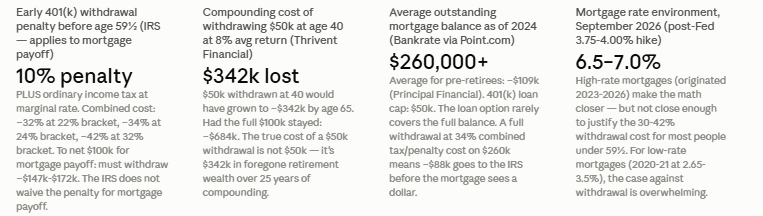
The average American mortgage borrower owed over $260,000 in 2024. The idea of wiping it out with retirement savings feels compelling. But a 401(k) withdrawal before age 59½ triggers a 10% penalty on top of income tax — meaning up to 34% or more of what you withdraw never reaches the mortgage. The compounding you lose can cost you hundreds of thousands of dollars in retirement. For most people, using retirement funds to pay off a mortgage is the most expensive way to become debt-free. This guide explains when it makes sense, when it does not, and what to do instead.
The desire to pay off a mortgage before retirement is one of the most universally shared financial goals in America. The monthly payment disappears. The interest stops accruing. The home is owned outright. And the psychological burden of carrying a six-figure debt into retirement — or through it — is lifted. When a 401(k) or IRA account balance is large enough to cover the remaining mortgage balance, the idea of simply paying it off becomes difficult to ignore.
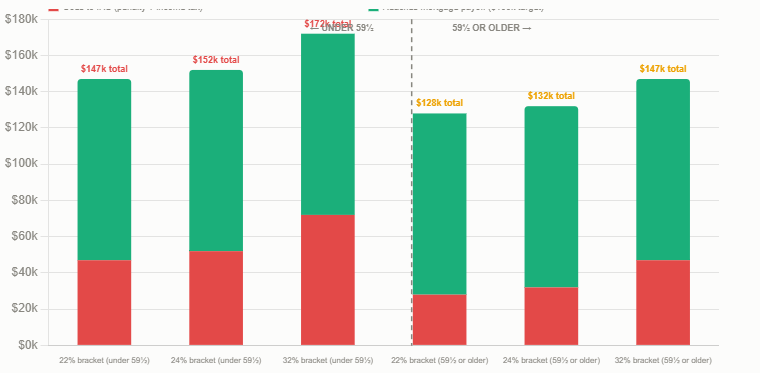
But the execution is almost always more expensive than it appears. The IRS places age-based restrictions on retirement account withdrawals that transform a straightforward-seeming transaction into a complicated tax event. For anyone under age 59½, a withdrawal from a traditional 401(k) or IRA triggers a 10% early withdrawal penalty on top of ordinary income tax — meaning a taxpayer in the 22% bracket loses 32 cents of every dollar withdrawn before it reaches the mortgage. In the 24% bracket, that becomes 34 cents. In the 32% bracket, 42 cents. Webull's June 2026 case study describes the extreme: a $300,000 withdrawal for someone under 59½ in the 22-24% bracket could result in $100,000 to $170,000 going directly to the IRS before a single dollar pays down the house.
Even for those past the early withdrawal penalty age, the income tax on the withdrawal remains — and a large withdrawal can push income into a higher bracket, trigger Social Security taxability, activate Medicare IRMAA surcharges, and eliminate the mortgage interest deduction in the same year. Point.com's analysis of the decision frames the compound problem: 'Retirement plan investments held in the stock market generally yield a 7% return each year, which can compound over time into big yields — likely higher than what you spend on your mortgage interest.' The money withdrawn does not just pay the mortgage. It permanently removes those dollars from decades of potential compounding growth.
Early withdrawal penalty: 10% of withdrawal amount before age 59½ (IRS). Average mortgage balance for pre-retirees: approximately $109,000 (Principal Financial). Average overall mortgage balance 2024: $260,000+ (Point.com citing Bankrate). Combined cost at 22% bracket + early withdrawal: approximately 32% of withdrawal. Combined cost at 24% bracket + early withdrawal: approximately 34%. On $100,000 withdrawn: only $66,000-$68,000 reaches the mortgage payoff. $50,000 withdrawn at age 40 forfeits approximately $342,000 in compounding by age 65 at 8% average (Thrivent Financial). 30-year mortgage rates September 2026: approximately 6.5-7.0%. Historical S&P 500 average long-term nominal return: approximately 10%; real return approximately 7%.
The exceptions to the early withdrawal penalty are narrow and specifically defined by the IRS. They include distributions made as part of a series of substantially equal periodic payments (SEPP/Rule 72(t)), distributions due to permanent disability, distributions to beneficiaries after the account holder's death, distributions for qualified higher education expenses (IRA only), distributions for first-time home purchases up to $10,000 (IRA only), and distributions to pay health insurance premiums while unemployed. Notably absent from this list: using the funds to pay off a mortgage. The IRS does not consider mortgage payoff a hardship distribution qualifying for penalty exemption. The 10% penalty applies regardless of the stated purpose.
SmartAsset's mortgage-and-401(k) analysis is direct on this point: 'If you're under the age of 59½, you'll face a 10% penalty for making a withdrawal from your 401(k) before retirement age... That applies no matter the intended purpose, even for a mortgage.' The implication: for anyone under 59½, the age barrier fundamentally changes the economics of the withdrawal. For those past 59½, the economics improve substantially — though the income tax on the withdrawal still remains and requires careful modelling.
The age 59½ threshold is not arbitrary — it represents the IRS's designation of when retirement funds may be accessed without the punitive penalty designed to discourage early depletion of retirement savings. For someone currently 55 and considering using retirement funds for a mortgage payoff, waiting four and a half years to cross the threshold eliminates a 10% levy on the entire withdrawal. On a $150,000 payoff, that is $15,000 in savings from waiting. The question is whether the mortgage interest during those four and a half years costs more than $15,000 — which at 6.5% on $150,000 is approximately $9,750 per year, or $43,875 over the period. The penalty savings are real but the interest cost of waiting is also real. Not financial advice — consult a CPA.
Example: Worked example: $100,000 withdrawal, age 55, married filing jointly. Existing income (salary, Social Security, other): $65,000. Mortgage balance to pay off: $100,000. Withdrawal amount: $100,000 (before taxes and penalty). 10% early withdrawal penalty: $10,000 (applied to full withdrawal). New AGI: $65,000 + $100,000 = $165,000. Tax at 22% on amount from $120,950 to $165,000 (MFJ 2026): $44,050 x 22% = $9,691. Tax at 12% on amount up to $120,950: varies; partial bracket. Total income tax on withdrawal approximately: $22,000 (simplified). Total IRS cost: $10,000 penalty + $22,000 income tax = $32,000. Net amount reaching mortgage payoff: approximately $68,000. RESULT: to pay off a $100,000 mortgage balance, you must withdraw approximately $147,000 from your 401(k) to receive $100,000 after taxes and penalty. The 'true' cost of a $100,000 mortgage payoff via 401(k) withdrawal is therefore approximately $147,000 in pre-tax retirement savings. This is a simplified illustration. Actual tax depends on specific income, filing status, deductions, and state tax. Not tax advice — consult a CPA.
After age 59½, the calculation improves because the 10% penalty is eliminated. A 62-year-old in the 22% marginal bracket who withdraws $100,000 from a traditional 401(k) pays approximately $22,000 in federal income tax, meaning approximately $78,000 reaches the mortgage payoff. To fully pay off a $100,000 balance, the withdrawal would need to be approximately $128,000 — significantly better than the under-59½ scenario but still meaning $28,000 disappears to taxes before any debt is eliminated.
The Roth IRA exception is important. Contributions to a Roth IRA can be withdrawn at any age without penalty or income tax, because they were made with after-tax dollars. If you have a Roth IRA, you can withdraw your contributions (not earnings) at any time without triggering the 10% penalty. Earnings in a Roth IRA are also tax-free after age 59½ when the 5-year rule has been met. This makes Roth IRA funds significantly less costly to use for mortgage payoff than traditional account funds — though the loss of tax-free compounding growth still applies.
The tax bracket cascade risk: a large withdrawal from a 401(k) or IRA to pay off a mortgage can simultaneously trigger multiple adverse tax events in the same year. These include: pushing income into a higher federal marginal tax bracket; making up to 85% of Social Security benefits taxable (the provisional income threshold is $44,000 for married filing jointly); triggering Medicare Part B and Part D IRMAA surcharges (which apply based on income from two years prior, so a 2026 large withdrawal affects 2028 Medicare premiums); and potentially eliminating eligibility for ACA marketplace health insurance subsidies. None of these are reflected in the simple 'penalty plus tax rate' calculation. Consult a CPA who can model the full tax impact across all of these dimensions before any large retirement withdrawal. Not tax advice.
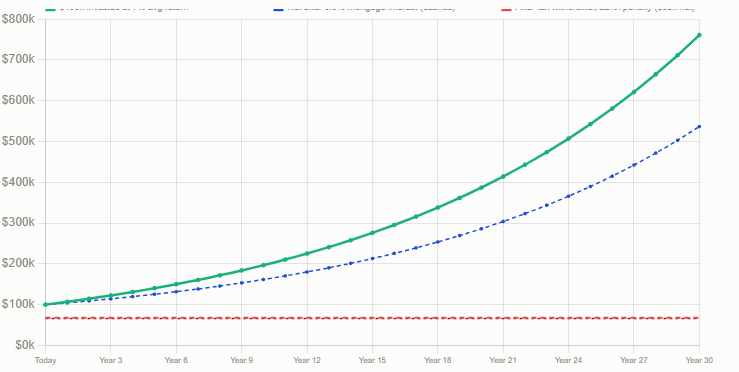
Thrivent Financial's retirement fund and debt analysis provides a clear illustration: if you have $100,000 in a retirement account at age 40 and withdraw $50,000 to pay off debt, the remaining $50,000 grows to approximately $342,000 by age 65 at an 8% average annual return. Had the full $100,000 remained invested, it would have grown to approximately $684,000 — a difference of approximately $342,000. The $50,000 withdrawal does not cost $50,000 in retirement wealth. It costs approximately $342,000 in compounded retirement wealth by the time it is most needed.
The magnitude of the compound cost depends on the time horizon and the return rate. The further from retirement the withdrawal is taken, and the higher the expected long-term investment return, the more severe the compounding loss. For someone in their late 50s with only a few years until planned retirement, the compounding loss is smaller because fewer years of growth are forfeited. For someone in their early 40s, the compounding loss can be six or seven times the amount actually withdrawn.
Point.com's 401(k) and mortgage analysis frames this directly: 'Retirement plan investments held in the stock market generally yield a 7% return each year, which can compound over time into big yields — likely higher than what you spend on your mortgage interest.' The comparison that matters is not the withdrawal amount versus the mortgage balance — it is the compound growth rate of the investment versus the after-tax cost of the mortgage interest. If the mortgage interest rate (net of any tax deduction benefit) is lower than the expected investment return, keeping the money invested and continuing to make mortgage payments generates more wealth than withdrawing to pay off the mortgage.
Mortgages originated during the 2020-2021 pandemic-era low-rate environment carry fixed rates of 2.65% to 3.50%. For a homeowner with one of these mortgages and a 401(k) earning a historical average of 7-10% annually, the financial case against withdrawal is overwhelming. The investment return exceeds the mortgage interest cost by 4-7 percentage points annually. The tax deduction benefit on the mortgage interest (for itemizers) makes the after-tax mortgage cost even lower. Keeping the money invested and continuing to pay the mortgage is dramatically better.
Mortgages originated in 2023-2026 carry rates of 6.5% to 7.5%, closer to the historical equity average. For homeowners at these rates, the comparison is less decisive. A 7% mortgage rate (after the mortgage interest deduction has been reduced or eliminated because the standard deduction exceeds itemised deductions for many households) is not dramatically below the historical equity average of 7-10%. The case against withdrawal is still strong because of the tax and penalty costs of the withdrawal itself — but the ongoing interest rate comparison is closer than it was with 3% mortgages.
Zacks' analysis of using a 401(k) to pay off a mortgage captures the September 2026 context: 'It is a question more homeowners are asking, especially in a high-interest-rate environment.' The September 16 Fed rate hike to 3.75%-4.00% has kept mortgage rates elevated, and for homeowners who purchased or refinanced in recent years at 6.5-7%, the desire to eliminate the higher-rate mortgage is more understandable — though the tax and compounding analysis still rarely favours withdrawal.
The mortgage rate threshold: as a rough framework used by many financial planners, if your mortgage interest rate is below 4-5% (after any deduction benefit), keeping retirement funds invested and paying the mortgage normally is almost certainly better. If your rate is above 6-7%, the math is closer — but the 10-32% tax/penalty cost on the withdrawal, combined with the loss of compounding, still usually tips the balance against withdrawal for those under 59½. For those over 59½ without the penalty, a high-rate mortgage becomes a more legitimate reason to consider withdrawal carefully with a CPA. Not financial advice.
Rocket Mortgage's 401(k)-to-mortgage payoff guide is direct: 'Using your 401(k) to pay off your mortgage is not generally the best way to pay off your mortgage early.' The combination of the early withdrawal penalty, the income tax, and the lost compounding almost always produces a worse outcome than simply continuing to make mortgage payments while keeping retirement funds invested.
The recommended path for this scenario: extra mortgage principal payments from current income (not from retirement accounts), if the goal is accelerating payoff. A $200 additional monthly principal payment on a $200,000 mortgage at 3.5% can reduce the loan term by approximately 4-5 years and save approximately $15,000-$20,000 in interest — without touching a single retirement dollar. Not financial advice.
Under 59½ and tempted? Do this calculation first: multiply your mortgage payoff balance by 1.45 (22% bracket) or 1.52 (24% bracket) or 1.71 (32% bracket). That is approximately the gross withdrawal needed to net the payoff amount after taxes and penalty. Then ask: is eliminating the mortgage worth permanently removing that gross amount from decades of compound growth? For most people in their 40s and early 50s, the answer is no. Not financial advice.
In the 24% bracket with a 10% penalty, a 34% total cost on the withdrawal means you need to withdraw $151,500 to net $100,000 for mortgage payoff. The guaranteed return from paying off a 7% mortgage on $100,000 is $7,000 per year in eliminated interest. The cost to achieve that guaranteed $7,000 annual saving is $51,500 in one-time taxes and penalties — approximately a 7.4-year break-even on the cost of the withdrawal. But during those 7.4 years, the $100,000 that could have remained invested at 7% would have grown to approximately $168,000. The withdrawal break-even is negative on net.
The recommended path for this scenario: exhaust all other options before touching retirement funds. A 401(k) loan (borrowing from yourself without triggering tax or penalty) may be available for part of the payoff. Accelerated principal payments from current income. Waiting until 59½ to eliminate the 10% penalty. For those with both a high-rate mortgage and real hardship, the Roth IRA contribution withdrawal (contributions only, any age, no tax or penalty) may provide some relief without the full cost.
Principal Financial's retirement and mortgage guide captures the key remaining consideration: 'If you're retired, any pre-tax money taken out of your 401(k) or IRA is treated as income, no matter how little or how much you withdraw. So, the more you need to withdraw, the greater your potential tax burden.' The income tax rate on the withdrawal depends on total income in the year, including the withdrawal itself. Large withdrawals can push income significantly higher, potentially triggering IRMAA, Social Security taxability, and higher marginal rates on income that would otherwise have been taxed at lower rates.
The most compelling case for withdrawal in this scenario: age 62-65, approaching retirement, carrying a 7%+ mortgage, already in a low-income year (early retirement with no Social Security yet, no RMDs yet, minimal other income) where a strategically timed withdrawal would be taxed at a low effective rate. Farther's 401(k) payoff guide notes the estate planning dimension: 'A clear title can help them focus on other aspects of your estate without added stress.' For those entering retirement, the psychological and practical simplicity of mortgage-free home ownership carries genuine value that purely financial comparisons do not fully capture.
Principal Financial's analysis of this scenario is instructive. The average person who carries mortgage debt into retirement owes approximately $109,000. In the context of a retirement account, this is potentially a manageable withdrawal — particularly if structured across two or more tax years to manage bracket exposure. A $55,000 withdrawal in year one and a $54,000 withdrawal in year two, carefully timed to keep total income below key thresholds (Social Security taxability, IRMAA tiers), can pay off a $109,000 mortgage with significantly lower tax cost than a single large withdrawal.
The cash flow improvement from eliminating the monthly mortgage payment is real and measurable. If the retirement mortgage payment is $1,500 per month, payoff immediately improves net retirement cash flow by $18,000 per year — which reduces the amount that must be drawn from the retirement account annually, potentially offsetting some of the compound growth loss. This is one of the few scenarios where a carefully structured retirement account withdrawal for mortgage payoff can be financially defensible — but it requires a CPA to model the multi-year tax and income implications.
The 401(k) loan parameters are established by the IRS: borrowers can take the lesser of $50,000 or 50% of their vested account balance. The repayment term is typically up to 5 years, though principal residence purchases may qualify for longer terms. The interest paid goes back to the borrower's own account — so effectively you are paying yourself the interest rather than a bank.
Rocket Mortgage's 401(k) payoff guide describes the trade-offs: 'You may lose the potential for investment gains on the money you borrowed, and you can also only borrow a certain amount for no more than five years. Your interest payments also aren't tax-deductible, and you may be charged loan processing and maintenance fees.' Point.com adds the critical employment risk: 'Given that the average mortgage borrower still owed over $260,000 in 2024, it's unlikely that many people will be able to use a 401(k) loan to pay off a mortgage' — because the $50,000 cap is far below most outstanding mortgage balances. And if you leave your employer while the loan is outstanding, it becomes due immediately or is treated as a taxable distribution
.
The exception — the scenario in which the withdrawal is at least defensible — is specific: past age 59½ (no penalty), in or near retirement with limited other income (lower effective tax rate on the withdrawal), carrying a high-rate mortgage (6.5%+) with a relatively small remaining balance, in a year where income is already low and the withdrawal can be structured to avoid bracket cascade and IRMAA triggers, and with the cash flow improvement from eliminating the monthly payment partially offsetting the portfolio impact. Even then, the decision requires careful multi-year tax modelling by a CPA, not a back-of-the-envelope calculation.
The far more common and far more affordable path to the goal of entering retirement without a mortgage: extra principal payments from current income; a plan to sell a larger home and purchase a smaller one at retirement; or directing required minimum distributions (which are mandatory and taxable regardless of use) toward mortgage acceleration from age 73 onward. None of these require paying a 30-42% tax on money that has been compounding for decades. Not financial or tax advice — the decision requires a qualified CPA and financial adviser who can model your specific situation.
In most cases, no — and for anyone under age 59½, almost certainly not. A withdrawal from a traditional 401(k) or IRA before age 59½ triggers a 10% early withdrawal penalty on the full amount, plus ordinary income tax at your marginal rate. In the 22% tax bracket, this means approximately 32% of the withdrawal goes to the IRS before a single dollar reaches the mortgage. On a $100,000 mortgage payoff, you would need to withdraw approximately $147,000 to net $100,000 after taxes and penalty. Additionally, the money withdrawn permanently leaves a tax-advantaged compounding environment. Fifty thousand dollars withdrawn at age 40 and growing at 8% average return would have become approximately $342,000 by age 65 — meaning the true cost of the withdrawal is not $50,000 but approximately $342,000 in retirement wealth (Thrivent Financial). The case improves after age 59½ when the 10% penalty is eliminated, but income tax on the withdrawal remains. For those in or near retirement with a high-rate mortgage and a low-income year, a carefully structured withdrawal — ideally spread across multiple years to manage bracket exposure — can be more defensible. Always consult a CPA before making this decision. Not tax or financial advice.
What is the tax penalty for using my 401(k) to pay off my mortgage?
If you are under age 59½, a withdrawal from a traditional 401(k) or IRA triggers a 10% early withdrawal penalty on the full amount withdrawn, plus ordinary income tax at your applicable marginal rate. The IRS does not consider mortgage payoff a qualifying hardship that waives the 10% penalty — it applies regardless of the intended use (IRS; SmartAsset; Principal Financial Group). If you are in the 22% federal marginal bracket and under 59½, the combined cost is approximately 32% of the withdrawal. If you are in the 24% bracket, approximately 34%. If you are in the 32% bracket, approximately 42%. Large withdrawals can also push income into higher brackets, trigger Social Security taxability (up to 85% of benefits taxable above certain income thresholds), activate Medicare IRMAA surcharges, and eliminate or reduce ACA marketplace subsidies. After age 59½, the 10% penalty disappears but ordinary income tax on the withdrawal remains. Roth IRA contributions (not earnings) can be withdrawn at any age without tax or penalty, because they were made with after-tax dollars. Not tax advice — consult a CPA for your specific situation.
Is it better to pay off my mortgage or keep money in my 401(k)?
For most people in most circumstances, keeping money in the 401(k) and continuing to pay the mortgage is the better financial outcome. The reasoning comes down to two comparisons: (1) Interest rate vs expected return: if your mortgage rate is 3-4% and your 401(k) earns a long-term average of 7-10%, the investment return significantly exceeds the mortgage interest cost, especially after the mortgage interest deduction. (2) Tax cost of withdrawal: even after age 59½ when there is no early withdrawal penalty, taking the money out of the 401(k) triggers income tax on the full withdrawal, meaning 12-35% of the money goes to taxes rather than the mortgage. The scenario where paying off the mortgage is more defensible: past age 59½, high-rate mortgage (6.5%+), low-income retirement year where the effective tax rate on the withdrawal is low, remaining mortgage balance is manageable in size, and the cash flow improvement from eliminating the monthly payment has meaningful retirement impact. Not financial or tax advice — consult a CPA and financial adviser.
What is a 401(k) loan and is it better than a withdrawal for paying off a mortgage?
A 401(k) loan allows you to borrow from your own retirement account — up to the lesser of $50,000 or 50% of your vested balance — without triggering the 10% early withdrawal penalty or immediate income tax. You repay the loan (with interest, which goes back into your own account) over a period of up to 5 years. Unlike a withdrawal, a 401(k) loan does not permanently remove funds from your retirement account. However, there are significant limitations: the $50,000 maximum rarely covers a full mortgage balance (the average outstanding mortgage balance in 2024 was over $260,000); the 5-year repayment period is inflexible; if you leave your employer while the loan is outstanding, the full balance typically becomes due within 60-90 days or is treated as a taxable distribution (and subject to the 10% penalty if under 59½); and you lose the investment growth on the borrowed amount during the repayment period (Rocket Mortgage; Point.com). For most people, the 401(k) loan can only cover a portion of a mortgage payoff, and the employment risk makes it precarious. It is more useful for a partial payoff or a bridge strategy than a full mortgage elimination. Not financial advice.
What are the best alternatives to using retirement savings for mortgage payoff?
The alternatives that achieve the goal of mortgage payoff without the tax cost of retirement account withdrawal include: (1) Extra monthly principal payments from current income — even $200-$300 extra per month materially reduces total interest and years remaining, and costs nothing in taxes or retirement wealth; (2) Biweekly payment strategy — switching to biweekly payments effectively makes 13 payments per year instead of 12, reducing the term by 3-5 years without additional cash outlay; (3) Downsizing — selling a larger home and purchasing a smaller property at retirement, using home equity to buy the replacement outright or with a small balance; (4) Waiting for RMDs at age 73 — required minimum distributions are mandatory and taxable regardless of use, so directing them toward mortgage principal acceleration adds no incremental tax cost; (5) Structuring the withdrawal across multiple tax years if truly necessary — taking the minimum needed each year to stay within optimal tax brackets, rather than one large withdrawal that triggers bracket cascade, IRMAA, and Social Security taxability simultaneously. Not financial or tax advice — consult a qualified CPA and financial adviser for a strategy specific to your situation.
Table of Contents
- The Appeal — and the Cost
- The Critical First Question: Are You Under Age 59½?
- The Tax and Penalty Math: What a Withdrawal Actually Costs
- The Compound Interest You Lose: The Hidden Cost Nobody Mentions
- The Mortgage Rate Variable: When the Math Gets Closer
- The Four Questions to Answer Before Deciding
- Scenario A: Under 59½ With a Low-Rate Mortgage
- Scenario B: Under 59½ With a High-Rate Mortgage
- Scenario C: Over 59½ — No Penalty, But Still Taxable
- Scenario D: Already Retired With Mortgage Debt
- The 401(k) Loan Alternative: Borrowing From Yourself
- Six Alternatives to Using Retirement Funds
- Side-by-Side Comparison: All Options at a Glance
- Conclusion: The Answer Is Almost Always No — Here Is the Exception
- Frequently Asked Questions
True cost of withdrawal: taxes + penalty by age and bracket
The compounding cost: what $100k grows to if left invested
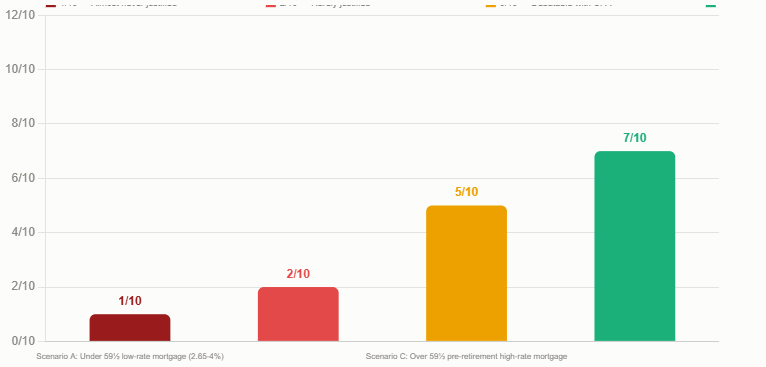
Scenario guide: when withdrawal is and isn't defensible
The Appeal — and the Cost
The desire to pay off a mortgage before retirement is one of the most universally shared financial goals in America. The monthly payment disappears. The interest stops accruing. The home is owned outright. And the psychological burden of carrying a six-figure debt into retirement — or through it — is lifted. When a 401(k) or IRA account balance is large enough to cover the remaining mortgage balance, the idea of simply paying it off becomes difficult to ignore.But the execution is almost always more expensive than it appears. The IRS places age-based restrictions on retirement account withdrawals that transform a straightforward-seeming transaction into a complicated tax event. For anyone under age 59½, a withdrawal from a traditional 401(k) or IRA triggers a 10% early withdrawal penalty on top of ordinary income tax — meaning a taxpayer in the 22% bracket loses 32 cents of every dollar withdrawn before it reaches the mortgage. In the 24% bracket, that becomes 34 cents. In the 32% bracket, 42 cents. Webull's June 2026 case study describes the extreme: a $300,000 withdrawal for someone under 59½ in the 22-24% bracket could result in $100,000 to $170,000 going directly to the IRS before a single dollar pays down the house.
Even for those past the early withdrawal penalty age, the income tax on the withdrawal remains — and a large withdrawal can push income into a higher bracket, trigger Social Security taxability, activate Medicare IRMAA surcharges, and eliminate the mortgage interest deduction in the same year. Point.com's analysis of the decision frames the compound problem: 'Retirement plan investments held in the stock market generally yield a 7% return each year, which can compound over time into big yields — likely higher than what you spend on your mortgage interest.' The money withdrawn does not just pay the mortgage. It permanently removes those dollars from decades of potential compounding growth.
Early withdrawal penalty: 10% of withdrawal amount before age 59½ (IRS). Average mortgage balance for pre-retirees: approximately $109,000 (Principal Financial). Average overall mortgage balance 2024: $260,000+ (Point.com citing Bankrate). Combined cost at 22% bracket + early withdrawal: approximately 32% of withdrawal. Combined cost at 24% bracket + early withdrawal: approximately 34%. On $100,000 withdrawn: only $66,000-$68,000 reaches the mortgage payoff. $50,000 withdrawn at age 40 forfeits approximately $342,000 in compounding by age 65 at 8% average (Thrivent Financial). 30-year mortgage rates September 2026: approximately 6.5-7.0%. Historical S&P 500 average long-term nominal return: approximately 10%; real return approximately 7%.
The Critical First Question: Are You Under Age 59½?
The most important variable in any retirement fund withdrawal decision is your age relative to 59½. The IRS uses this specific threshold because it marks the point at which retirement accounts can be accessed without the 10% early withdrawal penalty. Before that point, with very limited exceptions, every dollar withdrawn from a traditional 401(k) or IRA is subject to both ordinary income tax and the 10% penalty. After it, only ordinary income tax applies.The exceptions to the early withdrawal penalty are narrow and specifically defined by the IRS. They include distributions made as part of a series of substantially equal periodic payments (SEPP/Rule 72(t)), distributions due to permanent disability, distributions to beneficiaries after the account holder's death, distributions for qualified higher education expenses (IRA only), distributions for first-time home purchases up to $10,000 (IRA only), and distributions to pay health insurance premiums while unemployed. Notably absent from this list: using the funds to pay off a mortgage. The IRS does not consider mortgage payoff a hardship distribution qualifying for penalty exemption. The 10% penalty applies regardless of the stated purpose.
SmartAsset's mortgage-and-401(k) analysis is direct on this point: 'If you're under the age of 59½, you'll face a 10% penalty for making a withdrawal from your 401(k) before retirement age... That applies no matter the intended purpose, even for a mortgage.' The implication: for anyone under 59½, the age barrier fundamentally changes the economics of the withdrawal. For those past 59½, the economics improve substantially — though the income tax on the withdrawal still remains and requires careful modelling.
The age 59½ threshold is not arbitrary — it represents the IRS's designation of when retirement funds may be accessed without the punitive penalty designed to discourage early depletion of retirement savings. For someone currently 55 and considering using retirement funds for a mortgage payoff, waiting four and a half years to cross the threshold eliminates a 10% levy on the entire withdrawal. On a $150,000 payoff, that is $15,000 in savings from waiting. The question is whether the mortgage interest during those four and a half years costs more than $15,000 — which at 6.5% on $150,000 is approximately $9,750 per year, or $43,875 over the period. The penalty savings are real but the interest cost of waiting is also real. Not financial advice — consult a CPA.
The Tax and Penalty Math: What a Withdrawal Actually Costs
The tax cost of a traditional 401(k) or IRA withdrawal to pay off a mortgage is not a single number — it is the sum of the 10% early withdrawal penalty (if under 59½), plus the ordinary income tax on the full withdrawal amount at the marginal rate applicable to the added income. Because the withdrawal adds to adjusted gross income in the year it is taken, it is stacked on top of all other income — and can push a portion of the withdrawal into higher tax brackets than the baseline marginal rate might suggest.Example: Worked example: $100,000 withdrawal, age 55, married filing jointly. Existing income (salary, Social Security, other): $65,000. Mortgage balance to pay off: $100,000. Withdrawal amount: $100,000 (before taxes and penalty). 10% early withdrawal penalty: $10,000 (applied to full withdrawal). New AGI: $65,000 + $100,000 = $165,000. Tax at 22% on amount from $120,950 to $165,000 (MFJ 2026): $44,050 x 22% = $9,691. Tax at 12% on amount up to $120,950: varies; partial bracket. Total income tax on withdrawal approximately: $22,000 (simplified). Total IRS cost: $10,000 penalty + $22,000 income tax = $32,000. Net amount reaching mortgage payoff: approximately $68,000. RESULT: to pay off a $100,000 mortgage balance, you must withdraw approximately $147,000 from your 401(k) to receive $100,000 after taxes and penalty. The 'true' cost of a $100,000 mortgage payoff via 401(k) withdrawal is therefore approximately $147,000 in pre-tax retirement savings. This is a simplified illustration. Actual tax depends on specific income, filing status, deductions, and state tax. Not tax advice — consult a CPA.
After age 59½, the calculation improves because the 10% penalty is eliminated. A 62-year-old in the 22% marginal bracket who withdraws $100,000 from a traditional 401(k) pays approximately $22,000 in federal income tax, meaning approximately $78,000 reaches the mortgage payoff. To fully pay off a $100,000 balance, the withdrawal would need to be approximately $128,000 — significantly better than the under-59½ scenario but still meaning $28,000 disappears to taxes before any debt is eliminated.
The Roth IRA exception is important. Contributions to a Roth IRA can be withdrawn at any age without penalty or income tax, because they were made with after-tax dollars. If you have a Roth IRA, you can withdraw your contributions (not earnings) at any time without triggering the 10% penalty. Earnings in a Roth IRA are also tax-free after age 59½ when the 5-year rule has been met. This makes Roth IRA funds significantly less costly to use for mortgage payoff than traditional account funds — though the loss of tax-free compounding growth still applies.
The tax bracket cascade risk: a large withdrawal from a 401(k) or IRA to pay off a mortgage can simultaneously trigger multiple adverse tax events in the same year. These include: pushing income into a higher federal marginal tax bracket; making up to 85% of Social Security benefits taxable (the provisional income threshold is $44,000 for married filing jointly); triggering Medicare Part B and Part D IRMAA surcharges (which apply based on income from two years prior, so a 2026 large withdrawal affects 2028 Medicare premiums); and potentially eliminating eligibility for ACA marketplace health insurance subsidies. None of these are reflected in the simple 'penalty plus tax rate' calculation. Consult a CPA who can model the full tax impact across all of these dimensions before any large retirement withdrawal. Not tax advice.
The Compound Interest You Lose: The Hidden Cost Nobody Mentions
The tax and penalty calculation captures the immediate cost of withdrawing retirement funds for a mortgage payoff. The compound growth calculation captures the long-term cost — and it is typically far larger.Thrivent Financial's retirement fund and debt analysis provides a clear illustration: if you have $100,000 in a retirement account at age 40 and withdraw $50,000 to pay off debt, the remaining $50,000 grows to approximately $342,000 by age 65 at an 8% average annual return. Had the full $100,000 remained invested, it would have grown to approximately $684,000 — a difference of approximately $342,000. The $50,000 withdrawal does not cost $50,000 in retirement wealth. It costs approximately $342,000 in compounded retirement wealth by the time it is most needed.
The magnitude of the compound cost depends on the time horizon and the return rate. The further from retirement the withdrawal is taken, and the higher the expected long-term investment return, the more severe the compounding loss. For someone in their late 50s with only a few years until planned retirement, the compounding loss is smaller because fewer years of growth are forfeited. For someone in their early 40s, the compounding loss can be six or seven times the amount actually withdrawn.
Point.com's 401(k) and mortgage analysis frames this directly: 'Retirement plan investments held in the stock market generally yield a 7% return each year, which can compound over time into big yields — likely higher than what you spend on your mortgage interest.' The comparison that matters is not the withdrawal amount versus the mortgage balance — it is the compound growth rate of the investment versus the after-tax cost of the mortgage interest. If the mortgage interest rate (net of any tax deduction benefit) is lower than the expected investment return, keeping the money invested and continuing to make mortgage payments generates more wealth than withdrawing to pay off the mortgage.
The Mortgage Rate Variable: When the Math Gets Closer
The interest rate on your mortgage is the central variable that determines whether the comparison between keeping money invested and paying off the mortgage is decisive or close. The mathematics of this comparison have changed substantially over the past five years.Mortgages originated during the 2020-2021 pandemic-era low-rate environment carry fixed rates of 2.65% to 3.50%. For a homeowner with one of these mortgages and a 401(k) earning a historical average of 7-10% annually, the financial case against withdrawal is overwhelming. The investment return exceeds the mortgage interest cost by 4-7 percentage points annually. The tax deduction benefit on the mortgage interest (for itemizers) makes the after-tax mortgage cost even lower. Keeping the money invested and continuing to pay the mortgage is dramatically better.
Mortgages originated in 2023-2026 carry rates of 6.5% to 7.5%, closer to the historical equity average. For homeowners at these rates, the comparison is less decisive. A 7% mortgage rate (after the mortgage interest deduction has been reduced or eliminated because the standard deduction exceeds itemised deductions for many households) is not dramatically below the historical equity average of 7-10%. The case against withdrawal is still strong because of the tax and penalty costs of the withdrawal itself — but the ongoing interest rate comparison is closer than it was with 3% mortgages.
Zacks' analysis of using a 401(k) to pay off a mortgage captures the September 2026 context: 'It is a question more homeowners are asking, especially in a high-interest-rate environment.' The September 16 Fed rate hike to 3.75%-4.00% has kept mortgage rates elevated, and for homeowners who purchased or refinanced in recent years at 6.5-7%, the desire to eliminate the higher-rate mortgage is more understandable — though the tax and compounding analysis still rarely favours withdrawal.
The mortgage rate threshold: as a rough framework used by many financial planners, if your mortgage interest rate is below 4-5% (after any deduction benefit), keeping retirement funds invested and paying the mortgage normally is almost certainly better. If your rate is above 6-7%, the math is closer — but the 10-32% tax/penalty cost on the withdrawal, combined with the loss of compounding, still usually tips the balance against withdrawal for those under 59½. For those over 59½ without the penalty, a high-rate mortgage becomes a more legitimate reason to consider withdrawal carefully with a CPA. Not financial advice.
The Four Questions to Answer Before Deciding
Before any retirement fund withdrawal to pay off a mortgage, four specific questions determine whether the decision is potentially defensible or clearly counterproductive:- Question 1 — How old are you? If under 59½, the 10% early withdrawal penalty applies and must be factored into every calculation. The answer almost certainly points away from withdrawal. If over 59½, the penalty is eliminated and the income tax analysis is the primary consideration.
- Question 2 — What is your mortgage interest rate? A 3% mortgage in a 7-10% equity return environment is a mathematically obvious case for keeping retirement funds invested. A 7% mortgage approaches parity with expected returns, making the comparison more nuanced. Not tax or financial advice.
- Question 3 — What is your total tax picture in the withdrawal year? A large 401(k) withdrawal stacks on top of all other income. Will it push you into a higher tax bracket? Will it make Social Security benefits taxable? Will it trigger Medicare IRMAA surcharges? Will it eliminate or reduce ACA marketplace subsidies? A CPA should model the full tax year impact before any decision is made.
- Question 4 — What are the alternatives? A home equity line of credit, a cash-out refinance, accelerated extra principal payments, or simply waiting until after 59½ (or until the retirement account produces RMDs that naturally fund the payoff) all represent options with significantly lower tax costs. Have those options been thoroughly evaluated?
Scenario A: Under 59½ With a Low-Rate Mortgage
This is the clearest possible case against using retirement savings to pay off a mortgage. A homeowner in their 40s or early 50s with a mortgage at 3-4% and a 401(k) invested in equities earning a long-term average of 7-10% is looking at a three-way loss: the tax penalty (10%), the income tax on the withdrawal (12-32% depending on bracket), and the compounding loss (potentially six or seven times the amount withdrawn, measured at retirement).Rocket Mortgage's 401(k)-to-mortgage payoff guide is direct: 'Using your 401(k) to pay off your mortgage is not generally the best way to pay off your mortgage early.' The combination of the early withdrawal penalty, the income tax, and the lost compounding almost always produces a worse outcome than simply continuing to make mortgage payments while keeping retirement funds invested.
The recommended path for this scenario: extra mortgage principal payments from current income (not from retirement accounts), if the goal is accelerating payoff. A $200 additional monthly principal payment on a $200,000 mortgage at 3.5% can reduce the loan term by approximately 4-5 years and save approximately $15,000-$20,000 in interest — without touching a single retirement dollar. Not financial advice.
Under 59½ and tempted? Do this calculation first: multiply your mortgage payoff balance by 1.45 (22% bracket) or 1.52 (24% bracket) or 1.71 (32% bracket). That is approximately the gross withdrawal needed to net the payoff amount after taxes and penalty. Then ask: is eliminating the mortgage worth permanently removing that gross amount from decades of compound growth? For most people in their 40s and early 50s, the answer is no. Not financial advice.
Scenario B: Under 59½ With a High-Rate Mortgage
The combination of being under 59½ and carrying a 6.5-7.5% mortgage is the most emotionally difficult scenario. The mortgage rate is high enough that the interest rate comparison between keeping funds invested (7-10% expected return) and paying off the mortgage (7% guaranteed interest elimination) appears close. But the tax and penalty layer tilts the balance decisively.In the 24% bracket with a 10% penalty, a 34% total cost on the withdrawal means you need to withdraw $151,500 to net $100,000 for mortgage payoff. The guaranteed return from paying off a 7% mortgage on $100,000 is $7,000 per year in eliminated interest. The cost to achieve that guaranteed $7,000 annual saving is $51,500 in one-time taxes and penalties — approximately a 7.4-year break-even on the cost of the withdrawal. But during those 7.4 years, the $100,000 that could have remained invested at 7% would have grown to approximately $168,000. The withdrawal break-even is negative on net.
The recommended path for this scenario: exhaust all other options before touching retirement funds. A 401(k) loan (borrowing from yourself without triggering tax or penalty) may be available for part of the payoff. Accelerated principal payments from current income. Waiting until 59½ to eliminate the 10% penalty. For those with both a high-rate mortgage and real hardship, the Roth IRA contribution withdrawal (contributions only, any age, no tax or penalty) may provide some relief without the full cost.
Scenario C: Over 59½ — No Penalty, But Still Taxable
Once the 59½ threshold is crossed, the early withdrawal penalty disappears. The economics improve materially — but income tax on the withdrawal remains, and the compounding cost remains. For someone in their early 60s with a high-rate mortgage and a traditional 401(k), the case for withdrawal becomes genuinely debatable rather than obviously counterproductive.Principal Financial's retirement and mortgage guide captures the key remaining consideration: 'If you're retired, any pre-tax money taken out of your 401(k) or IRA is treated as income, no matter how little or how much you withdraw. So, the more you need to withdraw, the greater your potential tax burden.' The income tax rate on the withdrawal depends on total income in the year, including the withdrawal itself. Large withdrawals can push income significantly higher, potentially triggering IRMAA, Social Security taxability, and higher marginal rates on income that would otherwise have been taxed at lower rates.
The most compelling case for withdrawal in this scenario: age 62-65, approaching retirement, carrying a 7%+ mortgage, already in a low-income year (early retirement with no Social Security yet, no RMDs yet, minimal other income) where a strategically timed withdrawal would be taxed at a low effective rate. Farther's 401(k) payoff guide notes the estate planning dimension: 'A clear title can help them focus on other aspects of your estate without added stress.' For those entering retirement, the psychological and practical simplicity of mortgage-free home ownership carries genuine value that purely financial comparisons do not fully capture.
Scenario D: Already Retired With Mortgage Debt
The scenario that most directly triggers the question in this guide's title is the retiree who has left the workforce, is drawing from retirement accounts, and is still carrying mortgage debt. In this scenario, the 10% early withdrawal penalty typically no longer applies (past 59½). The relevant questions are the income tax impact of the withdrawal and whether eliminating the fixed monthly mortgage payment meaningfully improves retirement cash flow.Principal Financial's analysis of this scenario is instructive. The average person who carries mortgage debt into retirement owes approximately $109,000. In the context of a retirement account, this is potentially a manageable withdrawal — particularly if structured across two or more tax years to manage bracket exposure. A $55,000 withdrawal in year one and a $54,000 withdrawal in year two, carefully timed to keep total income below key thresholds (Social Security taxability, IRMAA tiers), can pay off a $109,000 mortgage with significantly lower tax cost than a single large withdrawal.
The cash flow improvement from eliminating the monthly mortgage payment is real and measurable. If the retirement mortgage payment is $1,500 per month, payoff immediately improves net retirement cash flow by $18,000 per year — which reduces the amount that must be drawn from the retirement account annually, potentially offsetting some of the compound growth loss. This is one of the few scenarios where a carefully structured retirement account withdrawal for mortgage payoff can be financially defensible — but it requires a CPA to model the multi-year tax and income implications.
The 401(k) Loan Alternative: Borrowing From Yourself
Before deciding on a full withdrawal, anyone with 401(k) funds should investigate whether their plan permits a 401(k) loan. This is a mechanism through which the account holder borrows from their own 401(k) balance — paying it back with interest over a defined period — without triggering the 10% early withdrawal penalty or ordinary income tax (as long as the loan is repaid).The 401(k) loan parameters are established by the IRS: borrowers can take the lesser of $50,000 or 50% of their vested account balance. The repayment term is typically up to 5 years, though principal residence purchases may qualify for longer terms. The interest paid goes back to the borrower's own account — so effectively you are paying yourself the interest rather than a bank.
Rocket Mortgage's 401(k) payoff guide describes the trade-offs: 'You may lose the potential for investment gains on the money you borrowed, and you can also only borrow a certain amount for no more than five years. Your interest payments also aren't tax-deductible, and you may be charged loan processing and maintenance fees.' Point.com adds the critical employment risk: 'Given that the average mortgage borrower still owed over $260,000 in 2024, it's unlikely that many people will be able to use a 401(k) loan to pay off a mortgage' — because the $50,000 cap is far below most outstanding mortgage balances. And if you leave your employer while the loan is outstanding, it becomes due immediately or is treated as a taxable distribution
.
Six Alternatives to Using Retirement Funds
The most important section in this guide may be this one: before any retirement fund withdrawal for mortgage payoff, the following alternatives should be fully evaluated and exhausted.- Extra monthly principal payments: applying even $100-$300 extra per month toward mortgage principal significantly reduces total interest paid and years remaining on the loan, without touching retirement savings. A $100/month extra payment on a $200,000 mortgage at 6.5% (30-year fixed) saves approximately $38,000 in total interest and reduces the term by approximately 4 years. This is the highest-value, lowest-cost path to paying down mortgage debt.
- Biweekly payment strategy: switching from monthly to biweekly payments effectively makes 13 full payments per year instead of 12, reducing the loan term by approximately 3-5 years and saving significant interest, without requiring any additional out-of-pocket funds beyond timing.
- Home equity line of credit (HELOC): a HELOC allows borrowing against home equity at typically lower rates than other consumer debt. However, in September 2026, HELOC rates are prime-linked and approximately 8-9%+ — higher than most existing mortgages. This alternative is most useful for strategic purposes other than mortgage payoff.
- Refinancing to a shorter term: a 15-year mortgage versus a 30-year mortgage at the same loan amount pays off the home in half the time with significantly less total interest, at the cost of a higher monthly payment. This is more viable for those who can afford the higher payment from current income.
- Downsizing and equity deployment: selling the current home and purchasing a smaller, less expensive property can allow the home equity from the sale to cover the full purchase price of the replacement — achieving mortgage-free ownership without touching retirement accounts. This is particularly powerful for empty-nesters or retirees who no longer need the space of their family home.
- Waiting for RMDs to fund payoff: for those approaching or past age 73, required minimum distributions from 401(k) and IRA accounts are mandatory. These RMD flows, which must be taken regardless of need, can be directed toward accelerated mortgage payoff without requiring any additional elective withdrawal. The RMD is taxable income regardless of what it is used for — so using it for mortgage payoff adds no additional tax cost.
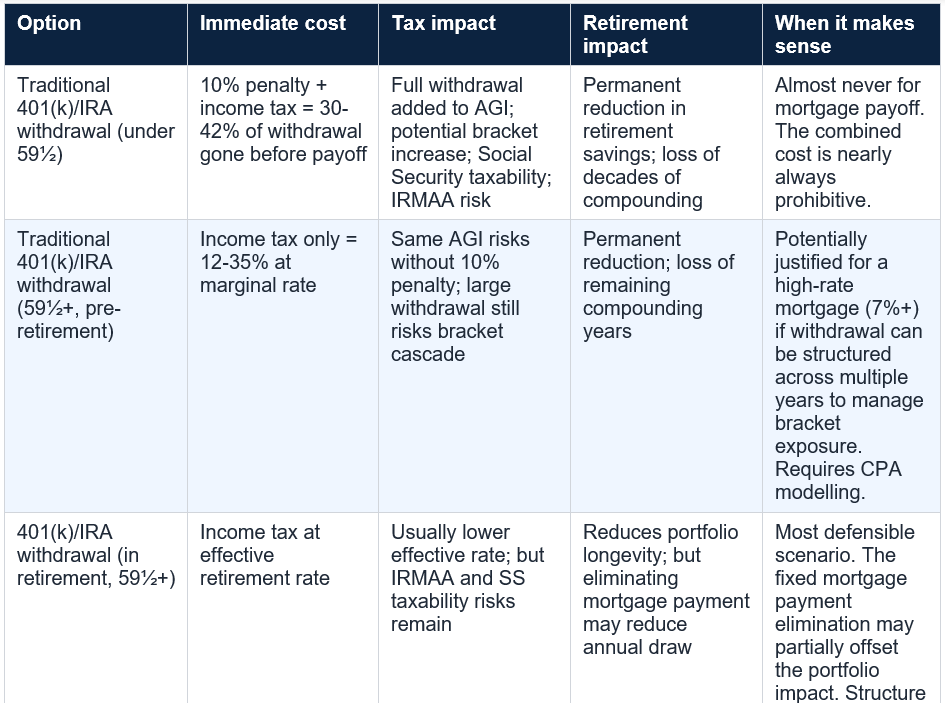
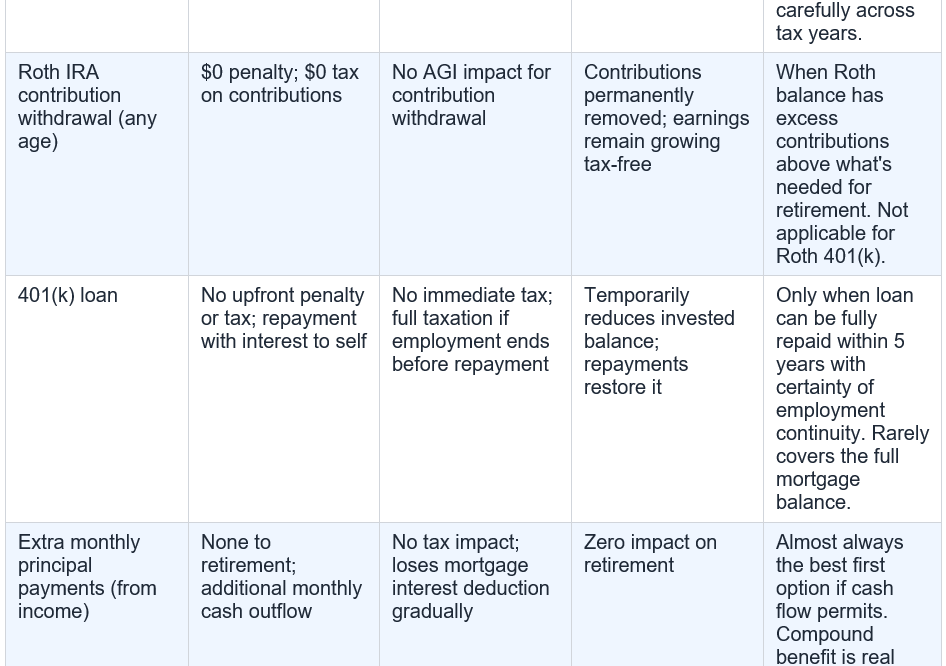
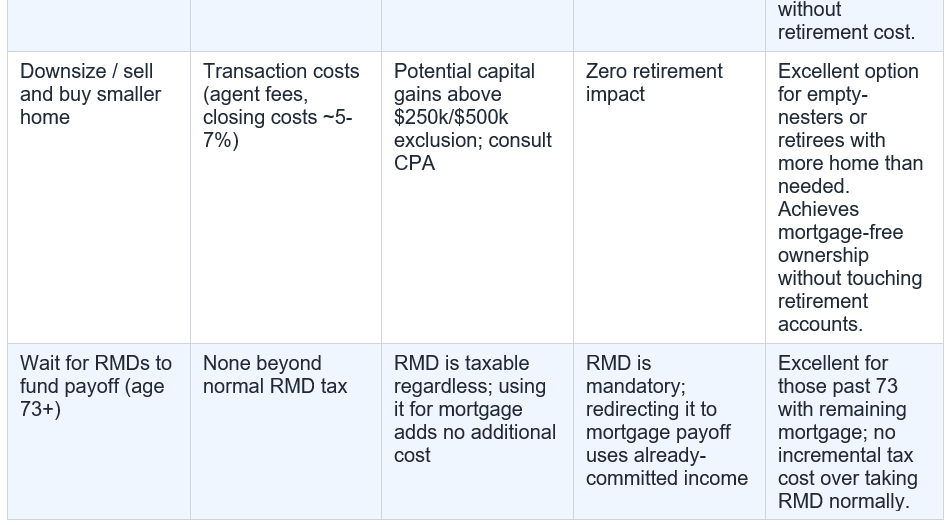
Side-by-Side Comparison: All Options at a Glance
Conclusion
For most Americans in most circumstances, using retirement savings — a 401(k), IRA, or pension equivalent — to pay off a mortgage is one of the most expensive financial moves available. For someone under 59½, the 10% early withdrawal penalty combined with income tax means 30-42% of every dollar withdrawn never reaches the mortgage. For someone at any age with a low-rate mortgage, the expected investment return from keeping the money in equities exceeds the after-tax cost of the mortgage interest. And for every scenario, the compounding loss from permanently removing funds from decades of growth can cost six or seven times the amount actually withdrawn.The exception — the scenario in which the withdrawal is at least defensible — is specific: past age 59½ (no penalty), in or near retirement with limited other income (lower effective tax rate on the withdrawal), carrying a high-rate mortgage (6.5%+) with a relatively small remaining balance, in a year where income is already low and the withdrawal can be structured to avoid bracket cascade and IRMAA triggers, and with the cash flow improvement from eliminating the monthly payment partially offsetting the portfolio impact. Even then, the decision requires careful multi-year tax modelling by a CPA, not a back-of-the-envelope calculation.
The far more common and far more affordable path to the goal of entering retirement without a mortgage: extra principal payments from current income; a plan to sell a larger home and purchase a smaller one at retirement; or directing required minimum distributions (which are mandatory and taxable regardless of use) toward mortgage acceleration from age 73 onward. None of these require paying a 30-42% tax on money that has been compounding for decades. Not financial or tax advice — the decision requires a qualified CPA and financial adviser who can model your specific situation.
Frequently Asked Questions
Should I use my 401(k) to pay off my mortgage?In most cases, no — and for anyone under age 59½, almost certainly not. A withdrawal from a traditional 401(k) or IRA before age 59½ triggers a 10% early withdrawal penalty on the full amount, plus ordinary income tax at your marginal rate. In the 22% tax bracket, this means approximately 32% of the withdrawal goes to the IRS before a single dollar reaches the mortgage. On a $100,000 mortgage payoff, you would need to withdraw approximately $147,000 to net $100,000 after taxes and penalty. Additionally, the money withdrawn permanently leaves a tax-advantaged compounding environment. Fifty thousand dollars withdrawn at age 40 and growing at 8% average return would have become approximately $342,000 by age 65 — meaning the true cost of the withdrawal is not $50,000 but approximately $342,000 in retirement wealth (Thrivent Financial). The case improves after age 59½ when the 10% penalty is eliminated, but income tax on the withdrawal remains. For those in or near retirement with a high-rate mortgage and a low-income year, a carefully structured withdrawal — ideally spread across multiple years to manage bracket exposure — can be more defensible. Always consult a CPA before making this decision. Not tax or financial advice.
What is the tax penalty for using my 401(k) to pay off my mortgage?
If you are under age 59½, a withdrawal from a traditional 401(k) or IRA triggers a 10% early withdrawal penalty on the full amount withdrawn, plus ordinary income tax at your applicable marginal rate. The IRS does not consider mortgage payoff a qualifying hardship that waives the 10% penalty — it applies regardless of the intended use (IRS; SmartAsset; Principal Financial Group). If you are in the 22% federal marginal bracket and under 59½, the combined cost is approximately 32% of the withdrawal. If you are in the 24% bracket, approximately 34%. If you are in the 32% bracket, approximately 42%. Large withdrawals can also push income into higher brackets, trigger Social Security taxability (up to 85% of benefits taxable above certain income thresholds), activate Medicare IRMAA surcharges, and eliminate or reduce ACA marketplace subsidies. After age 59½, the 10% penalty disappears but ordinary income tax on the withdrawal remains. Roth IRA contributions (not earnings) can be withdrawn at any age without tax or penalty, because they were made with after-tax dollars. Not tax advice — consult a CPA for your specific situation.
Is it better to pay off my mortgage or keep money in my 401(k)?
For most people in most circumstances, keeping money in the 401(k) and continuing to pay the mortgage is the better financial outcome. The reasoning comes down to two comparisons: (1) Interest rate vs expected return: if your mortgage rate is 3-4% and your 401(k) earns a long-term average of 7-10%, the investment return significantly exceeds the mortgage interest cost, especially after the mortgage interest deduction. (2) Tax cost of withdrawal: even after age 59½ when there is no early withdrawal penalty, taking the money out of the 401(k) triggers income tax on the full withdrawal, meaning 12-35% of the money goes to taxes rather than the mortgage. The scenario where paying off the mortgage is more defensible: past age 59½, high-rate mortgage (6.5%+), low-income retirement year where the effective tax rate on the withdrawal is low, remaining mortgage balance is manageable in size, and the cash flow improvement from eliminating the monthly payment has meaningful retirement impact. Not financial or tax advice — consult a CPA and financial adviser.
What is a 401(k) loan and is it better than a withdrawal for paying off a mortgage?
A 401(k) loan allows you to borrow from your own retirement account — up to the lesser of $50,000 or 50% of your vested balance — without triggering the 10% early withdrawal penalty or immediate income tax. You repay the loan (with interest, which goes back into your own account) over a period of up to 5 years. Unlike a withdrawal, a 401(k) loan does not permanently remove funds from your retirement account. However, there are significant limitations: the $50,000 maximum rarely covers a full mortgage balance (the average outstanding mortgage balance in 2024 was over $260,000); the 5-year repayment period is inflexible; if you leave your employer while the loan is outstanding, the full balance typically becomes due within 60-90 days or is treated as a taxable distribution (and subject to the 10% penalty if under 59½); and you lose the investment growth on the borrowed amount during the repayment period (Rocket Mortgage; Point.com). For most people, the 401(k) loan can only cover a portion of a mortgage payoff, and the employment risk makes it precarious. It is more useful for a partial payoff or a bridge strategy than a full mortgage elimination. Not financial advice.
What are the best alternatives to using retirement savings for mortgage payoff?
The alternatives that achieve the goal of mortgage payoff without the tax cost of retirement account withdrawal include: (1) Extra monthly principal payments from current income — even $200-$300 extra per month materially reduces total interest and years remaining, and costs nothing in taxes or retirement wealth; (2) Biweekly payment strategy — switching to biweekly payments effectively makes 13 payments per year instead of 12, reducing the term by 3-5 years without additional cash outlay; (3) Downsizing — selling a larger home and purchasing a smaller property at retirement, using home equity to buy the replacement outright or with a small balance; (4) Waiting for RMDs at age 73 — required minimum distributions are mandatory and taxable regardless of use, so directing them toward mortgage principal acceleration adds no incremental tax cost; (5) Structuring the withdrawal across multiple tax years if truly necessary — taking the minimum needed each year to stay within optimal tax brackets, rather than one large withdrawal that triggers bracket cascade, IRMAA, and Social Security taxability simultaneously. Not financial or tax advice — consult a qualified CPA and financial adviser for a strategy specific to your situation.

0 Comments Comments