

Savings
ISA or Pension? Scenarios for Age 30, 40 & 50

At 30, time works for you — both structures benefit enormously from compounding, but the pension’s tax relief head start is hard to beat. At 40, the employer match and higher-rate relief make the pension case overwhelming. At 50, the access gap to age 57 changes the equation entirely. Here’s what the numbers show — and why the answer for almost everyone is ‘both’.

The pension taxes the money on the way out. The ISA taxes it on the way in. Everything else — the tax relief, the employer match, the access restrictions, the inheritance rules, the flexibility — flows from that single structural difference. For most people on most incomes, the pension wins on arithmetic because tax rates tend to be lower in retirement than in work. But the ISA wins on flexibility, and flexibility has financial value that a pure arithmetic comparison misses.
This guide works through the specific scenarios for three life stages — age 30, 40, and 50 — and maps the rules, the numbers, and the practical decisions for each. All figures are based on 2026/27 rules. The critical change on the horizon — the inclusion of pension pots in Inheritance Tax from April 2027 — is addressed directly as a factor that changes the calculus for savers with larger estates.
Key Numbers: ISA allowance 2026/27: £20,000 per person. Pension annual allowance: £60,000 gross. Tax relief: 20% basic, 40% higher, 45% additional rate. Pension access age: 55 now, rising to 57 from April 2028. Tax-free cash from pension: 25% capped at £268,275. From April 2027: unspent pension pots included in estate for IHT at 40%.
The pension wins on the way in (tax relief) but loses on the way out (income tax in retirement). The ISA loses on the way in (no relief) but wins on the way out (zero tax). For someone in a higher tax band now and a lower tax band in retirement — which is most higher earners — the pension produces a real, lasting advantage from the tax rate differential. For someone who expects to remain in the same tax band from now through retirement, the pension and ISA are broadly comparable on arithmetic.
A worked example (mortgagevpension.com, February 2026):
The employer match amplifies this further. A 30-year-old with a 5% employer match on a £35,000 salary is receiving £145 per month in free employer contributions alongside their own. Over 35 years, employer contributions alone at 5% growth could produce approximately £145,000 of additional retirement wealth.
From mortgagevpension.com’s February 2026 analysis: ‘For 40% taxpayers, pension tax relief is worth far more than the ISA’s complete flexibility at withdrawal. You’re saving 40% on the way in and likely only paying 20% (basic rate) on most pension withdrawals in retirement. That spread creates real, lasting value.’
The practical approach: maximise pension contributions to capture the full tax relief advantage, while also building an ISA to fund the years between early retirement and pension access. The ISA drawdown period can be calculated precisely: if you plan to retire at 55 and pension access is at 57, you need two years of living expenses in an ISA (or other accessible savings). If the target retirement age is 50, you need 7 years of living expenses.
At 40, run both calculations: (1) what your pension pot would be at 57 if you continue at your current contribution rate; (2) how much you need in an ISA to bridge from your target retirement age to 57. The pension gets the larger allocation for most higher-rate taxpayers, but the ISA bridge is essential for anyone targeting early retirement.
Maximise pension contributions — the higher-rate relief advantage is at its peak. Fully capture employer match. Build ISA alongside as the early retirement bridge fund, sized to cover spending from target retirement age to 57 (or older if starting pension drawdown later). The pension wins the arithmetic; the ISA wins the access flexibility.
A 50-year-old higher-rate taxpayer making a £500 per month gross pension contribution (£300 net after 40% relief) for 7 years to age 57, with 5% annual growth, would accumulate approximately £50,000 in that period. The same £300 per month in an ISA over the same period would generate approximately £29,000. The pension’s advantage from the relief — even over only 7 years — is still meaningful, provided the investment is accessed at retirement and not passed down (because from April 2027, the IHT picture changes).
At 50, consider the pension access date carefully relative to your target retirement date. If you plan to retire before 57, additional pension contributions beyond the employer match may lock away money you need for the early retirement period. Build the ISA bridge fund actively in your 50s — the access gap is real and cannot be bridged from the pension.
Priority shifts toward ISA for anyone targeting retirement before 57. Continue capturing employer match in pension; further pension contributions make sense for longer retirement horizons. The ISA becomes the primary flexible retirement vehicle for those who may need funds before 57, and the essential bridge fund for anyone retiring early. The pension still wins on arithmetic; the ISA wins on access certainty.
Under current rules (to April 2027), most DC pension pots fall outside the estate for IHT. Nominated beneficiaries can inherit the pension free of IHT, making the pension a powerful estate planning tool for wealthier individuals who do not need to spend the pension in retirement. From April 2027:
From April 2027, the pension loses its most distinctive estate planning advantage. For retirees with estates above IHT thresholds, the pre-April 2027 strategy of 'preserve the pension for inheritance' becomes less attractive. This makes ISAs incrementally more valuable as an inheritance vehicle relative to pensions — not because ISAs escape IHT, but because inherited ISA withdrawals are tax-free whereas inherited pension withdrawals are taxed as income.
LISA mechanics in 2026/27:
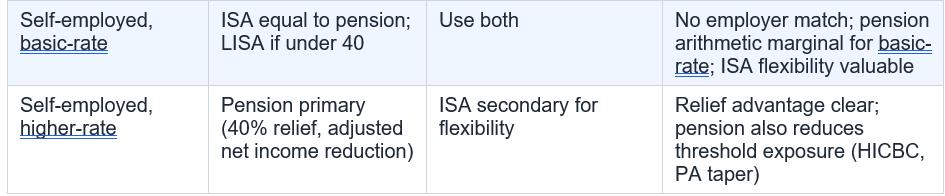
For self-employed basic-rate taxpayers, the comparison is closer than for employees. Pension relief adds 25% to contributions (the government tops up £100 to £125 gross); the ISA provides no relief but full flexibility. The pension wins if the saver is likely to be a lower-rate taxpayer in retirement than while working; the ISA wins if flexibility is valued or if they are likely to remain basic-rate throughout.
For self-employed higher-rate taxpayers, the pension case is stronger: 40% relief on contributions against likely 20% basic-rate withdrawals in retirement is a 20-percentage-point net advantage. The pension also reduces adjusted net income, which matters for the personal allowance taper above £100,000, the High Income Child Benefit Charge above £60,000, and Tax-Free Childcare eligibility.
Self-employed savers should also note that the pension’s annual allowance (£60,000 gross) is substantially higher than the ISA’s £20,000 ceiling, providing greater capacity for larger contributions in good income years.
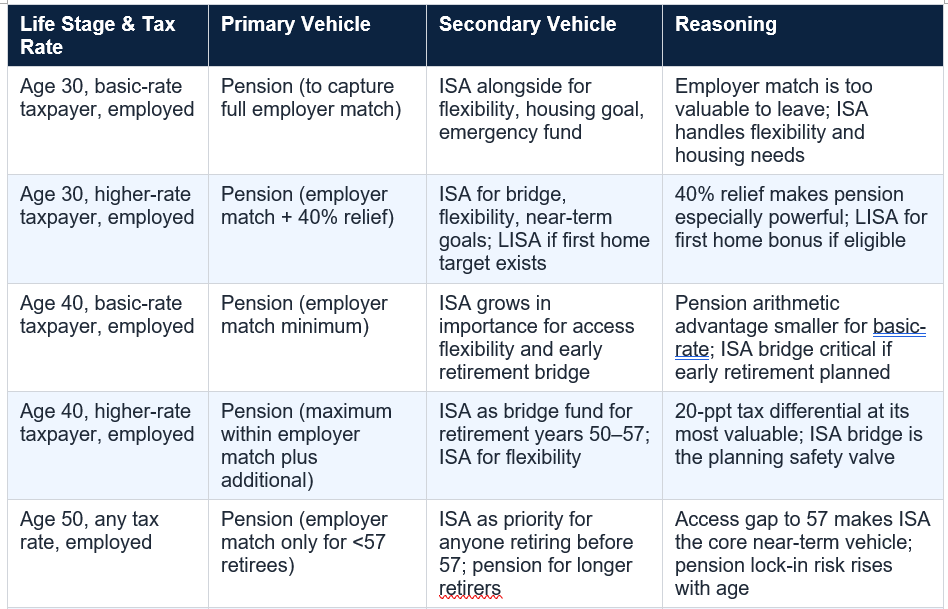
The scenarios by age reflect genuinely different priorities, not just different timelines. At 30, the compounding power of the pension’s tax-relieved contributions is maximised, but the ISA’s flexibility has real option value for a life not yet fully mapped. At 40, the higher-rate tax advantage of the pension is typically at its peak and the bridge strategy — pension for retirement wealth, ISA for early retirement access — is the natural answer for serious retirement planners. At 50, the ISA’s flexibility and access are decisive for anyone targeting retirement before 57, and the pension’s lock-in risk is at its highest relative to available time to compound.
The practical guidance for almost every reader is the same: capture the employer match first, pension contributions next up to the point where tax relief advantage is significant, then ISA alongside for the flexibility and access the pension cannot provide. The two structures are more complementary than they are competitive, and the optimal retirement savings strategy in 2026/27 almost always involves both.
For a basic-rate taxpayer, the choice is closer than for higher-rate earners. The pension offers 20% tax relief on contributions, which adds £25 for every £100 saved. However, pension withdrawals in retirement are taxed at your marginal rate, while ISA withdrawals are completely tax-free. If you expect to remain a basic-rate taxpayer in retirement (which most people do, receiving the State Pension plus modest private income), the pension's tax advantage on contributions is broadly offset by the tax on withdrawals. The decisive factors then become: the employer match (if available, always take it via the pension first), your need for flexibility (ISA wins here), and your retirement timeline (pension wins for long-term growth with employer match; ISA wins if you might need funds before age 57). Most basic-rate savers benefit from contributing enough to the pension to capture the employer match, then building ISA savings alongside.
Should a higher-rate taxpayer use a pension or ISA?
For higher-rate taxpayers, the pension typically wins the arithmetic comparison. You receive 40% relief on contributions (the government adds £67 for every £60 contributed from take-home pay) and you will likely pay only 20% (basic rate) on most pension withdrawals in retirement, because your retirement income will typically be lower than your working income. This creates a 20-percentage-point net advantage over the ISA on the money that goes into the pension. Additionally, pension contributions above employer match reduce your adjusted net income, which can preserve Tax-Free Childcare eligibility below £100,000, reduce the High Income Child Benefit Charge above £60,000, and help manage the Personal Allowance taper above £100,000. The ISA remains important alongside the pension for flexibility and as the bridge fund if you plan to retire before age 57 (57 from April 2028).
What is the pension access age in the UK in 2026?
The current pension access age in the UK is 55. It rises to 57 from 6 April 2028 (Finance Act 2022). This means that from April 2028, most people will not be able to access their pension savings until age 57. A small number of scheme members have a protected pension age below 57 under transitional rules — check your specific scheme terms. The rising access age means that savers who plan to retire before 57 must fund those years from non-pension sources such as ISAs, cash savings, or other accessible investments. For a 40-year-old targeting retirement at 52, for example, 5 years of retirement spending must be funded without touching the pension.
What happens to pensions and inheritance tax from April 2027?
From 6 April 2027, unspent defined contribution (DC) pension pots will be included in the deceased's estate for Inheritance Tax (IHT) purposes. IHT is currently charged at 40% on estate values above the nil-rate band of £325,000 (plus the residence nil-rate band of up to £175,000 in qualifying cases, frozen until 2030). The government estimates 10,500 additional estates per year will become IHT-liable as a result of the change (David Gray LLP, May 2026), though the vast majority of estates will remain below the thresholds. The spousal exemption is maintained — pensions and ISAs passed to a spouse or civil partner remain IHT-free. For non-spouse beneficiaries with large pension pots, there is a risk of double taxation: IHT on the estate plus Income Tax on pension withdrawals. This changes the optimal drawdown strategy for wealthier savers with taxable estates, potentially favouring spending the pension in retirement and using the ISA as the inheritance vehicle.
Is a Lifetime ISA (LISA) better than a pension?
For most employed people, the pension beats the Lifetime ISA because the pension's tax relief and employer match combine to produce a better outcome. The Lifetime ISA offers a 25% government bonus on up to £4,000 per year — equivalent to basic-rate pension relief. But a higher-rate taxpayer gets 40% pension relief, which is better than the LISA's 25% bonus. And employed savers with an employer match get free employer contributions via the pension that are unavailable in a LISA. The LISA is most beneficial for: basic-rate taxpayers saving for a first home (the 25% bonus and property purchase feature make it ideal); self-employed basic-rate savers with no employer match; and as a supplement to pension saving for those eligible (ages 18–39). Key LISA restrictions: the 25% withdrawal penalty for non-qualifying withdrawals, age eligibility (must be opened before 40), and the £450,000 property price limit for home purchase use.
Should I use an ISA if I'm planning to retire early?
Yes, emphatically. If you plan to retire before age 57 (the pension access age from April 2028), an ISA is essential. The pension is inaccessible before 57 without severe penalties, so any income needed between your planned retirement date and age 57 must come from accessible savings. An ISA is the most tax-efficient vehicle for this purpose: withdrawals are completely tax-free and there is no minimum access age. The recommended approach is to build an ISA pot sized to cover your expected spending from your target retirement age to 57 (or until pension drawdown begins), then use pension drawdown from 57 onwards for long-term retirement income. The size of the required ISA bridge depends on: your annual retirement spending, the number of years between early retirement and pension access, and any other accessible income (rental income, part-time work, partner's income).
Table of Contents
- Two Wrappers, One Question, Different Answers by Age
- The Fundamental Difference: Tax In vs Tax Out
- The Employer Match: The Argument That Ends the Debate
- ISA vs Pension: The Core Rules at a Glance (2026/27)
- Age 30: The Compounding Advantage and When the ISA Makes Sense Too
- Age 40: The Higher-Rate Sweet Spot and the Bridge Strategy
- Age 50: The Access Gap That Changes Everything
- The Inheritance Tax Dimension: What Changes from April 2027
- The Lifetime ISA: Where It Fits and Where It Doesn’t
- Self-Employed Savers: A Different Calculation
- The Case for Using Both: The Practical Portfolio
- Decision Framework: Five Questions to Find Your Answer
- Conclusion: The Answer Is Almost Always ‘Both’
- Frequently Asked Questions
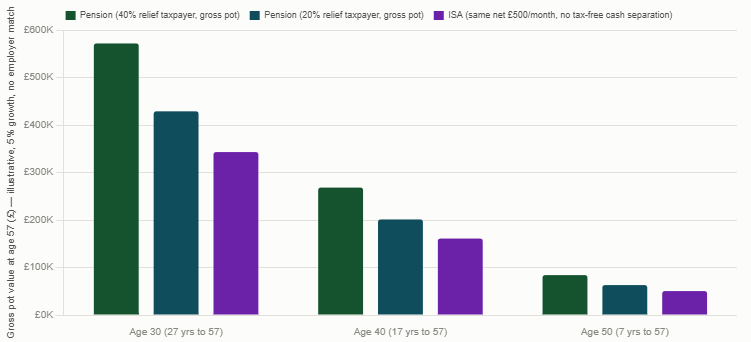
Net Pot Value At 57: Pension vs ISA
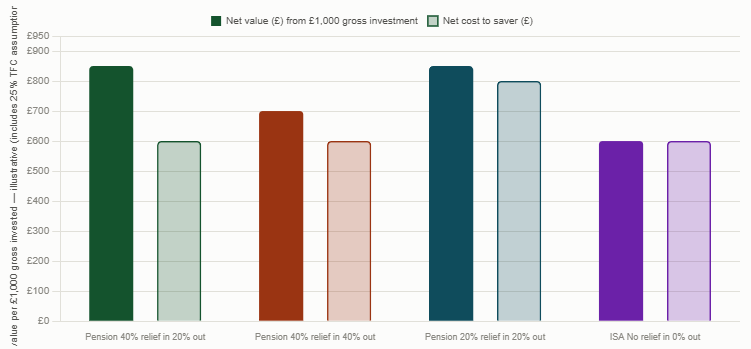
Tax Relief Advantage By Income Ban.
Two Wrappers, One Question, Different Answers by Age
The ISA or pension question is one of the most common and most consequential financial decisions a UK adult will make. Both are tax-advantaged wrappers. Both allow investments to grow without Capital Gains Tax or Income Tax on the growth inside. Both are central to long-term wealth building. But they work on opposite tax principles — and the right balance between them depends almost entirely on three variables: your age, your income tax rate today, and your income tax rate in retirement.The pension taxes the money on the way out. The ISA taxes it on the way in. Everything else — the tax relief, the employer match, the access restrictions, the inheritance rules, the flexibility — flows from that single structural difference. For most people on most incomes, the pension wins on arithmetic because tax rates tend to be lower in retirement than in work. But the ISA wins on flexibility, and flexibility has financial value that a pure arithmetic comparison misses.
This guide works through the specific scenarios for three life stages — age 30, 40, and 50 — and maps the rules, the numbers, and the practical decisions for each. All figures are based on 2026/27 rules. The critical change on the horizon — the inclusion of pension pots in Inheritance Tax from April 2027 — is addressed directly as a factor that changes the calculus for savers with larger estates.
Key Numbers: ISA allowance 2026/27: £20,000 per person. Pension annual allowance: £60,000 gross. Tax relief: 20% basic, 40% higher, 45% additional rate. Pension access age: 55 now, rising to 57 from April 2028. Tax-free cash from pension: 25% capped at £268,275. From April 2027: unspent pension pots included in estate for IHT at 40%.
The Fundamental Difference: Tax In vs Tax Out
The structural logic of pension and ISA taxation is the starting point for every decision:The pension wins on the way in (tax relief) but loses on the way out (income tax in retirement). The ISA loses on the way in (no relief) but wins on the way out (zero tax). For someone in a higher tax band now and a lower tax band in retirement — which is most higher earners — the pension produces a real, lasting advantage from the tax rate differential. For someone who expects to remain in the same tax band from now through retirement, the pension and ISA are broadly comparable on arithmetic.
The Employer Match: The Argument That Ends the Debate
Before any discussion of tax rates or access, there is one factor that should determine the first pound of pension contribution every month: the employer match. Auto-enrolment requires employers to contribute at least 3 percent of qualifying earnings to a workplace pension. Many employers match employee contributions beyond that minimum. The employer match is effectively free money that cannot be replicated by any other savings vehicle.A worked example (mortgagevpension.com, February 2026):
- Employee earns £50,000. Employer matches 5% of salary.
- Employee contributes £2,500 per year (5% of £50,000).
- As a higher-rate taxpayer, the net cost after 40% tax relief: £1,500 per year (£125 per month out of take-home pay).
- Employer adds another £2,500. Total pension contribution: £5,000 per year.
- For an input cost to the employee of £1,500, £5,000 goes into the pension. That is a 233% return on the employee’s net contribution before any investment return.
ISA vs Pension: The Core Rules at a Glance (2026/27)
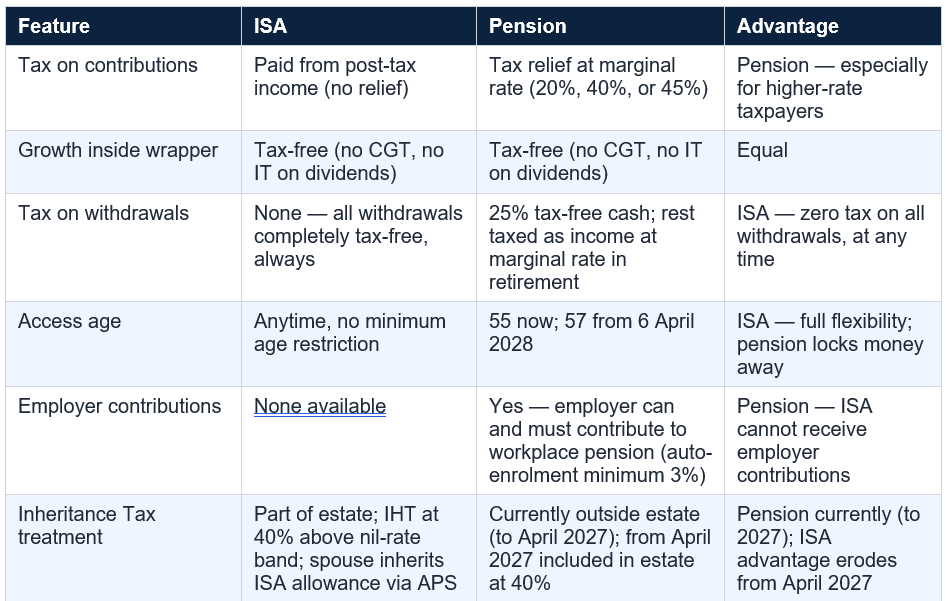
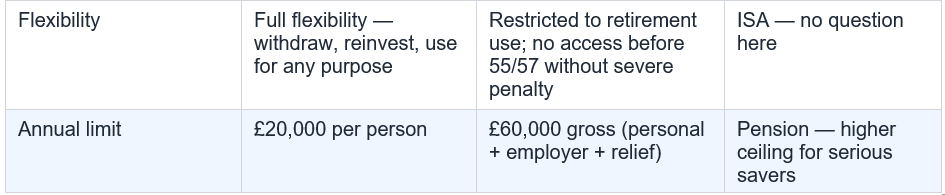
A quick reference on the current rules, confirmed for 2026/27:- Pension annual allowance: £60,000 gross (employee + employer + relief). Tapered for very high earners (threshold income above £200,000 and adjusted income above £260,000; reduces by £1 for every £2 above £260,000 to a minimum of £10,000).
- Pension tax relief: 20% relief at source for all contributors (the government adds £25 for every £80 contributed). Higher-rate taxpayers can claim an additional 20% via Self Assessment. Additional-rate taxpayers can claim an additional 25%. Salary sacrifice arrangements provide relief at source before tax is calculated.
- Tax-free cash: up to 25% of the pension pot, capped at £268,275 in 2026/27 (the Lump Sum and Death Benefit Allowance, LSDBA). The old Lifetime Allowance was abolished from April 2024.
- Pension access age: 55 currently; rising to 57 from 6 April 2028 (Finance Act 2022 confirmed).
- ISA annual allowance: £20,000 per person. All types of ISA combined (Cash, Stocks and Shares, Innovative Finance, Lifetime).
- ISA flexibility: full access at any time; no penalties; no minimum age. Flexible ISAs allow withdrawals and re-contributions in the same tax year without losing the annual allowance.
- Lifetime ISA: up to £4,000 per year within the £20,000 total; 25% government bonus (£1,000 max per year); open to ages 18 to 39; for first home purchase or retirement from age 60; 25% penalty on any other withdrawal.
Age 30: The Compounding Advantage and When the ISA Makes Sense Too
A 30-year-old faces the longest investment horizon of the three scenarios: 27 years until pension access at 57 (from 2028), and typically 35 to 37 years until a conventional retirement target of 65 to 67. Compounding works exponentially over these timescales, which means the decisions made at 30 have an outsized impact on eventual retirement wealth.The pension case at 30
For a 30-year-old basic-rate taxpayer contributing £300 per month (£240 net of 20% relief), the government’s top-up adds £60 per month. Over 35 years at 5% annual growth, that £300 per month (gross) generates a pot of approximately £300,000 to £340,000. For a higher-rate taxpayer, the net cost of a £300 per month gross contribution is only £180 (after 40% relief) — making the real cost of pension saving at 30 exceptionally low for those in the 40% band.The employer match amplifies this further. A 30-year-old with a 5% employer match on a £35,000 salary is receiving £145 per month in free employer contributions alongside their own. Over 35 years, employer contributions alone at 5% growth could produce approximately £145,000 of additional retirement wealth.
When the ISA wins at 30
The ISA wins at 30 in specific circumstances:- Housing: a 30-year-old saving for a first home needs accessible savings. The pension’s lock-in until 57 makes it unsuitable for a house deposit fund. The Lifetime ISA (LISA) is the designated solution: £4,000 per year earns a £1,000 government bonus, usable for a first home purchase on a property up to £450,000. A 30-year-old can open a LISA (up to age 39), which is the only other vehicle with a government bonus on contributions.
- Near-term needs: if a 30-year-old expects to need savings before age 57 (career change, sabbatical, potential redundancy), the ISA provides access where the pension cannot.
- Flexibility and life uncertainty: at 30, many people have significant life uncertainty — family plans, potential relocation, career pivots. The ISA’s flexibility has real option value at this stage that reduces over time as life becomes more predictable.
Age 40: The Higher-Rate Sweet Spot and the Bridge Strategy
Age 40 is typically the peak of the pension case. Many 40-year-olds are at or approaching peak earnings, which means higher-rate tax relief is more likely to apply. The investment horizon is still long enough for compounding to generate material returns — 17 years to the new 57 access age, and 25 to 27 years to a conventional retirement target. And the life uncertainties of age 30 have reduced: most 40-year-olds have a clearer picture of their likely housing situation, income trajectory, and family obligations.The pension case at 40
A 40-year-old higher-rate taxpayer making pension contributions receives 40 percent relief on the way in and will likely pay only 20 percent (basic rate) on most pension withdrawals in retirement. That 20-percentage-point differential is the core of the pension’s financial advantage. On a £1,000 gross pension contribution, the net cost to the employee is £600 (after 40% relief). In retirement, withdrawals from a fund that received those contributions are taxed at 20%. The net advantage on this cycle: save 40%, pay 20% on withdrawal — a 20% net gain over the ISA’s position of saving from post-tax income and paying no tax on withdrawal.From mortgagevpension.com’s February 2026 analysis: ‘For 40% taxpayers, pension tax relief is worth far more than the ISA’s complete flexibility at withdrawal. You’re saving 40% on the way in and likely only paying 20% (basic rate) on most pension withdrawals in retirement. That spread creates real, lasting value.’
The bridge strategy at 40
The pension’s access restriction becomes more relevant for 40-year-olds who might want to retire or semi-retire before age 57. A 40-year-old targeting retirement at 55 would face a 2-year gap even at the current 55 age; at 57 (post-2028), that gap grows to 3 years minimum after the rule change. For someone targeting retirement at 50, the gap is 7 years. The bridge strategy addresses this by building an ISA alongside the pension, specifically to fund spending from early retirement until pension access opens.The practical approach: maximise pension contributions to capture the full tax relief advantage, while also building an ISA to fund the years between early retirement and pension access. The ISA drawdown period can be calculated precisely: if you plan to retire at 55 and pension access is at 57, you need two years of living expenses in an ISA (or other accessible savings). If the target retirement age is 50, you need 7 years of living expenses.
At 40, run both calculations: (1) what your pension pot would be at 57 if you continue at your current contribution rate; (2) how much you need in an ISA to bridge from your target retirement age to 57. The pension gets the larger allocation for most higher-rate taxpayers, but the ISA bridge is essential for anyone targeting early retirement.
Maximise pension contributions — the higher-rate relief advantage is at its peak. Fully capture employer match. Build ISA alongside as the early retirement bridge fund, sized to cover spending from target retirement age to 57 (or older if starting pension drawdown later). The pension wins the arithmetic; the ISA wins the access flexibility.
Age 50: The Access Gap That Changes Everything
At 50, the ISA’s flexibility becomes its defining advantage. A 50-year-old who wants to retire at 55, or who might need accessible savings for an unexpected event, faces a 7-year gap before pension access opens at 57 (from 2028). That gap cannot be filled from the pension. The ISA is the primary vehicle for bridging it.The access problem at 50
PensionBible.co.uk’s May 2026 decision framework states it directly: ‘A person retiring at 50 faces a 7-year gap before pension access (assuming the 2028 increase to 57). That gap must be funded from non-pension sources. The standard approach is to build an ISA pot large enough to cover spending from retirement age to pension access age, then switch to pension drawdown.’ A person spending £30,000 per year in retirement would need approximately £210,000 in accessible ISA savings to bridge 7 years at the current PLSA moderate lifestyle standard — before any adjustment for investment growth inside the ISA during the drawdown period.The pension still matters at 50
For a 50-year-old who will not retire until 57 or 60 or later, the pension still offers meaningful advantages. The remaining horizon of 7 to 15 years is long enough for compounding to be material, and 40 percent tax relief (for higher-rate taxpayers) on contributions made at 50 still produces a meaningful advantage over ISA contributions from the same post-tax income. The key difference from age 40 is that the time horizon is shorter, so compounding has less opportunity to amplify the initial tax advantage.A 50-year-old higher-rate taxpayer making a £500 per month gross pension contribution (£300 net after 40% relief) for 7 years to age 57, with 5% annual growth, would accumulate approximately £50,000 in that period. The same £300 per month in an ISA over the same period would generate approximately £29,000. The pension’s advantage from the relief — even over only 7 years — is still meaningful, provided the investment is accessed at retirement and not passed down (because from April 2027, the IHT picture changes).
At 50, consider the pension access date carefully relative to your target retirement date. If you plan to retire before 57, additional pension contributions beyond the employer match may lock away money you need for the early retirement period. Build the ISA bridge fund actively in your 50s — the access gap is real and cannot be bridged from the pension.
Priority shifts toward ISA for anyone targeting retirement before 57. Continue capturing employer match in pension; further pension contributions make sense for longer retirement horizons. The ISA becomes the primary flexible retirement vehicle for those who may need funds before 57, and the essential bridge fund for anyone retiring early. The pension still wins on arithmetic; the ISA wins on access certainty.
The Inheritance Tax Dimension: What Changes from April 2027
One of the most significant changes to the ISA vs pension comparison in a generation is the inclusion of unspent pension pots in the estate for Inheritance Tax from 6 April 2027 (Autumn Budget 2024; confirmed by HMRC).Under current rules (to April 2027), most DC pension pots fall outside the estate for IHT. Nominated beneficiaries can inherit the pension free of IHT, making the pension a powerful estate planning tool for wealthier individuals who do not need to spend the pension in retirement. From April 2027:
- Unspent DC pension pots are included in the estate for IHT purposes.
- IHT is charged at 40% on the value of the estate above the nil-rate band (£325,000) and residence nil-rate band (up to £175,000 in qualifying cases, frozen until 2030).
- The government estimates 10,500 additional estates per year will become IHT-liable as a result (David Gray LLP, May 2026). Most estates will remain below the thresholds.
- The spousal exemption is maintained: pensions and ISAs passed to a surviving spouse or civil partner remain IHT-free regardless of estate size.
- Double taxation risk for non-spouse beneficiaries: a pension inherited by a child who is a higher-rate taxpayer could face combined IHT (40%) on the estate and Income Tax (40%) on withdrawals if the pension holder died aged 75 or over. PocketWise’s April 2026 analysis describes this as the core planning issue: a pension passed to a higher-rate child before April 2027 might attract only 40% Income Tax; after April 2027, combined IHT and Income Tax could approach 64 percent or higher.
From April 2027, the pension loses its most distinctive estate planning advantage. For retirees with estates above IHT thresholds, the pre-April 2027 strategy of 'preserve the pension for inheritance' becomes less attractive. This makes ISAs incrementally more valuable as an inheritance vehicle relative to pensions — not because ISAs escape IHT, but because inherited ISA withdrawals are tax-free whereas inherited pension withdrawals are taxed as income.
The Lifetime ISA: Where It Fits and Where It Doesn’t
The Lifetime ISA (LISA) occupies a specific niche between a standard ISA and a pension. For eligible savers, it is highly attractive; for others, it is irrelevant or potentially costly.LISA mechanics in 2026/27:
- Eligible age: 18 to 39 (must be opened before age 40; contributions can continue until age 50).
- Government bonus: 25% on contributions up to £4,000 per year (£1,000 maximum annual bonus).
- Use: first home purchase (property up to £450,000) or retirement from age 60. No other access without the 25% withdrawal penalty, which effectively returns less than the original contribution (25% taken on the combined contribution + bonus).
- Total per year: LISA counts within the £20,000 ISA allowance, not in addition to it.
- A 30-year-old basic-rate taxpayer saving for a first home: the 25% LISA bonus is equivalent to basic-rate pension relief, with the additional potential to use the money for a house purchase — which the pension cannot offer.
- A self-employed basic-rate taxpayer who wants a retirement savings vehicle with a government bonus and has no employer match available.
- A higher-rate taxpayer using a pension gets 40% relief vs the LISA’s 25% bonus. The pension wins on arithmetic for higher-rate contributors.
- Anyone who might need access before age 60 for something other than a first home purchase — the 25% withdrawal penalty is severe.
- Anyone over 40 (cannot open a LISA after this age).
Self-Employed Savers: A Different Calculation
The ISA vs pension decision is materially different for self-employed people because the employer match — the single strongest argument for pension priority for employees — is unavailable. A self-employed person’s pension is funded only by personal contributions and the government’s tax relief.For self-employed basic-rate taxpayers, the comparison is closer than for employees. Pension relief adds 25% to contributions (the government tops up £100 to £125 gross); the ISA provides no relief but full flexibility. The pension wins if the saver is likely to be a lower-rate taxpayer in retirement than while working; the ISA wins if flexibility is valued or if they are likely to remain basic-rate throughout.
For self-employed higher-rate taxpayers, the pension case is stronger: 40% relief on contributions against likely 20% basic-rate withdrawals in retirement is a 20-percentage-point net advantage. The pension also reduces adjusted net income, which matters for the personal allowance taper above £100,000, the High Income Child Benefit Charge above £60,000, and Tax-Free Childcare eligibility.
Self-employed savers should also note that the pension’s annual allowance (£60,000 gross) is substantially higher than the ISA’s £20,000 ceiling, providing greater capacity for larger contributions in good income years.
The Case for Using Both: The Practical Portfolio
For most people in most income situations, the answer to ‘ISA or pension’ is ‘both’ — with the balance determined by tax rate, employer match, access needs, and time horizon. The practical portfolio framework:
Decision Framework: Five Questions to Find Your Answer
If you are deciding between ISA and pension contributions right now, work through these five questions in order:- Do you have employer pension contributions or matching available? If yes, contribute at least enough to capture the full employer match before directing any savings to an ISA. This is non-negotiable.
- What is your current income tax rate? Basic rate (20%): pension and ISA are more comparable; ISA flexibility has real value. Higher rate (40%): pension wins on arithmetic — the 40% relief vs likely 20% withdrawal rate creates a 20-percentage-point advantage. Additional rate (45%): pension advantage is maximum.
- When do you need the money? Before age 57: ISA is essential and pension cannot help. Between 57 and 67: pension plus ISA bridge. Retirement at 67+: pension dominates on arithmetic.
- 4. What is your estate likely to look like at death? Estate below IHT thresholds (£325,000 nil-rate band plus up to £175,000 residence NRB): current pension IHT advantage means pensions are efficient inheritance vehicles to April 2027; ISA equally efficient after. Estate above thresholds: from April 2027, spend the pension in retirement and consider ISA as the more efficient inheritance vehicle for beneficiaries who will pay Income Tax on pension withdrawals.
- Do you have specific near-term goals (first home, emergency fund, career change)? ISA (or LISA for first home if under 40) is the right vehicle for accessible savings with a specific near-term purpose.
Conclusion
The ISA or pension question rarely has a clean, exclusive answer. The pension wins on tax relief for higher-rate contributors, on employer match for employees, and on overall contribution limits for larger savers. The ISA wins on flexibility, on access before 57, and — from April 2027 — on the inheritance position for those with taxable estates whose beneficiaries will pay Income Tax on pension withdrawals.The scenarios by age reflect genuinely different priorities, not just different timelines. At 30, the compounding power of the pension’s tax-relieved contributions is maximised, but the ISA’s flexibility has real option value for a life not yet fully mapped. At 40, the higher-rate tax advantage of the pension is typically at its peak and the bridge strategy — pension for retirement wealth, ISA for early retirement access — is the natural answer for serious retirement planners. At 50, the ISA’s flexibility and access are decisive for anyone targeting retirement before 57, and the pension’s lock-in risk is at its highest relative to available time to compound.
The practical guidance for almost every reader is the same: capture the employer match first, pension contributions next up to the point where tax relief advantage is significant, then ISA alongside for the flexibility and access the pension cannot provide. The two structures are more complementary than they are competitive, and the optimal retirement savings strategy in 2026/27 almost always involves both.
Frequently Asked Questions
Is a pension or ISA better for a basic-rate taxpayer?For a basic-rate taxpayer, the choice is closer than for higher-rate earners. The pension offers 20% tax relief on contributions, which adds £25 for every £100 saved. However, pension withdrawals in retirement are taxed at your marginal rate, while ISA withdrawals are completely tax-free. If you expect to remain a basic-rate taxpayer in retirement (which most people do, receiving the State Pension plus modest private income), the pension's tax advantage on contributions is broadly offset by the tax on withdrawals. The decisive factors then become: the employer match (if available, always take it via the pension first), your need for flexibility (ISA wins here), and your retirement timeline (pension wins for long-term growth with employer match; ISA wins if you might need funds before age 57). Most basic-rate savers benefit from contributing enough to the pension to capture the employer match, then building ISA savings alongside.
Should a higher-rate taxpayer use a pension or ISA?
For higher-rate taxpayers, the pension typically wins the arithmetic comparison. You receive 40% relief on contributions (the government adds £67 for every £60 contributed from take-home pay) and you will likely pay only 20% (basic rate) on most pension withdrawals in retirement, because your retirement income will typically be lower than your working income. This creates a 20-percentage-point net advantage over the ISA on the money that goes into the pension. Additionally, pension contributions above employer match reduce your adjusted net income, which can preserve Tax-Free Childcare eligibility below £100,000, reduce the High Income Child Benefit Charge above £60,000, and help manage the Personal Allowance taper above £100,000. The ISA remains important alongside the pension for flexibility and as the bridge fund if you plan to retire before age 57 (57 from April 2028).
What is the pension access age in the UK in 2026?
The current pension access age in the UK is 55. It rises to 57 from 6 April 2028 (Finance Act 2022). This means that from April 2028, most people will not be able to access their pension savings until age 57. A small number of scheme members have a protected pension age below 57 under transitional rules — check your specific scheme terms. The rising access age means that savers who plan to retire before 57 must fund those years from non-pension sources such as ISAs, cash savings, or other accessible investments. For a 40-year-old targeting retirement at 52, for example, 5 years of retirement spending must be funded without touching the pension.
What happens to pensions and inheritance tax from April 2027?
From 6 April 2027, unspent defined contribution (DC) pension pots will be included in the deceased's estate for Inheritance Tax (IHT) purposes. IHT is currently charged at 40% on estate values above the nil-rate band of £325,000 (plus the residence nil-rate band of up to £175,000 in qualifying cases, frozen until 2030). The government estimates 10,500 additional estates per year will become IHT-liable as a result of the change (David Gray LLP, May 2026), though the vast majority of estates will remain below the thresholds. The spousal exemption is maintained — pensions and ISAs passed to a spouse or civil partner remain IHT-free. For non-spouse beneficiaries with large pension pots, there is a risk of double taxation: IHT on the estate plus Income Tax on pension withdrawals. This changes the optimal drawdown strategy for wealthier savers with taxable estates, potentially favouring spending the pension in retirement and using the ISA as the inheritance vehicle.
Is a Lifetime ISA (LISA) better than a pension?
For most employed people, the pension beats the Lifetime ISA because the pension's tax relief and employer match combine to produce a better outcome. The Lifetime ISA offers a 25% government bonus on up to £4,000 per year — equivalent to basic-rate pension relief. But a higher-rate taxpayer gets 40% pension relief, which is better than the LISA's 25% bonus. And employed savers with an employer match get free employer contributions via the pension that are unavailable in a LISA. The LISA is most beneficial for: basic-rate taxpayers saving for a first home (the 25% bonus and property purchase feature make it ideal); self-employed basic-rate savers with no employer match; and as a supplement to pension saving for those eligible (ages 18–39). Key LISA restrictions: the 25% withdrawal penalty for non-qualifying withdrawals, age eligibility (must be opened before 40), and the £450,000 property price limit for home purchase use.
Should I use an ISA if I'm planning to retire early?
Yes, emphatically. If you plan to retire before age 57 (the pension access age from April 2028), an ISA is essential. The pension is inaccessible before 57 without severe penalties, so any income needed between your planned retirement date and age 57 must come from accessible savings. An ISA is the most tax-efficient vehicle for this purpose: withdrawals are completely tax-free and there is no minimum access age. The recommended approach is to build an ISA pot sized to cover your expected spending from your target retirement age to 57 (or until pension drawdown begins), then use pension drawdown from 57 onwards for long-term retirement income. The size of the required ISA bridge depends on: your annual retirement spending, the number of years between early retirement and pension access, and any other accessible income (rental income, part-time work, partner's income).
0 Comments
Be the first to share your thoughts on this article.