

Financial Literacy
Manage Money Like a Millionaire (Even If You’re Not One Yet)

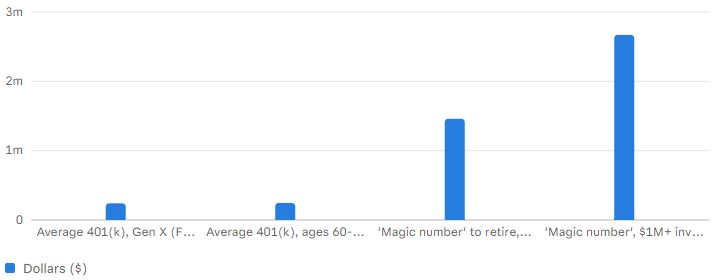
Americans’ retirement “magic number” is $1.46 million (up $200,000 in a year) and $2.67 million for people with $1 million or more invested (Northwestern Mutual); Fidelity Q2 2026 average 401(k) balances $240,700 for Gen X and $246,500 for ages 60–64; 19.5% of savers have a 401(k) loan; Vanguard average $148,153 vs median $38,176. Limits (2026): 401(k) $24,500 plus $8,000 catch-up at 50+; IRA $7,500; HSA $4,400 (self-only) or $8,750 (family). Millionaire research: 79% received no inheritance and about 8 in 10 used a 401(k) (Ramsey); 401(k) millionaires saved 17.3% of pay vs 14.4% average (Fidelity). My arithmetic on the $64,064 median salary at a constant 7% with 3.5% raises: saving 5%, 10%, 15% or 20% reaches $1 million in about 40, 32, 27 or 24 years; 15% is about $9,610 a year ($801 a month); the 25x rule gives $900,000, $1.2 million or $1.5 million for $3,000, $4,000 or $5,000 of monthly spending.
This guide turns that idea into nine moves, each with 2026 data and a concrete first step, drawing on surveys of wealthy people, Northwestern Mutual’s 2026 study of what Americans think they need and Fidelity’s account data, plus simple arithmetic on the US median salary. Treat the research as patterns, not promises, and the arithmetic as illustration, not forecast.
Averages hide a wide spread: Vanguard’s latest survey showed an average 401(k) balance of $148,153 against a median of $38,176. The average 60-to-64-year-old’s balance is about 17% of the $1.46 million survey number, a gap of roughly $1.2 million. The message is not despair but that a system started early matters enormously, and most people are behind the target they say they need.
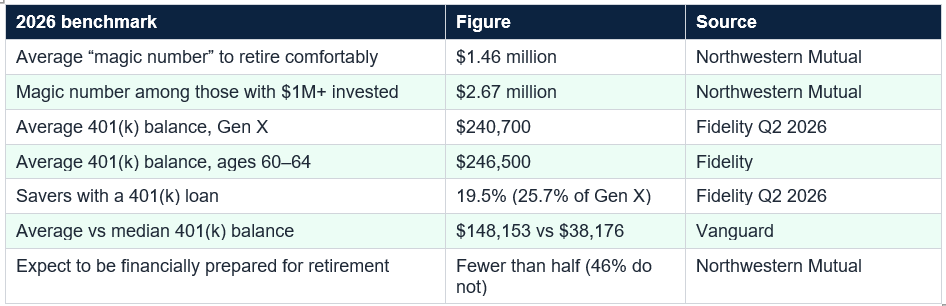
Northwestern Mutual 2026: average retirement “magic number” $1.46 million; $2.67 million for those with $1 million or more invested; 46% do not expect to be prepared. Fidelity Q2 2026: average 401(k) $240,700 (Gen X) and $246,500 (ages 60–64); 19.5% of savers have a loan.
Start with your employer’s match, which is part of your pay: a 50% match on the first 6% of that salary is about $1,922 a year. Then raise your rate by a point each year or with each raise, beginning at 5% if 15% is too much today. Set the transfer this week, because a decision made once beats a hundred made monthly.
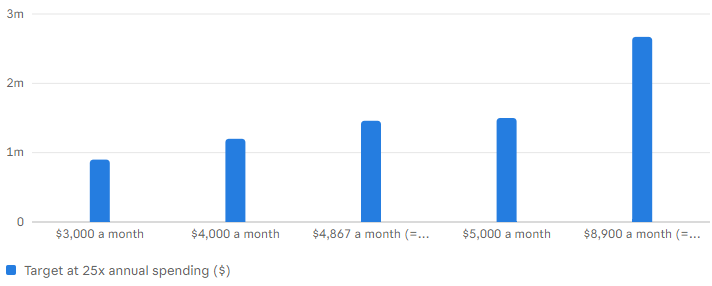
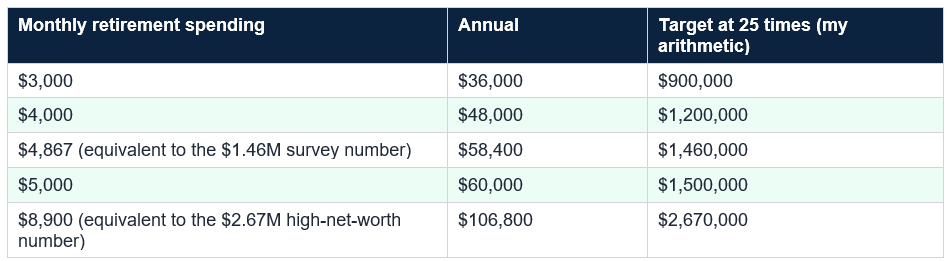
The 25 times rule, which Northwestern Mutual cites among its strategies, turns spending into a target: $3,000 a month implies about $900,000, $4,000 about $1.2 million and $5,000 about $1.5 million. The survey’s $1.46 million equals about $4,870 a month of spending on that rule, which may be more or less than you need.
A sensible order for many people: capture the employer match, build a starter emergency fund, pay off expensive debt, then raise 401(k) contributions, fund an IRA or HSA and invest any extra in a taxable account. In my illustration, $24,500 a year for 35 years at a constant 7% grows to about $3.4 million. Rules differ by situation, so check eligibility and consider advice on Roth versus traditional choices.
Then stay in. DALBAR found the average investor earned about 6.8% a year over 30 years against 10.2% for the S&P 500, largely from badly timed trades, and JPMorgan found missing just the 10 best days over 20 years cut the S&P 500’s annualized return from about 10.6% to about 6.4%. Write down an allocation you can keep through a 35% decline, automate contributions and look at your account less often.
In my illustration, a 3.5% raise on $64,064 is about $2,242 a year, and saving half, about $1,121, lifts your savings rate without feeling like a cut, since you never saw the money. Raising your rate a point or two every year can move you from 5% to 15% in a decade. Decide the rule in advance, before the raise arrives and the new spending plan forms.
Also watch borrowing from your future: Fidelity found 19.5% of 401(k) savers have a loan outstanding, 25.7% for Gen X. A 401(k) loan can seem cheap, but it removes money from compounding. Not all debt is bad, since a sensible mortgage can build wealth, but high-interest consumer debt is a leak worth plugging first.
The point is to protect the system you are building: a single uninsured event can wipe out years of saving, and buffers keep your investing on track when life surprises you. Review coverage every year or two and keep account beneficiaries up to date.
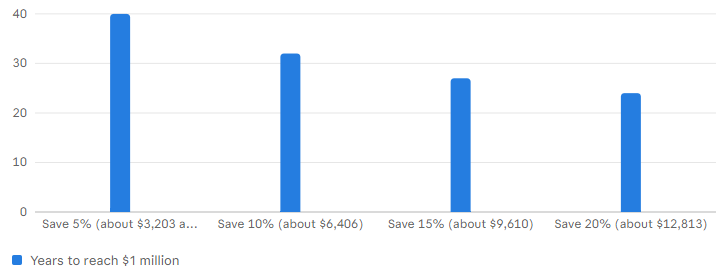
In my illustration on the $64,064 median salary at a constant 7% with 3.5% raises, saving 5% reaches $1 million in about 40 years, 10% in about 32, 15% in about 27 and 20% in about 24. That shows how much the savings rate matters and that a million is reachable on an ordinary income with time, though it is not a forecast, and a million may be too little or more than you need.

On the $64,064 median salary, with 3.5% raises and a constant 7% return: saving 5% reaches $1 million in about 40 years, 10% in about 32, 15% in about 27 and 20% in about 24. A 25x rule target is $1.2 million for $4,000 a month of spending.
Also keep learning. Corley’s survey of 233 millionaires, as reported by Nasdaq, found many spend time improving themselves daily, and BLS data show skills pay: median weekly earnings of $1,752 for those with a bachelor’s degree or more against $993 for high school graduates. The goal is not to become an expert in everything but to understand enough to avoid the big mistakes.

Do one thing today: log in to your payroll or bank and set an automatic transfer to savings or investing, even if it is only 1% more than you save now.
The good news is that the system is within reach. In my illustration, saving 15% of the median salary with 3.5% raises at a constant 7% reaches $1 million in about 27 years, and 20% in about 24. None of it is guaranteed, and a million is not the right number for everyone, but the habits are ordinary, the first steps take minutes and each year you delay costs real money. Start with one move this week.
Research suggests a pattern of ordinary habits rather than secrets: they save and invest consistently, often through a workplace plan, live below their means, avoid expensive debt and keep their costs low. Ramsey’s survey of more than 10,000 millionaires found 79% received no inheritance and about eight in ten invested in a 401(k). These are survey patterns, not guarantees.
How much do I need to retire like a millionaire?
It depends on your spending. Northwestern Mutual’s 2026 study found Americans say they need $1.46 million on average, and people with $1 million or more invested say $2.67 million. A rule of thumb is 25 times your annual retirement spending, which for $4,000 a month is about $1.2 million. Your own number matters more than a survey average.
What is the first thing to do?
Automate. Set up a transfer or payroll deduction so saving happens before you can spend, and capture any employer match first. On the US median full-time salary of $64,064, 15% is about $9,610 a year, or about $801 a month. Start with what you can sustain and raise it by a point each year.
Do I need a financial adviser?
Not necessarily, but help can improve confidence. Northwestern Mutual found 74% of people with an adviser feel confident they will be prepared for retirement against 43% without one, though that is a correlation, and advisers vary in cost and quality. Compare fees and ask whether the adviser is a fiduciary. This is general education, not personal advice.
Is it too late to start if I am in my 40s or 50s?
It is later, but not too late. Fidelity data show average 401(k) balances of about $240,700 for Gen X and $246,500 for ages 60 to 64, well short of the $1.46 million survey number, so many people are catching up. Catch-up contributions of $8,000 are allowed for those 50 and over in 2026, on top of the $24,500 limit. Raise your savings rate, cut costs and consider working a little longer.
Table of Contents
- Millionaires Run a System
- The Short Answer: Nine Moves
- Where Americans Stand in 2026
- Move 1: Pay Yourself First, Automatically
- Move 2: Track a Few Numbers
- Move 3: Fill the Tax-Advantaged Accounts
- Move 4: Own Cheap, Diversified Assets and Stay In
- Move 5: Tame Lifestyle Inflation
- Move 6: Kill Expensive Debt
- Move 7: Build Buffers and Protect Yourself
- Move 8: Plan Your Number, Not the Survey’s
- Move 9: Get Help and Keep Learning
- Your 90-Day Start
- Conclusion
- Frequently Asked Questions
The gap: average 401(k) balances vs. what Americans say they need ($)
Dollars by Fidelity (via Kiplinger and Yahoo Finance) and Northwestern Mutual 2026 Planning & Progress Study (Harris Poll, 4,375 adults); averages hide wide differences
The savings rate sets the timeline: years to $1 million on the median salary
Years by my illustration: $64,064 BLS median salary, 3.5% annual raises, constant 7% return, year-end contributions, no taxes or fees; not a forecast
Your number, not the survey's: the 25x rule by monthly retirement spending ($)
Target ($) by my arithmetic: monthly spending x 12 x 25; the 25x rule is a rough guide cited by Northwestern Mutual, not a guarantee
Millionaires Run a System
Ask someone who has built real wealth how they manage their money and you will rarely hear a secret. You will hear a system: money moves automatically, spending has limits, investments are boring and cheap and someone looks at the numbers regularly. It is mostly process, and process is something anyone can copy, even before they have a million dollars.This guide turns that idea into nine moves, each with 2026 data and a concrete first step, drawing on surveys of wealthy people, Northwestern Mutual’s 2026 study of what Americans think they need and Fidelity’s account data, plus simple arithmetic on the US median salary. Treat the research as patterns, not promises, and the arithmetic as illustration, not forecast.
The Short Answer: Nine Moves
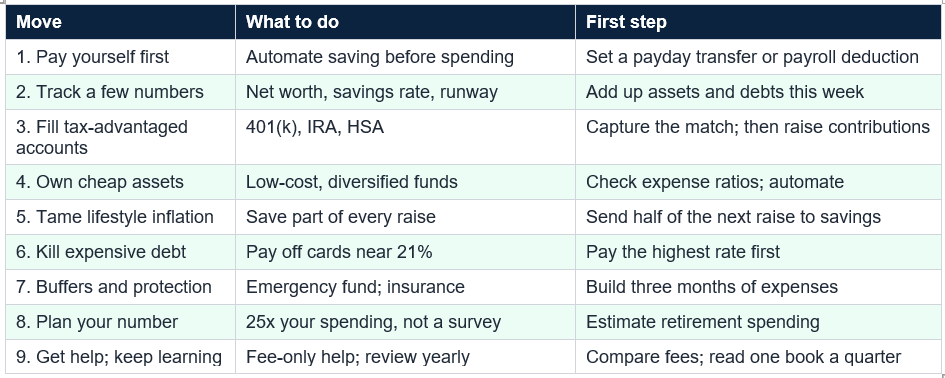
Managing money like a millionaire comes down to nine moves: pay yourself first and automate it; track a few numbers; fill the tax-advantaged accounts; own cheap, diversified assets and stay in; tame lifestyle inflation; kill expensive debt; build buffers; plan your own retirement number; and get help and keep learning. None needs a high income: in my illustration, saving 15% of the US median salary of $64,064, with 3.5% raises and a constant 7% return, reaches $1 million in about 27 years.
Where Americans Stand in 2026
Northwestern Mutual’s 2026 Planning & Progress Study, a Harris Poll of 4,375 adults in January, found that Americans say they need $1.46 million to retire comfortably, up $200,000 in a year, and people with $1 million or more invested say $2.67 million. Forty-six percent do not expect to be financially prepared, and 48% think it somewhat or very likely they will outlive their savings. Fidelity’s second-quarter data show an average 401(k) balance of $240,700 for Gen X and $246,500 for ages 60 to 64, and 19.5% of savers have borrowed from their 401(k).Averages hide a wide spread: Vanguard’s latest survey showed an average 401(k) balance of $148,153 against a median of $38,176. The average 60-to-64-year-old’s balance is about 17% of the $1.46 million survey number, a gap of roughly $1.2 million. The message is not despair but that a system started early matters enormously, and most people are behind the target they say they need.
Northwestern Mutual 2026: average retirement “magic number” $1.46 million; $2.67 million for those with $1 million or more invested; 46% do not expect to be prepared. Fidelity Q2 2026: average 401(k) $240,700 (Gen X) and $246,500 (ages 60–64); 19.5% of savers have a loan.
Move 1: Pay Yourself First, Automatically
The core habit is saving before spending: instead of saving what is left, which is usually nothing, you move money the moment you are paid. Fidelity’s 401(k) millionaires saved about 17.3% of pay, or 25.8% including employer contributions, against a 14.4% average. For a worker at the US median full-time salary of $64,064, 15% is about $9,610 a year, or about $801 a month.Start with your employer’s match, which is part of your pay: a 50% match on the first 6% of that salary is about $1,922 a year. Then raise your rate by a point each year or with each raise, beginning at 5% if 15% is too much today. Set the transfer this week, because a decision made once beats a hundred made monthly.
Move 2: Track a Few Numbers
People who manage money well know their numbers, and you do not need a complicated spreadsheet. Track four: net worth, everything you own minus everything you owe; savings rate, the share of income you save; runway, liquid savings divided by monthly spending; and your independence number, annual retirement spending multiplied by 25. Check them monthly and write them down so you can see the trend.The 25 times rule, which Northwestern Mutual cites among its strategies, turns spending into a target: $3,000 a month implies about $900,000, $4,000 about $1.2 million and $5,000 about $1.5 million. The survey’s $1.46 million equals about $4,870 a month of spending on that rule, which may be more or less than you need.
Move 3: Fill the Tax-Advantaged Accounts
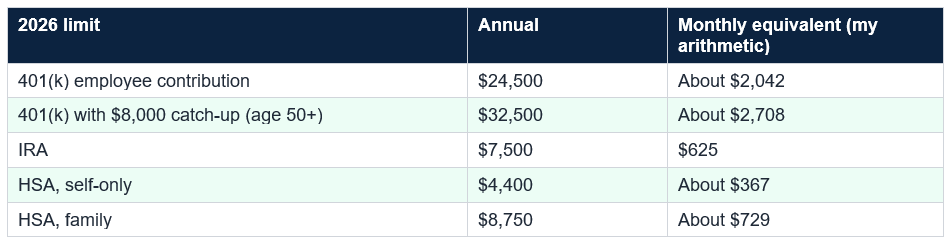
The easiest way to be tax-aware is to use the accounts built for it. In 2026 the 401(k) limit is $24,500, with an extra $8,000 catch-up for those 50 and over; the IRA limit is $7,500; and health savings accounts allow $4,400 for self-only coverage or $8,750 for family coverage, for those eligible. Few people max everything, but it helps to know the targets: maxing a 401(k) takes about $2,042 a month, or $2,708 with the catch-up.A sensible order for many people: capture the employer match, build a starter emergency fund, pay off expensive debt, then raise 401(k) contributions, fund an IRA or HSA and invest any extra in a taxable account. In my illustration, $24,500 a year for 35 years at a constant 7% grows to about $3.4 million. Rules differ by situation, so check eligibility and consider advice on Roth versus traditional choices.
Move 4: Own Cheap, Diversified Assets and Stay In
The evidence favors broad, low-cost funds: 79% of active large-cap funds trailed the S&P 500 in 2025, and Hendrik Bessembinder found the best 4.3% of stocks created all the market’s net wealth, an argument for owning the whole market. Fees compound against you: $500 a month for 30 years at 7% before fees grows to about $606,000 at a 0.03% fund and $538,000 at 0.64%, so check the expense ratio of every fund, including those in your 401(k).Then stay in. DALBAR found the average investor earned about 6.8% a year over 30 years against 10.2% for the S&P 500, largely from badly timed trades, and JPMorgan found missing just the 10 best days over 20 years cut the S&P 500’s annualized return from about 10.6% to about 6.4%. Write down an allocation you can keep through a 35% decline, automate contributions and look at your account less often.
Move 5: Tame Lifestyle Inflation
Income rises, and spending often rises with it. Summaries of Ramsey’s study of more than 10,000 millionaires say most did not earn big salaries and that many used coupons and drove modest cars, which points to the gap between income and spending as the key. A simple tool is a raise rule: send half of every raise to savings and let the other half improve your life.In my illustration, a 3.5% raise on $64,064 is about $2,242 a year, and saving half, about $1,121, lifts your savings rate without feeling like a cut, since you never saw the money. Raising your rate a point or two every year can move you from 5% to 15% in a decade. Decide the rule in advance, before the raise arrives and the new spending plan forms.
Move 6: Kill Expensive Debt
The average credit card rate was about 20.9% in the second quarter, a guaranteed cost few investments can beat. In my illustration, a $5,000 balance at 20.9% paid at $200 a month takes about 34 months and costs about $1,622 in interest, and paying it off is a guaranteed return of about 21%.Also watch borrowing from your future: Fidelity found 19.5% of 401(k) savers have a loan outstanding, 25.7% for Gen X. A 401(k) loan can seem cheap, but it removes money from compounding. Not all debt is bad, since a sensible mortgage can build wealth, but high-interest consumer debt is a leak worth plugging first.
Move 7: Build Buffers and Protect Yourself
Bankrate found only 46% of Americans could cover three months of expenses and 27% six months, and an emergency fund keeps you from selling investments or borrowing at a bad time. Aim for three to six months of essentials in an insured savings account. Beyond cash, it is sensible to insure against big risks, such as health, disability, life insurance if others depend on you and liability, and to have a will in place, general guidance I did not retrieve from a source.The point is to protect the system you are building: a single uninsured event can wipe out years of saving, and buffers keep your investing on track when life surprises you. Review coverage every year or two and keep account beneficiaries up to date.
Move 8: Plan Your Number, Not the Survey’s
The $1.46 million figure is an average of what people say, not a target for you. Northwestern Mutual generally recommends aiming to replace about 80% of pre-retirement income and notes that rules of thumb cannot replace personalized planning, and Fidelity estimates retirees may need roughly 15% of retirement income for medical costs not covered by Medicare. Add up your expected spending, multiply by 25 for a rough target and adjust for Social Security, pensions, taxes and health care.In my illustration on the $64,064 median salary at a constant 7% with 3.5% raises, saving 5% reaches $1 million in about 40 years, 10% in about 32, 15% in about 27 and 20% in about 24. That shows how much the savings rate matters and that a million is reachable on an ordinary income with time, though it is not a forecast, and a million may be too little or more than you need.
On the $64,064 median salary, with 3.5% raises and a constant 7% return: saving 5% reaches $1 million in about 40 years, 10% in about 32, 15% in about 27 and 20% in about 24. A 25x rule target is $1.2 million for $4,000 a month of spending.
Move 9: Get Help and Keep Learning
Northwestern Mutual found that 74% of people with an adviser feel confident they will be financially prepared for retirement against 43% of those without one. That is a correlation, not proof that advisers cause better outcomes, and advisers differ in quality and cost. If you use one, ask whether they are a fiduciary, how they are paid and what the total fee is, since fees compound just as returns do.Also keep learning. Corley’s survey of 233 millionaires, as reported by Nasdaq, found many spend time improving themselves daily, and BLS data show skills pay: median weekly earnings of $1,752 for those with a bachelor’s degree or more against $993 for high school graduates. The goal is not to become an expert in everything but to understand enough to avoid the big mistakes.
Your 90-Day Start
In the first 30 days, set up automatic saving, capture any employer match and list your net worth. In days 31 to 60, build a starter emergency fund of at least $1,000, rank your debts by rate and attack the highest, and check every fund’s expense ratio. In days 61 to 90, raise your contribution a point, set up a raise rule and write down your estimated retirement spending and 25 times number. Review monthly and adjust yearly.Do one thing today: log in to your payroll or bank and set an automatic transfer to savings or investing, even if it is only 1% more than you save now.
Conclusion
Managing money like a millionaire is less about a secret and more about a system: automate saving, track a few numbers, use the tax-advantaged accounts, own cheap diversified assets and stay in, tame lifestyle inflation, kill expensive debt, build buffers, plan your own number and get help when you need it. The 2026 data show how many people are behind: the average Gen X 401(k) is $240,700 and the average for ages 60 to 64 $246,500, against a survey “magic number” of $1.46 million, with 19.5% of savers borrowing from their plans.The good news is that the system is within reach. In my illustration, saving 15% of the median salary with 3.5% raises at a constant 7% reaches $1 million in about 27 years, and 20% in about 24. None of it is guaranteed, and a million is not the right number for everyone, but the habits are ordinary, the first steps take minutes and each year you delay costs real money. Start with one move this week.
Frequently Asked Questions
How do millionaires manage their money?Research suggests a pattern of ordinary habits rather than secrets: they save and invest consistently, often through a workplace plan, live below their means, avoid expensive debt and keep their costs low. Ramsey’s survey of more than 10,000 millionaires found 79% received no inheritance and about eight in ten invested in a 401(k). These are survey patterns, not guarantees.
How much do I need to retire like a millionaire?
It depends on your spending. Northwestern Mutual’s 2026 study found Americans say they need $1.46 million on average, and people with $1 million or more invested say $2.67 million. A rule of thumb is 25 times your annual retirement spending, which for $4,000 a month is about $1.2 million. Your own number matters more than a survey average.
What is the first thing to do?
Automate. Set up a transfer or payroll deduction so saving happens before you can spend, and capture any employer match first. On the US median full-time salary of $64,064, 15% is about $9,610 a year, or about $801 a month. Start with what you can sustain and raise it by a point each year.
Do I need a financial adviser?
Not necessarily, but help can improve confidence. Northwestern Mutual found 74% of people with an adviser feel confident they will be prepared for retirement against 43% without one, though that is a correlation, and advisers vary in cost and quality. Compare fees and ask whether the adviser is a fiduciary. This is general education, not personal advice.
Is it too late to start if I am in my 40s or 50s?
It is later, but not too late. Fidelity data show average 401(k) balances of about $240,700 for Gen X and $246,500 for ages 60 to 64, well short of the $1.46 million survey number, so many people are catching up. Catch-up contributions of $8,000 are allowed for those 50 and over in 2026, on top of the $24,500 limit. Raise your savings rate, cut costs and consider working a little longer.
0 Comments
Be the first to share your thoughts on this article.