

Mental / Intellectual Development
The Strange Feeling So Many Adults Can't Explain

130 million US adults are navigating daily life while feeling fundamentally disconnected. The WHO links social isolation to 871,000 deaths annually. 1 in 8 adults has no close friends. And most people experiencing it don’t have the words for it.
There is a feeling that a remarkable number of adults share and almost none of them have adequate words for. It sits somewhere between loneliness and emptiness, but it is neither quite right. It is present in people who are busy, who have families, who have jobs and social lives and phones full of contacts. It arrives most often in the quiet moments — the end of an evening that was objectively fine, the Sunday afternoon that has no obvious problem, the moment after a perfectly pleasant social interaction when something still feels like it is missing. Some people describe it as feeling invisible. Some describe it as going through the motions. Some can’t describe it at all, which is part of what makes it so persistent: it is hard to address something you cannot name. The research has a name for what is underneath it. The WHO Commission on Social Connection released its landmark report in June 2025, the US Gallup survey has recorded a two-year high in adult loneliness, and 130 million Americans are now documented to be navigating daily life while feeling fundamentally disconnected. This article is about that feeling, where it comes from, why it is so common, and why calling it personal weakness is the wrong diagnosis.
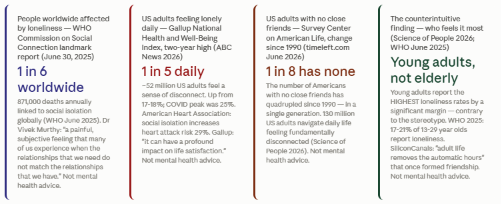
The research has been documenting this feeling with increasing precision. The WHO Commission on Social Connection’s landmark June 2025 report found that 1 in 6 people worldwide is affected by loneliness. Gallup’s most recent data marks a two-year high: 1 in 5 US adults reports feeling lonely on a daily basis. Science of People’s 2026 compilation identifies approximately 130 million Americans navigating daily life while feeling fundamentally disconnected from others. These numbers describe an experience so widespread it cannot be attributed to individual failure. It has structural causes. It has a research literature. And it is far more common than most people experiencing it realise, partly because the feeling itself inhibits disclosure.
WHO Commission on Social Connection (June 30, 2025): 1 in 6 people worldwide affected by loneliness. Gallup (two-year high): 1 in 5 US adults feel lonely daily; ~52 million adults disconnected. Science of People 2026: ~130 million Americans navigating daily life feeling fundamentally disconnected.
You are not the only one: WHO Commission on Social Connection (June 30, 2025): Dr Vivek Murthy described loneliness as 'a painful, subjective feeling that many of us experience when the relationships that we need do not match the relationships that we have.' Gallup: 52 million US adults feel a sense of disconnect. The experience is nearly always harder to describe than to feel.
The psychology behind it: Newsweek 2026: 'People can become surrounded by communication while feeling that nobody actually knows them.' Jeffrey Hall (University of Kansas): adult life removes the 'automatic hours' that once produced friendship — adult life replaces repetition with coordination. For many adults, 'the harder shortage is continuity' (SiliconCanals citing Hall).
WHO Commission on Social Connection (June 30, 2025): 1 in 6 worldwide affected by loneliness; 871,000 deaths per year linked to social isolation. Gallup: 1 in 5 US adults lonely daily; ~52 million adults disconnected (two-year high). Survey Center on American Life: Americans with no close friends quadrupled since 1990; 1 in 8 now has no close friends. 130 million US adults navigating daily life while feeling fundamentally disconnected (Science of People 2026).
The structural reason: Psychology Today (February 2026): 'Third places are now on the decline as fewer people go to bars, join in-person social clubs, or attend religious services.' Finlay et al. 2025 (University of Colorado Boulder; cited Axios July 2026): rapid decline in third place availability between 2019 and 2021 — Census tract-level data. Timeleft.com: Ray Oldenburg's third place concept — where casual, repeated contact turned acquaintances into friends.
BriefGlance September 2026: 'We are too busy, too geographically dispersed, and too exhausted to maintain meaningful relationships.' Newsweek 2026: 'We have made communication almost instantaneous while allowing many of the places and rituals that once produced actual relationships to weaken.' Timeleft.com June 2026: 'A packed social life can coexist with deep emotional loneliness, and often does.
Science of People 2026: young adults report the HIGHEST loneliness rates by a significant margin — contrary to the elderly stereotype. WHO June 2025: 17-21% of 13-29 year olds report loneliness. SiliconCanals citing Jeffrey Hall (University of Kansas): 'adult life removes the automatic hours.' The shortage is continuity — the same people, without arrangement, over time.
WHO Commission June 2025: loneliness increases risk of stroke, heart disease, diabetes, cognitive decline, premature death. American Heart Association: social isolation increases heart attack risk 29%. Social isolation risks comparable to smoking 15 cigarettes a day. $6.7-8B excess Medicare spending annually due to social isolation in older adults (BriefGlance Sep 2026). Lonely teens 22% more likely to underperform academically (WHO 2025).
Approach What the research says Why it works (or doesn’t) The caveat
Joining a recurring, in-person group (sport, hobby, class) Psychology Today February 2026; Finlay/Axios July 2026: structured, recurring, interest-based, in-person interaction is the most effective substitute for lost third places. Creates the automatic repetition that forms friendships — same people, regular contact, without requiring constant individual coordination. It takes time. Jeffrey Hall's research (University of Kansas): ~50 hours of shared time to move from acquaintance to casual friend. Consistency over weeks and months matters more than intensity.
Attending the same places regularly (becoming a regular) Newsweek 2026: 'A healthier society begins with places where people can keep showing up until they are no longer strangers.' Timeleft.com June 2026: Ray Oldenburg's third place research — repeated low-stakes contact is the mechanism. The relationship is built through repetition, not through single meaningful conversations. Being a familiar face IS the precursor to friendship. Requires proximity to accessible spaces. Axios/Finlay research shows third place access is uneven — majority-Black, low-income, and rural communities have experienced disproportionate losses.
Initiating lower-stakes contact (message, invitation) SiliconCanals citing Jeffrey Hall: adult life requires coordination rather than automatic co-presence. Coordination is harder than co-presence but not ineffective. A specific invitation produces more connection than a general willingness to hang out. Requires accepting that adult friendship requires more explicit initiation than it did in education settings. The cost of initiating is lower than the cost of waiting.
Individual therapy/counselling Useful for processing the experience and developing strategies. Not a substitute for the structural solution. A therapist can help with the internal experience of loneliness — the shame, the difficulty disclosing, the cognitive patterns. It cannot provide the connection itself. Psychology Today February 2026: 'not enough to tell people to practice self-care, get a therapist, or put down their phones.' Therapy is not a complete solution to a structural problem. Consult a qualified professional.
AI companions / wellness apps BriefGlance September 2026: 2026 data empirically rejects the premise that synthetic friends address loneliness. Adults rarely or never interact with AI companions in meaningful social terms. Does not replicate face-to-face, embodied, continued human relationship. Dr Murthy WHO June 2025: 'face-to-face interaction without distraction of technology is very important.' Not a solution to structural disconnection. May reduce the urgency felt to seek real connection, potentially making the underlying deficit worse over time.
The structural causes — the decline of third places, the removal of automatic social time in adulthood, the replacement of depth with volume in communication, the geographical dispersal that spreads social networks thin — do not have simple individual solutions. But understanding them transforms the way the feeling is experienced. It changes it from something private and shameful into something documented, widespread, and meaningful. The feeling is pointing at something real. It is asking for repeated, low-stakes, face-to-face contact with specific people over time. That is the research conclusion. The feeling has been trying to tell you the same thing. Not mental health advice. If this feeling is persistent, severe, or significantly affecting your daily life, please speak with a qualified healthcare or mental health professional.
Yes — and the research confirms this is one of the most misunderstood features of modern loneliness. Timeleft.com's June 2026 analysis states directly: 'A packed social life can coexist with deep emotional loneliness, and often does.' Science of People's 2026 compilation describes it as 'the quiet ache of feeling unseen, even in a crowd.' The distinction researchers draw is between social isolation (objectively lacking people around you) and loneliness (the felt gap between the relationships you need and the ones you have). Newsweek's 2026 essay puts it precisely: 'People can become surrounded by communication while feeling that nobody actually knows them.' The WHO Commission on Social Connection's June 2025 report reflects this: loneliness is defined as the subjective feeling, not the objective condition of aloneness. Having contacts, having a social life, having a busy calendar is compatible with significant loneliness.
Why do adults lose close friends as they get older?
It is structural, not personal. SiliconCanals' synthesis of Jeffrey Hall's friendship research at the University of Kansas identifies the key mechanism: 'Adult life removes the automatic hours.' In school and university, friendship time accumulated without arrangement — the same people, every day, for years, through forced proximity. Adult life replaces that automatic co-presence with coordination: you now have to schedule what used to just happen. Hall's research found it takes approximately 50 hours of shared time to move from acquaintance to casual friend. When those hours must be deliberately arranged around work, family, and commuting, many relationships quietly attenuate rather than being actively ended. SiliconCanals: 'For many adults, the harder shortage is continuity.' This is not a reflection of how much people value their friendships. It is a reflection of how the structure of adult life has changed.
Why are young adults more likely to feel lonely than older people?
The data consistently surprises people on this point. Science of People's 2026 analysis states: 'Contrary to the stereotype that elderly people are the loneliest, current research points in a surprising direction: young adults report the highest loneliness rates by a significant margin.' The WHO Commission's June 2025 report found 17-21% of those aged 13-29 reported loneliness (highest among teenagers). The structural reason is straightforward: young adults in their mid-to-late twenties and thirties are most likely to have recently experienced the life transitions that dismantle existing social structures without automatically replacing them — leaving university, changing jobs, moving cities, relationship changes. Timeleft.com's June 2026 analysis: 'Loneliness in adults is almost always the result of something changing, often a life stage shift that slowly and subtly dismantled the social structure you had, bit by bit, without replacing it with anything new.
What is a 'third place' and why does losing them matter so much?
A third place, in urban sociologist Ray Oldenburg's definition, is any space that is neither your home (first place) nor your workplace (second place) — pubs, cafes, community centres, churches, libraries, clubs. Psychology Today's February 2026 piece on third places explains why they matter: they create 'the routine, low-stakes contact that keeps people from drifting into isolation.' Timeleft.com adds the friendship formation mechanism: third places are where 'casual, repeated contact happened naturally, and where acquaintances slowly became friends.' The reason their decline matters is that friendship formation requires repeated, unplanned contact with the same people over time. Third places provided that automatically. Without them, that contact must be deliberately arranged — and the coordination cost is high enough that many people simply don't get enough of it. Finlay et al.'s 2025 research (cited Axios July 2026) found a rapid decline in third place availability between 2019 and 2021, with disproportionate impact on majority-Black, low-income, and rural communities.
What actually helps with this kind of loneliness?
The research converges on structural rather than individual solutions. Psychology Today's February 2026 article is explicit: 'It is not enough to tell people to practice self-care, get a therapist, or put down their phones.' The mechanism the research identifies for building genuine connection is repeated, low-stakes, face-to-face contact with the same people over time. Practically, this means: joining recurring, in-person groups where the same people show up regularly (sport, hobby, class, volunteering); becoming a regular somewhere; initiating specific invitations rather than vague openness to socialising. Newsweek 2026: 'A healthier society begins with creating places where people can keep showing up until they are no longer strangers.' BriefGlance September 2026 found that AI companions and wellness apps are not addressing the gap — the data empirically rejects synthetic substitutes. If the feeling is persistent, severe, or significantly affecting daily life, speaking with a qualified healthcare or mental health professional is the right step. Sources: Psychology Today February 2026; Newsweek 2026; BriefGlance September 2026; WHO June 2025.
There is a feeling that a remarkable number of adults share and almost none of them have adequate words for. It sits somewhere between loneliness and emptiness, but it is neither quite right. It is present in people who are busy, who have families, who have jobs and social lives and phones full of contacts. It arrives most often in the quiet moments — the end of an evening that was objectively fine, the Sunday afternoon that has no obvious problem, the moment after a perfectly pleasant social interaction when something still feels like it is missing. Some people describe it as feeling invisible. Some describe it as going through the motions. Some can’t describe it at all, which is part of what makes it so persistent: it is hard to address something you cannot name. The research has a name for what is underneath it. The WHO Commission on Social Connection released its landmark report in June 2025, the US Gallup survey has recorded a two-year high in adult loneliness, and 130 million Americans are now documented to be navigating daily life while feeling fundamentally disconnected. This article is about that feeling, where it comes from, why it is so common, and why calling it personal weakness is the wrong diagnosis.
Table of Contents
- The Feeling Without a Name
- The Feeling That Doesn’t Have a Name
- Why It Is Harder to Name in Adulthood
- The Numbers That Make It Structural, Not Personal
- What Has Actually Changed: The Third Place Collapse
- The Busy-but-Empty Paradox
- Why Young Adults Feel It Most (and Why No One Expects It)
- The Health Cost Nobody Talks About Enough
- What This Feeling Is Trying to Tell You
- What Can Actually Help (and What Cannot)
- Conclusion: The Feeling Is Information, Not Failure
- Frequently Asked Questions
The Feeling Without a Name
It does not announce itself like grief or anxiety. It does not arrive with a clear cause or a clear diagnosis. It exists more as a background quality to the day: a flatness underneath the busyness, a sense that something is slightly off without a compelling reason why. People who experience it often hesitate before naming it, because the available words feel wrong. ‘Lonely’ does not fit if you have people around you. ‘Depressed’ does not fit if you are functioning. ‘Unhappy’ does not fit if you have much to be grateful for. The feeling sits in the gaps between those words — a quiet, persistent, unnameable sense of disconnection from the life being lived.The research has been documenting this feeling with increasing precision. The WHO Commission on Social Connection’s landmark June 2025 report found that 1 in 6 people worldwide is affected by loneliness. Gallup’s most recent data marks a two-year high: 1 in 5 US adults reports feeling lonely on a daily basis. Science of People’s 2026 compilation identifies approximately 130 million Americans navigating daily life while feeling fundamentally disconnected from others. These numbers describe an experience so widespread it cannot be attributed to individual failure. It has structural causes. It has a research literature. And it is far more common than most people experiencing it realise, partly because the feeling itself inhibits disclosure.
WHO Commission on Social Connection (June 30, 2025): 1 in 6 people worldwide affected by loneliness. Gallup (two-year high): 1 in 5 US adults feel lonely daily; ~52 million adults disconnected. Science of People 2026: ~130 million Americans navigating daily life feeling fundamentally disconnected.
The Feeling That Doesn’t Have a Name
Most people who experience it describe it in the same fumbling, approximate terms. It is not quite sadness. It is not depression, at least not obviously. It is not loneliness in the classical sense, because they might be perfectly well surrounded by people at work, at home, in social media threads and group chats. It is more like a quiet background sense that something is missing — a kind of flatness underneath the busyness, a distance that persists even when everything is technically fine. ‘Feeling lonely even around people,’ is how timeleft.com put it in their June 2026 analysis of the loneliness research. The phrase captures the paradox precisely: the feeling is not about being alone. It is about a gap. Dr Vivek Murthy, co-chair of the WHO Commission on Social Connection and former US Surgeon General, defined loneliness in its landmark June 2025 report as ‘a painful, subjective feeling that many of us experience when the relationships that we need do not match the relationships that we have.’ That gap between the relationships we need and the ones we have is not always visible from the outside. From the outside, a person experiencing it may look fine: employed, connected, socially functional. The flatness is internal, structural, and often unspoken.You are not the only one: WHO Commission on Social Connection (June 30, 2025): Dr Vivek Murthy described loneliness as 'a painful, subjective feeling that many of us experience when the relationships that we need do not match the relationships that we have.' Gallup: 52 million US adults feel a sense of disconnect. The experience is nearly always harder to describe than to feel.
Why It Is Harder to Name in Adulthood
Part of what makes the feeling strange is how poorly the available vocabulary fits it. The word ‘lonely’ carries connotations of isolation, of being alone, of a lack of company. Many of the people experiencing it have plenty of company. They are busy. They have phones full of contacts. Their calendars are not empty. The Science of People’s 2026 analysis of loneliness statistics captures the language problem directly: ‘the quiet ache of feeling unseen, even in a crowd.’ Newsweek’s 2026 piece on the loneliness epidemic identifies the specific disconnect: ‘People can become surrounded by communication while feeling that nobody actually knows them.’ These two phrases point at the same structural problem: the channels of connection have multiplied, but something about the depth or quality of what passes through them has changed. The timeleft.com analysis added the life-stage dimension: ‘Loneliness in adults is almost always the result of something changing, often a life stage shift that slowly and subtly dismantled the social structure you had, bit by bit, without replacing it with anything new.’ The university friend group scatters after graduation. The work colleagues change when you change jobs. The neighbourhood connection never quite forms after the move. None of these are dramatic events. All of them quietly reduce the number of people who know you, really know you, over time.The psychology behind it: Newsweek 2026: 'People can become surrounded by communication while feeling that nobody actually knows them.' Jeffrey Hall (University of Kansas): adult life removes the 'automatic hours' that once produced friendship — adult life replaces repetition with coordination. For many adults, 'the harder shortage is continuity' (SiliconCanals citing Hall).
The Numbers That Make It Structural, Not Personal
The most important thing to understand about this feeling is that it is not a personal failure. The scale of the data makes that clear. The WHO Commission on Social Connection released its landmark global report on June 30, 2025, finding that 1 in 6 people worldwide is affected by loneliness, and that social isolation is now linked to an estimated 871,000 deaths every year globally. In the US, Gallup’s survey marked a two-year high: 1 in 5 US adults reports feeling lonely on a daily basis, with Gallup estimating approximately 52 million US adults feeling a sense of disconnect. The Survey Center on American Life found that the number of Americans with no close friends at all has quadrupled since 1990 — 1 in 8 adults now has nobody they consider a close friend, a change that happened over a single generation. Science of People’s 2026 compilation puts a more startling number on the same phenomenon: approximately 130 million adults in the US are navigating daily life while feeling fundamentally disconnected. The BriefGlance September 2026 analysis of the most recent data concluded bluntly: from 2025 to 2026, the metrics have barely budged, revealing a nation fundamentally disconnected from itself. When 130 million people share a private, unspoken feeling, it is no longer private. It is epidemiological.WHO Commission on Social Connection (June 30, 2025): 1 in 6 worldwide affected by loneliness; 871,000 deaths per year linked to social isolation. Gallup: 1 in 5 US adults lonely daily; ~52 million adults disconnected (two-year high). Survey Center on American Life: Americans with no close friends quadrupled since 1990; 1 in 8 now has no close friends. 130 million US adults navigating daily life while feeling fundamentally disconnected (Science of People 2026).
What Has Actually Changed: The Third Place Collapse
The feeling does not come from nowhere. It has a structural explanation that the research has been building toward for several years. Psychology Today’s February 2026 piece on the spaces that foster friendship names it directly: ‘Third places are now on the decline as fewer people go to bars, join in-person social clubs or associations, or attend religious services.’ Third places — a concept developed by urban sociologist Ray Oldenburg — are the spaces that are neither home nor work: the pub, the cafe, the library, the community centre, the church hall, the local club. They are the places where, as timeleft.com puts it, ‘casual, repeated contact happened naturally, and where acquaintances slowly became friends.’ Repeated, low-stakes, unplanned contact with the same people over time is the mechanism through which friendships actually form. Jeffrey Hall’s friendship research at the University of Kansas found that it takes approximately 50 hours of time together to move from acquaintance to casual friend. That time used to accumulate automatically in third places. It no longer does, because the third places are disappearing. A 2025 report by Jessica Finlay and colleagues at the University of Colorado Boulder found a rapid decline in third place availability between 2019 and 2021, using Census tract-level data. Axios’ July 2026 coverage of the Finlay research was direct: ‘Losing essential sites of connection and care — like senior centres and churches — risks escalating America’s loneliness epidemic.The structural reason: Psychology Today (February 2026): 'Third places are now on the decline as fewer people go to bars, join in-person social clubs, or attend religious services.' Finlay et al. 2025 (University of Colorado Boulder; cited Axios July 2026): rapid decline in third place availability between 2019 and 2021 — Census tract-level data. Timeleft.com: Ray Oldenburg's third place concept — where casual, repeated contact turned acquaintances into friends.
The Busy-but-Empty Paradox
One of the most reported features of this feeling is the coexistence of busyness and emptiness. The day is full. The schedule is dense. The phone has notifications in it. And yet underneath all of it there is a flatness, an absence of something that is hard to articulate because the external evidence for its presence should be convincing. BriefGlance’s September 2026 analysis of the American loneliness data put the structural explanation plainly: ‘We are too busy, too geographically dispersed, and too exhausted to maintain meaningful relationships.’ The busyness is not separate from the feeling. It is partly its cause. Timeleft.com’s June 2026 analysis names the syndrome explicitly: ‘You’re busy, but nothing feels particularly meaningful or fulfilling.’ Newsweek’s 2026 essay on why an ever-more-connected America is also an ever-more-lonely America identified the mechanism: ‘We have made communication almost instantaneous while allowing many of the places and rituals that once produced actual relationships to weaken.’ The speed of communication and the depth of connection are not the same thing. The quantity of contact and the quality of being known are not the same thing. The feeling that so many adults can’t quite explain is partly the registration of that gap — between the volume of contact available and the depth of genuine connection present.BriefGlance September 2026: 'We are too busy, too geographically dispersed, and too exhausted to maintain meaningful relationships.' Newsweek 2026: 'We have made communication almost instantaneous while allowing many of the places and rituals that once produced actual relationships to weaken.' Timeleft.com June 2026: 'A packed social life can coexist with deep emotional loneliness, and often does.
Why Young Adults Feel It Most (and Why No One Expects It)
The counterintuitive finding in the loneliness research is who feels it most. The stereotype of loneliness is the elderly person living alone. The data tells a different story. Science of People’s 2026 analysis is direct: ‘Contrary to the stereotype that elderly people are the loniest, current research points in a surprising direction: young adults report the highest loneliness rates by a significant margin.’ The WHO’s June 2025 report found that 17-21% of individuals aged 13-29 reported feeling lonely, with the highest rates among teenagers. This makes structural sense once you understand how friendships actually form. Young adults in their mid-to-late twenties and thirties are precisely the demographic most likely to have recently experienced the life transitions that dismantle existing social structures without automatically building new ones: leaving university, changing jobs, moving cities, ending or starting significant relationships. The timeleft.com analysis captures it: ‘Loneliness in adults is almost always the result of something changing, often a life stage shift that slowly and subtly dismantled the social structure you had, bit by bit, without replacing it with anything new.’ SiliconCanals’ research synthesis adds the most important practical point: adult life no longer provides the automatic accumulation of time that builds friendships. ‘Adult life removes the automatic hours.’ The school and university environments where most close friendships form operate on forced co-presence: the same people, every day, without arrangement, for years. Adult life replaces that with coordination. You now have to schedule what used to just happen.Science of People 2026: young adults report the HIGHEST loneliness rates by a significant margin — contrary to the elderly stereotype. WHO June 2025: 17-21% of 13-29 year olds report loneliness. SiliconCanals citing Jeffrey Hall (University of Kansas): 'adult life removes the automatic hours.' The shortage is continuity — the same people, without arrangement, over time.
The Health Cost Nobody Talks About Enough
The feeling is not merely unpleasant. The health implications of chronic loneliness and social isolation are among the most significant and least discussed public health findings of the past decade. The WHO Commission’s 2025 report identified that loneliness and social isolation increase the risk of stroke, heart disease, diabetes, cognitive decline, and premature death. Social isolation carries health risks comparable to smoking 15 cigarettes a day — a comparison that the US Surgeon General’s office has used and that timeleft.com cites in its June 2026 analysis. The Gallup ABC News report found that social isolation can increase the risk of a heart attack by 29% (American Heart Association research). BriefGlance’s September 2026 analysis put the financial cost on the table: $6.7-8 billion annually in excess Medicare spending due to social isolation among older adults. Adults who are lonely find it harder to find or maintain employment and may earn less over time (WHO 2025). WHO’s 2025 findings found that lonely teenagers are 22% more likely to underperform academically. These are not the consequences of a personal failure of social effort. They are the predictable outcomes of a structural environment that has systematically removed the infrastructure for human connection and then left individuals to solve the resulting deficit through individual self-improvement. Psychology Today’s February 2026 piece on third places made this point with precision: ‘If we want to understand why so many adults feel disconnected, it is not enough to tell people to practice self-care, get a therapist, or put down their phones.WHO Commission June 2025: loneliness increases risk of stroke, heart disease, diabetes, cognitive decline, premature death. American Heart Association: social isolation increases heart attack risk 29%. Social isolation risks comparable to smoking 15 cigarettes a day. $6.7-8B excess Medicare spending annually due to social isolation in older adults (BriefGlance Sep 2026). Lonely teens 22% more likely to underperform academically (WHO 2025).
What This Feeling Is Trying to Tell You
The feeling most adults can’t quite explain is not a malfunction. It is information. It is the human social nervous system registering a deficit between the connection it needs and the connection it has, in exactly the terms Dr Murthy used in the WHO Commission report. The difficulty is that the environment has changed in ways that make that deficit increasingly likely and increasingly hard to address through individual effort alone. The third places are fewer. The automatic time is gone. The coordination required to maintain friendships is high enough that many relationships quietly attenuate rather than being actively ended. BriefGlance’s September 2026 conclusion about the data is worth sitting with: ‘The message from the 2026 data is unequivocal: social connection cannot be left to chance, nor can it be outsourced to algorithms.’ The 2026 data explicitly found that startups promising synthetic friendship attracted massive valuations but the empirical reality rejects the premise. Most adults rarely or never interact with AI companions in meaningful social terms. What the research has consistently found since the WHO’s June 2025 landmark report is that face-to-face, repeated, low-stakes contact in shared physical spaces is the mechanism through which human connection forms and sustains itself. The feeling is a signal pointing toward that mechanism. It is not an instruction to download a wellness app. If this feeling is persistent, severe, or significantly affecting daily life, please speak with a qualified healthcare or mental health professional.What Can Actually Help (and What Cannot)
The research is clear on what the loneliness epidemic is not a failure of, and that framing determines what can actually help. It is not a failure of self-awareness, wellness habits, or individual social effort, which means that the prescribed solutions in those categories — journaling, therapy, phone-free time, ‘putting yourself out there’ — are insufficient as complete answers. BriefGlance’s September 2026 analysis is direct: ‘Social connection cannot be left to chance, nor can it be outsourced to algorithms.’ The 2026 data found that AI companions are not filling the gap. The evidence points to structural responses to a structural problem.Approach What the research says Why it works (or doesn’t) The caveat
Joining a recurring, in-person group (sport, hobby, class) Psychology Today February 2026; Finlay/Axios July 2026: structured, recurring, interest-based, in-person interaction is the most effective substitute for lost third places. Creates the automatic repetition that forms friendships — same people, regular contact, without requiring constant individual coordination. It takes time. Jeffrey Hall's research (University of Kansas): ~50 hours of shared time to move from acquaintance to casual friend. Consistency over weeks and months matters more than intensity.
Attending the same places regularly (becoming a regular) Newsweek 2026: 'A healthier society begins with places where people can keep showing up until they are no longer strangers.' Timeleft.com June 2026: Ray Oldenburg's third place research — repeated low-stakes contact is the mechanism. The relationship is built through repetition, not through single meaningful conversations. Being a familiar face IS the precursor to friendship. Requires proximity to accessible spaces. Axios/Finlay research shows third place access is uneven — majority-Black, low-income, and rural communities have experienced disproportionate losses.
Initiating lower-stakes contact (message, invitation) SiliconCanals citing Jeffrey Hall: adult life requires coordination rather than automatic co-presence. Coordination is harder than co-presence but not ineffective. A specific invitation produces more connection than a general willingness to hang out. Requires accepting that adult friendship requires more explicit initiation than it did in education settings. The cost of initiating is lower than the cost of waiting.
Individual therapy/counselling Useful for processing the experience and developing strategies. Not a substitute for the structural solution. A therapist can help with the internal experience of loneliness — the shame, the difficulty disclosing, the cognitive patterns. It cannot provide the connection itself. Psychology Today February 2026: 'not enough to tell people to practice self-care, get a therapist, or put down their phones.' Therapy is not a complete solution to a structural problem. Consult a qualified professional.
AI companions / wellness apps BriefGlance September 2026: 2026 data empirically rejects the premise that synthetic friends address loneliness. Adults rarely or never interact with AI companions in meaningful social terms. Does not replicate face-to-face, embodied, continued human relationship. Dr Murthy WHO June 2025: 'face-to-face interaction without distraction of technology is very important.' Not a solution to structural disconnection. May reduce the urgency felt to seek real connection, potentially making the underlying deficit worse over time.
Conclusion
The strange feeling so many adults can’t explain is not a personal flaw. It is not a symptom of insufficient gratitude, insufficient socialising, or insufficient effort. It is the human social nervous system registering, with considerable accuracy, a deficit between the connection it needs and the connection the current environment provides. The WHO Commission’s 2025 report made this as official as global health data can make anything: 1 in 6 people worldwide is affected. Dr Murthy described it as a mismatch between the relationships we need and the relationships we have. The data from 2025 to 2026 shows the mismatch has barely narrowed.The structural causes — the decline of third places, the removal of automatic social time in adulthood, the replacement of depth with volume in communication, the geographical dispersal that spreads social networks thin — do not have simple individual solutions. But understanding them transforms the way the feeling is experienced. It changes it from something private and shameful into something documented, widespread, and meaningful. The feeling is pointing at something real. It is asking for repeated, low-stakes, face-to-face contact with specific people over time. That is the research conclusion. The feeling has been trying to tell you the same thing. Not mental health advice. If this feeling is persistent, severe, or significantly affecting your daily life, please speak with a qualified healthcare or mental health professional.
12. Frequently Asked Questions
Is it normal to feel lonely even when you have people in your life?Yes — and the research confirms this is one of the most misunderstood features of modern loneliness. Timeleft.com's June 2026 analysis states directly: 'A packed social life can coexist with deep emotional loneliness, and often does.' Science of People's 2026 compilation describes it as 'the quiet ache of feeling unseen, even in a crowd.' The distinction researchers draw is between social isolation (objectively lacking people around you) and loneliness (the felt gap between the relationships you need and the ones you have). Newsweek's 2026 essay puts it precisely: 'People can become surrounded by communication while feeling that nobody actually knows them.' The WHO Commission on Social Connection's June 2025 report reflects this: loneliness is defined as the subjective feeling, not the objective condition of aloneness. Having contacts, having a social life, having a busy calendar is compatible with significant loneliness.
Why do adults lose close friends as they get older?
It is structural, not personal. SiliconCanals' synthesis of Jeffrey Hall's friendship research at the University of Kansas identifies the key mechanism: 'Adult life removes the automatic hours.' In school and university, friendship time accumulated without arrangement — the same people, every day, for years, through forced proximity. Adult life replaces that automatic co-presence with coordination: you now have to schedule what used to just happen. Hall's research found it takes approximately 50 hours of shared time to move from acquaintance to casual friend. When those hours must be deliberately arranged around work, family, and commuting, many relationships quietly attenuate rather than being actively ended. SiliconCanals: 'For many adults, the harder shortage is continuity.' This is not a reflection of how much people value their friendships. It is a reflection of how the structure of adult life has changed.
Why are young adults more likely to feel lonely than older people?
The data consistently surprises people on this point. Science of People's 2026 analysis states: 'Contrary to the stereotype that elderly people are the loneliest, current research points in a surprising direction: young adults report the highest loneliness rates by a significant margin.' The WHO Commission's June 2025 report found 17-21% of those aged 13-29 reported loneliness (highest among teenagers). The structural reason is straightforward: young adults in their mid-to-late twenties and thirties are most likely to have recently experienced the life transitions that dismantle existing social structures without automatically replacing them — leaving university, changing jobs, moving cities, relationship changes. Timeleft.com's June 2026 analysis: 'Loneliness in adults is almost always the result of something changing, often a life stage shift that slowly and subtly dismantled the social structure you had, bit by bit, without replacing it with anything new.
What is a 'third place' and why does losing them matter so much?
A third place, in urban sociologist Ray Oldenburg's definition, is any space that is neither your home (first place) nor your workplace (second place) — pubs, cafes, community centres, churches, libraries, clubs. Psychology Today's February 2026 piece on third places explains why they matter: they create 'the routine, low-stakes contact that keeps people from drifting into isolation.' Timeleft.com adds the friendship formation mechanism: third places are where 'casual, repeated contact happened naturally, and where acquaintances slowly became friends.' The reason their decline matters is that friendship formation requires repeated, unplanned contact with the same people over time. Third places provided that automatically. Without them, that contact must be deliberately arranged — and the coordination cost is high enough that many people simply don't get enough of it. Finlay et al.'s 2025 research (cited Axios July 2026) found a rapid decline in third place availability between 2019 and 2021, with disproportionate impact on majority-Black, low-income, and rural communities.
What actually helps with this kind of loneliness?
The research converges on structural rather than individual solutions. Psychology Today's February 2026 article is explicit: 'It is not enough to tell people to practice self-care, get a therapist, or put down their phones.' The mechanism the research identifies for building genuine connection is repeated, low-stakes, face-to-face contact with the same people over time. Practically, this means: joining recurring, in-person groups where the same people show up regularly (sport, hobby, class, volunteering); becoming a regular somewhere; initiating specific invitations rather than vague openness to socialising. Newsweek 2026: 'A healthier society begins with creating places where people can keep showing up until they are no longer strangers.' BriefGlance September 2026 found that AI companions and wellness apps are not addressing the gap — the data empirically rejects synthetic substitutes. If the feeling is persistent, severe, or significantly affecting daily life, speaking with a qualified healthcare or mental health professional is the right step. Sources: Psychology Today February 2026; Newsweek 2026; BriefGlance September 2026; WHO June 2025.
0 Comments
Be the first to share your thoughts on this article.