

Planning
What If You Don't Leave an Inheritance? Experts Say OK
THE INHERITANCE REALITY IN 2026 | Only 22% of boomers plan to leave an inheritance (Northwestern Mutual 2026). 60% of millennials will inherit nothing from the $93 trillion transfer. 2% of households get 50% of all transfers. Experts say: fund your retirement first. The inheritance is whatever is left. That is the right plan.
Table of Contents
- What If You Don't Leave an Inheritance? Experts Say That's Okay
- Table of Contents
- Introduction: The Guilt That Most Retirees Do Not Need to Feel
- The Inheritance Reality in 2026: What the Data Actually Shows
- Why Experts Say Not Leaving an Inheritance Is Okay: Five Evidence-Based Arguments
- The Case for Spending Your Retirement Fully: What Financial Planners Actually Say
- What This Means for Children Who Were Counting on an Inheritance
- Conclusion: The Permission You Already Had
- Frequently Asked Questions (FAQ)
- Am I obligated to leave an inheritance for my children?
- Why are 60% of millennials expected to inherit nothing?
- What is "giving while living" and why do experts recommend it?
- How do healthcare costs affect what retirees can leave as an inheritance?
- What is the "Die With Zero" philosophy and does it make financial sense?
- External References & Further Reading
The Guilt That Most Retirees Do Not Need to Feel
There is a particular kind of financial guilt that settles on many retirees in their later years. They watch their savings, worked for over decades of employment, being gradually drawn down by healthcare costs, living expenses, and the modest enjoyments of retirement. And alongside the legitimate concern about outliving their money sits another anxiety: the worry that there will be nothing left to pass on. That they will have spent what their children were counting on. That they will have failed some unstated obligation of parenthood by arriving at the end of their life with little or nothing in the accountThe data, the financial research, and the expert consensus all point in the same direction: this guilt, in most cases, is not only unnecessary -- it is based on a set of assumptions about inheritance that simply do not hold up to scrutiny. According to the Northwestern Mutual 2026 Planning and Progress Study, only 22% of boomers plan to leave an inheritance. Yet 55% of millennials expect to receive one. This 33-percentage-point expectation gap -- between what the giving generation intends and what the receiving generation expects -- is not going to resolve in the millennials' favour. Yahoo Finance (3 weeks ago -- most current): 60% of millennials will inherit nothing from the $93 trillion boomer wealth transfer.
This guide examines the data on what inheritance actually looks like in 2026, what financial experts actually say about the obligation to leave one, and what the alternatives -- from spending your retirement savings fully, to giving while living, to investing in experiences over assets -- actually mean for both retirees and the families they worry about. The conclusion of every expert quoted in this guide is consistent: your first obligation is to fund your own retirement. The inheritance is whatever survives that. And that is the right plan.
The Inheritance Reality in 2026: What the Data Actually Shows
The $93 trillion Great Wealth Transfer is one of the most cited statistics in personal finance journalism. It sounds like a windfall that will reshape the financial lives of millions of Gen X, Millennial, and Gen Z heirs. The reality is considerably more concentrated, more complicated, and much less distributed than the headline suggests.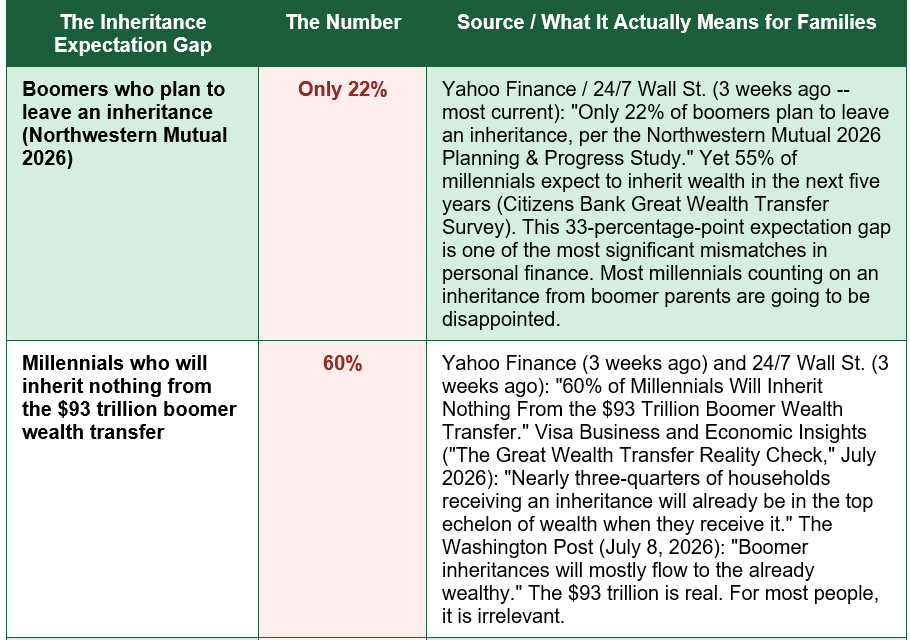
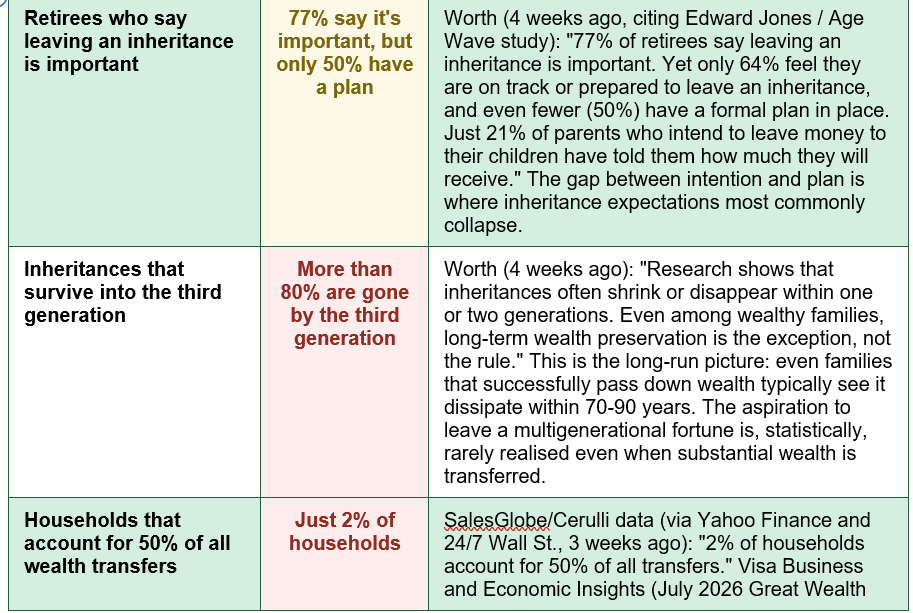
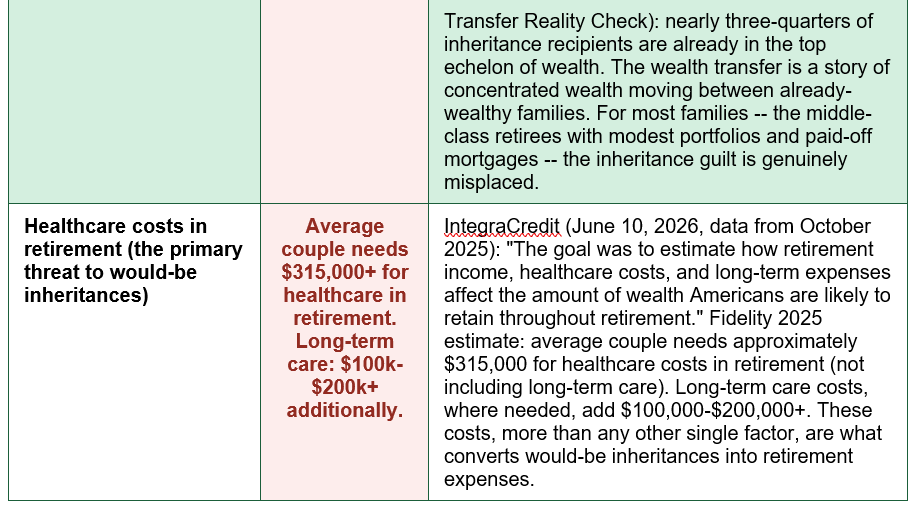
The inheritance gap in 2026: 22% of boomers plan to leave anything. 55% of millennials expect to receive something. 60% will inherit nothing. 2% of households get 50% of all transfers. — Northwestern Mutual 2026 Planning & Progress Study (via Yahoo Finance / 24/7 Wall St., 3 weeks ago): 'Only 22% of boomers plan to leave an inheritance.' Citizens Bank Great Wealth Transfer Survey: '55% of millennials expect to inherit in next 5 years.' Yahoo Finance 3 weeks ago: '60% of millennials will inherit nothing from the $93 trillion boomer wealth transfer.' Visa Great Wealth Transfer Reality Check (July 2026 -- 3 weeks ago, most current): '2% of households account for 50% of all transfers. Nearly 75% of recipients already in top wealth echelon.'
Why Experts Say Not Leaving an Inheritance Is Okay: Five Evidence-Based Arguments
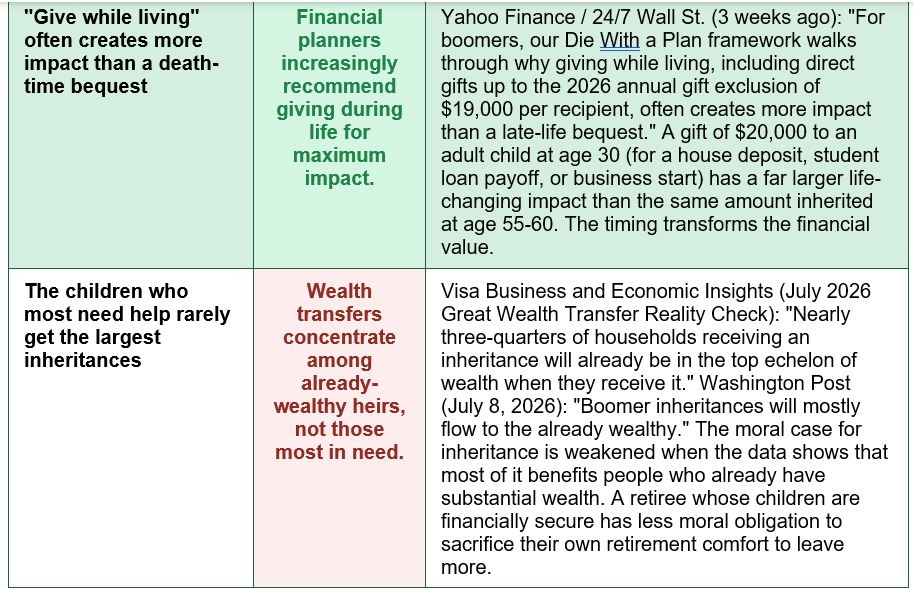
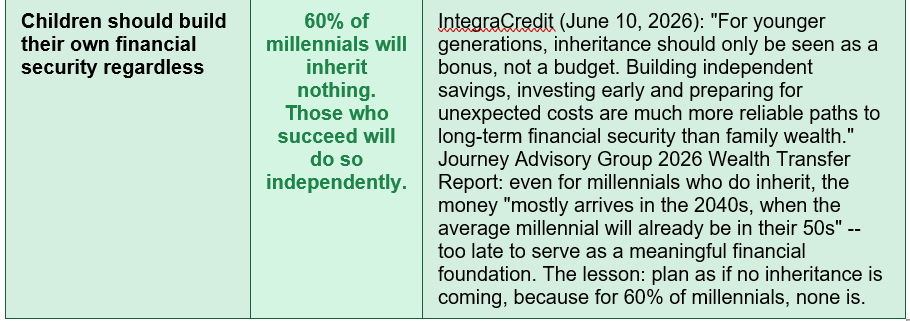
The expert consensus on inheritance has shifted meaningfully in recent years. The following table maps the five strongest evidence-based arguments from financial planners, researchers, and wealth management professionals: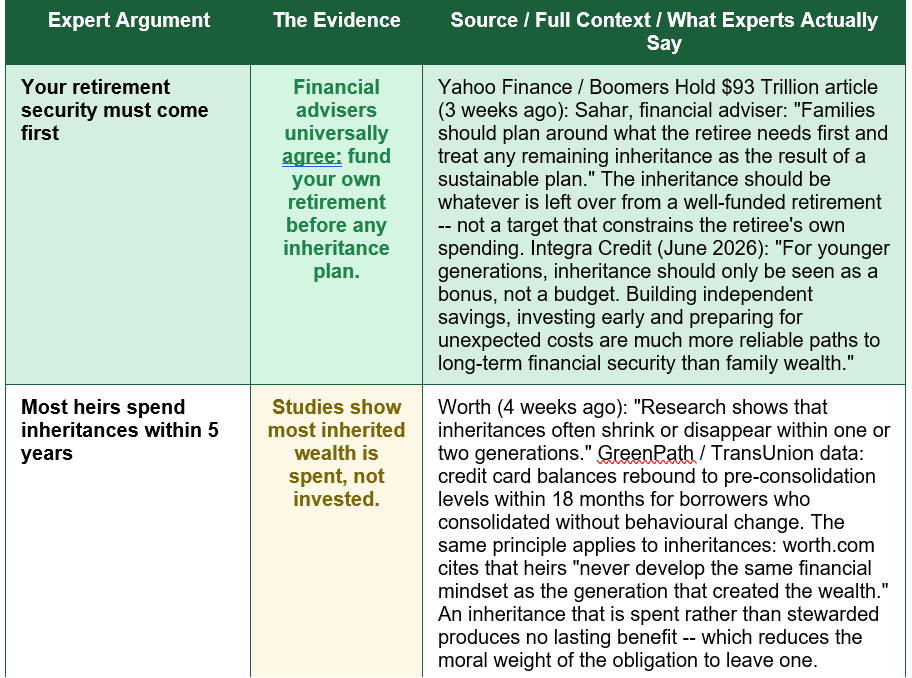
The Case for Spending Your Retirement Fully: What Financial Planners Actually Say
1 YOUR RETIREMENT SECURITY IS NOT NEGOTIABLE -- YOUR CHILDREN'S INHERITANCE IS | The right priority order, according to every financial adviser who has addressed this question
The most consistent piece of advice from financial planners who work with retirees is that the priority order is non-negotiable: fund your own retirement needs first. The inheritance is whatever remains. Yahoo Finance (3 weeks ago -- most current): financial adviser Sahar says 'Families should plan around what the retiree needs first and treat any remaining inheritance as the result of a sustainable plan.' This framing matters enormously. It converts the inheritance from a target (I need to leave $X for my children) to a residual (whatever is left after I have lived well and with security is what I pass on). The moral and practical case for this framing is strong. Children cannot retroactively fund a parent's retirement shortfall. A parent who runs out of money in their 80s becomes a financial burden on their children that typically exceeds whatever inheritance they were trying to preserve. The retiree who spends their savings on their own care, comfort, and quality of life is not failing their children -- they are exercising the fundamental purpose of those savings. IntegraCredit (June 10, 2026): 'For younger generations, inheritance should only be seen as a bonus, not a budget. Building independent savings, investing early and preparing for unexpected costs are much more reliable paths to long-term financial security than family wealth.' This is the financial adviser's consensus: the children who build their own financial security are far better positioned than those who wait for an inheritance that may not arrive, may arrive much later than expected, or may arrive in a much smaller amount than anticipated.2 THE $93 TRILLION TRANSFER IS REAL -- BUT FOR MOST FAMILIES, IRRELEVANT | Where the money actually goes, and who actually gets it
The Great Wealth Transfer captures the imagination because the numbers are genuinely enormous. Cerulli Associates estimates a $124 trillion total multigenerational transfer over the next several decades (CNBC, 2 weeks ago). Boomers hold at least $93 trillion in assets. These numbers are real. But the distribution is so concentrated that for most middle-class families, they are largely irrelevant. Visa Business and Economic Insights (Great Wealth Transfer Reality Check, July 2026 -- 3 weeks ago, most current): 'Nearly three-quarters of households receiving an inheritance will already be in the top echelon of wealth when they receive it.' SalesGlobe/Cerulli: 2% of households account for 50% of all transfers. Washington Post (July 8, 2026): 'Boomer inheritances will mostly flow to the already wealthy.' 24/7 Wall St. (3 weeks ago) walks through the arithmetic precisely: of the $93 trillion in boomer assets, subtract the top 1% (concentrated in charitable foundations and high-net-worth vehicles), subtract retirement spending, subtract taxes and healthcare costs, and what reaches most middle-class heirs is far less than the headline number implies. Journey Advisory Group 2026 Wealth Transfer Report: for millennials, the largest share of their inheritance arrives in the 2040s, when the average millennial will already be in their 50s -- too late to serve as a house deposit, startup capital, or student loan relief. The wealth transfer is real. For most people, it is a headline, not a personal financial plan.3 GIVING WHILE LIVING IS MORE POWERFUL THAN LEAVING MONEY AT DEATH | The timing of financial support changes its entire meaning
One of the most consistent recommendations from estate planners and wealth advisers in 2026 is the concept of giving while living: transferring assets, making direct gifts, and providing financial support during life rather than leaving a larger sum at death. Yahoo Finance / 24/7 Wall St. (3 weeks ago): 'For boomers, our Die With a Plan framework walks through why giving while living, including direct gifts up to the 2026 annual gift exclusion of $19,000 per recipient, often creates more impact than a late-life bequest.' The 2026 annual gift exclusion is $19,000 per recipient -- meaning a couple with two adult children can gift $76,000 per year ($19,000 x 2 recipients x 2 donors) tax-free, with no impact on the lifetime exemption. The impact argument for giving while living: a gift of $20,000 at age 30 (when an adult child is saving for a house deposit, paying off student loans, or starting a business) has a compounding life-impact that dwarfs the same amount inherited at age 55 or 60. At 30, the money is transformative. At 55, the recipient is likely already financially established, and the inheritance, while welcome, does not change the trajectory of their life in the same way. Worth (4 weeks ago): '2025 working paper estimates that parental transfers account for 13 percentage points, or 27%, of the homeownership rate among young households.' This is the most concrete evidence that timely financial support -- not a death-time bequest -- is what changes younger people's financial trajectories. A gift toward a house deposit at 28 matters more than an inherited portfolio at 58.4 HEALTHCARE COSTS IN RETIREMENT MAKE THE INHERITANCE UNPREDICTABLE BY DESIGN | The numbers that convert theoretical inheritances into retirement expenses
The most common reason that well-intentioned inheritance plans fail is healthcare. The costs of medical care, long-term care, assisted living, and end-of-life care in the United States are both enormous and deeply unpredictable. Fidelity's 2025 estimate: the average couple needs approximately $315,000 for healthcare costs in retirement, excluding long-term care. Long-term care -- nursing home care, memory care, assisted living -- adds $100,000 to $200,000 or more for those who require it, with an average long-term care need of approximately 3 years. These numbers, for many middle-class retirees, exceed the entire value of their investment portfolio. IntegraCredit (June 10, 2026): 'The goal was to estimate how retirement income, healthcare costs, and long-term expenses affect the amount of wealth Americans are likely to retain throughout retirement. Americans in states with lower average costs retain between $238,628 and $286,000 for their family to inherit at the average age of 79 -- while those in the highest-cost states retain much less.' A retiree who begins retirement with $500,000 in savings and faces $315,000 in healthcare costs over 20 years has approximately $185,000 remaining -- before any long-term care costs are factored in. If long-term care is needed, that residual disappears entirely. This is not failure. It is the design of the American healthcare system, and no amount of frugality or financial discipline fully insulates a retiree from it. Worth (4 weeks ago): 'It's much easier to make a million dollars than it is to keep a million dollars.' Healthcare costs are the primary mechanism by which would-be inheritances are converted into survival expenses.5 INHERITANCES RARELY PERSIST BEYOND ONE OR TWO GENERATIONS ANYWAY | The long-run data on whether inherited wealth actually builds multigenerational security
Worth (4 weeks ago, citing estate planning research): 'Research shows that inheritances often shrink or disappear within one or two generations. Even among wealthy families, long-term wealth preservation is the exception, not the rule. More than 80% of Americans want to leave money or assets to a loved one. Yet only 64% feel they are on track or prepared to leave an inheritance.' The 80% want-to versus 22% plan-to gap reflects the complicated truth about inheritance: most retirees want to leave something, but the financial realities of retirement make the plan fragile. The long-term data is even more sobering: among families that do successfully transfer wealth, more than 80% see it dissipated by the third generation. Worth: 'Many heirs never develop the same financial mindset as the generation that created the wealth.' This is not a moral failing -- it is a consistent finding across estate planning research. The generation that accumulates wealth does so through specific habits, behaviours, and circumstances that are not automatically transmitted along with the money. The heir who receives a large inheritance without the financial habits that created it often spends it back to zero within years. This finding does not argue for not leaving an inheritance. But it does significantly weaken the moral force of the obligation: if the evidence shows that most inherited wealth disappears within a generation or two, the retiree sacrificing their own comfort to preserve an estate is, on average, sacrificing for an outcome that will not persist.The 'Die With Zero' philosophy: a growing retirement movement and what financial planners actually say about it. The concept of 'Die With Zero' -- popularised by Bill Perkins' 2020 book of the same name -- argues that optimal retirement planning involves spending down savings to zero at the end of life, maximising the experiences and impact of money during the years when it can be most enjoyed. It has found growing resonance among retirees who feel guilty about spending their own savings. Yahoo Finance (3 weeks ago): the 'Die With a Plan framework' for boomers explicitly addresses 'why giving while living often creates more impact than a late-life bequest.' Worth (4 weeks ago): the Ameriprise study found that 'more than 80% of Americans want to leave money or assets to a loved one' -- but the same study found only 50% have a formal plan and just 21% have told their children what to expect. The financial planner's version of 'Die With Zero' is more nuanced than the book title implies: it does not mean spending recklessly, or ignoring longevity risk, or failing to plan for healthcare costs. It means that the money accumulated over a lifetime of work should primarily serve the person who accumulated it -- and that the heirs' portion is whatever remains after a well-funded, well-lived retirement. IntegraCredit (June 2026): 'For younger generations, inheritance should only be seen as a bonus, not a budget.' This is exactly right -- and it applies in both directions. It should not be a budget for heirs expecting it, and it should not be an obligation that prevents retirees from spending what they earned on the life they deserve.
What This Means for Children Who Were Counting on an Inheritance
If you are a millennial or Gen X adult who has been factoring a parental inheritance into your financial planning, the 2026 data is a clear and specific message: do not. Journey Advisory Group 2026 Wealth Transfer Report: even for the 40% of millennials who do inherit something, the money 'mostly arrives in the 2040s, when the average millennial will already be in their 50s.' IntegraCredit (June 10, 2026): 'Inheritance should only be seen as a bonus, not a budget. Building independent savings, investing early and preparing for unexpected costs are much more reliable paths to long-term financial security.'The practical implications: build your retirement savings, emergency fund, investment portfolio, and homeownership plan as though no inheritance is coming. Because for 60% of millennials, none is. And for the 40% who do receive something, the most likely scenario is that the money arrives when they are already in their 50s and financially established -- welcome, but not transformative. The alternative -- building financial security on the assumption of a parental inheritance -- is a plan that leaves the financial future of an entire generation dependent on the retirement spending decisions of another.
Worth (4 weeks ago): 'A 2025 working paper estimates that parental transfers account for 13 percentage points, or 27%, of the homeownership rate among young households.' This is the most meaningful role that parental financial support plays in younger adults' lives: not a late-life inheritance, but a timely gift or transfer that enables homeownership, education, or early investing. If you are a parent who wants to help your children financially, the research consistently shows that doing so now -- at the age when it changes their trajectory -- is more valuable than preserving the same amount in an estate they will receive at 55.
FIVE THINGS TO UNDERSTAND BEFORE MAKING AN INHERITANCE DECISION: (1) THE ESTATE TAX EXEMPTION IS CHANGING. Worth (4 weeks ago): 'The current estate tax exemption of roughly $13.6 million per individual is set to drop by half after 2025 unless Congress acts.' For the very small number of estates large enough to face federal estate tax, this is a significant and time-sensitive planning issue. For the vast majority of retirees with estates well below this threshold, it is not directly relevant to their situation. (2) INHERITED IRAs HAVE A 10-YEAR WITHDRAWAL RULE. Worth: 'New rules under the SECURE Act 2.0 generally require non-spouse heirs to fully withdraw inherited IRA funds within 10 years, potentially triggering substantial taxes if distributions aren't managed wisely.' If your estate includes a significant IRA, heirs need to understand the tax implications of the 10-year mandatory withdrawal rule. An inherited $400,000 IRA distributed over 10 years adds $40,000/year to the heir's taxable income -- potentially pushing them into a higher tax bracket. (3) THE 2026 ANNUAL GIFT EXCLUSION IS $19,000 PER RECIPIENT. Yahoo Finance (3 weeks ago): the 2026 annual gift exclusion is $19,000 per recipient. A couple with three adult children can gift $114,000 per year tax-free ($19,000 x 3 x 2). This is a powerful giving-while-living tool that reduces the taxable estate while providing timely support. (4) LONG-TERM CARE IS THE LARGEST THREAT TO YOUR ESTATE. Before committing to a specific inheritance target, model the long-term care scenarios. If you or your spouse requires two to three years of nursing home care at $80,000-$120,000 per year, the impact on a $600,000 estate is potentially complete. Consider long-term care insurance if affordable, or a hybrid life-insurance/LTC policy. (5) NOT HAVING A WILL DOES NOT MEAN YOUR ESTATE GOES TO THE STATE. Intestate succession laws distribute assets to surviving family members according to a state-specific formula. However, assets distributed by intestate succession may not reflect your wishes and cannot be directed to non-family recipients (friends, charities, step-family members not legally adopted). Even if you do not plan to leave a large inheritance, a basic will, healthcare proxy, and power of attorney are important documents.
HOW TO THINK ABOUT INHERITANCE PLANNING AS A RETIREE: STEP 1 -- FUND YOUR RETIREMENT FIRST, FULLY: Calculate the retirement income you need (Social Security, pension, portfolio withdrawals, part-time income). Model healthcare costs: add $315,000 for average couple healthcare costs and research long-term care options in your area. Whatever remains after this calculation is the realistic inheritance -- not a starting target. STEP 2 -- CONSIDER GIVING WHILE LIVING: Yahoo Finance (3 weeks ago): gifts up to the 2026 annual gift exclusion of $19,000 per recipient per year are tax-free and often more impactful than a later bequest. If you want to help your children, giving them $10,000-$19,000 now toward a house deposit or student loan repayment creates more life-changing impact than the same amount inherited in 25 years. STEP 3 -- COMMUNICATE HONESTLY WITH YOUR CHILDREN: Worth (4 weeks ago): only 21% of parents who intend to leave money have told their children how much they will receive. Set realistic expectations early. If there is likely to be little or no inheritance, saying so clearly and kindly -- while encouraging children to build their own financial security -- is a gift in itself. STEP 4 -- BUILD A BASIC ESTATE PLAN REGARDLESS OF ESTATE SIZE: A will, healthcare proxy, durable power of attorney, and beneficiary designations on accounts are important even for modest estates. They ensure your wishes are followed, protect your surviving spouse, and prevent family conflict. STEP 5 -- DO NOT SACRIFICE QUALITY OF LIFE FOR AN UNCERTAIN INHERITANCE: IntegraCredit (June 2026): inheritance should be a bonus, not a budget. The same principle applies to the retiree: enjoy your retirement. Travel. Support causes you care about. Help your children while you can see the impact. The inheritance is what is left. PLANNING RESOURCES: US: CFPB consumerfinance.gov/retirement | National Academy of Elder Law Attorneys naela.org. UK: MoneyHelper 0800 138 7777 | Age UK ageuk.org.uk.
Conclusion
Only 22% of boomers plan to leave an inheritance, according to the Northwestern Mutual 2026 Planning and Progress Study. Sixty percent of millennials will inherit nothing from the $93 trillion boomer wealth transfer, according to the most current data from Visa Business and Economic Insights and Cerulli Associates. Two percent of households account for 50% of all wealth transfers. The inheritances that are left tend to disappear within one or two generations. And the heirs who receive them are, disproportionately, people who already have substantial wealth.None of this means that leaving something for your children is wrong, unimportant, or not worth planning for. It means that the guilt felt by retirees who spend their savings on their own care, comfort, and quality of life is, in the vast majority of cases, misplaced. Financial expert Sahar (Yahoo Finance, 3 weeks ago): 'Families should plan around what the retiree needs first and treat any remaining inheritance as the result of a sustainable plan.' Worth (4 weeks ago): 'It's much easier to make a million dollars than it is to keep a million dollars.' IntegraCredit (June 2026): 'For younger generations, inheritance should only be seen as a bonus, not a budget.'
The money you saved over a lifetime of work was saved for your retirement. Spending it on the life you earned -- with generosity where it is possible, with giving while living where it is timely and impactful, and with the security and comfort that decades of careful financial behaviour were designed to produce -- is not a failure of family duty. It is the plan working as intended. The permission to spend your own retirement savings on your own retirement has always been there. The data just makes it easier to accept it.
Frequently Asked Questions (FAQ)
Am I obligated to leave an inheritance for my children?There is no legal obligation to leave an inheritance in the United States or the United Kingdom. In the US, adults have broad testamentary freedom -- the legal right to distribute their estate as they choose, to whomever they choose, or to spend it entirely during their lifetime. In the UK, the same principle applies, although spouses and financially dependent children have some legal rights to claim reasonable provision from an estate under the Inheritance (Provision for Family and Dependants) Act 1975. The moral question is more complex, but the data and expert consensus in 2026 are consistent. Northwestern Mutual 2026 Planning and Progress Study (via Yahoo Finance, 3 weeks ago): only 22% of boomers plan to leave an inheritance. Financial adviser Sahar (Yahoo Finance, 3 weeks ago): 'Families should plan around what the retiree needs first and treat any remaining inheritance as the result of a sustainable plan.' The obligation that does exist is to fund your own retirement adequately enough that you do not become a financial burden on your children -- which is, in a meaningful sense, the inverse of the inheritance obligation. The retiree who spends their savings on their own care rather than burdening their adult children with elder care costs is, in financial terms, giving their children a gift even if no estate transfers at death.
Why are 60% of millennials expected to inherit nothing?
The 60% figure reflects the highly concentrated nature of the Great Wealth Transfer, combined with the substantial costs that reduce boomer wealth before it reaches heirs. Visa Business and Economic Insights (Great Wealth Transfer Reality Check, July 2026 -- 3 weeks ago, most current): starting with $93 trillion in boomer assets, subtract the top 1% (concentrated in charitable foundations and ultra-high-net-worth vehicles), subtract taxes and debt, subtract retirement spending over an average 20+ year retirement. The amount reaching middle-class heirs is a fraction of the headline figure. 24/7 Wall St. (3 weeks ago): 'Per SalesGlobe/Cerulli data, 2% of households account for 50% of all transfers. Nearly three-quarters of households receiving an inheritance will already be in the top echelon of wealth when they receive it.' Northwestern Mutual 2026: only 22% of boomers plan to leave an inheritance at all. The expectation gap -- 55% of millennials expect to inherit while only 22% of boomers plan to leave anything -- explains much of the 60%. Journey Advisory Group 2026 Wealth Transfer Report: even for the 40% who do inherit, 'the money mostly arrives in the 2040s, when the average millennial will already be in their 50s.' IntegraCredit (June 2026): 'For younger generations, inheritance should only be seen as a bonus, not a budget.' The $93 trillion headline number is real. But it belongs overwhelmingly to a small number of already-wealthy families, and the portion reaching most middle-class millennials will be much smaller, much later, and less financially impactful than the headline implies.
What is "giving while living" and why do experts recommend it?
Giving while living refers to the practice of making financial gifts to family members during your lifetime rather than preserving the same amount in an estate to be distributed at death. Yahoo Finance / 24/7 Wall St. (3 weeks ago -- most current): 'For boomers, our Die With a Plan framework walks through why giving while living, including direct gifts up to the 2026 annual gift exclusion of $19,000 per recipient, often creates more impact than a late-life bequest.' Experts recommend giving while living for several evidence-based reasons: timing impact (a gift of $20,000 at age 30 for a house deposit or student loan payoff has a life-changing effect; the same amount inherited at 55 is welcome but not transformative); tax efficiency (the 2026 annual gift exclusion of $19,000 per recipient allows substantial transfers without gift tax or impact on the lifetime exemption); transparency (unlike a bequest, a living gift allows the giver to see its impact and adjust based on need); and emotional value (the relationship benefit of supporting a child's house purchase, business start, or education is available to the giver while they are alive to experience it). Worth (4 weeks ago): 'A 2025 working paper estimates that parental transfers account for 13 percentage points, or 27%, of the homeownership rate among young households.' This is the most concrete evidence that timely financial support -- during life, at the moment of need -- is what changes younger generations' financial trajectories.
How do healthcare costs affect what retirees can leave as an inheritance?
Healthcare costs are the primary mechanism by which well-intentioned inheritance plans fail to materialise. Fidelity's 2025 estimate: the average couple needs approximately $315,000 for healthcare costs in retirement, excluding long-term care. Long-term care -- nursing home care, memory care, assisted living -- adds $100,000 to $200,000 or more for those who require it. For a couple with $600,000 in retirement savings, the combination of standard healthcare costs ($315,000) and a single long-term care episode ($150,000) consumes the entire portfolio. IntegraCredit (June 10, 2026, data from October 2025): the research modelling how retirement income, healthcare costs, and long-term expenses affect retained wealth found that even in the most favourable states, average retirees retain between $238,628 and $286,000 for inheritance at the average age of 79 -- before any long-term care costs are included. In high-cost states and for those requiring extended care, this number drops significantly or disappears entirely. Worth (4 weeks ago): 'It's much easier to make a million dollars than it is to keep a million dollars. Many heirs never develop the same financial mindset as the generation that created the wealth.' Healthcare cost unpredictability is the primary reason that Sahar's advice -- 'plan around what the retiree needs first and treat any remaining inheritance as the result of a sustainable plan' -- is not just compassionate but financially correct.
What is the "Die With Zero" philosophy and does it make financial sense?
The Die With Zero philosophy -- popularised by Bill Perkins' 2020 book -- argues that optimal financial planning involves timing your spending to maximise life experiences across all stages of life, with the goal of spending your last dollar on your last day. In practice, this means deliberately drawing down retirement savings rather than preserving them for an inheritance, and front-loading experiences and financial support to the years when they produce the most value. The financial planning profession's response to this philosophy is nuanced. The core insight -- that money has time value and experiences have peak ages -- is well-supported by research. Yahoo Finance (3 weeks ago): the 'Die With a Plan framework' for boomers explicitly addresses giving while living and spending down retirement savings rather than preserving them for late-life bequests. The valid concerns: longevity risk (living longer than planned creates the possibility of genuinely running out of money); healthcare cost unpredictability (long-term care costs can be $200,000+ for those who require it); and psychological wellbeing (many retirees find genuine happiness in knowing they are leaving something for their children, independent of the financial value). The balance that most financial planners recommend: plan for a well-funded retirement with healthcare contingencies; spend generously on experiences and giving while living; do not sacrifice current quality of life to preserve an estate; and let the inheritance be whatever remains after a life fully and well lived. IntegraCredit (June 2026): 'For younger generations, inheritance should only be seen as a bonus, not a budget.' The same principle, inverted, is the financial planner's advice to retirees: your savings are not your children's budget. They are yours.

0 Comments Comments