

Savings
What Is the Energy Price Cap? Your Complete UK Guide for 2026

A QUICK ANSWER: The energy price cap is £1,862/yr from 1 July 2026 (direct debit). It caps the unit RATE — not your total bill. If you use more energy, you still pay more.
The UK energy price cap from 1 July 2026 is £1,862 per year for a typical dual-fuel household paying by direct debit. This figure, announced by Ofgem on 27 May 2026, represents a 13% increase from the Q2 2026 level of £1,641, driven by a sharp rise in wholesale gas prices linked to the escalating conflict in the Middle East. But £1,862 is not a limit on your total energy bill. It is a limit on the unit rate your energy supplier can charge for each kilowatt hour of gas and electricity you use, and on the daily standing charge. Use more energy than a typical household and your bill will exceed £1,862; use less and it will be lower. The price cap is, in technical terms, a unit price ceiling, not a total expenditure ceiling.
Understanding this distinction — and several others like it — is the foundation of being able to manage your energy costs effectively. This guide covers what the price cap is, how Ofgem calculates it, its full history from introduction to the current level, who it covers and who it does not, the actual unit rates and standing charges in force from July 2026, what the forecasts say about future levels, and exactly what your options are as a household to reduce what you pay.
Specifically, the cap sets two things: the maximum unit rate in pence per kilowatt hour (p/kWh) for both gas and electricity, and the maximum daily standing charge in pence per day for both fuels. From 1 July 2026, the cap-regulated unit rates for direct debit customers are 26.11p/kWh for electricity and 7.33p/kWh for gas, with standing charges of 57.19p per day for electricity and 29.09p per day for gas. These are national averages; actual rates vary by region and are slightly higher or lower depending on where you live.
What the cap does not do is place a ceiling on your total annual energy spending. The £1,862 figure widely reported for Q3 2026 is calculated by taking those unit rates and standing charges and multiplying them by Ofgem's Typical Domestic Consumption Values — the assumed annual usage for a 'typical' dual-fuel household, which from July 2026 is 2,500 kWh of electricity and 9,500 kWh of gas (revised down significantly from prior assumptions to reflect actual measured falls in household consumption). If you use more energy than these benchmarks, you will pay more than £1,862; if you use less, you will pay less.
The most common misconception: Many people assume the energy price cap means their energy bill cannot exceed £1,862 per year. This is incorrect. The cap limits the price per unit, not the total bill. A household that uses twice the typical amount of energy on a standard variable tariff will pay approximately twice the 'typical' cap level — well above £1,862. The cap protects against unit price overcharging, not against high usage. Reducing your consumption is the only way to directly reduce your total energy bill, regardless of whether the cap goes up or down.
The cap was initially intended as a temporary measure that would be phased out once competition in the energy retail market was deemed sufficient to protect consumers without regulatory intervention. That plan was overtaken by events in 2021, when global gas prices began rising sharply as post-pandemic demand recovery collided with tightened supply, triggering what the UK government and Ofgem both described as the worst energy crisis since the 1970s. By October 2022, the cap methodology would have implied a level approaching £4,000 per year for a typical household — a figure so far above household affordability that the government introduced the Energy Price Guarantee (EPG), a separate policy that superseded the Ofgem cap and limited the effective price to £2,500.
From July 2023 onward, the Ofgem cap fell back below the EPG level as wholesale prices moderated, the EPG was wound down, and the cap mechanism took over as the primary price protection mechanism again. The table below shows the full trajectory from the cap's introduction to the present:
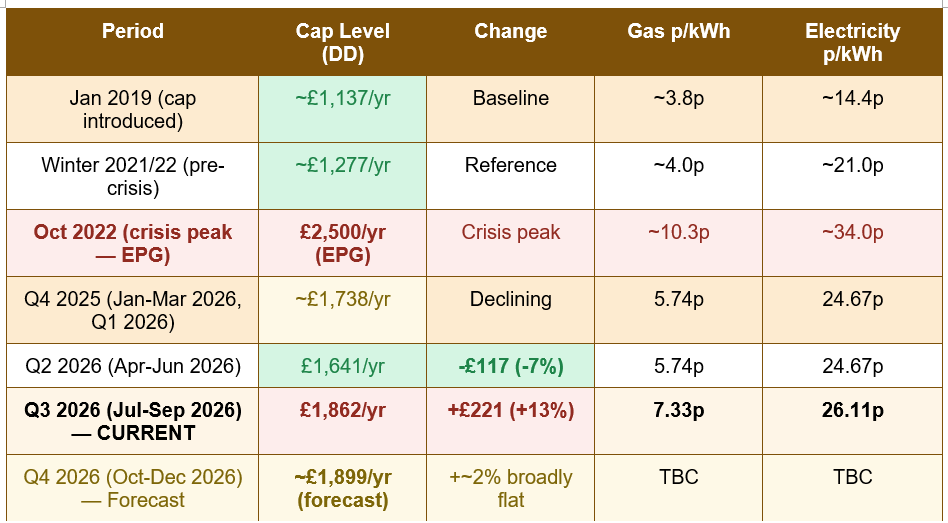
Current cap vs pre-crisis level: £1,862 in Q3 2026 vs ~£1,277 in Winter 2021/22 — despite the moderation from the 2022 crisis peak, current bill levels remain 35% higher than in Winter 2021/22, and the House of Commons Library confirms no current forecasts support a return to pre-crisis pricing levels (House of Commons Library CBP-9714, July 2026)
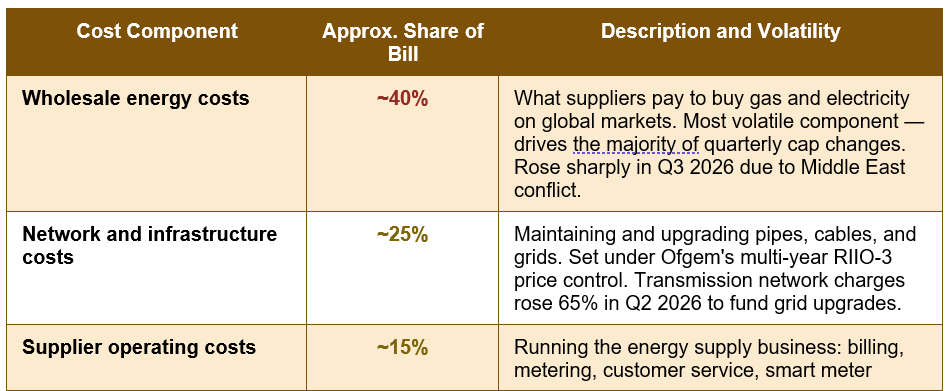
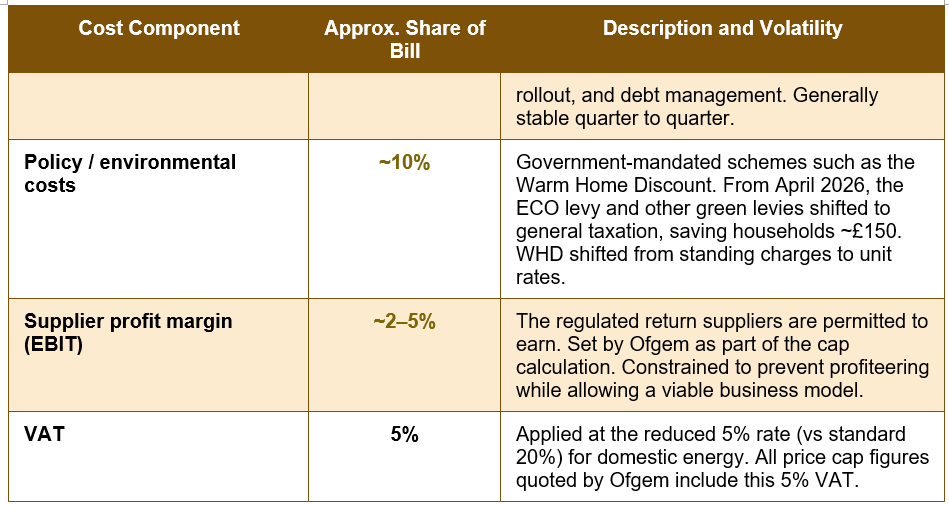
The formula Ofgem uses to set the cap for each quarter is broadly: Cap Level = Wholesale Cost + Network Costs + Policy Costs + Operating Costs + Profit Margin + VAT. Each component is assessed against the costs energy suppliers are actually incurring or expected to incur for the quarter, with adjustments for efficient operation rather than simply passing through whatever suppliers claim to spend. The process takes approximately three months from data collection to announcement, which is why the cap for July is announced in late May — giving suppliers and consumers around five weeks' notice.
The most important practical point about this methodology is that wholesale energy costs — what suppliers pay on global gas and electricity markets — account for approximately 40% of a typical bill and are responsible for the vast majority of quarterly cap changes. When global gas prices rise, the cap rises. When they fall, the cap falls. The UK's heavy reliance on natural gas, both for direct domestic heating and for a significant proportion of electricity generation, means the price cap is acutely sensitive to global gas market movements in a way that countries with higher proportions of nuclear or renewable generation are not. This is why the cap jumped 13% in Q3 2026 specifically in response to Middle East conflict escalation driving up global LNG prices.
The prepayment meter difference: Prepayment meter customers — those who top up a meter card or key rather than receiving a monthly bill — have historically paid slightly higher rates than direct debit customers, since prepayment billing is more administratively expensive to operate. From July 2026, prepayment customers are covered by a cap level of £1,620 for typical usage, meaning they actually pay slightly less than direct debit customers (£1,663) under the current cap configuration, following Ofgem's equalisation efforts in recent years. This is a relatively recent change in the cap structure.
At these rates, the total annual standing charge commitment alone — the amount you pay simply to have your home connected to the grid and the gas network, before using a single kilowatt hour — is approximately £315 per year. This is the basis of the long-running campaign by MoneySavingExpert founder Martin Lewis, who has argued that standing charges unfairly penalise low-income households and those who have made the effort to reduce their consumption, since they cannot reduce or avoid the standing charge component regardless of how little energy they use.
Regional variations mean the actual rates you face may be slightly different from the national averages quoted above. Ofgem publishes region-specific unit rates and standing charges, and your energy supplier will quote your specific applicable rates on your bill or in your online account.
These forecasts assume no significant further escalation of the Middle East conflict beyond its current scope, and no major unexpected developments in global LNG supply or demand. They are subject to revision weekly as wholesale energy market data evolves. As the electrifying.com analysis of the Q3 cap noted: 'Current forecasts are for prices to drop before the end of the year, but then no one expected them to rise so much in 2026' — a candid acknowledgement that energy price forecasting is inherently uncertain in a market this sensitive to geopolitical events.
The House of Commons Library's research briefing CBP-9714, updated in June 2026, provides the most authoritative public-sector assessment of the energy price trajectory, confirming that bills remain 35% above pre-crisis Winter 2021/22 levels even at Q2 2026's comparatively low £1,641 cap, and that current forecasts do not support any expectation of a return to pre-2021 pricing. The RIIO-3 network cost framework, which runs to 2031, has built in significant infrastructure investment costs that will keep network charges elevated even if wholesale prices moderate.
The current cap level of £1,862 per year for a typical direct debit dual-fuel household from 1 July 2026 reflects a 13% increase driven by rising wholesale gas prices linked to Middle East conflict. It is 35% above pre-crisis levels and, based on current forecasts, unlikely to fall significantly before the end of 2026. The unit rates now in force — 26.11p/kWh for electricity and 7.33p/kWh for gas, with daily standing charges of 57.19p and 29.09p respectively — are the practical floor of what any variable-tariff household pays per unit of energy in Great Britain.
The most important things to take away from this guide are: the cap limits the rate, not the total bill; fixed tariffs are not covered by the cap and currently offer rates below the Q3 2026 cap level; and the most durable way to reduce your exposure to cap volatility is to reduce your energy consumption, since no quarterly announcement can change the mathematical relationship between the unit rate and the number of units you use. The cap is a protection, not a guarantee — and understanding precisely what it protects you from, and what it does not, is the foundation of effective household energy management.
From 1 July to 30 September 2026, the Ofgem energy price cap is set at £1,862 per year for a typical dual-fuel household paying by monthly direct debit in England, Scotland, and Wales. For households paying by cash, cheque, or quarterly direct debit, the cap equivalent is £1,795 per year. For prepayment meter customers, the cap level is £1,620 per year. All figures are based on Ofgem's Typical Domestic Consumption Values of 2,500 kWh of electricity and 9,500 kWh of gas per year, revised downward by Ofgem in July 2026 to reflect actual falls in average household consumption
.
Does the energy price cap mean I will only ever pay £1,862 for energy?
No — this is the single most important misconception to correct. The price cap limits the unit rate your supplier can charge for each kilowatt hour of energy, and the daily standing charge. It does not cap your total bill. If you use significantly more energy than the 'typical' household assumed in Ofgem's calculation, your bill will be higher than £1,862. The £1,862 figure is what a household using exactly 2,500 kWh of electricity and 9,500 kWh of gas per year would pay at the capped unit rates — it is an illustrative benchmark, not a maximum spending limit.
Why does the price cap change every three months?
Ofgem reviews the cap quarterly because the largest component of the cap — wholesale energy costs, which account for approximately 40% of a typical bill — fluctuates continuously with global commodity markets. Fixing the cap annually would risk it being either too high (overcharging consumers in a falling market) or too low (making energy supply financially unviable for suppliers in a rising market). The quarterly review cycle attempts to keep the cap aligned with supplier costs while giving households and suppliers enough advance notice (approximately five weeks) to plan. Ofgem announces each new quarter's cap level on set dates: typically late May for July, late August for October, late November for January, and late February for April.
Does the energy price cap apply to fixed tariffs?
No. Fixed tariffs — where you agree a specific unit rate with your supplier for a set contract period, typically 12 or 24 months — sit entirely outside the price cap framework. This means the cap cannot protect you if a fixed tariff is poorly priced, but it also means a cap increase does not affect you while you are fixed. Conversely, if the cap falls while you are on a fixed tariff, you will not automatically benefit from the lower cap level — you remain on your agreed fixed rate until the contract ends. Fixed tariffs are subject to standard consumer contract law rather than Ofgem's cap mechanism.
What is the energy price cap forecast for October 2026?
Based on analysis from Cornwall Insight — the UK's most widely cited independent energy market forecaster — the Q4 2026 price cap (covering 1 October to 31 December 2026) is currently forecast at approximately £1,899 per year, representing an increase of roughly 2% from the Q3 2026 level of £1,862. This forecast assumes no significant further escalation in wholesale gas markets beyond the level seen when the forecast was produced. Ofgem will announce the confirmed Q4 2026 cap level on or before 26 August 2026. These forecasts should be treated as indicative rather than certain, given the demonstrated sensitivity of wholesale gas prices to geopolitical developments.
Table of Contents
- Introduction
- What the Energy Price Cap Actually Is
- The History of the Energy Price Cap: From 2019 to Today
- How Ofgem Calculates the Price Cap
- Who the Energy Price Cap Covers — and Who It Does Not
- The cap covers:
- The cap does not cover:
- The Current Rates in Detail: July to September 2026
- Price Cap Forecasts: What's Expected for the Rest of 2026
- What You Can Do About the Price Cap
- Conclusion
- Frequently Asked Questions (FAQ)
Introduction
The energy price cap is one of the most frequently mentioned and most widely misunderstood financial concepts in the UK. Almost every British household is affected by it, yet polling consistently shows that most people cannot correctly explain what it actually caps, why it changes, or what they can and cannot do to reduce their exposure to it. This guide fixes that — completely, accurately, and in plain English.The UK energy price cap from 1 July 2026 is £1,862 per year for a typical dual-fuel household paying by direct debit. This figure, announced by Ofgem on 27 May 2026, represents a 13% increase from the Q2 2026 level of £1,641, driven by a sharp rise in wholesale gas prices linked to the escalating conflict in the Middle East. But £1,862 is not a limit on your total energy bill. It is a limit on the unit rate your energy supplier can charge for each kilowatt hour of gas and electricity you use, and on the daily standing charge. Use more energy than a typical household and your bill will exceed £1,862; use less and it will be lower. The price cap is, in technical terms, a unit price ceiling, not a total expenditure ceiling.
Understanding this distinction — and several others like it — is the foundation of being able to manage your energy costs effectively. This guide covers what the price cap is, how Ofgem calculates it, its full history from introduction to the current level, who it covers and who it does not, the actual unit rates and standing charges in force from July 2026, what the forecasts say about future levels, and exactly what your options are as a household to reduce what you pay.
What the Energy Price Cap Actually Is
The energy price cap is the maximum amount that energy suppliers operating in Great Britain (England, Scotland, and Wales — Northern Ireland has separate arrangements) can charge households on default tariffs for each unit of energy they consume. Ofgem — the Office of Gas and Electricity Markets, the UK's independent energy regulator — sets and reviews the cap every three months, with new levels taking effect in January, April, July, and October each year.Specifically, the cap sets two things: the maximum unit rate in pence per kilowatt hour (p/kWh) for both gas and electricity, and the maximum daily standing charge in pence per day for both fuels. From 1 July 2026, the cap-regulated unit rates for direct debit customers are 26.11p/kWh for electricity and 7.33p/kWh for gas, with standing charges of 57.19p per day for electricity and 29.09p per day for gas. These are national averages; actual rates vary by region and are slightly higher or lower depending on where you live.
What the cap does not do is place a ceiling on your total annual energy spending. The £1,862 figure widely reported for Q3 2026 is calculated by taking those unit rates and standing charges and multiplying them by Ofgem's Typical Domestic Consumption Values — the assumed annual usage for a 'typical' dual-fuel household, which from July 2026 is 2,500 kWh of electricity and 9,500 kWh of gas (revised down significantly from prior assumptions to reflect actual measured falls in household consumption). If you use more energy than these benchmarks, you will pay more than £1,862; if you use less, you will pay less.
The most common misconception: Many people assume the energy price cap means their energy bill cannot exceed £1,862 per year. This is incorrect. The cap limits the price per unit, not the total bill. A household that uses twice the typical amount of energy on a standard variable tariff will pay approximately twice the 'typical' cap level — well above £1,862. The cap protects against unit price overcharging, not against high usage. Reducing your consumption is the only way to directly reduce your total energy bill, regardless of whether the cap goes up or down.
The History of the Energy Price Cap: From 2019 to Today
The energy price cap was introduced on 1 January 2019 by Ofgem under powers granted by the Domestic Gas and Electricity (Tariff Cap) Act 2018, following years of campaigning by consumer groups who argued that the 11 million households on expensive default tariffs were being systematically overcharged in a market they did not understand or actively engage with. The original cap level was approximately £1,137 per year for a typical dual-fuel household — a figure that now seems remarkably low compared with current levels, but was itself the product of a low-wholesale-price era that proved to be the last years of an abnormally cheap energy period.The cap was initially intended as a temporary measure that would be phased out once competition in the energy retail market was deemed sufficient to protect consumers without regulatory intervention. That plan was overtaken by events in 2021, when global gas prices began rising sharply as post-pandemic demand recovery collided with tightened supply, triggering what the UK government and Ofgem both described as the worst energy crisis since the 1970s. By October 2022, the cap methodology would have implied a level approaching £4,000 per year for a typical household — a figure so far above household affordability that the government introduced the Energy Price Guarantee (EPG), a separate policy that superseded the Ofgem cap and limited the effective price to £2,500.
From July 2023 onward, the Ofgem cap fell back below the EPG level as wholesale prices moderated, the EPG was wound down, and the cap mechanism took over as the primary price protection mechanism again. The table below shows the full trajectory from the cap's introduction to the present:
Current cap vs pre-crisis level: £1,862 in Q3 2026 vs ~£1,277 in Winter 2021/22 — despite the moderation from the 2022 crisis peak, current bill levels remain 35% higher than in Winter 2021/22, and the House of Commons Library confirms no current forecasts support a return to pre-crisis pricing levels (House of Commons Library CBP-9714, July 2026)
How Ofgem Calculates the Price Cap
Ofgem builds the price cap from the ground up, cost component by cost component, in a detailed methodology first established in 2018 and refined through multiple regulatory reviews since then. The breakdown table below shows what each element contributes to a typical bill at the current cap level:The formula Ofgem uses to set the cap for each quarter is broadly: Cap Level = Wholesale Cost + Network Costs + Policy Costs + Operating Costs + Profit Margin + VAT. Each component is assessed against the costs energy suppliers are actually incurring or expected to incur for the quarter, with adjustments for efficient operation rather than simply passing through whatever suppliers claim to spend. The process takes approximately three months from data collection to announcement, which is why the cap for July is announced in late May — giving suppliers and consumers around five weeks' notice.
The most important practical point about this methodology is that wholesale energy costs — what suppliers pay on global gas and electricity markets — account for approximately 40% of a typical bill and are responsible for the vast majority of quarterly cap changes. When global gas prices rise, the cap rises. When they fall, the cap falls. The UK's heavy reliance on natural gas, both for direct domestic heating and for a significant proportion of electricity generation, means the price cap is acutely sensitive to global gas market movements in a way that countries with higher proportions of nuclear or renewable generation are not. This is why the cap jumped 13% in Q3 2026 specifically in response to Middle East conflict escalation driving up global LNG prices.
Who the Energy Price Cap Covers — and Who It Does Not
The energy price cap applies to default tariffs — also called standard variable tariffs (SVTs) — offered by energy suppliers to domestic customers in Great Britain. If you have never actively switched your energy tariff, or if your previous fixed deal ended and you were moved onto your supplier's default rate, you are almost certainly on an SVT and covered by the cap. Approximately 19 million UK households are on variable tariffs subject to the cap.The cap covers:
- Households on standard variable tariffs (SVTs) paying by monthly direct debit.
- Households on default tariffs paying by cash, cheque, or quarterly direct debit (at a slightly higher cap level of £1,795 from July 2026, vs £1,663 for monthly direct debit — reflecting the higher administrative cost of non-direct-debit payment methods).
- Prepayment meter customers (at £1,620 from July 2026 for typical usage, also set by the cap mechanism).
The cap does not cover:
- Customers on fixed-rate tariffs — these are entirely separate from the cap. If you are on a fixed deal, your unit rate was agreed at the time of signing and cannot change during the contract, regardless of what Ofgem does to the cap level.
- Businesses, commercial properties, or industrial energy customers — the price cap applies to domestic household customers only.
- Households in Northern Ireland — Northern Ireland has its own separate regulatory regime and the Ofgem price cap does not apply there.
The prepayment meter difference: Prepayment meter customers — those who top up a meter card or key rather than receiving a monthly bill — have historically paid slightly higher rates than direct debit customers, since prepayment billing is more administratively expensive to operate. From July 2026, prepayment customers are covered by a cap level of £1,620 for typical usage, meaning they actually pay slightly less than direct debit customers (£1,663) under the current cap configuration, following Ofgem's equalisation efforts in recent years. This is a relatively recent change in the cap structure.
The Current Rates in Detail: July to September 2026
From 1 July 2026, direct debit customers on a standard variable tariff in England, Scotland, and Wales face the following cap-regulated rates:- Electricity unit rate: 26.11 pence per kilowatt hour (kWh) — up from 24.67p in Q2 2026, representing a roughly 6% increase in the electricity unit rate. The electricity rise was relatively modest compared with gas, since electricity generation involves a more diverse fuel mix.
- Gas unit rate: 7.33 pence per kilowatt hour (kWh) — up from 5.74p in Q2 2026, representing a 28% increase in the gas unit rate. This is the primary driver of the Q3 2026 bill increase and directly reflects the surge in wholesale gas prices linked to Middle East tensions.
- Electricity standing charge: 57.19 pence per day — approximately £208.74 per year before any usage, contributing to the annual cost regardless of how much electricity you use.
- Gas standing charge: 29.09 pence per day — approximately £106.18 per year before any gas usage.
At these rates, the total annual standing charge commitment alone — the amount you pay simply to have your home connected to the grid and the gas network, before using a single kilowatt hour — is approximately £315 per year. This is the basis of the long-running campaign by MoneySavingExpert founder Martin Lewis, who has argued that standing charges unfairly penalise low-income households and those who have made the effort to reduce their consumption, since they cannot reduce or avoid the standing charge component regardless of how little energy they use.
Regional variations mean the actual rates you face may be slightly different from the national averages quoted above. Ofgem publishes region-specific unit rates and standing charges, and your energy supplier will quote your specific applicable rates on your bill or in your online account.
Price Cap Forecasts: What's Expected for the Rest of 2026
The Q4 2026 price cap — covering October to December 2026 — will be announced by Ofgem on or before 26 August 2026. Based on current forecasts from Cornwall Insight, the UK's most widely cited energy market forecaster, the Q4 cap is expected to be approximately £1,899 per year — broadly flat compared with the Q3 2026 cap of £1,862, representing an increase of only around 2%.These forecasts assume no significant further escalation of the Middle East conflict beyond its current scope, and no major unexpected developments in global LNG supply or demand. They are subject to revision weekly as wholesale energy market data evolves. As the electrifying.com analysis of the Q3 cap noted: 'Current forecasts are for prices to drop before the end of the year, but then no one expected them to rise so much in 2026' — a candid acknowledgement that energy price forecasting is inherently uncertain in a market this sensitive to geopolitical events.
The House of Commons Library's research briefing CBP-9714, updated in June 2026, provides the most authoritative public-sector assessment of the energy price trajectory, confirming that bills remain 35% above pre-crisis Winter 2021/22 levels even at Q2 2026's comparatively low £1,641 cap, and that current forecasts do not support any expectation of a return to pre-2021 pricing. The RIIO-3 network cost framework, which runs to 2031, has built in significant infrastructure investment costs that will keep network charges elevated even if wholesale prices moderate.
What You Can Do About the Price Cap
Understanding the price cap is most useful when it informs action. There are a limited but meaningful set of things any household on a variable tariff can do in response to the cap:- Consider switching to a fixed tariff: As of July 2026, the cheapest available 12-month fixed tariffs are priced at approximately £1,381 to £1,602 per year for typical consumption — £260 to £481 below the current £1,862 variable cap. If you are currently on a standard variable tariff and can access a competitively priced fixed deal at your postcode, fixing locks in a lower unit rate and provides certainty against further cap increases. Use Uswitch, MoneySavingExpert's energy comparison tool, or EnergyPlus to compare deals at your actual address.
- Reduce your consumption: Since the cap limits the unit rate but not total spending, the most direct control you have over your total bill is how much energy you use. Each kilowatt hour of electricity you save is worth 26.11p at current rates; each kilowatt hour of gas saves 7.33p. Reducing consumption through insulation, efficient appliances, smart meters, thermostat optimisation, and behavioural change all directly reduce your total bill regardless of where the cap sits.
- Check eligibility for Warm Home Discount and other support: The Warm Home Discount provides a £150 credit to eligible low-income households during winter. The Winter Fuel Payment supports most pensioners. Both schemes continue in 2026-27. Contact your energy supplier or use the government's eligibility checker on gov.uk to confirm whether your household qualifies.
- Submit regular meter readings: If you do not have a smart meter, submitting an accurate reading before the Q3 2026 cap took effect on 1 July ensured your usage in June was billed at the lower Q2 rates rather than the higher Q3 rates. Before each quarterly cap change, submit a reading so you are not estimated onto the higher rate for usage that actually occurred in the cheaper period.
Conclusion
The UK energy price cap is, at its most fundamental level, a regulatory mechanism that limits the unit rate energy suppliers can charge domestic customers on default tariffs, reviewed quarterly by Ofgem based on the costs suppliers face — primarily wholesale energy prices, network charges, policy costs, and operating expenses. It was introduced in 2019 to protect the millions of households on expensive default tariffs, reached its maximum effectiveness as a consumer protection tool during the 2022 energy crisis when the government's Energy Price Guarantee stepped in above it, and remains the primary price protection mechanism for approximately 19 million UK households today.The current cap level of £1,862 per year for a typical direct debit dual-fuel household from 1 July 2026 reflects a 13% increase driven by rising wholesale gas prices linked to Middle East conflict. It is 35% above pre-crisis levels and, based on current forecasts, unlikely to fall significantly before the end of 2026. The unit rates now in force — 26.11p/kWh for electricity and 7.33p/kWh for gas, with daily standing charges of 57.19p and 29.09p respectively — are the practical floor of what any variable-tariff household pays per unit of energy in Great Britain.
The most important things to take away from this guide are: the cap limits the rate, not the total bill; fixed tariffs are not covered by the cap and currently offer rates below the Q3 2026 cap level; and the most durable way to reduce your exposure to cap volatility is to reduce your energy consumption, since no quarterly announcement can change the mathematical relationship between the unit rate and the number of units you use. The cap is a protection, not a guarantee — and understanding precisely what it protects you from, and what it does not, is the foundation of effective household energy management.
Frequently Asked Questions (FAQ)
What is the energy price cap right now?From 1 July to 30 September 2026, the Ofgem energy price cap is set at £1,862 per year for a typical dual-fuel household paying by monthly direct debit in England, Scotland, and Wales. For households paying by cash, cheque, or quarterly direct debit, the cap equivalent is £1,795 per year. For prepayment meter customers, the cap level is £1,620 per year. All figures are based on Ofgem's Typical Domestic Consumption Values of 2,500 kWh of electricity and 9,500 kWh of gas per year, revised downward by Ofgem in July 2026 to reflect actual falls in average household consumption
.
Does the energy price cap mean I will only ever pay £1,862 for energy?
No — this is the single most important misconception to correct. The price cap limits the unit rate your supplier can charge for each kilowatt hour of energy, and the daily standing charge. It does not cap your total bill. If you use significantly more energy than the 'typical' household assumed in Ofgem's calculation, your bill will be higher than £1,862. The £1,862 figure is what a household using exactly 2,500 kWh of electricity and 9,500 kWh of gas per year would pay at the capped unit rates — it is an illustrative benchmark, not a maximum spending limit.
Why does the price cap change every three months?
Ofgem reviews the cap quarterly because the largest component of the cap — wholesale energy costs, which account for approximately 40% of a typical bill — fluctuates continuously with global commodity markets. Fixing the cap annually would risk it being either too high (overcharging consumers in a falling market) or too low (making energy supply financially unviable for suppliers in a rising market). The quarterly review cycle attempts to keep the cap aligned with supplier costs while giving households and suppliers enough advance notice (approximately five weeks) to plan. Ofgem announces each new quarter's cap level on set dates: typically late May for July, late August for October, late November for January, and late February for April.
Does the energy price cap apply to fixed tariffs?
No. Fixed tariffs — where you agree a specific unit rate with your supplier for a set contract period, typically 12 or 24 months — sit entirely outside the price cap framework. This means the cap cannot protect you if a fixed tariff is poorly priced, but it also means a cap increase does not affect you while you are fixed. Conversely, if the cap falls while you are on a fixed tariff, you will not automatically benefit from the lower cap level — you remain on your agreed fixed rate until the contract ends. Fixed tariffs are subject to standard consumer contract law rather than Ofgem's cap mechanism.
What is the energy price cap forecast for October 2026?
Based on analysis from Cornwall Insight — the UK's most widely cited independent energy market forecaster — the Q4 2026 price cap (covering 1 October to 31 December 2026) is currently forecast at approximately £1,899 per year, representing an increase of roughly 2% from the Q3 2026 level of £1,862. This forecast assumes no significant further escalation in wholesale gas markets beyond the level seen when the forecast was produced. Ofgem will announce the confirmed Q4 2026 cap level on or before 26 August 2026. These forecasts should be treated as indicative rather than certain, given the demonstrated sensitivity of wholesale gas prices to geopolitical developments.
0 Comments
Be the first to share your thoughts on this article.