
Investing
Will Oracle Stock Soar in 2027? The Case After Its 42% Slide

Oracle is down sharply in 2026 despite booming growth. Here is the bull case, the bear case and the math behind a possible rebound. ORCL about $111 on 24 Nov, about 42% below the start of 2026 (my calculation), Q1 FY27 revenue +30%, OCI +121%, RPO $664B, Q1 free cash flow -$5B, FY27 revenue guide at least $90B, EPS $8.10, Fed funds 3.75%-4.00%.
Oracle looks like a stock in two minds. On one side, the business is growing fast: quarterly revenue rose 30% to $19.3 billion, Cloud Infrastructure revenue more than doubled, and the contracted backlog hit $664 billion. On the other, the share price is around $111 and, by my arithmetic, roughly 42% below where it started 2026. The gap between the two comes down to money. Oracle is spending enormous sums on data centers, burning cash while it does, and borrowing and issuing shares to pay for it, all while interest rates are rising again. Erneroy writer argues that a 2027 rebound is plausible because earnings growth should accelerate and the discount to the Nasdaq-100 leaves room for a re-rating.
I think that is a fair argument and also an incomplete one. In this post I lay out the case, run three scenarios for where the stock could be by the end of 2027, and flag what could go wrong. The honest answer to "will it soar?" is: it could, if a few specific things go right.
Key takeaway: The bull case rests on the backlog turning into revenue and free cash flow. The bear case rests on debt, dilution and interest rates getting there first.
Is it really down 42%? A 24/7 Wall St. piece reported ORCL closed at $127.05 on 20 July, down 34.18% for the year. That implies a 2025 close near $193 (my calculation). From there, $111.35 is about 42% lower (my calculation), which matches the headline. The causes are layered. Financing is one: Oracle announced in early November that it would raise $10 billion of stock and $10 billion of debt, and the shares fell about 5% on the day according to MarketWatch, or nearly 9% according to IBTimes. Another is the plan to raise about $40 billion in fiscal 2027 through debt and equity.
Why does that matter for Oracle specifically? It is a heavy borrower. Higher rates raise the cost of the bonds it needs to sell, and they reduce what investors will pay today for earnings that arrive years from now. That is my reasoning rather than a quote from any source. In mid-September, markets priced in one more 25-basis-point hike in 2026, followed by further hikes extending into 2027. I could not confirm today's market pricing for December, so treat "expected" as a signal, not a certainty. There is an upside to the same story. The Fed's own projections have PCE inflation at 3.7% in 2026 falling to 2.3% in 2027. If that path holds, the rate pressure should ease during the very year Oracle's growth is supposed to accelerate (my reading).
Oracle Q1 FY27 results, 10 September 2026. Operations were not just growing, they were scaling. Oracle delivered 850 megawatts of additional data center capacity in the quarter, and more than 300,000 GPUs to AI customers since the end of the prior quarter. It also booked more than $30 billion of additional AI cloud contracts.
That fits the claim that Oracle has beaten expectations repeatedly. Benzinga's chart page notes an earlier quarter in which EPS of $1.79 beat the $1.55 estimate, with fiscal revenue guidance of $90 billion against $86 billion expected. So the problem is not a missing quarter, it is the financing.
Debt is the other half. Figures differ by source and definition. The Fool's writer cites $167.4 billion of debt at the end of fiscal 2026, up $43 billion over the year. A June report put total debt near $130 billion , and IBTimes reported $125.34 billion as of 31 August, nearly twice shareholders' equity. The higher figure may include lease obligations, but I could not confirm that, so please check Oracle's filings. Oracle also sold $20 billion of common stock through an at-the-market program in Q1, and announced a $10 billion stock offering in November. The reports overlap and I could not reconcile the totals, but dilution is real. The share count rises as Oracle sells stock, so earnings per share must grow faster than total earnings to benefit existing holders (my reasoning).
Second, free cash flow must turn. That requires revenue from new data centers to arrive before the next wave of spending, plus those customer prepayments. Q1's negative $5 billion is better than fiscal 2026's pace of about $6 billion a quarter, but that is my rough arithmetic and not management guidance.
Third, financing fear must fade. The Fool's writer argues funding the build-out should speed recognition of the backlog. The market will want proof in the next report. Yahoo Finance lists the earnings date as 14 December.
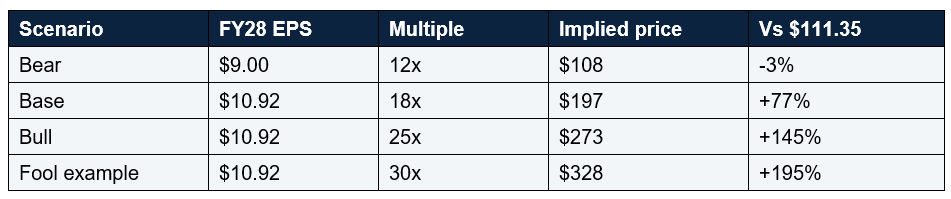
My calculation. The $10.92 EPS and the 30x example come from via Webull; the others are my assumptions. Not a forecast. Excludes dividends and taxes. Notice how much the multiple matters. The bear case is not a collapse. It simply assumes earnings fall short and the market refuses to pay more than 12 times. The base case needs both earnings delivery and a rerating to 18 times, a level still below the Nasdaq-100's 35 times earnings the Fool cites. The Fool's own 30 times example gives $328 and "149% upside" from their starting price. That is the bullish end, and it would require a very strong multiple after a period of heavy borrowing. I include it as the author's case, not as a likelihood.
Mistake one is treating a prediction headline as a forecast. "Will soar" is an opinion, and the people who write these articles can be wrong. Mistake two is anchoring on the old price. The stock's fall from $250 does not mean it is cheap, and cheap does not mean it will rise. Mistake three is ignoring dilution and debt. A rising share count and a $125 billion to $167 billion debt load, depending on definition, change what each share is worth. Mistake four is ignoring concentration. Even if you believe the story, one stock is a bet on a single set of risks. Check the filings, size any position so a further 40% drop would not hurt, and consider talking to a qualified adviser.
A mix of heavy borrowing and share issuance to fund data centers, negative free cash flow, rising interest rates and concerns about AI spending. Software worries and political scrutiny of data centers also hit the stock.
How much debt does Oracle have?
Sources differ: about $125 billion as of 31 August, about $130 billion at the end of May, or $167.4 billion at the end of fiscal 2026, likely depending on definitions.
What is Oracle's backlog?
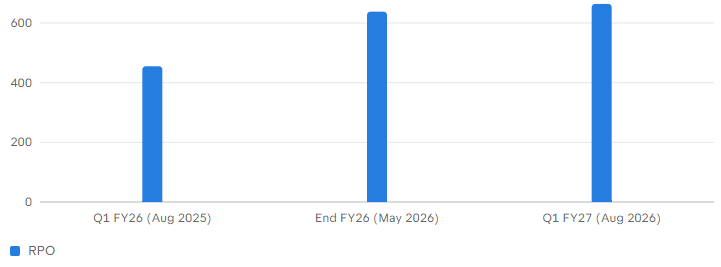
Remaining performance obligations were $664 billion at the end of Q1 FY27, up $209 billion from a year earlier.
Will the Fed raise rates again in December?
The Fed signaled another hike was possible and its median projection showed one more increase in 2026, with the next meeting on 8 to 9 December. The outcome is not certain.
What do analysts expect for Oracle?
Consensus price targets sit around $235 to $251, with most analysts rating it a buy, though some such as CLSA are at hold with lower targets.
Table of Contents
- Why Oracle fell about 42% in 2026
- The interest-rate backdrop
- The business is not shrinking
- The backlog: a $664 billion promise
- Cash flow and debt: the real debate
- What a 2027 comeback would need
- Valuation math: three 2027 scenarios
- What analysts say
- Risks that could sink the thesis
- Conclusion
- FAQ
Oracle looks like a stock in two minds. On one side, the business is growing fast: quarterly revenue rose 30% to $19.3 billion, Cloud Infrastructure revenue more than doubled, and the contracted backlog hit $664 billion. On the other, the share price is around $111 and, by my arithmetic, roughly 42% below where it started 2026. The gap between the two comes down to money. Oracle is spending enormous sums on data centers, burning cash while it does, and borrowing and issuing shares to pay for it, all while interest rates are rising again. Erneroy writer argues that a 2027 rebound is plausible because earnings growth should accelerate and the discount to the Nasdaq-100 leaves room for a re-rating.
I think that is a fair argument and also an incomplete one. In this post I lay out the case, run three scenarios for where the stock could be by the end of 2027, and flag what could go wrong. The honest answer to "will it soar?" is: it could, if a few specific things go right.
Key takeaway: The bull case rests on the backlog turning into revenue and free cash flow. The bear case rests on debt, dilution and interest rates getting there first.
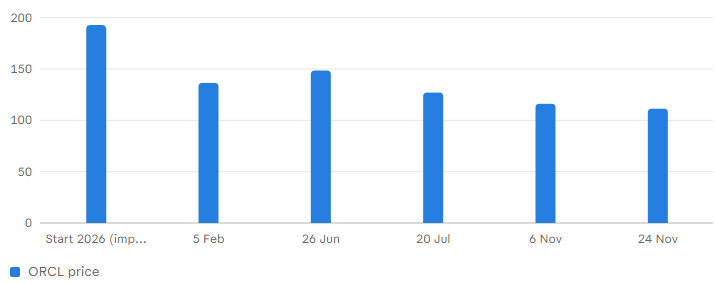
Oracle (ORCL) share price snapshots, 2026 ($)
$ per share by Sources: MarketWatch, Herald Corp, 24/7 Wall St., Yahoo Finance. Start-of-year is my calculation
Why Oracle fell about 42% in 2026
Start with the damage. A MarketWatch piece in February said Oracle's stock had shed about 25% over eight trading sessions, its worst such stretch since May 2002, hit by software worries and AI debt concerns. By late June it had its steepest weekly decline since August 2001, closing at $148.53, down 24% for the year. The slide kept going. On 5 November, a post-election sell-off in AI infrastructure stocks hit Oracle as investors worried that tighter political scrutiny of data centers could slow the build-out. A data center moratorium was part of many Democratic campaigns, and Texas alone accounts for about a quarter of the US compute capacity due online by 2030. The quote on the Fool's page on 24 November showed ORCL at $111.35 with a 52-week range of $100.25 to $250.25.Is it really down 42%? A 24/7 Wall St. piece reported ORCL closed at $127.05 on 20 July, down 34.18% for the year. That implies a 2025 close near $193 (my calculation). From there, $111.35 is about 42% lower (my calculation), which matches the headline. The causes are layered. Financing is one: Oracle announced in early November that it would raise $10 billion of stock and $10 billion of debt, and the shares fell about 5% on the day according to MarketWatch, or nearly 9% according to IBTimes. Another is the plan to raise about $40 billion in fiscal 2027 through debt and equity.
The interest-rate backdrop
The Fed has turned from a tailwind into a headwind. It raised its benchmark rate by 25 basis points on 16 September to a range of 3.75% to 4%, the first increase since 2023. The vote was unanimous. The central bank also signaled that another hike could come later this year. The median official projected one more 25-basis-point increase in 2026. The next meeting runs 8 to 9 December. In September, the 10-year Treasury yield was around 5%, the highest since 2023.Why does that matter for Oracle specifically? It is a heavy borrower. Higher rates raise the cost of the bonds it needs to sell, and they reduce what investors will pay today for earnings that arrive years from now. That is my reasoning rather than a quote from any source. In mid-September, markets priced in one more 25-basis-point hike in 2026, followed by further hikes extending into 2027. I could not confirm today's market pricing for December, so treat "expected" as a signal, not a certainty. There is an upside to the same story. The Fed's own projections have PCE inflation at 3.7% in 2026 falling to 2.3% in 2027. If that path holds, the rate pressure should ease during the very year Oracle's growth is supposed to accelerate (my reading).
The business is not shrinking
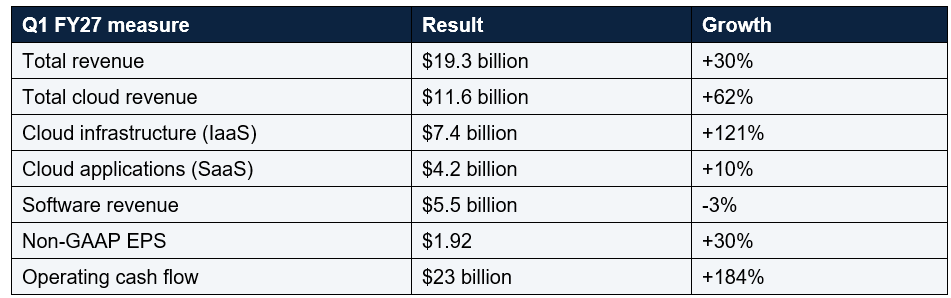
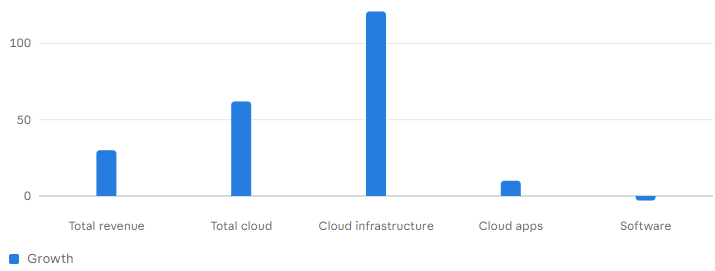
It is easy to forget, amid the share price drop, how strong the latest results were. In the first quarter of fiscal 2027, which ended in August, total revenue rose 30% to $19.3 billion, cloud revenue rose 62% to $11.6 billion, and Cloud Infrastructure revenue rose 121% to $7.4 billion.Oracle Q1 FY27 results, 10 September 2026. Operations were not just growing, they were scaling. Oracle delivered 850 megawatts of additional data center capacity in the quarter, and more than 300,000 GPUs to AI customers since the end of the prior quarter. It also booked more than $30 billion of additional AI cloud contracts.
That fits the claim that Oracle has beaten expectations repeatedly. Benzinga's chart page notes an earlier quarter in which EPS of $1.79 beat the $1.55 estimate, with fiscal revenue guidance of $90 billion against $86 billion expected. So the problem is not a missing quarter, it is the financing.
Oracle Q1 FY27 growth by segment (% year on year)
% growth by Source: Oracle Q1 FY27 results, 10 September 2026The backlog: a $664 billion promise
Remaining performance obligations, or RPO, are contracted revenue not yet recognized. Oracle's RPO rose $209 billion over the year to $664 billion. At the end of fiscal 2026 it was $638 billion, almost ten times that year's revenue of $67.4 billion. Management expects to convert about 12% of RPO into revenue over the next year, and 34% between 13 and 36 months out. Fiscal 2027 revenue is guided to at least $90 billion, and fiscal 2028 is forecast to rise 46% to $130.2 billion. That is the visibility bulls cite. A big caveat applies. A backlog is a promise, not cash. Much of it is tied to a $300 billion contract with OpenAI, and investors have questioned whether OpenAI can pay. A June report said OpenAI was weighing pushing its IPO to next year. If a large customer stumbles, the backlog stops being a safety net.Cash flow and debt: the real debate
This is the section the whole debate turns on. In fiscal 2026, capital expenditure jumped 162% to $55.7 billion and free cash flow fell to negative $23.7 billion. In Q1 of fiscal 2027, operating cash flow was a record $23 billion, but free cash flow was still negative $5 billion. The plan for fiscal 2027 is bigger still. One Motley Fool writer reported Oracle expects about $70 billion of capital spending, with another $20 billion to $25 billion financed by customer prepayments, so reported capex could land between $90 billion and $95 billion. Prepayments matter because they reduce what Oracle must fund itself.Debt is the other half. Figures differ by source and definition. The Fool's writer cites $167.4 billion of debt at the end of fiscal 2026, up $43 billion over the year. A June report put total debt near $130 billion , and IBTimes reported $125.34 billion as of 31 August, nearly twice shareholders' equity. The higher figure may include lease obligations, but I could not confirm that, so please check Oracle's filings. Oracle also sold $20 billion of common stock through an at-the-market program in Q1, and announced a $10 billion stock offering in November. The reports overlap and I could not reconcile the totals, but dilution is real. The share count rises as Oracle sells stock, so earnings per share must grow faster than total earnings to benefit existing holders (my reasoning).
What a 2027 comeback would need
What would a 2027 rebound actually need? Three things, in my view. First, earnings growth must show up. Oracle guides fiscal 2027 non-GAAP EPS to $8.10, and the Fool's writer cites analyst forecasts of $10.92 in fiscal 2028. The growth rates reported differ. One article says EPS growth rises from 5.4% in fiscal 2027 to 36% in fiscal 2028, while another had fiscal 2027 EPS up 18%. A one-time investment gain in last year's second quarter distorts the comparison, which is why Oracle guides Q2 EPS to fall 14% to 18% in USD.Second, free cash flow must turn. That requires revenue from new data centers to arrive before the next wave of spending, plus those customer prepayments. Q1's negative $5 billion is better than fiscal 2026's pace of about $6 billion a quarter, but that is my rough arithmetic and not management guidance.
Third, financing fear must fade. The Fool's writer argues funding the build-out should speed recognition of the backlog. The market will want proof in the next report. Yahoo Finance lists the earnings date as 14 December.
Valuation math: three 2027 scenarios
Here is my simple framework. Take analysts' fiscal 2028 EPS of $10.92, apply a range of multiples, and compare it with today's $111.35 price. At the current price, Oracle trades at about 13.7 times fiscal 2027 guidance and about 10.2 times fiscal 2028 forecasts (my calculation).My calculation. The $10.92 EPS and the 30x example come from via Webull; the others are my assumptions. Not a forecast. Excludes dividends and taxes. Notice how much the multiple matters. The bear case is not a collapse. It simply assumes earnings fall short and the market refuses to pay more than 12 times. The base case needs both earnings delivery and a rerating to 18 times, a level still below the Nasdaq-100's 35 times earnings the Fool cites. The Fool's own 30 times example gives $328 and "149% upside" from their starting price. That is the bullish end, and it would require a very strong multiple after a period of heavy borrowing. I include it as the author's case, not as a likelihood.
Oracle remaining performance obligations ($ billions)
$ billions by Source: Oracle. Q1 FY26 is derived from the $209B year-on-year rise
What analysts say
Wall Street is far more bullish than the share price. Benzinga lists a consensus price target of $250.91, the Fool cites a 12-month median target of $243, with 38 of 45 analysts rating it a buy, and Yahoo shows a one-year target estimate of $235.77 [14]. Not everyone agrees. Investing.com lists CLSA with a hold and a $145 target, while Piper Sandler is at a buy with $225. A June report noted 71% of analysts rated it a buy, and Evercore said the pace of financing, leverage and share issuance would be "a key debate". A word of caution on analyst targets. They can lag the share price rather than lead it (my observation). Treat them as a signal of sentiment, not proof.Risks that could sink the thesis
Here is what could break the story. Financing risk is first. If credit markets get tougher, Oracle's plan to raise about $40 billion becomes harder and more expensive. The cost of insurance against Oracle defaulting, measured by five-year credit default swaps, reached its highest level since 2008 in late 2025. Customer concentration is second. A large share of the backlog relates to OpenAI, which is burning cash heavily. Policy risk is third. A data center slowdown in Texas or other states would hit Oracle's timetable, and the Fool says even a slight delay could seriously endanger its prospects. Competition is fourth. Analysts have noted Oracle lacks the full-range cloud offering of Amazon, Microsoft and Google, which can hurt profitability. And software worries about AI replacing traditional enterprise tools rippled through its legacy database business. Last is the rate path. If the Fed hikes more than expected, valuation multiples across tech could compress, hurting even good companies (my reasoning).Mistake one is treating a prediction headline as a forecast. "Will soar" is an opinion, and the people who write these articles can be wrong. Mistake two is anchoring on the old price. The stock's fall from $250 does not mean it is cheap, and cheap does not mean it will rise. Mistake three is ignoring dilution and debt. A rising share count and a $125 billion to $167 billion debt load, depending on definition, change what each share is worth. Mistake four is ignoring concentration. Even if you believe the story, one stock is a bet on a single set of risks. Check the filings, size any position so a further 40% drop would not hurt, and consider talking to a qualified adviser.
Conclusion
Oracle's business is booming while its stock is struggling. Revenue grew 30% in the latest quarter, the backlog is $664 billion, and analysts see earnings accelerating in fiscal 2028. But free cash flow is negative, debt is high by any measure, shares are being issued, and the Fed is raising rates. My scenarios show why the debate is so heated. If earnings reach $10.92 and the market pays 18 times, the stock lands near $197 by the end of 2027, roughly 77% above today (my calculation). If earnings disappoint and the multiple stays at 12 times, it is about flat. The outcome depends on execution and financing more than on the headline. So could Oracle soar in 2027? It could. Whether it will depends on the backlog converting into cash faster than the debt piles up. That is general education, not advice, and I am not a financial adviser. Check live prices and Oracle's filings, and watch the December earnings report.FAQ
Why is Oracle stock down in 2026?A mix of heavy borrowing and share issuance to fund data centers, negative free cash flow, rising interest rates and concerns about AI spending. Software worries and political scrutiny of data centers also hit the stock.
How much debt does Oracle have?
Sources differ: about $125 billion as of 31 August, about $130 billion at the end of May, or $167.4 billion at the end of fiscal 2026, likely depending on definitions.
What is Oracle's backlog?
Remaining performance obligations were $664 billion at the end of Q1 FY27, up $209 billion from a year earlier.
Will the Fed raise rates again in December?
The Fed signaled another hike was possible and its median projection showed one more increase in 2026, with the next meeting on 8 to 9 December. The outcome is not certain.
What do analysts expect for Oracle?
Consensus price targets sit around $235 to $251, with most analysts rating it a buy, though some such as CLSA are at hold with lower targets.
0 Comments
Be the first to share your thoughts on this article.