
Investing
Bloom Energy Stock Down 60%: Buy at $145 or Wait for a Drop?

Bloom Energy has plunged about 60% from its peak, even as revenue and profits surge. Is it a screaming buy, or still expensive? Q3 revenue $1.24B (up 138%), 2026 revenue guide $4.4B-$4.6B (up 122% at midpoint), Adjusted EPS guide $3.10-$3.40, 52-week high $351.28, Two customers = 69% of Q3 revenue, Beta about 3.6.
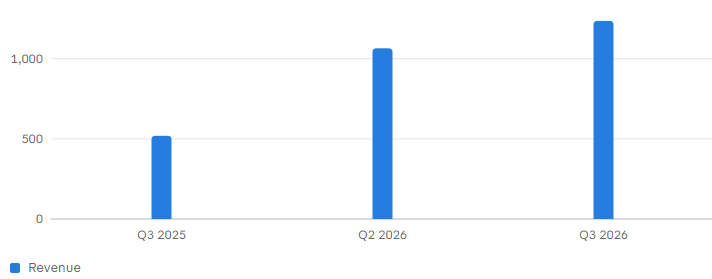
Bloom Energy is a strange sight right now: a company reporting record revenue and surging profits, with a share price that has fallen by more than half from its peak. Its fiscal third-quarter revenue rose 138.1% to $1,235.8 million, and it raised its 2026 revenue guidance to $4.4 billion to $4.6 billion. Yet the shares trade well below their 52-week high of $351.28.
Is $145 a once-in-a-decade opportunity? My honest answer is that I cannot tell you, and nobody else can either. What I can do is lay out what is strong, what is risky, and what the price already assumes. The business looks excellent on the numbers. The stock is still expensive by ordinary standards, and it has a long record of violent swings.
One housekeeping note. The latest official close I found was $168.11 on 19 November; I could not retrieve the 20 November close. Treat $145 as the figure in your headline. If you are buying, use the live price on your screen. Key takeaway: Bloom has real growth, rising margins and a big backlog. It also depends on a few giant customers, its cash flow is lumpy, and its stock has fallen by an average of about 49%, and up to 78%, in earlier market shocks. Whether $145 is a bargain depends on how much risk you can hold, not just on the numbers.
The slide since then has come in steps. On 13 October, the stock traded at $263.45. In the month to 5 November, it lost 42.5%. On 5 November itself, it dropped 16.4% while the S&P 500 lost 4.4%. Data-center spending came into doubt that day, and a customer deal with NTT Data did not stop the fall. A week later it traded around $191.70, and on 19 November it closed at $168.11.
Notice what is missing from that story: bad company news. A Kalkine report on 5 November said the stock was swept into a market-wide AI sell-off with no confirmed company setback in the material it reviewed. Fuel-cell peers fell together, with FuelCell Energy down 15.3% that day. Some of this is a fall in sentiment, not in fundamentals (my inference).
Profitability is the other half of the story. Gross margin rose 453 basis points to 33.8%. Net income attributable to common stockholders reached $250.3 million, compared with a loss of $23.1 million a year earlier. Trefis notes the third-quarter operating margin was 18.2%, up from 1.5% a year earlier, and called it the highest operating margin at any quarter-end since the end of 2017. Put plainly, Bloom has moved from a business that struggled to make money to one making a lot of it. That is why the share price fall looks so odd to many investors.
Zooming out, TIKR also reports that analysts keep raising estimates. The 2027 EPS consensus rose to $5.32 from $4.88 in the month to 10 November, and the 2028 consensus stands at $8.24. Those are forecasts, and forecasts for fast-growing companies are often revised both ways.
Capacity is expanding to match. Bloom plans to double annual production at its Fremont plant from 1 gigawatt to 2 gigawatts by the end of 2026. Management also says the story is spreading beyond hyperscalers; CEO KR Sridhar said every major US hyperscaler has approved Bloom's systems. On backlog, the last full figure I found was about $20 billion in total, roughly $6 billion of product and $14 billion of service, as of the fourth quarter of 2025. That is a year-old figure, and I did not find an updated one, so please check the company's latest filing. The Q4 2025 call also described the product backlog as 100% attached to service.
Cash flow. Profits are not yet turning into cash every quarter. Operating cash flow was negative $27 million in the third quarter even though net income was $250 million, because inventory, contract assets and receivables rose as Bloom built for future deliveries. TIKR puts third-quarter free cash flow at negative $181 million, and positive $41.6 million for the first nine months. The CFO called the cash use "not the beginning of a trend". The two sources use different measures, so they are not in conflict, but the direction is clear: growth is consuming cash.
A short-seller report. On 8 July, Hunterbrook published a short report alleging Chinese scandium sourcing, and class-action suits followed. The company rebutted the report. I have no way to judge the claims, but they are part of the risk picture. Competition and sentiment. A Chevron and Microsoft deal in June, to use natural gas turbines for a West Texas data-center project from 2028, showed that there will be other providers of data-center power. And the stock is tied to sentiment about AI spending, which is why it fell with other tech stocks on 5 November.
The conversion price is the interesting part. The notes can convert into shares only when the stock reaches $194.97. At $145, the stock sits below that level (my calculation), so dilution from the converts is a future concern, not an immediate one. If the stock recovered strongly, the notes would start to look like extra shares. There is also an Oracle warrant. Bloom issued Oracle a warrant for 3.5 million shares at $113.28, which was exercised without cash on 1 May 2026. Warrants and converts are common for a fast-growing industrial company, but they are a reminder to check the share count and not only the share price.
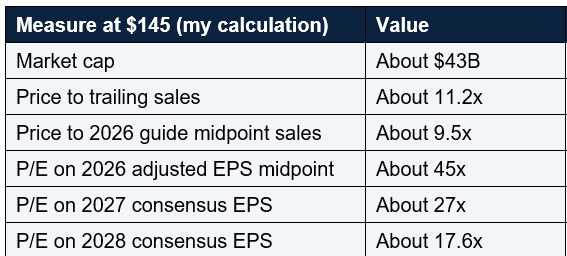
Market cap. StockAnalysis showed a market cap of $56.76 billion when the last close was $191.99. That implies roughly 295.6 million shares (my calculation). At $145, the market cap would be about $43 billion (my calculation). Price to sales. Trailing twelve-month revenue to 30 September was $3.83 billion, so $43 billion is about 11.2 times trailing sales (my calculation). On the 2026 guidance midpoint of $4.5 billion, it is about 9.5 times (my calculation). For comparison, StockAnalysis showed a price-to-sales ratio of 14.8 at the $191.99 price.
Price to earnings. Using the midpoint of adjusted EPS guidance of $3.25, $145 is about 45 times current-year earnings (my calculation). Using the 2027 consensus of $5.32, it is about 27 times, and on the 2028 consensus of $8.24, about 17.6 times (my calculation, using figures from [9]). TIKR said that at roughly $173 the stock traded at about 35 times forward earnings, versus a three-year average of about 75 times.
So is it cheap? Compared with where Bloom traded earlier this year, yes. One Motley Fool piece noted that on 22 June the shares cost about 170 times guided earnings, and another said they traded at around 100 times expected earnings in October. Compared with an ordinary industrial company, no: even 27 times 2027 earnings assumes years of very strong growth. The analyst average target is about $284, but targets for volatile stocks move quickly, and I would not lean on them.
More recently, Bloom has bounced back fast. A Motley Fool piece noted that after a 46% slide from 3 November to 17 December 2025, the stock was back at a new high by 16 January 2026, 30 days after the low. It has fallen 20% or more five times since September 2025, and recovered from four of them within weeks. That record cuts both ways. It suggests that dips have often been buying opportunities for patient holders. It also means large drops are normal for this stock, not rare, which is why "once in a decade" may overstate it (my inference). With a beta of about 3.6, a drop of 15% on a bad day should not surprise anyone. Worth remembering: Past recoveries do not guarantee a future one. The earlier peaks were reached when the business was much smaller and cheaper (my inference). A recovery from here needs earnings to grow into the price.
A middle path. My suggestion, not advice: if you want exposure, consider splitting your intended purchase into several parts over weeks or months, for example one third now and the rest later. That way, a further fall hurts less, and a rebound still helps. Keep the position small enough that a 50% fall would not change your life. For a stock with a beta above 3, sizing matters more than timing. Also decide in advance what would change your mind. For example: a missed fourth-quarter revenue target, a cut to Oracle-related plans, or free cash flow staying negative. Writing the rules down beforehand makes it easier to follow them when the stock is moving 10% in a day.
If you want to own it, size the position for the volatility, consider buying in stages, and set your own rules for what would change your mind. If you would rather wait, that is a legitimate choice too, and the stock's history shows that it can fall further or rebound fast. This post is general education, and I am not a financial adviser. Please check live prices and the company's filings before you decide.
Mostly sentiment. The stock fell with AI and chip stocks after the US midterms on fears of a data-center slowdown, and a Kalkine report found no company setback behind the 5 November fall. It was also priced for a lot of growth before the fall.
Is Bloom Energy profitable?
Yes, increasingly. Third-quarter GAAP EPS was $0.78 and net income attributable to common stockholders was $250.3 million. Cash flow is less steady: operating cash flow was negative $27 million in the quarter.
What is Bloom Energy's 2026 guidance?
Revenue of $4.4 billion to $4.6 billion and adjusted EPS of $3.10 to $3.40, raised for the third time this year. Timing of year-end deliveries could affect where revenue falls.
Is $145 a good price to buy?
I cannot say. At $145 the stock is about 27 times 2027 consensus EPS and about 11 times trailing sales (my calculation), and it has fallen by an average of 48.6%, and up to 78%, in earlier shocks. I could not confirm a $145 close, so check the live price.
What are the biggest risks?
Customer concentration (two customers were 69% of Q3 revenue), negative free cash flow in the quarter, a short-seller report, convertible notes with a $194.97 conversion price, and sensitivity to AI spending sentiment.
Table of Contents
- How far has Bloom fallen, and why?
- The business behind the drop: a record third quarter
- Guidance and what the fourth quarter must deliver
- Where the demand is coming from
- The catches: concentration, cash flow and a short report
- Convertible notes and dilution
- Valuation at $145: cheap, or just cheaper?
- "Once in a decade"? What past drops tell us
- Buy now, or wait for a bigger drop?
- Who this stock suits, and who it does not
- What to watch next
- Conclusion
- FAQ
Bloom Energy is a strange sight right now: a company reporting record revenue and surging profits, with a share price that has fallen by more than half from its peak. Its fiscal third-quarter revenue rose 138.1% to $1,235.8 million, and it raised its 2026 revenue guidance to $4.4 billion to $4.6 billion. Yet the shares trade well below their 52-week high of $351.28.
Is $145 a once-in-a-decade opportunity? My honest answer is that I cannot tell you, and nobody else can either. What I can do is lay out what is strong, what is risky, and what the price already assumes. The business looks excellent on the numbers. The stock is still expensive by ordinary standards, and it has a long record of violent swings.
One housekeeping note. The latest official close I found was $168.11 on 19 November; I could not retrieve the 20 November close. Treat $145 as the figure in your headline. If you are buying, use the live price on your screen. Key takeaway: Bloom has real growth, rising margins and a big backlog. It also depends on a few giant customers, its cash flow is lumpy, and its stock has fallen by an average of about 49%, and up to 78%, in earlier market shocks. Whether $145 is a bargain depends on how much risk you can hold, not just on the numbers.
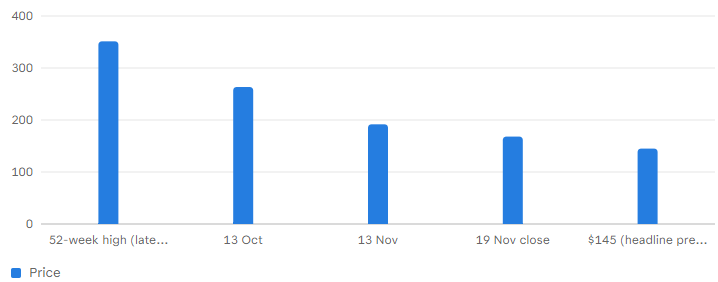
Bloom Energy (BE) share price, selected points in 2026 (US$)
US$ per share by Sources: StockAnalysis, 24/7 Wall St., Chronicle Journal. $145 is from your headline and was not confirmed.
How far has Bloom fallen, and why?
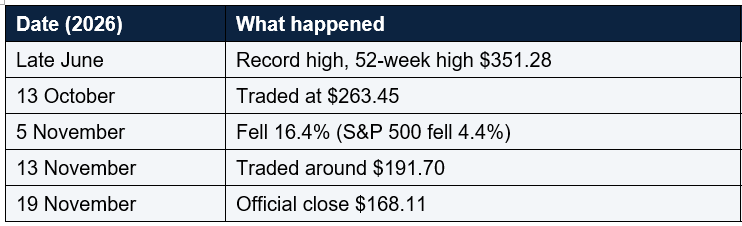
First, what does "down nearly 60%" actually measure? The 52-week high is $351.28. Against that, $145 is about 59% lower (my calculation). The peak came in late June: Motley Fool pieces cite a record close on 22 June, while TIKR refers to a 25 June high [9], so I describe it simply as late June.The slide since then has come in steps. On 13 October, the stock traded at $263.45. In the month to 5 November, it lost 42.5%. On 5 November itself, it dropped 16.4% while the S&P 500 lost 4.4%. Data-center spending came into doubt that day, and a customer deal with NTT Data did not stop the fall. A week later it traded around $191.70, and on 19 November it closed at $168.11.
Notice what is missing from that story: bad company news. A Kalkine report on 5 November said the stock was swept into a market-wide AI sell-off with no confirmed company setback in the material it reviewed. Fuel-cell peers fell together, with FuelCell Energy down 15.3% that day. Some of this is a fall in sentiment, not in fundamentals (my inference).
The business behind the drop: a record third quarter
Behind the price, the third-quarter report was exceptional. Revenue was $1,235.8 million, up 138.1%, and product revenue rose 179.4% to $1,073.6 million. GAAP earnings per share were $0.78, a swing of $0.88 from a year earlier, and non-GAAP EPS was $0.94. The results beat expectations by a wide margin. Benzinga reported revenue of $1.24 billion versus analyst estimates of $1.05 billion, and adjusted EPS of 94 cents versus 68 cents. Zacks gives different figures, an operating EPS of 76 cents against a consensus of 56 cents. The gap probably reflects different definitions of adjusted earnings (my inference), but either way it was a beat.Profitability is the other half of the story. Gross margin rose 453 basis points to 33.8%. Net income attributable to common stockholders reached $250.3 million, compared with a loss of $23.1 million a year earlier. Trefis notes the third-quarter operating margin was 18.2%, up from 1.5% a year earlier, and called it the highest operating margin at any quarter-end since the end of 2017. Put plainly, Bloom has moved from a business that struggled to make money to one making a lot of it. That is why the share price fall looks so odd to many investors.
Guidance and what the fourth quarter must deliver
Management raised its full-year 2026 revenue guidance to $4.4 billion to $4.6 billion from $3.9 billion to $4.2 billion, which at the midpoint is 122% growth. Adjusted EPS guidance rose to $3.10 to $3.40 from $2.55 to $2.85, above the analyst consensus of $2.73. Non-GAAP operating income is expected between $960 million and $1.03 billion. It was the third guidance increase this year. There is a catch, and management admitted it. The timing of a few year-end deliveries could determine where revenue lands within the range. TIKR calculated that Bloom needs about $1.35 billion to $1.55 billion of revenue in the fourth quarter to meet guidance. The midpoint of $1.45 billion would be about 17% above the third quarter's $1.24 billion (my calculation). That is achievable, but it is not guaranteed.Zooming out, TIKR also reports that analysts keep raising estimates. The 2027 EPS consensus rose to $5.32 from $4.88 in the month to 10 November, and the 2028 consensus stands at $8.24. Those are forecasts, and forecasts for fast-growing companies are often revised both ways.
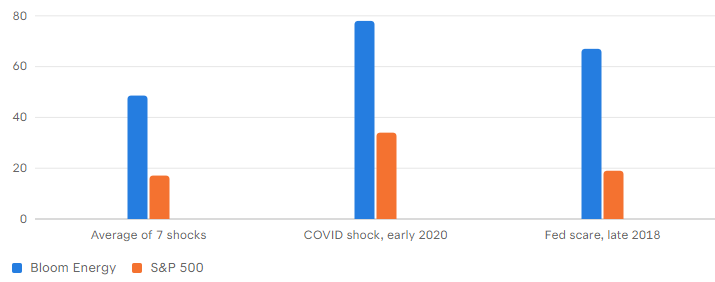
Bloom Energy: past drops in market shocks vs S&P 500 (%)
% decline by Source: Trefis, 17 November 2026 (declines in %, since 2018 listing).
Where the demand is coming from
What is driving the demand? Mostly AI data centers that need power faster than the grid can supply it. Bloom's solid-oxide fuel cells generate electricity on site, which is attractive when grid connections take years. The best-known customer is Oracle. In April, Oracle expanded its partnership to cover up to 2.8 gigawatts of fuel cell systems, with 1.2 gigawatts contracted up front and deployments continuing into 2027. On 5 November, NTT DATA announced a 900-megawatt on-site power deal [9]. Brookfield Asset Management has a financing framework with Bloom, described at $5 billion early on and later as a $25 billion agreement.Capacity is expanding to match. Bloom plans to double annual production at its Fremont plant from 1 gigawatt to 2 gigawatts by the end of 2026. Management also says the story is spreading beyond hyperscalers; CEO KR Sridhar said every major US hyperscaler has approved Bloom's systems. On backlog, the last full figure I found was about $20 billion in total, roughly $6 billion of product and $14 billion of service, as of the fourth quarter of 2025. That is a year-old figure, and I did not find an updated one, so please check the company's latest filing. The Q4 2025 call also described the product backlog as 100% attached to service.
The catches: concentration, cash flow and a short report
Now the risks. I would put four on the list. Customer concentration. TIKR reports that two customers made up 69% of third-quarter revenue, and that 97% of third-quarter revenue was US-based. If one big buyer slows its build-out, the numbers can change fast. TIKR flags Oracle's spending as the main variable to watch [9]. Some arguments for a lower valuation also cite related-party revenue through the Brookfield joint ventures.Cash flow. Profits are not yet turning into cash every quarter. Operating cash flow was negative $27 million in the third quarter even though net income was $250 million, because inventory, contract assets and receivables rose as Bloom built for future deliveries. TIKR puts third-quarter free cash flow at negative $181 million, and positive $41.6 million for the first nine months. The CFO called the cash use "not the beginning of a trend". The two sources use different measures, so they are not in conflict, but the direction is clear: growth is consuming cash.
A short-seller report. On 8 July, Hunterbrook published a short report alleging Chinese scandium sourcing, and class-action suits followed. The company rebutted the report. I have no way to judge the claims, but they are part of the risk picture. Competition and sentiment. A Chevron and Microsoft deal in June, to use natural gas turbines for a West Texas data-center project from 2028, showed that there will be other providers of data-center power. And the stock is tied to sentiment about AI spending, which is why it fell with other tech stocks on 5 November.
Convertible notes and dilution
Bloom funded much of its expansion with convertible debt, and that matters for the share count. As of 30 June 2026, cash was $2.67 billion against $2.48 billion of debt, almost all of it $2.5 billion of 0% convertible notes due November 2030 with a conversion price of $194.97. At 30 September, Trefis reported total debt of $2.78 billion and cash plus short-term investments of $2.56 billion.The conversion price is the interesting part. The notes can convert into shares only when the stock reaches $194.97. At $145, the stock sits below that level (my calculation), so dilution from the converts is a future concern, not an immediate one. If the stock recovered strongly, the notes would start to look like extra shares. There is also an Oracle warrant. Bloom issued Oracle a warrant for 3.5 million shares at $113.28, which was exercised without cash on 1 May 2026. Warrants and converts are common for a fast-growing industrial company, but they are a reminder to check the share count and not only the share price.
Valuation at $145: cheap, or just cheaper?
Now the question of whether $145 is cheap. To judge, I use the figures below. Most of this is my own arithmetic, so please treat it as a rough guide.Market cap. StockAnalysis showed a market cap of $56.76 billion when the last close was $191.99. That implies roughly 295.6 million shares (my calculation). At $145, the market cap would be about $43 billion (my calculation). Price to sales. Trailing twelve-month revenue to 30 September was $3.83 billion, so $43 billion is about 11.2 times trailing sales (my calculation). On the 2026 guidance midpoint of $4.5 billion, it is about 9.5 times (my calculation). For comparison, StockAnalysis showed a price-to-sales ratio of 14.8 at the $191.99 price.
Price to earnings. Using the midpoint of adjusted EPS guidance of $3.25, $145 is about 45 times current-year earnings (my calculation). Using the 2027 consensus of $5.32, it is about 27 times, and on the 2028 consensus of $8.24, about 17.6 times (my calculation, using figures from [9]). TIKR said that at roughly $173 the stock traded at about 35 times forward earnings, versus a three-year average of about 75 times.
So is it cheap? Compared with where Bloom traded earlier this year, yes. One Motley Fool piece noted that on 22 June the shares cost about 170 times guided earnings, and another said they traded at around 100 times expected earnings in October. Compared with an ordinary industrial company, no: even 27 times 2027 earnings assumes years of very strong growth. The analyst average target is about $284, but targets for volatile stocks move quickly, and I would not lean on them.
"Once in a decade"? What past drops tell us
The headline asks whether this is a once-in-a-decade opportunity. History suggests being careful with that phrase. Bloom has fallen hard many times. Trefis looked at seven market shocks since its 2018 listing: the stock fell an average of 48.6% in them, versus 17.1% for the S&P 500, and the worst was a 78% drop in the early-2020 COVID shock. The stock recovered to its earlier peak after every one of those falls, with a median of 3.9 months from the low, but three of the seven took more than a year, and the slowest took 23.5 months.More recently, Bloom has bounced back fast. A Motley Fool piece noted that after a 46% slide from 3 November to 17 December 2025, the stock was back at a new high by 16 January 2026, 30 days after the low. It has fallen 20% or more five times since September 2025, and recovered from four of them within weeks. That record cuts both ways. It suggests that dips have often been buying opportunities for patient holders. It also means large drops are normal for this stock, not rare, which is why "once in a decade" may overstate it (my inference). With a beta of about 3.6, a drop of 15% on a bad day should not surprise anyone. Worth remembering: Past recoveries do not guarantee a future one. The earlier peaks were reached when the business was much smaller and cheaper (my inference). A recovery from here needs earnings to grow into the price.
Bloom Energy quarterly revenue (US$ millions)
US$ millions by Source: Bloom Energy Q3 2026 results (Form 8-K). Q3 2026 up 138.1% year on year.
Buy now, or wait for a bigger drop?
Should you buy now or wait for a bigger drop? Nobody can time this, and I will not pretend to. But I can describe the trade-offs. The case for buying now. The business is growing fast, guidance has been raised three times, estimates are still rising, and the stock is far below its high. If you believe the AI power build-out continues, waiting for a lower price may mean missing a rebound. Bloom has sometimes recovered in weeks. The case for waiting. The stock fell 42.5% in a month to 5 November and could keep falling if AI sentiment weakens. Its average fall in past shocks was 48.6%, and from a late-June peak of $351.28 that average would imply a price near $180 (my calculation), a level the stock has already passed through. The risks, cash burn and concentration, are real. And there is no rule that says a stock must stop at 60%.A middle path. My suggestion, not advice: if you want exposure, consider splitting your intended purchase into several parts over weeks or months, for example one third now and the rest later. That way, a further fall hurts less, and a rebound still helps. Keep the position small enough that a 50% fall would not change your life. For a stock with a beta above 3, sizing matters more than timing. Also decide in advance what would change your mind. For example: a missed fourth-quarter revenue target, a cut to Oracle-related plans, or free cash flow staying negative. Writing the rules down beforehand makes it easier to follow them when the stock is moving 10% in a day.
Who this stock suits, and who it does not
This is a stock for a specific kind of investor. These are my suggestions, not advice. It may suit you if you have a long horizon of five years or more, can tolerate losing half your investment on paper without selling, believe in the on-site power thesis for data centers, and are keeping the position small. It may not suit you if you need the money soon, if sharp falls would push you to sell, or if you want dividends, because the data page I checked shows no dividend for Bloom. It also may not suit you if you already hold a lot of AI-linked stocks. Chips, software and power names have been falling together, so they may not diversify one another. If you are unsure, a broad fund that includes Bloom may give you some exposure with less risk. Bloom was added to the S&P 500, so many index funds already hold it, though the weight is small (my inference).Several things will tell you whether the bull case is working. The fourth-quarter report, expected in early 2027, will show whether Bloom hit the $4.4 billion to $4.6 billion revenue range, and whether free cash flow turned positive. TIKR's author said the thesis depends on that cash flow improving. Next, watch Oracle's spending and any change to its 2.8-gigawatt plan. Then watch the fourth-quarter backlog disclosure, new customers beyond the top two, the Fremont expansion to 2 gigawatts, and the share price relative to the $194.97 conversion level. Finally, keep an eye on the AI sentiment backdrop. Bloom fell with other tech stocks on 5 November, so news about data-center spending can move it even when nothing about Bloom has changed.
Conclusion
So, is Bloom Energy a once-in-a-decade opportunity at $145? My honest view is that it is a high-quality growth story at a more reasonable price than it had a few months ago, but not a bargain by conventional standards. Revenue is up 138%, margins are rising, guidance has gone up three times, and demand is broad. Against that, two customers make up most of revenue, cash flow is lumpy, a short-seller report hangs over the name, and the stock has a history of very deep falls, averaging 48.6% in past shocks and reaching 78%. At about 27 times 2027 earnings (my calculation), the price still assumes a lot of growth.If you want to own it, size the position for the volatility, consider buying in stages, and set your own rules for what would change your mind. If you would rather wait, that is a legitimate choice too, and the stock's history shows that it can fall further or rebound fast. This post is general education, and I am not a financial adviser. Please check live prices and the company's filings before you decide.
FAQ
Why has Bloom Energy stock fallen so much if results are so strong?Mostly sentiment. The stock fell with AI and chip stocks after the US midterms on fears of a data-center slowdown, and a Kalkine report found no company setback behind the 5 November fall. It was also priced for a lot of growth before the fall.
Is Bloom Energy profitable?
Yes, increasingly. Third-quarter GAAP EPS was $0.78 and net income attributable to common stockholders was $250.3 million. Cash flow is less steady: operating cash flow was negative $27 million in the quarter.
What is Bloom Energy's 2026 guidance?
Revenue of $4.4 billion to $4.6 billion and adjusted EPS of $3.10 to $3.40, raised for the third time this year. Timing of year-end deliveries could affect where revenue falls.
Is $145 a good price to buy?
I cannot say. At $145 the stock is about 27 times 2027 consensus EPS and about 11 times trailing sales (my calculation), and it has fallen by an average of 48.6%, and up to 78%, in earlier shocks. I could not confirm a $145 close, so check the live price.
What are the biggest risks?
Customer concentration (two customers were 69% of Q3 revenue), negative free cash flow in the quarter, a short-seller report, convertible notes with a $194.97 conversion price, and sensitivity to AI spending sentiment.
0 Comments
Be the first to share your thoughts on this article.