

Investing
Which ETFs Belong in a Taxable Brokerage Account? 3 Tax Tips

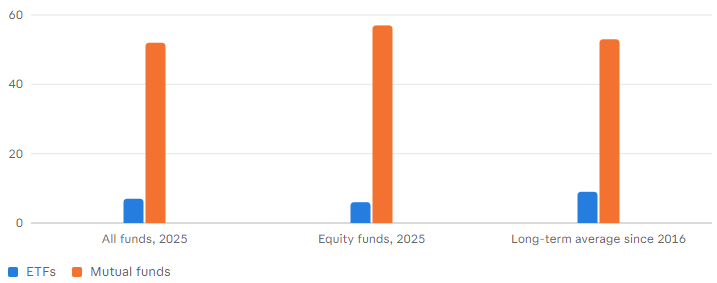
Three ETF strategies can help reduce tax drag in a taxable brokerage account, but each comes with its own costs and trade-offs. 7% of ETFs vs 52% of mutual funds paid capital gains in 2025; ETF tax efficiency worth about 1.05% a year after tax; top long-term gains rate 23.8% with the 3.8% surtax; AAA muni yield 4.58% vs 5.56% for taxable bonds.
% by Source: State Street Global Advisors
In a taxable brokerage account, you pay tax along the way: on dividends and interest each year, on capital gains the fund passes to you, and on gains you realise when you sell. That steady leakage is what people mean by "tax drag," and the right ETFs can cut it. Three strategies stand out. The first is broad, low-turnover index ETFs, which tend to distribute little in capital gains. The second is municipal bond ETFs, whose interest is generally exempt from federal income tax. The third is tax-loss harvesting, using ETFs to realise losses while staying invested. WealthManagement.com makes a similar point, saying investors can reduce the effect of taxes through asset location, by understanding the tax costs of active management, and by choosing vehicles with structural tax advantages.
Each has a price. Index ETFs can still pay taxable dividends. Muni ETFs usually yield less than taxable bonds. Harvesting adds complexity and rule risk. The rest of this post explains how each works, what it costs and who it suits. Key takeaway: Put tax-efficient assets in your taxable account and tax-inefficient ones in retirement accounts where you can. Then choose ETFs by what they pay out and how often they trade, not just by past returns.
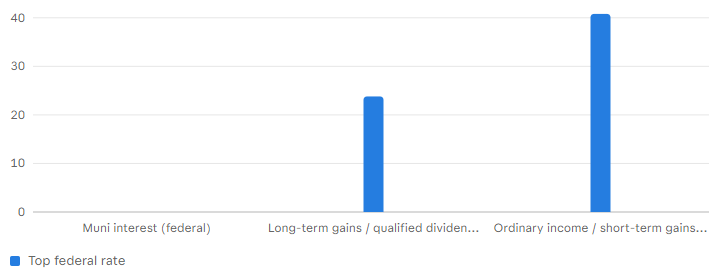
Higher earners may also owe the 3.8% net investment income tax. Experian lists the thresholds as $200,000 for single filers and $250,000 for married couples filing jointly. MarketWatch notes those thresholds are not indexed to inflation. Together, the highest common federal rate on long-term gains is 23.8% before state tax. Taxable accounts still have a big advantage: flexibility. From my general knowledge, a taxable account has no contribution cap and no age-based withdrawal rules. So the goal is not to avoid taxable accounts but to fill them wisely.
This is where asset location comes in. Kitces estimates that asset location can reduce ongoing tax drag by nearly 10 basis points a year, with more gains possible from further refinements. That is modest, but it compounds and costs nothing to implement beyond some thought.
Morningstar's own 2025 survey of about 1,600 ETFs from 15 providers found the average ETF capital gains distribution was more than a percentage point lower than the average mutual fund. Advisorpedia, summarising it, says 6% of ETFs would distribute gains and only 2% of those would exceed 1% of net asset value. The 6% and 7% figures differ slightly because the universes and sources differ, but the message is the same. An academic study in the Review of Financial Studies estimates that ETF tax efficiency has increased long-term investors' after-tax returns by 1.05% a year relative to mutual funds in recent years. That is a large gap over decades. There is a caveat. The edge is structural, not magical. Morningstar notes that the advantage matters less inside retirement accounts, where capital gains distributions have no immediate tax. And not every ETF benefits equally, as the next sections show.
Why does it work? Low turnover means few trades inside the fund, so few realised gains. The in-kind mechanism removes much of the rest. And because most equity ETFs avoid large year-end capital gains distributions, you have more control over when you realise gains, by choosing when to sell or trim.
Qualified dividends help too. Schwab notes that low-turnover funds holding US and developed-market equities can pay dividends taxed at the lower long-term capital gains rates, assuming you meet the holding period requirements. That is better than ordinary-income treatment. Morningstar's guidance for taxable accounts leans the same way. It suggests downplaying taxable bonds and bond funds, allocation funds and actively managed stock funds, and favouring things like ETFs and individual stocks. For many investors, this one strategy does most of the work. A simple, broad equity index ETF held for the long term is hard to beat on tax efficiency, and it is easy to understand.
There is also an eventual tax bill. The ETF's structure defers capital gains, but when you sell at a profit you pay tax. So the benefit is mainly about control and timing, not permanent avoidance. Holding for more than a year gets you the lower long-term rates. Finally, concentration. A broad index ETF may hold a lot of a few big names, which is a risk question, not a tax one. Tax efficiency should not push you into a portfolio that is wrong for your goals.
Money has flowed in. Advisor Perspectives says municipal bonds captured $105 billion in trailing 12-month net inflows, and WealthManagement.com reports that ETFs account for 97% of the $76 billion in muni fund inflows this year, per JPMorgan. A November commentary says munis are sometimes offering more than 8% in tax-equivalent yields on some funds. Costs are low for the broad funds. WTOP (U.S. News) lists the Vanguard Tax-Exempt Bond ETF at a 0.03% expense ratio and a 3.5% 30-day SEC yield, whose income is exempt from federal tax and the alternative minimum tax [20]. A comparable taxable bond fund, BND, paid 4.5%, but each distribution is generally a taxable event outside a tax-advantaged account [20]. Muni income also generally avoids the 3.8% net investment income tax, while the taxable alternative may be exposed to it, according to VanEck. For high earners, that widens the gap further.
Second, risk. Munis carry credit risk and interest-rate risk like other bonds. High-yield muni funds offer more income but more risk, and the longer a fund's duration, the more its price moves when rates change. A 30-day SEC yield of 3.5% does not guarantee a total return of 3.5%.
Third, state taxes. From my general knowledge, not a retrieved source, funds holding bonds from other states may produce income that is taxable by your own state, while single-state funds can be exempt from both. Check the fund's tax disclosures. Fourth, and again from my general knowledge, muni funds can still distribute taxable capital gains, and some muni income can count in certain tax calculations. Seeking Alpha's profile of MUB notes the fund is commonly used in taxable accounts, with a tax-equivalent yield of about 5.7% at the 40.8% bracket. Taxable-equivalent figures depend entirely on your bracket, so run your own numbers.
The wash sale rule is the hurdle. NerdWallet explains that the IRS defines a wash sale as selling a security in a taxable account and repurchasing the same or a "substantially identical" security within 30 days before or after the sale. Kiplinger notes that gives you a 61-day window to avoid. The rule covers stocks, bonds, mutual funds, ETFs and options. Muni ETFs have been popular for this. WealthManagement.com says tax-loss harvesting drove $23 billion into municipal bond ETFs last quarter while open-end funds saw outflows. That reflects investors realising losses on older, lower-yielding bonds and moving into similar exposures. Used well, harvesting turns a market dip into a tax asset. That is a good way to reduce tax drag, and it is the one strategy here that takes active effort.
The third is that it is a deferral, not a free lunch. HumbleDollar notes that harvesting resets your cost basis, meaning a lower basis and a larger gain later. The benefit is tax deferral, plus the chance to use losses against gains or income. Kitces notes it may not be worth harvesting unless the deferral benefit outweighs the risk of tracking error between the two funds. The fourth is attention and costs. Trading spreads, the temporary difference between your two funds, and record-keeping all add friction. For a small account with few losses, the benefit may be tiny.
Kiplinger cites a Tax Alpha Insider comparison using Morningstar's tax cost ratio over three years to 30 September, finding the tax cost of covered-call funds was seven times that of the Vanguard S&P 500 ETF. And in Kiplinger's own test, every Nasdaq-100 covered-call ETF underperformed QQQM in total return between January 2024 and September 2026, despite higher income. A higher yield is not higher return. REITs are another classic. HumbleDollar says REIT stocks and ETFs are the least tax-efficient asset class to hold in a brokerage account because their distributions are not qualified. Taxable bond funds, whose interest is ordinary income, also tend to belong in tax-advantaged accounts if you have room [8]. None of these are banned from taxable accounts. If the income is worth it to you, they can work. But you should know the tax bill before you buy.
Fifth, mind your holding periods. Selling after more than a year gets long-term rates. Sixth, review annually. Tax rules, your bracket and fund distributions change, and Morningstar publishes estimates of ETF capital gains distributions each year. Remember, this is a framework, not advice. Your state taxes, income, time horizon and needs for cash all change the answer. A qualified tax professional can turn the framework into a plan.
Mainly because of in-kind redemptions, which let ETFs hand over appreciated stocks instead of selling them. In 2025, 7% of ETFs paid capital gains versus 52% of mutual funds.
Do ETFs avoid taxes completely?
No. Dividends and interest are still taxable, and you owe tax on any gain when you sell. The advantage is mostly about fewer surprise distributions and more control over timing.
Are municipal bond ETFs worth it in a taxable account?
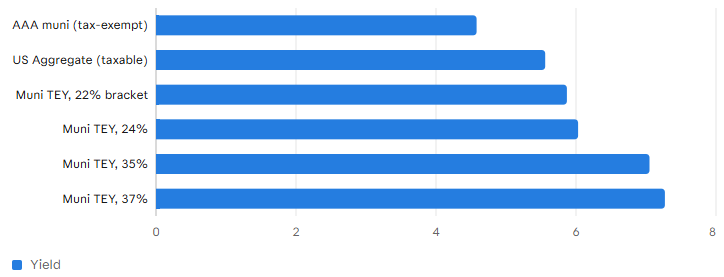
They can be for higher brackets: VanEck's table shows a taxable-equivalent yield of 7.27% at the 37% bracket versus 5.87% at 22%. Run the numbers for your own bracket and state.
Can I tax-loss harvest with ETFs?
Yes, but watch the wash sale rule: no substantially identical purchase within 30 days before or after the sale . The IRS has not defined the term for ETFs from different providers tracking the same index.
Which ETFs should I avoid in a taxable account?
Often REITs, taxable bond funds and covered-call income ETFs, which can have much higher tax costs. Check each fund's distribution history first.
Table of Contents
- Why the account type matters
- Why ETFs start with a tax advantage
- Strategy 1: Broad, low-turnover index ETFs
- The costs and trade-offs of index ETFs
- Strategy 2: Municipal bond ETFs
- The costs and trade-offs of muni ETFs
- Strategy 3: Tax-loss harvesting with ETFs
- The costs and trade-offs of harvesting
- ETFs that tend to fit poorly in taxable accounts
- A simple way to decide
- Mistakes to avoid
- Conclusion
- FAQ
Share of funds that paid a capital gain (%)
% by Source: State Street Global Advisors
AAA muni yield vs taxable-equivalent yields, 30 Sept 2026 (%)
% by Source: VanEck, ICE Data; federal tax only
Top federal rate by type of ETF income (%)
% by Source: Bear Savings, iShares; before state tax; NIIT applies above income thresholdsIn a taxable brokerage account, you pay tax along the way: on dividends and interest each year, on capital gains the fund passes to you, and on gains you realise when you sell. That steady leakage is what people mean by "tax drag," and the right ETFs can cut it. Three strategies stand out. The first is broad, low-turnover index ETFs, which tend to distribute little in capital gains. The second is municipal bond ETFs, whose interest is generally exempt from federal income tax. The third is tax-loss harvesting, using ETFs to realise losses while staying invested. WealthManagement.com makes a similar point, saying investors can reduce the effect of taxes through asset location, by understanding the tax costs of active management, and by choosing vehicles with structural tax advantages.
Each has a price. Index ETFs can still pay taxable dividends. Muni ETFs usually yield less than taxable bonds. Harvesting adds complexity and rule risk. The rest of this post explains how each works, what it costs and who it suits. Key takeaway: Put tax-efficient assets in your taxable account and tax-inefficient ones in retirement accounts where you can. Then choose ETFs by what they pay out and how often they trade, not just by past returns.
Why the account type matters
Different accounts are taxed differently. Traditional 401(k)s and IRAs defer tax until withdrawal, and Roth accounts allow tax-free growth and withdrawals, according to WealthManagement.com. A taxable account gets none of that, so every dividend and realised gain can generate a tax bill. The rates matter too. Long-term capital gains, on assets held more than a year, are taxed at 0%, 15% or 20% depending on income, while short-term gains are taxed as ordinary income at 10% to 37%. For 2026, the 15% rate applies to single filers with taxable income from $49,451 up to $545,500, and 20% above that.Higher earners may also owe the 3.8% net investment income tax. Experian lists the thresholds as $200,000 for single filers and $250,000 for married couples filing jointly. MarketWatch notes those thresholds are not indexed to inflation. Together, the highest common federal rate on long-term gains is 23.8% before state tax. Taxable accounts still have a big advantage: flexibility. From my general knowledge, a taxable account has no contribution cap and no age-based withdrawal rules. So the goal is not to avoid taxable accounts but to fill them wisely.
This is where asset location comes in. Kitces estimates that asset location can reduce ongoing tax drag by nearly 10 basis points a year, with more gains possible from further refinements. That is modest, but it compounds and costs nothing to implement beyond some thought.
Why ETFs start with a tax advantage
ETFs have a structural edge over traditional mutual funds. When mutual fund investors redeem, the fund may have to sell holdings, which can create capital gains passed to everyone who stays. Morningstar explains that ETFs usually avoid this through in-kind redemptions: instead of selling appreciated stocks to meet redemptions, the ETF transfers stocks out of the portfolio through an authorised participant. The data shows the effect. State Street reports that only 7% of ETFs paid a capital gain in 2025, compared with 52% of mutual funds, and since 2016 a long-term average of 9% of ETFs against 53% of mutual funds [4]. Among equity funds, 6% of ETFs paid gains in 2025 against 57% of equity mutual funds.Morningstar's own 2025 survey of about 1,600 ETFs from 15 providers found the average ETF capital gains distribution was more than a percentage point lower than the average mutual fund. Advisorpedia, summarising it, says 6% of ETFs would distribute gains and only 2% of those would exceed 1% of net asset value. The 6% and 7% figures differ slightly because the universes and sources differ, but the message is the same. An academic study in the Review of Financial Studies estimates that ETF tax efficiency has increased long-term investors' after-tax returns by 1.05% a year relative to mutual funds in recent years. That is a large gap over decades. There is a caveat. The edge is structural, not magical. Morningstar notes that the advantage matters less inside retirement accounts, where capital gains distributions have no immediate tax. And not every ETF benefits equally, as the next sections show.
Strategy 1: Broad, low-turnover index ETFs
The first strategy is the simplest: hold broad, low-cost, low-turnover index ETFs in your taxable account. Think of funds that track a large share of the US or global stock market. BlackRock summarises the idea as parking low-cost index ETFs in taxable accounts, while active mutual funds go in tax-advantaged accounts to protect returns from tax drag [10].Why does it work? Low turnover means few trades inside the fund, so few realised gains. The in-kind mechanism removes much of the rest. And because most equity ETFs avoid large year-end capital gains distributions, you have more control over when you realise gains, by choosing when to sell or trim.
Qualified dividends help too. Schwab notes that low-turnover funds holding US and developed-market equities can pay dividends taxed at the lower long-term capital gains rates, assuming you meet the holding period requirements. That is better than ordinary-income treatment. Morningstar's guidance for taxable accounts leans the same way. It suggests downplaying taxable bonds and bond funds, allocation funds and actively managed stock funds, and favouring things like ETFs and individual stocks. For many investors, this one strategy does most of the work. A simple, broad equity index ETF held for the long term is hard to beat on tax efficiency, and it is easy to understand.
The costs and trade-offs of index ETFs
Index ETFs are not free of tax. Kiplinger reminds us that while most equity ETFs avoid the large year-end capital gains distributions that historically affected mutual funds, investors can still face taxes from regular dividend payouts. Those dividends are taxable in a brokerage account. Some ETFs do distribute gains. Advisorpedia notes that the worst offenders in Morningstar's 2025 study had things in common: exposure to international markets that prohibit in-kind transactions, or derivatives-based strategies. Morningstar Canada adds that fixed-income ETFs, currency-hedged ETFs and ETFs in markets that do not allow in-kind redemptions are more likely to make distributions.There is also an eventual tax bill. The ETF's structure defers capital gains, but when you sell at a profit you pay tax. So the benefit is mainly about control and timing, not permanent avoidance. Holding for more than a year gets you the lower long-term rates. Finally, concentration. A broad index ETF may hold a lot of a few big names, which is a risk question, not a tax one. Tax efficiency should not push you into a portfolio that is wrong for your goals.
Strategy 2: Municipal bond ETFs
The second strategy is municipal bond ETFs. Interest from municipal bonds is generally exempt from federal income tax, and, as the iShares explainer notes, that is why the tax-equivalent yield is usually quoted. The formula is the muni yield divided by one minus your tax rate. iShares gives the example 3.5% divided by (1 minus 0.408), which is 5.91% for someone in the 40.8% bracket. The numbers have become more interesting. VanEck reported AAA municipal yields of 4.58% on 30 September, against 5.56% for the US Aggregate taxable index. Adjusting for tax, the taxable-equivalent yield was 5.87% at the 22% bracket, 6.03% at 24%, 7.05% at 35% and 7.27% at 37%. So at the 22% bracket, the muni advantage over taxable bonds was about 0.31 percentage points, but at the 37% bracket it was about 1.71.Money has flowed in. Advisor Perspectives says municipal bonds captured $105 billion in trailing 12-month net inflows, and WealthManagement.com reports that ETFs account for 97% of the $76 billion in muni fund inflows this year, per JPMorgan. A November commentary says munis are sometimes offering more than 8% in tax-equivalent yields on some funds. Costs are low for the broad funds. WTOP (U.S. News) lists the Vanguard Tax-Exempt Bond ETF at a 0.03% expense ratio and a 3.5% 30-day SEC yield, whose income is exempt from federal tax and the alternative minimum tax [20]. A comparable taxable bond fund, BND, paid 4.5%, but each distribution is generally a taxable event outside a tax-advantaged account [20]. Muni income also generally avoids the 3.8% net investment income tax, while the taxable alternative may be exposed to it, according to VanEck. For high earners, that widens the gap further.
The costs and trade-offs of muni ETFs
Munis are not for everyone. The first trade-off is the lower headline yield. A tax-free 3.5% only beats a taxable bond if your bracket is high enough. At lower brackets, the advantage shrinks: the 22% bracket showed only about 0.31 percentage points of benefit in VanEck's table. If you are in a low bracket, or likely to be in one, a taxable bond fund in a taxable account may make no sense, but neither may munis. In that case, putting bonds inside a tax-advantaged account may be the better move. That is my general reading, not a rule.Second, risk. Munis carry credit risk and interest-rate risk like other bonds. High-yield muni funds offer more income but more risk, and the longer a fund's duration, the more its price moves when rates change. A 30-day SEC yield of 3.5% does not guarantee a total return of 3.5%.
Third, state taxes. From my general knowledge, not a retrieved source, funds holding bonds from other states may produce income that is taxable by your own state, while single-state funds can be exempt from both. Check the fund's tax disclosures. Fourth, and again from my general knowledge, muni funds can still distribute taxable capital gains, and some muni income can count in certain tax calculations. Seeking Alpha's profile of MUB notes the fund is commonly used in taxable accounts, with a tax-equivalent yield of about 5.7% at the 40.8% bracket. Taxable-equivalent figures depend entirely on your bracket, so run your own numbers.
Strategy 3: Tax-loss harvesting with ETFs
The third strategy is tax-loss harvesting. When an investment falls below your cost, you can sell it, realise the loss, and use the loss to offset capital gains. Bear Savings notes that net capital losses can reduce ordinary income by up to $3,000 a year, with the rest carried forward. ETFs make this easier because you can swap into a similar fund and stay invested. Fidelity notes that ETFs can be used to avoid the wash sale rule while maintaining a similar investment holding.The wash sale rule is the hurdle. NerdWallet explains that the IRS defines a wash sale as selling a security in a taxable account and repurchasing the same or a "substantially identical" security within 30 days before or after the sale. Kiplinger notes that gives you a 61-day window to avoid. The rule covers stocks, bonds, mutual funds, ETFs and options. Muni ETFs have been popular for this. WealthManagement.com says tax-loss harvesting drove $23 billion into municipal bond ETFs last quarter while open-end funds saw outflows. That reflects investors realising losses on older, lower-yielding bonds and moving into similar exposures. Used well, harvesting turns a market dip into a tax asset. That is a good way to reduce tax drag, and it is the one strategy here that takes active effort.
The costs and trade-offs of harvesting
Harvesting has real catches. The first is the wash sale rule's grey area. The IRS has not defined "substantially identical," so uncertainty remains. Fidelity says there has been no IRS ruling on whether ETFs from two different companies tracking the same index are substantially identical. NerdWallet adds that two ETFs tracking the same index may be hard to judge. The second is the account trap. Fidelity warns you cannot skirt the rule by selling at a loss in a taxable account and having your IRA buy the same ETF within the window. Kiplinger adds that a spouse's purchases can also trigger it. Dividend reinvestment can create accidental wash sales too, so check reinvestment settings.The third is that it is a deferral, not a free lunch. HumbleDollar notes that harvesting resets your cost basis, meaning a lower basis and a larger gain later. The benefit is tax deferral, plus the chance to use losses against gains or income. Kitces notes it may not be worth harvesting unless the deferral benefit outweighs the risk of tracking error between the two funds. The fourth is attention and costs. Trading spreads, the temporary difference between your two funds, and record-keeping all add friction. For a small account with few losses, the benefit may be tiny.
ETFs that tend to fit poorly in taxable accounts
Some ETFs are a poor fit for taxable accounts. Covered-call and income ETFs are a good example. Schwab says all or part of option-selling income is typically taxed at higher ordinary rates, so an ETF with significant covered-call income generally produces a larger tax drag. The details vary by fund. 24/7 Wall St. reports that JEPI taxes every distribution as ordinary income, while SPYI's Section 1256 treatment splits gains into a 60/40 long-term and short-term blend [31]. ProShares says distributions can be characterised as ordinary dividends, capital gains or return of capital, and the mix varies by fund and year.Kiplinger cites a Tax Alpha Insider comparison using Morningstar's tax cost ratio over three years to 30 September, finding the tax cost of covered-call funds was seven times that of the Vanguard S&P 500 ETF. And in Kiplinger's own test, every Nasdaq-100 covered-call ETF underperformed QQQM in total return between January 2024 and September 2026, despite higher income. A higher yield is not higher return. REITs are another classic. HumbleDollar says REIT stocks and ETFs are the least tax-efficient asset class to hold in a brokerage account because their distributions are not qualified. Taxable bond funds, whose interest is ordinary income, also tend to belong in tax-advantaged accounts if you have room [8]. None of these are banned from taxable accounts. If the income is worth it to you, they can work. But you should know the tax bill before you buy.
A simple way to decide
A simple order of operations can help. First, fill your tax-advantaged accounts with the assets that are least tax-efficient: taxable bonds, REITs, high-turnover or income-heavy funds. Second, put broad equity index ETFs in the taxable account, because they distribute little. Third, if you are in a high bracket and need bonds in the taxable account, compare a municipal bond ETF's tax-equivalent yield with a taxable alternative at your own bracket. Fourth, consider harvesting losses when markets dip, with a clear list of replacement funds and a calendar for the 61-day window.Fifth, mind your holding periods. Selling after more than a year gets long-term rates. Sixth, review annually. Tax rules, your bracket and fund distributions change, and Morningstar publishes estimates of ETF capital gains distributions each year. Remember, this is a framework, not advice. Your state taxes, income, time horizon and needs for cash all change the answer. A qualified tax professional can turn the framework into a plan.
Mistakes to avoid
A few mistakes are common. The first is chasing yield without checking tax treatment, which the covered-call examples show. The second is assuming every ETF is tax-efficient. The structure helps, but international and derivative-heavy funds have been the main offenders. The third is triggering a wash sale by accident, through reinvested dividends, a spouse's account or an IRA. The fourth is letting the tax tail wag the dog: do not hold a fund you would not otherwise want just to save a little tax. The fifth is forgetting state taxes and the 3.8% surtax, which can change which option wins [14]. And the sixth is neglecting the basics: diversification, costs and your time horizon matter more than a few basis points of tax savings.Conclusion
Three strategies can reduce tax drag in a taxable account. Broad, low-turnover index ETFs lean on the in-kind structure that lets most ETFs avoid capital gains distributions: only 7% of ETFs paid one in 2025 against 52% of mutual funds. Municipal bond ETFs offer federally tax-exempt income, with taxable-equivalent yields that look compelling for higher brackets. Tax-loss harvesting turns market dips into tax assets, if you can navigate the wash sale rule [24]. Each has a cost. Index ETFs still pay taxable dividends. Munis yield less in absolute terms and carry credit and rate risk. Harvesting defers tax, resets basis and runs into rules the IRS has not fully defined. So start simple. Keep broad equity index ETFs in the taxable account, put tax-inefficient funds in retirement accounts where possible, and add munis or harvesting only if your bracket and situation justify them. And whatever you choose, check the tax rules for your own situation, ideally with a professional.FAQ
Why are ETFs more tax-efficient than mutual funds?Mainly because of in-kind redemptions, which let ETFs hand over appreciated stocks instead of selling them. In 2025, 7% of ETFs paid capital gains versus 52% of mutual funds.
Do ETFs avoid taxes completely?
No. Dividends and interest are still taxable, and you owe tax on any gain when you sell. The advantage is mostly about fewer surprise distributions and more control over timing.
Are municipal bond ETFs worth it in a taxable account?
They can be for higher brackets: VanEck's table shows a taxable-equivalent yield of 7.27% at the 37% bracket versus 5.87% at 22%. Run the numbers for your own bracket and state.
Can I tax-loss harvest with ETFs?
Yes, but watch the wash sale rule: no substantially identical purchase within 30 days before or after the sale . The IRS has not defined the term for ETFs from different providers tracking the same index.
Which ETFs should I avoid in a taxable account?
Often REITs, taxable bond funds and covered-call income ETFs, which can have much higher tax costs. Check each fund's distribution history first.
0 Comments
Be the first to share your thoughts on this article.