
Investing
Larry Ellison Lost ~$145B: Is Oracle's OpenAI Bet Too Risky?

Oracle is estimated to have over $300 billion in orders from OpenAI, and Wall Street thinks that could be a bad thing.$125B; fiscal 2026 free cash flow negative $23.7B; 5-year CDS about 295 to 296 basis points; stock about $125 on 13 Nov;
The Motley Fool puts the loss at about $145 billion, with the stock down roughly 50% from its high and closing at $125.35 on 13 November. Other outlets give larger numbers: a loss of about $194 billion and a 59% to 62% fall from the peak. I explain below why the figures differ.
The reason Wall Street is nervous is concentration. Roughly $300 billion of Oracle's $664 billion backlog is tied to OpenAI, about 45% (my calculation from. Oracle is spending far more on data centres than it earns in cash, has raised large amounts of debt, and has just raised another $20 billion. If OpenAI could not pay, or asked to renegotiate, the effect would be large.
Key takeaway: Oracle has real demand and a big backlog, but a large share of that backlog depends on one customer, and the buildout is being funded with debt. Whether the stock is a bargain or a warning depends on whether OpenAI can keep paying.
TheStreet reports that his net worth peaked near $393 billion in September 2025 and dropped by about $194 billion in a year as ORCL fell 59%. TickerRoast cites Bloomberg's index at about $178 billion on 16 October, a decline of about $194 billion, and Forbes at $169.1 billion, and says the stock had lost about 62%. More recently, Yahoo Finance said Oracle fell about 7% to 7.5% on 5 November, taking Ellison's estimated fortune down roughly $11.5 billion to about $152.5 billion on the Forbes real-time list, and out of the global top 10.
So the honest summary is that Ellison has lost something like $145 billion to $194 billion, depending on the starting point, the date, and whether you use Bloomberg or Forbes. These are estimates of paper wealth, based on share prices, not cash he has spent.
There is also an internal mismatch in the headline. The Fool's own article says the stock is down roughly 50% from its high and 44% over the stretch, while the headline says 59%. Using the price data in that article, $125.35 against a 52-week high of $250.25 is a 49.9% fall (my calculation). A 59% fall would imply a lower price. The 59% figure comes from other sources that measure from the September 2025 peak, which, by my inference, was higher than the 52-week high.
By July 2026 Fast Company said the shares had fallen more than 43% since the deal, wiping out the gains [10]. In early November the pace picked up. On 2 November the stock fell 8.76% to $119.22 after a $20 billion equity and bond offering, according to TradingKey. Three days later it fell another 7% to 7.5%. Where things stand: the Fool reports a $125.35 close on 13 November, a 52-week range of $109.21 to $250.25, and a market value of about $379 billion.
Two cautions. First, the contract terms are not public, and the Fool says cancellation fees are assumed, not confirmed. Second, Fast Company describes OpenAI as a company reportedly losing billions [10], so the question is who funds the payments.
The concern is the make-up. Luminix says roughly $300 billion of the $664 billion is tied to the OpenAI contract, about 45%. The Fool calls it nearly half. Fast Company said more than $300 billion of $553 billion came from OpenAI at an earlier date, which would be about 54% (my calculation: $300B / $553B). The share has fallen as other contracts were added, but it remains very large. S&P has flagged OpenAI concentration in the backlog as a central credit risk. A simple illustration: if the OpenAI contract were cut by a quarter, about $75 billion would come out of the backlog, or 11% of the $664 billion total (my calculation). This is a what-if, not a forecast.
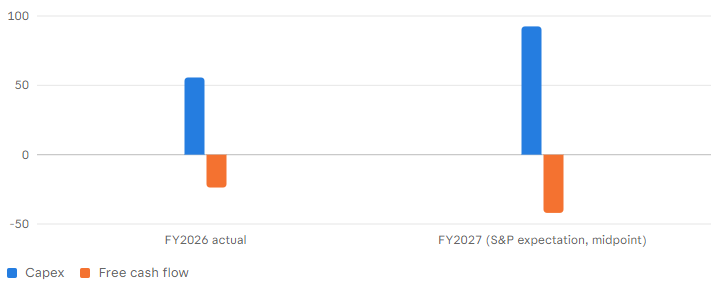
The spending is still rising. Luminix says S&P expects fiscal 2027 capex of about $90 billion to $95 billion and a free operating cash flow deficit near $42 billion, financed with a mix of debt and equity. That capex would be 62% to 71% higher than fiscal 2026's $55.66 billion (my calculation). The Fool notes capex of $28 billion last quarter against operating cash flow of $23 billion, a gap of about $5 billion in the quarter (my calculation).
The article's own figure of free cash flow for the quarter is shown as negative $5 million, which looks like a typo for $5 billion, since $23 billion minus $28 billion is about negative $5 billion. I use my arithmetic here. Debt is large, and sources vary. The Fool says about $125 billion, Beardynerd says about $125 billion in borrowings and the $20 billion raise on top, BigGo cites FactSet for $118 billion of long-term debt plus $39 billion of capital and lease obligations [9], and Fast Company, citing JPMorgan research, says more than $160 billion in outstanding liabilities, with $133 billion tied to the AI buildout. These measure different things, so I would not pick one. Debt of $125 billion against a $379 billion market value is about 33% (my calculation).
TradingKey also notes that the 2 November $20 billion offering exhausted Oracle's planned funding cap through fiscal 2030 in just five days. That is a striking detail, but it comes from one site, so I treat it as indicative. Why does this matter for shareholders? Because a credit downgrade to junk would raise borrowing costs and could limit how much Oracle can spend, at the moment it needs to spend most.
Several indicators matter: the next quarterly results and any update to the backlog and its OpenAI share; free cash flow and capex guidance; the credit rating and credit default swap spreads; further equity or bond raises; any news about OpenAI's own funding; and the pace of data-centre construction against the 2027 start date for the contract.
This is general, not personal advice. A stock like this may suit someone who can tolerate large swings, holds a diversified portfolio, and has a long horizon. It may suit people less if they need the money soon, already hold a lot of AI-related companies, or would panic-sell after a 30% fall. Many people already own Oracle through index funds.
If you do consider buying, some people spread purchases over time instead of picking one day. That reduces timing risk but not the risk that the business case weakens. A regulated adviser can help with your specific situation.
The bull case: strong demand, a $664 billion backlog, rising cloud revenue, a forward P/E of about 15, and the chance that concentration eases over time. The bear case: about 45% of the backlog depends on one customer, free cash flow is deeply negative, debt is rising, and the credit market is pricing stress. Both are true. The deal could make Oracle a major AI infrastructure company, or it could strain the balance sheet if the customer falters.
The business is growing, and the valuation is lower than it was. But the main risk is not demand. It is whether the buildout can be funded and whether OpenAI can pay. Watch the backlog mix, cash flow and credit signals, and make decisions based on your own goals and risk tolerance. This post is education only, not advice.
Estimates range from about $145 billion (Motley Fool, measured from the valuation peak) to about $194 billion (TheStreet and Bloomberg-based figures), depending on the start date and index.
How much of Oracle's backlog is OpenAI?
Roughly $300 billion of a $664 billion backlog, about 45% [7]. Contract terms are not public.
Why is Oracle stock falling?
Concerns about customer concentration, heavy capex, negative free cash flow and debt, and a $20 billion raise on 2 November that was followed by an 8.76% drop.
Is Oracle in danger of default?
There is no sign of default in the sources I read. But credit default swaps near 295 basis points and a BBB- rating under scrutiny show the market is pricing more risk.
Is Oracle stock a buy now?
I cannot say. The forward P/E is about 15 and demand is strong, but concentration and funding risks are real. Consider speaking to a regulated adviser.
Table of Contents
- The quick answer
- What happened to Larry Ellison's fortune
- How Oracle's stock got here
- The OpenAI deal in plain English
- The backlog: big number, big concentration
- Where the money goes: capex, cash flow and debt
- What the credit market is saying
- Why Wall Street is nervous
- The bull case: what Oracle has going for it
- How sensitive is Ellison's fortune?
- What could go wrong, and what could go right
- What to watch next
- Who this might suit, and who it might not
- Bull case versus bear case
- Conclusion
- FAQ
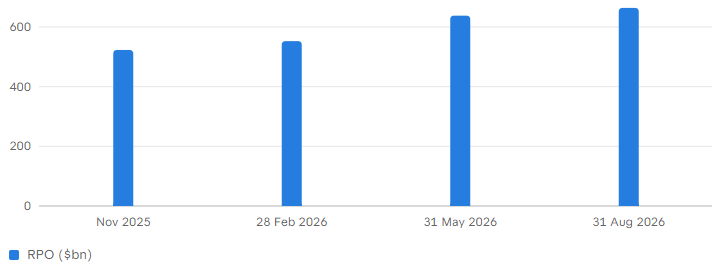
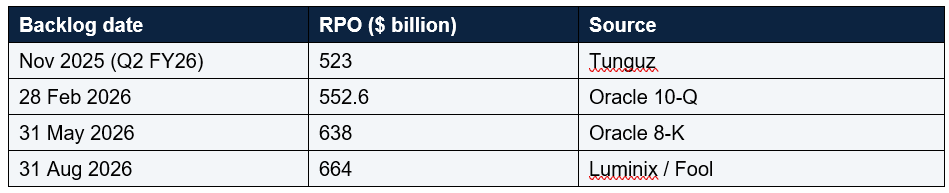
Oracle remaining performance obligations ($ billions)
US dollars, billions by Sources: Tunguz, Oracle 10-Q and 8-K, Luminix
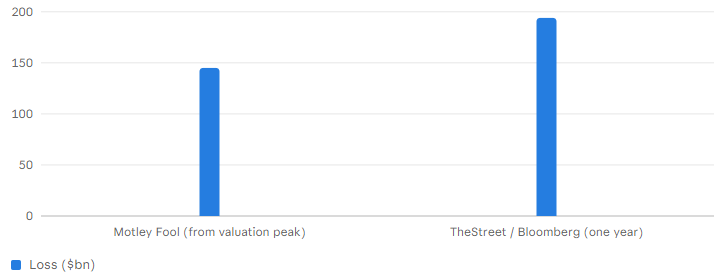
Estimates of Larry Ellison's loss differ by source ($ billions)
US dollars, billions by Different start points and indexes
Oracle capex and free cash flow ($ billions)
US dollars, billions by Sources: Oracle 8-K, Luminix citing S&P; FY2027 capex is midpoint of $90-95B
The quick answer
Oracle has become the market's favourite example of an AI bet that grew very large very fast. A reported $300 billion computing deal with OpenAI sent the stock soaring in September 2025, briefly making Larry Ellison the richest person in the world. A year on, the shares have fallen by roughly half or more, depending on the measure, and his fortune with them.The Motley Fool puts the loss at about $145 billion, with the stock down roughly 50% from its high and closing at $125.35 on 13 November. Other outlets give larger numbers: a loss of about $194 billion and a 59% to 62% fall from the peak. I explain below why the figures differ.
The reason Wall Street is nervous is concentration. Roughly $300 billion of Oracle's $664 billion backlog is tied to OpenAI, about 45% (my calculation from. Oracle is spending far more on data centres than it earns in cash, has raised large amounts of debt, and has just raised another $20 billion. If OpenAI could not pay, or asked to renegotiate, the effect would be large.
Key takeaway: Oracle has real demand and a big backlog, but a large share of that backlog depends on one customer, and the buildout is being funded with debt. Whether the stock is a bargain or a warning depends on whether OpenAI can keep paying.
What happened to Larry Ellison's fortune
Different sources report different losses, and it is worth understanding why before quoting any of them. The Motley Fool says Ellison's net worth fell roughly $145 billion compared to where it stood at Oracle's valuation peak. His 1.16 billion shares, roughly a 40% stake, make him the largest shareholder. The headline says "over the past year", but the body measures from the valuation peak, which is a slightly different thing.TheStreet reports that his net worth peaked near $393 billion in September 2025 and dropped by about $194 billion in a year as ORCL fell 59%. TickerRoast cites Bloomberg's index at about $178 billion on 16 October, a decline of about $194 billion, and Forbes at $169.1 billion, and says the stock had lost about 62%. More recently, Yahoo Finance said Oracle fell about 7% to 7.5% on 5 November, taking Ellison's estimated fortune down roughly $11.5 billion to about $152.5 billion on the Forbes real-time list, and out of the global top 10.
So the honest summary is that Ellison has lost something like $145 billion to $194 billion, depending on the starting point, the date, and whether you use Bloomberg or Forbes. These are estimates of paper wealth, based on share prices, not cash he has spent.
There is also an internal mismatch in the headline. The Fool's own article says the stock is down roughly 50% from its high and 44% over the stretch, while the headline says 59%. Using the price data in that article, $125.35 against a 52-week high of $250.25 is a 49.9% fall (my calculation). A 59% fall would imply a lower price. The 59% figure comes from other sources that measure from the September 2025 peak, which, by my inference, was higher than the 52-week high.
How Oracle's stock got here
The September 2025 surge was extraordinary. Oracle signed a $300 billion deal with OpenAI that sent its stock soaring 36% in a single day. Its remaining performance obligations, the backlog of contracted revenue, jumped. The mood then turned. In November 2025, Barclays downgraded Oracle's debt to underweight, warning it could fall to BBB-, the lowest investment-grade rating before junk. Tomasz Tunguz notes that backlog rose 438% to $523 billion, but revenue did not rise as quickly as hoped .By July 2026 Fast Company said the shares had fallen more than 43% since the deal, wiping out the gains [10]. In early November the pace picked up. On 2 November the stock fell 8.76% to $119.22 after a $20 billion equity and bond offering, according to TradingKey. Three days later it fell another 7% to 7.5%. Where things stand: the Fool reports a $125.35 close on 13 November, a 52-week range of $109.21 to $250.25, and a market value of about $379 billion.
The OpenAI deal in plain English
Here is the deal as best the public information allows. OpenAI agreed to buy about $300 billion of computing power from Oracle over roughly five years, starting in 2027. Oracle is building data-centre capacity to deliver it. That works out at an average of about $60 billion a year (my calculation: $300 billion over five years). For scale, Oracle's fiscal 2026 revenue by segment adds up to about $67 billion (my sum of cloud $34.0 billion, software $24.5 billion, services $5.7 billion and hardware $3.1 billion from its filing. In other words, the OpenAI contract, if fully delivered, would be roughly equal to Oracle's entire current revenue every year. That is the scale of the bet.Two cautions. First, the contract terms are not public, and the Fool says cancellation fees are assumed, not confirmed. Second, Fast Company describes OpenAI as a company reportedly losing billions [10], so the question is who funds the payments.
The backlog: big number, big concentration
Oracle's remaining performance obligations, or RPO, are contracted revenue it has not yet booked. They have grown fast: $552.6 billion at 28 February 2026 [6], $638 billion at the end of the fiscal year (up 363% year over year) , and $664 billion at 31 August. By my calculation that is a 4% rise from $638 billion in one quarter and 20% from February. The backlog is big and still growing.The concern is the make-up. Luminix says roughly $300 billion of the $664 billion is tied to the OpenAI contract, about 45%. The Fool calls it nearly half. Fast Company said more than $300 billion of $553 billion came from OpenAI at an earlier date, which would be about 54% (my calculation: $300B / $553B). The share has fallen as other contracts were added, but it remains very large. S&P has flagged OpenAI concentration in the backlog as a central credit risk. A simple illustration: if the OpenAI contract were cut by a quarter, about $75 billion would come out of the backlog, or 11% of the $664 billion total (my calculation). This is a what-if, not a forecast.
Where the money goes: capex, cash flow and debt
Backlog does not pay bills. Cash does. For fiscal 2026, Oracle reported record operating cash flow of $32.0 billion, up 54%, but free cash flow of negative $23.7 billion as it invested in cloud infrastructure. Luminix gives capex of $55.66 billion for the year, against negative free cash flow of $23.7 billion versus negative $0.39 billion in fiscal 2025.The spending is still rising. Luminix says S&P expects fiscal 2027 capex of about $90 billion to $95 billion and a free operating cash flow deficit near $42 billion, financed with a mix of debt and equity. That capex would be 62% to 71% higher than fiscal 2026's $55.66 billion (my calculation). The Fool notes capex of $28 billion last quarter against operating cash flow of $23 billion, a gap of about $5 billion in the quarter (my calculation).
The article's own figure of free cash flow for the quarter is shown as negative $5 million, which looks like a typo for $5 billion, since $23 billion minus $28 billion is about negative $5 billion. I use my arithmetic here. Debt is large, and sources vary. The Fool says about $125 billion, Beardynerd says about $125 billion in borrowings and the $20 billion raise on top, BigGo cites FactSet for $118 billion of long-term debt plus $39 billion of capital and lease obligations [9], and Fast Company, citing JPMorgan research, says more than $160 billion in outstanding liabilities, with $133 billion tied to the AI buildout. These measure different things, so I would not pick one. Debt of $125 billion against a $379 billion market value is about 33% (my calculation).
What the credit market is saying
Lenders have noticed. BigGo reports that Oracle's five-year credit default swaps, which work like insurance against default, widened to 295 basis points, up 287% in a year, a level typical of BB and B rated credits, which puts its BBB- investment-grade rating under scrutiny. TradingKey puts them at about 296 basis points, or 2.96% of the insured debt a year [8].TradingKey also notes that the 2 November $20 billion offering exhausted Oracle's planned funding cap through fiscal 2030 in just five days. That is a striking detail, but it comes from one site, so I treat it as indicative. Why does this matter for shareholders? Because a credit downgrade to junk would raise borrowing costs and could limit how much Oracle can spend, at the moment it needs to spend most.
Why Wall Street is nervous
Put it together and the nervousness is easy to understand. The deal is huge relative to Oracle. The customer is a company that is reportedly losing billions. The buildout is funded by debt and share sales. Free cash flow is negative and expected to stay so. And the credit market is pricing more risk. A small note on the headline: I did not find named analysts behind the phrase "Wall Street is nervous" in the Fool article, so I rely on market signals such as the share price and credit spreads instead. This is the classic shape of a counterparty risk story: one very large customer, a long contract, and a supplier that has to spend first and be paid later.The bull case: what Oracle has going for it
It would be unfair to stop there. Demand is real. Oracle's fiscal first-quarter revenue rose 30% to $19.3 billion, and cloud infrastructure revenue rose 62% to $11.6 billion, according to the Fool [1]. For fiscal 2026, cloud revenue rose 39% to $34.0 billion and non-GAAP operating income hit a record $28.9 billion. The stock is not expensive on forward earnings. The Fool puts the forward price-to-earnings ratio at about 15 and says there is a solid case that the stock is undervalued on sales and earnings momentum, while calling the picture more complicated. The dividend yield is about 1.6%. TradingKey sums up the optimistic reading: with a $664 billion backlog, including the reported $300 billion OpenAI contract, demand is not the problem [8]. The risk is about funding and the customer, not about whether the services are wanted.How sensitive is Ellison's fortune?
Ellison's holdings make his wealth a leveraged view on one stock. With about 1.16 billion shares, each $10 move in Oracle's price changes his paper wealth by about $11.6 billion (my calculation). A $125 fall is about $145 billion, which matches the Fool's number and shows how that figure was built (my calculation). The 5 November drop alone cost him about $11.5 billion. The point is that his fortune is not diversified, so headlines about OpenAI hit it directly.What could go wrong, and what could go right
What could go wrong: OpenAI's finances weaken and it asks to delay or reduce purchases; credit markets tighten and Oracle loses its investment-grade rating; construction delays push revenue back; or funding needs force more share sales, diluting existing holders. What could go right: OpenAI keeps funding its commitments, Oracle wins more customers to dilute concentration, cash flow turns positive as buildouts finish, and the stock re-rates from a low multiple. No one can say which path is likelier. The market's pricing, a roughly 50% fall and credit spreads near high-yield levels, reflects fear of the first set.Several indicators matter: the next quarterly results and any update to the backlog and its OpenAI share; free cash flow and capex guidance; the credit rating and credit default swap spreads; further equity or bond raises; any news about OpenAI's own funding; and the pace of data-centre construction against the 2027 start date for the contract.
This is general, not personal advice. A stock like this may suit someone who can tolerate large swings, holds a diversified portfolio, and has a long horizon. It may suit people less if they need the money soon, already hold a lot of AI-related companies, or would panic-sell after a 30% fall. Many people already own Oracle through index funds.
If you do consider buying, some people spread purchases over time instead of picking one day. That reduces timing risk but not the risk that the business case weakens. A regulated adviser can help with your specific situation.
The bull case: strong demand, a $664 billion backlog, rising cloud revenue, a forward P/E of about 15, and the chance that concentration eases over time. The bear case: about 45% of the backlog depends on one customer, free cash flow is deeply negative, debt is rising, and the credit market is pricing stress. Both are true. The deal could make Oracle a major AI infrastructure company, or it could strain the balance sheet if the customer falters.
Conclusion
Larry Ellison's loss of roughly $145 billion to $194 billion is a story about concentration. Oracle bet big on OpenAI, the backlog grew to $664 billion, and about 45% of it depends on one customer. The company is spending faster than it earns, borrowing heavily, and the credit market is nervous.The business is growing, and the valuation is lower than it was. But the main risk is not demand. It is whether the buildout can be funded and whether OpenAI can pay. Watch the backlog mix, cash flow and credit signals, and make decisions based on your own goals and risk tolerance. This post is education only, not advice.
FAQ
How much has Larry Ellison lost?Estimates range from about $145 billion (Motley Fool, measured from the valuation peak) to about $194 billion (TheStreet and Bloomberg-based figures), depending on the start date and index.
How much of Oracle's backlog is OpenAI?
Roughly $300 billion of a $664 billion backlog, about 45% [7]. Contract terms are not public.
Why is Oracle stock falling?
Concerns about customer concentration, heavy capex, negative free cash flow and debt, and a $20 billion raise on 2 November that was followed by an 8.76% drop.
Is Oracle in danger of default?
There is no sign of default in the sources I read. But credit default swaps near 295 basis points and a BBB- rating under scrutiny show the market is pricing more risk.
Is Oracle stock a buy now?
I cannot say. The forward P/E is about 15 and demand is strong, but concentration and funding risks are real. Consider speaking to a regulated adviser.
0 Comments
Be the first to share your thoughts on this article.