
Investing
Is Your Portfolio Really Diversified? The Illusion Explained

A broad range of stocks, bonds and savings vehicles doesn't equate to a truly diversified portfolio. This wealth adviser's unique take on spreading your investments can help. 2022: S&P 500 about -18%, US bonds about -13%; stocks and bonds fell together in 28% of months over five years vs 14% over 25 years; private credit funds capped redemptions at about 5% a quarter.
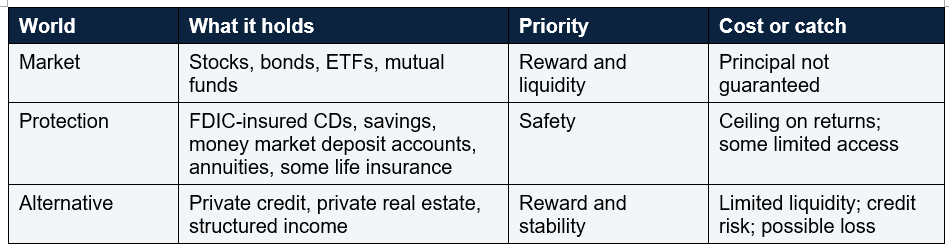
His proposed fix is to think in three "worlds": Market World (stocks, bonds, funds), Protection World (savings, CDs, insurance products) and Alternative World (private credit, private real estate, structured income). He calls the combination the Triversified Approach, a trademark of his firm.
The first half of his argument is well supported by history. The second half, which relies on alternatives, deserves much more caution, especially after the problems that hit retail private credit funds in 2026. This post gives you both sides. It is education, not a recommendation.
Key takeaway: Real diversification means owning things that behave differently when it matters. But "different" can mean "harder to sell," and that trade-off is the part that most often gets glossed over.
There are simple ways it happens. Different funds can own many of the same stocks. One practitioner described a hypothetical portfolio of eight funds from eight providers that all bought the same shares, with a stock-overlap report running nine pages. Another common case is a mix of stocks and bonds where bonds only protect you under certain economic conditions.
I make the same point. He says true diversification "requires assets that are not highly correlated". Correlation is just a measure of how closely two investments move together. A figure near +1 means they move in step, near zero means no consistent link, and below zero means they tend to move in opposite directions.
Sources differ on the exact figure for a 60/40 portfolio that year, which depends on the funds and dates chosen. I saw -16.1% in one source and about -17.5% in another. I would treat "about 16% to 17%" as the fair summary.
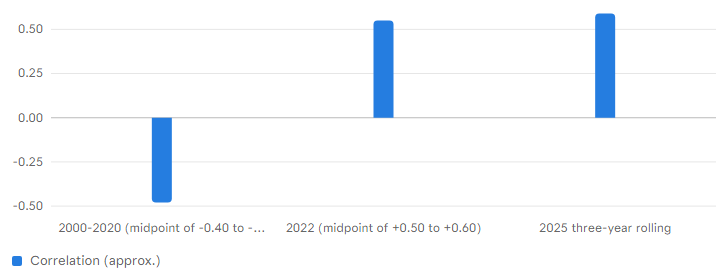
Why did it happen? Bonds helped for about two decades because stock-bond correlation was negative, roughly -0.40 to -0.55 according to one analysis. In 2022, inflation and rate hikes pushed both down together, and correlation turned positive. Estimates of how far vary, from about +0.50 to +0.60.
A theoretical illustration from the same analysis shows why it matters: a 60/40 portfolio's volatility would be about 8.3% with correlation at -0.40 and about 11.2% at +0.60. That is a model result, not a market record, and it comes from a Substack newsletter, so I treat it as an illustration only.
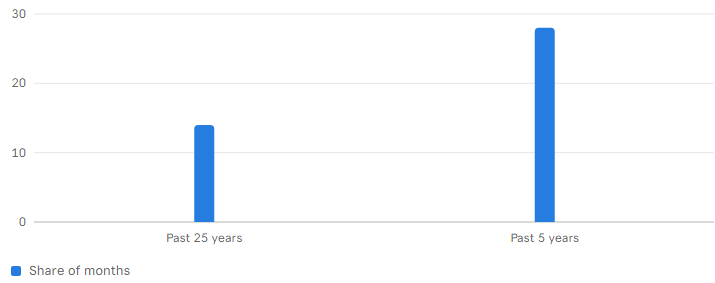
Morningstar offers a useful counterweight. Stocks and bonds lost money together in about 14% of months over 25 years, and that rose to 28% over the past five years because of 2022 Its argument is that recent years have been harder for 60/40, but not because diversification has failed. Another source says the three-year rolling correlation was about 0.59 in 2025, still well above the old norm. Some sources claim correlation has jumped much higher in 2026, such as +0.77, but I could only find that figure in a secondary summary. I have not relied on it.
His main point is that the trade-offs should be intentional rather than "happenstance". If you know why you hold each piece, and what you are giving up, you are more likely to stay put when markets move. That seems a sensible principle to me, whatever you think of the specific products.
Within this world, you can still do better than a pile of overlapping funds: check what each fund actually holds, look at geography and sector, and consider how bonds behave in an inflation shock. In my own view, a portfolio dominated by US equities and domestic government bonds is closer to a single-country bet than to global diversification.
For a retiree, this world often plays a plain role: money for the next few years of spending that does not need to be sold in a downturn. That is a reasonable idea, and it works with savings accounts alone.
That sentence deserves a careful read. It says the stability comes from the fact that you cannot easily sell. In my view, which is general analysis and not from his article, part of that calm can reflect infrequent pricing: if an asset is valued only now and then, its price looks steadier than the underlying economics may be. The SEC made a related point in September 2026, reminding managers that private credit assets can be difficult to value because they are illiquid and lack readily available quoted prices. To be fair, the article lists risks. Alternatives carry credit risk and potential for loss, and redemptions may be limited to set windows. The question is how much weight a reader gives them after the sales pitch.
One law firm's summary sums it up well: liquidity in these vehicles can be limited precisely when investor demand for it is highest. Put differently, the thing you cannot sell is also the thing you will most want to sell in a panic.
Here are some of the numbers I found, each from a single source:
Apollo capped withdrawals from its retail-focused private credit fund at 5% after second-quarter requests reached almost 17%, about $2.4 billion. If requests are 17% and the cap is 5%, a pro rata payout would meet about 29% of each request (my calculation, assuming simple pro rata treatment).
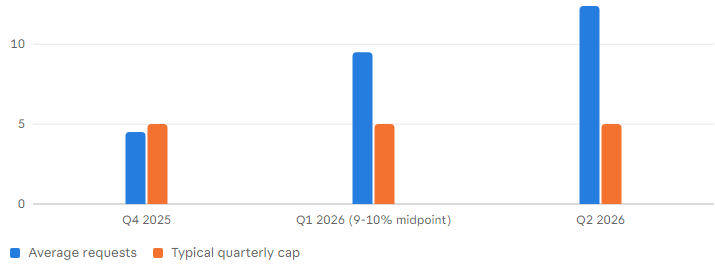
U.S. Bank reports that redemption requests at non-traded business development companies averaged 9% to 10% of net asset value in the first quarter of 2026, against 5% limits at many vehicles, up from an average of 4.5% in the fourth quarter of 2025. One secondary source reports that Blue Owl permanently closed redemptions in a $1.6 billion fund in February, and that retail investors pulled $12.7 billion from non-traded BDCs in the first half of 2026. I could not confirm these figures from a primary source.
There are other views. The Federal Reserve called private credit risks "limited and manageable" in May, according to a secondary summary. The FSB, meanwhile, warned the market has not been tested in a severe economic downturn, as reported by the same source [16]. Institutional investors, who commit to closed-end funds with no redemption windows, kept putting record sums in during the first half
.
The SEC's enforcement director said in May that the agency is attuned to risks around liquidity, fees, valuations and conflicts of interest throughout the distribution chain [12]. None of this means alternatives are bad. It means the liquidity terms are not a footnote.
Imagine a retiree with $500,000. They might ask three questions in order. How many years of spending do I want in safe, accessible money? How much do I want in liquid growth assets? And only then, is there any money I truly will not need for many years that could go into something harder to sell?

The numbers are made up to show the logic. The key discipline is working from need to product, not from product to need. Many people do the reverse, buying something because it sounds appealing and only later asking whether they can get their money out. If that $50,000 in alternatives were in a fund that paid out only 29% of a redemption request in a stressed quarter, you would receive about $14,700 of it in the first window (my calculation, pro rata assumption). The other $35,300 would wait. For a small slice, that may be tolerable. For a large slice, it would not.
The bear case: alternatives were tested in 2026 and some retail funds gated withdrawals; valuations can look smoother than reality; fees can be high; and complexity can make it harder to see what you actually own. Both cases are partly right. The principle is good and the products need scrutiny.
If you hold alternatives or are being offered them, these are the signs I would watch: redemption requests versus fund limits, valuation write-downs, regulatory guidance from the SEC on private credit valuations, and whether private assets are added to retirement plans. For the traditional part of your portfolio, watch stock-bond correlation. If it stays high, a portfolio built on the old assumption that bonds always cushion stocks may need rethinking.
What I would add is caution about the Alternative World. The same limited liquidity that gives a smooth ride also means you may not be able to leave when you need to, and 2026 gave real examples of that. Start with your own needs, keep enough in accessible money, and treat any hard-to-sell investment as a small, deliberate slice. This post is education only, not advice, and a fee-only fiduciary adviser can look at your full situation.
Owning many investments that actually move together, so you are less protected than you think. The idea is that variety is not the same as independence.
What are the "three worlds" in the Kiplinger article?
Market World (stocks, bonds, funds), Protection World (savings, CDs, insurance products) and Alternative World (private credit, private real estate, structured income).
Did bonds really fall with stocks in 2022?
Yes. The article says US stocks fell about 18% and the broad bond market about 13%. Morningstar says this does not mean diversification failed, only that it worked less well that year.
Are private credit funds safe for retirees?
They carry credit, valuation and liquidity risk. In 2026 several retail funds limited withdrawals, often to about 5% of net asset value a quarter. Whether they suit you depends on your needs and how much you can afford to lock away.
Does the 2022 loss mean 60/40 is dead?
Not according to Morningstar, which argues the problem is not that diversification failed. Others disagree. The honest answer is that it depends on inflation and interest rates.
Table of Contents
- The quick answer
- The problem: variety is not independence
- What went wrong in 2022
- The adviser's idea: three worlds
- Market World
- Protection World
- Alternative World
- The trade-off nobody can avoid
- What 2026 taught us about private credit
- A worked example
- A fair view of the idea
- Questions to ask any adviser
- Bull case versus bear case
- Conclusion
- FAQ
Non-traded private credit: redemption requests vs 5% cap (% of NAV)
% of net asset value by Sources: U.S. Bank (Fitch data), Angel Investors Network
Stock-bond correlation across regimes
Correlation by Sources: Halley Tech, Masterworks, Discovery Alert; midpoints are mine
Share of months stocks and bonds both lost money (%)
% of months by Source: Morningstar (search excerpt)
The quick answer
Many investors believe they are diversified because they own a long list of funds, a bond allocation and some savings. A wealth adviser writing for Kiplinger argues that this is often an illusion, because those holdings can behave alike when markets are under stress.His proposed fix is to think in three "worlds": Market World (stocks, bonds, funds), Protection World (savings, CDs, insurance products) and Alternative World (private credit, private real estate, structured income). He calls the combination the Triversified Approach, a trademark of his firm.
The first half of his argument is well supported by history. The second half, which relies on alternatives, deserves much more caution, especially after the problems that hit retail private credit funds in 2026. This post gives you both sides. It is education, not a recommendation.
Key takeaway: Real diversification means owning things that behave differently when it matters. But "different" can mean "harder to sell," and that trade-off is the part that most often gets glossed over.
The problem: variety is not independence
Diversification only works if your holdings do not all fall at the same time. One financial planner puts it neatly: the illusion comes from "confusing variety with independence". Owning twenty funds is variety. Owning twenty funds that react the same way to the same event is not independence.There are simple ways it happens. Different funds can own many of the same stocks. One practitioner described a hypothetical portfolio of eight funds from eight providers that all bought the same shares, with a stock-overlap report running nine pages. Another common case is a mix of stocks and bonds where bonds only protect you under certain economic conditions.
I make the same point. He says true diversification "requires assets that are not highly correlated". Correlation is just a measure of how closely two investments move together. A figure near +1 means they move in step, near zero means no consistent link, and below zero means they tend to move in opposite directions.
What went wrong in 2022
The textbook example is 2022. I says the S&P 500 lost roughly 18% that year while the broad US bond market fell about 13%, one of its worst years on record. A simple 60/40 mix of those two would have lost about 16% (my calculation: 60% times -18% plus 40% times -13%), which is close to the 16.1% loss another source gives. On $100,000, that is roughly a $16,000 drop.Sources differ on the exact figure for a 60/40 portfolio that year, which depends on the funds and dates chosen. I saw -16.1% in one source and about -17.5% in another. I would treat "about 16% to 17%" as the fair summary.
Why did it happen? Bonds helped for about two decades because stock-bond correlation was negative, roughly -0.40 to -0.55 according to one analysis. In 2022, inflation and rate hikes pushed both down together, and correlation turned positive. Estimates of how far vary, from about +0.50 to +0.60.
A theoretical illustration from the same analysis shows why it matters: a 60/40 portfolio's volatility would be about 8.3% with correlation at -0.40 and about 11.2% at +0.60. That is a model result, not a market record, and it comes from a Substack newsletter, so I treat it as an illustration only.
Morningstar offers a useful counterweight. Stocks and bonds lost money together in about 14% of months over 25 years, and that rose to 28% over the past five years because of 2022 Its argument is that recent years have been harder for 60/40, but not because diversification has failed. Another source says the three-year rolling correlation was about 0.59 in 2025, still well above the old norm. Some sources claim correlation has jumped much higher in 2026, such as +0.77, but I could only find that figure in a secondary summary. I have not relied on it.
The adviser's idea: three worlds
The adviser organises investments by what they prioritise: reward, safety and liquidity, and he says every investment balances these three. From that he builds three "worlds". I describe them as he does, then give my own comments in later sections.His main point is that the trade-offs should be intentional rather than "happenstance". If you know why you hold each piece, and what you are giving up, you are more likely to stay put when markets move. That seems a sensible principle to me, whatever you think of the specific products.
Market World
Market World is what most people already own. It is the most liquid, since you can generally sell on any trading day, and it is where long-term growth usually comes from. The article notes that principal is not guaranteed. The author's concern is that Market World on its own leaves a retiree exposed to sequence-of-returns risk, which is the danger of withdrawing money while prices are falling early in retirement. I agree that this risk is real. It is the reason many planners suggest holding a cash buffer outside the market.Within this world, you can still do better than a pile of overlapping funds: check what each fund actually holds, look at geography and sector, and consider how bonds behave in an inflation shock. In my own view, a portfolio dominated by US equities and domestic government bonds is closer to a single-country bet than to global diversification.
Protection World
Protection World covers savings accounts, CDs and money market deposit accounts, plus insurance products such as annuities. The cost is a ceiling on returns and, for some products, limited access to your money. The deposit products are straightforward: FDIC-insured balances do not swing with markets. Insurance guarantees are different, because they depend on the issuer's ability to pay claims, as the article itself notes. Annuities in particular can have surrender charges and fees, and the terms vary widely. I did not research specific products for this post, so please read the contract and ask about every cost before buying one.For a retiree, this world often plays a plain role: money for the next few years of spending that does not need to be sold in a downturn. That is a reasonable idea, and it works with savings accounts alone.
Alternative World
Alternative World is the novel part. The author lists private credit, private real estate and structured income strategies, and says they operate largely outside the rhythms of public markets. He adds that their limited liquidity is precisely what makes that stability possible.That sentence deserves a careful read. It says the stability comes from the fact that you cannot easily sell. In my view, which is general analysis and not from his article, part of that calm can reflect infrequent pricing: if an asset is valued only now and then, its price looks steadier than the underlying economics may be. The SEC made a related point in September 2026, reminding managers that private credit assets can be difficult to value because they are illiquid and lack readily available quoted prices. To be fair, the article lists risks. Alternatives carry credit risk and potential for loss, and redemptions may be limited to set windows. The question is how much weight a reader gives them after the sales pitch.
The trade-off nobody can avoid
Every portfolio trades off reward, safety and liquidity, and the adviser is right that you cannot have all three. Something has to give. The question is what you are willing to give up, and when you might need the money. With stocks, you give up certainty about the price but keep the ability to sell. With CDs, you give up some return for safety. With alternatives, you may gain yield or smoother-looking values but give up the ability to leave when you want. That last one matters most in a crisis, which is exactly when many people want to sell.One law firm's summary sums it up well: liquidity in these vehicles can be limited precisely when investor demand for it is highest. Put differently, the thing you cannot sell is also the thing you will most want to sell in a panic.
What 2026 taught us about private credit
This is not a theoretical worry. Through 2026, several retail private credit funds restricted withdrawals. Many cap redemptions at about 5% of net asset value per quarter, and the Financial Stability Board noted in May that managers used these limits to manage large redemption requests in early 2026.Here are some of the numbers I found, each from a single source:
Apollo capped withdrawals from its retail-focused private credit fund at 5% after second-quarter requests reached almost 17%, about $2.4 billion. If requests are 17% and the cap is 5%, a pro rata payout would meet about 29% of each request (my calculation, assuming simple pro rata treatment).
U.S. Bank reports that redemption requests at non-traded business development companies averaged 9% to 10% of net asset value in the first quarter of 2026, against 5% limits at many vehicles, up from an average of 4.5% in the fourth quarter of 2025. One secondary source reports that Blue Owl permanently closed redemptions in a $1.6 billion fund in February, and that retail investors pulled $12.7 billion from non-traded BDCs in the first half of 2026. I could not confirm these figures from a primary source.
There are other views. The Federal Reserve called private credit risks "limited and manageable" in May, according to a secondary summary. The FSB, meanwhile, warned the market has not been tested in a severe economic downturn, as reported by the same source [16]. Institutional investors, who commit to closed-end funds with no redemption windows, kept putting record sums in during the first half
.
The SEC's enforcement director said in May that the agency is attuned to risks around liquidity, fees, valuations and conflicts of interest throughout the distribution chain [12]. None of this means alternatives are bad. It means the liquidity terms are not a footnote.
A worked example
Here is a simple illustration, which is mine and not the author's, of how someone might think about sizing the three worlds. It is not a recommendation and not a suggested allocation.Imagine a retiree with $500,000. They might ask three questions in order. How many years of spending do I want in safe, accessible money? How much do I want in liquid growth assets? And only then, is there any money I truly will not need for many years that could go into something harder to sell?
The numbers are made up to show the logic. The key discipline is working from need to product, not from product to need. Many people do the reverse, buying something because it sounds appealing and only later asking whether they can get their money out. If that $50,000 in alternatives were in a fund that paid out only 29% of a redemption request in a stressed quarter, you would receive about $14,700 of it in the first window (my calculation, pro rata assumption). The other $35,300 would wait. For a small slice, that may be tolerable. For a large slice, it would not.
A fair view of the idea
What I like about the idea: it starts with the right question, which is how your investments behave together, not how many you own. It acknowledges that safety, reward and liquidity pull against each other. And it encourages holding some money outside markets, which is sound for anyone nearing retirement. What gives me pause: the framework doubles as a product shelf, and some of the products on it, such as annuities and private funds, can carry higher fees and less liquidity. The article carries disclosures that the views are the adviser's, that he took part in Kiplinger's Adviser Intel program, that a public relations firm helped prepare the piece, and that "Triversified" is his firm's trademark. That does not make the ideas wrong. It does mean you should check them independently. Also, there are simpler routes to genuine diversification, such as holding global stocks, high-quality bonds of different maturities, cash and, if appropriate, inflation-linked assets, all in low-cost funds. They are less exciting, but they are liquid and transparent.Questions to ask any adviser
If anyone offers you an alternative investment as a diversifier, these questions are worth asking, and writing down the answers:- How and when can I get my money out, and what happens if many investors ask at once?
- What is the full cost, including management fees, performance fees, fund expenses and sales commissions?
- How is it valued, how often, and by whom?
- What would this investment have done in 2022, and in a deep recession?
- How are you paid if I buy it?
- What share of my total wealth does this represent, and what happens if I cannot sell it for five years?
Bull case versus bear case
The bull case for the three-worlds idea: it forces intentional trade-offs, it recognises that stocks and bonds can fall together, and it could help a retiree avoid selling in a downturn.The bear case: alternatives were tested in 2026 and some retail funds gated withdrawals; valuations can look smoother than reality; fees can be high; and complexity can make it harder to see what you actually own. Both cases are partly right. The principle is good and the products need scrutiny.
If you hold alternatives or are being offered them, these are the signs I would watch: redemption requests versus fund limits, valuation write-downs, regulatory guidance from the SEC on private credit valuations, and whether private assets are added to retirement plans. For the traditional part of your portfolio, watch stock-bond correlation. If it stays high, a portfolio built on the old assumption that bonds always cushion stocks may need rethinking.
Conclusion
The core message of the Kiplinger article is right: a long list of investments is not the same as diversification, and 2022 showed how stocks and bonds can fall together. Thinking in terms of reward, safety and liquidity, and being deliberate about the trade-offs, is useful.What I would add is caution about the Alternative World. The same limited liquidity that gives a smooth ride also means you may not be able to leave when you need to, and 2026 gave real examples of that. Start with your own needs, keep enough in accessible money, and treat any hard-to-sell investment as a small, deliberate slice. This post is education only, not advice, and a fee-only fiduciary adviser can look at your full situation.
FAQ
What is the diversification illusion?Owning many investments that actually move together, so you are less protected than you think. The idea is that variety is not the same as independence.
What are the "three worlds" in the Kiplinger article?
Market World (stocks, bonds, funds), Protection World (savings, CDs, insurance products) and Alternative World (private credit, private real estate, structured income).
Did bonds really fall with stocks in 2022?
Yes. The article says US stocks fell about 18% and the broad bond market about 13%. Morningstar says this does not mean diversification failed, only that it worked less well that year.
Are private credit funds safe for retirees?
They carry credit, valuation and liquidity risk. In 2026 several retail funds limited withdrawals, often to about 5% of net asset value a quarter. Whether they suit you depends on your needs and how much you can afford to lock away.
Does the 2022 loss mean 60/40 is dead?
Not according to Morningstar, which argues the problem is not that diversification failed. Others disagree. The honest answer is that it depends on inflation and interest rates.
0 Comments
Be the first to share your thoughts on this article.