

Investing
CoreWeave vs. Nebius: 1 Soars, 1 Plunges on Q3 Earnings

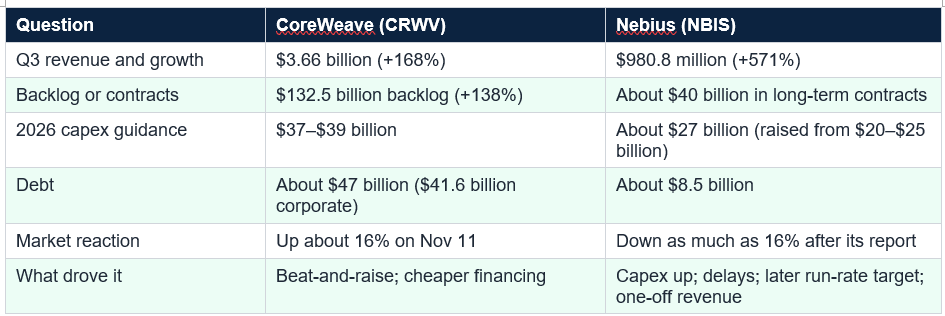
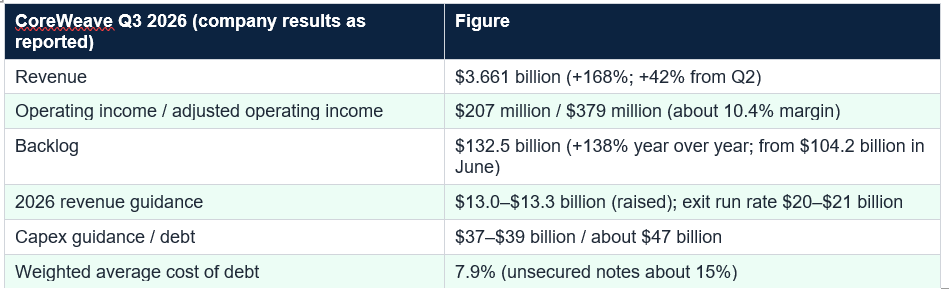
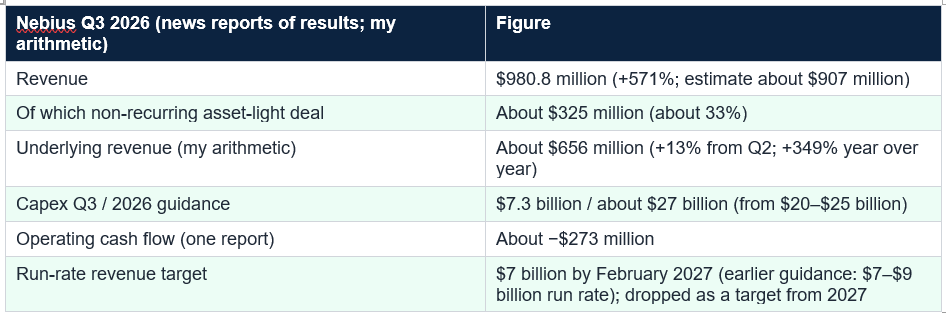
CoreWeave (Q3 2026): revenue $3.66 billion (+168%); backlog $132.5 billion (+138%); 2026 revenue guidance $13.0–$13.3 billion; capex guidance $37–$39 billion; debt about $47 billion; weighted average cost of debt 7.9%; stock up about 16% on November 11. Nebius (Q3 2026): revenue $980.8 million (+571%), with about $325 million non-recurring; capex guidance about $27 billion; debt about $8.5 billion; contracts about $40 billion; stock down as much as 16% after the report. My arithmetic: Nebius’s underlying Q3 revenue excluding the one-off deal was about $656 million, up about 13% from Q2 and about 349% year over year; capex is about 2.8–3.0 times 2026 revenue at CoreWeave and about 8–9 times at Nebius; debt is about 3.2 times annualized revenue at CoreWeave and 2.2 times at Nebius; CoreWeave’s Q3 interest guidance (about $900 million) is about 25% of revenue versus 11.6% for Nebius in Q2.
That framing is dramatic and needs a caveat: both stocks had already fallen about 40% in the month before the reports, so “soar” and “plunge” describe one-day moves within a violent decline, and CoreWeave remains far below its high. The interesting question is why investors treated two triple-digit growers so differently, and the answer lies in financing, capital spending and the timing of revenue.
The business is capital-hungry: CoreWeave plans $37 billion to $39 billion of capital spending in 2026 against expected revenue of about $13 billion, and Nebius about $27 billion against about $3 billion. That is why investors watch how the spending is funded; a recent slide in AI infrastructure stocks was tied to concerns about interest rates and debt-financed build-outs, per CNBC, and in that setting financing news can move a stock more than growth news.
Guidance rose: 2026 revenue to $13.0 billion to $13.3 billion and exit annualized run-rate revenue to $20 billion to $21 billion. The key reassurance was financing. Management said its weighted average cost of debt has fallen to 7.9%, well below about 15% on its unsecured notes, by shifting to contract-backed delayed-draw loans; it expects about $9 billion of customer prepayments and does not expect to tap the unsecured debt market in 2027. If it focused only on committed backlog, the CFO said, 2027 capex would stay in line with 2026 while revenue and EBITDA grow significantly. Still, about $47 billion of debt remains, and interest consumes a large share of revenue.
CoreWeave Q3: revenue $3.66B (+168%), backlog $132.5B, 2026 guide $13.0–$13.3B, capex $37–$39B, debt about $47B, cost of debt 7.9%. Nebius Q3: revenue $980.8M (+571%), about $325M one-off, capex about $27B, debt about $8.5B, run rate to clear $7B in Feb 2027. CRWV up about 16% Nov 11; NBIS down as much as 16% after its report.
But the quarter was messier than the headline. About $325 million, roughly a third, of revenue came from a non-recurring asset-light deal, leaving underlying revenue of about $656 million in my arithmetic, up about 13% from Q2 though still up about 349% year over year. Colocation delays in New Jersey pushed 2026 revenue to the low end of its $3.0 billion to $3.4 billion range, Q3 capex was $7.3 billion, operating cash flow was reported at an outflow of $273 million and full-year capex rose to about $27 billion. And the company said its monthly annualized revenue run rate will clear $7 billion in February 2027, later than its earlier annualized run-rate guidance of $7 billion to $9 billion, and it will drop ARR as a target from 2027.
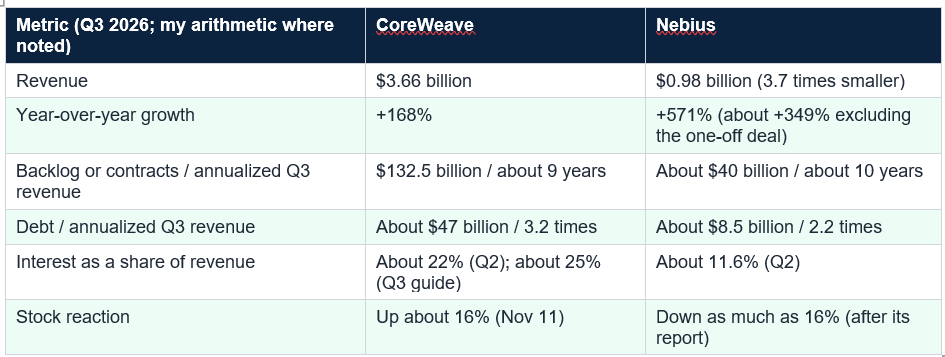
What changed this quarter is the cost and source of that debt. CoreWeave said its weighted average cost has fallen to 7.9% by using delayed-draw facilities secured by customer contracts, against about 15% on unsecured notes; on $41.6 billion of corporate debt each percentage point is about $416 million a year in my arithmetic. Nebius uses prepayments the same way, which is why its balance sheet looks cleaner. With investors fearing a financing squeeze, evidence that the model can be funded cheaply was worth more than another quarter of triple-digit growth.
That is why timing matters so much. When capex is eight to nine times revenue, a data-center delay such as New Jersey’s, or a slip in the run-rate target, matters more because the money is already committed. It also explains why raising capex to $27 billion from $20 billion to $25 billion (about 20% above the midpoint) worried investors even as revenue beat: it adds to what must be funded and earned back. CoreWeave’s statement that 2027 capex could stay flat if it focused only on committed backlog gave the opposite signal.
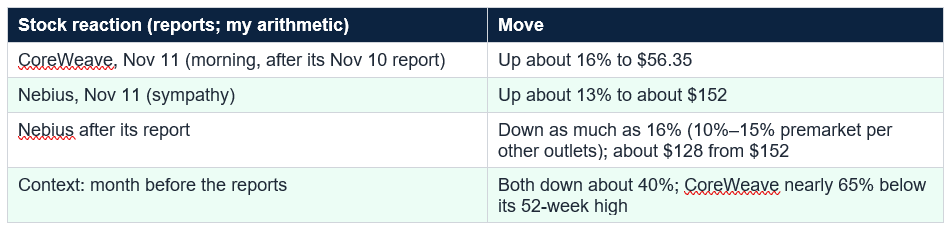
That fall reflects higher capex, delayed revenue, a later run-rate target and a quarter flattered by a one-time deal, and part of the sympathy gain was given back. From $152, a 16% drop would be about $128 (my approximation; I did not retrieve closing prices). In this sector expectations are high and the market reads each report for clues on financing and timing, so a revenue beat is not enough.
There is also sentiment risk. These stocks moved 10% to 16% in a day on news after falling about 40% in a month, and with heavy debt and large capex, small changes in expectations have big effects; they also tend to move with the AI trade, as Nebius rose when CoreWeave did. I did not retrieve valuations or net income, so I cannot say whether either is cheap, and both should be treated as highly speculative.
Both stocks are highly volatile, heavily financed and dependent on AI demand continuing. A single report moved them by double digits in either direction, and they fell about 40% in the month before. Never invest money you cannot afford to lose.
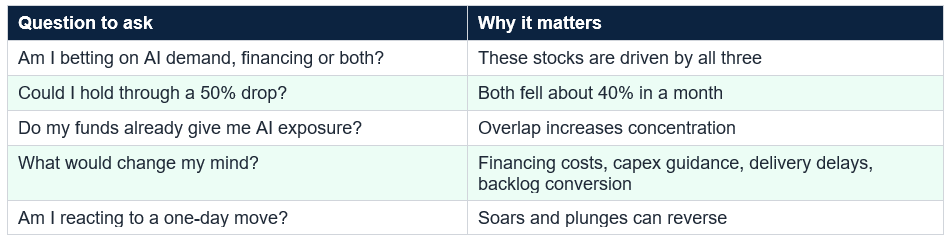
Practical habits apply. Size a position so a 50% drop would not change your plans, which is not far-fetched for stocks that fell 40% in a month; consider whether index funds already give you AI exposure through Nvidia and other large AI names (general knowledge); and watch the indicators that moved these stocks: financing costs, capex guidance, backlog conversion and delivery timing. Today’s winner in a one-day move can be tomorrow’s loser.
Read each company’s latest shareholder letter for three numbers: capex guidance, cost of debt and when the run-rate revenue target is expected to be reached. Then compare them with the figures here before forming a view. Common mistakes include judging these stocks by revenue growth alone, ignoring debt and interest costs, treating a one-day move as a verdict, overlooking that a third of Nebius’s revenue was a one-off, assuming backlog guarantees revenue and sizing positions too large. In this sector financing and timing often matter more than the growth rate.
Both remain high-risk. CoreWeave carries about $47 billion of debt and pays about a quarter of revenue in interest, while Nebius spends about eight to nine times its expected revenue on capex, and both stocks had fallen about 40% in the month before their reports and could swing again. The tale of two neoclouds is really one story about how expensive it is to build AI capacity and how much the market cares who is paying for it. Check current data and size any position carefully.
A neocloud is a newer cloud provider that rents large clusters of AI chips, mostly Nvidia GPUs, to companies that train and run AI models, rather than offering the full range of services of Amazon, Microsoft or Google. CoreWeave and Nebius are the two largest publicly traded examples. They sign long-term contracts, borrow heavily to buy chips and build data centers, and are valued on how fast they can turn that spending into revenue.
How did each company do in the third quarter?
CoreWeave reported revenue of $3.66 billion, up 168%, a $132.5 billion backlog and raised 2026 revenue guidance to $13.0 billion to $13.3 billion. Nebius reported revenue of $980.8 million, up 571%, ahead of the roughly $907 million expected, but about $325 million of it came from a non-recurring asset-light deal, it raised 2026 capex to about $27 billion and it said monthly annualized revenue run rate would clear $7 billion in February 2027, later than investors hoped.
Why did one stock rise and the other fall?
CoreWeave’s report eased fears about financing: it raised guidance, cut its weighted average cost of debt to 7.9% and said it did not expect to tap the unsecured debt market in 2027, and the stock rose about 16%. Nebius beat on revenue but disclosed higher capex, delays that put 2026 revenue at the low end of its range and a later run-rate target, and its stock fell as much as 16%. Both stocks had already fallen about 40% in the prior month.
Which is riskier?
Both are high-risk. CoreWeave has more debt, about $47 billion in total, and spends about a fifth of revenue on interest. Nebius has less debt, about $8.5 billion, but is spending about eight to nine times its expected 2026 revenue on capex, so it depends on its ramp arriving on time and on customer prepayments. Neither is profitable on a net basis in what I retrieved. This is general education, not personal advice.
Should I buy either stock?
I cannot say, and this article does not recommend either. They are volatile, concentrated bets on AI infrastructure demand, financing conditions and a few large customers. Many investors who want AI exposure use diversified funds instead, and anyone who buys individual neoclouds should size positions so a 50% drop would not harm their plans and check current prices, since figures here are a day or more old.
Table of Contents
- The Split
- The Short Answer
- What Is a Neocloud
- CoreWeave: Bigger, Leveraged and Reassuring
- Nebius: Faster Growth, Messier Quarter
- Side by Side
- The Debt Question
- Capex Versus Revenue
- Why the Stocks Moved
- Risks Both Share
- How an Investor Might Think About It
- Common Mistakes
- Conclusion
- Frequently Asked Questions
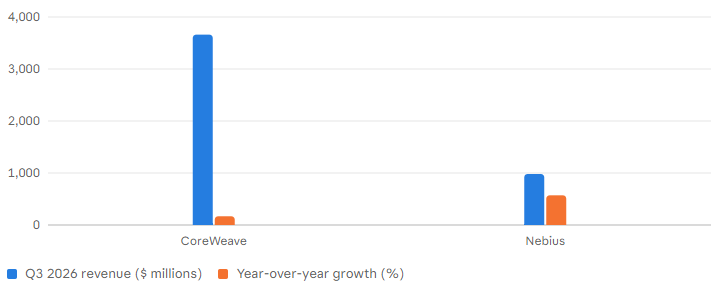
Same quarter, different scale: CoreWeave vs. Nebius Q3 2026 revenue ($ millions) and growth (%)
$ millions / % growth by News reports of each company's Q3 2026 results (CNBC, 24/7 Wall St., The Motley Fool): CoreWeave $3.661B (+168%); Nebius $980.8M (+571%), including about $325M of non-recurring revenue; the two series
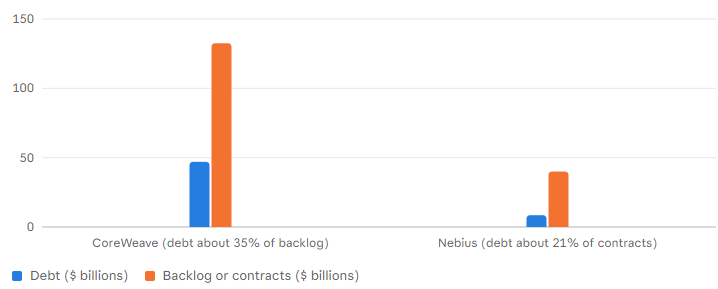
The balance sheet gap: debt vs. backlog or contracts, CoreWeave and Nebius ($ billions)
$ billions by CNBC and 24/7 Wall St. (CoreWeave debt about $47B; $41.6B corporate; backlog $132.5B); BigGo (Nebius debt about $8.5B; about $40B of long-term contracts); ratios are the my arithmetic
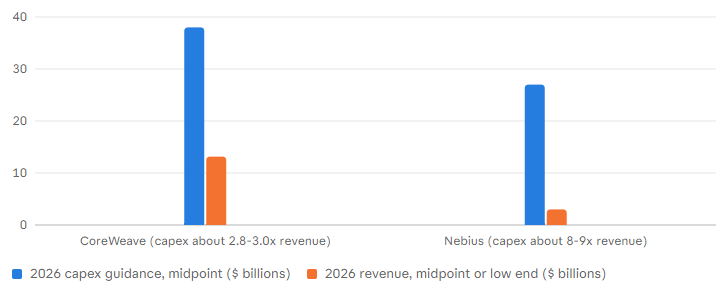
Spending far ahead of income: 2026 capex vs. expected revenue ($ billions)
$ billions by Company guidance as reported: CoreWeave capex $37B-$39B (midpoint $38B) and revenue $13.0B-$13.3B (midpoint shown); Nebius capex about $27B (raised from $20B-$25B) and revenue at the low end of $3.0B
The Split
On paper, the two companies had the same quarter. CoreWeave, the largest independent provider of rented AI computing power, reported third-quarter revenue up 168% to $3.66 billion; smaller rival Nebius Group reported revenue up 571% to $980.8 million. Both said demand for AI computing exceeds the capacity they can bring online. Yet the day after CoreWeave reported its stock jumped about 16%, and after Nebius reported its shares fell as much as 16%. A Motley Fool article published November 13 calls it a tale of two neoclouds.That framing is dramatic and needs a caveat: both stocks had already fallen about 40% in the month before the reports, so “soar” and “plunge” describe one-day moves within a violent decline, and CoreWeave remains far below its high. The interesting question is why investors treated two triple-digit growers so differently, and the answer lies in financing, capital spending and the timing of revenue.
The Short Answer
Investors rewarded CoreWeave for reducing a fear and punished Nebius for adding some. CoreWeave beat estimates, raised guidance, lowered its cost of debt to 7.9% and said it would not need unsecured debt markets in 2027, easing worries about its roughly $47 billion of debt. Nebius beat revenue estimates too, but about a third of its revenue was a one-time deal, capex rose to about $27 billion, delays pushed 2026 revenue to the low end of its range and its run-rate target slipped to February 2027. Neither company is safe: both are spending several times their revenue on data centers and chips and depend on financing and a few big customers.
What Is a Neocloud
A neocloud rents out clusters of AI chips, mostly Nvidia GPUs, to customers such as AI labs and software companies that need huge computing power but do not want to build it. Unlike Amazon, Microsoft or Google, neoclouds focus on this one service: they sign multiyear contracts with big customers, then raise money, often with debt secured by those contracts, to buy chips and lease or build data centers. The model works if customers keep paying and the chips earn more than they cost, which is why backlog, financing costs and delivery schedules dominate the discussion.The business is capital-hungry: CoreWeave plans $37 billion to $39 billion of capital spending in 2026 against expected revenue of about $13 billion, and Nebius about $27 billion against about $3 billion. That is why investors watch how the spending is funded; a recent slide in AI infrastructure stocks was tied to concerns about interest rates and debt-financed build-outs, per CNBC, and in that setting financing news can move a stock more than growth news.
CoreWeave: Bigger, Leveraged and Reassuring
CoreWeave’s third quarter, reported November 10, beat on almost every line. Revenue rose 168% to $3.661 billion against a $3.54 billion estimate (up 42% from Q2), and operating income grew about fourfold to $207 million. Adjusted operating income was $379 million, about a 10.4% margin in my arithmetic, which BigGo notes reached double digits a quarter early. Backlog rose to $132.5 billion from $104.2 billion in June (+27% in one quarter, +138% year over year), with more than half attached to contracts that begin delivery by year-end.Guidance rose: 2026 revenue to $13.0 billion to $13.3 billion and exit annualized run-rate revenue to $20 billion to $21 billion. The key reassurance was financing. Management said its weighted average cost of debt has fallen to 7.9%, well below about 15% on its unsecured notes, by shifting to contract-backed delayed-draw loans; it expects about $9 billion of customer prepayments and does not expect to tap the unsecured debt market in 2027. If it focused only on committed backlog, the CFO said, 2027 capex would stay in line with 2026 while revenue and EBITDA grow significantly. Still, about $47 billion of debt remains, and interest consumes a large share of revenue.
CoreWeave Q3: revenue $3.66B (+168%), backlog $132.5B, 2026 guide $13.0–$13.3B, capex $37–$39B, debt about $47B, cost of debt 7.9%. Nebius Q3: revenue $980.8M (+571%), about $325M one-off, capex about $27B, debt about $8.5B, run rate to clear $7B in Feb 2027. CRWV up about 16% Nov 11; NBIS down as much as 16% after its report.
Nebius: Faster Growth, Messier Quarter
Nebius is smaller and growing faster. Third-quarter revenue of $980.8 million rose 571% and beat the roughly $907 million expected. Datadog, Snowflake and Databricks signed multiyear deals, GPU-hour prices rose more than 20% from the second quarter per one report, and the company has signed more than $12 billion of contracts since the quarter began. More than 130,000 GPUs come off contract in 2027, with renewals potentially adding close to $4 billion of annualized revenue with no new capex. CEO Arkady Volozh said prepayments on Q3 agreements covered more than 100% of the associated capex.But the quarter was messier than the headline. About $325 million, roughly a third, of revenue came from a non-recurring asset-light deal, leaving underlying revenue of about $656 million in my arithmetic, up about 13% from Q2 though still up about 349% year over year. Colocation delays in New Jersey pushed 2026 revenue to the low end of its $3.0 billion to $3.4 billion range, Q3 capex was $7.3 billion, operating cash flow was reported at an outflow of $273 million and full-year capex rose to about $27 billion. And the company said its monthly annualized revenue run rate will clear $7 billion in February 2027, later than its earlier annualized run-rate guidance of $7 billion to $9 billion, and it will drop ARR as a target from 2027.
Side by Side
Together, the two look like different stages of the same bet. CoreWeave is about 3.7 times Nebius’s size by quarterly revenue, with a far larger backlog but more debt and a heavier interest burden. Nebius is growing faster off a smaller base, with less debt and more of its capex covered by prepayments, but with a later ramp and a weaker cash profile in the quarter. Both are priced on whether the future revenue arrives and whether financing stays available at tolerable rates.
The Debt Question
Debt is the central difference. CoreWeave owed almost $47 billion at the end of the quarter, including $41.6 billion of corporate debt; its second-quarter interest cost was $558 million (21.7% of revenue) and third-quarter interest was guided to $860 million to $940 million, about 25% of Q3 revenue at the midpoint in my arithmetic. Nebius had about $8.5 billion of debt and Q2 interest of $67.3 million (11.6% of revenue). CoreWeave’s debt is about 3.2 times annualized Q3 revenue and Nebius’s about 2.2 times, and debt is about 35% of CoreWeave’s backlog against about 21% of Nebius’s contracts.What changed this quarter is the cost and source of that debt. CoreWeave said its weighted average cost has fallen to 7.9% by using delayed-draw facilities secured by customer contracts, against about 15% on unsecured notes; on $41.6 billion of corporate debt each percentage point is about $416 million a year in my arithmetic. Nebius uses prepayments the same way, which is why its balance sheet looks cleaner. With investors fearing a financing squeeze, evidence that the model can be funded cheaply was worth more than another quarter of triple-digit growth.
Capex Versus Revenue
The scale of spending relative to revenue is striking. CoreWeave guides to $37 billion to $39 billion of 2026 capex against $13.0 billion to $13.3 billion of revenue, about 2.8 to 3.0 times revenue in my arithmetic; Nebius guides to about $27 billion against revenue at the low end of $3.0 billion to $3.4 billion, about 8 to 9 times. Nebius is earlier in its ramp, with revenue arriving after the chips and buildings are paid for.That is why timing matters so much. When capex is eight to nine times revenue, a data-center delay such as New Jersey’s, or a slip in the run-rate target, matters more because the money is already committed. It also explains why raising capex to $27 billion from $20 billion to $25 billion (about 20% above the midpoint) worried investors even as revenue beat: it adds to what must be funded and earned back. CoreWeave’s statement that 2027 capex could stay flat if it focused only on committed backlog gave the opposite signal.
Why the Stocks Moved
Context shapes the reaction. CoreWeave had fallen almost 65% from its 52-week high and about 40% in the month before earnings as investors questioned whether debt-financed build-outs could be sustained, with rising interest rates adding pressure (CNBC, BigGo). A strong report with raised guidance and cheaper financing relieved those fears: the stock rose about 16% to $56.35 on November 11, and Nebius rose about 13% to $152 in sympathy. Nebius reported a day or two later and its shares fell as much as 16% (10% to 15% premarket per other outlets) even though it beat revenue estimates.That fall reflects higher capex, delayed revenue, a later run-rate target and a quarter flattered by a one-time deal, and part of the sympathy gain was given back. From $152, a 16% drop would be about $128 (my approximation; I did not retrieve closing prices). In this sector expectations are high and the market reads each report for clues on financing and timing, so a revenue beat is not enough.
Risks Both Share
The two share the same fundamental risks. Customer concentration comes first: both rely on a small number of large AI customers (general knowledge, not verified here). Financing is second: if interest rates rise or credit markets tighten, borrowing costs could climb again, as the recent slide showed. Execution is third: power, data-center construction and chip supply can all delay revenue, as at Nebius. And demand risk: if AI spending slows or chip prices fall, contracts could be repriced or renewals could disappoint.There is also sentiment risk. These stocks moved 10% to 16% in a day on news after falling about 40% in a month, and with heavy debt and large capex, small changes in expectations have big effects; they also tend to move with the AI trade, as Nebius rose when CoreWeave did. I did not retrieve valuations or net income, so I cannot say whether either is cheap, and both should be treated as highly speculative.
Both stocks are highly volatile, heavily financed and dependent on AI demand continuing. A single report moved them by double digits in either direction, and they fell about 40% in the month before. Never invest money you cannot afford to lose.
How an Investor Might Think About It
If you are drawn to the neocloud story, decide what you are betting on: continued AI demand, a company’s ability to finance its growth or both. CoreWeave offers scale, a large backlog and now cheaper financing but carries about $47 billion of debt; Nebius offers faster growth, less debt and customer prepayments but a later ramp and heavier spending relative to revenue. Neither is a safe harbor, and which performs better depends on delivery, financing markets and demand, none of which anyone can predict.Practical habits apply. Size a position so a 50% drop would not change your plans, which is not far-fetched for stocks that fell 40% in a month; consider whether index funds already give you AI exposure through Nvidia and other large AI names (general knowledge); and watch the indicators that moved these stocks: financing costs, capex guidance, backlog conversion and delivery timing. Today’s winner in a one-day move can be tomorrow’s loser.
Read each company’s latest shareholder letter for three numbers: capex guidance, cost of debt and when the run-rate revenue target is expected to be reached. Then compare them with the figures here before forming a view. Common mistakes include judging these stocks by revenue growth alone, ignoring debt and interest costs, treating a one-day move as a verdict, overlooking that a third of Nebius’s revenue was a one-off, assuming backlog guarantees revenue and sizing positions too large. In this sector financing and timing often matter more than the growth rate.
Conclusion
CoreWeave and Nebius both grew revenue at triple-digit rates in the third quarter, 168% to $3.66 billion and 571% to $980.8 million, yet the market split them: CoreWeave jumped about 16% after a beat-and-raise quarter that cut its cost of debt to 7.9%, while Nebius fell as much as 16% after higher capex of about $27 billion, delays and a later run-rate target. The difference lay in financing and timing, not growth. Nebius also relied on about $325 million of one-off revenue, and underlying growth was about 13% from the previous quarter.Both remain high-risk. CoreWeave carries about $47 billion of debt and pays about a quarter of revenue in interest, while Nebius spends about eight to nine times its expected revenue on capex, and both stocks had fallen about 40% in the month before their reports and could swing again. The tale of two neoclouds is really one story about how expensive it is to build AI capacity and how much the market cares who is paying for it. Check current data and size any position carefully.
Frequently Asked Questions
What is a neocloud?A neocloud is a newer cloud provider that rents large clusters of AI chips, mostly Nvidia GPUs, to companies that train and run AI models, rather than offering the full range of services of Amazon, Microsoft or Google. CoreWeave and Nebius are the two largest publicly traded examples. They sign long-term contracts, borrow heavily to buy chips and build data centers, and are valued on how fast they can turn that spending into revenue.
How did each company do in the third quarter?
CoreWeave reported revenue of $3.66 billion, up 168%, a $132.5 billion backlog and raised 2026 revenue guidance to $13.0 billion to $13.3 billion. Nebius reported revenue of $980.8 million, up 571%, ahead of the roughly $907 million expected, but about $325 million of it came from a non-recurring asset-light deal, it raised 2026 capex to about $27 billion and it said monthly annualized revenue run rate would clear $7 billion in February 2027, later than investors hoped.
Why did one stock rise and the other fall?
CoreWeave’s report eased fears about financing: it raised guidance, cut its weighted average cost of debt to 7.9% and said it did not expect to tap the unsecured debt market in 2027, and the stock rose about 16%. Nebius beat on revenue but disclosed higher capex, delays that put 2026 revenue at the low end of its range and a later run-rate target, and its stock fell as much as 16%. Both stocks had already fallen about 40% in the prior month.
Which is riskier?
Both are high-risk. CoreWeave has more debt, about $47 billion in total, and spends about a fifth of revenue on interest. Nebius has less debt, about $8.5 billion, but is spending about eight to nine times its expected 2026 revenue on capex, so it depends on its ramp arriving on time and on customer prepayments. Neither is profitable on a net basis in what I retrieved. This is general education, not personal advice.
Should I buy either stock?
I cannot say, and this article does not recommend either. They are volatile, concentrated bets on AI infrastructure demand, financing conditions and a few large customers. Many investors who want AI exposure use diversified funds instead, and anyone who buys individual neoclouds should size positions so a 50% drop would not harm their plans and check current prices, since figures here are a day or more old.
0 Comments
Be the first to share your thoughts on this article.