

Investing
Lemonade’s First Positive Adjusted EBITDA: What to Know Now

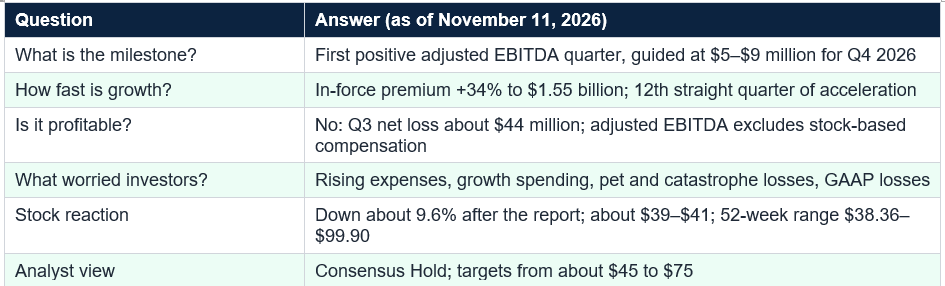
The quarter (Q3 2026, reported November): in-force premium $1.55 billion (+34%, the 12th straight quarter of acceleration); revenue $336.1 million (+73%); gross profit $118 million (+48%); adjusted EBITDA loss $20.4 million (from $26 million); net loss about $44 million; adjusted free cash flow $27 million; cash and investments about $1.2 billion; Lemonade Car in-force premium +63%. The guidance: Q4 adjusted EBITDA of $5–$9 million (the first positive quarter) on revenue of $342–$346 million; full-year 2026 in-force premium of $1,632–$1,639 million (about 33% growth) and adjusted EBITDA loss of $47–$51 million; 2027 expected to be positive for the full year. The stock and my arithmetic: down about 9.6% after the report; about $39–$41, near a 52-week low of about $38 and about 61% below the $99.90 high; market cap about $3.06 billion, or about 2.5 times 2026 revenue; adjusted EBITDA minus about $24 million of stock-based compensation is about −$44 million in Q3, matching the net loss.
It is a real milestone, but investors should read it carefully: adjusted EBITDA leaves out important costs, the company still loses money on a GAAP basis and the stock fell after the report. This guide looks at what the numbers show, what they leave out and what to watch next.
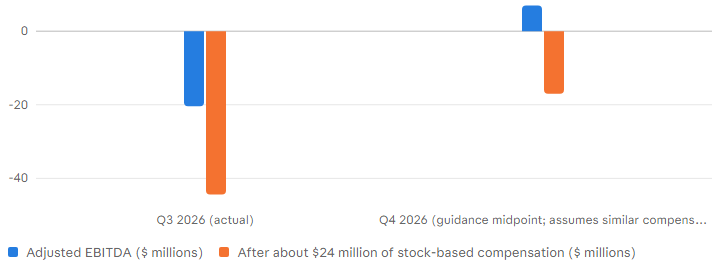
The effect is easy to see in Q3: adjusted EBITDA was a loss of $20.4 million, and subtracting about $24 million of stock-based compensation gives roughly −$44 million, close to the reported net loss. In my arithmetic, a Q4 adjusted EBITDA of $7 million (the midpoint) minus a similar $24 million of compensation would still be about −$17 million before interest and other items, so Q4 would likely remain a net loss, assuming compensation is similar to Q3. Positive adjusted EBITDA is a step, not the finish line.
Lemonade Q3 2026: in-force premium $1.55B (+34%, 12th straight quarter of acceleration); revenue $336.1M (+73%); gross profit $118M (+48%); adjusted EBITDA −$20.4M; net loss about $44M; adjusted free cash flow $27M; cash and investments about $1.2B. Q4 guidance: adjusted EBITDA +$5M to +$9M; revenue $342M–$346M. Stock about $39–$41, down about 61% from its 52-week high.
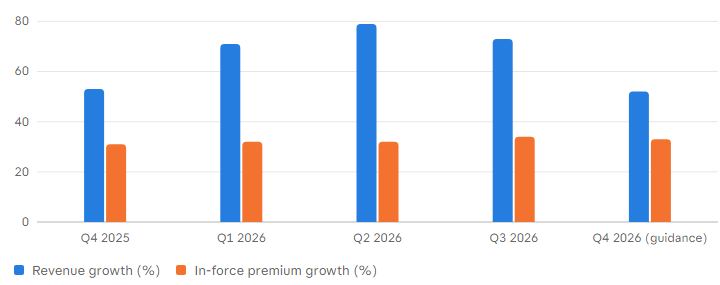
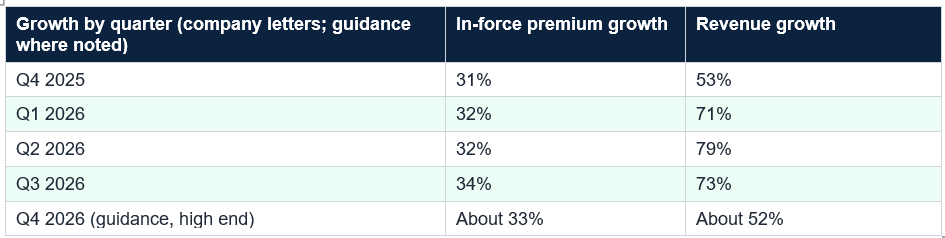
Revenue growth looks even higher, at 73%, but it is flattered by a change in reinsurance: Lemonade reduced the share of premium it passes to reinsurers, effective in the third quarter of 2025, so it keeps more premium as revenue. That tailwind fades, with management expecting revenue growth of roughly 52% in Q4 and 67% for the year, so in-force premium is the cleaner measure, as the Fool says. KBW noted that growth above 30% stands out as premium growth slows across much of the property and casualty industry, but that Lemonade may need higher growth spending to sustain it off a larger base.
But there were pressure points. Higher pet insurance costs and elevated European catastrophe losses weighed on Q3 loss ratios, per MarketBeat’s summary of the call, and growth has come with higher spending: growth spend was $54.3 million in Q1, up about 43% from $38.1 million. Management says growth spending should rise more slowly than in-force premium from here, which is what makes the margin story work, and noted that similar dollar additions produce lower growth rates on a larger base. Catastrophes remain a risk for any insurer and can erase a quarter’s progress.
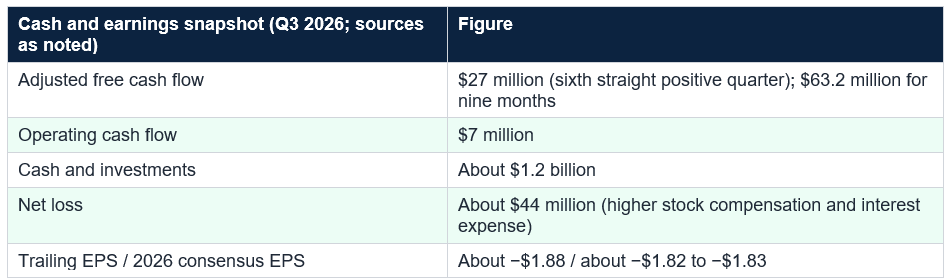
The net loss widened to about $44 million in Q3, partly on higher stock-based compensation and interest expense, per MarketBeat. Trailing earnings per share were about −$1.88, and analysts expect a loss of around $1.82 to $1.83 per share for 2026, so while operating metrics improve, GAAP profitability is further away. Investors who value GAAP earnings should keep that in mind and watch dilution from stock compensation.
Other factors may have contributed: the stock had run up ahead of earnings, a substantial short position can amplify moves and insiders sold 15,148 shares worth about $804,000 over 90 days, per MarketBeat. Sources conflict on the quarter, with some headlines saying it fell short of estimates and others that it beat, probably because revenue beat while the per-share loss was wider; I could not resolve that. Either way, the market’s message seemed to be that milestone optimism was priced in and that expenses matter.
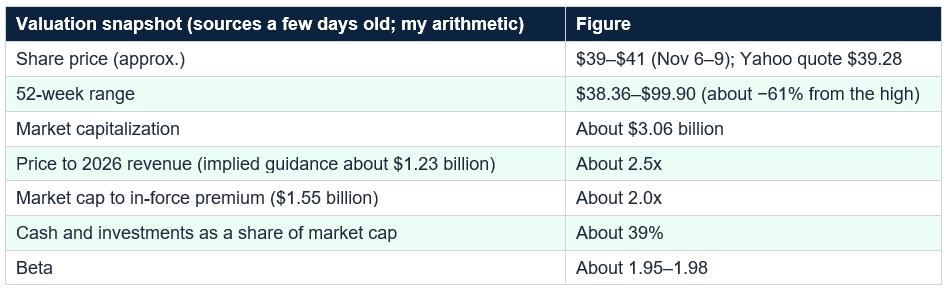
Analyst targets average from $56 (Yahoo) to about $61 to $63 (MarketBeat), roughly 43% to 56% above the price, but they range from $45 to $92 and are being cut, so they are a sentiment indicator, not a forecast. The question is whether growth above 30%, rising margins and a path to GAAP profit justify the multiple, which depends on loss ratios, growth spending and 2027 execution that no one can know. A beta near 2 means the stock tends to move about twice as much as the market.
The bear case is that adjusted EBITDA flatters the picture, GAAP losses persist, stock-based compensation dilutes holders and growth may require ever more spending. Claims are volatile, car insurance is a competitive market with large rivals, the stock is a volatile small cap and analysts rate it Hold on average with targets falling. The first positive quarter was also a long-promised milestone, so meeting it may already be priced in. Both cases are plausible, and I assign no probabilities.
The fourth-quarter report, which typically comes in February (general knowledge), will show whether Lemonade delivers positive adjusted EBITDA and at what level, and whether it guides 2027 to a positive year. Watch growth spending as a share of premium, since the margin thesis depends on it; loss ratios in pet, car and homeowners and any catastrophe events; stock-based compensation and whether GAAP losses narrow; and in-force premium growth, since a slip below 30% would weaken the story.
A practical approach is to separate the story from the price. The story, accelerating growth and a first positive adjusted EBITDA quarter, is documented in the company’s own letters; the price depends on what you believe about margins, claims and growth spending, and the market is currently skeptical. If you are interested, read the shareholder letter, compare adjusted and GAAP results and decide how much of a volatile small cap belongs in your portfolio: in my illustration, a 10% position in a $50,000 portfolio is $5,000, and a 50% drop would cost $2,500, or 5% of the portfolio.
Milestones are often priced in, and stocks can fall on good news when expectations were high; the reverse can also happen, since a stock down 61% may rise if results keep improving or may fall further. I cannot tell which. Diversification, position sizing and a time horizon of years, not weeks, are more useful than guessing the reaction to the next report.
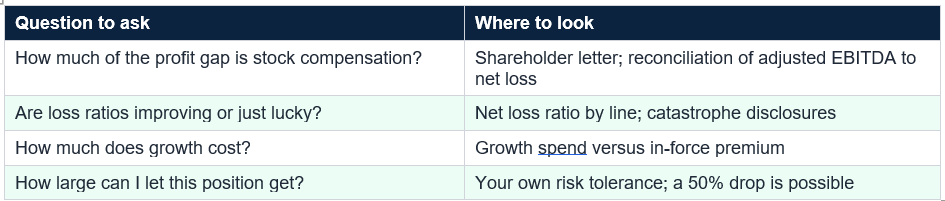
Open Lemonade’s Q3 shareholder letter and find the reconciliation from net loss to adjusted EBITDA, then compare the Q4 guidance with the stock-based compensation figure before forming a view. Common mistakes include treating adjusted EBITDA as profit, ignoring stock-based compensation and dilution, assuming good news means a rising stock, relying on revenue growth boosted by a reinsurance change instead of in-force premium, treating analyst targets as forecasts and sizing a small-cap position too large. Guidance can also be missed, and a first positive quarter is a milestone, not a guarantee of future profits.
But the milestone has limits. Adjusted EBITDA leaves out about $24 million a quarter of stock-based compensation, so Lemonade still posts net losses (about $44 million in Q3), and revenue growth of 73% is flattered by a reinsurance change. The stock fell about 9.6% after the report and trades near $39, about 61% below its 52-week high, at roughly 2.5 times revenue, with a Hold consensus and falling targets. Whether that is an opportunity or a warning depends on loss ratios, growth spending and 2027 execution. Size any position for a volatile small cap and check current data.
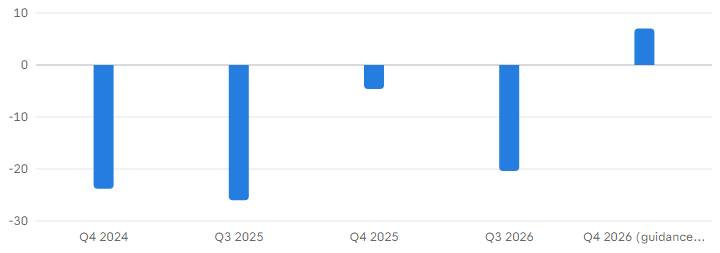
Lemonade guided to adjusted EBITDA of $5 million to $9 million in the fourth quarter of 2026, which would be its first positive quarter, and to revenue of $342 million to $346 million. It also expects 2027 to be positive on an adjusted EBITDA basis for the full year. In the third quarter, adjusted EBITDA was a loss of about $20 million, narrower than the $26 million loss a year earlier. The company first outlined the Q4 2026 target to investors in 2022.
Does positive adjusted EBITDA mean Lemonade is profitable?
No. Adjusted EBITDA is a non-GAAP measure that excludes interest, taxes, depreciation, amortization and stock-based compensation. Lemonade’s third-quarter net loss was about $44 million, and in my arithmetic the adjusted EBITDA loss of $20.4 million minus about $24 million of stock-based compensation roughly equals that figure. Even at the top of its Q4 guidance, the quarter would likely still show a net loss. This is general education, not personal advice.
How fast is Lemonade growing?
In-force premium, the annualized value of its policies, rose 34% to $1.55 billion in the third quarter, the 12th consecutive quarter of accelerating growth, and the fastest pace in over a year according to the Motley Fool. Revenue grew 73% to $336 million, but that figure is boosted by Lemonade keeping more of its premium after reducing reinsurance cessions in the second half of 2025, so in-force premium is the cleaner measure. Lemonade Car’s in-force premium grew 63%.
Why did the stock fall after good results?
Shares dropped about 9.6% after the report, per MarketBeat, after rising more than 10% beforehand. Analysts pointed to rising expenses, higher growth spending, ongoing GAAP losses and elevated pet and European catastrophe losses, and several cut price targets. The stock was around $39 to $41 in the following days, near its 52-week low of about $38. Short interest is substantial, which can amplify moves in both directions.
Is Lemonade stock a buy?
I cannot say, and this article does not recommend it. The stock has fallen about 61% from its 52-week high, trades at about 2.5 times 2026 revenue in my arithmetic and has a consensus rating of Hold with targets ranging from the mid-$40s to $75. It is a small-cap, volatile company with a beta near 2. Any position should be sized so a 50% drop would not harm your plans, and you should check current data.
Table of Contents
- The Milestone
- The Short Answer
- What Adjusted EBITDA Includes and Leaves Out
- Growth Is Accelerating: Reading the Numbers
- Underwriting and the Loss Ratio
- Cash, Balance Sheet and the Net Loss
- Why the Stock Fell
- Valuation in Numbers
- The Bull and Bear Cases
- What to Watch Next
- How to Think About It
- Common Mistakes
- Conclusion
- Frequently Asked Questions
Why in-force premium is the cleaner measure: revenue growth vs. in-force premium growth (%)
Year-over-year growth (%) by Lemonade shareholder letters and call: revenue growth was boosted by reduced reinsurance cession from Q3 2025 (more premium retained); management expects about 52% Q4 and 67% full-year 2026 revenue growth; Q4 2026 values are high-end guidance
The milestone: Lemonade's adjusted EBITDA, history and Q4 2026 guidance midpoint ($ millions)
Adjusted EBITDA ($ millions) by Lemonade shareholder letters: Q4 2024 -$23.8M, Q3 2025 about -$26M, Q4 2025 -$4.6M, Q3 2026 -$20.4M; Q4 2026 guidance is +$5M to +$9M (midpoint +$7M), which would be the first positive quarter; adjusted EBITDA is non-GAAP
The catch: adjusted EBITDA vs. after stock-based compensation, Q3 2026 and Q4 guidance ($ millions)
$ millions by Author's arithmetic: Q3 adjusted EBITDA -$20.4M less about $24M of stock compensation is about -$44M, close to the reported net loss of about $44M; the Q4 figure assumes Q4 compensation is similar to Q3 (not confirmed)
The Milestone
Lemonade has spent a decade as the poster child for fast-growing, money-losing insurance technology. Now the company says it is about to report a quarter of positive adjusted EBITDA for the first time. In its third-quarter results on November 5, 2026, it guided to adjusted EBITDA of $5 million to $9 million in the fourth quarter, a target management says it first outlined for investors in 2022, while in-force premium rose 34%, the 12th consecutive quarter of acceleration. A Motley Fool article published November 11 highlights both.It is a real milestone, but investors should read it carefully: adjusted EBITDA leaves out important costs, the company still loses money on a GAAP basis and the stock fell after the report. This guide looks at what the numbers show, what they leave out and what to watch next.
The Short Answer
Lemonade expects its first positive adjusted EBITDA quarter in Q4 2026 and its first full positive year in 2027, while in-force premium growth accelerated to 34%, per its shareholder letter. That is meaningful progress: the adjusted EBITDA loss narrowed to $20 million from $26 million, adjusted free cash flow was positive for the sixth straight quarter and gross profit rose 48% to a record $118 million. But adjusted EBITDA excludes about $24 million a quarter of stock-based compensation, so the company still posts net losses (about $44 million in Q3, matching its adjusted loss minus stock compensation in my arithmetic). The stock fell about 9.6% after the report and trades near a 52-week low, so the market is skeptical about expenses, growth spending and claims.
What Adjusted EBITDA Includes and Leaves Out
EBITDA stands for earnings before interest, taxes, depreciation and amortization, and Lemonade’s adjusted version also excludes stock-based compensation, so it is a non-GAAP measure. It shows operating performance before some costs, which is useful for a growing company but can flatter results. For Lemonade the biggest exclusion is stock-based compensation, guided to about $24 million for Q3 and $95 million for 2026, a real cost to shareholders because it dilutes their ownership.The effect is easy to see in Q3: adjusted EBITDA was a loss of $20.4 million, and subtracting about $24 million of stock-based compensation gives roughly −$44 million, close to the reported net loss. In my arithmetic, a Q4 adjusted EBITDA of $7 million (the midpoint) minus a similar $24 million of compensation would still be about −$17 million before interest and other items, so Q4 would likely remain a net loss, assuming compensation is similar to Q3. Positive adjusted EBITDA is a step, not the finish line.
Lemonade Q3 2026: in-force premium $1.55B (+34%, 12th straight quarter of acceleration); revenue $336.1M (+73%); gross profit $118M (+48%); adjusted EBITDA −$20.4M; net loss about $44M; adjusted free cash flow $27M; cash and investments about $1.2B. Q4 guidance: adjusted EBITDA +$5M to +$9M; revenue $342M–$346M. Stock about $39–$41, down about 61% from its 52-week high.
Growth Is Accelerating: Reading the Numbers
The growth story is genuine. In-force premium, the annualized value of all policies in place, rose 34% year over year to $1.55 billion from $1.158 billion, against 31% in Q4 2025, 32% in each of the first two quarters of 2026 and about 33% guided for Q4, so the pace has been rising, which the Fool calls the fastest in over a year. Lemonade Car’s in-force premium grew 63%, and premium per customer was $433 in Q2, up 8%, so the company is both adding customers and getting more from each.Revenue growth looks even higher, at 73%, but it is flattered by a change in reinsurance: Lemonade reduced the share of premium it passes to reinsurers, effective in the third quarter of 2025, so it keeps more premium as revenue. That tailwind fades, with management expecting revenue growth of roughly 52% in Q4 and 67% for the year, so in-force premium is the cleaner measure, as the Fool says. KBW noted that growth above 30% stands out as premium growth slows across much of the property and casualty industry, but that Lemonade may need higher growth spending to sustain it off a larger base.
Underwriting and the Loss Ratio
Gross profit rose 48% to a record $118 million in the third quarter, and adjusted gross profit rose 49% to $120.5 million, per the company, which called underwriting performance healthy. That matters because the path to profit depends on keeping claims in check as the business grows. In Q1 the net loss ratio improved 19 percentage points year over year, helped by a comparison with the California wildfires of early 2025, which shows how much one event can swing results.But there were pressure points. Higher pet insurance costs and elevated European catastrophe losses weighed on Q3 loss ratios, per MarketBeat’s summary of the call, and growth has come with higher spending: growth spend was $54.3 million in Q1, up about 43% from $38.1 million. Management says growth spending should rise more slowly than in-force premium from here, which is what makes the margin story work, and noted that similar dollar additions produce lower growth rates on a larger base. Catastrophes remain a risk for any insurer and can erase a quarter’s progress.
Cash, Balance Sheet and the Net Loss
Cash flow looks better than earnings. Lemonade generated $27 million of adjusted free cash flow in Q3, its sixth straight positive quarter, and $63.2 million over nine months, with operating cash flow of $7 million, per the call, and ended the quarter with about $1.2 billion in cash and investments. Insurers hold investment portfolios against claims, so not all of it is free to spend (general knowledge), but it is about 39% of the company’s roughly $3.06 billion market value in my arithmetic.The net loss widened to about $44 million in Q3, partly on higher stock-based compensation and interest expense, per MarketBeat. Trailing earnings per share were about −$1.88, and analysts expect a loss of around $1.82 to $1.83 per share for 2026, so while operating metrics improve, GAAP profitability is further away. Investors who value GAAP earnings should keep that in mind and watch dilution from stock compensation.
Why the Stock Fell
If the news is good, why did the stock drop? MarketBeat reports shares rose more than 10% ahead of the release and fell about 9.6% after it, to around $39.59 on November 6, with another decline shown on November 9. Revenue of $336.1 million topped the $322.7 million consensus, yet shares came under pressure amid concerns about rising expenses and continued unprofitability. Piper Sandler cut its target from $51 to $47, Truist from $70 to $60 and KBW from $48 to $45, citing higher growth spending and operating expenses.Other factors may have contributed: the stock had run up ahead of earnings, a substantial short position can amplify moves and insiders sold 15,148 shares worth about $804,000 over 90 days, per MarketBeat. Sources conflict on the quarter, with some headlines saying it fell short of estimates and others that it beat, probably because revenue beat while the per-share loss was wider; I could not resolve that. Either way, the market’s message seemed to be that milestone optimism was priced in and that expenses matter.
Valuation in Numbers
The stock has been cut roughly in half in 2026. Yahoo Finance showed a 52-week range of $38.36 to $99.90, and the price was about $39 in early November, about 61% below the high and about 52% below the roughly $81 of early February, in my arithmetic. At a market value of about $3.06 billion and 2026 revenue of about $1.23 billion implied by reported quarters plus Q4 guidance, the stock trades at roughly 2.5 times revenue and about 2.0 times in-force premium. I did not retrieve peer valuations, so I cannot say whether that is cheap or expensive.Analyst targets average from $56 (Yahoo) to about $61 to $63 (MarketBeat), roughly 43% to 56% above the price, but they range from $45 to $92 and are being cut, so they are a sentiment indicator, not a forecast. The question is whether growth above 30%, rising margins and a path to GAAP profit justify the multiple, which depends on loss ratios, growth spending and 2027 execution that no one can know. A beta near 2 means the stock tends to move about twice as much as the market.
The Bull and Bear Cases
The bull case is that Lemonade is at an inflection point: premium growth above 30% and accelerating, rising gross profit, positive adjusted free cash flow, a path to full-year positive adjusted EBITDA in 2027 and cross-sell opportunities in car and pet. If growth spending rises more slowly than premium, as management plans, margins could expand sharply, and a low multiple on revenue could look cheap in hindsight. Growth is also unusual in an industry where it is slowing, as KBW observed.The bear case is that adjusted EBITDA flatters the picture, GAAP losses persist, stock-based compensation dilutes holders and growth may require ever more spending. Claims are volatile, car insurance is a competitive market with large rivals, the stock is a volatile small cap and analysts rate it Hold on average with targets falling. The first positive quarter was also a long-promised milestone, so meeting it may already be priced in. Both cases are plausible, and I assign no probabilities.
The fourth-quarter report, which typically comes in February (general knowledge), will show whether Lemonade delivers positive adjusted EBITDA and at what level, and whether it guides 2027 to a positive year. Watch growth spending as a share of premium, since the margin thesis depends on it; loss ratios in pet, car and homeowners and any catastrophe events; stock-based compensation and whether GAAP losses narrow; and in-force premium growth, since a slip below 30% would weaken the story.
A practical approach is to separate the story from the price. The story, accelerating growth and a first positive adjusted EBITDA quarter, is documented in the company’s own letters; the price depends on what you believe about margins, claims and growth spending, and the market is currently skeptical. If you are interested, read the shareholder letter, compare adjusted and GAAP results and decide how much of a volatile small cap belongs in your portfolio: in my illustration, a 10% position in a $50,000 portfolio is $5,000, and a 50% drop would cost $2,500, or 5% of the portfolio.
Milestones are often priced in, and stocks can fall on good news when expectations were high; the reverse can also happen, since a stock down 61% may rise if results keep improving or may fall further. I cannot tell which. Diversification, position sizing and a time horizon of years, not weeks, are more useful than guessing the reaction to the next report.
Open Lemonade’s Q3 shareholder letter and find the reconciliation from net loss to adjusted EBITDA, then compare the Q4 guidance with the stock-based compensation figure before forming a view. Common mistakes include treating adjusted EBITDA as profit, ignoring stock-based compensation and dilution, assuming good news means a rising stock, relying on revenue growth boosted by a reinsurance change instead of in-force premium, treating analyst targets as forecasts and sizing a small-cap position too large. Guidance can also be missed, and a first positive quarter is a milestone, not a guarantee of future profits.
Conclusion
Lemonade expects its first positive adjusted EBITDA quarter in Q4 2026, guided at $5 million to $9 million, while in-force premium growth accelerated to 34% for the 12th straight quarter. Gross profit hit a record $118 million, adjusted free cash flow was positive for a sixth straight quarter and the company holds about $1.2 billion of cash and investments. Those are real achievements for a company that has lost money for a decade.But the milestone has limits. Adjusted EBITDA leaves out about $24 million a quarter of stock-based compensation, so Lemonade still posts net losses (about $44 million in Q3), and revenue growth of 73% is flattered by a reinsurance change. The stock fell about 9.6% after the report and trades near $39, about 61% below its 52-week high, at roughly 2.5 times revenue, with a Hold consensus and falling targets. Whether that is an opportunity or a warning depends on loss ratios, growth spending and 2027 execution. Size any position for a volatile small cap and check current data.
Frequently Asked Questions
What exactly is Lemonade expecting in the fourth quarter?Lemonade guided to adjusted EBITDA of $5 million to $9 million in the fourth quarter of 2026, which would be its first positive quarter, and to revenue of $342 million to $346 million. It also expects 2027 to be positive on an adjusted EBITDA basis for the full year. In the third quarter, adjusted EBITDA was a loss of about $20 million, narrower than the $26 million loss a year earlier. The company first outlined the Q4 2026 target to investors in 2022.
Does positive adjusted EBITDA mean Lemonade is profitable?
No. Adjusted EBITDA is a non-GAAP measure that excludes interest, taxes, depreciation, amortization and stock-based compensation. Lemonade’s third-quarter net loss was about $44 million, and in my arithmetic the adjusted EBITDA loss of $20.4 million minus about $24 million of stock-based compensation roughly equals that figure. Even at the top of its Q4 guidance, the quarter would likely still show a net loss. This is general education, not personal advice.
How fast is Lemonade growing?
In-force premium, the annualized value of its policies, rose 34% to $1.55 billion in the third quarter, the 12th consecutive quarter of accelerating growth, and the fastest pace in over a year according to the Motley Fool. Revenue grew 73% to $336 million, but that figure is boosted by Lemonade keeping more of its premium after reducing reinsurance cessions in the second half of 2025, so in-force premium is the cleaner measure. Lemonade Car’s in-force premium grew 63%.
Why did the stock fall after good results?
Shares dropped about 9.6% after the report, per MarketBeat, after rising more than 10% beforehand. Analysts pointed to rising expenses, higher growth spending, ongoing GAAP losses and elevated pet and European catastrophe losses, and several cut price targets. The stock was around $39 to $41 in the following days, near its 52-week low of about $38. Short interest is substantial, which can amplify moves in both directions.
Is Lemonade stock a buy?
I cannot say, and this article does not recommend it. The stock has fallen about 61% from its 52-week high, trades at about 2.5 times 2026 revenue in my arithmetic and has a consensus rating of Hold with targets ranging from the mid-$40s to $75. It is a small-cap, volatile company with a beta near 2. Any position should be sized so a 50% drop would not harm your plans, and you should check current data.
0 Comments
Be the first to share your thoughts on this article.