

Investing
Coinbase vs. Toast: Which Is the Better Buy for 2027?

Total revenue $1.22 billion (−35% year over year, flat from Q2); transaction revenue $590 million (−44%); subscription and services $570 million (−20%; 49% of net revenue); net income $718.7 million including a $715.0 million crypto gain; adjusted EBITDA $332.9 million; cash $8.6 billion; nine-month net income about −$35 million; stock about $134.76 and down about 56% over a year (about 10 days old). Toast (Q3 2026): revenue $1.98 billion; net income $169 million (from $105 million); adjusted EBITDA $240 million (from $176 million); ARR $2.5 billion (+24%); locations about 189,000 (+21%); payments volume $61.8 billion (+20%); 2026 recurring gross profit growth outlook raised to 26%; trailing P/E 37.2 at about $34; FTC lawsuit and CFO transition. My arithmetic: Coinbase’s Q3 net income excluding the crypto gain is about $4 million; at $134.76 it trades at about 56 times consensus 2027 earnings of $2.41 (the estimate was cut about 21% in 30 days) and about 6.3 times trailing revenue; Toast’s Q3 net margin was about 8.5% and its net income grew 61%.
That is a fair shorthand, but the facts behind it deserve a closer look. Coinbase’s latest quarter was ugly on revenue and flattering on net income. Toast’s was solid on almost every line, with a few asterisks. This guide compares the two using their own results, looks at the quality of their earnings and their valuations and covers the risks on each side. I do not recommend either stock; the aim is to show what the numbers say and do not say.
The profit picture needs care. Net income was $718.7 million, or $2.51 a share, but one analysis of the filing says it included a $715.0 million gain on crypto holdings. In my arithmetic, that leaves earnings of about $4 million before any tax effects, and the first two quarters of 2026 were losses of about $394 million and $359 million, so nine-month net income was roughly a $35 million loss. Adjusted EBITDA, a non-GAAP measure, was $332.9 million, down about 58% from a year earlier. On the positive side, Coinbase holds $8.6 billion of cash, has repurchased shares and reports 12 products generating more than $100 million annualized, plus prediction markets above $200 million annualized.
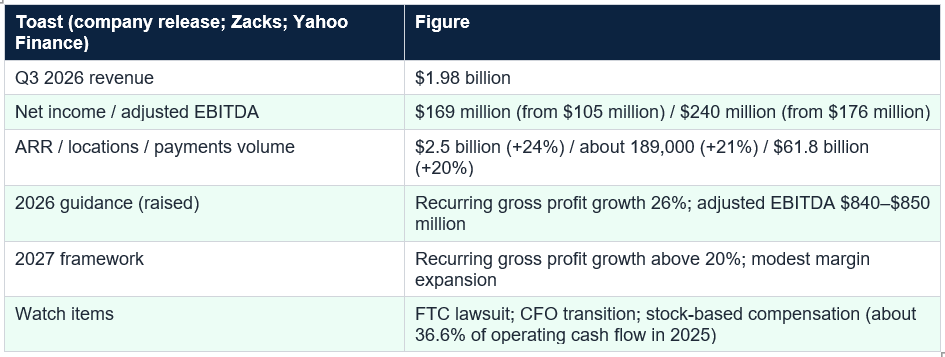
Coinbase Q3 2026: revenue $1.22B (−35%), transaction revenue $590M (−44%), subscription and services $570M (49% of net revenue), net income $718.7M including a $715.0M crypto gain, adjusted EBITDA $332.9M, cash $8.6B. Toast Q3 2026: revenue $1.98B, net income $169M (from $105M), adjusted EBITDA $240M, ARR $2.5B (+24%), locations about 189,000 (+21%).
There are caveats. The Fool notes that stock-based compensation was about 36.6% of operating cash flow, so reported profits and cash flow benefit from paying employees in stock, which dilutes shareholders. For 2027, Toast says it is confident in recurring gross profit growth above 20% but expects only modest adjusted EBITDA margin expansion as it invests in new opportunities, with formal guidance in February. It faces an FTC lawsuit and a chief financial officer transition, per Yahoo Finance, and Zacks has it at Hold with a weak momentum score. Fiscal 2025 revenue was nearly $6.2 billion, up 24.1%, with a net margin of about 5.6%.
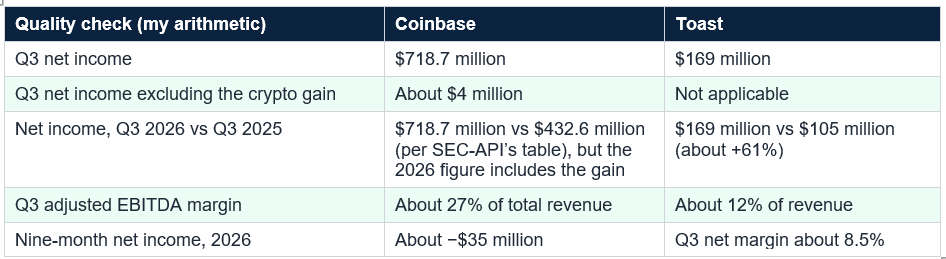
Earnings quality is where they differ most. Toast’s profit comes from its operations, with net income up 61% year over year, although stock-based compensation matters. Coinbase’s third-quarter net income came overwhelmingly from a crypto gain, which is not repeatable and can reverse if prices fall. That does not mean Coinbase is a bad business: it has $8.6 billion of cash, a dominant US position and growing non-trading revenue. But its reported EPS of $2.51 for the quarter is a poor guide to what it earns when markets are quiet.
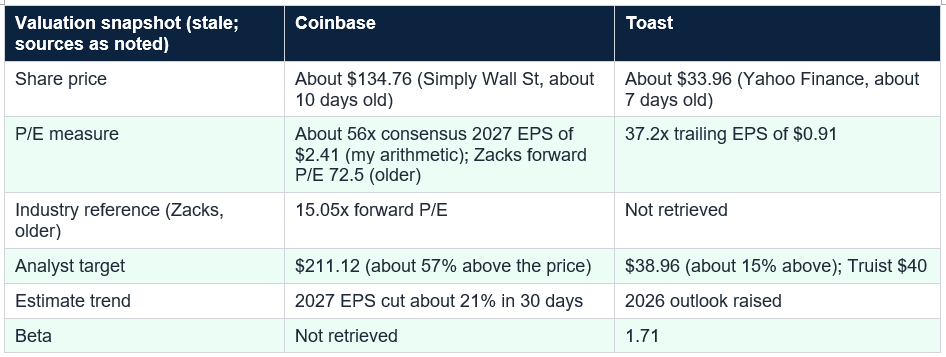
Toast traded at about $34 with a trailing P/E of 37.2 and $0.91 of trailing earnings per share, per Yahoo Finance about a week ago, with a consensus target near $39 and Truist raising its target to $40. I did not retrieve Toast’s market value, so I cannot compute its price-to-sales ratio. A P/E of 37 is not cheap in absolute terms, but it is paired with 24% recurring revenue growth and rising profits, while Coinbase’s multiple rests on a sharp earnings recovery that analysts keep trimming. At about 6.3 times trailing revenue, Coinbase is also not cheap in my arithmetic.
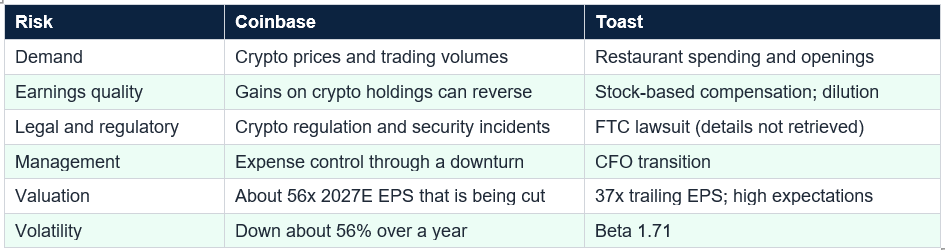
Toast’s risks are different. It depends on restaurant spending, restaurant openings and closings and competition from other point-of-sale providers. The Fool says it feels like every restaurant runs on Toast or Square, which suggests a crowded field. It faces an FTC lawsuit, the details of which I did not retrieve, and a CFO transition. Stock-based compensation is a large cost to shareholders. And at a P/E of 37, expectations are high, so any slowdown in growth could hurt the stock. Toast’s beta of 1.71 shows it, too, is more volatile than the market.
For Toast, the upside case is continued location growth, rising payments volume and expanding software revenue, with recurring gross profit growing above 20% as management expects, while AI products help margins. The downside case is a restaurant slowdown, competition, a costly outcome in the FTC matter or a growth deceleration that does not justify a P/E of 37. Management’s expectation of only modest margin expansion in 2027 suggests profit growth could trail revenue growth. I have not assigned probabilities, and nobody can know which path either company will take.
A few practical rules help. Size each position so a 40% drop would not damage your plans: in my illustration, a 5% position in a $50,000 portfolio is $2,500, and a 40% fall costs $1,000, or 2% of the portfolio. Do not choose on a single article, including this one and the Fool’s. Check current prices, since my figures are a week or more old. Read each company’s latest filing. And remember that holding both, or neither, are also choices: nothing says you must pick one.
Common mistakes include treating Coinbase’s reported net income as recurring profit, ignoring stock-based compensation at Toast, using stale prices to judge valuation, relying on analyst targets as forecasts, comparing a cyclical business with a recurring-revenue business as if they behaved alike, sizing a volatile position too large and taking any single article, including this one, as advice. Also remember that “better buy” depends on price, and prices have moved since my sources were written.
On the evidence, the Fool’s preference for Toast is understandable: steadier earnings, rising guidance and a lower valuation signal. But Coinbase offers more upside if crypto recovers, and both stocks are volatile. The right answer depends on your view of crypto, your risk tolerance and the price you pay, which has changed since my sources. Size any position carefully, check current data and do not rely on one article. This is general education, not personalized investment advice.
Total revenue was $1.22 billion, down 35% from a year earlier and flat from the second quarter. Transaction revenue fell 44% to $590 million, while subscription and services revenue was $570 million, about 49% of net revenue. Net income was $718.7 million, but it included a $715.0 million gain on crypto holdings, per one analysis of the filing, and adjusted EBITDA was $332.9 million. Nine-month net income was roughly a $35 million loss.
What did Toast report for the third quarter of 2026?
Revenue was $1.98 billion, net income was $169 million, up from $105 million a year earlier, and adjusted EBITDA was $240 million, up from $176 million. Annualized recurring run-rate rose 24% to $2.5 billion, locations rose 21% to about 189,000 and gross payment volume rose 20% to $61.8 billion. Toast raised 2026 guidance for recurring gross profit growth to 26% and adjusted EBITDA to $840 million to $850 million.
Which stock does the Motley Fool prefer?
The Fool’s November 11 article says it would pick Toast for 2027 because it has a more reasonable valuation and recently flipped from a loss to a profit. That is the author’s opinion. My numbers point the same way on current earnings quality, but Coinbase has more upside if crypto trading recovers and more downside if it does not.
Is Coinbase’s profit real?
Its reported third-quarter profit was dominated by a gain on crypto holdings, a non-operating item that can reverse when prices fall. Excluding it, my arithmetic suggests earnings were near zero, and the company had net losses in the first two quarters. Adjusted EBITDA, a non-GAAP measure, was $332.9 million, down about 58% from a year earlier. Check the filing to see how each measure is defined. This is general education, not personal advice.
Should I buy either stock for 2027?
I cannot say, and this article does not recommend either stock. Coinbase’s results depend on crypto trading volumes and prices, which are unpredictable. Toast depends on restaurant spending and execution, and faces an FTC lawsuit and a CFO transition. Both are volatile, and the right size for a position depends on your goals and risk tolerance. Compare the facts, size any position so a 40% drop would not harm your plans and avoid relying on one article.
Table of Contents
- The Matchup
- The Short Answer
- Coinbase: A Cyclical Platform in a Trough
- Toast: A Growing Platform That Turned Profitable
- Side by Side: Growth and Earnings Quality
- Valuation: Two Very Different Stories
- The Risks on Each Side
- What Could Go Right and Wrong in 2027
- How to Think About Choosing
- Common Mistakes
- Conclusion
- Frequently Asked Questions
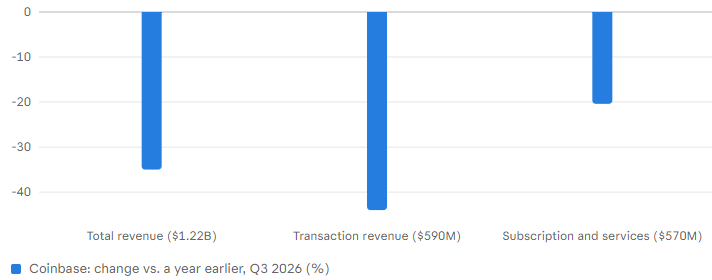
Coinbase Q3 2026: revenue fell across the board (% change vs. Q3 2025)
Change vs. a year earlier (%) by Coinbase SEC earnings materials and SEC-API's analysis (October 29, 2026): total revenue -35%, transaction revenue -43.6% from $1,046M, subscription and services -20.4% from $717M; crypto volatility reached multi-year lows
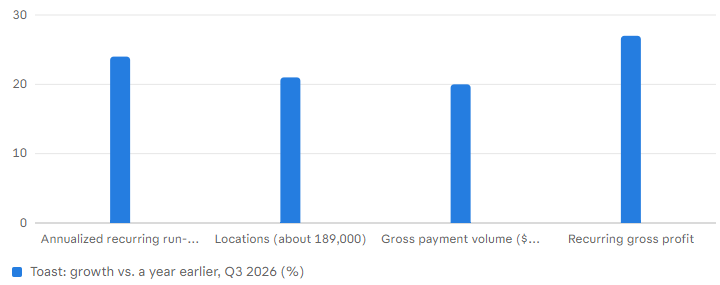
Toast Q3 2026: recurring metrics keep climbing (% change vs. Q3 2025)
Growth vs. a year earlier (%) by Toast Q3 2026 results (investor relations site): ARR +24%, locations +21%, gross payment volume +20%, recurring gross profit +27%; net income $169M vs $105M; revenue $1.98B
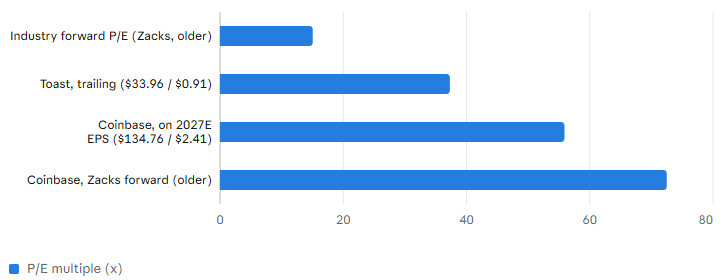
Valuation snapshot (stale data): P/E multiples for Toast and Coinbase vs. the industry (x)
Price-to-earnings multiple (x) by Zacks (industry 15.05x and Coinbase 72.5x forward, older article); Yahoo Finance (Toast price, trailing EPS, Coinbase 2027 estimate of $2.41 from 27 analysts, range -$1.44 to $6.60); Simply Wall St (Coinbase $134.76); prices are about 7-10 days old and have changed
The Matchup
On paper, Coinbase and Toast have little in common. One runs the largest US crypto exchange and a growing set of crypto, stablecoin and payments products. The other sells point-of-sale systems, payments and software to restaurants. What links them, according to a Motley Fool comparison published November 11, is that both are growth-oriented companies at the intersection of technology and financial services, and both are candidates for investors looking toward 2027. The Fool’s verdict is that Toast has a more reasonable valuation and recently flipped from a loss to a profit.That is a fair shorthand, but the facts behind it deserve a closer look. Coinbase’s latest quarter was ugly on revenue and flattering on net income. Toast’s was solid on almost every line, with a few asterisks. This guide compares the two using their own results, looks at the quality of their earnings and their valuations and covers the risks on each side. I do not recommend either stock; the aim is to show what the numbers say and do not say.
The Short Answer
On current fundamentals, Toast looks steadier and Coinbase looks more cyclical. Toast grew annualized recurring revenue 24%, raised guidance and earned $169 million in the third quarter, up from $105 million. Coinbase’s revenue fell 35% year over year to $1.22 billion, and its $718.7 million net income included a $715.0 million crypto gain, so underlying profit was close to zero. Coinbase trades at roughly 56 times 2027 consensus earnings that are still being cut, while Toast trades at about 37 times trailing earnings. But Coinbase has more upside if crypto volumes recover, and Toast carries an FTC lawsuit, a CFO change and heavy stock-based compensation. The better buy depends on your view and risk tolerance.
Coinbase: A Cyclical Platform in a Trough
Coinbase’s third quarter, reported October 29, showed how tied the company still is to crypto trading. Total revenue of $1.22 billion was down 35% from a year earlier and flat from the second quarter. Transaction revenue fell 44% to $590 million as crypto volatility reached multi-year lows and consumer spot volume fell about 59%, per an analysis of the filing. Subscription and services revenue, which includes stablecoin income, staking and subscriptions, was $570 million, down 20% but now 49% of net revenue, up from 41% a year earlier. That diversification is real, but it shrank in dollars.The profit picture needs care. Net income was $718.7 million, or $2.51 a share, but one analysis of the filing says it included a $715.0 million gain on crypto holdings. In my arithmetic, that leaves earnings of about $4 million before any tax effects, and the first two quarters of 2026 were losses of about $394 million and $359 million, so nine-month net income was roughly a $35 million loss. Adjusted EBITDA, a non-GAAP measure, was $332.9 million, down about 58% from a year earlier. On the positive side, Coinbase holds $8.6 billion of cash, has repurchased shares and reports 12 products generating more than $100 million annualized, plus prediction markets above $200 million annualized.
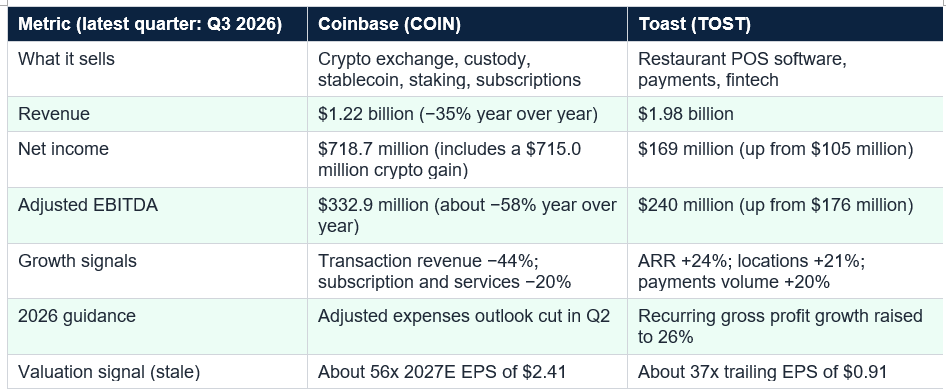
Coinbase Q3 2026: revenue $1.22B (−35%), transaction revenue $590M (−44%), subscription and services $570M (49% of net revenue), net income $718.7M including a $715.0M crypto gain, adjusted EBITDA $332.9M, cash $8.6B. Toast Q3 2026: revenue $1.98B, net income $169M (from $105M), adjusted EBITDA $240M, ARR $2.5B (+24%), locations about 189,000 (+21%).
Toast: A Growing Platform That Turned Profitable
Toast’s story is steadier. In the third quarter it reported revenue of $1.98 billion, net income of $169 million against $105 million a year earlier and adjusted EBITDA of $240 million against $176 million. Annualized recurring run-rate rose 24% to $2.5 billion, locations rose 21% to about 189,000 with roughly 8,500 net additions in the quarter and gross payment volume rose 20% to $61.8 billion. Management raised its 2026 outlook: recurring gross profit growth of 26% (from 23% to 25%) and adjusted EBITDA of $840 million to $850 million (from $805 million to $825 million).There are caveats. The Fool notes that stock-based compensation was about 36.6% of operating cash flow, so reported profits and cash flow benefit from paying employees in stock, which dilutes shareholders. For 2027, Toast says it is confident in recurring gross profit growth above 20% but expects only modest adjusted EBITDA margin expansion as it invests in new opportunities, with formal guidance in February. It faces an FTC lawsuit and a chief financial officer transition, per Yahoo Finance, and Zacks has it at Hold with a weak momentum score. Fiscal 2025 revenue was nearly $6.2 billion, up 24.1%, with a net margin of about 5.6%.
Side by Side: Growth and Earnings Quality
Set next to each other, the growth pictures diverge. Coinbase’s revenue is shrinking with the crypto cycle, while Toast’s recurring metrics keep climbing. Toast’s Q3 net margin was about 8.5% in my arithmetic (net income divided by revenue), and its adjusted EBITDA margin about 12.1%, versus Coinbase’s adjusted EBITDA margin of about 27% on a much smaller and more volatile revenue base. Coinbase’s margins are higher when volumes are strong and collapse when they are not, which is the nature of a trading-driven business.Earnings quality is where they differ most. Toast’s profit comes from its operations, with net income up 61% year over year, although stock-based compensation matters. Coinbase’s third-quarter net income came overwhelmingly from a crypto gain, which is not repeatable and can reverse if prices fall. That does not mean Coinbase is a bad business: it has $8.6 billion of cash, a dominant US position and growing non-trading revenue. But its reported EPS of $2.51 for the quarter is a poor guide to what it earns when markets are quiet.
Valuation: Two Very Different Stories
Valuation is the other half of the Fool’s argument, and the figures I found support it, with the caution that they are stale. Coinbase was about $134.76 with a market value of about $35.7 billion roughly ten days ago, down about 56% over a year. Zacks, in an older article, put its 12-month forward P/E at 72.5 against an industry average of 15. On Yahoo’s consensus of $2.41 of 2027 earnings per share, the stock would be at about 56 times, in my arithmetic, though 27 analysts ranged from a loss of $1.44 to a $6.60 profit, and the 2027 estimate had been cut from $3.05 a month earlier, about 21%.Toast traded at about $34 with a trailing P/E of 37.2 and $0.91 of trailing earnings per share, per Yahoo Finance about a week ago, with a consensus target near $39 and Truist raising its target to $40. I did not retrieve Toast’s market value, so I cannot compute its price-to-sales ratio. A P/E of 37 is not cheap in absolute terms, but it is paired with 24% recurring revenue growth and rising profits, while Coinbase’s multiple rests on a sharp earnings recovery that analysts keep trimming. At about 6.3 times trailing revenue, Coinbase is also not cheap in my arithmetic.
The Risks on Each Side
Coinbase’s main risk is crypto itself. Its revenue follows trading volumes and prices, which have been weak: volatility hit multi-year lows in the third quarter, and prices rebounded in September but volumes fell. Regulation can help or hurt, and the company’s expense discipline helps only so much when revenue drops 35%. Its stock has fallen about 56% over a year, showing how violently sentiment can swing. Earnings are also exposed to marks on its crypto holdings, which cut both ways. For investors, that makes it a bet on the crypto cycle as much as on the company.Toast’s risks are different. It depends on restaurant spending, restaurant openings and closings and competition from other point-of-sale providers. The Fool says it feels like every restaurant runs on Toast or Square, which suggests a crowded field. It faces an FTC lawsuit, the details of which I did not retrieve, and a CFO transition. Stock-based compensation is a large cost to shareholders. And at a P/E of 37, expectations are high, so any slowdown in growth could hurt the stock. Toast’s beta of 1.71 shows it, too, is more volatile than the market.
What Could Go Right and Wrong in 2027
For Coinbase, the upside case is a crypto recovery: if prices and volumes rise, transaction revenue could rebound sharply, operating leverage would lift earnings toward the higher analyst estimates (up to $6.60 for 2027) and the company’s diversification into stablecoins, subscriptions, prediction markets and other products could add stability. The downside case is a prolonged quiet market, in which revenue stays near $1.2 billion a quarter, earnings stay near zero and estimates keep falling toward the low end, a loss of $1.44. The range of analyst estimates, from a loss to a large profit, shows the uncertainty.For Toast, the upside case is continued location growth, rising payments volume and expanding software revenue, with recurring gross profit growing above 20% as management expects, while AI products help margins. The downside case is a restaurant slowdown, competition, a costly outcome in the FTC matter or a growth deceleration that does not justify a P/E of 37. Management’s expectation of only modest margin expansion in 2027 suggests profit growth could trail revenue growth. I have not assigned probabilities, and nobody can know which path either company will take.
How to Think About Choosing
The choice is really about what you want to own. If you want exposure to the crypto cycle, with the potential for large gains and large losses, Coinbase is the most direct US public-company route, and you should be comfortable with an earnings line that can swing from loss to gain on price moves. If you prefer a business with recurring revenue, a rising customer base and profits that come from operations, Toast fits better, though you pay a growth multiple and accept dilution and legal uncertainty. Neither is a safe harbor, and both are volatile.A few practical rules help. Size each position so a 40% drop would not damage your plans: in my illustration, a 5% position in a $50,000 portfolio is $2,500, and a 40% fall costs $1,000, or 2% of the portfolio. Do not choose on a single article, including this one and the Fool’s. Check current prices, since my figures are a week or more old. Read each company’s latest filing. And remember that holding both, or neither, are also choices: nothing says you must pick one.
Common mistakes include treating Coinbase’s reported net income as recurring profit, ignoring stock-based compensation at Toast, using stale prices to judge valuation, relying on analyst targets as forecasts, comparing a cyclical business with a recurring-revenue business as if they behaved alike, sizing a volatile position too large and taking any single article, including this one, as advice. Also remember that “better buy” depends on price, and prices have moved since my sources were written.
Conclusion
Coinbase and Toast are very different companies with very different recent results. Coinbase’s third-quarter revenue fell 35% to $1.22 billion, transaction revenue fell 44% and its $718.7 million net income included a $715.0 million crypto gain, so underlying earnings were close to zero; the stock trades at about 56 times 2027 consensus earnings that analysts are cutting. Toast grew annualized recurring revenue 24% to $2.5 billion, earned $169 million, raised 2026 guidance and trades at about 37 times trailing earnings, though it faces an FTC lawsuit, a CFO change and heavy stock-based compensation.On the evidence, the Fool’s preference for Toast is understandable: steadier earnings, rising guidance and a lower valuation signal. But Coinbase offers more upside if crypto recovers, and both stocks are volatile. The right answer depends on your view of crypto, your risk tolerance and the price you pay, which has changed since my sources. Size any position carefully, check current data and do not rely on one article. This is general education, not personalized investment advice.
Frequently Asked Questions
What did Coinbase report for the third quarter of 2026?Total revenue was $1.22 billion, down 35% from a year earlier and flat from the second quarter. Transaction revenue fell 44% to $590 million, while subscription and services revenue was $570 million, about 49% of net revenue. Net income was $718.7 million, but it included a $715.0 million gain on crypto holdings, per one analysis of the filing, and adjusted EBITDA was $332.9 million. Nine-month net income was roughly a $35 million loss.
What did Toast report for the third quarter of 2026?
Revenue was $1.98 billion, net income was $169 million, up from $105 million a year earlier, and adjusted EBITDA was $240 million, up from $176 million. Annualized recurring run-rate rose 24% to $2.5 billion, locations rose 21% to about 189,000 and gross payment volume rose 20% to $61.8 billion. Toast raised 2026 guidance for recurring gross profit growth to 26% and adjusted EBITDA to $840 million to $850 million.
Which stock does the Motley Fool prefer?
The Fool’s November 11 article says it would pick Toast for 2027 because it has a more reasonable valuation and recently flipped from a loss to a profit. That is the author’s opinion. My numbers point the same way on current earnings quality, but Coinbase has more upside if crypto trading recovers and more downside if it does not.
Is Coinbase’s profit real?
Its reported third-quarter profit was dominated by a gain on crypto holdings, a non-operating item that can reverse when prices fall. Excluding it, my arithmetic suggests earnings were near zero, and the company had net losses in the first two quarters. Adjusted EBITDA, a non-GAAP measure, was $332.9 million, down about 58% from a year earlier. Check the filing to see how each measure is defined. This is general education, not personal advice.
Should I buy either stock for 2027?
I cannot say, and this article does not recommend either stock. Coinbase’s results depend on crypto trading volumes and prices, which are unpredictable. Toast depends on restaurant spending and execution, and faces an FTC lawsuit and a CFO transition. Both are volatile, and the right size for a position depends on your goals and risk tolerance. Compare the facts, size any position so a 40% drop would not harm your plans and avoid relying on one article.
0 Comments
Be the first to share your thoughts on this article.