

Investing
What Is a Money Market Fund? Yields, Risks and How They Work

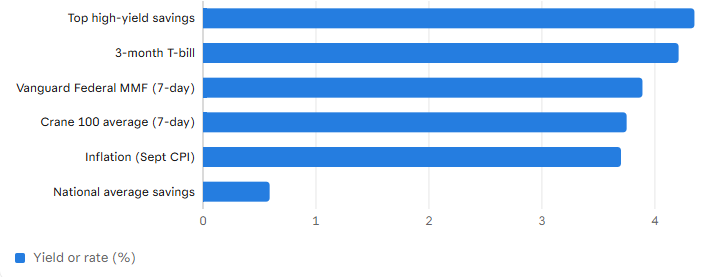
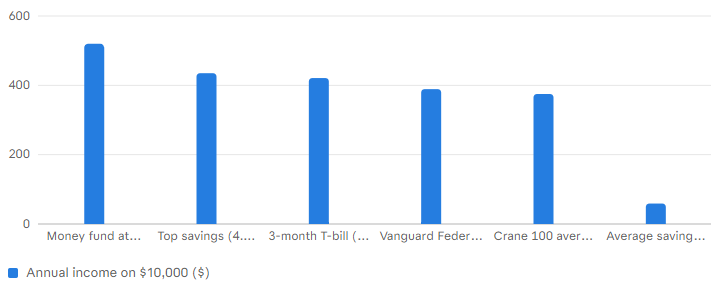
Total money market fund assets $8.02 trillion; government funds about $6.62 trillion (about 83%); prime about $1.23 trillion (15%); tax-exempt about $162 billion (2%); retail funds $3.12 trillion (39%); Crane counts $8.36 trillion, up 6.5% in 12 months. Yields: Crane 100 index 3.75% (7-day, November 7); Vanguard Federal Money Market Fund 3.89% (7-day, November 6; expense ratio 0.11%); 3-month Treasury bill 4.21%; top high-yield savings about 4.35%; national average savings about 0.59%; inflation 3.7%; peak 5.20% in November 2023. My arithmetic: $10,000 at 3.75% earns about $375 a year versus about $59 at the average savings rate and $435 at the top savings rate; the real yield after 3.7% inflation is about 0.05%; the drop from the 5.20% peak costs $145 a year on $10,000; a 1-point fall in yields would cost $100 a year per $10,000.
This guide explains what a money market fund is, how it works, the types that exist, why so much money is in them, what they pay today and how they compare with savings accounts, including the risks, fees and taxes that short explainers skip. I use November 2026 data and flag where sources differ.
The 7-day yield is the fund’s income over the last seven days, annualized and after expenses. Government money market funds must invest at least 99.5% of their assets in cash, US government securities or repurchase agreements backed by them, according to Vanguard’s prospectus, which describes the objective as current income, liquidity and a stable $1 share price. Single funds are huge: Vanguard’s Federal Money Market Fund had about $374 billion in net assets in February.
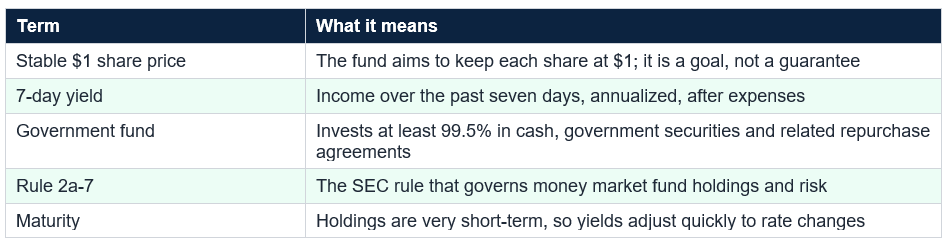
Funds also split into retail, aimed at individuals, with about $3.12 trillion (39% of the total), and institutional, used by businesses and large investors, with about $4.90 trillion. As a saver you will usually see government funds from Vanguard or Fidelity and sometimes money market ETFs, such as the State Street Prime Money Market ETF and the JPMorgan Treasury money market ETF, which US News lists at yields of about 3.7% to 3.9% and expense ratios of 0.16% to 0.20%.

ICI, week ended November 4, 2026: total money market fund assets $8.02 trillion; government funds about $6.62 trillion (83%), prime about $1.23 trillion (15%), tax-exempt about $162 billion (2%); retail $3.12 trillion, institutional $4.90 trillion. Crane counts $8.36 trillion, up 6.5% in 12 months.
There is also a practical reason: many brokers use money market funds as the place where cash waits between trades, and companies use them for operating cash. They are liquid, and you can usually sell shares and get the money in a day or so (general knowledge). Some brokerage sweep options pay very little, which makes a money fund an upgrade, and the national average savings rate of about 0.59% is far below the 3.75% fund average.
In my arithmetic, $10,000 at 3.75% earns about $375 a year, about $316 more than at the national average savings rate of 0.59% but about $60 less than the best online savings account at 4.35% and about $46 less than a 3-month Treasury bill at 4.21%. After inflation of 3.7% the real return is about 0.05%, so a money fund mostly preserves purchasing power. And yields are variable: a 1-point drop would cost $100 a year per $10,000.
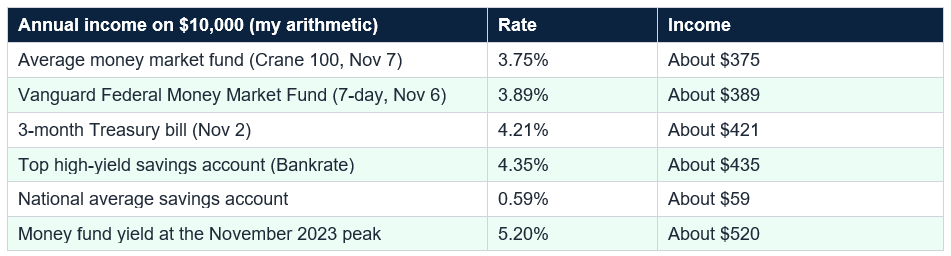
Which pays more depends on the day. Right now the best online savings accounts, at about 4.35%, pay more than the average money fund at 3.75%, and Treasury bills at about 4.21% also beat it, though that reverses at times. If you already invest through a brokerage, a money fund is convenient and likely pays more than a sweep account; if you want insured cash, a bank is better; if you want state tax savings, Treasury funds may help. Compare current yields, not names.

The other risks are quieter. Because holdings are so short-term, income falls quickly when rates drop, as it did from 5.20% to about 3.45% before the recent recovery. With inflation at 3.7%, a 3.75% yield barely keeps up. Expenses reduce your return, though they are low at the big funds. And cash is a safe place to wait, not a way to grow wealth over decades, so money market funds suit money you need soon, not retirement savings.
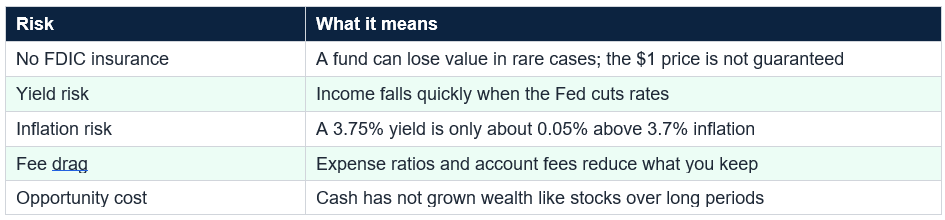
A money market fund is not a bank account. It is not FDIC-insured, and its $1 share price is a goal, not a guarantee. Government funds are generally the lowest-risk type, but check the fund type before you buy.
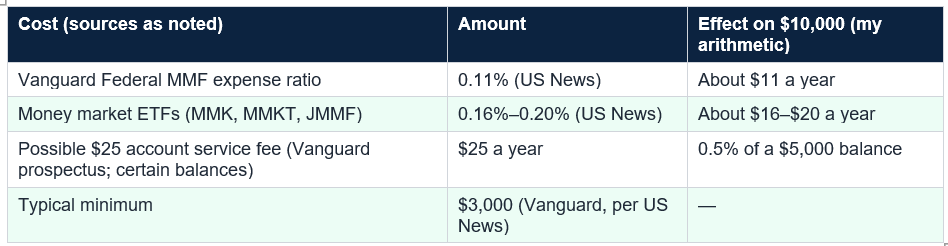
Watch for account fees too. The Vanguard prospectus lists a $25 annual account service fee for certain balances: on a $5,000 balance that is 0.5%, which would cut a 3.89% yield to about 3.39%. A small holder can lose a surprising share of the return to fees, so check the fee table and your balance, and whether your broker charges a separate fee. Expenses are already inside the quoted 7-day yield, so compare yields after expenses.
In my illustration, a fund yielding 3.75% in a 24% federal bracket keeps about 2.85% after federal tax, which a tax-exempt fund yielding about 2.9% would match. You will receive a Form 1099, and you report the income whether or not you take it in cash. Rules differ by fund and state, so check with your fund company or a tax professional.
They suit less well as a long-term holding. With inflation at 3.7% and a yield of about 3.75%, purchasing power is flat, while over decades stocks have returned more, with more risk. Keep a cash cushion (Bankrate found only 46% of Americans could cover three months of expenses) in an account you understand and trust, then invest the rest according to your goals.

Check what your broker does by default: many accounts sweep cash into a low-yielding option unless you choose a money fund, and moving $50,000 from a 0.59% account to a 3.75% fund adds about $1,580 a year in my arithmetic. Review the yield now and then, since it follows the Fed, and keep emergency savings separate from money you are investing.
Look at where your brokerage cash is sitting today. If it is in a sweep paying well below the money market fund average of about 3.75%, compare a government money fund and see what the difference is worth over a year. Common mistakes include confusing a money market fund with a money market account, assuming it is FDIC-insured, leaving brokerage cash in a low-yield sweep, ignoring fees, chasing a slightly higher yield from a riskier fund, holding long-term savings in cash and forgetting that yields fall when the Fed cuts. The safeguard is to know what you hold: its type, its yield after expenses and its protections.
Use it for what it does well: holding cash you will need soon and earning more than a typical sweep or savings account. Choose a government fund for the lowest risk, compare yields and fees, and remember the best online savings accounts at about 4.35% and Treasury bills at about 4.21% pay more today. Keep long-term money invested for growth.
It is a mutual fund (or ETF) that invests in very short-term, high-quality debt such as Treasury bills, repurchase agreements, commercial paper and certificates of deposit, and aims to keep its share price at $1. You earn income from the interest the fund collects, shown as a 7-day yield. It is an investment, not a bank deposit, and it is not FDIC-insured.
Is a money market fund the same as a money market account?
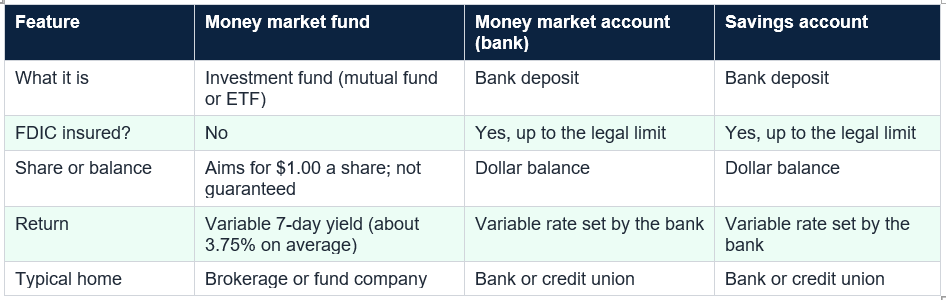
No. A money market account is a bank deposit, insured by the FDIC up to the legal limit. A money market fund is an investment fund that aims to hold a $1.00 share price but carries no FDIC insurance and no guarantee. The names sound alike, but the protections differ, so check which one you are buying.
Can you lose money in a money market fund?
It is rare but possible. Funds aim to keep $1 a share, and government funds hold mostly cash and government securities, but there is no guarantee. In my general knowledge, the Reserve Primary Fund fell below $1 in 2008, and later rules tightened liquidity and risk requirements. Government funds are generally considered the lowest-risk type.
What do money market funds yield now?
Crane Data’s index of the 100 largest funds averaged 3.75% (7-day annualized) on November 7, 2026, down from a 5.20% peak in November 2023. Vanguard’s Federal Money Market Fund showed a 3.89% 7-day yield on November 6. Yields move with the Federal Reserve’s rate, so they can rise or fall. Top online savings accounts, at about 4.35%, currently pay more.
How are money market fund earnings taxed?
Dividends from taxable money market funds are generally taxed as ordinary income at your federal rate, which I note from general knowledge. Funds that invest only in Treasuries may be exempt from state and local income tax, and tax-exempt funds invest in municipal securities. Check each fund’s details and consult a tax professional. This is general education, not personal advice.
Table of Contents
- Cash That Is Not in a Bank
- The Short Answer
- How a Money Market Fund Works
- The Three Types
- Why $8 Trillion Is Parked There
- What They Pay Now
- Money Market Fund vs. Money Market Account vs. Savings
- The Risks
- Costs, Minimums and Fees
- Taxes
- When a Money Market Fund Makes Sense
- How to Buy One
- Common Mistakes
- Conclusion
- Frequently Asked Questions
What cash pays now: money market funds vs. alternatives and inflation (%)
% by Bankrate; DividendFlow (T-bill, Nov 2); Vanguard (Nov 6); Crane Data (Nov 7); First Trust; Bankrate average 0.57%-0.63%; yields change daily; money funds are not FDIC-insured
What the yield means in dollars: annual income on $10,000 ($)
Income per year ($) by Author's arithmetic on published yields; before tax, fees beyond expense ratios and any change in yields; the drop from the peak to the average costs $145 a year per $10,000
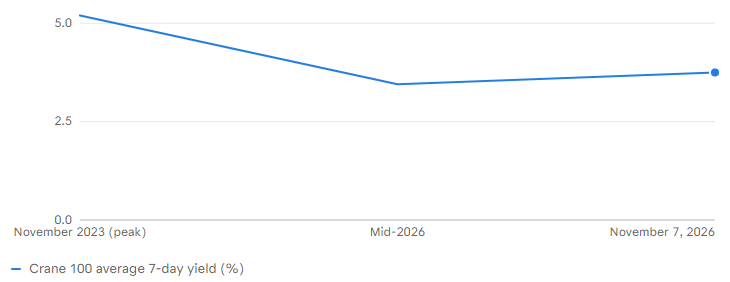
Yields follow the Fed: Crane 100 average money fund yield (%)
7-day yield (%) by Crane Data as cited by Walnut (peak and mid-2026) and Crane Data directly (Nov 7); three points only, not a full history; yields change with the Federal Reserve's rate
Cash That Is Not in a Bank
Most people keep spare cash in a bank, so a place to park cash that is not a bank can sound odd. Yet more than $8 trillion sits in money market funds, one of the largest pools of cash in the financial system. If you have a brokerage account, you have probably met one: cash waiting to be invested is often swept into a money market fund. They behave like cash, but they are not the same as cash in a bank.This guide explains what a money market fund is, how it works, the types that exist, why so much money is in them, what they pay today and how they compare with savings accounts, including the risks, fees and taxes that short explainers skip. I use November 2026 data and flag where sources differ.
The Short Answer
A money market fund is a mutual fund or ETF that invests in very short-term, high-quality debt, such as Treasury bills, repurchase agreements and commercial paper, and aims to keep its share price at $1. You earn the interest it collects, shown as a 7-day yield, about 3.75% on average right now, according to Crane Data. It is easy to buy and sell, but it is an investment, not a bank deposit: it is not FDIC-insured, the $1 price is a goal, not a guarantee, and the yield changes with interest rates. Government funds are generally considered the lowest-risk kind.
How a Money Market Fund Works
The fund pools your money with other investors’ and lends it for very short periods to borrowers considered safe, mainly the US government but in some funds also banks and companies. The loans mature in days or months, so when interest rates change, the fund’s income changes quickly. The fund passes the interest to you, minus expenses, as dividends and aims to keep its share price at $1, so your return comes as income rather than a rising price, which is why the 7-day yield is the number to watch.The 7-day yield is the fund’s income over the last seven days, annualized and after expenses. Government money market funds must invest at least 99.5% of their assets in cash, US government securities or repurchase agreements backed by them, according to Vanguard’s prospectus, which describes the objective as current income, liquidity and a stable $1 share price. Single funds are huge: Vanguard’s Federal Money Market Fund had about $374 billion in net assets in February.
The Three Types
Money market funds come in three main kinds. Government funds invest almost entirely in cash, US government securities and repurchase agreements and are the largest group, about $6.62 trillion or 83% of the total, according to the Investment Company Institute. Prime funds can also hold commercial paper, bank certificates of deposit and other corporate debt, which can pay a little more with a little more risk, and hold about $1.23 trillion (15%). Tax-exempt funds invest in municipal debt and hold about $162 billion (2%).Funds also split into retail, aimed at individuals, with about $3.12 trillion (39% of the total), and institutional, used by businesses and large investors, with about $4.90 trillion. As a saver you will usually see government funds from Vanguard or Fidelity and sometimes money market ETFs, such as the State Street Prime Money Market ETF and the JPMorgan Treasury money market ETF, which US News lists at yields of about 3.7% to 3.9% and expense ratios of 0.16% to 0.20%.
ICI, week ended November 4, 2026: total money market fund assets $8.02 trillion; government funds about $6.62 trillion (83%), prime about $1.23 trillion (15%), tax-exempt about $162 billion (2%); retail $3.12 trillion, institutional $4.90 trillion. Crane counts $8.36 trillion, up 6.5% in 12 months.
Why $8 Trillion Is Parked There
Money market funds grew because they combine a decent yield, easy access and a feeling of safety. When the Federal Reserve raised rates, money fund yields followed quickly, reaching a 5.20% peak in November 2023 on Crane’s 100-fund index, while many banks were slower to raise savings rates, so investors moved cash into funds. Crane reports a rise of $507 billion, or 6.5%, over the past 12 months, with a record near $7.95 trillion on ICI’s measure earlier this year and $8.02 trillion now.There is also a practical reason: many brokers use money market funds as the place where cash waits between trades, and companies use them for operating cash. They are liquid, and you can usually sell shares and get the money in a day or so (general knowledge). Some brokerage sweep options pay very little, which makes a money fund an upgrade, and the national average savings rate of about 0.59% is far below the 3.75% fund average.
What They Pay Now
Crane Data’s index of the 100 largest funds showed an average 7-day yield of 3.75% on November 7, 2026, up from about 3.45% in the summer and down from the 5.20% peak. Vanguard’s Federal Money Market Fund showed a 3.89% 7-day yield on November 6, and US News lists it at 3.8% with a 0.11% expense ratio. Yields track short-term Treasury rates and usually sit a little below them after expenses; the 3-month Treasury bill yielded about 4.21% on November 2.In my arithmetic, $10,000 at 3.75% earns about $375 a year, about $316 more than at the national average savings rate of 0.59% but about $60 less than the best online savings account at 4.35% and about $46 less than a 3-month Treasury bill at 4.21%. After inflation of 3.7% the real return is about 0.05%, so a money fund mostly preserves purchasing power. And yields are variable: a 1-point drop would cost $100 a year per $10,000.
Money Market Fund vs. Money Market Account vs. Savings
The names cause more confusion than anything. A money market account is a bank deposit insured by the FDIC up to the legal limit, often with check-writing or a debit card. A money market fund is an investment sold by brokerages and fund companies: it is not FDIC-insured and aims for a $1 share price. A high-yield savings account is also a bank deposit. For an emergency fund, bank deposits within insurance limits are the more conservative choice (general knowledge).Which pays more depends on the day. Right now the best online savings accounts, at about 4.35%, pay more than the average money fund at 3.75%, and Treasury bills at about 4.21% also beat it, though that reverses at times. If you already invest through a brokerage, a money fund is convenient and likely pays more than a sweep account; if you want insured cash, a bank is better; if you want state tax savings, Treasury funds may help. Compare current yields, not names.
The Risks
Money market funds are low-risk, not no-risk. They are not insured, and if a fund’s holdings lose value faster than expected, the share price can fall below $1, called “breaking the buck.” In my general knowledge, the Reserve Primary Fund did so in 2008, prompting regulation, and prime funds faced heavy withdrawals in March 2020; later reforms tightened liquidity rules and, as I understand it, added liquidity fees for some funds, though I did not retrieve the details. Government funds are generally seen as the safest.The other risks are quieter. Because holdings are so short-term, income falls quickly when rates drop, as it did from 5.20% to about 3.45% before the recent recovery. With inflation at 3.7%, a 3.75% yield barely keeps up. Expenses reduce your return, though they are low at the big funds. And cash is a safe place to wait, not a way to grow wealth over decades, so money market funds suit money you need soon, not retirement savings.
A money market fund is not a bank account. It is not FDIC-insured, and its $1 share price is a goal, not a guarantee. Government funds are generally the lowest-risk type, but check the fund type before you buy.
Costs, Minimums and Fees
Money market funds charge an annual expense ratio, taken out of the yield before you see it. Vanguard’s Federal Money Market Fund shows a 0.10% management fee in its prospectus and a 0.11% expense ratio per US News, about $11 a year on $10,000 and $55 on $50,000; money market ETFs charge about 0.16% to 0.20%. Some funds have minimums, such as $3,000 for Vanguard’s fund, per US News.Watch for account fees too. The Vanguard prospectus lists a $25 annual account service fee for certain balances: on a $5,000 balance that is 0.5%, which would cut a 3.89% yield to about 3.39%. A small holder can lose a surprising share of the return to fees, so check the fee table and your balance, and whether your broker charges a separate fee. Expenses are already inside the quoted 7-day yield, so compare yields after expenses.
Taxes
Money market fund income is generally taxed as ordinary income at your federal rate, like bank interest, and does not get the lower rates for qualified dividends and long-term gains (general knowledge). Funds that invest only in US Treasuries may be exempt from state and local income tax, which can matter in high-tax states, and tax-exempt funds invest in municipal debt and pay income generally free of federal tax, at lower yields, so compare after tax.In my illustration, a fund yielding 3.75% in a 24% federal bracket keeps about 2.85% after federal tax, which a tax-exempt fund yielding about 2.9% would match. You will receive a Form 1099, and you report the income whether or not you take it in cash. Rules differ by fund and state, so check with your fund company or a tax professional.
When a Money Market Fund Makes Sense
Money market funds suit money you will need in the near term but want to earn something on: cash waiting to be invested, a house down payment, a tax bill and, for some people, part of an emergency fund. They are a natural home for a brokerage account’s cash and a useful comparison for a high-yield savings account, depending on which pays more that day.They suit less well as a long-term holding. With inflation at 3.7% and a yield of about 3.75%, purchasing power is flat, while over decades stocks have returned more, with more risk. Keep a cash cushion (Bankrate found only 46% of Americans could cover three months of expenses) in an account you understand and trust, then invest the rest according to your goals.
How to Buy One
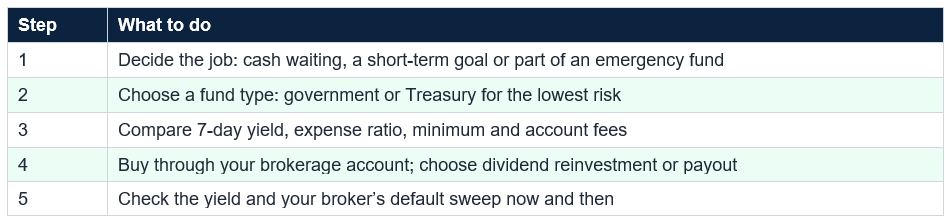
Open a brokerage account or use one you have, and look for a government money market fund from a large provider, such as Vanguard’s VMFXX or Fidelity’s SPAXX, which sources say hold hundreds of billions of dollars each. Compare the 7-day yield, expense ratio, minimum and any account fees, decide whether you want a government, Treasury or prime fund and whether tax-exempt suits you, then buy shares and choose to reinvest or pay out dividends.Check what your broker does by default: many accounts sweep cash into a low-yielding option unless you choose a money fund, and moving $50,000 from a 0.59% account to a 3.75% fund adds about $1,580 a year in my arithmetic. Review the yield now and then, since it follows the Fed, and keep emergency savings separate from money you are investing.
Look at where your brokerage cash is sitting today. If it is in a sweep paying well below the money market fund average of about 3.75%, compare a government money fund and see what the difference is worth over a year. Common mistakes include confusing a money market fund with a money market account, assuming it is FDIC-insured, leaving brokerage cash in a low-yield sweep, ignoring fees, chasing a slightly higher yield from a riskier fund, holding long-term savings in cash and forgetting that yields fall when the Fed cuts. The safeguard is to know what you hold: its type, its yield after expenses and its protections.
Conclusion
A money market fund is a pooled investment in very short-term, high-quality debt that aims to keep a $1 share price and pays you the interest, shown as a 7-day yield. With $8.02 trillion in assets, it is one of the most used places to park cash, and with the Crane 100 index at 3.75% and Vanguard’s government fund at 3.89% it pays far more than the average savings account at about 0.59%. But it is not a bank account: it is not FDIC-insured, the $1 is a goal, yields move with the Fed and after 3.7% inflation the real return is about 0.05%.Use it for what it does well: holding cash you will need soon and earning more than a typical sweep or savings account. Choose a government fund for the lowest risk, compare yields and fees, and remember the best online savings accounts at about 4.35% and Treasury bills at about 4.21% pay more today. Keep long-term money invested for growth.
Frequently Asked Questions
What is a money market fund?It is a mutual fund (or ETF) that invests in very short-term, high-quality debt such as Treasury bills, repurchase agreements, commercial paper and certificates of deposit, and aims to keep its share price at $1. You earn income from the interest the fund collects, shown as a 7-day yield. It is an investment, not a bank deposit, and it is not FDIC-insured.
Is a money market fund the same as a money market account?
No. A money market account is a bank deposit, insured by the FDIC up to the legal limit. A money market fund is an investment fund that aims to hold a $1.00 share price but carries no FDIC insurance and no guarantee. The names sound alike, but the protections differ, so check which one you are buying.
Can you lose money in a money market fund?
It is rare but possible. Funds aim to keep $1 a share, and government funds hold mostly cash and government securities, but there is no guarantee. In my general knowledge, the Reserve Primary Fund fell below $1 in 2008, and later rules tightened liquidity and risk requirements. Government funds are generally considered the lowest-risk type.
What do money market funds yield now?
Crane Data’s index of the 100 largest funds averaged 3.75% (7-day annualized) on November 7, 2026, down from a 5.20% peak in November 2023. Vanguard’s Federal Money Market Fund showed a 3.89% 7-day yield on November 6. Yields move with the Federal Reserve’s rate, so they can rise or fall. Top online savings accounts, at about 4.35%, currently pay more.
How are money market fund earnings taxed?
Dividends from taxable money market funds are generally taxed as ordinary income at your federal rate, which I note from general knowledge. Funds that invest only in Treasuries may be exempt from state and local income tax, and tax-exempt funds invest in municipal securities. Check each fund’s details and consult a tax professional. This is general education, not personal advice.
0 Comments
Be the first to share your thoughts on this article.