

Investing
Inheriting Gold: How Gold IRAs, ETFs and Bullion Differ Now!

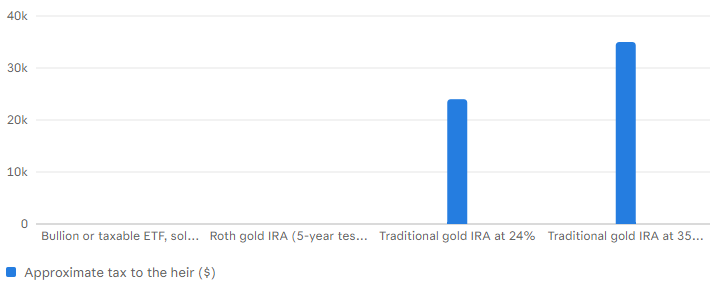
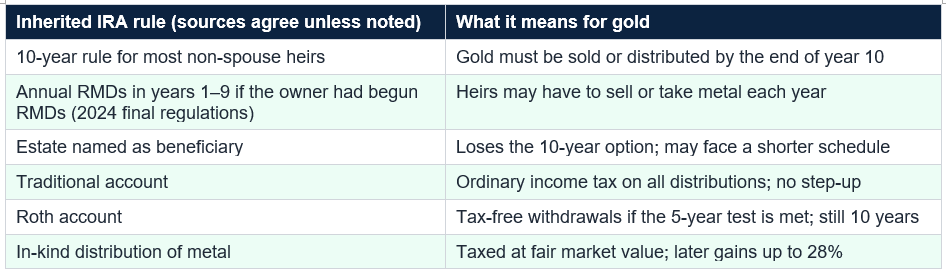
Taxes: long-term gains on physical gold and grantor-trust gold ETFs (GLD, IAU, SLV) are taxed at up to 28% as collectibles; inherited bullion and taxable-account ETFs generally get a step-up in basis to date-of-death value; a traditional gold IRA gets no step-up and its distributions are ordinary income. Inherited IRA rules: most non-spouse beneficiaries must empty the account within 10 years; annual RMDs apply in years 1–9 if the owner had begun RMDs (final regulations, July 2024); an estate named as beneficiary loses the 10-year rule; inherited Roth accounts also follow the 10-year rule but with tax-free distributions if the 5-year test is met. Federal estate tax exemption: $15 million per person in 2026 ($30 million for couples), up from $13.99 million in 2025. My arithmetic on $100,000 of gold bought for $40,000: if the owner sold in life, tax at 28% is about $16,800; inherited bullion or ETF sold at once, about $0; traditional gold IRA taxed at 24% about $24,000 and at 35% about $35,000; inherited Roth gold IRA $0; a 10% gain after inheriting costs about $2,800 at 28% for bullion.
This guide compares physical bullion owned outright, gold ETFs held in a regular account and gold held inside an IRA, covering the step-up in basis, the 28% collectibles tax, the inherited-IRA rules and estate tax, with a worked example of $100,000 of gold. Inheritance tax rules are technical and personal, so treat it as a map and check the details with a professional.
I did not retrieve the IRS publications themselves or a current gold price, so nothing here depends on what gold is worth today. The official references are Publication 590-B for inherited IRAs, Publication 551 for basis and the IRS pages on capital gains and estate tax, listed below. If a salesperson uses inheritance rules to pressure you into buying gold, slow down and compare independent information.
The tax is the easy part; the logistics are hard. Physical gold has no beneficiary form, so in my general knowledge it passes under the will, a trust or state law, which may mean probate. Someone must find it, count it, identify it and get a date-of-death valuation, often from a dealer quote or a published price, and dealers usually buy below the quoted price, so the heir pays a spread (general knowledge). Heirs may not know where the keys are or whether a safe deposit box exists, and without an inventory gold can be lost, undervalued or sold in a hurry at a poor price.
The practical side is far easier. A brokerage account has statements, a custodian and, if the owner set it up, a transfer-on-death beneficiary, so shares can often move to the heir without probate (general knowledge). There is no safe to find, no storage and no dealer spread, though the fund charges an annual expense ratio I did not retrieve, and you own a claim on gold through a fund, not the metal in your hand. For heirs, an ETF is often the simplest of the three to inherit.
Then the clock starts. Most non-spouse beneficiaries must empty the account by the end of the tenth year after the owner’s death, and final regulations of July 2024 require annual distributions in years 1 through 9 if the owner had already begun required minimum distributions, according to one source. Spouses have extra options, as do minor children of the owner, disabled or chronically ill beneficiaries and those not more than 10 years younger than the owner. An inherited Roth gold IRA also follows the 10-year rule, with no annual distributions required and tax-free withdrawals if the five-year test is met.
There is a metals-specific wrinkle: gold pays no dividends or interest, so required withdrawals must come from selling metal or taking it in-kind. Physical gold taken in-kind is taxed at its fair market value on distribution, and later gains at the collectibles rate, up to 28%, according to the sources. A traditional IRA’s tax bill can be large and lumpy, so spreading withdrawals across the 10 years can matter, and mistakes can bring penalties.
Some states have their own estate taxes with much lower thresholds, one source counting 12 states and the District of Columbia, and a few have inheritance taxes (general knowledge), so check local rules. In my illustration, a $2 million estate would use about 13% of a single person’s $15 million exemption, so federal estate tax would not apply.
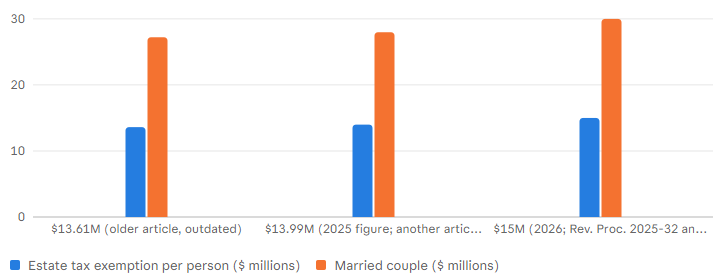
Federal estate tax exemption: $15 million per person in 2026 ($30 million for a married couple), up from $13.99 million in 2025 and indexed for inflation. Some states have lower thresholds; one source counts 12 states plus DC. Heirs do not pay federal estate tax; the estate does, and only above the exemption.
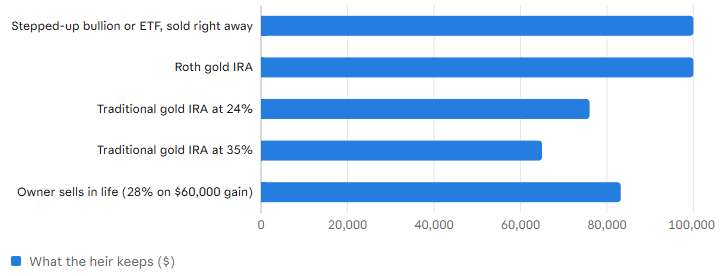
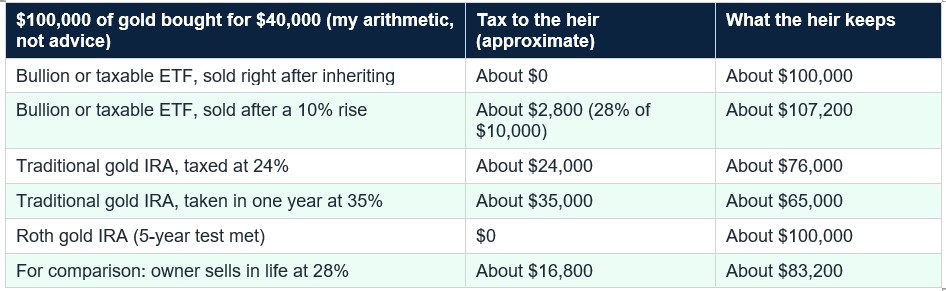
If the same $100,000 sat in a traditional gold IRA, there is no step-up and the heir pays ordinary income tax: at an assumed 24% bracket about $24,000, leaving $76,000, or, if the heir takes it all in one year and lands in a 35% bracket, about $35,000, leaving $65,000, an $11,000 difference caused only by timing. A Roth gold IRA of the same size leaves the full $100,000, though it must still be emptied within 10 years. The brackets are assumptions; an heir’s actual tax depends on their income.
Keep in mind: These examples ignore state taxes, fees, dealer spreads, ETF expenses and the net investment income tax, and they assume simple tax brackets. Your result will depend on your situation.
Think about the wrapper too. For heirs, a gold ETF in a taxable account is easier to transfer and still gets a step-up, while a traditional gold IRA carries income tax and a deadline. Some owners convert part of a traditional gold IRA to a Roth, paying tax now so heirs inherit tax-free, a strategy mentioned by one source and not suitable for everyone. Compare it with a professional, and do not let a salesperson’s urgency drive an estate plan.
For bullion or ETF shares, get a date-of-death valuation, which sets your new basis, and keep it with your records. Secure and insure any physical gold, and compare dealer quotes before selling, since the spread can cost more than the tax. If the estate is large, ask whether a federal return is needed, and be wary of strangers offering to buy the gold quickly. A calm, documented process nearly always beats a fast sale. Common mistakes include forgetting to update the beneficiary form, naming the estate on an IRA, leaving physical gold with no inventory, assuming a gold IRA gets a step-up, missing distribution deadlines, selling at a poor dealer price in a hurry, ignoring state estate taxes and treating all gold the same. The wrapper decides most of the outcome, so know which one you have before you decide anything.
In my example, $100,000 of gold with a $40,000 cost leaves an heir about $100,000 as stepped-up bullion or an ETF, about $76,000 to $65,000 from a traditional gold IRA depending on bracket and timing, and $100,000 from a Roth gold IRA. Most estates owe no federal estate tax, with a $15 million exemption per person in 2026. The best preparation is cheap: current beneficiary forms, a clear inventory and a conversation with an estate attorney and CPA.
On physical gold and on gold ETFs held in a regular taxable account, generally yes: inherited assets typically get a basis equal to their fair market value on the date of death, which can erase most of the taxable gain. A traditional gold IRA does not get a step-up, because the distributions are taxed as ordinary income. This is general information, not tax advice, and the rules have exceptions.
How is inherited gold taxed when the heir sells it?
Gains above the stepped-up value are generally taxed as a collectible, at a maximum federal long-term rate of 28%, whether the gold is physical or held through a grantor-trust ETF such as GLD, IAU or SLV, according to the sources I found. Gold mining stocks and futures-based ETFs are not collectibles. Selling right after inheriting usually produces little or no gain.
What is the 10-year rule for an inherited gold IRA?
Most non-spouse beneficiaries must empty the inherited IRA by the end of the tenth year after the owner’s death. If the owner had already begun required minimum distributions, final regulations from July 2024 require annual distributions in years 1 through 9 as well. Spouses, minor children, disabled or chronically ill beneficiaries and those not more than 10 years younger have different, more flexible rules.
Does a gold IRA go through the will?
No, an IRA passes by its beneficiary designation, not by the will. If no beneficiary is named, or the estate is named, the IRA passes through the estate and the individual 10-year rule does not apply, according to the sources. That makes keeping beneficiary forms current one of the most important and cheapest steps.
Is there federal estate tax on gold?
Only if the total estate is large. The federal exemption is $15 million per person in 2026, about $30 million for a married couple, indexed for inflation, under the 2025 law. Some states have their own estate taxes with lower thresholds, with one source counting 12 states and the District of Columbia. The estate, not the heir, pays any federal estate tax.
Table of Contents
- One Metal, Three Wrappers
- The Short Answer
- A Caution About the Sources
- Physical Bullion: Big Step-Up, Big Practical Problems
- Gold ETFs in a Taxable Account
- Gold IRAs: No Step-Up and a Ticking Clock
- Estate Tax: Who Actually Pays
- Side by Side: $100,000 of Gold
- What Owners Can Do Now
- What Heirs Should Do First
- Common Mistakes
- Conclusion
- Frequently Asked Questions
Tax on inheriting $100,000 of gold (cost $40,000), by how it was held ($)
Tax ($) by Author's hypothetical arithmetic using rules reported by gold-dealer sources (step-up, ordinary income on IRA distributions); ignores state tax, fees and net investment income tax; not tax advice
What an heir keeps of $100,000 of gold by structure, versus the owner selling in life ($)
After-tax value ($) by Author's hypothetical arithmetic; brackets are assumptions; the last bar shows what the owner would keep after a $16,800 collectibles tax; not tax advice
Why sources conflict: the federal estate tax exemption figures reported ($ millions)
$ millions by GoldIRAPath, Precious Metals Insider, Brighton Enterprises and Goldiew (commercial sources); the $15 million 2026 figure is the one I rely on; older figures shown to explain the conflict
One Metal, Three Wrappers
When someone leaves you gold, the first question is not how much it is worth but how it was held. The same ounce can be a coin in a safe, a share of a gold ETF in a brokerage account or a bar in a depository inside a gold IRA, and each wrapper follows different rules when the owner dies. One may give you a tax-free reset of the gain, another an income-tax bill on every dollar and a third may leave you hunting for the metal itself.This guide compares physical bullion owned outright, gold ETFs held in a regular account and gold held inside an IRA, covering the step-up in basis, the 28% collectibles tax, the inherited-IRA rules and estate tax, with a worked example of $100,000 of gold. Inheritance tax rules are technical and personal, so treat it as a map and check the details with a professional.
The Short Answer
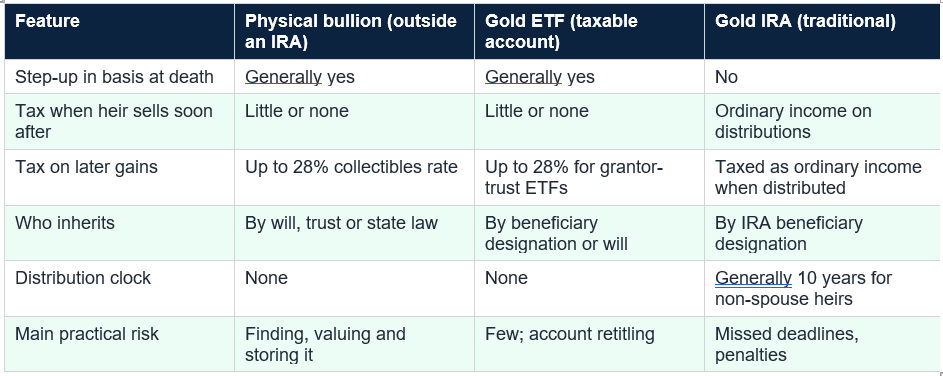
Bullion and gold ETFs in a taxable account generally receive a step-up in basis at death, so heirs usually owe little or no tax if they sell soon, though later gains are taxed at up to 28% as collectibles. A traditional gold IRA gets no step-up: heirs pay ordinary income tax on every distribution and, for most non-spouse beneficiaries, must empty the account within 10 years. A Roth gold IRA avoids the income tax but follows the same clock. The federal estate tax exemption is $15 million per person in 2026, so most estates owe none. The practical differences matter as much as the tax: ETFs and IRAs leave paperwork trails, while physical gold may be hard to find.
3aution About the Sources
Most of the detailed material online about inheriting gold comes from companies that sell gold or gold IRAs. That does not make it wrong, and on the core mechanics several agree with each other and with general tax rules, but they have a reason to make gold look appealing and are sometimes sloppy about dates: one article gives the 2026 federal estate tax exemption as $13.99 million and another as $13.61 million, while a newer source cites IRS Revenue Procedure 2025-32 and the 2025 law for $15 million per person. I rely on the $15 million figure and on points that multiple sources share.I did not retrieve the IRS publications themselves or a current gold price, so nothing here depends on what gold is worth today. The official references are Publication 590-B for inherited IRAs, Publication 551 for basis and the IRS pages on capital gains and estate tax, listed below. If a salesperson uses inheritance rules to pressure you into buying gold, slow down and compare independent information.
Physical Bullion: Big Step-Up, Big Practical Problems
Physical gold you own outright, such as coins and bars held at home, in a safe deposit box or in non-IRA storage, generally gets a step-up in basis under Section 1014 of the tax code, so the heir’s cost basis becomes the fair market value on the date of death, wiping out most of the gain built up while the owner held it. Heirs generally do not owe income tax simply for receiving inherited gold, and gains after the step-up are taxed on sale at the collectibles rate, up to 28% for long-term holdings, instead of the lower rates on most stocks. In my general knowledge, inherited property is automatically treated as long-term, which I did not retrieve.The tax is the easy part; the logistics are hard. Physical gold has no beneficiary form, so in my general knowledge it passes under the will, a trust or state law, which may mean probate. Someone must find it, count it, identify it and get a date-of-death valuation, often from a dealer quote or a published price, and dealers usually buy below the quoted price, so the heir pays a spread (general knowledge). Heirs may not know where the keys are or whether a safe deposit box exists, and without an inventory gold can be lost, undervalued or sold in a hurry at a poor price.
Gold ETFs in a Taxable Account
A gold ETF held in a regular brokerage account is treated much like bullion for tax purposes. Shares generally get a step-up in basis at death, so heirs who sell soon owe little or no tax, and later gains are taxed at up to 28% when the ETF is a grantor trust that holds physical metal, which the sources say describes SPDR Gold Shares (GLD), iShares Gold Trust (IAU) and iShares Silver Trust (SLV). Gold mining stocks and futures-based ETFs are not collectibles and follow the usual capital gains rules.The practical side is far easier. A brokerage account has statements, a custodian and, if the owner set it up, a transfer-on-death beneficiary, so shares can often move to the heir without probate (general knowledge). There is no safe to find, no storage and no dealer spread, though the fund charges an annual expense ratio I did not retrieve, and you own a claim on gold through a fund, not the metal in your hand. For heirs, an ETF is often the simplest of the three to inherit.
Gold IRAs: No Step-Up and a Ticking Clock
A gold IRA is a retirement account and gets no step-up in basis: the money has never been taxed, so heirs owe ordinary income tax on distributions from a traditional account, whether they take cash or the physical metal. It passes by the beneficiary designation filed with the custodian, not by the will, and if no beneficiary is named or the estate is named, the IRA passes through the estate and the individual 10-year rule does not apply, according to the sources, so keeping that form current is crucial.Then the clock starts. Most non-spouse beneficiaries must empty the account by the end of the tenth year after the owner’s death, and final regulations of July 2024 require annual distributions in years 1 through 9 if the owner had already begun required minimum distributions, according to one source. Spouses have extra options, as do minor children of the owner, disabled or chronically ill beneficiaries and those not more than 10 years younger than the owner. An inherited Roth gold IRA also follows the 10-year rule, with no annual distributions required and tax-free withdrawals if the five-year test is met.
There is a metals-specific wrinkle: gold pays no dividends or interest, so required withdrawals must come from selling metal or taking it in-kind. Physical gold taken in-kind is taxed at its fair market value on distribution, and later gains at the collectibles rate, up to 28%, according to the sources. A traditional IRA’s tax bill can be large and lumpy, so spreading withdrawals across the 10 years can matter, and mistakes can bring penalties.
Estate Tax: Who Actually Pays
Estate tax is separate from income tax and is paid by the estate, not the heirs. The federal exemption is $15 million per person in 2026, about $30 million for a married couple, according to a source citing IRS Revenue Procedure 2025-32, up from $13.99 million in 2025 and made permanent and indexed to inflation by the 2025 law. If the total estate is below the exemption, no federal estate tax is owed, so for most families the main issues are income tax and logistics.Some states have their own estate taxes with much lower thresholds, one source counting 12 states and the District of Columbia, and a few have inheritance taxes (general knowledge), so check local rules. In my illustration, a $2 million estate would use about 13% of a single person’s $15 million exemption, so federal estate tax would not apply.
Federal estate tax exemption: $15 million per person in 2026 ($30 million for a married couple), up from $13.99 million in 2025 and indexed for inflation. Some states have lower thresholds; one source counts 12 states plus DC. Heirs do not pay federal estate tax; the estate does, and only above the exemption.
Side by Side: $100,000 of Gold
In my illustration, someone holds $100,000 of gold that cost $40,000, a gain of $60,000. Selling it in life would cost about $16,800 at 28%. If they die holding it as bullion or in a taxable ETF, the heir’s basis steps up to $100,000, and selling right away produces about $0 of tax; if the gold then rose 10% to $110,000 before the heir sold, the $10,000 gain would cost about $2,800 at 28%.If the same $100,000 sat in a traditional gold IRA, there is no step-up and the heir pays ordinary income tax: at an assumed 24% bracket about $24,000, leaving $76,000, or, if the heir takes it all in one year and lands in a 35% bracket, about $35,000, leaving $65,000, an $11,000 difference caused only by timing. A Roth gold IRA of the same size leaves the full $100,000, though it must still be emptied within 10 years. The brackets are assumptions; an heir’s actual tax depends on their income.
Keep in mind: These examples ignore state taxes, fees, dealer spreads, ETF expenses and the net investment income tax, and they assume simple tax brackets. Your result will depend on your situation.
What Owners Can Do Now
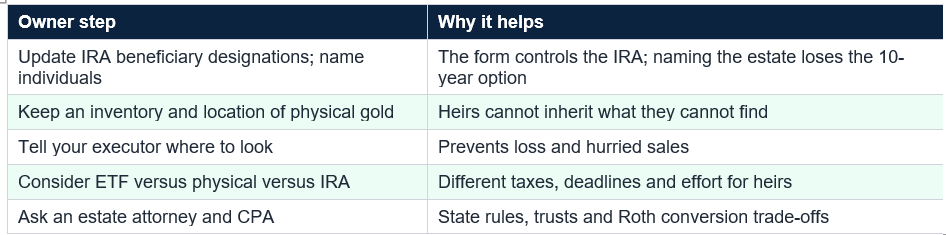
A few steps make life far easier for your heirs. Update beneficiary designations on any gold IRA, naming individuals, since an estate loses the individual 10-year rule. Keep an inventory of physical gold, what it is, where it is, who has access and any receipts, and tell your executor where to look. Consider whether a trust suits you, and talk to an estate attorney about probate in your state.Think about the wrapper too. For heirs, a gold ETF in a taxable account is easier to transfer and still gets a step-up, while a traditional gold IRA carries income tax and a deadline. Some owners convert part of a traditional gold IRA to a Roth, paying tax now so heirs inherit tax-free, a strategy mentioned by one source and not suitable for everyone. Compare it with a professional, and do not let a salesperson’s urgency drive an estate plan.
What Heirs Should Do First
If you have inherited gold, do not rush. For a gold IRA, notify the custodian with a death certificate, confirm the beneficiary designation and find out the owner’s distribution status, which decides whether you owe annual distributions. Decide between cash and metal in-kind, either taxable as ordinary income on a traditional account, mark the 10-year deadline in your calendar and consider spreading withdrawals. Do not roll a non-spouse inheritance into your own IRA, which one source says is not allowed.For bullion or ETF shares, get a date-of-death valuation, which sets your new basis, and keep it with your records. Secure and insure any physical gold, and compare dealer quotes before selling, since the spread can cost more than the tax. If the estate is large, ask whether a federal return is needed, and be wary of strangers offering to buy the gold quickly. A calm, documented process nearly always beats a fast sale. Common mistakes include forgetting to update the beneficiary form, naming the estate on an IRA, leaving physical gold with no inventory, assuming a gold IRA gets a step-up, missing distribution deadlines, selling at a poor dealer price in a hurry, ignoring state estate taxes and treating all gold the same. The wrapper decides most of the outcome, so know which one you have before you decide anything.
Conclusion
Gold is not one thing when it comes to inheritance. Physical bullion and gold ETFs in a taxable account generally get a step-up in basis, so heirs who sell soon owe little or no tax, though later gains are taxed at up to 28% as collectibles, and the practical burden is far heavier for physical gold. A traditional gold IRA gets no step-up, taxes every distribution as ordinary income and, for most non-spouse heirs, starts a 10-year clock.In my example, $100,000 of gold with a $40,000 cost leaves an heir about $100,000 as stepped-up bullion or an ETF, about $76,000 to $65,000 from a traditional gold IRA depending on bracket and timing, and $100,000 from a Roth gold IRA. Most estates owe no federal estate tax, with a $15 million exemption per person in 2026. The best preparation is cheap: current beneficiary forms, a clear inventory and a conversation with an estate attorney and CPA.
Frequently Asked Questions
Do heirs get a step-up in basis on gold?On physical gold and on gold ETFs held in a regular taxable account, generally yes: inherited assets typically get a basis equal to their fair market value on the date of death, which can erase most of the taxable gain. A traditional gold IRA does not get a step-up, because the distributions are taxed as ordinary income. This is general information, not tax advice, and the rules have exceptions.
How is inherited gold taxed when the heir sells it?
Gains above the stepped-up value are generally taxed as a collectible, at a maximum federal long-term rate of 28%, whether the gold is physical or held through a grantor-trust ETF such as GLD, IAU or SLV, according to the sources I found. Gold mining stocks and futures-based ETFs are not collectibles. Selling right after inheriting usually produces little or no gain.
What is the 10-year rule for an inherited gold IRA?
Most non-spouse beneficiaries must empty the inherited IRA by the end of the tenth year after the owner’s death. If the owner had already begun required minimum distributions, final regulations from July 2024 require annual distributions in years 1 through 9 as well. Spouses, minor children, disabled or chronically ill beneficiaries and those not more than 10 years younger have different, more flexible rules.
Does a gold IRA go through the will?
No, an IRA passes by its beneficiary designation, not by the will. If no beneficiary is named, or the estate is named, the IRA passes through the estate and the individual 10-year rule does not apply, according to the sources. That makes keeping beneficiary forms current one of the most important and cheapest steps.
Is there federal estate tax on gold?
Only if the total estate is large. The federal exemption is $15 million per person in 2026, about $30 million for a married couple, indexed for inflation, under the 2025 law. Some states have their own estate taxes with lower thresholds, with one source counting 12 states and the District of Columbia. The estate, not the heir, pays any federal estate tax.
0 Comments
Be the first to share your thoughts on this article.