

Investing
AI ETF Down a Third: Should 20-Somethings Hold CHAT Forever?

CHAT, actively managed since May 2023, holds 36 stocks, has lost more than one-third of its value since June and is up 160% since inception versus 75% for the S&P 500; expense ratio 0.75%. In July the same publisher showed CHAT at $93.49, about 20% below its peak, up 220% since inception, with 52 holdings. The structure: top holdings include Nvidia (about 7%), Alphabet, SK hynix, Microsoft and ASML; about 39% in foreign issues and 92% turnover (older AAII data); the 0.75% fee is $75 per $10,000, versus about $18 for QQQ (0.18%) and $3 for a 0.03% S&P 500 fund. My arithmetic: the published returns imply a price near $76 (about 35% below an implied peak near $117) and about 31% a year for CHAT versus 17% for the S&P 500 over 3.5 years; a 35% loss needs a 53.8% gain to recover; on $500 a month at 7% for 40 years, the 0.75% fee costs about $246,000, versus about $11,000 at 0.03%.
There is real logic in that: younger investors have decades to recover from drops, and AI may be a major force in coming decades. But “hold it forever” is a strong claim for a fund with a three-and-a-half-year record, active management and a 0.75% fee. This guide takes the idea seriously, then tests it with the numbers: what CHAT is, how it has performed, why AI stocks fell, what the fee costs and what a crash does to the math.
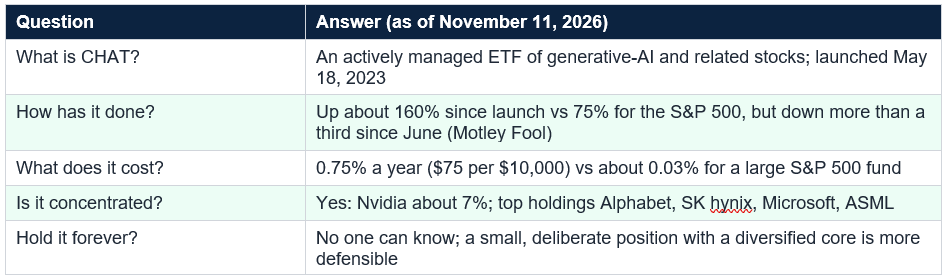
Details vary by source and date. The Fool says CHAT holds 36 stocks now but listed 52 in July and 43 in May; ETF Database showed 37, AAII 54, and Robinhood says the fund holds 25 to 50 companies. AAII’s older snapshot reported about 39% in foreign issues, which fits SK hynix and ASML, and 92% turnover, meaning heavy trading. I did not retrieve the current holdings list, so check Roundhill’s website before relying on any of these figures.
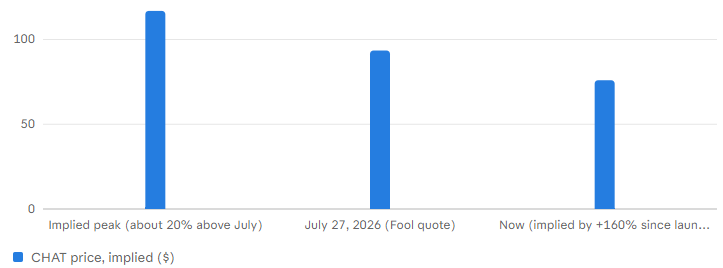
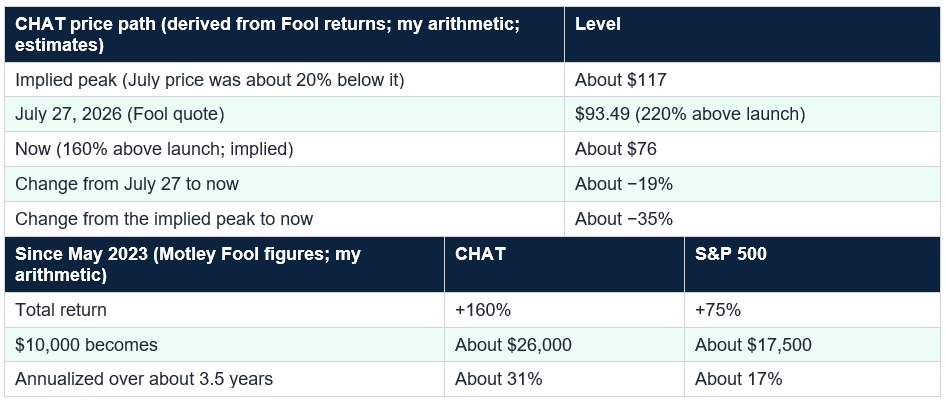
The ride has been rough. In July the Fool showed CHAT at $93.49, about 20% below its recent peak, with a 220% gain since inception. The fund’s 160% gain now implies, in my arithmetic, a price of about $76, roughly 19% below July’s level and about 35% below an implied peak near $117, matching the Fool’s “more than one-third.” These prices are derived from published returns, so treat them as estimates. Someone who bought in July is down about 19%, someone who bought at the peak about 35%: timing has mattered enormously.
CHAT (Fool, Nov 11, 2026): 36 holdings; down more than one-third since June; up 160% since May 2023 vs 75% for the S&P 500; expense ratio 0.75%. July (Fool): $93.49, up 220% since inception, 52 holdings. My arithmetic: implied price about $76, about 35% below an implied peak near $117; about 31% a year vs 17% for the index.
Rates matter too. The 10-year Treasury yield returned to about 5% on November 10 and markets expect the Fed to raise rates again in December. When safe yields rise, expensive growth stocks can suffer, and the Shiller CAPE was above 41 in early October. None of this says the AI theme is broken; it says the theme is sensitive to rates, spending expectations and sentiment, and if you hold CHAT you hold all of those sensitivities at once.
The case for holding is simple: in your 20s you may not need the money for 40 years, and a decline that looks painful today may be a blip then. Investing regularly through ups and downs has historically worked for broad market funds, and if AI does reshape the economy, a fund of AI leaders could benefit. Those are reasonable arguments, and they are why the Fool author is bullish.
But “forever” has problems. CHAT has existed for 3.5 years, so there is no evidence of how it behaves through a full cycle. It is a thematic fund, and themes can fade or be replaced; it is actively managed, so results depend on a team that can change; and the fund itself could close or change strategy, which happens to many specialized ETFs (general knowledge). A reasonable plan is to review a thematic position regularly rather than promise never to sell.
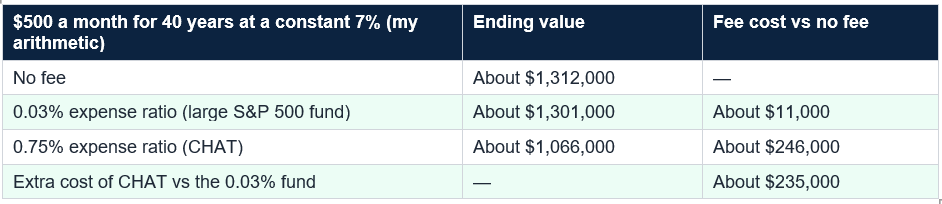
In my illustration, $500 a month for 40 years at a constant 7% grows to about $1.31 million before fees. After CHAT’s 0.75% fee it would be about $1.07 million, a cost of about $246,000, while a 0.03% fund would cost about $11,000 and leave about $1.30 million. That $235,000 gap is what you pay for active AI management; it could be worth it if CHAT beats the index by more than about 0.72 percentage points a year, but that is a bet, and most active funds trail their benchmarks over decades (general knowledge).
Position size controls how much a crash can hurt. In my illustration, a 10% position in a $50,000 portfolio is $5,000, and a 35% fall costs $1,750, or 3.5% of the portfolio; a 25% position ($12,500) would lose $4,375, or 8.75%. Neither is catastrophic for a young investor with steady income, but the second is much harder to watch. Choose a size you could leave alone, because the plan only works if you do.
A crash does not make a fund cheap, and past returns do not predict future ones. CHAT is concentrated, actively managed and volatile, and a loss of a third or more can happen again. Never invest money you may need in the next several years.
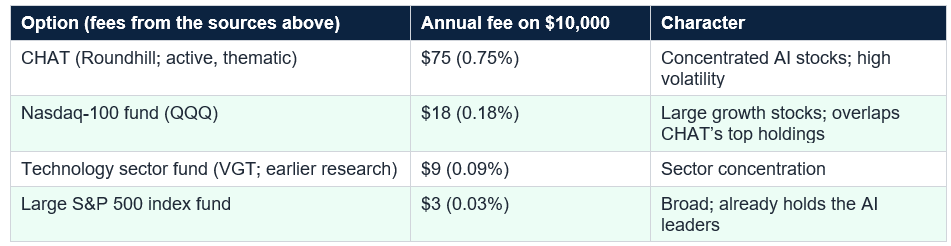
If the goal is to own the AI boom without paying for it twice, there are alternatives. A broad S&P 500 index fund already holds Nvidia, Alphabet, Microsoft, Amazon and Meta among its largest positions (general knowledge), so it carries a great deal of AI exposure at about 0.03%. The Nasdaq-100 fund QQQ charges 0.18% and includes several of CHAT’s top holdings, per the Fool, and Vanguard’s technology fund VGT charges 0.09% (earlier research), though it too is concentrated.
That overlap is the heart of the question. If you already own an S&P 500 fund, a target-date fund or a growth fund, you probably own much of the same stocks, and adding CHAT concentrates your bets rather than diversifying them. It may still be a valid choice if you want an AI tilt and accept the fee, but check what you already own first.
Finally, review it once or twice a year rather than every day: is the fund still what you bought, do the fee and performance justify it and has your allocation drifted? If CHAT has doubled while your core fund has not, it may be a larger share of your portfolio than you intended, and rebalancing may make sense. “Hold it forever” is a nice slogan, but a better plan is to hold it as long as it fits your goals and to check that it still does.
Look at your 401(k) and brokerage holdings and add up how much you already have in Nvidia, Alphabet, Microsoft, Amazon and Meta through index and growth funds. Decide on any AI tilt with that number in hand.
Common mistakes include assuming a crash means a bargain, treating a 3.5-year record as proof, ignoring fees and overlap with index funds, investing money you may need soon, buying all at once and selling in a panic. Another is confusing a theme with a plan: AI may be important, and a portfolio can still be badly built around it.
Whether a 20-something should buy it and hold it forever is a personal question, and “forever” is more than anyone can promise. A reasonable approach is a broad index fund as the core, a small, deliberate AI position sized to survive a 35% drop, gradual buying, regular reviews and no money you may need soon. The crash is a reason to look closely, not a reason to buy.
CHAT is an actively managed exchange-traded fund that launched on May 18, 2023 and invests in companies involved in generative artificial intelligence and related technologies, according to Roundhill. It charges a 0.75% expense ratio. Its holdings include Nvidia, Alphabet, SK hynix, Microsoft and ASML among the largest, according to Roundhill’s page as of September 30, 2026. The number of holdings varies by source and date, from 36 to 54.
How much has CHAT fallen, and how has it done overall?
A Motley Fool article published November 11 says CHAT has lost more than one-third of its value since June but is still up 160% since inception, against 75% for the S&P 500 over the same period. In my arithmetic, that is about 31% a year for CHAT versus 17% for the S&P 500 over 3.5 years, a short window that includes the AI boom. In July, the same publisher put the gain since inception at 220%.
Is it wise to hold a thematic AI ETF forever?
It depends on your goals and temperament, and “forever” is a long time for a fund with a three-and-a-half-year record. Younger investors have time to recover from drops, but a fund can change, close or lag, and an actively managed fund with a 0.75% fee costs far more than an index fund over decades. In my illustration, the fee difference on $500 a month over 40 years is about $235,000. This is general education, not personal advice.
Should I buy after a crash?
A fall does not make a fund cheap. Lower prices can be an opportunity, but they can also reflect real changes: higher interest rates, doubts about AI spending and local opposition to data centers, according to Invesco. A 35% decline needs a gain of about 54% to recover. If you invest, doing so gradually and in an amount you could hold through further declines is safer than guessing a bottom.
How much of my portfolio should be in an AI ETF?
There is no formula, and I cannot tell you. The article that inspired this guide describes adding it to a diversified portfolio, and an earlier Fool piece suggested a small position because of the fee and risk. In my illustration, a 10% position in a $50,000 portfolio that falls 35% costs $1,750, or 3.5% of the portfolio, while a 25% position would cost $4,375, or 8.75%. Your own tolerance and timeline should decide.
Table of Contents
- The Claim
- The Short Answer
- What CHAT Is
- The Numbers: Boom, Bust and Both
- Why AI Stocks Fell
- What “Hold It Forever” Really Means
- The Cost of the Fee
- The Math of a Crash
- Cheaper and Broader Alternatives
- How a 20-Something Might Use It
- Questions to Ask First
- Common Mistakes
- Conclusion
- Frequently Asked Questions
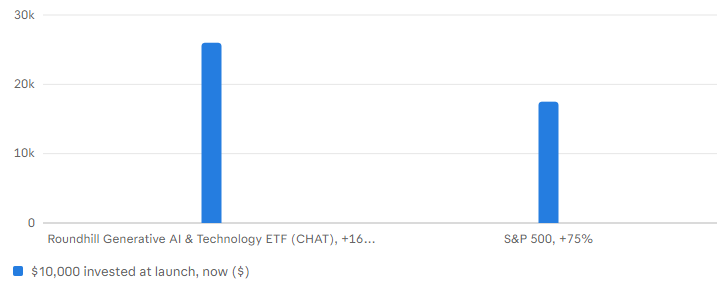
The claim: $10,000 invested in May 2023, CHAT vs. the S&P 500 ($)
Value of $10,000 ($), November 11, 2026 (returns since CHAT's May 2023 launch); author's arithmetic on the totals; about 31% vs 17% a year over roughly 3.5 years; a short window that includes the AI boom; past performance does not predict the future
The crash, estimated: CHAT's implied price path, peak to July to now ($)
Share price ($) by Author's estimates: July 27 price $93.49 (Motley Fool) was about 20% below the peak; +220% since launch then and +160% now imply about $76 (about -19% vs July, about -35% vs the implied peak); I did not retrieve a current quote
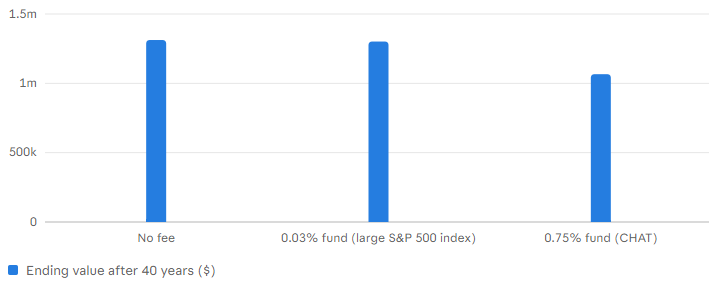
What the fee costs: $500 a month for 40 years at a constant 7% before fees ($)
Ending value ($) by Author's hypothetical arithmetic, monthly compounding: the 0.75% fee costs about $246,000 versus about $11,000 for 0.03%, a gap of about $235,000; real returns vary, and CHAT may or may not beat the index by enough to justify the fee
The Claim
It is a seductive headline: an AI fund that has crashed and a writer who says that in their 20s they would buy it and never sell. A Motley Fool article published November 11 argues that adding AI stocks to a diversified portfolio can supercharge long-term returns, and that the Roundhill Generative AI & Technology ETF (CHAT) is a way to do it. The fund holds 36 AI-related stocks, the article says, has lost more than one-third of its value since June but is still up 160% since its May 2023 launch, more than double the S&P 500’s 75% over the same period.There is real logic in that: younger investors have decades to recover from drops, and AI may be a major force in coming decades. But “hold it forever” is a strong claim for a fund with a three-and-a-half-year record, active management and a 0.75% fee. This guide takes the idea seriously, then tests it with the numbers: what CHAT is, how it has performed, why AI stocks fell, what the fee costs and what a crash does to the math.
The Short Answer
CHAT has rewarded investors handsomely since 2023 but is volatile, concentrated and expensive, and “forever” overstates what anyone can know. The fund is up about 160% since launch against 75% for the S&P 500, per the Fool, but has fallen more than a third since June. At 0.75%, its fee is 25 times that of a 0.03% S&P 500 fund, which in my illustration costs about $235,000 more over 40 years of $500 monthly contributions. A small, deliberate position within a diversified portfolio is more defensible than an all-in bet, and no one should commit money they cannot leave alone through a 35% drop.
What CHAT Is
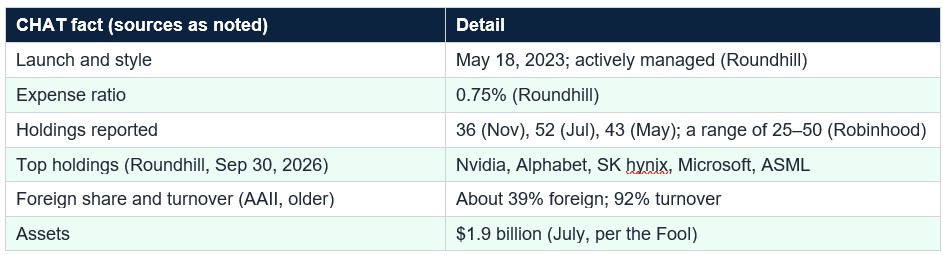
CHAT, from Roundhill Investments, began trading on May 18, 2023 and describes itself as the world’s first generative AI ETF. It is actively managed: a team chooses and trades the stocks instead of tracking an index, which the Fool notes is why the fee is higher. Roundhill’s page lists Nvidia, Alphabet, SK hynix, Microsoft and ASML as its top five holdings as of September 30, 2026; earlier snapshots show Nvidia near 7%, Alphabet 5% to 7% and AMD, Micron and Samsung among the largest, so it is a bet on both AI chip makers and big platform companies.Details vary by source and date. The Fool says CHAT holds 36 stocks now but listed 52 in July and 43 in May; ETF Database showed 37, AAII 54, and Robinhood says the fund holds 25 to 50 companies. AAII’s older snapshot reported about 39% in foreign issues, which fits SK hynix and ASML, and 92% turnover, meaning heavy trading. I did not retrieve the current holdings list, so check Roundhill’s website before relying on any of these figures.
The Numbers: Boom, Bust and Both
The headline return is striking. If the Fool’s figures are right, $10,000 invested at launch would be about $26,000 now against $17,500 for the S&P 500, in my arithmetic, or about 31% a year for CHAT versus about 17% for the index over roughly 3.5 years. But the window is short, it starts as the AI boom took off and it includes a large run followed by a sharp fall. Returns this high are unusual and do not tell you what the next 3.5 years will bring.The ride has been rough. In July the Fool showed CHAT at $93.49, about 20% below its recent peak, with a 220% gain since inception. The fund’s 160% gain now implies, in my arithmetic, a price of about $76, roughly 19% below July’s level and about 35% below an implied peak near $117, matching the Fool’s “more than one-third.” These prices are derived from published returns, so treat them as estimates. Someone who bought in July is down about 19%, someone who bought at the peak about 35%: timing has mattered enormously.
CHAT (Fool, Nov 11, 2026): 36 holdings; down more than one-third since June; up 160% since May 2023 vs 75% for the S&P 500; expense ratio 0.75%. July (Fool): $93.49, up 220% since inception, 52 holdings. My arithmetic: implied price about $76, about 35% below an implied peak near $117; about 31% a year vs 17% for the index.
Why AI Stocks Fell
The crash did not happen in a vacuum. Invesco’s Brian Levitt wrote on November 6 that rising interest rates, aggressive capital spending and local opposition to data-center expansion accelerated a reset in AI-related stocks, though he expects long-term demand for computing to remain intact. Many of CHAT’s biggest holdings were hit: Nvidia was down about 26% over the month to November 9 amid a board investigation of its CEO, Micron was about 40% below its June 25 record close of $1,213.56 (the Fool), and Alphabet fell after reporting $51.4 billion of quarterly capital spending and negative free cash flow.Rates matter too. The 10-year Treasury yield returned to about 5% on November 10 and markets expect the Fed to raise rates again in December. When safe yields rise, expensive growth stocks can suffer, and the Shiller CAPE was above 41 in early October. None of this says the AI theme is broken; it says the theme is sensitive to rates, spending expectations and sentiment, and if you hold CHAT you hold all of those sensitivities at once.
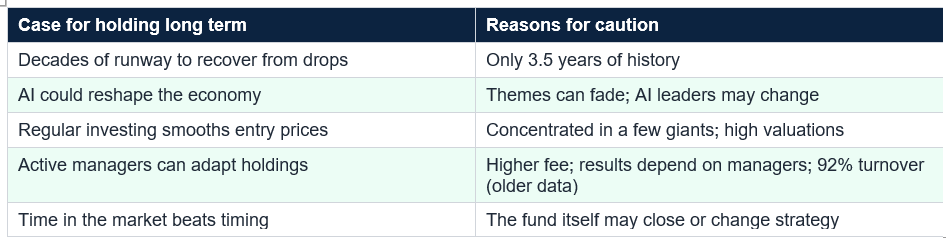
The case for holding is simple: in your 20s you may not need the money for 40 years, and a decline that looks painful today may be a blip then. Investing regularly through ups and downs has historically worked for broad market funds, and if AI does reshape the economy, a fund of AI leaders could benefit. Those are reasonable arguments, and they are why the Fool author is bullish.
But “forever” has problems. CHAT has existed for 3.5 years, so there is no evidence of how it behaves through a full cycle. It is a thematic fund, and themes can fade or be replaced; it is actively managed, so results depend on a team that can change; and the fund itself could close or change strategy, which happens to many specialized ETFs (general knowledge). A reasonable plan is to review a thematic position regularly rather than promise never to sell.
The Cost of the Fee
The fee is the most certain number in this story. CHAT charges 0.75% a year, or $75 on $10,000, according to Roundhill, versus about $18 for QQQ (0.18%) and $3 for a 0.03% S&P 500 fund. The Fool’s July article made the same point and suggested a small position because of it, and AAII lists the category average at 0.55%. A fee that looks small each year compounds into a large sum over decades.In my illustration, $500 a month for 40 years at a constant 7% grows to about $1.31 million before fees. After CHAT’s 0.75% fee it would be about $1.07 million, a cost of about $246,000, while a 0.03% fund would cost about $11,000 and leave about $1.30 million. That $235,000 gap is what you pay for active AI management; it could be worth it if CHAT beats the index by more than about 0.72 percentage points a year, but that is a bet, and most active funds trail their benchmarks over decades (general knowledge).
The Math of a Crash
Losses and gains are not symmetrical: a fund that falls 35% needs about a 53.8% gain to get back to even, and a 50% fall needs 100%. For a 25-year-old that is survivable, but the real risk is behavioral: will you keep buying, or sell near the bottom? The average investor has historically earned less than the market partly because of badly timed trades, per DALBAR figures from earlier research in this series (about 6.8% a year against 10.2% over 30 years).Position size controls how much a crash can hurt. In my illustration, a 10% position in a $50,000 portfolio is $5,000, and a 35% fall costs $1,750, or 3.5% of the portfolio; a 25% position ($12,500) would lose $4,375, or 8.75%. Neither is catastrophic for a young investor with steady income, but the second is much harder to watch. Choose a size you could leave alone, because the plan only works if you do.
A crash does not make a fund cheap, and past returns do not predict future ones. CHAT is concentrated, actively managed and volatile, and a loss of a third or more can happen again. Never invest money you may need in the next several years.
If the goal is to own the AI boom without paying for it twice, there are alternatives. A broad S&P 500 index fund already holds Nvidia, Alphabet, Microsoft, Amazon and Meta among its largest positions (general knowledge), so it carries a great deal of AI exposure at about 0.03%. The Nasdaq-100 fund QQQ charges 0.18% and includes several of CHAT’s top holdings, per the Fool, and Vanguard’s technology fund VGT charges 0.09% (earlier research), though it too is concentrated.
That overlap is the heart of the question. If you already own an S&P 500 fund, a target-date fund or a growth fund, you probably own much of the same stocks, and adding CHAT concentrates your bets rather than diversifying them. It may still be a valid choice if you want an AI tilt and accept the fee, but check what you already own first.
How a 20-Something Might Use It
If you are in your 20s and want an AI tilt, a simple framework may help, though it is not advice. First, build the basics: an emergency fund, no high-interest debt and the employer 401(k) match. Second, keep a broad, low-cost index fund as the core. Third, if you want CHAT or a similar fund, treat it as a satellite of a size you could see fall by half without changing your plan, and buy gradually. Fourth, consider a tax-advantaged account, since an actively traded fund can produce taxable distributions (general knowledge).Finally, review it once or twice a year rather than every day: is the fund still what you bought, do the fee and performance justify it and has your allocation drifted? If CHAT has doubled while your core fund has not, it may be a larger share of your portfolio than you intended, and rebalancing may make sense. “Hold it forever” is a nice slogan, but a better plan is to hold it as long as it fits your goals and to check that it still does.
Look at your 401(k) and brokerage holdings and add up how much you already have in Nvidia, Alphabet, Microsoft, Amazon and Meta through index and growth funds. Decide on any AI tilt with that number in hand.
Questions to Ask First
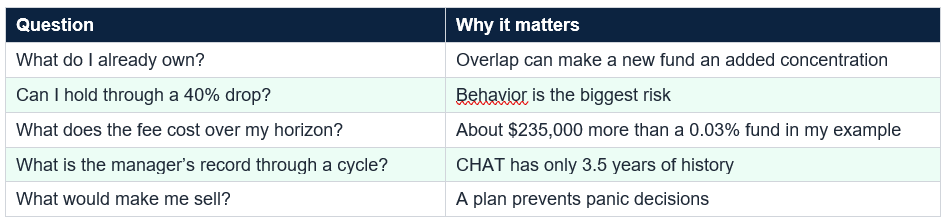
Before buying, ask: what do I already own, and how much of it is AI? Can I leave this money alone for ten years, including through a 40% drop? What does the 0.75% fee cost me against an index fund? What is the manager’s record through a full cycle, which CHAT does not yet have? And what would make me sell? Writing the answers down in advance helps when the headlines are scary.Common mistakes include assuming a crash means a bargain, treating a 3.5-year record as proof, ignoring fees and overlap with index funds, investing money you may need soon, buying all at once and selling in a panic. Another is confusing a theme with a plan: AI may be important, and a portfolio can still be badly built around it.
Conclusion
The Roundhill Generative AI & Technology ETF has been a spectacular performer since 2023, up about 160% against 75% for the S&P 500 per the Motley Fool, and it has also lost more than a third of its value since June, an implied price of about $76 against a peak near $117. It is actively managed, concentrated in names such as Nvidia, Alphabet, SK hynix, Microsoft and ASML, and charges 0.75%, which in my illustration costs about $235,000 more than a 0.03% fund over 40 years of $500 monthly contributions.Whether a 20-something should buy it and hold it forever is a personal question, and “forever” is more than anyone can promise. A reasonable approach is a broad index fund as the core, a small, deliberate AI position sized to survive a 35% drop, gradual buying, regular reviews and no money you may need soon. The crash is a reason to look closely, not a reason to buy.
Frequently Asked Questions
What is the Roundhill Generative AI & Technology ETF (CHAT)?CHAT is an actively managed exchange-traded fund that launched on May 18, 2023 and invests in companies involved in generative artificial intelligence and related technologies, according to Roundhill. It charges a 0.75% expense ratio. Its holdings include Nvidia, Alphabet, SK hynix, Microsoft and ASML among the largest, according to Roundhill’s page as of September 30, 2026. The number of holdings varies by source and date, from 36 to 54.
How much has CHAT fallen, and how has it done overall?
A Motley Fool article published November 11 says CHAT has lost more than one-third of its value since June but is still up 160% since inception, against 75% for the S&P 500 over the same period. In my arithmetic, that is about 31% a year for CHAT versus 17% for the S&P 500 over 3.5 years, a short window that includes the AI boom. In July, the same publisher put the gain since inception at 220%.
Is it wise to hold a thematic AI ETF forever?
It depends on your goals and temperament, and “forever” is a long time for a fund with a three-and-a-half-year record. Younger investors have time to recover from drops, but a fund can change, close or lag, and an actively managed fund with a 0.75% fee costs far more than an index fund over decades. In my illustration, the fee difference on $500 a month over 40 years is about $235,000. This is general education, not personal advice.
Should I buy after a crash?
A fall does not make a fund cheap. Lower prices can be an opportunity, but they can also reflect real changes: higher interest rates, doubts about AI spending and local opposition to data centers, according to Invesco. A 35% decline needs a gain of about 54% to recover. If you invest, doing so gradually and in an amount you could hold through further declines is safer than guessing a bottom.
How much of my portfolio should be in an AI ETF?
There is no formula, and I cannot tell you. The article that inspired this guide describes adding it to a diversified portfolio, and an earlier Fool piece suggested a small position because of the fee and risk. In my illustration, a 10% position in a $50,000 portfolio that falls 35% costs $1,750, or 3.5% of the portfolio, while a 25% position would cost $4,375, or 8.75%. Your own tolerance and timeline should decide.
0 Comments
Be the first to share your thoughts on this article.