
Investing
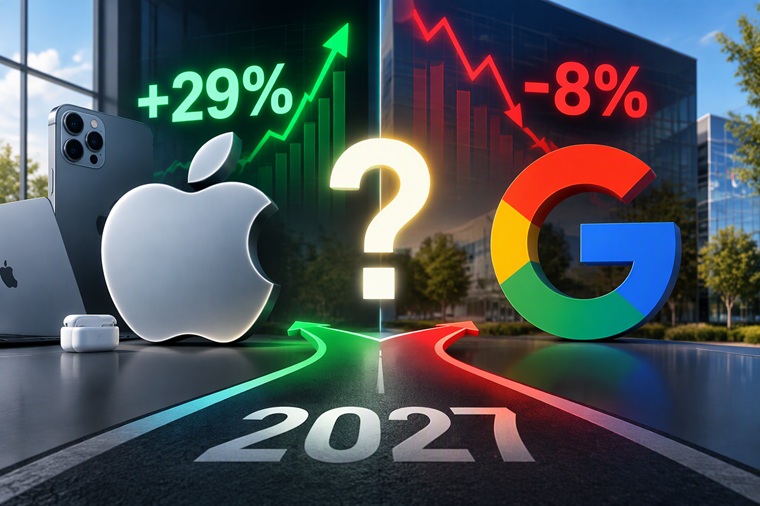
Apple +29%, Alphabet -8%: Which Is the Better Buy for 2027?!

Apple revenue $114.5 billion (+12%); iPhone $57.6 billion (+17%); fiscal 2026 revenue $478.8 billion (+15%) and EPS $8.98 (+20%); December-quarter gross margin guided to 45%–46% on memory costs; $355.36 on November 11, at its 52-week high; market cap $5.17 trillion; about 38 times fiscal 2027 consensus EPS of about $9.40 (+5%). Alphabet (Q3 2026, filings): revenue $127.6 billion (+25%); Google Cloud $30.7 billion (+103%) with a 36.2% margin and a $561 billion backlog; capex $51.4 billion and free cash flow −$9.1 billion; 2026 capex guided to $195–$205 billion; fell more than 10% after the report; $293.45 on November 11, 28% below its 52-week high; market cap $3.59 trillion. My arithmetic: Alphabet at about 24 times 2026 and 19 times 2027 consensus adjusted EPS (early-October estimates) versus a GAAP trailing P/E near 15 distorted by investment gains; Apple at 1.9 times the S&P 500’s 19.8 forward multiple; Apple sits at the 99.5th percentile of its 52-week range and Alphabet at the 16.5th; Alphabet trades 16.6% below the $351.81 Berkshire paid.
The argument is simple: Apple’s new products and new chief executive could keep the momentum going and it is less exposed to an AI spending slowdown, while Alphabet is cheaper but spending heavily. This guide tests each part with the companies’ own results and the valuation math. It does not recommend either stock; the goal is to show what the numbers say and leave out.
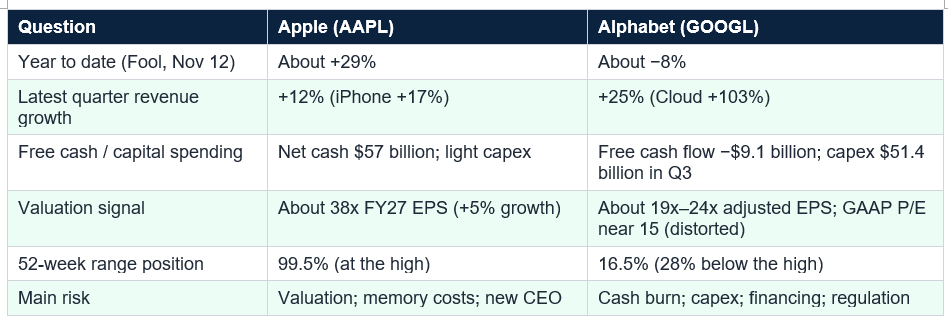
The flip also reflects starting points: Alphabet rose about 66% in 2025 while Apple lagged. CNBC noted on October 28 that Apple was up about 27% to 28% for the year and Alphabet 2.2%; Alphabet then fell more than 10% on its earnings report, which puts it near an 8% loss in my arithmetic. So part of this is the market rewarding a safe-haven narrative and part is a post-earnings reset.
The warning was in the guidance. Gross margin was 47.9%, including about one point from tariff refunds, so about 46.9% underlying. For the December quarter Apple guided gross margin to 45% to 46%, mainly on higher memory costs, which Ternus called unprecedented, plus costs of rolling out its new Siri AI assistant, with revenue growth of 7% to 10%. In my arithmetic a margin drop of about 1.4 points on this quarter’s revenue is about $1.6 billion of gross profit. The stock fell about 2% after the report, then recovered to a record, closing at $355.36 on November 11.
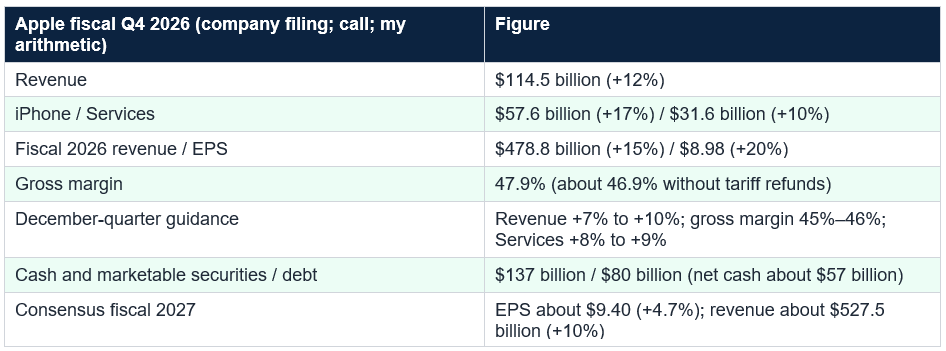
Apple: fiscal Q4 revenue $114.5B (+12%), iPhone $57.6B (+17%), fiscal 2026 EPS $8.98 (+20%); December-quarter gross margin guided 45%–46%; $355.36 (Nov 11), at its 52-week high; about 38x FY27 EPS growing about 5%. Alphabet: Q3 revenue $127.6B (+25%), Cloud $30.7B (+103%), capex $51.4B, free cash flow −$9.1B; 2026 capex $195B–$205B; $293.45 (Nov 11), 28% below its 52-week high.
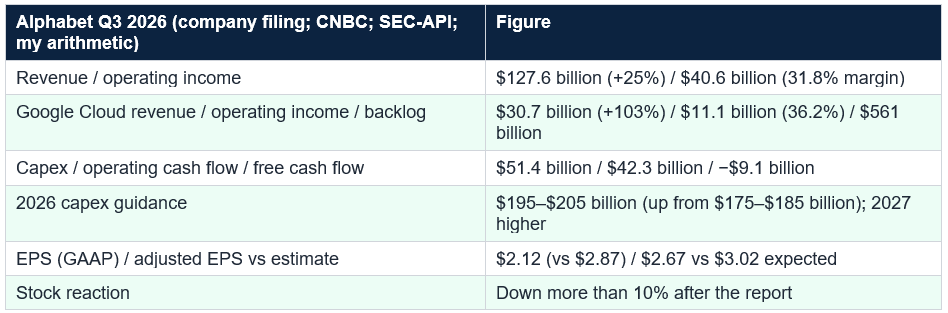
The problem is cash. Capital spending was $51.4 billion in the quarter, about 40% of revenue, so with operating cash flow of $42.3 billion free cash flow was negative $9.1 billion, against about $2.7 billion positive expected. Alphabet kept its 2026 capex guidance at $195 billion to $205 billion, up from $175 billion to $185 billion in February, and said 2027 would rise significantly. It is also raising capital: a $40 billion at-the-market stock program ($12.4 billion sold in Q3), $28.7 billion of net note issuance and a $10 billion Berkshire Hathaway placement at $351.81 a share, about 20% above the $293.45 close (the stock is 16.6% below that price).
Earnings are noisy. GAAP EPS of $2.12 was down from $2.87 a year earlier after an $8.7 billion loss on equity securities, following a $98 billion gain in Q2 and a $37.7 billion gain in Q1. CNBC reported adjusted EPS of $2.67 against $3.02 expected, while another source compared GAAP $2.12 with a $3.01 consensus, a different basis. Either way Alphabet missed on earnings and slightly on revenue, the stock fell more than 10% and Citizens downgraded it: a business doubling in cloud can still disappoint if the cost of growth rises faster.
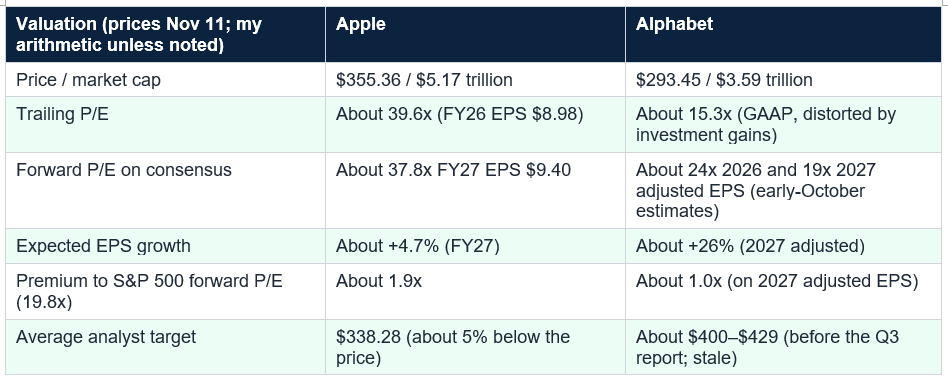
Those low figures are distorted by unrealized gains on Alphabet’s investments in private companies, which swung from a $98 billion gain in one quarter to an $8.7 billion loss in the next (one analysis ties the Q3 loss to SpaceX). A fairer comparison uses adjusted earnings. Using early-October consensus adjusted EPS of about $12.11 for 2026 and $15.21 for 2027, which predate the Q3 miss and may have changed, Alphabet trades at about 24 times 2026 and 19 times 2027 at $293.45: about half Apple’s 2027 multiple, but not the 13 to 15 times that headline ratios imply.
Growth matters too. Apple’s consensus EPS is expected to rise only about 4.7% in fiscal 2027, a crude price-to-growth ratio near 8 at a multiple of 38, while Alphabet’s adjusted EPS is expected to grow about 26% in 2027, a ratio near 0.75 (my arithmetic; estimates change). The market pays more for Apple for stability and cash, not growth. The question is whether Apple can grow into its multiple: at 10% annual EPS growth and a flat price, it would take about four years to reach 25 times.
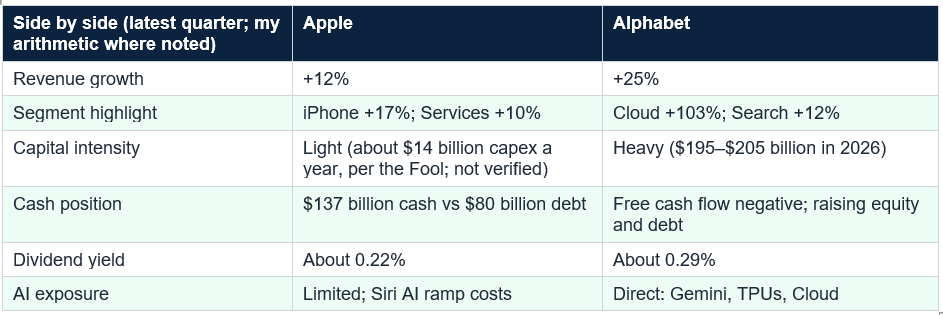
Neither profile wins in every environment. When the market punishes AI spending, Apple’s light-capex model looks smart; when it rewards AI growth, Alphabet’s Cloud acceleration, backlog and Gemini adoption look more valuable, which is why leadership has swung and could reverse again. Another Fool writer notes the same risk for Apple: if the market turns bullish on AI again, Apple could lag.
At about 19 times 2027 adjusted earnings, Alphabet’s stock assumes that Cloud growth and the $561 billion backlog convert to profit, that capital spending eventually peaks and that free cash flow turns positive. If AI demand holds that looks reasonable, and the price is 28% below the 52-week high; if spending keeps rising faster than revenue or demand disappoints, it could fall further. An illustration: with half your money in each, a 20% drop in both loses $2,000 on $10,000, while a 30% fall in one offset by a 30% rise in the other leaves you even.
Alphabet’s risks are about money and policy. Negative free cash flow and rising capex make it depend on capital markets and continued AI demand, and its earnings swing with investment marks. Regulation is another unknown: the Fool argues that Democrats, after the election, may favor a slower pace of data-center construction and more AI regulation, which could weigh on Alphabet more than on Apple. That is a prediction about politics, which I cannot evaluate and take no side on, and policy could cut either way. Antitrust cases and AI search competition are other risks.
Neither stock is a sure thing. Apple is priced for stability at an all-time-high multiple; Alphabet is priced for a payoff from heavy spending that has not yet appeared in free cash flow. Prices, estimates and year-to-date figures change daily and differ by source.
Some investors hold both, which can offset some risk: when AI sentiment is poor Apple may hold up, and when it is strong Alphabet may lead. Others wait for a better entry on Apple or for evidence that Alphabet’s free cash flow is turning. The Fool author sees Apple winning in 2027, while the numbers could also support Alphabet; I cannot say which is right. Avoid putting too much into one or two names, check current prices and treat any single article, including this one, as one input.
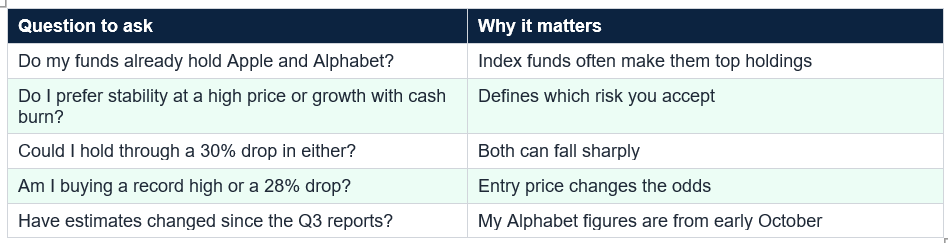
Look up your top holdings across your index funds and retirement accounts and add up your exposure to Apple and Alphabet. Then check current prices and the latest analyst estimates before deciding. Common mistakes include assuming last year’s winner will win again, treating Alphabet’s GAAP P/E as the real multiple, ignoring Apple’s record valuation because the business is strong, extrapolating a year-to-date gain or loss, confusing a great company with a great price and overlooking that index funds already hold both.
So which is the better buy for 2027? The Fool says Apple. Alphabet is cheaper, at roughly 19 to 24 times adjusted earnings in my arithmetic though not as cheap as its headline P/E, with faster growth but a cash-flow question. Each price assumes something different, and the answer depends on your time horizon, risk tolerance and what you already own. Check current data and size any position carefully.
By most tallies, yes. A Motley Fool article published November 12 says Apple is up about 29%, while CNBC’s October 28 tally had it up about 27% to 28%, and other Fool pieces put it at 25% to 29% depending on the date. Apple also closed at $355.36 on November 11, essentially at its 52-week high. The exact figure changes daily, so check a current quote.
Is Alphabet really down 8%, and why?
The Fool says it has declined more than 8% this year. CNBC showed it up 2.2% on October 28, before a drop of more than 10% after its third-quarter report, which fits an eight-ish percent loss for the year. Investors reacted to negative free cash flow of $9.1 billion, a miss on adjusted earnings per share and a signal that 2027 capital spending will rise significantly, even as Google Cloud revenue doubled.
Is Alphabet cheaper than Apple?
On most measures, yes, but less dramatically than headlines suggest. Apple trades at about 38 times fiscal 2027 consensus earnings. Alphabet’s reported trailing P/E is about 15, but that is flattered by large unrealized gains on its investments; on consensus adjusted earnings, my arithmetic gives about 24 times 2026 and 19 times 2027, using estimates from early October that may have changed. Alphabet is cheaper, though not dirt cheap.
What are the main risks for each stock?
For Apple, the risks are a valuation near an all-time high on slowing earnings growth (consensus fiscal 2027 EPS growth of about 5%), rising memory costs that cut gross margin guidance to 45% to 46% and a new CEO. For Alphabet, they are heavy capital spending ($195 billion to $205 billion in 2026), negative free cash flow, equity and debt financing, and the chance that AI demand or regulation changes. This is general education, not personal advice.
Which one is the better buy for 2027?
I cannot say, and this article does not recommend either. The Motley Fool author picks Apple, citing new products and its smaller exposure to an AI spending slowdown; the numbers also support Alphabet’s faster growth and lower multiple. The answer depends on your time horizon, risk tolerance and how much of each you already own through index funds. Many investors hold both.
Table of Contents
- The Claim
- The Short Answer
- Why the Leader and the Laggard Swapped Places
- Apple: A Record Quarter and a Margin Warning
- Alphabet: Booming Business, Cash Burn
- Valuation: What “Cheaper” Really Means
- Side by Side
- What Each Price Implies
- The Risks on Each Side
- How an Investor Might Weigh the Two
- Common Mistakes
- Conclusion
- Frequently Asked Questions
The Claim
It is an unusual turn. In 2025 Alphabet was the best-performing Magnificent Seven stock, returning about 66%, while Apple was second worst, up about 9%, per CNBC. This year the order has flipped: a Motley Fool article published November 12 says Apple has climbed about 29% and Alphabet has fallen more than 8%, making Apple the best performer by far and Alphabet the worst AI stock in the group, and it picks Apple as the better buy for 2027.The argument is simple: Apple’s new products and new chief executive could keep the momentum going and it is less exposed to an AI spending slowdown, while Alphabet is cheaper but spending heavily. This guide tests each part with the companies’ own results and the valuation math. It does not recommend either stock; the goal is to show what the numbers say and leave out.
The Short Answer
Apple has been the better stock this year, and the facts behind it are solid: record September-quarter revenue of $114.5 billion, iPhone up 17% and net cash. But the stock sits at its 52-week high, trades at about 38 times next year’s consensus earnings (expected to grow only about 5%) and has warned that memory costs will cut gross margin. Alphabet has the faster-growing business, with revenue up 25% and Google Cloud up 103%, and a lower multiple, but it is burning cash on $195 billion to $205 billion of capital spending, its reported earnings are inflated by investment gains and its stock fell more than 10% after earnings. Alphabet is cheaper; whether it is better depends on whether the AI spending pays off.
Why the Leader and the Laggard Swapped Places
The reversal is largely about AI spending. As investors worried that giant AI build-outs would not earn adequate returns, they favored companies with less exposure: one Fool piece says Apple is the only top-10 US company without significant AI investments riding on the build-out, and a Zacks note calls its limited AI infrastructure exposure a boon while the AI trade falters. Apple’s iPhone 17 cycle was also strong. Alphabet, by contrast, is investing at a pace that turned free cash flow negative.The flip also reflects starting points: Alphabet rose about 66% in 2025 while Apple lagged. CNBC noted on October 28 that Apple was up about 27% to 28% for the year and Alphabet 2.2%; Alphabet then fell more than 10% on its earnings report, which puts it near an 8% loss in my arithmetic. So part of this is the market rewarding a safe-haven narrative and part is a post-earnings reset.
Apple: A Record Quarter and a Margin Warning
Apple’s fiscal fourth quarter, ended September 26 and reported November 2, was John Ternus’s first as chief executive; he took over from Tim Cook on September 1. Revenue rose 12% to a September-quarter record of $114.5 billion, iPhone revenue rose 17% to $57.6 billion despite supply constraints, Mac rose 24% and Services reached an all-time high of $31.6 billion (+10%). EPS was $2.10 against a $1.99 estimate, and for the fiscal year revenue was $478.8 billion (+15%) and EPS $8.98 (+20%).The warning was in the guidance. Gross margin was 47.9%, including about one point from tariff refunds, so about 46.9% underlying. For the December quarter Apple guided gross margin to 45% to 46%, mainly on higher memory costs, which Ternus called unprecedented, plus costs of rolling out its new Siri AI assistant, with revenue growth of 7% to 10%. In my arithmetic a margin drop of about 1.4 points on this quarter’s revenue is about $1.6 billion of gross profit. The stock fell about 2% after the report, then recovered to a record, closing at $355.36 on November 11.
Apple: fiscal Q4 revenue $114.5B (+12%), iPhone $57.6B (+17%), fiscal 2026 EPS $8.98 (+20%); December-quarter gross margin guided 45%–46%; $355.36 (Nov 11), at its 52-week high; about 38x FY27 EPS growing about 5%. Alphabet: Q3 revenue $127.6B (+25%), Cloud $30.7B (+103%), capex $51.4B, free cash flow −$9.1B; 2026 capex $195B–$205B; $293.45 (Nov 11), 28% below its 52-week high.
Alphabet: Booming Business, Cash Burn
Alphabet’s business is strong by almost any operating measure. Q3 revenue rose 25% to $127.6 billion, the 13th straight quarter of double-digit growth, and operating income rose 30% to $40.6 billion at a 31.8% margin. Search and other grew 12%, with query growth the highest in five years. Google Cloud revenue more than doubled to $30.7 billion (+103%), its operating income more than tripled to $11.1 billion (a 36.2% margin) and its backlog reached $561 billion; the Gemini app reached one billion users.The problem is cash. Capital spending was $51.4 billion in the quarter, about 40% of revenue, so with operating cash flow of $42.3 billion free cash flow was negative $9.1 billion, against about $2.7 billion positive expected. Alphabet kept its 2026 capex guidance at $195 billion to $205 billion, up from $175 billion to $185 billion in February, and said 2027 would rise significantly. It is also raising capital: a $40 billion at-the-market stock program ($12.4 billion sold in Q3), $28.7 billion of net note issuance and a $10 billion Berkshire Hathaway placement at $351.81 a share, about 20% above the $293.45 close (the stock is 16.6% below that price).
Earnings are noisy. GAAP EPS of $2.12 was down from $2.87 a year earlier after an $8.7 billion loss on equity securities, following a $98 billion gain in Q2 and a $37.7 billion gain in Q1. CNBC reported adjusted EPS of $2.67 against $3.02 expected, while another source compared GAAP $2.12 with a $3.01 consensus, a different basis. Either way Alphabet missed on earnings and slightly on revenue, the stock fell more than 10% and Citizens downgraded it: a business doubling in cloud can still disappoint if the cost of growth rises faster.
Valuation: What “Cheaper” Really Means
The Fool says Alphabet is clearly cheaper than Apple, and it is, but the gap depends on which earnings you use. At $355.36 Apple trades at about 39.6 times fiscal 2026 EPS of $8.98 and about 38 times consensus fiscal 2027 EPS of about $9.40, against about 19.8 for the S&P 500, an all-time high for Apple per Bernstein. Sources put Alphabet at 13 to 18.5 times forward earnings and about 15 times trailing GAAP earnings (my arithmetic: $293.45 over about $19.16 of four-quarter GAAP EPS).Those low figures are distorted by unrealized gains on Alphabet’s investments in private companies, which swung from a $98 billion gain in one quarter to an $8.7 billion loss in the next (one analysis ties the Q3 loss to SpaceX). A fairer comparison uses adjusted earnings. Using early-October consensus adjusted EPS of about $12.11 for 2026 and $15.21 for 2027, which predate the Q3 miss and may have changed, Alphabet trades at about 24 times 2026 and 19 times 2027 at $293.45: about half Apple’s 2027 multiple, but not the 13 to 15 times that headline ratios imply.
Growth matters too. Apple’s consensus EPS is expected to rise only about 4.7% in fiscal 2027, a crude price-to-growth ratio near 8 at a multiple of 38, while Alphabet’s adjusted EPS is expected to grow about 26% in 2027, a ratio near 0.75 (my arithmetic; estimates change). The market pays more for Apple for stability and cash, not growth. The question is whether Apple can grow into its multiple: at 10% annual EPS growth and a flat price, it would take about four years to reach 25 times.
Side by Side
The two companies are almost opposites. Apple is a mature, cash-rich hardware and services company growing in the low double digits with modest capital needs. Alphabet is a faster-growing platform reinvesting more than its cash flow into AI infrastructure. Apple pays a 0.22% dividend yield and holds $57 billion of net cash; Alphabet pays 0.29% and is raising money. One is priced as a safe compounder, the other as a high-spending growth bet.Neither profile wins in every environment. When the market punishes AI spending, Apple’s light-capex model looks smart; when it rewards AI growth, Alphabet’s Cloud acceleration, backlog and Gemini adoption look more valuable, which is why leadership has swung and could reverse again. Another Fool writer notes the same risk for Apple: if the market turns bullish on AI again, Apple could lag.
What Each Price Implies
A useful way to think about valuation is what the price assumes. At 38 times 2027 earnings, Apple’s stock assumes steady iPhone and Services growth, a successful foldable iPhone and Siri AI launch, margins that stabilize after the memory squeeze and no major disruption in China or from tariffs. The average analyst target of about $338 is below the price and one firm’s is $295, though Bernstein ($380) and Wedbush ($400) are higher: little margin for error on valuation.At about 19 times 2027 adjusted earnings, Alphabet’s stock assumes that Cloud growth and the $561 billion backlog convert to profit, that capital spending eventually peaks and that free cash flow turns positive. If AI demand holds that looks reasonable, and the price is 28% below the 52-week high; if spending keeps rising faster than revenue or demand disappoints, it could fall further. An illustration: with half your money in each, a 20% drop in both loses $2,000 on $10,000, while a 30% fall in one offset by a 30% rise in the other leaves you even.
The Risks on Each Side
Apple’s risks are mostly about the price paid. At a record multiple on slowing earnings growth, a small disappointment could cut the stock; memory costs are a near-term squeeze that management says may keep rising beyond December; a new CEO adds strategic uncertainty, though early results are strong; the iPhone Duo is supply constrained; and the safe-haven rotation could reverse. One Fool writer argued on November 2 that investors buying at these levels should tread carefully.Alphabet’s risks are about money and policy. Negative free cash flow and rising capex make it depend on capital markets and continued AI demand, and its earnings swing with investment marks. Regulation is another unknown: the Fool argues that Democrats, after the election, may favor a slower pace of data-center construction and more AI regulation, which could weigh on Alphabet more than on Apple. That is a prediction about politics, which I cannot evaluate and take no side on, and policy could cut either way. Antitrust cases and AI search competition are other risks.
Neither stock is a sure thing. Apple is priced for stability at an all-time-high multiple; Alphabet is priced for a payoff from heavy spending that has not yet appeared in free cash flow. Prices, estimates and year-to-date figures change daily and differ by source.
How an Investor Might Weigh the Two
Rather than choosing a winner, consider what you already own. If you hold an S&P 500 or Nasdaq-100 index fund you probably own both stocks, among the largest holdings (general knowledge), so adding either increases your concentration in big tech; a target-date fund likely holds them too. If you want to tilt, decide whether you prefer stability at a high price or growth with cash-flow risk, and size the position so a 30% decline would not harm your plans.Some investors hold both, which can offset some risk: when AI sentiment is poor Apple may hold up, and when it is strong Alphabet may lead. Others wait for a better entry on Apple or for evidence that Alphabet’s free cash flow is turning. The Fool author sees Apple winning in 2027, while the numbers could also support Alphabet; I cannot say which is right. Avoid putting too much into one or two names, check current prices and treat any single article, including this one, as one input.
Look up your top holdings across your index funds and retirement accounts and add up your exposure to Apple and Alphabet. Then check current prices and the latest analyst estimates before deciding. Common mistakes include assuming last year’s winner will win again, treating Alphabet’s GAAP P/E as the real multiple, ignoring Apple’s record valuation because the business is strong, extrapolating a year-to-date gain or loss, confusing a great company with a great price and overlooking that index funds already hold both.
Conclusion
Apple has climbed about 29% this year and Alphabet has fallen about 8%, reversing 2025. Apple’s record $114.5 billion quarter, 17% iPhone growth and net cash support the rally, but at $355.36 it sits at its 52-week high and about 38 times fiscal 2027 consensus earnings expected to grow only about 5%, with memory costs cutting gross margin guidance to 45% to 46%. Alphabet’s business is booming (revenue +25%, Cloud +103%, a $561 billion backlog), but $51.4 billion of quarterly capex made free cash flow negative $9.1 billion, and the stock fell more than 10% after earnings.So which is the better buy for 2027? The Fool says Apple. Alphabet is cheaper, at roughly 19 to 24 times adjusted earnings in my arithmetic though not as cheap as its headline P/E, with faster growth but a cash-flow question. Each price assumes something different, and the answer depends on your time horizon, risk tolerance and what you already own. Check current data and size any position carefully.
Frequently Asked Questions
Is Apple really the best-performing Magnificent Seven stock this year?By most tallies, yes. A Motley Fool article published November 12 says Apple is up about 29%, while CNBC’s October 28 tally had it up about 27% to 28%, and other Fool pieces put it at 25% to 29% depending on the date. Apple also closed at $355.36 on November 11, essentially at its 52-week high. The exact figure changes daily, so check a current quote.
Is Alphabet really down 8%, and why?
The Fool says it has declined more than 8% this year. CNBC showed it up 2.2% on October 28, before a drop of more than 10% after its third-quarter report, which fits an eight-ish percent loss for the year. Investors reacted to negative free cash flow of $9.1 billion, a miss on adjusted earnings per share and a signal that 2027 capital spending will rise significantly, even as Google Cloud revenue doubled.
Is Alphabet cheaper than Apple?
On most measures, yes, but less dramatically than headlines suggest. Apple trades at about 38 times fiscal 2027 consensus earnings. Alphabet’s reported trailing P/E is about 15, but that is flattered by large unrealized gains on its investments; on consensus adjusted earnings, my arithmetic gives about 24 times 2026 and 19 times 2027, using estimates from early October that may have changed. Alphabet is cheaper, though not dirt cheap.
What are the main risks for each stock?
For Apple, the risks are a valuation near an all-time high on slowing earnings growth (consensus fiscal 2027 EPS growth of about 5%), rising memory costs that cut gross margin guidance to 45% to 46% and a new CEO. For Alphabet, they are heavy capital spending ($195 billion to $205 billion in 2026), negative free cash flow, equity and debt financing, and the chance that AI demand or regulation changes. This is general education, not personal advice.
Which one is the better buy for 2027?
I cannot say, and this article does not recommend either. The Motley Fool author picks Apple, citing new products and its smaller exposure to an AI spending slowdown; the numbers also support Alphabet’s faster growth and lower multiple. The answer depends on your time horizon, risk tolerance and how much of each you already own through index funds. Many investors hold both.
0 Comments
Be the first to share your thoughts on this article.