

Investing
Shopify, Dell, Snap: Where Could $3,000 Go After the AI Rout

Shopify (Q3 2026): revenue $3.74 billion (+32%, the seventh straight quarter of low-30s growth); GMV $119 billion (+29.5%, a slight miss); free cash flow $816 million (22% margin); stock fell about 9% on November 3; about $149 (November 11), about 17% below its 52-week high; market cap about $192 billion; trailing P/E about 92. Dell (fiscal Q2 2027): revenue $47.0 billion (+58%); AI server orders $60.9 billion and backlog $95 billion; FY27 revenue guidance $192 billion; free cash flow $986 million (−47%); about $329 premarket on November 9; fiscal Q3 report expected November 24. Snap (Q3 2026): revenue $1.72 billion (+14%, down from +19%); net income $56 million versus a $104 million loss; free cash flow $164 million; about $5 a share, down about 46% from its 52-week high. My arithmetic: free cash flow margins of about 22% (Shopify), 9.6% (Snap) and 2.1% (Dell); Dell at about 13 times FY27 non-GAAP EPS guidance at $329 (a derived multiple); Snap’s annualized nine-month free cash flow is about 8% to 9% of its market price; a 40% drop in all three on a $3,000 split costs $1,200.
The idea that good companies get sold along with bad ones is often true and sometimes dangerously wrong. This guide checks it with the companies’ own results, then looks at valuations, risks and what $3,000 actually buys. It does not recommend any of the three; the aim is to give you the facts to judge a headline like this one yourself.
A sell-off can drag down good companies, but it can also expose businesses priced for perfection. Shopify’s multiple was already high before the drop, Dell’s stock had risen more than 300% over the year to late September so some of its fall reverses a run, and Snap at about $5 was never a market darling. Whether a stock was “errantly” dragged lower depends on where it started.
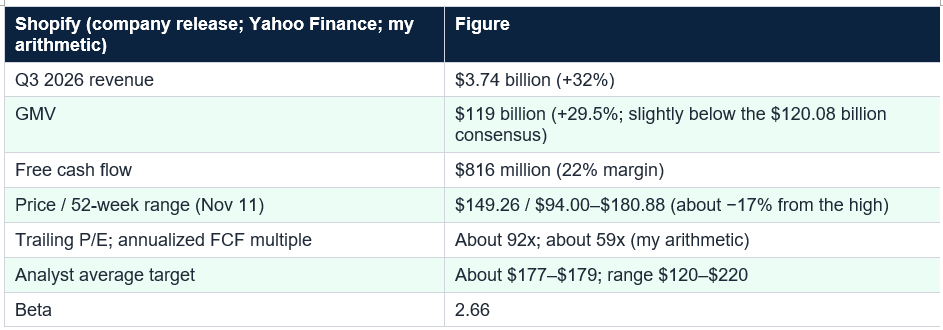
Why did the stock fall about 9%? GMV of $119.15 billion narrowly missed the $120.08 billion consensus, revenue of $3.742 billion was a hair below the $3.747 billion estimate and the stock was expensive, at about 87 times 2026 earnings before the drop (Investing.com). Shopify closed at $149.26 on November 11, about 17% below its $180.88 52-week high and about 59% above its $94.00 low, with a market value near $192 billion: about 92 times trailing earnings, 59 times annualized Q3 free cash flow and 13 times annualized revenue in my arithmetic.
Analysts remain positive, with an average target near $177 to $179, about 19% above the price, though targets were trimmed after earnings. A different Fool writer said he would start considering shares around $115, about 23% below the current price, which shows how much valuation matters. With a beta of 2.66, Shopify is a high-quality business at a price that leaves little room for disappointment.
Shopify Q3 2026: revenue $3.74B (+32%), GMV $119B (+29.5%), free cash flow $816M (22%). About $149 (Nov 11), about 17% below its 52-week high; trailing P/E about 92. Dell fiscal Q2 2027: revenue $47.0B (+58%), AI backlog $95B, FCF $986M (−47%). Snap Q3 2026: revenue $1.72B (+14%), net income $56M, FCF $164M, about $5 a share.
The stock has fallen sharply since. It was quoted at $329.00 premarket on November 9, and a September analysis put it at 22.2 times forward earnings, implying a price near $566, so it is down roughly 42% in my arithmetic (the earlier price is derived). At $329 it trades at about 12.9 times the $25.50 guidance. The concern is cash: fiscal Q2 free cash flow was $986 million, down 47%, or about 2.1% of revenue, while orders came in at $3.71 for every dollar shipped, meaning lots of future revenue but also execution demands.
Dell is also not really off the beaten path: it is a direct play on AI infrastructure spending, the theme that sold off. The Fool’s argument, as I read it, is that Dell’s solutions fit enterprises that want practical AI, which may be true, but it still depends on AI spending holding up, on margins on large server deals and on converting backlog to cash. The November 24 report will be the next test.
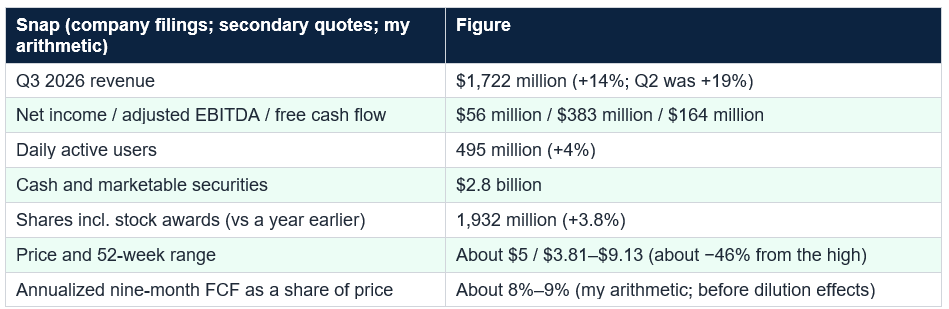
The stock looks cheap on revenue and cash flow, and the market is skeptical. At about $5 a share, with a market value of $8.6 to $10.0 billion depending on the source, Snap trades at roughly 1.4 to 1.6 times trailing revenue of $6.35 billion, and its annualized nine-month free cash flow of $571 million is about 8% to 9% of the market price in my arithmetic, though stock-based compensation is large (shares including awards rose 3.8% to 1,932 million). The stock is about 46% below its $9.13 52-week high, and consensus is Hold with targets around $7.44 to $7.91.
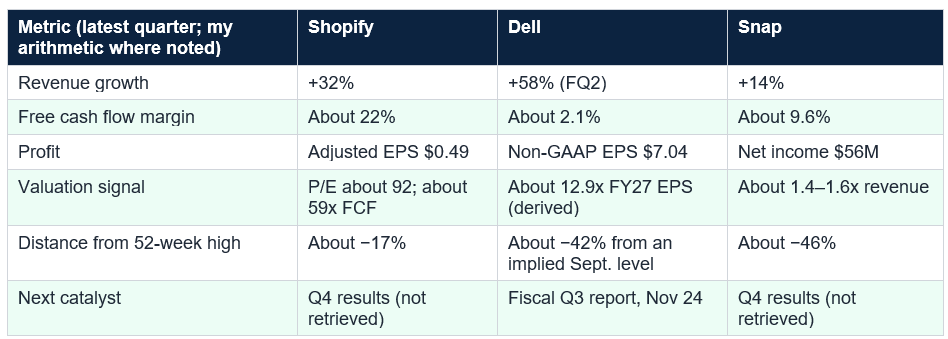
These are not like-for-like comparisons, since Shopify and Snap are platform businesses, Dell sells hardware and fiscal quarters differ. But the contrast shows three different bets: a premium compounder, AI infrastructure demand turning into cash and a turnaround in advertising and subscriptions. A $3,000 split is not one theme; it is three bets that happen to share the same recent sell-off.
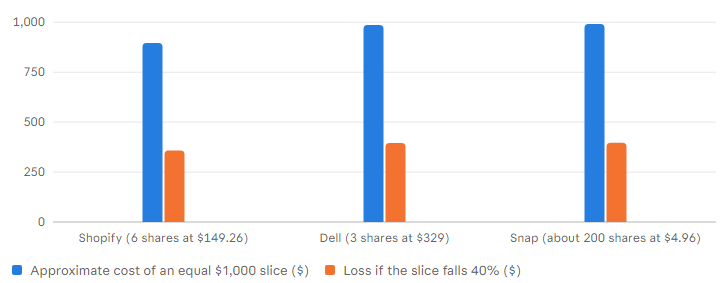
Sizing is where risk lives. In my illustration, if all three fell 40%, the $3,000 would lose $1,200 and need a 66.7% gain to recover, and if just one fell 50% the loss would be $500. Because all three are sensitive to technology sentiment and rates, they may fall together. Many investors put money into broad index funds, an emergency fund and retirement accounts before individual stocks (general knowledge); a small stock position can be fine, but it should be money you can afford to lose.
$3,000 split equally (prices from my sources; approximate) Shares and cost
There is also a common risk: all three can fall if the AI sell-off resumes, rates keep rising or the economy weakens. Dell is the most direct AI play, Shopify depends on consumer spending and Snap on advertising budgets, and the Fed is expected to raise rates in December, which hurts high-multiple stocks most. None of this means the stocks will fall, only that “errantly dragged lower” is a judgment, not a fact.
A stock that has fallen is not necessarily cheap. Each of these three has specific risks, and they share exposure to the same market forces. Never invest money you may need soon, and remember that prices in this article are days old.
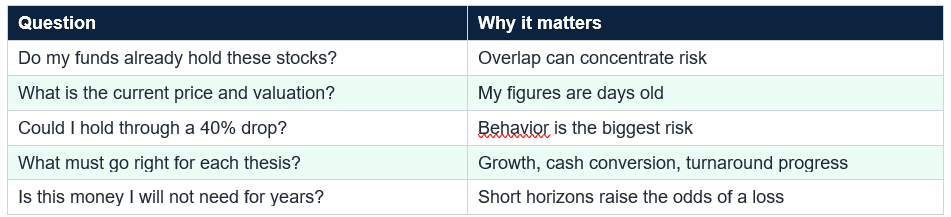
Look up your top ten holdings across your index and growth funds and check whether Shopify or Dell already appear before adding more. Then check each company’s latest results for yourself. Common mistakes include assuming a fallen stock is a bargain, treating a headline’s “errantly” as fact, buying three stocks with shared risks and calling it diversification, using stale prices, forgetting dilution at companies that pay in stock and relying on one article, including this one. A small position in a stock you understand is more defensible than a large position in a list.
They are also three separate bets that share exposure to the same technology and rate sensitivity. A $3,000 split buys about 6 shares of Shopify, 3 of Dell and 200 of Snap at recent prices, and a 40% fall in all three would cost $1,200. Whether the stocks were errantly priced depends on whether growth holds, which no one knows. Check current prices, size positions carefully and keep a broad, diversified core.
A Motley Fool article published November 12, 2026 suggests Shopify (SHOP), Dell Technologies (DELL) and Snap (SNAP) for an investor with $3,000, arguing that the recent artificial intelligence sell-off dragged them lower more than their results justify. The author says Shopify is doing better than its recent weakness suggests, that Dell’s approach to AI makes increasing sense and that Snap belongs on the list too. This guide tests those claims with the companies’ own results.
Did these companies actually report good results?
Mostly, with caveats. Shopify’s third-quarter revenue rose 32% to $3.74 billion with a 22% free cash flow margin, though GMV slightly missed estimates. Dell’s fiscal second-quarter revenue rose 58% to $47.0 billion with a $95 billion AI server backlog, but free cash flow fell 47%. Snap swung to a $56 million net profit with revenue up 14%, but growth slowed from 19% the quarter before and the stock trades around $5.
Are these stocks cheap after the sell-off?
Not uniformly. Shopify trades at about 92 times trailing earnings and roughly 59 times annualized free cash flow in my arithmetic. Dell was around $329 premarket on November 9, about 13 times its fiscal 2027 non-GAAP earnings guidance, though that price is days old and I derived the multiple. Snap trades around $5 at about 1.4 to 1.6 times revenue. Cheap or expensive depends on whether the growth holds, which no one can know.
How should I split $3,000 among three stocks?
There is no formula, and I cannot tell you. An equal split is $1,000 each, which at recent prices is about 6 shares of Shopify, 3 of Dell and 200 of Snap. But all three are sensitive to technology sentiment and rates, so they may fall together: in my illustration, a 40% drop in all three would cost $1,200 and need a 66.7% gain to recover. Many investors would put more in broad index funds first. This is general education, not personal advice.
What should I check before buying any of them?
Read each company’s latest results and risk factors, compare current prices with the data in this guide (which is days old), note when the next report is due (Dell reports November 24) and decide how much you could lose without changing your plans. Also check what you already own: if you hold index or growth funds, you probably own parts of Shopify and Dell already.
Table of Contents
- The Pitch
- The Short Answer
- What the AI Sell-Off Was and Was Not
- Shopify: Strong Growth, Rich Price
- Dell: The AI Hardware Name With a Cash Question
- Snap: A Turnaround With Dilution
- Side by Side
- What $3,000 Actually Buys
- Risks the Headline Skips
- Questions to Ask Before Buying
- Common Mistakes
- Conclusion
- Frequently Asked Questions
What $3,000 buys and what a 40% fall costs: an equal split across the three stocks ($)
Dollars ($) by Author's arithmetic with prices from sources one day to one week old (Shopify Nov 11, Dell Nov 9 premarket, Snap Nov 6-7), ignoring fractional shares; if all three fall 40% the loss is about $1,150 on the amounts invested (about $1,200 on a full $3,000)
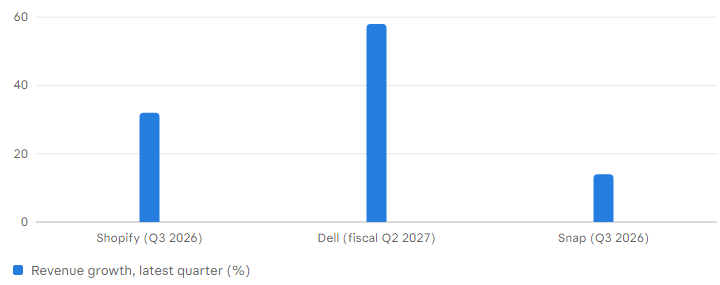
Three different growth profiles: latest-quarter revenue growth, Shopify, Dell and Snap (%)
Year-over-year growth (%) by Company releases and SEC filings: Shopify $3.74B (+32%), Dell $47.0B (+58%, quarter ended July 31), Snap $1.72B (+14%, down from +19% in Q2); fiscal quarters differ; Dell reports fiscal Q3 on November 24
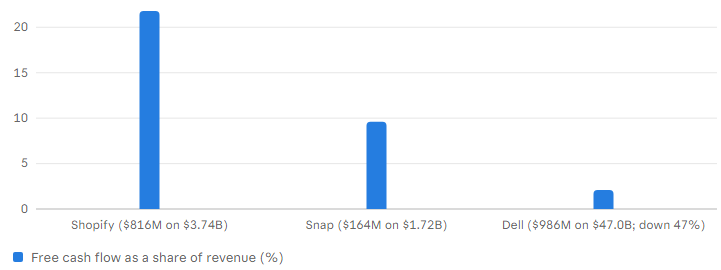
Growth is not the same as cash: free cash flow margin, latest quarter (%)
FCF margin (%) by Author's arithmetic from company releases and filings (Shopify Q3 2026, Snap Q3 2026, Dell fiscal Q2 2027); Dell sells lower-margin hardware, so margins are not like-for-likeThe Pitch
It is a tempting setup: a rout hits artificial intelligence stocks and a few good companies get dragged down with them. A Motley Fool article published November 12 argues that Shopify, Dell Technologies and Snap fit that description and are worth considering for an investor with $3,000. Its case is that Shopify is doing better than its recent weakness suggests, that Dell’s way of selling AI makes increasing sense and that Snap deserves a place on the list.The idea that good companies get sold along with bad ones is often true and sometimes dangerously wrong. This guide checks it with the companies’ own results, then looks at valuations, risks and what $3,000 actually buys. It does not recommend any of the three; the aim is to give you the facts to judge a headline like this one yourself.
The Short Answer
All three companies have real strengths, and none is simply “errantly” priced. Shopify grew revenue 32% with a 22% free cash flow margin, but trades at about 92 times trailing earnings and slightly missed GMV estimates. Dell has a record $95 billion AI server backlog and guides to about 69% revenue growth this fiscal year, but its free cash flow fell 47% last quarter and it reports again on November 24. Snap returned to a $56 million profit and strong cash flow, but revenue growth slowed to 14% and analysts rate it Hold. The risks differ, though the stocks may fall together if technology sentiment sours.What the AI Sell-Off Was and Was Not
The backdrop is a hard few weeks. The Nasdaq Composite closed in correction territory on November 5, and chip stocks fell more than 12% in a single day, according to a Motley Fool report that attributed the drop to policy fears rather than company results. Invesco’s Brian Levitt pointed to rising interest rates, aggressive capital spending and local opposition to data-center expansion, and the 10-year Treasury yield has returned to about 5% with another Fed hike expected in December (earlier research).A sell-off can drag down good companies, but it can also expose businesses priced for perfection. Shopify’s multiple was already high before the drop, Dell’s stock had risen more than 300% over the year to late September so some of its fall reverses a run, and Snap at about $5 was never a market darling. Whether a stock was “errantly” dragged lower depends on where it started.
Shopify: Strong Growth, Rich Price
Shopify’s third quarter, reported November 3, was strong on the headline numbers. Revenue rose 32% to $3.74 billion, its seventh straight quarter of low-30s growth, and GMV, the total value of goods sold on its platform, reached $119 billion, up 29.5%. Free cash flow was $816 million (a 22% margin), merchant solutions revenue rose 35%, B2B GMV rose 74% and adjusted EPS of $0.49 beat the $0.46 estimate. Shopify guided to low-thirties revenue growth for 2026.Why did the stock fall about 9%? GMV of $119.15 billion narrowly missed the $120.08 billion consensus, revenue of $3.742 billion was a hair below the $3.747 billion estimate and the stock was expensive, at about 87 times 2026 earnings before the drop (Investing.com). Shopify closed at $149.26 on November 11, about 17% below its $180.88 52-week high and about 59% above its $94.00 low, with a market value near $192 billion: about 92 times trailing earnings, 59 times annualized Q3 free cash flow and 13 times annualized revenue in my arithmetic.
Analysts remain positive, with an average target near $177 to $179, about 19% above the price, though targets were trimmed after earnings. A different Fool writer said he would start considering shares around $115, about 23% below the current price, which shows how much valuation matters. With a beta of 2.66, Shopify is a high-quality business at a price that leaves little room for disappointment.
Shopify Q3 2026: revenue $3.74B (+32%), GMV $119B (+29.5%), free cash flow $816M (22%). About $149 (Nov 11), about 17% below its 52-week high; trailing P/E about 92. Dell fiscal Q2 2027: revenue $47.0B (+58%), AI backlog $95B, FCF $986M (−47%). Snap Q3 2026: revenue $1.72B (+14%), net income $56M, FCF $164M, about $5 a share.
Dell: The AI Hardware Name With a Cash Question
Dell’s results are the most dramatic of the three. In its fiscal second quarter (ended July 31) revenue rose 58% to a record $47.0 billion, with GAAP EPS of $6.34 and non-GAAP EPS of $7.04, up 203%. It booked a record $60.9 billion of AI server orders, recognized $16.4 billion of AI server revenue and ended with a $95 billion backlog. It raised fiscal 2027 revenue guidance by $25 billion to $192 billion, with AI server revenue of $74 billion and non-GAAP EPS of $25.50, and guided to about $49 billion of revenue in the third quarter.The stock has fallen sharply since. It was quoted at $329.00 premarket on November 9, and a September analysis put it at 22.2 times forward earnings, implying a price near $566, so it is down roughly 42% in my arithmetic (the earlier price is derived). At $329 it trades at about 12.9 times the $25.50 guidance. The concern is cash: fiscal Q2 free cash flow was $986 million, down 47%, or about 2.1% of revenue, while orders came in at $3.71 for every dollar shipped, meaning lots of future revenue but also execution demands.
Dell is also not really off the beaten path: it is a direct play on AI infrastructure spending, the theme that sold off. The Fool’s argument, as I read it, is that Dell’s solutions fit enterprises that want practical AI, which may be true, but it still depends on AI spending holding up, on margins on large server deals and on converting backlog to cash. The November 24 report will be the next test.
Snap: A Turnaround With Dilution
Snap’s third quarter, reported November 4, shows a company that has turned a corner on profit while growth cools. Revenue rose 14% to $1.72 billion, down from 19% in Q2. Net income was $56 million ($0.03 a share) against a $104 million loss a year earlier, adjusted EBITDA was $383 million, free cash flow $164 million and cash and marketable securities $2.8 billion. Daily active users reached 495 million (+4%), and the company says free cash flow per share is now its primary financial objective.The stock looks cheap on revenue and cash flow, and the market is skeptical. At about $5 a share, with a market value of $8.6 to $10.0 billion depending on the source, Snap trades at roughly 1.4 to 1.6 times trailing revenue of $6.35 billion, and its annualized nine-month free cash flow of $571 million is about 8% to 9% of the market price in my arithmetic, though stock-based compensation is large (shares including awards rose 3.8% to 1,932 million). The stock is about 46% below its $9.13 52-week high, and consensus is Hold with targets around $7.44 to $7.91.
Side by Side
The three are very different. Shopify has the highest growth quality and the highest price: a free cash flow margin of about 22% on 32% revenue growth. Dell has the fastest growth, 58%, but a free cash flow margin of about 2.1%, as is typical of hardware. Snap has the lowest growth, 14%, a free cash flow margin of about 9.6% and the lowest price: you pay the most for the best business and the least for the one that is hardest to grow.These are not like-for-like comparisons, since Shopify and Snap are platform businesses, Dell sells hardware and fiscal quarters differ. But the contrast shows three different bets: a premium compounder, AI infrastructure demand turning into cash and a turnaround in advertising and subscriptions. A $3,000 split is not one theme; it is three bets that happen to share the same recent sell-off.
What $3,000 Actually Buys
An equal split of $1,000 each buys about 6 shares of Shopify at $149.26 ($896), 3 shares of Dell at $329 ($987) and about 200 shares of Snap at $4.96 ($992), at the recent prices in my sources, ignoring fractional shares, which many brokers offer. Prices will have moved, so the numbers are only for scale. The bigger question is weight: $3,000 is a small slice of most portfolios, and each $1,000 slice is a small bet.Sizing is where risk lives. In my illustration, if all three fell 40%, the $3,000 would lose $1,200 and need a 66.7% gain to recover, and if just one fell 50% the loss would be $500. Because all three are sensitive to technology sentiment and rates, they may fall together. Many investors put money into broad index funds, an emergency fund and retirement accounts before individual stocks (general knowledge); a small stock position can be fine, but it should be money you can afford to lose.
$3,000 split equally (prices from my sources; approximate) Shares and cost
Risks the Headline Skips
Each stock has risks a short headline does not mention. For Shopify it is multiple compression: at a trailing P/E near 92 and a beta of 2.66, a small growth disappointment can cause a large drop, as November 3 showed. For Dell it is cash conversion, margins on large AI server deals, possible customer concentration (general knowledge, not verified) and the possibility that AI orders slow. For Snap, the risks are slowing revenue growth, advertising competition, dilution from stock compensation and net debt of about $1.8 billion by one source.There is also a common risk: all three can fall if the AI sell-off resumes, rates keep rising or the economy weakens. Dell is the most direct AI play, Shopify depends on consumer spending and Snap on advertising budgets, and the Fed is expected to raise rates in December, which hurts high-multiple stocks most. None of this means the stocks will fall, only that “errantly dragged lower” is a judgment, not a fact.
A stock that has fallen is not necessarily cheap. Each of these three has specific risks, and they share exposure to the same market forces. Never invest money you may need soon, and remember that prices in this article are days old.
Questions to Ask Before Buying
Before acting on a list like this, ask: how much of my portfolio already depends on technology, and do my funds already hold these companies? What is the current price compared with the data here? What would I do if a stock fell 40%? Do I understand how each company makes money and what must go right? Is this money I can leave alone for years? And am I buying the business or a headline?Look up your top ten holdings across your index and growth funds and check whether Shopify or Dell already appear before adding more. Then check each company’s latest results for yourself. Common mistakes include assuming a fallen stock is a bargain, treating a headline’s “errantly” as fact, buying three stocks with shared risks and calling it diversification, using stale prices, forgetting dilution at companies that pay in stock and relying on one article, including this one. A small position in a stock you understand is more defensible than a large position in a list.
Conclusion
A Motley Fool article says Shopify, Dell and Snap were errantly dragged lower by the AI sell-off and suggests them for $3,000. The numbers show three real businesses with real strengths: Shopify grew revenue 32% with a 22% free cash flow margin, Dell reported 58% revenue growth and a $95 billion AI backlog, and Snap swung to a $56 million profit with strong cash flow. But each carries a catch: Shopify at about 92 times trailing earnings and 17% below its high, Dell with free cash flow down 47% and a report due November 24, and Snap with slowing growth, dilution and a Hold consensus.They are also three separate bets that share exposure to the same technology and rate sensitivity. A $3,000 split buys about 6 shares of Shopify, 3 of Dell and 200 of Snap at recent prices, and a 40% fall in all three would cost $1,200. Whether the stocks were errantly priced depends on whether growth holds, which no one knows. Check current prices, size positions carefully and keep a broad, diversified core.
Frequently Asked Questions
Which three stocks does the article pick?A Motley Fool article published November 12, 2026 suggests Shopify (SHOP), Dell Technologies (DELL) and Snap (SNAP) for an investor with $3,000, arguing that the recent artificial intelligence sell-off dragged them lower more than their results justify. The author says Shopify is doing better than its recent weakness suggests, that Dell’s approach to AI makes increasing sense and that Snap belongs on the list too. This guide tests those claims with the companies’ own results.
Did these companies actually report good results?
Mostly, with caveats. Shopify’s third-quarter revenue rose 32% to $3.74 billion with a 22% free cash flow margin, though GMV slightly missed estimates. Dell’s fiscal second-quarter revenue rose 58% to $47.0 billion with a $95 billion AI server backlog, but free cash flow fell 47%. Snap swung to a $56 million net profit with revenue up 14%, but growth slowed from 19% the quarter before and the stock trades around $5.
Are these stocks cheap after the sell-off?
Not uniformly. Shopify trades at about 92 times trailing earnings and roughly 59 times annualized free cash flow in my arithmetic. Dell was around $329 premarket on November 9, about 13 times its fiscal 2027 non-GAAP earnings guidance, though that price is days old and I derived the multiple. Snap trades around $5 at about 1.4 to 1.6 times revenue. Cheap or expensive depends on whether the growth holds, which no one can know.
How should I split $3,000 among three stocks?
There is no formula, and I cannot tell you. An equal split is $1,000 each, which at recent prices is about 6 shares of Shopify, 3 of Dell and 200 of Snap. But all three are sensitive to technology sentiment and rates, so they may fall together: in my illustration, a 40% drop in all three would cost $1,200 and need a 66.7% gain to recover. Many investors would put more in broad index funds first. This is general education, not personal advice.
What should I check before buying any of them?
Read each company’s latest results and risk factors, compare current prices with the data in this guide (which is days old), note when the next report is due (Dell reports November 24) and decide how much you could lose without changing your plans. Also check what you already own: if you hold index or growth funds, you probably own parts of Shopify and Dell already.
0 Comments
Be the first to share your thoughts on this article.