
Investing
ExxonMobil’s 44th Dividend Raise, $20B Buybacks: Can It Pay?

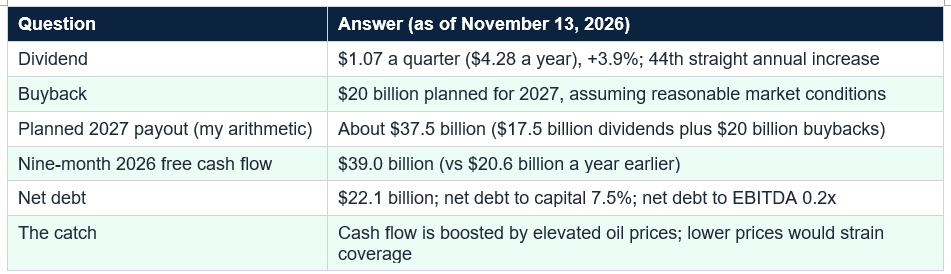
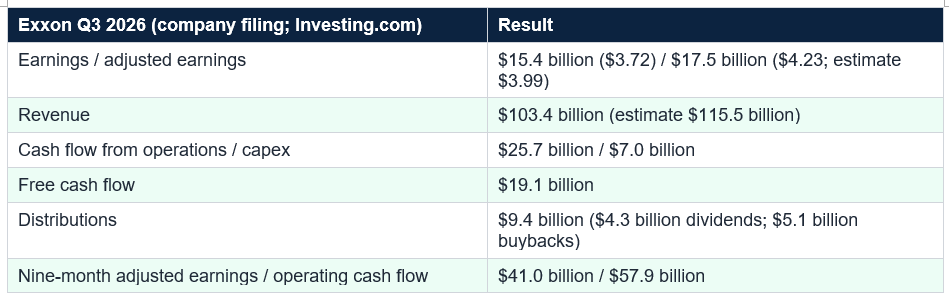
The announcement (Exxon, October 30): quarterly dividend raised 3.9% to $1.07 ($4.28 a year), the 44th straight annual increase; $20 billion of share repurchases planned for 2027 “assuming reasonable market conditions”; Q3 earnings $15.4 billion ($3.72 a share; $4.23 adjusted); cash flow from operations $25.7 billion; free cash flow $19.1 billion; distributions $9.4 billion. The balance sheet and cash: nine-month free cash flow $39.0 billion (vs $20.6 billion a year earlier); net debt $22.1 billion (debt $34.3 billion less $12.2 billion of cash); net debt to capital 7.5%; net debt to EBITDA 0.2 times; net debt cut by nearly $11 billion this year; more than $160 billion returned since 2022. My arithmetic: 2027 dividends of about $17.5 billion plus $20 billion of buybacks is about $37.5 billion; 2026 free cash flow annualizes to about $52 billion (1.4 times coverage) versus about $27 billion at last year’s pace (0.7 times); dividends use about 22% of Q3 free cash flow; the dividend yield is about 2.6% and the buyback yield about 2.9% (total about 5.5%) at about $167 a share.

Few companies make a promise as sweeping as ExxonMobil’s: a bigger dividend every year and $20 billion of buybacks, whatever oil does. On October 30, 2026, with third-quarter results, Exxon raised its quarterly dividend 3.9% to $1.07 a share, its 44th straight annual increase, and said it plans to keep repurchases at $20 billion in 2027. A Motley Fool article published November 13 asks how it can afford both and answers that it generated more than $39 billion of free cash flow in the first nine months of the year.
That answer is right as far as it goes, but the interesting question is how comfortable the funding is if oil prices fall, since 2026 has been a year of elevated prices and supply disruptions. This guide checks the claim against Exxon’s filings, runs a simple stress test and covers the balance sheet, valuation and risks.
At today’s oil prices, Exxon can afford both easily. Nine-month free cash flow of $39.0 billion annualizes to about 1.4 times the roughly $37.5 billion it plans to pay out in 2027 in my arithmetic, and net debt, now just $22.1 billion, has been falling. At last year’s lower prices free cash flow would have fallen short (about 0.7 times coverage by my math) and the balance sheet would have to fill the gap, which is the point of keeping debt low. Management says the buyback assumes reasonable market conditions, so it is the flexible part; the dividend, about 44% of earnings, is the safer part.
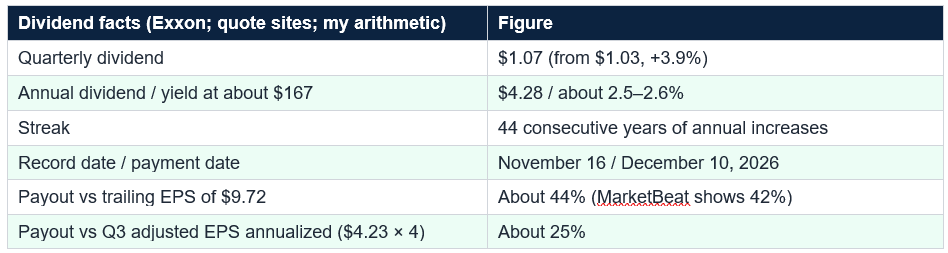
The streak has survived oil crashes, a pandemic and major acquisitions, which is why dividend investors prize it, but the raises are modest: 3.9% this time is about $0.16 more per share per year. At 4% annual growth the dividend would reach about $5.21 in five years and $6.34 in ten (hypothetical). The payout is about 44% of trailing earnings per share of $9.72 and about 25% of Q3 adjusted earnings annualized, so it has ample room.
Exxon Q3 2026: earnings $15.4B ($3.72; adjusted $4.23), cash flow from operations $25.7B, free cash flow $19.1B, distributions $9.4B. Nine-month free cash flow $39.0B vs $20.6B a year earlier. Net debt $22.1B (7.5% of capital). Dividend $1.07 a quarter (44th straight raise); $20B of buybacks planned for 2027. Planned 2027 payout about $37.5B (my arithmetic).
When an analyst asked on the call whether the $20 billion was fixed or variable, and whether it would hold if oil were $60 rather than $120, management stressed ratable purchases and a very strong balance sheet to eliminate distribution volatility across cycles. That is reassuring but not a guarantee: “assuming reasonable market conditions” is the qualifier. In practice the buyback is the lever management can pull if prices fall sharply, as it has in the past (general knowledge), while the dividend is the commitment.
Context matters. The company said results were supported by resilient operations amid conflict-related supply constraints, and an analyst’s question on the call referred to oil at $120, which I could not verify. Brent was reported at about $90 to nearly $96 recently, amid Iran-related tensions and talk of the war ending: elevated prices that helped profits. Nine-month adjusted earnings of $41.0 billion and operating cash flow of $57.9 billion are therefore not a baseline for every year.
Planned 2027 distributions are about $37.5 billion: about $17.5 billion of dividends ($4.28 a share on 4.08 billion shares) plus $20 billion of buybacks, close to the Fool’s $18 billion and $20 billion. At the 2026 nine-month pace of free cash flow, about $52 billion annualized, coverage would be about 1.4 times, leaving room for investment and debt reduction. But that pace depends on prices and nearly doubled from a year earlier, when nine-month free cash flow was $20.6 billion.
That is not a crisis. A $10 billion annual gap is about 45% of Exxon’s $22.1 billion of net debt, and net debt to capital is only 7.5%, so the company could fund a shortfall for a while, and the buyback could be reduced first; keeping debt low in good years is meant to provide this flexibility in bad ones. But it shows why the answer depends partly on the oil price: if prices stay near $90 the plan is comfortable, and if they fall toward the 2025 range buybacks, not the dividend, are likely to bear the strain. I have not modeled any particular price.
Exxon’s 2026 cash flow is boosted by elevated oil prices tied to a Middle East conflict. At last year’s lower prices, free cash flow would not cover both the dividend and a $20 billion buyback; the balance sheet could bridge the gap, and management says the buyback assumes reasonable market conditions.
Spending is not light, though. Exxon invested $20.0 billion in cash capital expenditures in the first nine months, about $7 billion a quarter, in advantaged projects, and said its 2026 planned investment is 20% higher than the nearest international oil company; a $12.5 billion Guyana project was also reported. The capital returns are therefore funded after substantial growth spending, which supports future cash flow but raises the bar if prices fall.

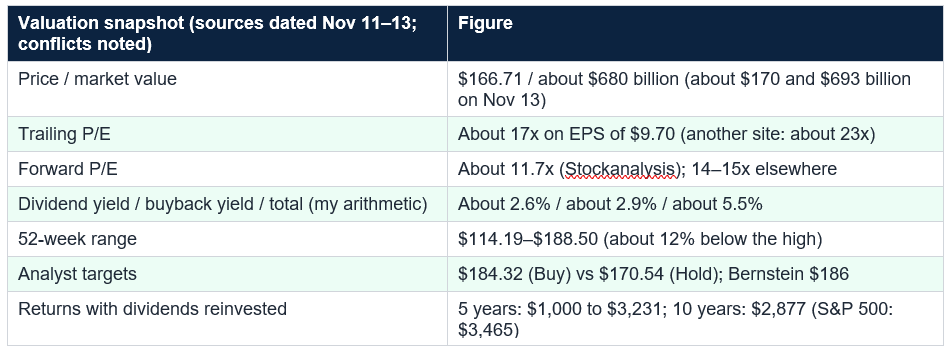
Analysts are divided: Stockanalysis shows a Buy consensus with a $184.32 target, MarketBeat a Hold at $170.54, and Bernstein trimmed its target to $186 while warning energy stocks may struggle to appreciate. Long-term returns have been uneven: $1,000 invested five years ago with dividends reinvested is worth about $3,231, but a ten-year holder is at $2,877, behind the S&P 500’s $3,465 (24/7 Wall St.), showing how much the starting point and the oil cycle matter.
The capital return plan has its own risks. The buyback is conditional, not guaranteed; repurchases at the top of an oil cycle can disappoint; large capital spending commits cash for years; and a 2.5% yield is not high, so the dividend’s appeal rests on its growth. Energy stocks have had long periods of poor returns, as the ten-year figure above shows.
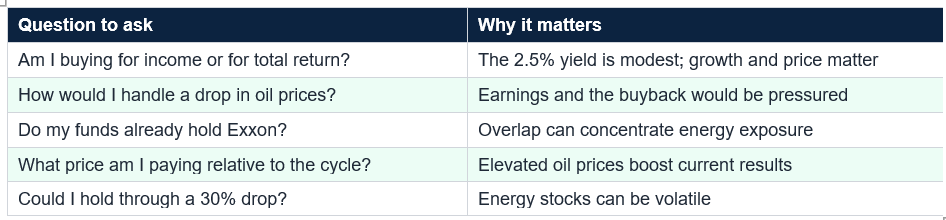
Check what you already own: an S&P 500 or energy fund probably already holds Exxon, one of the largest US companies (general knowledge). If you add it, think about position size, since energy can fall sharply; some investors buy gradually to reduce timing risk, others hold through the oil cycle and reinvest dividends. I cannot say whether Exxon is right for you.
Look at Exxon’s latest 10-Q and compare free cash flow with dividends and buybacks. Then decide how much a lower-oil scenario, such as 2025’s free cash flow of about $27 billion annualized, would change your view. Common mistakes include assuming a 44-year dividend streak makes the stock risk-free, extrapolating 2026 cash flow to every year, ignoring that the buyback is conditional, overlooking that energy stocks are cyclical and relying on one valuation figure when sources disagree.
The honest caveat is oil. 2026 cash flow is boosted by elevated prices, and at last year’s pace free cash flow would be about $27 billion annualized, roughly 0.7 times the planned payout. The balance sheet could bridge the gap and the buyback is explicitly conditional, so it is the part most at risk. Exxon is a strong company with a strong record, but at about $167 it is a cyclical stock with a 2.5% yield. Check current data and consider your own goals.
On October 30, 2026, Exxon raised its quarterly dividend 3.9% to $1.07 a share from $1.03, or $4.28 a year, extending its streak of annual increases to 44 years. The next payment goes to shareholders of record on November 16, 2026 and is paid on December 10. The yield is about 2.5%, based on a share price near $167, and with the planned buyback the total shareholder yield is about 5.5% in my arithmetic.
How can Exxon afford a dividend and $20 billion of buybacks?
Mainly through cash flow and a very strong balance sheet. Through the first nine months of 2026, Exxon generated $39.0 billion of free cash flow, enough to pay about $28 billion of dividends and buybacks and cut net debt by nearly $11 billion, according to its results. Net debt is $22.1 billion, only 7.5% of capital. The catch is that 2026 profits are boosted by elevated oil prices, so the plan is easier to fund at today’s prices than at lower ones.
What happens if oil prices fall?
Free cash flow would fall. A year earlier, with lower oil prices, Exxon’s nine-month free cash flow was $20.6 billion, which in my arithmetic annualizes to about $27 billion, below the roughly $37.5 billion of planned 2027 distributions. The balance sheet could bridge a shortfall for some time, and management says the buyback assumes reasonable market conditions, so it is the flexible part. The dividend is the priority.
Is the dividend safe?
It looks well covered. The $4.28 dividend is about 44% of trailing earnings of $9.72 per share and about 25% of Q3 adjusted earnings annualized, and dividends alone use about 22% of Q3 free cash flow in my arithmetic. A 44-year record and a 0.2 times net debt to EBITDA ratio support it. Still, dividends are never guaranteed, and this is general education, not personal investment advice.
Is Exxon stock a buy now?
I cannot say, and this article does not recommend it. The stock is up more than a third in 2026 and trades near $167, about 17 times trailing earnings with a 2.5% yield, below its $188.50 52-week high. Its earnings depend on oil and gas prices and refining margins, which can swing sharply, and energy stocks have a long record of cycles. Consider your time horizon, your exposure through index funds and how much a drop would affect you.
Table of Contents
- The 44-Year Dividend Streak
- The $20 Billion Buyback
- What the Third Quarter Shows
- The Cash Flow Math
- The Oil-Price Stress Test
- The Balance Sheet
- Valuation and Total Yield
- Risks
- How a Dividend Investor Might Think
- Common Mistakes
- Conclusion
- Frequently Asked Questions
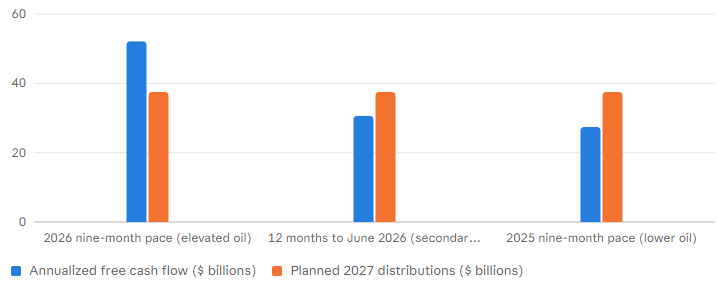
The oil-price stress test: free cash flow at three paces vs. planned 2027 payouts ($ billions)
$ billions per year by Author's arithmetic from ExxonMobil's Q3 release (nine-month FCF $39.0B and $20.6B annualized) and TickerNerd (TTM to June $30.6B); planned distributions about $37.5B = $17.5B dividends ($4.28 x 4.08B
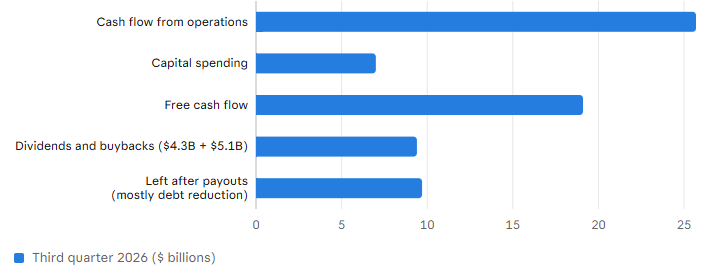
Where Q3 cash went: ExxonMobil cash flow, capex, free cash flow, payouts and what was left ($ billions)
$ billions by ExxonMobil Form 8-K, Q3 2026 (October 30, 2026): operations $25.7B, free cash flow $19.1B, distributions $9.4B; the $9.7B remainder is the author's arithmetic (net debt fell by more than $9B in the quarter
Total shareholder yield: dividend yield plus buyback yield for ExxonMobil (%)
Yield (%) by Author's arithmetic from Stockanalysis and Morningstar quotes (Nov 11, 2026: $166.71, market cap about $680B) and Exxon's $20B 2027 buyback plan; Morningstar shows a total yield of 5.48%; the buybackFew companies make a promise as sweeping as ExxonMobil’s: a bigger dividend every year and $20 billion of buybacks, whatever oil does. On October 30, 2026, with third-quarter results, Exxon raised its quarterly dividend 3.9% to $1.07 a share, its 44th straight annual increase, and said it plans to keep repurchases at $20 billion in 2027. A Motley Fool article published November 13 asks how it can afford both and answers that it generated more than $39 billion of free cash flow in the first nine months of the year.
That answer is right as far as it goes, but the interesting question is how comfortable the funding is if oil prices fall, since 2026 has been a year of elevated prices and supply disruptions. This guide checks the claim against Exxon’s filings, runs a simple stress test and covers the balance sheet, valuation and risks.
At today’s oil prices, Exxon can afford both easily. Nine-month free cash flow of $39.0 billion annualizes to about 1.4 times the roughly $37.5 billion it plans to pay out in 2027 in my arithmetic, and net debt, now just $22.1 billion, has been falling. At last year’s lower prices free cash flow would have fallen short (about 0.7 times coverage by my math) and the balance sheet would have to fill the gap, which is the point of keeping debt low. Management says the buyback assumes reasonable market conditions, so it is the flexible part; the dividend, about 44% of earnings, is the safer part.
The 44-Year Dividend Streak
Exxon says it has raised its annual dividend per share for 44 consecutive years, a streak it says is longer than 95% of S&P 500 companies. The latest increase was 3.9%, from $1.03 to $1.07 a quarter ($4.28 a year), payable December 10 to shareholders of record on November 16. At a share price near $167 that is a yield of about 2.5%, modest next to savings accounts but growing. The dividend is the center of management’s capital return strategy: the company says it wants certainty and reliability in distributions, primarily through a continuously growing dividend.The streak has survived oil crashes, a pandemic and major acquisitions, which is why dividend investors prize it, but the raises are modest: 3.9% this time is about $0.16 more per share per year. At 4% annual growth the dividend would reach about $5.21 in five years and $6.34 in ten (hypothetical). The payout is about 44% of trailing earnings per share of $9.72 and about 25% of Q3 adjusted earnings annualized, so it has ample room.
Exxon Q3 2026: earnings $15.4B ($3.72; adjusted $4.23), cash flow from operations $25.7B, free cash flow $19.1B, distributions $9.4B. Nine-month free cash flow $39.0B vs $20.6B a year earlier. Net debt $22.1B (7.5% of capital). Dividend $1.07 a quarter (44th straight raise); $20B of buybacks planned for 2027. Planned 2027 payout about $37.5B (my arithmetic).
The $20 Billion Buyback
The buyback is the bigger and less certain piece. Exxon plans to maintain repurchases at $20 billion in 2027, “assuming reasonable market conditions.” It has bought back about $5.1 billion a quarter this year, and the Fool says it has returned more than $160 billion to shareholders since 2022. At about $167 a share, $20 billion would retire roughly 120 million shares, about 2.9% of the 4.08 billion outstanding in my arithmetic, which supports earnings per share if the price stays similar.When an analyst asked on the call whether the $20 billion was fixed or variable, and whether it would hold if oil were $60 rather than $120, management stressed ratable purchases and a very strong balance sheet to eliminate distribution volatility across cycles. That is reassuring but not a guarantee: “assuming reasonable market conditions” is the qualifier. In practice the buyback is the lever management can pull if prices fall sharply, as it has in the past (general knowledge), while the dividend is the commitment.
What the Third Quarter Shows
Exxon’s third-quarter results, reported October 30, were strong. Earnings were $15.4 billion ($3.72 a share) and adjusted earnings $17.5 billion ($4.23), ahead of the $3.99 expected, even though revenue of $103.4 billion missed the $115.5 billion forecast. Cash flow from operations was $25.7 billion, capital spending $7.0 billion and free cash flow $19.1 billion. Refining was a highlight, with record year-to-date performance, and the company reported milestones in Guyana, Kearl and PNG LNG plus larger stakes in LNG projects in Papua and Mozambique.Context matters. The company said results were supported by resilient operations amid conflict-related supply constraints, and an analyst’s question on the call referred to oil at $120, which I could not verify. Brent was reported at about $90 to nearly $96 recently, amid Iran-related tensions and talk of the war ending: elevated prices that helped profits. Nine-month adjusted earnings of $41.0 billion and operating cash flow of $57.9 billion are therefore not a baseline for every year.
The Cash Flow Math
Here is the arithmetic behind “how it can afford both.” In Q3, cash flow from operations of $25.7 billion paid for $7.0 billion of capital spending and left free cash flow of $19.1 billion. Distributions took $9.4 billion, about 49% of it (dividends alone about 22%), and the remaining $9.7 billion went mostly to cutting net debt, which fell by more than $9 billion. Over nine months, free cash flow of $39.0 billion paid for about $28 billion of distributions (three quarters of $9.4 billion, my assumption) and left about $10.8 billion, close to the nearly $11 billion by which net debt fell.Planned 2027 distributions are about $37.5 billion: about $17.5 billion of dividends ($4.28 a share on 4.08 billion shares) plus $20 billion of buybacks, close to the Fool’s $18 billion and $20 billion. At the 2026 nine-month pace of free cash flow, about $52 billion annualized, coverage would be about 1.4 times, leaving room for investment and debt reduction. But that pace depends on prices and nearly doubled from a year earlier, when nine-month free cash flow was $20.6 billion.
The Oil-Price Stress Test
The stress test is simple but telling. In the first nine months of 2025, a period of lower oil prices (general knowledge, not retrieved), Exxon’s free cash flow was $20.6 billion, about $27.4 billion annualized, or about 0.7 times the planned $37.5 billion of 2027 distributions, a shortfall of about $10 billion a year in my arithmetic. A secondary source put free cash flow for the twelve months to June 2026 at $30.6 billion against $37.7 billion of dividends and buybacks, so even recently the payout has exceeded free cash flow over some periods.That is not a crisis. A $10 billion annual gap is about 45% of Exxon’s $22.1 billion of net debt, and net debt to capital is only 7.5%, so the company could fund a shortfall for a while, and the buyback could be reduced first; keeping debt low in good years is meant to provide this flexibility in bad ones. But it shows why the answer depends partly on the oil price: if prices stay near $90 the plan is comfortable, and if they fall toward the 2025 range buybacks, not the dividend, are likely to bear the strain. I have not modeled any particular price.
Exxon’s 2026 cash flow is boosted by elevated oil prices tied to a Middle East conflict. At last year’s lower prices, free cash flow would not cover both the dividend and a $20 billion buyback; the balance sheet could bridge the gap, and management says the buyback assumes reasonable market conditions.
The Balance Sheet
The balance sheet is why the stress test is manageable. At September 30 Exxon had total debt of $34.3 billion and $12.2 billion of cash, so net debt was $22.1 billion, down nearly $11 billion this year, with net debt to capital of 7.5% and net debt to EBITDA of 0.2 times, which management calls the strongest in the sector. In plain terms, Exxon could repay its net debt with less than one quarter of operating cash flow at current levels, which is what lets it promise rising dividends and steady buybacks through price swings.Spending is not light, though. Exxon invested $20.0 billion in cash capital expenditures in the first nine months, about $7 billion a quarter, in advantaged projects, and said its 2026 planned investment is 20% higher than the nearest international oil company; a $12.5 billion Guyana project was also reported. The capital returns are therefore funded after substantial growth spending, which supports future cash flow but raises the bar if prices fall.
Valuation and Total Yield
At the November 11 close of $166.71, Exxon had a market value of about $680 billion and traded about 17 times trailing earnings of $9.70 a share (another site shows about 23 on a different earnings basis), with forward multiples given as about 11.7 and 14 to 15. The stock is up more than a third this year and about 12% below its $188.50 52-week high. The 2.57% dividend yield plus a roughly 2.9% buyback yield gives a total shareholder yield of about 5.5% in my arithmetic, matching Morningstar’s 5.48%.Analysts are divided: Stockanalysis shows a Buy consensus with a $184.32 target, MarketBeat a Hold at $170.54, and Bernstein trimmed its target to $186 while warning energy stocks may struggle to appreciate. Long-term returns have been uneven: $1,000 invested five years ago with dividends reinvested is worth about $3,231, but a ten-year holder is at $2,877, behind the S&P 500’s $3,465 (24/7 Wall St.), showing how much the starting point and the oil cycle matter.
Risks
The main risk is the oil price. Exxon’s earnings and cash flow depend on oil, gas and refining margins, which swing sharply with geopolitics, demand and supply. Elevated prices from the Middle East conflict have boosted 2026; if the conflict ends and prices fall, as Brent briefly did toward $90 on peace hopes, profits and free cash flow would likely drop, and record refining margins are cyclical too. Other risks include project delays and cost overruns, regulation and the long-term shift away from fossil fuels, none of which I modeled.The capital return plan has its own risks. The buyback is conditional, not guaranteed; repurchases at the top of an oil cycle can disappoint; large capital spending commits cash for years; and a 2.5% yield is not high, so the dividend’s appeal rests on its growth. Energy stocks have had long periods of poor returns, as the ten-year figure above shows.
How a Dividend Investor Might Think
For an income investor, the appeal is a growing dividend backed by a strong balance sheet, and the stress test suggests it is well covered even in a weaker year. But a yield of about 2.5% is not large and the stock is cyclical, so total return depends on oil prices and the price you pay. Top savings accounts pay about 4.35% in my earlier research, so Exxon’s case rests on growth and potential price gains, not income today: a $10,000 position buys about 60 shares and would pay about $257 a year at the current rate.Check what you already own: an S&P 500 or energy fund probably already holds Exxon, one of the largest US companies (general knowledge). If you add it, think about position size, since energy can fall sharply; some investors buy gradually to reduce timing risk, others hold through the oil cycle and reinvest dividends. I cannot say whether Exxon is right for you.
Look at Exxon’s latest 10-Q and compare free cash flow with dividends and buybacks. Then decide how much a lower-oil scenario, such as 2025’s free cash flow of about $27 billion annualized, would change your view. Common mistakes include assuming a 44-year dividend streak makes the stock risk-free, extrapolating 2026 cash flow to every year, ignoring that the buyback is conditional, overlooking that energy stocks are cyclical and relying on one valuation figure when sources disagree.
Conclusion
ExxonMobil raised its dividend 3.9% to $1.07 a quarter, its 44th straight annual increase, and plans $20 billion of buybacks in 2027. It can afford both at current prices: nine-month free cash flow of $39.0 billion covers about 1.4 times the roughly $37.5 billion planned payout in my arithmetic, net debt is just $22.1 billion, or 7.5% of capital, and the company cut it by nearly $11 billion this year. The dividend, about 44% of earnings, looks very safe.The honest caveat is oil. 2026 cash flow is boosted by elevated prices, and at last year’s pace free cash flow would be about $27 billion annualized, roughly 0.7 times the planned payout. The balance sheet could bridge the gap and the buyback is explicitly conditional, so it is the part most at risk. Exxon is a strong company with a strong record, but at about $167 it is a cyclical stock with a 2.5% yield. Check current data and consider your own goals.
Frequently Asked Questions
How much is ExxonMobil’s dividend now?On October 30, 2026, Exxon raised its quarterly dividend 3.9% to $1.07 a share from $1.03, or $4.28 a year, extending its streak of annual increases to 44 years. The next payment goes to shareholders of record on November 16, 2026 and is paid on December 10. The yield is about 2.5%, based on a share price near $167, and with the planned buyback the total shareholder yield is about 5.5% in my arithmetic.
How can Exxon afford a dividend and $20 billion of buybacks?
Mainly through cash flow and a very strong balance sheet. Through the first nine months of 2026, Exxon generated $39.0 billion of free cash flow, enough to pay about $28 billion of dividends and buybacks and cut net debt by nearly $11 billion, according to its results. Net debt is $22.1 billion, only 7.5% of capital. The catch is that 2026 profits are boosted by elevated oil prices, so the plan is easier to fund at today’s prices than at lower ones.
What happens if oil prices fall?
Free cash flow would fall. A year earlier, with lower oil prices, Exxon’s nine-month free cash flow was $20.6 billion, which in my arithmetic annualizes to about $27 billion, below the roughly $37.5 billion of planned 2027 distributions. The balance sheet could bridge a shortfall for some time, and management says the buyback assumes reasonable market conditions, so it is the flexible part. The dividend is the priority.
Is the dividend safe?
It looks well covered. The $4.28 dividend is about 44% of trailing earnings of $9.72 per share and about 25% of Q3 adjusted earnings annualized, and dividends alone use about 22% of Q3 free cash flow in my arithmetic. A 44-year record and a 0.2 times net debt to EBITDA ratio support it. Still, dividends are never guaranteed, and this is general education, not personal investment advice.
Is Exxon stock a buy now?
I cannot say, and this article does not recommend it. The stock is up more than a third in 2026 and trades near $167, about 17 times trailing earnings with a 2.5% yield, below its $188.50 52-week high. Its earnings depend on oil and gas prices and refining margins, which can swing sharply, and energy stocks have a long record of cycles. Consider your time horizon, your exposure through index funds and how much a drop would affect you.
0 Comments
Be the first to share your thoughts on this article.