
Investing
3 Dow Stocks to Hold a Decade: Amazon, Alphabet, Home Depot.

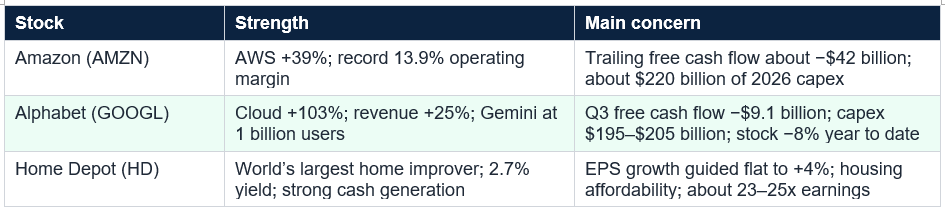
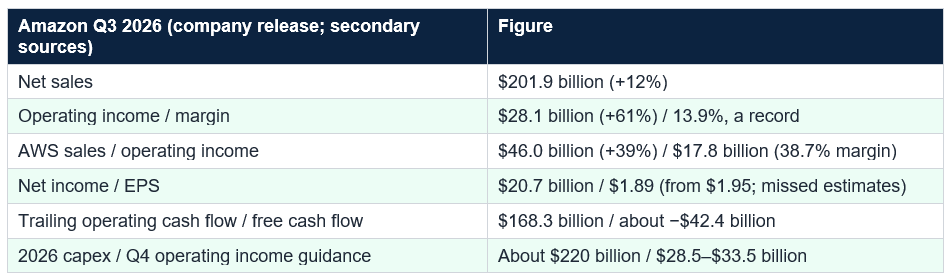
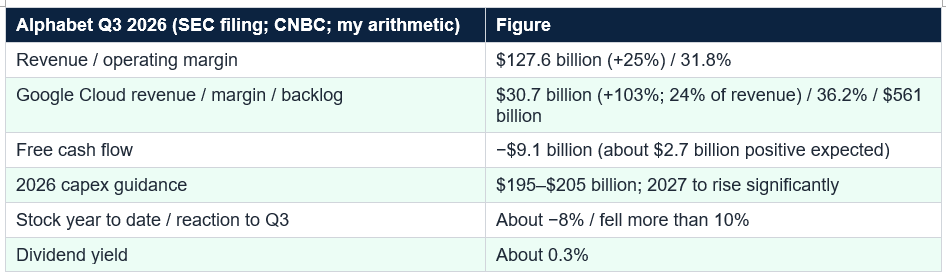
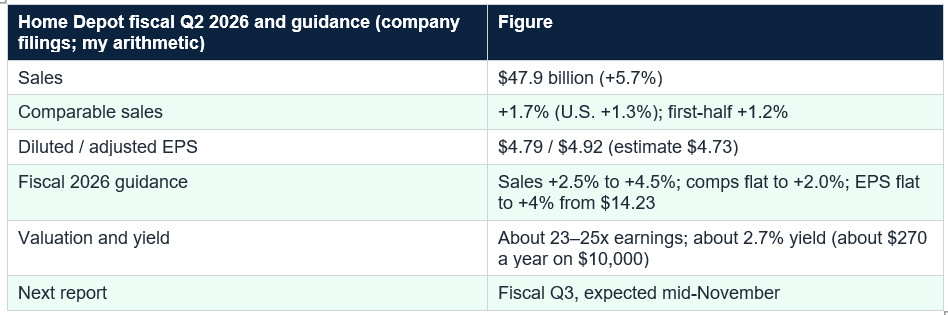
Amazon (Q3 2026): revenue $201.9 billion (+12%); AWS $46.0 billion (+39%); record 13.9% operating margin; trailing free cash flow about −$42.4 billion on about $220 billion of 2026 capex. Alphabet (Q3 2026): revenue $127.6 billion (+25%); Google Cloud $30.7 billion (+103%, 24% of revenue); free cash flow −$9.1 billion; 2026 capex $195–$205 billion. Home Depot (fiscal Q2 2026): sales $47.9 billion (+5.7%); comparable sales +1.7%; 2026 EPS guided flat to +4%. The valuations and market: Amazon about 28 times forward earnings; Home Depot about 23 times with a 2.7% yield; S&P 500 about 19 times; Alphabet about 19–24 times adjusted earnings in my arithmetic (stale estimates); the Dow up about 9% year to date through November 9; year to date Amazon +17%, Home Depot +2%, Alphabet −8% (about two days old). My arithmetic: AWS is about 23% of Amazon’s revenue but about 63% of its operating income; Amazon and Alphabet together plan about $415–$425 billion of 2026 capex; $10,000 grows to about $17,900, $21,600 or $25,900 over ten years at 6%, 8% or 10% a year (hypothetical); $10,000 in Home Depot yields about $270 a year in dividends versus about $29 for Alphabet and $0 for Amazon.
It is a neat idea: take three of the 30 companies in the Dow Jones Industrial Average, each a leader in its field, and hold them for a decade. A Motley Fool article published November 12 does that with Amazon, Alphabet and Home Depot, calling them “unstoppable” Dow stocks that pair market dominance with the financial strength to keep growing. The Dow is up about 9% this year through November 9, and the article argues these three offer long-term growth in cloud computing, search and AI, and home improvement.
The label deserves a closer look. These are excellent but very different businesses, and each has a real issue: Amazon and Alphabet are burning cash on AI, and Home Depot is growing slowly in a soft housing market. This guide covers what each reported most recently, what their valuations imply and what “unstoppable” leaves out.
All three are market leaders with strong franchises and reasonable candidates for a long-term portfolio, but “unstoppable” overstates it. Amazon posted a record 13.9% operating margin and AWS growth of 39%, yet its trailing free cash flow is about −$42 billion as it spends roughly $220 billion on capital projects. Alphabet’s Google Cloud revenue doubled, but free cash flow was −$9.1 billion in the quarter and the stock is down about 8% this year. Home Depot is stable and pays a 2.7% dividend, but it is guiding for EPS growth of flat to 4% and trades around 23 to 25 times earnings. A ten-year hold depends less on these headlines than on the price you pay and what the spending earns.
The lesson is that being in the Dow tells you a company is large and well established, not that it will outperform. Verizon was a member until June, and the index has swapped out once-dominant companies such as Intel in 2024 and Walgreens before it. Treat the Dow label as a starting point for research, not a conclusion.
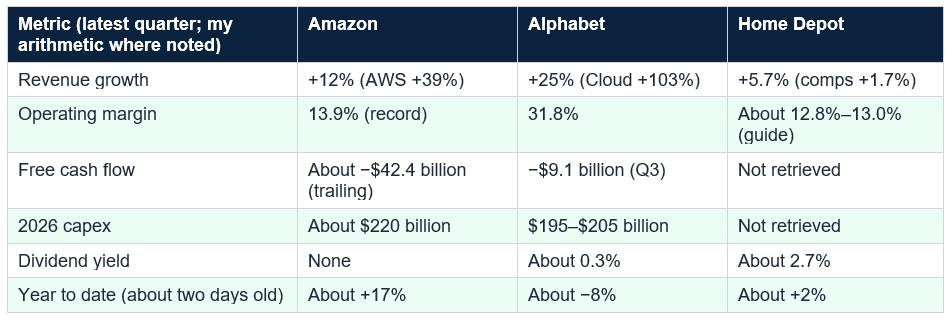
Amazon Q3: revenue $201.9B (+12%), AWS $46.0B (+39%), operating margin 13.9%, trailing free cash flow about −$42.4B, 2026 capex about $220B. Alphabet Q3: revenue $127.6B (+25%), Cloud $30.7B (+103%), free cash flow −$9.1B, capex $195–$205B. Home Depot fiscal Q2: sales $47.9B (+5.7%), comps +1.7%, EPS growth guided flat to +4%.
The harder story is cash. Capital spending was about $77 billion in the quarter, roughly 1.8 times operating cash flow of $42 billion per one secondary summary, and trailing free cash flow was an outflow of about $42.4 billion after a $94.8 billion rise in property and equipment purchases, mostly for AI. Amazon expects about $220 billion of capex in 2026. Diluted EPS of $1.89 was down from $1.95 and missed estimates, partly because of investment gains in the prior year, and the stock fell about 7%. CEO Andy Jassy sees a path to $2 trillion of annual revenue, per the Fool, which would justify the spending if it materializes.
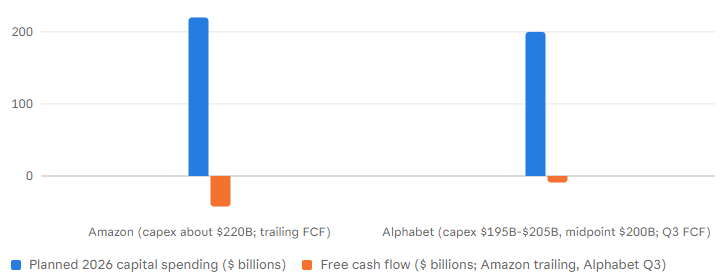
But the stock fell more than 10% on the report and is down about 8% this year. Free cash flow was negative $9.1 billion, against about $2.7 billion positive expected, as capital spending of $51.4 billion outran operating cash flow. Alphabet guided 2026 capex to $195 billion to $205 billion, said 2027 would rise significantly and is raising money through stock and debt. Reported EPS is also distorted by large unrealized investment gains and losses, which swung from a $98 billion gain in Q2 to an $8.7 billion loss in Q3, and the dividend yield is only about 0.3%.
The case for Home Depot is resilience and a recovery: the Fool argues the stock should earn a higher premium when housing rebounds, and it is up only about 1% this year with a 2.7% yield, about $270 a year on $10,000 in my arithmetic against about $29 for Alphabet and nothing for Amazon. The case against is price: at about 23 to 25 times earnings for guided EPS growth of flat to 4%, investors are paying for a recovery that has not arrived. The next test is fiscal third-quarter results, expected in mid-November.
Two of them depend on the same theme, AI-driven cloud demand, and plan about $415 billion to $425 billion of combined capital spending in 2026 in my arithmetic; if the return on that spending disappoints, both could suffer together. Home Depot depends on housing and consumer confidence instead. So the three are not a diversified portfolio but three concentrated bets with different drivers.
None of the three is cheap in absolute terms: paying 28 times earnings for Amazon, 23 to 25 for Home Depot or about 19 to 24 for Alphabet means betting on growth that may not arrive on schedule. A ten-year hold can absorb a high starting multiple if earnings grow enough, but can disappoint if they do not. In my illustration $10,000 would grow to about $17,900 at 6% a year, $21,600 at 8% and $25,900 at 10%, which shows how much the return assumption matters; these are constant-return examples, not forecasts.
There are shared risks too. A Fed expected to raise rates in December and a 10-year yield near 5% (earlier research) weigh on high-multiple stocks and on housing, and a consumer slowdown would hit Amazon’s retail business and Home Depot. The “hold for a decade” framing also hides how much can change: Verizon was a Dow member until this June. None of this means the stocks will fall, but it is why “unstoppable” is a slogan, not an analysis.
“Unstoppable” is not a forecast. Amazon and Alphabet have negative free cash flow because of AI spending, and Home Depot is guiding for flat-to-4% earnings growth. Prices, estimates and year-to-date figures change daily and differ by source.
Practical habits help: spread purchases over several months, decide in advance what would change your mind (free cash flow staying negative for years, or Home Depot’s comparable sales turning negative), review once or twice a year instead of daily and keep an emergency fund and a diversified core first. I cannot say which of the three, if any, is right for you.
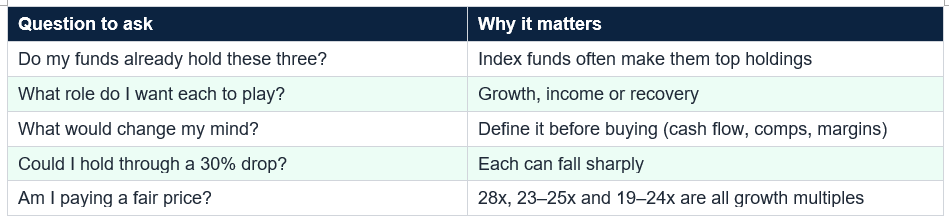
Look up your top holdings in your index funds and 401(k), add up your exposure to these three, and read each company’s latest results before adding more.
Common mistakes include treating Dow membership as a guarantee, taking “unstoppable” literally, ignoring negative free cash flow because earnings look good, paying any price for a good company, overlooking that index funds already hold these stocks and relying on one article, including this one.
A ten-year hold can work if you buy at a fair price, size sensibly and accept that outcomes depend on execution, interest rates and the return on AI investment. At 28, 23 to 25 and roughly 19 to 24 times earnings none of these stocks is cheap, and they are three concentrated bets, not a diversified portfolio. Check current data, consider what you already own and decide for yourself.
Yes. Alphabet replaced Verizon in the Dow Jones Industrial Average on June 29, 2026, according to published reports of the index change. That made it the fifth “Magnificent Seven” company in the Dow, alongside Amazon (added February 2024), Nvidia (November 2024), Microsoft and Apple (the last two long-time members). A 2022 stock split lowered its share price enough to make a price-weighted index inclusion practical. Home Depot has been a member since 1999.
Are these three stocks really “unstoppable”?
No stock is. All three are dominant businesses, but each has a specific risk. Amazon and Alphabet are spending enormous sums on AI, which has pushed Amazon’s trailing free cash flow to about −$42 billion and Alphabet’s third-quarter free cash flow to −$9.1 billion. Home Depot depends on a soft housing market and is guiding for earnings growth of flat to 4%. Dow membership is chosen by a committee and is not a guarantee of future returns.
Which of the three is cheapest?
It depends on the measure. A Motley Fool article puts Amazon at 28 times forward earnings against 19 for the S&P 500 and Home Depot at 23 times with a 2.7% dividend yield. Alphabet’s reported trailing P/E is low (about 15), but that is distorted by gains on its investments; on consensus adjusted earnings, my arithmetic gives about 24 times 2026 and 19 times 2027 using estimates that may be stale. None is cheap in absolute terms.
How long should I plan to hold them?
The article’s premise is a decade, which matches the time such businesses need to turn heavy investment into returns. Over that time, outcomes depend on execution, competition, regulation and the price you pay. In my illustration, $10,000 grows to about $17,900 at 6% a year, $21,600 at 8% and $25,900 at 10% over ten years, but these are constant-return assumptions that real markets will not deliver. This is general education, not personal advice.
Should I buy all three in November?
I cannot say, and this article does not recommend them. Home Depot reports fiscal third-quarter results in mid-November, which could move the stock. If you are interested, consider spreading purchases over time, check what you already own through index funds (these three are large holdings in many), and size positions so a 30% drop would not harm your plans.
Table of Contents
- What Makes a Dow Stock
- Amazon: Record Profit, Negative Free Cash Flow
- Alphabet: A Growth Engine and a Cash Question
- Home Depot: Durable, Slow and Fully Priced
- Side by Side
- Valuation: What You Pay
- What Could Go Wrong
- How to Think About a Ten-Year Hold
- Common Mistakes
- Conclusion
- Frequently Asked Questions
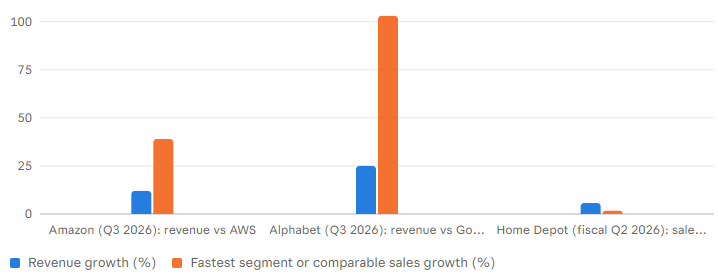
Three very different growth profiles: latest-quarter growth, Amazon, Alphabet and Home Depot (%)
Year-over-year growth (%) by Company filings and releases: Amazon revenue $201.9B (+12%), AWS $46.0B (+39%); Alphabet revenue $127.6B (+25%), Cloud $30.7B (+103%); Home Depot sales $47.9B (+5.7%), comparable sales +1.7%; fiscal quarter
The AI cash question: 2026 capex vs. free cash flow, Amazon and Alphabet ($ billions)
$ billions by Amazon release and secondary summaries (trailing free cash flow about -$42.4B; 2026 cash capex about $220B); Alphabet via CNBC (Q3 free cash flow -$9.07B; 2026 capex $195B-$205B, midpoint shown);
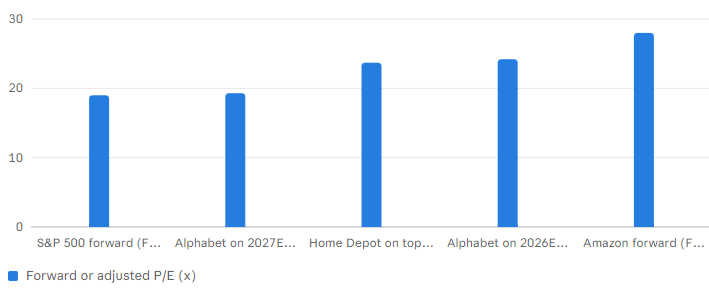
What you pay: P/E multiples for the three Dow stocks vs. the S&P 500 (x)
Price-to-earnings multiple (x) by Motley Fool (Amazon 28x, Home Depot about 23x, S&P 500 19x); author's arithmetic for Home Depot at $351 on $14.23-$14.80 and for Alphabet at $293.45 on early-October consensus adjusted EPS of $12.11It is a neat idea: take three of the 30 companies in the Dow Jones Industrial Average, each a leader in its field, and hold them for a decade. A Motley Fool article published November 12 does that with Amazon, Alphabet and Home Depot, calling them “unstoppable” Dow stocks that pair market dominance with the financial strength to keep growing. The Dow is up about 9% this year through November 9, and the article argues these three offer long-term growth in cloud computing, search and AI, and home improvement.
The label deserves a closer look. These are excellent but very different businesses, and each has a real issue: Amazon and Alphabet are burning cash on AI, and Home Depot is growing slowly in a soft housing market. This guide covers what each reported most recently, what their valuations imply and what “unstoppable” leaves out.
All three are market leaders with strong franchises and reasonable candidates for a long-term portfolio, but “unstoppable” overstates it. Amazon posted a record 13.9% operating margin and AWS growth of 39%, yet its trailing free cash flow is about −$42 billion as it spends roughly $220 billion on capital projects. Alphabet’s Google Cloud revenue doubled, but free cash flow was −$9.1 billion in the quarter and the stock is down about 8% this year. Home Depot is stable and pays a 2.7% dividend, but it is guiding for EPS growth of flat to 4% and trades around 23 to 25 times earnings. A ten-year hold depends less on these headlines than on the price you pay and what the spending earns.
What Makes a Dow Stock
Dow membership is often treated as a seal of quality, but it is more modest. The index tracks 30 large US companies chosen by a committee at S&P Dow Jones Indices (general knowledge) and is price-weighted, so a stock with a higher share price counts for more regardless of the company’s size. That is why Home Depot, at about $351 a share, has a larger weight (about 4.0%) than Alphabet at about $287 (3.3%) or Amazon at about $271 (3.1%) in one tracker I found. Alphabet joined on June 29, 2026, replacing Verizon, after a 2022 split made its price compatible.The lesson is that being in the Dow tells you a company is large and well established, not that it will outperform. Verizon was a member until June, and the index has swapped out once-dominant companies such as Intel in 2024 and Walgreens before it. Treat the Dow label as a starting point for research, not a conclusion.
Amazon Q3: revenue $201.9B (+12%), AWS $46.0B (+39%), operating margin 13.9%, trailing free cash flow about −$42.4B, 2026 capex about $220B. Alphabet Q3: revenue $127.6B (+25%), Cloud $30.7B (+103%), free cash flow −$9.1B, capex $195–$205B. Home Depot fiscal Q2: sales $47.9B (+5.7%), comps +1.7%, EPS growth guided flat to +4%.
Amazon: Record Profit, Negative Free Cash Flow
Amazon’s third-quarter report, on October 29, had two stories. The good one: net sales rose 12% to $201.9 billion, operating income jumped 61% to $28.1 billion and the operating margin hit 13.9%, the highest in its history. AWS sales rose 39% to $46.0 billion, the fastest in nearly five years, at a $184 billion annualized run rate and a 38.7% operating margin. In my arithmetic AWS is about 23% of revenue but about 63% of operating income, and the rest of Amazon earned about a 6.6% margin.The harder story is cash. Capital spending was about $77 billion in the quarter, roughly 1.8 times operating cash flow of $42 billion per one secondary summary, and trailing free cash flow was an outflow of about $42.4 billion after a $94.8 billion rise in property and equipment purchases, mostly for AI. Amazon expects about $220 billion of capex in 2026. Diluted EPS of $1.89 was down from $1.95 and missed estimates, partly because of investment gains in the prior year, and the stock fell about 7%. CEO Andy Jassy sees a path to $2 trillion of annual revenue, per the Fool, which would justify the spending if it materializes.
Alphabet: A Growth Engine and a Cash Question
Alphabet’s third quarter, on October 28, was strong operationally. Revenue rose 25% to $127.6 billion, operating income rose 30% to $40.6 billion at a 31.8% margin, and Search and other grew 12%, with query growth the highest in five years. Google Cloud revenue more than doubled, up 103% to $30.7 billion (about 24% of revenue), with a 36.2% margin and a $561 billion backlog, and the Gemini app reached one billion users. The Fool calls Cloud the company’s biggest growth engine for the next decade.But the stock fell more than 10% on the report and is down about 8% this year. Free cash flow was negative $9.1 billion, against about $2.7 billion positive expected, as capital spending of $51.4 billion outran operating cash flow. Alphabet guided 2026 capex to $195 billion to $205 billion, said 2027 would rise significantly and is raising money through stock and debt. Reported EPS is also distorted by large unrealized investment gains and losses, which swung from a $98 billion gain in Q2 to an $8.7 billion loss in Q3, and the dividend yield is only about 0.3%.
Home Depot: Durable, Slow and Fully Priced
Home Depot is the odd one out: a mature retailer, not a growth story. In its second fiscal quarter, ended August 2, sales rose 5.7% to $47.9 billion, comparable sales rose 1.7% (the U.S. 1.3%, the strongest since fiscal 2022) and adjusted EPS of $4.92 beat the $4.73 estimate. It reaffirmed fiscal 2026 guidance: sales growth of about 2.5% to 4.5%, comparable sales flat to 2.0%, an adjusted operating margin of 12.8% to 13.0% and diluted EPS growth of flat to 4% from $14.23. Management said customers continue to do smaller projects, and in May the CEO cited consumer uncertainty and housing affordability pressure.The case for Home Depot is resilience and a recovery: the Fool argues the stock should earn a higher premium when housing rebounds, and it is up only about 1% this year with a 2.7% yield, about $270 a year on $10,000 in my arithmetic against about $29 for Alphabet and nothing for Amazon. The case against is price: at about 23 to 25 times earnings for guided EPS growth of flat to 4%, investors are paying for a recovery that has not arrived. The next test is fiscal third-quarter results, expected in mid-November.
Side by Side
The three are very different bets. Alphabet is the fastest grower and most profitable (31.8% operating margin) but has negative free cash flow. Amazon is growing 12% overall, with AWS at 39% and a record 13.9% margin, but also has negative trailing free cash flow. Home Depot is the slowest, with comparable sales up 1.7%, but has a 12.8% to 13.0% operating margin, pays a meaningful dividend and, unlike the other two, is not betting its cash flow on AI infrastructure.Two of them depend on the same theme, AI-driven cloud demand, and plan about $415 billion to $425 billion of combined capital spending in 2026 in my arithmetic; if the return on that spending disappoints, both could suffer together. Home Depot depends on housing and consumer confidence instead. So the three are not a diversified portfolio but three concentrated bets with different drivers.
Valuation: What You Pay
The Fool puts Amazon at 28 times forward earnings against 19 for the S&P 500, a premium it says is supported by surging profitability and market dominance, and Home Depot at 23 times with a 2.7% yield. Alphabet is harder to pin down: its trailing P/E is about 15 and sources give forward multiples from 13 to 18.5, but those are distorted by investment gains. On early-October consensus adjusted EPS of about $12.11 for 2026 and $15.21 for 2027, which predate the Q3 miss and may have changed, my arithmetic gives about 24 times and 19 times at $293.45.None of the three is cheap in absolute terms: paying 28 times earnings for Amazon, 23 to 25 for Home Depot or about 19 to 24 for Alphabet means betting on growth that may not arrive on schedule. A ten-year hold can absorb a high starting multiple if earnings grow enough, but can disappoint if they do not. In my illustration $10,000 would grow to about $17,900 at 6% a year, $21,600 at 8% and $25,900 at 10%, which shows how much the return assumption matters; these are constant-return examples, not forecasts.
What Could Go Wrong
Each stock has specific risks. For Amazon, AI capital spending of about $220 billion may fail to earn adequate returns, negative free cash flow may force more borrowing (long-term debt was reported at $173 billion) and the retail margin of about 6.6% could be squeezed. Alphabet’s risks are similar: $195 billion to $205 billion of capex, negative free cash flow, equity and debt issuance, and regulatory and competitive pressure on search. For Home Depot the main risk is that housing stays frozen, keeping earnings growth at flat to 4% while the valuation assumes a rebound.There are shared risks too. A Fed expected to raise rates in December and a 10-year yield near 5% (earlier research) weigh on high-multiple stocks and on housing, and a consumer slowdown would hit Amazon’s retail business and Home Depot. The “hold for a decade” framing also hides how much can change: Verizon was a Dow member until this June. None of this means the stocks will fall, but it is why “unstoppable” is a slogan, not an analysis.
“Unstoppable” is not a forecast. Amazon and Alphabet have negative free cash flow because of AI spending, and Home Depot is guiding for flat-to-4% earnings growth. Prices, estimates and year-to-date figures change daily and differ by source.
How to Think About a Ten-Year Hold
A long holding period is a good habit, but it works best when you size positions sensibly and understand what you own. If you hold an S&P 500 or Dow index fund you probably already own all three (general knowledge), so buying them directly adds concentration. Think about what you want each to do: Amazon and Alphabet for growth with cash-flow risk, Home Depot for income and a housing recovery. Equal $3,000 positions would buy about 11 Amazon, 10 Alphabet and 8 Home Depot shares at recent prices in my illustration.Practical habits help: spread purchases over several months, decide in advance what would change your mind (free cash flow staying negative for years, or Home Depot’s comparable sales turning negative), review once or twice a year instead of daily and keep an emergency fund and a diversified core first. I cannot say which of the three, if any, is right for you.
Look up your top holdings in your index funds and 401(k), add up your exposure to these three, and read each company’s latest results before adding more.
Common mistakes include treating Dow membership as a guarantee, taking “unstoppable” literally, ignoring negative free cash flow because earnings look good, paying any price for a good company, overlooking that index funds already hold these stocks and relying on one article, including this one.
Conclusion
Amazon, Alphabet and Home Depot are three of the strongest companies in the Dow, and each is a defensible long-term holding. Amazon posted a record 13.9% operating margin and AWS growth of 39%; Alphabet grew revenue 25% with Google Cloud up 103%; and Home Depot is a stable retailer yielding about 2.7%. But the evidence does not support “unstoppable.” Amazon’s trailing free cash flow is about −$42 billion and Alphabet’s was −$9.1 billion in the quarter, both because of AI spending that totals about $415 billion to $425 billion this year, and Home Depot is guiding for earnings growth of flat to 4%.A ten-year hold can work if you buy at a fair price, size sensibly and accept that outcomes depend on execution, interest rates and the return on AI investment. At 28, 23 to 25 and roughly 19 to 24 times earnings none of these stocks is cheap, and they are three concentrated bets, not a diversified portfolio. Check current data, consider what you already own and decide for yourself.
Frequently Asked Questions
Is Alphabet really in the Dow?Yes. Alphabet replaced Verizon in the Dow Jones Industrial Average on June 29, 2026, according to published reports of the index change. That made it the fifth “Magnificent Seven” company in the Dow, alongside Amazon (added February 2024), Nvidia (November 2024), Microsoft and Apple (the last two long-time members). A 2022 stock split lowered its share price enough to make a price-weighted index inclusion practical. Home Depot has been a member since 1999.
Are these three stocks really “unstoppable”?
No stock is. All three are dominant businesses, but each has a specific risk. Amazon and Alphabet are spending enormous sums on AI, which has pushed Amazon’s trailing free cash flow to about −$42 billion and Alphabet’s third-quarter free cash flow to −$9.1 billion. Home Depot depends on a soft housing market and is guiding for earnings growth of flat to 4%. Dow membership is chosen by a committee and is not a guarantee of future returns.
Which of the three is cheapest?
It depends on the measure. A Motley Fool article puts Amazon at 28 times forward earnings against 19 for the S&P 500 and Home Depot at 23 times with a 2.7% dividend yield. Alphabet’s reported trailing P/E is low (about 15), but that is distorted by gains on its investments; on consensus adjusted earnings, my arithmetic gives about 24 times 2026 and 19 times 2027 using estimates that may be stale. None is cheap in absolute terms.
How long should I plan to hold them?
The article’s premise is a decade, which matches the time such businesses need to turn heavy investment into returns. Over that time, outcomes depend on execution, competition, regulation and the price you pay. In my illustration, $10,000 grows to about $17,900 at 6% a year, $21,600 at 8% and $25,900 at 10% over ten years, but these are constant-return assumptions that real markets will not deliver. This is general education, not personal advice.
Should I buy all three in November?
I cannot say, and this article does not recommend them. Home Depot reports fiscal third-quarter results in mid-November, which could move the stock. If you are interested, consider spreading purchases over time, check what you already own through index funds (these three are large holdings in many), and size positions so a 30% drop would not harm your plans.
0 Comments
Be the first to share your thoughts on this article.