
Investing
Dutch Bros Stock Cut in Half: Is a $500 Buy Smart Right Now?

The business (Q3 2026, filings): revenue $549.8 million (+29.8%); net income $37.2 million (from $27.3 million); adjusted EBITDA $101.1 million (+29.6%, 18.4% margin); 1,273 shops (960 company-operated); 48 openings; company-operated shop contribution margin 28.1%. The slowdown: systemwide same-shop sales +8.3% (Q1), +5.8% (Q2), +4.4% (Q3); systemwide visits +5.1%, +1.7%, +0.4%; 2026 guidance: revenue at least $2.1 billion (below the $2.13 billion consensus), adjusted EBITDA about $380 million (from $385–$390 million), capex $370–$390 million; about 250 openings planned for 2027. The stock and my arithmetic: $74.02 52-week high; $33.77 close on November 6; about $36 since; about 51% below the high; about 47–50 times trailing earnings; about 14.5–18 times 2026 adjusted EBITDA; implied Q4 adjusted EBITDA margin about 16% vs 18.4% in Q3; capex roughly equals 2026 adjusted EBITDA; $500 buys about 13 shares.
When a growing company’s stock is cut in half, investors face a classic question: bargain or warning? Dutch Bros, the fast-growing drive-through coffee chain, fits that setup. Its stock hit a 52-week high of $74.02 and closed at $33.77 on November 6, a drop of about 54%, after a third-quarter report showing slowing growth in existing shops and a trimmed profit outlook. A Motley Fool article from November 8 calls the plunge a golden opportunity, and the headline behind this post makes a similar case for $500.
The case is not silly: revenue grew nearly 30%, profit rose and the chain plans about 250 openings in 2027. But the stock fell for reasons, and a lower price is not the same as a good price. This guide goes through the company’s own filings, what slowed, what the valuation implies and what a small buyer should consider.
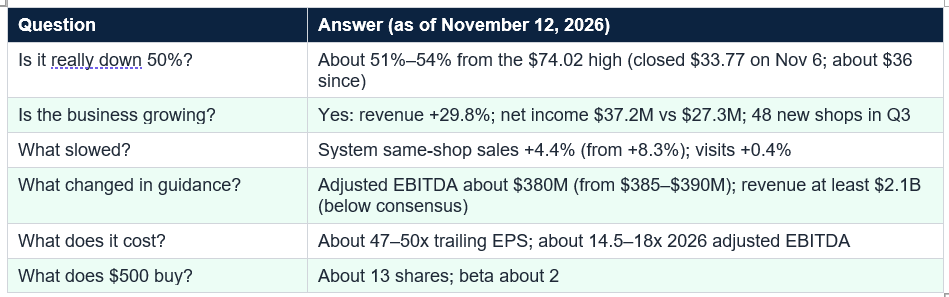
The company opened 48 shops, 42 of them company-operated, and completed the reacquisition of 32 franchise shops in Phoenix’s East Valley on July 27. It was the 14th consecutive quarter of positive same-shop sales and the ninth of customer visit growth, management noted. On the surface that is a strong report, which is why the 15% to 19% drop surprised some investors; the reasons are in the pace of growth in existing shops, the guidance and the cost of growing.
Dutch Bros Q3 2026: revenue $549.8M (+29.8%), net income $37.2M, adjusted EBITDA $101.1M. System same-shop sales +4.4% (from +8.3% in Q1); visits +0.4%. 2026 guide: revenue at least $2.1B, adjusted EBITDA about $380M (from $385–$390M), capex $370M–$390M. Stock $74.02 high; $33.77 close Nov 6; about $36 since.
Management kept the full-year target of at least 5% same-shop sales growth. With nine-month growth of 6.0%, my rough arithmetic implies about 2% or more in the fourth quarter, a further slowdown, and management said the consumer environment remains volatile. The 14-quarter record of positive same-shop sales is impressive, but the direction of travel is down, and that is what the market is pricing.
The guidance implies a weaker fourth quarter. Nine-month revenue was about $1,565 million, so at least $2.1 billion for the year implies Q4 revenue of at least about $535 million, about 3% below Q3 in my arithmetic. Nine-month adjusted EBITDA was $294 million, so about $380 million implies about $86 million in Q4, about 15% below Q3, a margin near 16% against 18.4%. And with capex of $370 million to $390 million against adjusted EBITDA of about $380 million, the company is investing roughly everything it earns before interest and taxes, which I could not check against operating cash flow.
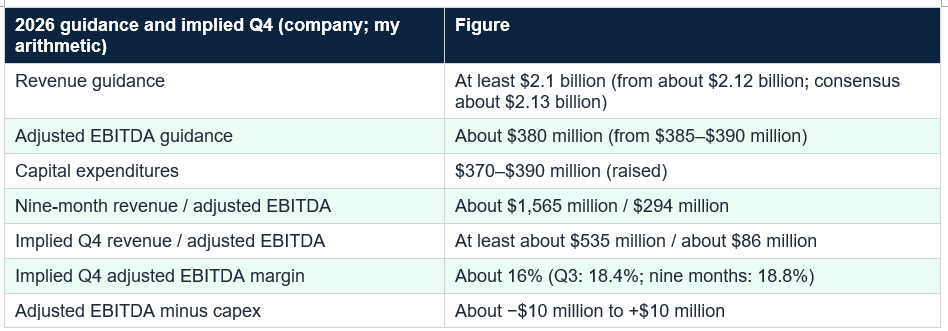
But expansion has a cost and a risk. It requires about $370 million to $390 million of capital spending this year, likely more as openings accelerate, and relies on new shops performing as well as old ones, particularly in new markets where the brand is less known. The company says the primary lever to gain share is opening new shops, which means growth depends on continued capital and on traffic not weakening further.
Analysts have responded with cuts: TD Cowen lowered its target to $50 from $55 and Stephens to $47 from $65, both keeping bullish ratings, per Benzinga. Earlier snapshots showed 24 of 25 analysts at Buy with a consensus target near $80, but those predate the report and are stale. One site reported high short interest in September (about 41.5% of the float), which I could not verify and which can amplify moves either way. A beta of about 1.9 to 2.4 means the stock tends to move roughly twice as much as the market.
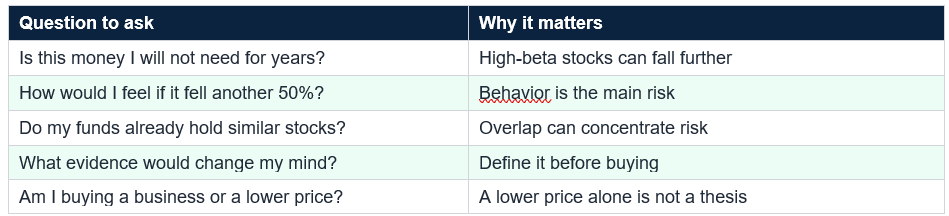
The usual cautions apply: a stock that has halved can halve again, and one that has halved is not necessarily cheap. Think about how it fits with what you own, since growth funds may already give you some exposure to restaurant stocks, consider buying gradually and decide in advance what evidence would change your mind, such as traffic growth recovering or margins stabilizing.
The bear case is that growth is slowing faster than the multiple has adjusted: visit growth is nearly zero, same-shop sales are decelerating, margin is guided lower, capex roughly equals adjusted EBITDA and accelerating to 250 openings raises spending and execution risk just as consumers look stretched. If traffic turns negative the stock could fall further, and at 47 to 50 times earnings it is still not cheap. Both views are plausible, and I assign no probabilities.
The decision is less about the headline than about fit: is the $500 money you will not need for years, how would you feel if it fell by half and how does Dutch Bros fit with what you own? Buying a beaten-down stock because it is cheaper is different from buying because the business is improving, and right now the evidence is a business still growing quickly but decelerating, with rising costs. Waiting for traffic to stabilize may cost you part of a rebound; buying now may cost more if it keeps slowing.
Some investors split the difference with a small starter position, adding if the data improve; others wait for the next report. Neither is right for everyone, but treating a 50% drop as proof of value is wrong for almost everyone. A good plan checks the numbers, decides the size in advance and accepts that the outcome is uncertain.
Open Dutch Bros’s third-quarter release and find the same-shop sales and visits lines, then write down what you would need to see next quarter before adding to a position.
Common mistakes include assuming a stock that halved must be cheap, focusing on revenue growth and ignoring slowing traffic and capital spending, using stale analyst targets, sizing a volatile position too large and treating one article, including this one, as a recommendation. A lower price is information about expectations, not proof of value.
The long-term story, 1,273 shops heading toward 2,029 by 2029 with about 250 openings in 2027, is intact, and at roughly 14.5 to 18 times 2026 adjusted EBITDA the stock is cheaper than before, but it is not cheap on earnings, at 47 to 50 times, and it is volatile. A $500 purchase, about 13 shares, can make sense for an investor who understands the risks and sizes accordingly, and not for one who treats the drop as a guarantee.
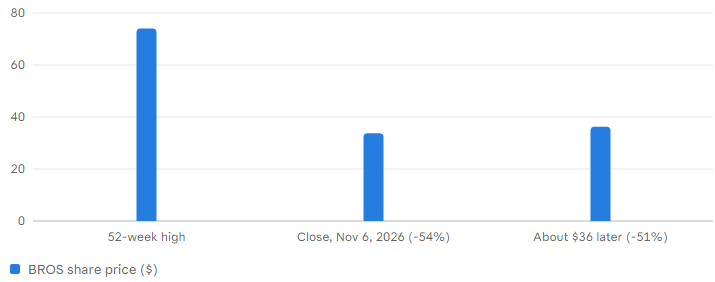
Roughly, yes. Its 52-week high is $74.02, and it closed at $33.77 on November 6, 2026, after falling about 15% to 19% on its third-quarter report. That is a drop of about 54% from the high; at about $36 more recently, it is about 51%. One tracker puts the stock down about 42% for the year. Prices change daily, so check a current quote.
Why did the stock fall if revenue grew 30%?
Because growth in existing shops slowed and costs rose. System same-shop sales growth fell to 4.4% from 8.3% in the first quarter, customer visits at systemwide shops rose only 0.4%, adjusted EBITDA guidance was trimmed to about $380 million from $385 million to $390 million, and revenue guidance of at least $2.1 billion fell short of the roughly $2.13 billion consensus. Management cited higher utility and freight costs.
How fast is Dutch Bros expanding?
It opened 48 shops in the third quarter and ended with 1,273, of which 960 are company-operated. It expects at least 185 openings in 2026, about 250 in 2027 and has a real estate pipeline to reach 2,029 shops by 2029, according to management. In my arithmetic, 250 openings on about 1,321 shops at the end of 2026 is about 19% unit growth, which is expensive: capital spending is guided to $370 million to $390 million.
Is Dutch Bros stock cheap now?
Not obviously. At roughly $36, the stock trades at about 47 to 50 times trailing earnings and, in my arithmetic, about 14.5 to 18 times 2026 adjusted EBITDA, depending on how the share count and net debt are measured. That is lower than a few months ago but still a growth multiple, so it depends on continued growth. This is general education, not personal advice.
How should I think about putting $500 in?
$500 buys about 13 shares at recent prices. The stock is volatile, with a beta near 2, so a further 50% decline would cost about $235 on 13 shares. If you invest, consider whether this money is part of a diversified plan, whether you could hold through more drops and whether you would add on weakness or wait for evidence that traffic growth is recovering. Never invest money you may need soon.
Table of Contents
- The Short Answer
- What Dutch Bros Reported
- The Slowdown Behind the Plunge
- Profits, Guidance and Cash
- The Growth Runway
- Valuation: Cheaper, Not Cheap
- What $500 Actually Buys
- Bull and Bear Cases
- What to Watch Next
- How a $500 Investor Might Think
- Conclusion
- Frequently Asked Questions
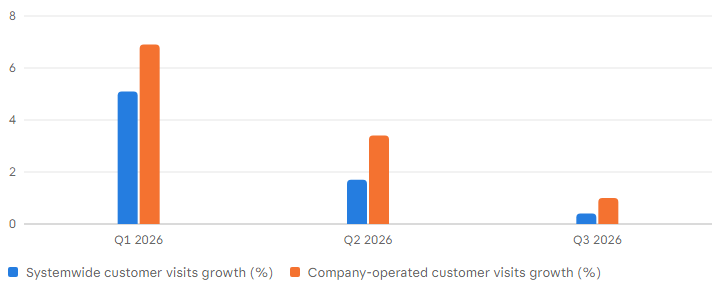
The real warning sign: Dutch Bros customer visit growth by quarter, 2026 (%)
Year-over-year growth (%) by Dutch Bros SEC 8-K releases: same-shop transactions or customer visits; systemwide +5.1%, +1.7%, +0.4%; company-operated +6.9%, +3.4%, +1.0%; total revenue growth stayed near 30% because of new shops
Cut in half: Dutch Bros stock vs. its 52-week high ($)
Share price ($) by 52-week high and Nov 6 close from MarketChameleon and Yahoo Finance; $36.25 from FrenzyCap (date not stated); drops are the author's arithmetic; one tracker shows the stock down about 42% year to date
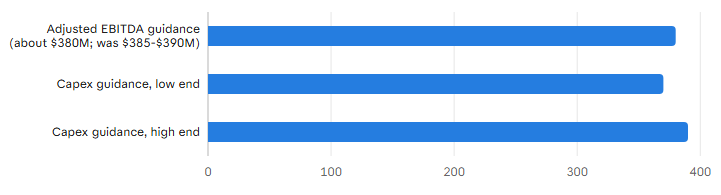
Growth is expensive: Dutch Bros 2026 adjusted EBITDA guidance vs. capital spending guidance ($ millions)
$ millions by Dutch Bros Q3 2026 release: adjusted EBITDA about $380M (trimmed from $385-$390M), capex $370M-$390M (raised); implied Q4 adjusted EBITDA margin about 16% vs 18.4% in Q3 (my arithmetic).When a growing company’s stock is cut in half, investors face a classic question: bargain or warning? Dutch Bros, the fast-growing drive-through coffee chain, fits that setup. Its stock hit a 52-week high of $74.02 and closed at $33.77 on November 6, a drop of about 54%, after a third-quarter report showing slowing growth in existing shops and a trimmed profit outlook. A Motley Fool article from November 8 calls the plunge a golden opportunity, and the headline behind this post makes a similar case for $500.
The case is not silly: revenue grew nearly 30%, profit rose and the chain plans about 250 openings in 2027. But the stock fell for reasons, and a lower price is not the same as a good price. This guide goes through the company’s own filings, what slowed, what the valuation implies and what a small buyer should consider.
The Short Answer
Dutch Bros is a real growth business whose stock has been reset, but the reset reflects real slowing. Revenue grew 29.8% to $549.8 million and net income rose to $37.2 million, yet system same-shop sales growth fell to 4.4% from 8.3% in the first quarter, customer visits grew only 0.4%, and management trimmed 2026 adjusted EBITDA guidance to about $380 million. With capital spending guided to $370 million to $390 million, the company is spending about as much as it earns before interest and taxes. At about $36 the stock is cheaper (roughly 14.5 to 18 times 2026 adjusted EBITDA in my arithmetic) but not cheap, and it moves a lot. A $500 position could be reasonable for some investors and unwise for others.
What Dutch Bros Reported
Dutch Bros reported third-quarter results on November 4. Revenue rose 29.8% to $549.8 million from $423.6 million, in line with estimates; net income was $37.2 million, up from $27.3 million; and adjusted EPS of $0.25 beat the $0.24 estimate and compared with $0.19 a year earlier. Adjusted EBITDA rose 29.6% to $101.1 million, an 18.4% margin. Company-operated shops, 960 of the 1,273 locations, generated $515 million of revenue (+31%) and a $144 million contribution at a 28.1% margin, up 30 basis points.The company opened 48 shops, 42 of them company-operated, and completed the reacquisition of 32 franchise shops in Phoenix’s East Valley on July 27. It was the 14th consecutive quarter of positive same-shop sales and the ninth of customer visit growth, management noted. On the surface that is a strong report, which is why the 15% to 19% drop surprised some investors; the reasons are in the pace of growth in existing shops, the guidance and the cost of growing.
Dutch Bros Q3 2026: revenue $549.8M (+29.8%), net income $37.2M, adjusted EBITDA $101.1M. System same-shop sales +4.4% (from +8.3% in Q1); visits +0.4%. 2026 guide: revenue at least $2.1B, adjusted EBITDA about $380M (from $385–$390M), capex $370M–$390M. Stock $74.02 high; $33.77 close Nov 6; about $36 since.
The Slowdown Behind the Plunge
Same-shop sales, growth at shops open at least a year, is the metric investors watch most, and it has decelerated all year: systemwide 8.3% in the first quarter, 5.8% in the second and 4.4% in the third (against 5.7% a year earlier), and company-operated 10.6%, 8.3% and 5.4%. The more telling trend is traffic: systemwide visits rose 5.1%, then 1.7%, then just 0.4%. Most of the third-quarter same-shop growth therefore came from higher spending per visit, not more visits.Management kept the full-year target of at least 5% same-shop sales growth. With nine-month growth of 6.0%, my rough arithmetic implies about 2% or more in the fourth quarter, a further slowdown, and management said the consumer environment remains volatile. The 14-quarter record of positive same-shop sales is impressive, but the direction of travel is down, and that is what the market is pricing.
Profits, Guidance and Cash
The guidance change rattled investors most. Dutch Bros now expects 2026 revenue of at least $2.1 billion, narrowed from about $2.12 billion at the midpoint and below the roughly $2.13 billion analysts expected, and adjusted EBITDA of about $380 million, trimmed from $385 million to $390 million. The CFO cited the revenue range plus elevated utility costs in Q3 and higher freight costs in the franchise segment, both expected to stay elevated in Q4. Capital spending was raised to $370 million to $390 million.The guidance implies a weaker fourth quarter. Nine-month revenue was about $1,565 million, so at least $2.1 billion for the year implies Q4 revenue of at least about $535 million, about 3% below Q3 in my arithmetic. Nine-month adjusted EBITDA was $294 million, so about $380 million implies about $86 million in Q4, about 15% below Q3, a margin near 16% against 18.4%. And with capex of $370 million to $390 million against adjusted EBITDA of about $380 million, the company is investing roughly everything it earns before interest and taxes, which I could not check against operating cash flow.
The Growth Runway
The bull case rests on expansion. Dutch Bros ended the quarter with 1,273 shops and says it has the real estate pipeline to reach 2,029 by 2029, with at least 185 openings in 2026 and about 250 in 2027 (about 35% more). In my arithmetic, 250 openings on about 1,321 shops at the end of 2026 is unit growth of about 19%. Management says Q3 openings are annualizing at about $2 million, ahead of the $1.8 million year-two underwriting framework, and company-operated shop average unit volume was $2.23 million against $2.02 million, up about 10%.But expansion has a cost and a risk. It requires about $370 million to $390 million of capital spending this year, likely more as openings accelerate, and relies on new shops performing as well as old ones, particularly in new markets where the brand is less known. The company says the primary lever to gain share is opening new shops, which means growth depends on continued capital and on traffic not weakening further.
Valuation: Cheaper, Not Cheap
After the plunge the stock is much cheaper than in the spring, but the numbers still describe a growth stock. At about $36 it trades at about 47 to 50 times trailing earnings (my arithmetic on trailing EPS of $0.72 to $0.77, which sources report differently). Market value depends on which shares you count: about $4.7 billion on Class A shares and about $6.1 billion in Yahoo’s intraday figure. With net debt near $820 million per one source, enterprise value is about $5.5 billion to $6.9 billion, or about 14.5 to 18 times 2026 adjusted EBITDA of about $380 million. I did not retrieve peer valuations to say whether that is high.Analysts have responded with cuts: TD Cowen lowered its target to $50 from $55 and Stephens to $47 from $65, both keeping bullish ratings, per Benzinga. Earlier snapshots showed 24 of 25 analysts at Buy with a consensus target near $80, but those predate the report and are stale. One site reported high short interest in September (about 41.5% of the float), which I could not verify and which can amplify moves either way. A beta of about 1.9 to 2.4 means the stock tends to move roughly twice as much as the market.
What $500 Actually Buys
At about $36, $500 buys about 13.8 shares, or 13 whole shares for about $471. The risk is limited to what you put in, but context matters: if the stock fell another 50%, 13 shares would lose about $235, and if it recovered to its $74.02 high they would be worth about $962, a gain of about $490, though no one can say whether or when that will happen. With a beta near 2, swings of 10% to 20% after earnings are not unusual.The usual cautions apply: a stock that has halved can halve again, and one that has halved is not necessarily cheap. Think about how it fits with what you own, since growth funds may already give you some exposure to restaurant stocks, consider buying gradually and decide in advance what evidence would change your mind, such as traffic growth recovering or margins stabilizing.
Bull and Bear Cases
The bull case is that Dutch Bros is a durable growth story temporarily penalized for a normal slowdown: revenue is still growing about 30%, adjusted EBITDA is up almost 30%, company-operated shops earn a 28% contribution margin, new shops are ahead of underwriting and the runway to 2,029 shops is long. If utility and freight costs ease and traffic stabilizes, earnings could grow faster than the price implies, and 14 to 18 times EBITDA could look inexpensive in hindsight.The bear case is that growth is slowing faster than the multiple has adjusted: visit growth is nearly zero, same-shop sales are decelerating, margin is guided lower, capex roughly equals adjusted EBITDA and accelerating to 250 openings raises spending and execution risk just as consumers look stretched. If traffic turns negative the stock could fall further, and at 47 to 50 times earnings it is still not cheap. Both views are plausible, and I assign no probabilities.
What to Watch Next
A few indicators will tell you more than the headline. Customer visits come first: if systemwide visit growth turns negative the growth story weakens, and if it recovers above 1% the plunge may look overdone. Watch same-shop sales against the implied Q4 figure of about 2% or more, the 28.1% company-operated margin, utility and freight costs (expected to stay elevated in Q4) and capital spending and free cash flow, since I could not retrieve operating cash flow. And watch the pace and performance of the 2027 openings and the next report, which typically comes in February (general knowledge, not retrieved).The decision is less about the headline than about fit: is the $500 money you will not need for years, how would you feel if it fell by half and how does Dutch Bros fit with what you own? Buying a beaten-down stock because it is cheaper is different from buying because the business is improving, and right now the evidence is a business still growing quickly but decelerating, with rising costs. Waiting for traffic to stabilize may cost you part of a rebound; buying now may cost more if it keeps slowing.
Some investors split the difference with a small starter position, adding if the data improve; others wait for the next report. Neither is right for everyone, but treating a 50% drop as proof of value is wrong for almost everyone. A good plan checks the numbers, decides the size in advance and accepts that the outcome is uncertain.
Open Dutch Bros’s third-quarter release and find the same-shop sales and visits lines, then write down what you would need to see next quarter before adding to a position.
Common mistakes include assuming a stock that halved must be cheap, focusing on revenue growth and ignoring slowing traffic and capital spending, using stale analyst targets, sizing a volatile position too large and treating one article, including this one, as a recommendation. A lower price is information about expectations, not proof of value.
Conclusion
Dutch Bros’s stock fell from a 52-week high of $74.02 to $33.77, about 54%, even as third-quarter revenue grew 29.8% to $549.8 million and net income rose to $37.2 million. The reasons are in the details: system same-shop sales growth slowed to 4.4% from 8.3%, customer visits grew only 0.4%, 2026 adjusted EBITDA guidance was trimmed to about $380 million, revenue guidance fell short of consensus and capital spending of $370 million to $390 million roughly equals adjusted EBITDA.The long-term story, 1,273 shops heading toward 2,029 by 2029 with about 250 openings in 2027, is intact, and at roughly 14.5 to 18 times 2026 adjusted EBITDA the stock is cheaper than before, but it is not cheap on earnings, at 47 to 50 times, and it is volatile. A $500 purchase, about 13 shares, can make sense for an investor who understands the risks and sizes accordingly, and not for one who treats the drop as a guarantee.
Frequently Asked Questions
Is Dutch Bros stock really down 50%?Roughly, yes. Its 52-week high is $74.02, and it closed at $33.77 on November 6, 2026, after falling about 15% to 19% on its third-quarter report. That is a drop of about 54% from the high; at about $36 more recently, it is about 51%. One tracker puts the stock down about 42% for the year. Prices change daily, so check a current quote.
Why did the stock fall if revenue grew 30%?
Because growth in existing shops slowed and costs rose. System same-shop sales growth fell to 4.4% from 8.3% in the first quarter, customer visits at systemwide shops rose only 0.4%, adjusted EBITDA guidance was trimmed to about $380 million from $385 million to $390 million, and revenue guidance of at least $2.1 billion fell short of the roughly $2.13 billion consensus. Management cited higher utility and freight costs.
How fast is Dutch Bros expanding?
It opened 48 shops in the third quarter and ended with 1,273, of which 960 are company-operated. It expects at least 185 openings in 2026, about 250 in 2027 and has a real estate pipeline to reach 2,029 shops by 2029, according to management. In my arithmetic, 250 openings on about 1,321 shops at the end of 2026 is about 19% unit growth, which is expensive: capital spending is guided to $370 million to $390 million.
Is Dutch Bros stock cheap now?
Not obviously. At roughly $36, the stock trades at about 47 to 50 times trailing earnings and, in my arithmetic, about 14.5 to 18 times 2026 adjusted EBITDA, depending on how the share count and net debt are measured. That is lower than a few months ago but still a growth multiple, so it depends on continued growth. This is general education, not personal advice.
How should I think about putting $500 in?
$500 buys about 13 shares at recent prices. The stock is volatile, with a beta near 2, so a further 50% decline would cost about $235 on 13 shares. If you invest, consider whether this money is part of a diversified plan, whether you could hold through more drops and whether you would add on weakness or wait for evidence that traffic growth is recovering. Never invest money you may need soon.
0 Comments
Be the first to share your thoughts on this article.