

Investing
Is Cisco Stock a Buy After Earnings? A Beat-and-Raise Review

A beat-and-raise first quarter that didn't look as impressive as the headlines. Published November 2026. Revenue +24%; non-GAAP EPS +40%; non-GAAP gross margin 65.6% (down 250 bps); product orders +21%; stock -6.24% to $95.64.
My short take, which is a framing and not a recommendation: the business is clearly strong, but the quality of that growth is now under debate. More of the revenue is coming from lower-margin AI hardware, order growth slowed, and the company stopped sharing a number investors had been watching closely. Whether that is a buying opportunity or a warning depends on how much you trust the margin to recover.
Key takeaway: Strong headline numbers, softer details. The shares fell because of margins, orders and visibility, not because revenue missed.
Cash flow was also healthy, with operating cash flow up about 36% according to the coverage I retrieved [6]. Management raised its fiscal 2027 outlook and lifted its AI infrastructure order target from hyperscale customers to $9 billion.
Using the reported figures, non-GAAP gross profit works out to about $12.1 billion this quarter against about $10.1 billion a year ago, roughly 20% growth (my calculation). Notice that this is slower than the 24% revenue growth. That small difference is the first clue to what spooked investors.
First, expectations were high. The stock had already climbed sharply this year before the report. Sources disagree on the exact year-to-date gain, with some saying about 35% and others closer to 24%, so I would not lean on either figure. Either way, a stock that has run hard has less room for disappointment. A Morgan Stanley downgrade earlier in November added to the cautious mood.
Second, the details underneath the headline were weaker than the headline itself. Margins fell, order growth slowed, and a closely watched disclosure was dropped. The next four sections take these one at a time.
This matters because Cisco historically earned premium margins from software, security and campus networking. AI infrastructure sales to large cloud customers tend to be big and lumpy but thinner on margin. If AI hardware becomes a larger share of sales, the company can grow revenue quickly while profit grows more slowly.
To put the size of the hit in perspective, each 250 basis points of gross margin on $18.5 billion of revenue is roughly $0.46 billion of gross profit per quarter (my calculation). That is meaningful, though not catastrophic, and it is the reason EPS growth of 40% still looked strong.
The question to ask: Is the margin dip a temporary mix and cost issue, or the new normal as AI becomes a bigger part of Cisco? The report does not settle this.
Those are still good numbers by the standards of a mature networking company. But the direction is what investors react to. A business growing 24% in revenue today and ordering 21% more product suggests growth may moderate, not accelerate, in the quarters ahead. Slower orders from customers outside the hyperscalers also suggest the broader enterprise refresh cycle may be less powerful than hoped.
The company did raise its AI target to $9 billion from hyperscalers, which is a positive signal [10]. My calculation puts that at around 12% of the new fiscal 2027 revenue midpoint of about $75.3 billion. That is a meaningful slice, but it also shows that the bulk of Cisco is still its traditional business.
The sting came from the second-quarter guide. The revenue midpoint of about $18.1 billion is roughly 2.2% below the first quarter (my calculation). Management's finance chief also flagged tougher comparisons and less visibility in the second half of the year [3]. So the full-year guide went up, but the near-term path looks bumpy. That is a classic setup for a sell-off: a stronger year, but a sequential dip and caution about later quarters.

Be careful with the multiples you see online, because they use different bases. One source cites about 25.4 times trailing GAAP earnings, another a stale 28.4 times, and forward estimates sit near 19 times. These are not contradictions so much as different yardsticks, and some of the figures may be dated. I could not retrieve the full quarterly filing or peer valuations, so I cannot tell you whether Cisco is cheap versus competitors.
A fair summary is that the price already assumes decent execution, but it does not assume perfection. The earnings multiple is not extreme, which is part of why some analysts see the drop as an opening.
Treat these with caution. Targets are often set before an earnings report and updated afterwards, so some figures may be stale. Analysts also have incentives and track records that vary widely. A wide spread like this is itself informative: professionals disagree about how much the margin issue matters. Be careful: Price targets are opinions, not forecasts you can bank on. Use them to see the range of views, not as a promise.
As an illustration only, $10,000 would buy about 104.6 shares at $95.64 and produce roughly $176 a year in dividends if the payout stayed at $1.68 (my calculation, before tax and ignoring any change in the dividend).
On buybacks, the company repurchased shares at around $111.53 in the fourth quarter of fiscal 2026, per the coverage I saw. Today's price is about 14% below that (my calculation). Buybacks at higher prices look worse in hindsight, but repurchasing shares at lower prices now would stretch each dollar further.
The bear case: margin pressure from mix and memory costs, slowing orders, a softer next quarter, reduced disclosure, and a stock that had already climbed before the report. If margins keep sliding, a high-teens multiple could prove less cheap than it looks. Both cases rest on the same facts. The difference is whether you view the margin drop as a bump or a trend. Nobody, including me, can know that today.
Rather than asking "is it a buy?", try these questions. How long is your time horizon? A multi-year holder can often tolerate a rough quarter better than someone who needs the money soon. How much of your portfolio is already in technology? Does a dividend near 1.7% matter to your plan? And would you still be comfortable owning the stock if it fell another 15%?
These questions will not give you an answer, but they will point you to the right one for your situation. If you are unsure, a licensed adviser can look at your whole financial picture, which a blog post cannot.
That leaves a real debate rather than an obvious answer. At roughly 17 times forward earnings with a dividend and a raised outlook, bulls have a fair argument. With margins under pressure and visibility falling, bears do too. Do your own research, consider your own situation, and remember that this post is education, not advice.
Mainly because of a 250 basis point drop in non-GAAP gross margin, slower product order growth, a softer second-quarter revenue guide and reduced disclosure on hyperscaler AI orders.
Is Cisco a buy right now?
I cannot tell you that. The business is growing fast and trades near 17 times forward earnings by my calculation, but margin pressure is a real risk. The answer depends on your goals, time horizon and risk tolerance.
How much is Cisco's dividend?
Yahoo Finance shows a yield of about 1.65%. My calculation using $1.68 a year gives about 1.76% at $95.64. Check the latest declaration before relying on either number.
What is the $9 billion AI target?
Cisco raised its target for AI infrastructure orders from hyperscale customers to $9 billion ([10]). By my calculation that is roughly 12% of the fiscal 2027 revenue midpoint.
Where can I check the numbers myself?
Start with Cisco's earnings release and filings on its investor relations site, then compare with independent coverage, as listed in the references below.
Table of Contents
- The quick answer
- What Cisco actually reported
- Why the stock fell anyway
- The gross margin squeeze
- Slowing product orders
- The disclosure change
- Guidance: raised year, softer quarter
- Valuation: what you pay
- Analyst views and conflicting numbers
- Dividend and buybacks
- Bull case versus bear case
- What to watch next
- Conclusion
- FAQ
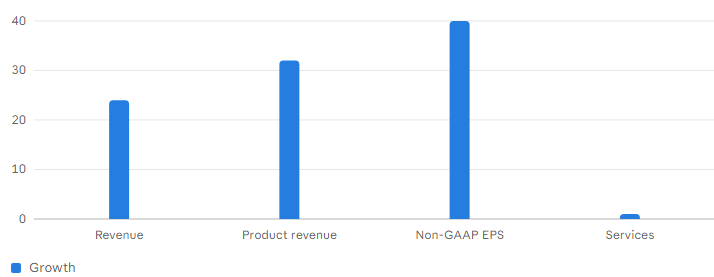
Cisco Q1 FY2027: year-over-year growth (%)
% change by Source: Cisco earnings release and coverage
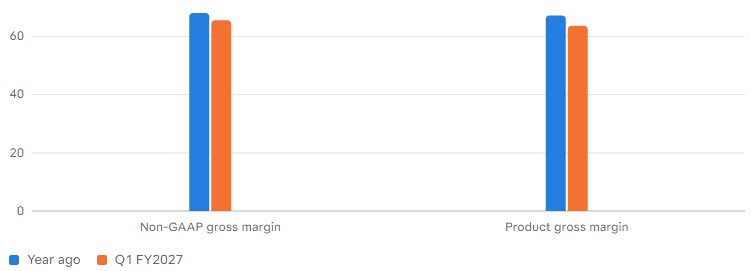
Gross margin squeeze (%)
% of revenue by Source: Cisco results; prior-year figures implied by reported bps declines
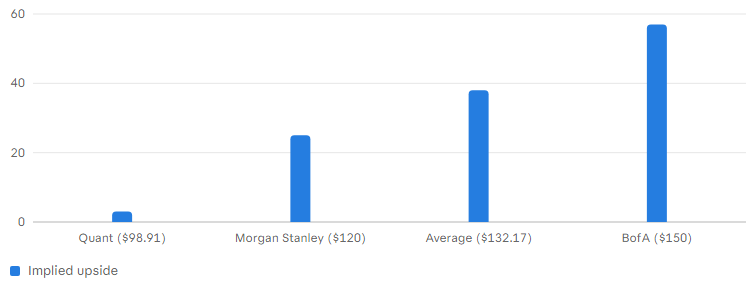
Upside to price targets from $95.64 (%)
% upside by My calculation; targets may be stale
The quick answer
Cisco delivered its fastest revenue growth in more than 15 years, raised its full-year outlook, and still watched its shares drop about 6% the next day. That gap between a great-looking report and a weak market reaction is the whole story, and it is why the question "is Cisco a buy?" is harder than it looks?My short take, which is a framing and not a recommendation: the business is clearly strong, but the quality of that growth is now under debate. More of the revenue is coming from lower-margin AI hardware, order growth slowed, and the company stopped sharing a number investors had been watching closely. Whether that is a buying opportunity or a warning depends on how much you trust the margin to recover.
Key takeaway: Strong headline numbers, softer details. The shares fell because of margins, orders and visibility, not because revenue missed.
What Cisco actually reported
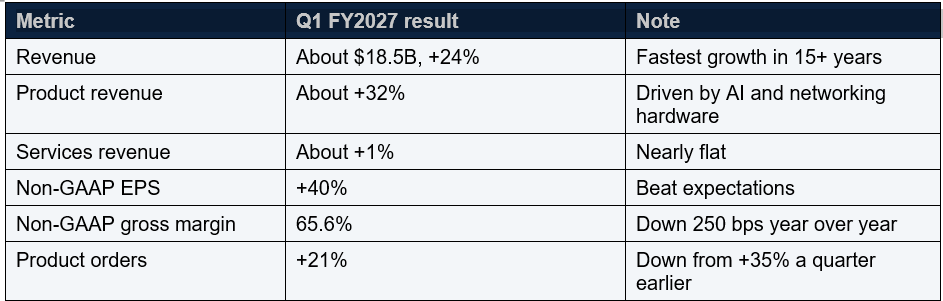
Cisco's fiscal first quarter of 2027 ended in late October. Revenue rose 24% year over year to roughly $18.5 billion, non-GAAP earnings per share rose 40%, and product revenue grew about 32% [1][2]. Services revenue was nearly flat, up around 1%, so almost all of the growth came from selling hardware and networking gear.Cash flow was also healthy, with operating cash flow up about 36% according to the coverage I retrieved [6]. Management raised its fiscal 2027 outlook and lifted its AI infrastructure order target from hyperscale customers to $9 billion.
Using the reported figures, non-GAAP gross profit works out to about $12.1 billion this quarter against about $10.1 billion a year ago, roughly 20% growth (my calculation). Notice that this is slower than the 24% revenue growth. That small difference is the first clue to what spooked investors.
Why the stock fell anyway
When a stock falls after a beat-and-raise, it usually means the market expected more than a beat. Cisco's shares closed at $102.01 on 12 November and at $95.64 on 13 November, a 6.24% drop (my reading of the quoted prices) [5][7]. Several things combined.First, expectations were high. The stock had already climbed sharply this year before the report. Sources disagree on the exact year-to-date gain, with some saying about 35% and others closer to 24%, so I would not lean on either figure. Either way, a stock that has run hard has less room for disappointment. A Morgan Stanley downgrade earlier in November added to the cautious mood.
Second, the details underneath the headline were weaker than the headline itself. Margins fell, order growth slowed, and a closely watched disclosure was dropped. The next four sections take these one at a time.
The gross margin squeeze
The biggest concern is gross margin. Non-GAAP gross margin fell 250 basis points to 65.6%, and product gross margin fell about 350 basis points to 63.7% [7][11]. Coverage attributes this to a richer mix of lower-margin AI hardware and to higher memory costs.This matters because Cisco historically earned premium margins from software, security and campus networking. AI infrastructure sales to large cloud customers tend to be big and lumpy but thinner on margin. If AI hardware becomes a larger share of sales, the company can grow revenue quickly while profit grows more slowly.
To put the size of the hit in perspective, each 250 basis points of gross margin on $18.5 billion of revenue is roughly $0.46 billion of gross profit per quarter (my calculation). That is meaningful, though not catastrophic, and it is the reason EPS growth of 40% still looked strong.
The question to ask: Is the margin dip a temporary mix and cost issue, or the new normal as AI becomes a bigger part of Cisco? The report does not settle this.
Slowing product orders
Orders are a leading indicator, and this is where growth showed signs of cooling. Product orders rose 21%, down from 35% growth in the previous quarter. Excluding hyperscalers, product orders grew about 14%, compared with roughly 25% before.Those are still good numbers by the standards of a mature networking company. But the direction is what investors react to. A business growing 24% in revenue today and ordering 21% more product suggests growth may moderate, not accelerate, in the quarters ahead. Slower orders from customers outside the hyperscalers also suggest the broader enterprise refresh cycle may be less powerful than hoped.
The disclosure change
Cisco also stopped disclosing hyperscaler AI orders in the same way it had before, according to the coverage I retrieved. Companies change reporting for many legitimate reasons, such as simplifying metrics or aligning to how they run the business. Still, investors tend to read the removal of a number they were tracking as a loss of visibility, especially right after the number had been central to the bull case.The company did raise its AI target to $9 billion from hyperscalers, which is a positive signal [10]. My calculation puts that at around 12% of the new fiscal 2027 revenue midpoint of about $75.3 billion. That is a meaningful slice, but it also shows that the bulk of Cisco is still its traditional business.
Guidance: raised year, softer quarter
Cisco raised its fiscal 2027 outlook. Based on the reported ranges, the revenue midpoint moved from about $72.8 billion to about $75.3 billion, up roughly 3.4%, and the EPS midpoint moved from about $5.08 to about $5.50, up roughly 8.3% (my calculation from the midpoints).The sting came from the second-quarter guide. The revenue midpoint of about $18.1 billion is roughly 2.2% below the first quarter (my calculation). Management's finance chief also flagged tougher comparisons and less visibility in the second half of the year [3]. So the full-year guide went up, but the near-term path looks bumpy. That is a classic setup for a sell-off: a stronger year, but a sequential dip and caution about later quarters.
Valuation: what you pay
At $95.64, the stock trades at roughly 17.4 times the new fiscal 2027 EPS midpoint of $5.50 (my calculation). At the prior close of $102.01, that figure was about 18.5 times. Both are reasonable for a company growing earnings this quickly, and below what many AI-linked hardware names command.Be careful with the multiples you see online, because they use different bases. One source cites about 25.4 times trailing GAAP earnings, another a stale 28.4 times, and forward estimates sit near 19 times. These are not contradictions so much as different yardsticks, and some of the figures may be dated. I could not retrieve the full quarterly filing or peer valuations, so I cannot tell you whether Cisco is cheap versus competitors.
A fair summary is that the price already assumes decent execution, but it does not assume perfection. The earnings multiple is not extreme, which is part of why some analysts see the drop as an opening.
Analyst views and conflicting numbers
Analyst reactions are mixed, and the numbers I found conflict. One compilation shows an average price target near $132, which would imply about 38% upside from $95.64 (my calculation). Morgan Stanley's target of $120 implies about 25%, Bank of America's $150 implies about 57%, and a lower quantitative target near $99 implies only about 3%.Treat these with caution. Targets are often set before an earnings report and updated afterwards, so some figures may be stale. Analysts also have incentives and track records that vary widely. A wide spread like this is itself informative: professionals disagree about how much the margin issue matters. Be careful: Price targets are opinions, not forecasts you can bank on. Use them to see the range of views, not as a promise.
Dividend and buybacks
Cisco pays a dividend, and the yield is around 1.65% according to Yahoo Finance, while my own calculation using $1.68 annual dividends gives about 1.76% at $95.64. The gap is likely down to timing and the exact dividend figure used. I could not retrieve the latest dividend declaration details, so check them before relying on the number.As an illustration only, $10,000 would buy about 104.6 shares at $95.64 and produce roughly $176 a year in dividends if the payout stayed at $1.68 (my calculation, before tax and ignoring any change in the dividend).
On buybacks, the company repurchased shares at around $111.53 in the fourth quarter of fiscal 2026, per the coverage I saw. Today's price is about 14% below that (my calculation). Buybacks at higher prices look worse in hindsight, but repurchasing shares at lower prices now would stretch each dollar further.
Bull case versus bear case
The bull case: record growth, rising guidance, a $9 billion AI order target, strong cash flow and a forward multiple in the high teens. If margins stabilise as AI volumes scale, earnings could keep outgrowing revenue.The bear case: margin pressure from mix and memory costs, slowing orders, a softer next quarter, reduced disclosure, and a stock that had already climbed before the report. If margins keep sliding, a high-teens multiple could prove less cheap than it looks. Both cases rest on the same facts. The difference is whether you view the margin drop as a bump or a trend. Nobody, including me, can know that today.
What to watch next
If you follow Cisco, these are the data points I would track over the next few quarters, in rough order of importance: Gross margin: does the non-GAAP figure stabilise near 65% or keep falling? Product margin is the one to watch. Order growth: especially outside the hyperscalers, where growth slowed the most. Hyperscaler progress: how Cisco reports its AI orders now, and whether it moves toward the $9 billion target. Second-half commentary: management warned about tougher comparisons and less visibility. Services growth: near-flat services revenue limits how much the recurring-revenue story can help.Rather than asking "is it a buy?", try these questions. How long is your time horizon? A multi-year holder can often tolerate a rough quarter better than someone who needs the money soon. How much of your portfolio is already in technology? Does a dividend near 1.7% matter to your plan? And would you still be comfortable owning the stock if it fell another 15%?
These questions will not give you an answer, but they will point you to the right one for your situation. If you are unsure, a licensed adviser can look at your whole financial picture, which a blog post cannot.
Conclusion
Cisco's report was objectively strong on revenue, earnings and guidance, which is why the sell-off feels puzzling. The details explain it: gross margin fell 250 basis points, order growth slowed, a key disclosure was removed, and the next quarter is guided lower than this one.That leaves a real debate rather than an obvious answer. At roughly 17 times forward earnings with a dividend and a raised outlook, bulls have a fair argument. With margins under pressure and visibility falling, bears do too. Do your own research, consider your own situation, and remember that this post is education, not advice.
FAQ
Why did Cisco stock fall after a beat-and-raise quarter?Mainly because of a 250 basis point drop in non-GAAP gross margin, slower product order growth, a softer second-quarter revenue guide and reduced disclosure on hyperscaler AI orders.
Is Cisco a buy right now?
I cannot tell you that. The business is growing fast and trades near 17 times forward earnings by my calculation, but margin pressure is a real risk. The answer depends on your goals, time horizon and risk tolerance.
How much is Cisco's dividend?
Yahoo Finance shows a yield of about 1.65%. My calculation using $1.68 a year gives about 1.76% at $95.64. Check the latest declaration before relying on either number.
What is the $9 billion AI target?
Cisco raised its target for AI infrastructure orders from hyperscale customers to $9 billion ([10]). By my calculation that is roughly 12% of the fiscal 2027 revenue midpoint.
Where can I check the numbers myself?
Start with Cisco's earnings release and filings on its investor relations site, then compare with independent coverage, as listed in the references below.
0 Comments
Be the first to share your thoughts on this article.