

Investing
How to Reach $4,000/Month in Passive Income: Dividend Basics

The arithmetic, the trade-offs and a realistic timeline, explained plainly. $48,000 a year needed; $1.6M at a 3% yield, $960,000 at 5%; SCHD about 2.96% yield, VYM about 2.15%, VIG about 1.48%; qualified dividends taxed at 0%, 15% or 20%.
I will be direct about one thing up front: dividend investing is a sound way to build income, but it is not a shortcut. The "passive" part arrives after years of saving.
Key takeaway: Required portfolio = $48,000 divided by your yield. A lower, steadier yield means a bigger pot but a safer income. A higher yield means a smaller pot but a bigger chance of cuts.
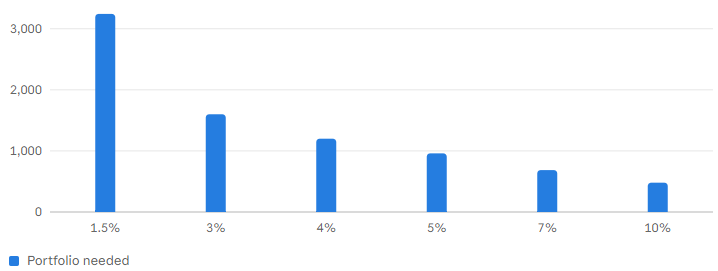
For $4,000 a month, the goal is $48,000 a year. Divide by 0.03 and you get $1.6 million. Divide by 0.05 and you get $960,000. That is all the maths there is. Everything else in this post is about choosing the yield sensibly and getting to the number.
There is one useful way to size your own target: use your real spending. One source points out that if your actual annual costs are $40,000 instead of $48,000, you could need $200,000 less capital. Another says a paid-off house and Medicare eligibility might cut the income needed by about a third, though that depends heavily on your circumstances.
Also consider Social Security if you are in the US. The Social Security Administration estimated the average monthly benefit for an aged couple, both receiving benefits, at $3,208 in January 2026. So for some retirees, $4,000 a month may be the total they want from all sources, which lowers what the dividend portfolio must produce.
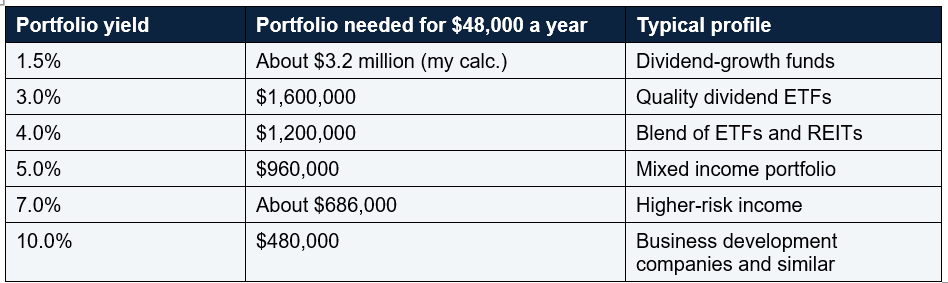
The gap between a 3% and a 10% yield is more than $1.1 million of capital. That is why people chase yield. It is also why you should be cautious about doing so.
A 24/7 Wall St. article gives concrete examples from its 10% tier. Ares Capital (ARCC) yielded about 10.4%, but booked about $412 million of net unrealized losses in the first quarter of 2026, and its non-accrual loans rose to 2%. Main Street Capital's first-quarter distributable net investment income of $1.00 did not cover total dividends of $1.08. Both stocks were down for the year at the time.
The same article warns that if net asset value erodes, part of a high yield may be a return of your own capital, and that a high starting yield with no growth stays flat in dollars and can trail a lower-yield portfolio that raises its payout each year.
Even a quality REIT shows how yields move. Realty Income was quoted at 5.1% in one July article and 5.2% in another. Those differences come from the date and price used. The point is that every yield in this post is a snapshot, not a promise. Covered-call funds that pay very high income have their own quirk. One source notes they derive income mostly from selling options, so payouts vary with volatility, and that distributions of this type are generally taxed as ordinary income.

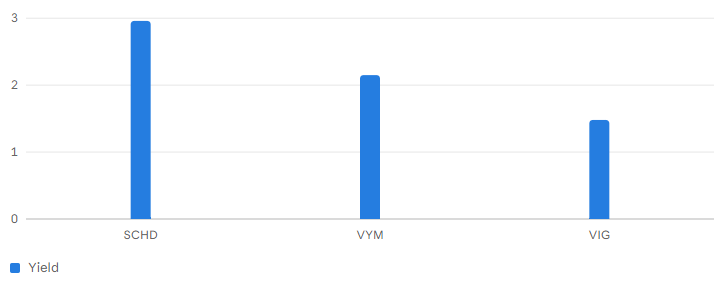
Notice how different the yields are. VIG pays the least today but is described as growing its dividend fastest, at about 10% a year according to one source [9]. SCHD pays the most of the three but includes a quality screen.
Sources disagree on the figures, which is normal. I saw SCHD yields between about 2.9% and 3.2% across pages, and one older page showed about 3.5%. Expense ratios also varied: one page listed VIG at 0.05% and others at 0.04%. Always check the fund company's own page for the current numbers before you buy.
Using the SCHD yield above, $4,000 a month would take about $1.63 million (my calculation: $48,000 divided by 2.95%). Using VYM's yield it would take about $2.2 million, and using VIG's, about $3.2 million. That is the honest price of safer, lower yields.
A blended approach is common. One illustrative mix from 24/7 Wall St. is 60% dividend growers, 30% REITs and utilities and 10% business development companies, targeting a blended yield near 5% and about $960,000. I show it as an example of how people think, not as a plan for you.
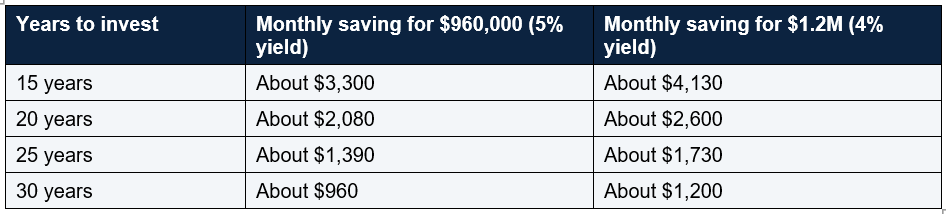
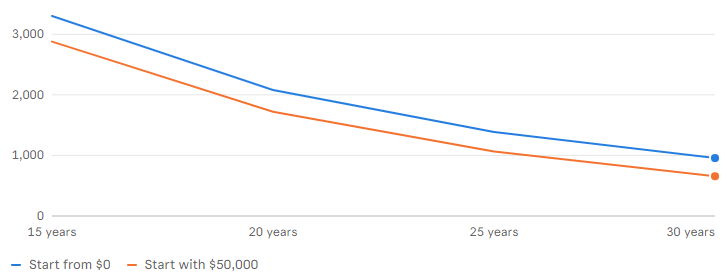
If you start with $50,000 already invested, the 30-year figures fall to about $660 and $900 a month, and the 20-year figures to about $1,720 and $2,240 (my calculation). Starting early and staying consistent matters more than which fund you pick.
There is one more way to see it, known as yield on cost. If a portfolio yields 3% today and its dividends grow 6% a year, then after 20 years the income on your original purchase price would be about 9.6% (my calculation: 3% times 1.06 raised to 20). That is one reason the lower-yield, growing approach can catch up with a high-yield one that stays flat. It depends on dividends actually growing, which is never certain.
To see what this means for $4,000 a month, here are some simple cases for $48,000 of qualified dividends (my calculation, ignoring other income and deductions): at a 0% rate you keep $4,000 a month. At 15% you pay $7,200 a year and keep about $3,400 a month. To net $4,000 a month after a flat 15% tax, you would need about $56,500 a year in gross dividends, which means roughly 18% more capital. Whether you reach the 0% rate depends on your total taxable income, because dividends stack on top of your other income. This is where a tax professional is worth paying.
Beyond cuts, there is price risk. Share prices fall in downturns even when dividends hold. If you depend on selling shares to cover a shortfall, you take losses at the worst time. That is why many retirees keep a cash buffer for a year or two of spending. Finally, inflation. A $4,000 monthly income that never grows buys less each year. Dividend growth helps, which is one reason a lower starting yield with growth can be attractive.
Using stale numbers. Yields, thresholds and fund fees change. Check the date on everything.
Dividends do arrive without you doing any work, which is the passive part. But getting to the point where they cover $4,000 a month usually takes years of regular saving, and then you still need to review holdings, deal with taxes and watch for cuts. I think "low-maintenance" is a fairer word than "passive". That is not a criticism of the approach. It is just worth knowing before you start, so the timeline does not come as a surprise.
For most people the route is regular saving over many years, low-cost diversified funds, reinvested dividends and a realistic eye on taxes. My illustration suggests that saving roughly $1,400 to $2,100 a month for 20 to 25 years could get to a $960,000 pot at an assumed 6% return, though real results will vary. Start with your actual spending, keep the plan simple, and review it each year. This post is education only, not advice.
It depends on the yield. Divide $48,000 by your yield: about $1.6 million at 3%, $960,000 at 5% and $480,000 at 10%.
What dividend yield is realistic for beginners?
Broad dividend ETFs yielded roughly 1.5% to 3% in November 2026 ([5]). Higher yields exist but usually carry more risk of the payout being cut.
Are dividends taxed?
Yes, in regular accounts. Qualified dividends are taxed at 0%, 15% or 20%, and ordinary dividends at regular income rates.
How long will it take?
At an assumed 6% annual return, saving about $2,100 a month for 20 years could reach about $960,000 (my calculation). Starting with savings or saving more shortens it.
Is dividend income guaranteed?
No. Companies and funds can cut or suspend payouts, and share prices can fall even when dividends continue.
Table of Contents
- The quick answer
- The one formula you need
- What the target looks like at different yields
- Why higher yield is not automatically better
- Three beginner building blocks
- How long it could take
- Taxes: what you actually keep
- Where to hold the investments
- Reinvest first, spend later
- A step-by-step beginner plan
- Stress test: what if dividends are cut?
- Common mistakes
- Bull case versus bear case
- Conclusion
- FAQ
Portfolio needed for $4,000/month by dividend yield ($ thousands)
US$ thousands by Yield; $48,000 a year divided by yield (DividendVision; 1.5% is my calc.)
Dividend ETF yields, November 2026 (%)
% yield by Source: DividendVision (sources vary by page and date)
Monthly saving needed to reach $960,000 (assumed 6% return)
US$ per month by My calculation; 6% annual return is an assumption, not a forecastThe quick answer
To receive $4,000 a month from dividends you need $48,000 a year in dividend income. How much money that requires depends almost entirely on the yield of what you own. At a 3% yield it takes about $1.6 million. At 5% it takes about $960,000, and at 10% about $480,000. That last figure looks tempting, but a 10% yield usually comes with far more risk of the payout shrinking. This guide explains the formula, the realistic ways to build the pot, how long it could take, and what taxes do to the result. It is education, not a recommendation.I will be direct about one thing up front: dividend investing is a sound way to build income, but it is not a shortcut. The "passive" part arrives after years of saving.
Key takeaway: Required portfolio = $48,000 divided by your yield. A lower, steadier yield means a bigger pot but a safer income. A higher yield means a smaller pot but a bigger chance of cuts.
The one formula you need
The formula is simple: annual income goal divided by dividend yield equals the portfolio you need. A dividend yield is just the yearly dividend as a percentage of the price.For $4,000 a month, the goal is $48,000 a year. Divide by 0.03 and you get $1.6 million. Divide by 0.05 and you get $960,000. That is all the maths there is. Everything else in this post is about choosing the yield sensibly and getting to the number.
There is one useful way to size your own target: use your real spending. One source points out that if your actual annual costs are $40,000 instead of $48,000, you could need $200,000 less capital. Another says a paid-off house and Medicare eligibility might cut the income needed by about a third, though that depends heavily on your circumstances.
Also consider Social Security if you are in the US. The Social Security Administration estimated the average monthly benefit for an aged couple, both receiving benefits, at $3,208 in January 2026. So for some retirees, $4,000 a month may be the total they want from all sources, which lowers what the dividend portfolio must produce.
What the target looks like at different yields
Here is the table for a $4,000 monthly target, combining figures from two sources and my own divisions.The gap between a 3% and a 10% yield is more than $1.1 million of capital. That is why people chase yield. It is also why you should be cautious about doing so.
Why higher yield is not automatically better
A high yield can mean a company or fund is paying a lot, or it can mean the share price has fallen because investors expect trouble. Both look the same on a yield screen.A 24/7 Wall St. article gives concrete examples from its 10% tier. Ares Capital (ARCC) yielded about 10.4%, but booked about $412 million of net unrealized losses in the first quarter of 2026, and its non-accrual loans rose to 2%. Main Street Capital's first-quarter distributable net investment income of $1.00 did not cover total dividends of $1.08. Both stocks were down for the year at the time.
The same article warns that if net asset value erodes, part of a high yield may be a return of your own capital, and that a high starting yield with no growth stays flat in dollars and can trail a lower-yield portfolio that raises its payout each year.
Even a quality REIT shows how yields move. Realty Income was quoted at 5.1% in one July article and 5.2% in another. Those differences come from the date and price used. The point is that every yield in this post is a snapshot, not a promise. Covered-call funds that pay very high income have their own quirk. One source notes they derive income mostly from selling options, so payouts vary with volatility, and that distributions of this type are generally taxed as ordinary income.
Three beginner building blocks
Many beginners start with low-cost dividend exchange-traded funds, because one fund holds many companies. These are examples of a type of fund, not recommendations. Here are three popular ones with yields reported in mid-November 2026.Notice how different the yields are. VIG pays the least today but is described as growing its dividend fastest, at about 10% a year according to one source [9]. SCHD pays the most of the three but includes a quality screen.
Sources disagree on the figures, which is normal. I saw SCHD yields between about 2.9% and 3.2% across pages, and one older page showed about 3.5%. Expense ratios also varied: one page listed VIG at 0.05% and others at 0.04%. Always check the fund company's own page for the current numbers before you buy.
Using the SCHD yield above, $4,000 a month would take about $1.63 million (my calculation: $48,000 divided by 2.95%). Using VYM's yield it would take about $2.2 million, and using VIG's, about $3.2 million. That is the honest price of safer, lower yields.
A blended approach is common. One illustrative mix from 24/7 Wall St. is 60% dividend growers, 30% REITs and utilities and 10% business development companies, targeting a blended yield near 5% and about $960,000. I show it as an example of how people think, not as a plan for you.
How long it could take
Few people start with a million dollars, so the question becomes: how much do you need to save each month? Here is my own illustration. It assumes your portfolio earns 6% a year in total, with dividends reinvested, and that contributions are made monthly. The 6% is an assumption I chose, not a forecast, and markets can do much better or worse.If you start with $50,000 already invested, the 30-year figures fall to about $660 and $900 a month, and the 20-year figures to about $1,720 and $2,240 (my calculation). Starting early and staying consistent matters more than which fund you pick.
There is one more way to see it, known as yield on cost. If a portfolio yields 3% today and its dividends grow 6% a year, then after 20 years the income on your original purchase price would be about 9.6% (my calculation: 3% times 1.06 raised to 20). That is one reason the lower-yield, growing approach can catch up with a high-yield one that stays flat. It depends on dividends actually growing, which is never certain.
Taxes: what you actually keep
Dividends are taxable income in a regular brokerage account. Qualified dividends are taxed at 0%, 15% or 20% depending on your taxable income, while ordinary dividends are taxed at your regular rates, which can reach 37%. For 2026, the 0% rate applies up to $49,450 of taxable income for single filers and $98,900 for married couples filing jointly. The 15% rate runs up to $545,500 (single) or $613,700 (joint), and the 20% rate applies above that. Some websites still show the 2025 thresholds of $48,350 and $96,700 for 2026, so check the date on anything you read. High earners may also owe a 3.8% net investment income tax once modified adjusted gross income passes $200,000 (single) or $250,000 (joint), and those thresholds are not adjusted for inflation.To see what this means for $4,000 a month, here are some simple cases for $48,000 of qualified dividends (my calculation, ignoring other income and deductions): at a 0% rate you keep $4,000 a month. At 15% you pay $7,200 a year and keep about $3,400 a month. To net $4,000 a month after a flat 15% tax, you would need about $56,500 a year in gross dividends, which means roughly 18% more capital. Whether you reach the 0% rate depends on your total taxable income, because dividends stack on top of your other income. This is where a tax professional is worth paying.
Where to hold the investments
Where you hold dividend investments matters. In general, tax-advantaged retirement accounts such as IRAs and 401(k)s shelter dividends from yearly tax, while a regular brokerage account does not. That is general knowledge and the specific rules vary by account type and country. One of my sources says that high-yield covered-call funds are usually best held in an IRA or 401(k), because their distributions are generally taxed as ordinary income. Qualified dividends from ordinary companies are already taxed more lightly, so they are less urgent to shelter. If you live outside the US, the tax rules on dividends, withholding on US shares and the available tax-free accounts differ a lot. I have not covered them here, so please check local guidance.Reinvest first, spend later
There is a sensible order for most people. While you are still building, reinvest dividends so that they buy more shares, which then pay more dividends. When you are ready to live on the income, switch the reinvestment off. Another source suggests the pot can be built faster by combining reinvestment with regular contributions. It shows how a $235,000 portfolio at a 5.1% weighted yield could produce about $1,000 a month, and says that adding $500 to $1,000 a month plus reinvested dividends could get there in about five to eight years. That is a smaller target than ours, but it illustrates the pattern. Scaling the same idea to $4,000 a month means a target roughly four times larger, which is why timelines run to decades, not years, unless you already have a large sum.A step-by-step beginner plan
Here is a plain sequence a beginner could follow. It is a framework, not advice.- Set your real number. Work out what you actually spend, and what other income you expect. Your target may be smaller than $4,000.
- Build an emergency fund first, so you never have to sell investments at a bad time.
- Use tax-advantaged accounts where they suit you, and keep a record of the account types.
- Choose low-cost, diversified funds as the core. Check expense ratios and the current yield on the provider's own page.
- Decide on your yield target. Remember the table: higher yield, smaller pot, bigger risk.
- Automate monthly contributions, so saving does not depend on motivation.
- Reinvest dividends until you need the income.
- Review once a year: check that payouts are covered, rebalance if needed, and revisit the target.
Stress test: what if dividends are cut?
Every income plan should be tested against a bad year. A 24/7 Wall St. piece suggests assuming a 20% distribution cut on the high-yield business development company part of a portfolio and checking whether your budget still works. If it does not, make that part smaller. Here is my own example using the blended portfolio above. If $960,000 is split 60/30/10 and the 10% sleeve, which is $96,000, yields 10%, it produces $9,600 a year. A 20% cut costs $1,920 a year, or about 4% of the $48,000 goal (my calculation). That is survivable. A portfolio that was entirely high-yield funds would feel the same cut across all of its income.Beyond cuts, there is price risk. Share prices fall in downturns even when dividends hold. If you depend on selling shares to cover a shortfall, you take losses at the worst time. That is why many retirees keep a cash buffer for a year or two of spending. Finally, inflation. A $4,000 monthly income that never grows buys less each year. Dividend growth helps, which is one reason a lower starting yield with growth can be attractive.
Common mistakes
Chasing the highest yield. As the examples above show, a 10% yield can go with falling asset values and uncovered payouts . Ignoring total return. A fund can pay a large dividend and still lose money overall if its price keeps falling. Concentrating on a few names. One source warns that concentration in five stocks strips out the diversification a broad fund provides, and a $900,000 portfolio has a thinner cushion than a $2 million one when one holding cuts. Forgetting taxes. A plan built on gross dividends can fall short once tax is deducted.Using stale numbers. Yields, thresholds and fund fees change. Check the date on everything.
Dividends do arrive without you doing any work, which is the passive part. But getting to the point where they cover $4,000 a month usually takes years of regular saving, and then you still need to review holdings, deal with taxes and watch for cuts. I think "low-maintenance" is a fairer word than "passive". That is not a criticism of the approach. It is just worth knowing before you start, so the timeline does not come as a surprise.
Bull case versus bear case
The bull case for dividend investing: regular cash, a clear target, low-cost funds make it easy to start, dividend growth can lift income over time, and qualified dividends get lighter tax treatment than wages. The bear case: the required capital is large at sensible yields, dividends can be cut, high yields hide risk, and a stock-heavy portfolio can still fall sharply in a downturn. Both are true at once, which is why the plan should be sized to your needs and tested against a bad year.Conclusion
Reaching $4,000 a month in dividend income comes down to one equation: $48,000 divided by the yield. At about 3% that is roughly $1.6 million, and at 5% about $960,000. Lower yields are steadier but need more capital. Higher yields need less but carry more risk of cuts.For most people the route is regular saving over many years, low-cost diversified funds, reinvested dividends and a realistic eye on taxes. My illustration suggests that saving roughly $1,400 to $2,100 a month for 20 to 25 years could get to a $960,000 pot at an assumed 6% return, though real results will vary. Start with your actual spending, keep the plan simple, and review it each year. This post is education only, not advice.
FAQ
How much do I need to invest to earn $4,000 a month in dividends?It depends on the yield. Divide $48,000 by your yield: about $1.6 million at 3%, $960,000 at 5% and $480,000 at 10%.
What dividend yield is realistic for beginners?
Broad dividend ETFs yielded roughly 1.5% to 3% in November 2026 ([5]). Higher yields exist but usually carry more risk of the payout being cut.
Are dividends taxed?
Yes, in regular accounts. Qualified dividends are taxed at 0%, 15% or 20%, and ordinary dividends at regular income rates.
How long will it take?
At an assumed 6% annual return, saving about $2,100 a month for 20 years could reach about $960,000 (my calculation). Starting with savings or saving more shortens it.
Is dividend income guaranteed?
No. Companies and funds can cut or suspend payouts, and share prices can fall even when dividends continue.
0 Comments
Be the first to share your thoughts on this article.