
Investing
Nvidia After Huang's Exit: How Far Could Stock Fall by 2027?

Where the stock could fall to by the end of 2027, and what could stop it. Written 17 November 2026, before Nvidia’s results. Shares fell as much as 13% to 14% on the news; $162.85 close on 13 November, 31.9% below the 6 October record; consensus target $327.14 (pre-resignation); about 12 times next fiscal year's earnings before the drop.
The headline asks a fair question: is the resignation the least of Nvidia's problems? My reading of the evidence is that the leadership change is one of several overlapping risks, and not necessarily the biggest. The others are the first earnings report without Mr Huang on 17 November, a political backlash against AI data centres, China and export-control scrutiny, heavy dependence on a handful of customers, and the question of who runs the company next.
On where the stock could fall to by the end of 2027, I do not have a crystal ball. What I can do is show what different valuation multiples would imply on current analyst earnings estimates. On that arithmetic, a pessimistic case lands around $95 to $127 a share, against $162.85 now. A recovery case lands far higher. The range is wide because the uncertainty is wide.
Key takeaway: The business may be strong, but the share price now has to absorb a CEO change, an earnings test, political risk and geopolitical risk at once. How far it falls depends less on chips than on how much investors are willing to pay for each dollar of earnings.
Reports then named a Chinese businesswoman, described as a suspected agent of China, and a separate relationship with a senior Nvidia executive who reported to him. A company linked to the businesswoman, Megaspeed, said she left in August 2025 and denied wrongdoing, saying it conducts legitimate and lawful business. These are allegations and denials as reported, and I cannot verify them.
On 12 November Nvidia filed a regulatory notice saying Mr Huang had resigned as president, chief executive and board member, effective immediately. Chief financial officer Colette Kress became interim CEO while keeping her finance role, and the board began a search for a permanent successor. One source says the board decided the night before to oust him.
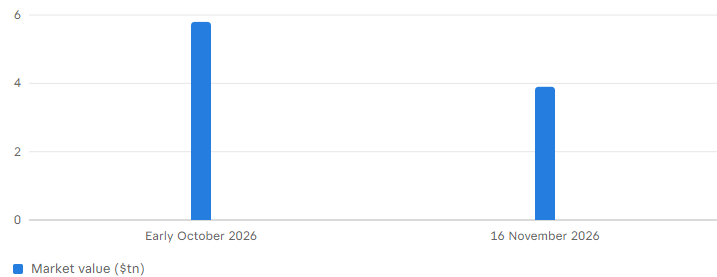
Nvidia had been valued at about $4 trillion, according to CNBC. A separate report says the shares have lost roughly 30% since early October, erasing about $1.7 trillion of market value.
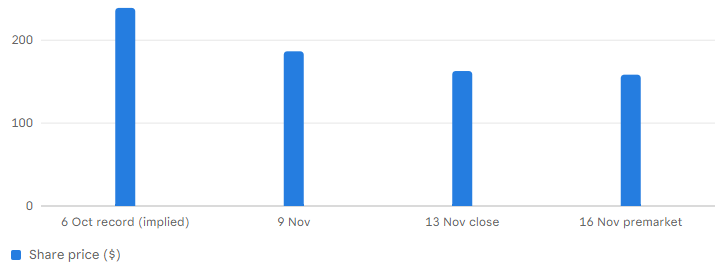
By 9 November a financial site had the shares at $186.64, down 21.4% over a month against a 5.56% fall for the S&P 500. Another report says the saga had already driven the shares to eight-month lows over national security concerns. Then the resignation came. Yahoo Finance had the stock at $162.61 on 13 November, down 28.8% over one month, after falling as much as 14% at the open on the news. Note that Axios says 13%, so the exact intraday low differs by source.
So there are really two stories layered together. One is a pre-existing sell-off tied to politics and AI spending worries. The other is the leadership shock. Separating them matters, because it means that fixing the leadership question alone might not bring the price back.
Analysts quoted by Yahoo Finance say they will listen less for the quarter and more for the backlog [8]. One preview describes the central risk as management confirming guidance while investors still fear customer-financing or relationship disruption, and the stock keeps falling regardless. Because this post was written the day before the report, I cannot tell you the result. If you are reading it afterwards, check how the shares reacted.
Another site describes a market worried about regulation and construction freezes after the election. I would not read too much into that one source, but it fits the wider picture.
There is also an uncomfortable overlap. Fortune argues that the board acted just days after a sweeping midterm result curtailed the President's power. Whether or not you agree with that framing, it shows that the political backdrop has changed for the whole sector.
A different report says officials suspect Megaspeed of diverting Nvidia chips to China in violation of export controls. Megaspeed has denied wrongdoing. Meanwhile, 24/7 Wall St notes that reports say companies linked to the businesswoman kept buying Nvidia chips, and that the board says it has no reason to believe national security or company secrets were compromised.
Nvidia's own annual report warns that US licensing decisions, and China's encouragement of local competitors, can hurt its sales and push customers towards alternatives. Washington officials have also called for greater scrutiny of the company. The investigation is the swing factor. The same 24/7 Wall St piece says findings that Mr Huang compromised company secrets, or binding federal limits on data-centre construction, would break the bullish thesis. I would add that a clean finding would remove a major overhang.
On the positive side, there is a $99 billion buyback authorisation remaining, and earnings estimates have kept rising, with the fiscal 2028 EPS estimate going from $12.81 to $15.91 in 90 days and no downward revisions in 30 days. The market is pricing the stock as if those estimates will not hold.
Yahoo Finance warns that an outsider announcement could cause a sharp gap in either direction, because the market is repricing leadership uncertainty rather than chips. Another analyst worry is that a lobbying fight could distract Ms Kress from rebuilding investor confidence. Founder-led companies carry a premium for vision. Losing the founder means losing some of that premium, at least until a successor proves themselves. That is a judgement on my part, not a data point.
At the $162.85 close on 13 November, the stock trades at about 10 times that estimate and 17.5 times the fiscal 2027 estimate of $9.31 (my calculation). Before the fall it was about 12 times next year's earnings.
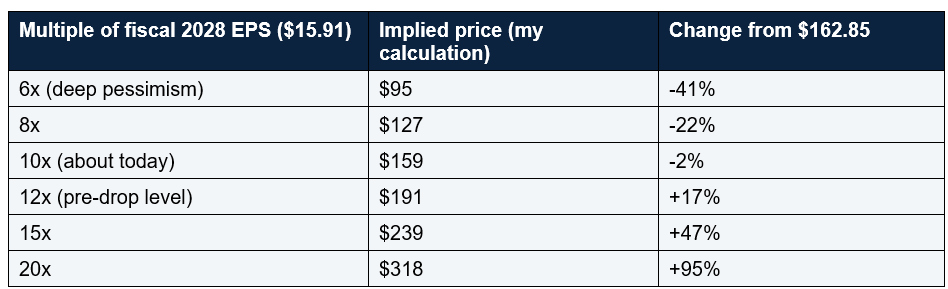
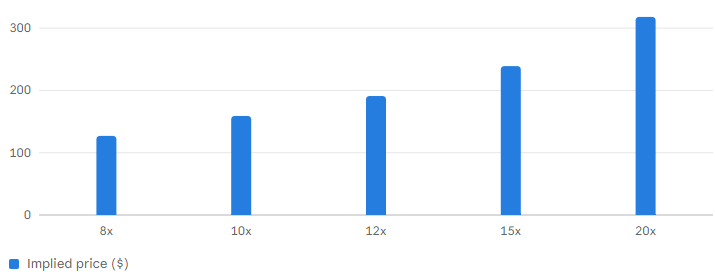
So a fall to $95 to $127 would need either a lower multiple than today's, or a cut to earnings estimates, or both. For example, a 25% cut to EPS combined with 8 times earnings gives about $95 (my calculation). A return to the pre-drop 12 times would imply about $191, and the $327.14 consensus target in the 24/7 Wall St article would need about 20 times, though it is a pre-resignation figure and may be revised.
The stock is also volatile. 24/7 Wall St lists a beta of 2.247, meaning it has tended to move more than twice as much as the market. Big swings in both directions are normal.
One reference point from a different source is that adjusted earnings multiples have averaged 35.7 over ten years, against 26.8 at one point cited by the finance app post. That multiple basis differs from mine, so I do not mix them. My point is only that Nvidia has traded far above today's levels. I cannot say which scenario is likeliest. A reasonable reader could argue for any row. What I would say is that an end-2027 price below today's needs something to go wrong with earnings, not just a lower mood.
A few things would move my view, and they are worth watching. The first is the guidance and tone on 17 November. The second is the board's search for a permanent CEO, and whether the successor is an insider or an outsider. The third is the investigation's findings and any official statements on chip diversion or national security. The fourth is how fast customers pay, shown by DSO. The fifth is any US legislation on data-centre building. Finally, watch whether analysts cut their fiscal 2028 EPS estimates, because that would shift every row in the table above.
If you own Nvidia, perhaps through an index fund, a sharp drop does not mean you must act. Many people hold it through funds that also own hundreds of other companies. If you hold individual shares, consider how much of your portfolio they represent, and whether a single stock's swings would cause you to sell at the wrong time. This is the point where a plan matters more than a prediction.
If you are thinking of buying the dip, the same logic applies. A cheaper price does not mean a safe one, and the next few weeks will bring news on earnings and the investigation. Spreading purchases over time is one common way to avoid betting everything on a single day, though it does not remove risk.
None of this is a recommendation. Consider speaking to a regulated financial adviser about your own circumstances.
The resignation may well be the least of Nvidia's problems or the most visible one. What decides the outcome is the earnings power underneath, and whether investors trust it. Watch the results, the investigation and the board's choice of successor, and keep your decisions tied to your own plan.
He resigned on 12 November 2026 after reports of extramarital relationships, including one with a woman described as a suspected Chinese agent. He admitted infidelity, and the board had launched an investigation.
Who is running Nvidia now?
CFO Colette Kress is interim CEO while keeping her finance role, and the board is searching for a permanent successor.
How far did the stock fall?
Shares fell as much as 13% to 14% on the news, and closed on 13 November at $162.85, 31.9% below the 6 October record.
How far could Nvidia stock fall by the end of 2027?
Nobody knows. My arithmetic on consensus earnings suggests about $95 to $127 if investors pay 6 to 8 times next fiscal year's earnings, but these are scenarios, not forecasts.
Is Nvidia a buy after the resignation?
I cannot say. It depends on your goals, timeline and risk tolerance, and the 17 November results and the investigation may change the picture. Consider speaking to a regulated adviser.
Table of Contents
- The quick answer
- What actually happened
- Why the stock fell so hard
- Problem 1: The 17 November earnings test
- Problem 2: Washington and the data-centre backlash
- Problem 3: China, export controls and the investigation
- Problem 4: Customer concentration and the balance sheet
- Problem 5: Who runs Nvidia next?
- Where the stock could fall to by end-2027
- Bull case versus bear case
- Conclusion
- FAQ
Nvidia market value ($ trillions)
US dollars, trillions by Source: LSEG data cited by Investing.com
Implied Nvidia price by multiple of FY2028 EPS ($15.91)
US dollars by My calculation on 24/7 Wall St consensus EPS; scenarios, not forecasts
Nvidia forward P/E and price fall
US dollars by Sources: BigGo, 24/7 Wall St, FinanceFeeds; record is my calculationThe quick answer
Jensen Huang, who co-founded Nvidia 33 years ago, resigned as chief executive on 12 November 2026. The shares fell as much as 13% on the news before recovering somewhat, and closed on Friday 13 November at $162.85, 31.9% below their 6 October record.The headline asks a fair question: is the resignation the least of Nvidia's problems? My reading of the evidence is that the leadership change is one of several overlapping risks, and not necessarily the biggest. The others are the first earnings report without Mr Huang on 17 November, a political backlash against AI data centres, China and export-control scrutiny, heavy dependence on a handful of customers, and the question of who runs the company next.
On where the stock could fall to by the end of 2027, I do not have a crystal ball. What I can do is show what different valuation multiples would imply on current analyst earnings estimates. On that arithmetic, a pessimistic case lands around $95 to $127 a share, against $162.85 now. A recovery case lands far higher. The range is wide because the uncertainty is wide.
Key takeaway: The business may be strong, but the share price now has to absorb a CEO change, an earnings test, political risk and geopolitical risk at once. How far it falls depends less on chips than on how much investors are willing to pay for each dollar of earnings.
What actually happened
The timeline moved fast. On 8 November Mr Huang wrote to employees admitting an extramarital affair, and the same day Nvidia's board said it had launched an independent investigation amid reports that he was the target of a foreign intelligence effort [5]. Mr Huang admitted being unfaithful to his wife and apologised to his family and to Nvidia employees.Reports then named a Chinese businesswoman, described as a suspected agent of China, and a separate relationship with a senior Nvidia executive who reported to him. A company linked to the businesswoman, Megaspeed, said she left in August 2025 and denied wrongdoing, saying it conducts legitimate and lawful business. These are allegations and denials as reported, and I cannot verify them.
On 12 November Nvidia filed a regulatory notice saying Mr Huang had resigned as president, chief executive and board member, effective immediately. Chief financial officer Colette Kress became interim CEO while keeping her finance role, and the board began a search for a permanent successor. One source says the board decided the night before to oust him.
Nvidia had been valued at about $4 trillion, according to CNBC. A separate report says the shares have lost roughly 30% since early October, erasing about $1.7 trillion of market value.
Why the stock fell so hard
It is tempting to blame the whole fall on the resignation, but the chart says otherwise. The stock was already under pressure before the news. A user post on a finance app says it dropped 9.26% to $181.60 on 5 November, about 24% below its record close of $239.24, after Democrats won in the midterms and investors worried about regulation and data-centre construction freezes. That source is lower quality, so treat the details with care.By 9 November a financial site had the shares at $186.64, down 21.4% over a month against a 5.56% fall for the S&P 500. Another report says the saga had already driven the shares to eight-month lows over national security concerns. Then the resignation came. Yahoo Finance had the stock at $162.61 on 13 November, down 28.8% over one month, after falling as much as 14% at the open on the news. Note that Axios says 13%, so the exact intraday low differs by source.
So there are really two stories layered together. One is a pre-existing sell-off tied to politics and AI spending worries. The other is the leadership shock. Separating them matters, because it means that fixing the leadership question alone might not bring the price back.
Problem 1: The 17 November earnings test
The next test is immediate. Nvidia reports its third-quarter fiscal 2027 results on Tuesday 17 November after the US close, with the call at 5pm New York time. Consensus points to roughly $109 billion of revenue and adjusted earnings of $2.47 a share. Management's own revenue guidance was $108 billion and it excluded China. The company has beaten earnings estimates for six straight quarters, according to 24/7 Wall St, and its last quarter showed revenue up 105.8% to $96.22 billion. A beat is therefore expected. What matters more is the outlook, and the tone from Ms Kress, who faces analysts as interim CEO for the first time.Analysts quoted by Yahoo Finance say they will listen less for the quarter and more for the backlog [8]. One preview describes the central risk as management confirming guidance while investors still fear customer-financing or relationship disruption, and the stock keeps falling regardless. Because this post was written the day before the report, I cannot tell you the result. If you are reading it afterwards, check how the shares reacted.
Problem 2: Washington and the data-centre backlash
The second problem is political. The 24/7 Wall St article says Democrats gained full control of Congress after running against unchecked data-centre expansion, and that a Texas governor-elect promised a moratorium on new data centres. The timing of any legislation is unknown. A legal or political curb on data-centre building would hit Nvidia, because its growth depends on customers building more of them.Another site describes a market worried about regulation and construction freezes after the election. I would not read too much into that one source, but it fits the wider picture.
There is also an uncomfortable overlap. Fortune argues that the board acted just days after a sweeping midterm result curtailed the President's power. Whether or not you agree with that framing, it shows that the political backdrop has changed for the whole sector.
Problem 3: China, export controls and the investigation
The third problem is China. Nvidia's third-quarter guidance excludes China, which means any China revenue would be upside, not a base assumption. Invezz says Nvidia's revenue from Chinese data centres is near zero, and that lawmakers from both parties are pushing for tougher chip-export curbs after the Huang reports.A different report says officials suspect Megaspeed of diverting Nvidia chips to China in violation of export controls. Megaspeed has denied wrongdoing. Meanwhile, 24/7 Wall St notes that reports say companies linked to the businesswoman kept buying Nvidia chips, and that the board says it has no reason to believe national security or company secrets were compromised.
Nvidia's own annual report warns that US licensing decisions, and China's encouragement of local competitors, can hurt its sales and push customers towards alternatives. Washington officials have also called for greater scrutiny of the company. The investigation is the swing factor. The same 24/7 Wall St piece says findings that Mr Huang compromised company secrets, or binding federal limits on data-centre construction, would break the bullish thesis. I would add that a clean finding would remove a major overhang.
Problem 4: Customer concentration and the balance sheet
The fourth problem is less visible: who is paying for all this? Gene Munster of Deepwater Asset Management estimated in an older article that Nvidia's top eight customers may represent as much as 80% of its business. That is an estimate, not a company disclosure. The same 24/7 Wall St article lists $279 billion in supply commitments, guarantee obligations of up to $108.5 billion, and days sales outstanding that rose to 60 days from 45, and says a capex slowdown would hit all three. Higher DSO means customers are taking longer to pay. None of this proves trouble, but it explains why investors worry about financing and customer relationships.On the positive side, there is a $99 billion buyback authorisation remaining, and earnings estimates have kept rising, with the fiscal 2028 EPS estimate going from $12.81 to $15.91 in 90 days and no downward revisions in 30 days. The market is pricing the stock as if those estimates will not hold.
Problem 5: Who runs Nvidia next?
The fifth problem is leadership itself. Harvey Jones, a former Synopsys CEO, chairs the board, and Ms Kress said she is committed to building on the foundation Mr Huang created over 33 years. One report says the board has approached Arm CEO Rene Haas as a potential successor. That is a single-source report, so I would not treat it as settled. The same report mentions comeback talk for Mr Huang, but analyst Daniel Ives says there is no chance of a comeback and favours either a new external CEO or Ms Kress.Yahoo Finance warns that an outsider announcement could cause a sharp gap in either direction, because the market is repricing leadership uncertainty rather than chips. Another analyst worry is that a lobbying fight could distract Ms Kress from rebuilding investor confidence. Founder-led companies carry a premium for vision. Losing the founder means losing some of that premium, at least until a successor proves themselves. That is a judgement on my part, not a data point.
Where the stock could fall to by end-2027
Now to the question in the headline. A stock price is roughly earnings multiplied by what investors will pay per dollar of earnings. I will use the fiscal 2028 consensus EPS of $15.91 from 24/7 Wall St. That is a pre-resignation estimate, and it could be cut, so treat it as an upper bound for pessimistic scenarios. Fiscal 2028 ends in January 2028, so it covers most of 2027.At the $162.85 close on 13 November, the stock trades at about 10 times that estimate and 17.5 times the fiscal 2027 estimate of $9.31 (my calculation). Before the fall it was about 12 times next year's earnings.
So a fall to $95 to $127 would need either a lower multiple than today's, or a cut to earnings estimates, or both. For example, a 25% cut to EPS combined with 8 times earnings gives about $95 (my calculation). A return to the pre-drop 12 times would imply about $191, and the $327.14 consensus target in the 24/7 Wall St article would need about 20 times, though it is a pre-resignation figure and may be revised.
The stock is also volatile. 24/7 Wall St lists a beta of 2.247, meaning it has tended to move more than twice as much as the market. Big swings in both directions are normal.
One reference point from a different source is that adjusted earnings multiples have averaged 35.7 over ten years, against 26.8 at one point cited by the finance app post. That multiple basis differs from mine, so I do not mix them. My point is only that Nvidia has traded far above today's levels. I cannot say which scenario is likeliest. A reasonable reader could argue for any row. What I would say is that an end-2027 price below today's needs something to go wrong with earnings, not just a lower mood.
Bull case versus bear case
The bull case: earnings estimates are rising, not falling; the company keeps beating; Vera Rubin is in full production at several major cloud providers; analysts remain bullish, with 59 of 62 rating it Buy or Strong Buy; and a clean investigation plus a strong report could refocus attention on demand. The bear case: leadership uncertainty, a political backlash against data centres, possible export-control tightening, customer concentration, rising DSO and large supply commitments. Analysts' ratings are also slow to react, and the consensus target pre-dates the resignation. A fair summary is that both cases rest on assumptions about things nobody can yet measure, such as the investigation's findings and the legislative outcome.A few things would move my view, and they are worth watching. The first is the guidance and tone on 17 November. The second is the board's search for a permanent CEO, and whether the successor is an insider or an outsider. The third is the investigation's findings and any official statements on chip diversion or national security. The fourth is how fast customers pay, shown by DSO. The fifth is any US legislation on data-centre building. Finally, watch whether analysts cut their fiscal 2028 EPS estimates, because that would shift every row in the table above.
If you own Nvidia, perhaps through an index fund, a sharp drop does not mean you must act. Many people hold it through funds that also own hundreds of other companies. If you hold individual shares, consider how much of your portfolio they represent, and whether a single stock's swings would cause you to sell at the wrong time. This is the point where a plan matters more than a prediction.
If you are thinking of buying the dip, the same logic applies. A cheaper price does not mean a safe one, and the next few weeks will bring news on earnings and the investigation. Spreading purchases over time is one common way to avoid betting everything on a single day, though it does not remove risk.
None of this is a recommendation. Consider speaking to a regulated financial adviser about your own circumstances.
Conclusion
Jensen Huang's resignation is a major event, but the stock's difficulties run wider: an earnings test on 17 November, political risk, China and export controls, customer concentration and an uncertain succession. On earnings estimates at the time of writing, a pessimistic outcome by end-2027 could be around $95 to $127 a share, while a recovery could take it well above $190 (my calculations, not forecasts).The resignation may well be the least of Nvidia's problems or the most visible one. What decides the outcome is the earnings power underneath, and whether investors trust it. Watch the results, the investigation and the board's choice of successor, and keep your decisions tied to your own plan.
FAQ
Why did Jensen Huang resign from Nvidia?He resigned on 12 November 2026 after reports of extramarital relationships, including one with a woman described as a suspected Chinese agent. He admitted infidelity, and the board had launched an investigation.
Who is running Nvidia now?
CFO Colette Kress is interim CEO while keeping her finance role, and the board is searching for a permanent successor.
How far did the stock fall?
Shares fell as much as 13% to 14% on the news, and closed on 13 November at $162.85, 31.9% below the 6 October record.
How far could Nvidia stock fall by the end of 2027?
Nobody knows. My arithmetic on consensus earnings suggests about $95 to $127 if investors pay 6 to 8 times next fiscal year's earnings, but these are scenarios, not forecasts.
Is Nvidia a buy after the resignation?
I cannot say. It depends on your goals, timeline and risk tolerance, and the 17 November results and the investigation may change the picture. Consider speaking to a regulated adviser.
0 Comments
Be the first to share your thoughts on this article.