
Investing
Best Blue Chip Stocks: 21 Hedge Fund Top Picks: Complete Guide

Blue chips dominate the stocks hedge funds own most. Here is the list, what it does and does not tell you, and the risks of copying the crowd. Amazon held by 1,021 hedge funds (47%); Microsoft 949; Nvidia 912; hedge fund index 5.8% in 2025 vs S&P 500 nearly 18%; 22 big funds net sold $8.65B of AI stocks in Q3 2026.
Number of hedge funds by Source: Kiplinger, citing WhaleWisdom and SEC 13F filings
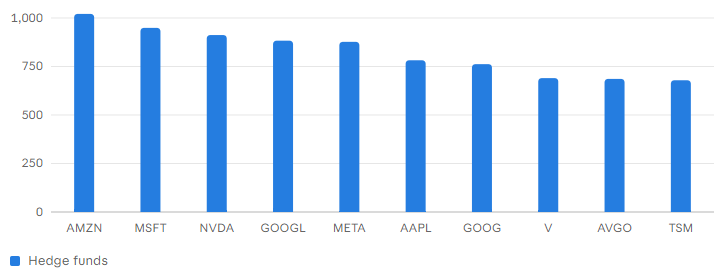
If you want to know what professional investors own, hedge fund filings are the obvious place to look. The 21 hedge fund favourites is topped by Amazon, held by 1,021 hedge funds or 47% of those it tracks, followed by Microsoft with 949 and Nvidia with 912. Eight of the top ten are technology or internet-related names, counting both Alphabet share classes (my classification), and the rest are household blue chips.
But there is a catch that every honest article on this topic should lead with. Kiplinger itself says hedge funds have a "rather poor long-term track record" against the broader market, and that not all blue chip stocks are equal. A popular holding is not a recommendation, and a list built from quarterly filings is always looking backwards. So read this post as a map, not a shopping list. It shows where the big money has been, why the names look the way they do, and what risks come with owning the same stocks as everyone else.
Key takeaway: Hedge funds love large, liquid blue chips, so the list is dominated by them. That tells you where the crowd is, not whether the stocks will beat the market from here.
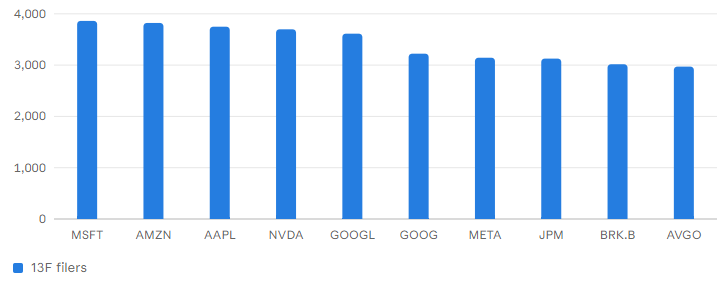
A second note on the data: different lists use different universes. Kiplinger's list draws on WhaleWisdom and SEC filings and counts roughly 2,170 hedge funds, implied by 1,021 being 47% (my calculation). Arkolith's Q3 2026 board covers 5,655 distinct 13F filers, and its own methodology note says that although the page headline says hedge funds, the universe is tracked 13F filers. Both agree on the top names, but the counts are not comparable.
One more wrinkle: the article was first published in August 2022 and last updated on 25 August 2026, yet it refers to market returns through October 2026. That date mismatch suggests the page has been refreshed more than once, so treat its holdings as "end of a recent third quarter" and check the filings before relying on any specific number.
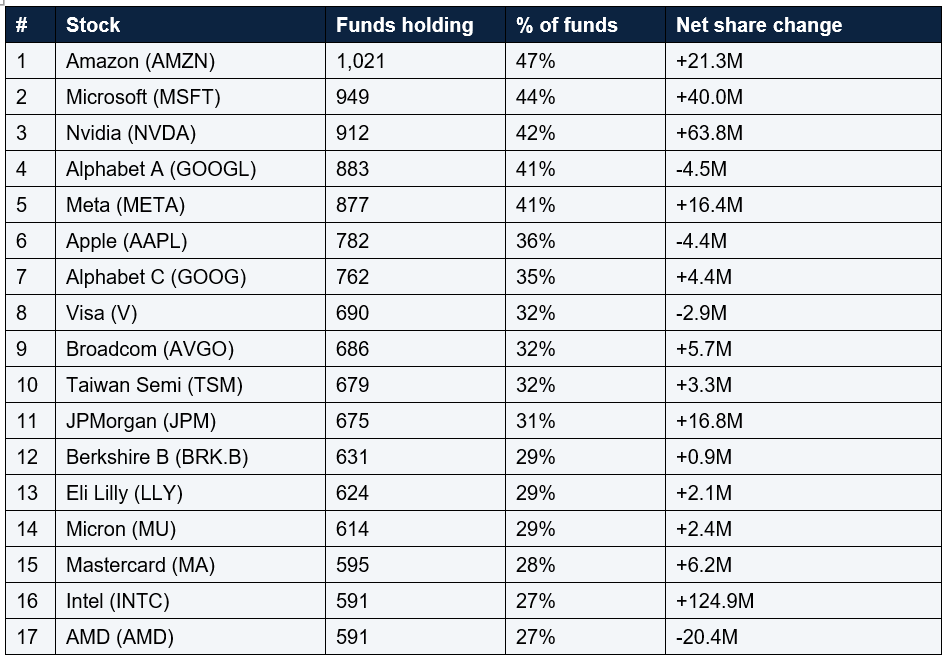

Notice how steep the top is. Amazon is held by nearly half of the funds, and by the time you reach number 21, Tesla, it is still held by about a quarter. Blue chip stocks, thanks to their massive market capitalisations and deep liquidity, are a natural home for hedge funds and other large pools of capital.
Goldman Sachs tracks the same idea with its "Hedge Fund VIP" list of the 50 stocks that appear most often among hedge funds' ten largest positions. It describes the most popular bets as remaining in mega-cap tech, with Microsoft, Amazon and Meta on the list [8]. The VIP list is built from funds with between 10 and 200 distinct US equity positions, a screen meant to isolate concentrated, fundamentally driven funds. The simple reason these stocks dominate is size. With market values in the trillions, they are among the few companies a fund running billions can buy without moving the price. That is a practical reason, not necessarily a verdict on their prospects.
Goldman's research highlights a small set of "shared favourites" held heavily by both hedge funds and mutual funds, including Mastercard, Visa, Boeing, Capital One, SpaceX and Thermo Fisher. In Citadel's Q3 filing, share counts rose in Microsoft and Mastercard and fell in Amazon and Apple. Berkshire is a special case. It is itself a big 13F filer, with reported 13F value of $299.25 billion at 30 June and $304.20 billion at 30 September, up 1.7%. It held none of the AI chip and data-centre stocks tracked in that comparison.
Q3 filings show hedge funds rotating within the group. Renaissance Technologies cut Nvidia by about 99.7% and rotated into Micron, AMD and SpaceX, but the same source stresses that Renaissance is a systematic fund, so its filing should not be read as a considered call on AI. In another analysis of eight funds, Nvidia and TSMC were net sold by $2.5 billion while Micron was bought by every fund that changed its holding.
There were buyers too. The largest single buy in that tracker was Coatue Management's Microsoft position at $1.81 billion, followed by Coatue's Meta at $1.44 billion, Lone Pine Capital's Amazon at $1.39 billion and Renaissance's Micron at $1.39 billion. And Citadel added Microsoft and Mastercard while cutting Amazon by more than half .
So the same stock can appear on a most-held list while some funds are buying and others are selling. Arkolith shows Microsoft with 2,105 funds buying or opening, Nvidia with 1,970 and Amazon with 1,957 in Q3 2026, even as some filers trimmed. Another cautionary note from the filings: a 13F is a snapshot at 30 September. Nvidia's leadership news came in November, after the snapshot date, so the filings do not reflect what has happened since.
Goldman's VIP basket has done better than the average fund at times. One summary says the basket outperformed the S&P 500 in 59% of quarters since 2001, with an average quarterly outperformance of 43 basis points. That summary does not say which year it is from, so I would not read it as a current claim. Put together: hedge funds as an industry have lagged a simple index in recent years, but their favourite stocks are not necessarily poor. A fund's returns reflect fees, hedges and strategy as well as stock picking, so you cannot read one from the other.
Fourth, remember the delay. By the time a 13F is public, the fund may have changed its mind. And fifth, think about costs and taxes. Frequent trading to chase fund moves can erode returns. If this feels complicated, a licensed adviser can help, and a low-cost diversified fund is a respectable default.
Before buying any of these 21 stocks, ask yourself a few questions. Why do I want this stock, apart from the fact that big funds own it? How much of my portfolio is already in large technology companies? What is my plan if it falls 30%? Do I understand the risks specific to this company, such as regulation, competition or heavy spending?
Also ask whether you are comfortable being in a crowded trade. If the answer is yes, you are making an informed choice. If the answer is "I did not think about that", pause and run the numbers on a broader approach.
On Kiplinger's list, Amazon (1,021 funds), Microsoft (949) and Nvidia (912) lead, followed by Alphabet, Meta and Apple.
What is a 13F filing?
A quarterly report of long stock holdings, filed up to 45 days after quarter-end, which omits short positions. It is a delayed snapshot, not a live view.
Do hedge funds beat the market?
Not recently. The Barclay Hedge Fund Index returned 5.8% in 2025, against nearly 18% for the S&P 500.
Should I copy hedge fund stock picks?
Not blindly. Filings are delayed, hedges and shorts are hidden, and crowded trades can reverse quickly. Use the list as research, not instructions.
Did hedge funds buy or sell AI stocks in Q3 2026?
Both. One tracker found 22 large funds net sold $8.65 billion of 13 AI chip and data-centre stocks, while others added Microsoft, Meta and Micron.
Table of Contents
- The quick answer
- What "hedge fund top picks" really means
- The 21 blue chips at a glance
- Mega-cap tech at the top
- Payments, banks and Berkshire
- Chips beyond Nvidia
- Healthcare, energy and Tesla
- What hedge funds actually did in Q3 2026
- Crowding: the risk of a popular trade
- Do hedge funds beat the market?
- How to use this list sensibly
- Conclusion
- FAQ
Top 10 blue chips by number of hedge funds holding them
Number of hedge funds by Source: Kiplinger, citing WhaleWisdom and SEC 13F filings
Wider 13F universe, Q3 2026: filers holding each stock
Number of filers by Source: Arkolith, 5,655 tracked 13F filers (not only hedge funds)
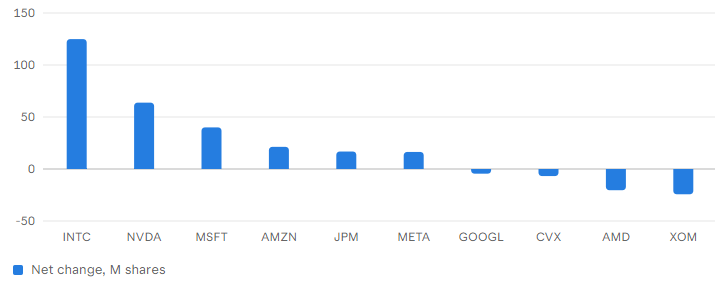
Net change in shares held by hedge funds (millions)
Millions of shares by Source: Kiplinger, quarterly 13F data (selected names)If you want to know what professional investors own, hedge fund filings are the obvious place to look. The 21 hedge fund favourites is topped by Amazon, held by 1,021 hedge funds or 47% of those it tracks, followed by Microsoft with 949 and Nvidia with 912. Eight of the top ten are technology or internet-related names, counting both Alphabet share classes (my classification), and the rest are household blue chips.
But there is a catch that every honest article on this topic should lead with. Kiplinger itself says hedge funds have a "rather poor long-term track record" against the broader market, and that not all blue chip stocks are equal. A popular holding is not a recommendation, and a list built from quarterly filings is always looking backwards. So read this post as a map, not a shopping list. It shows where the big money has been, why the names look the way they do, and what risks come with owning the same stocks as everyone else.
Key takeaway: Hedge funds love large, liquid blue chips, so the list is dominated by them. That tells you where the crowd is, not whether the stocks will beat the market from here.
What "hedge fund top picks" really means
Hedge funds in the United States disclose their long stock holdings in quarterly filings called 13Fs. One tracker notes that these arrive up to 45 days after quarter-end and omit short positions. Arkolith adds that its data covers long positions only, excludes options, and is a point-in-time snapshot with a quarterly lag. Those limits matter. A fund could have sold a stock the day after the quarter ended, or be hedged with a short you cannot see, or hold the stock only for a trading strategy. Kiplinger also reminds readers that fourth-quarter holdings will not be disclosed until mid-January.A second note on the data: different lists use different universes. Kiplinger's list draws on WhaleWisdom and SEC filings and counts roughly 2,170 hedge funds, implied by 1,021 being 47% (my calculation). Arkolith's Q3 2026 board covers 5,655 distinct 13F filers, and its own methodology note says that although the page headline says hedge funds, the universe is tracked 13F filers. Both agree on the top names, but the counts are not comparable.
One more wrinkle: the article was first published in August 2022 and last updated on 25 August 2026, yet it refers to market returns through October 2026. That date mismatch suggests the page has been refreshed more than once, so treat its holdings as "end of a recent third quarter" and check the filings before relying on any specific number.
The 21 blue chips at a glance
Here is the full list in order, with the number of hedge funds holding each stock and the net change in shares held over the quarter. The percentages are the share of hedge funds in its dataset.Notice how steep the top is. Amazon is held by nearly half of the funds, and by the time you reach number 21, Tesla, it is still held by about a quarter. Blue chip stocks, thanks to their massive market capitalisations and deep liquidity, are a natural home for hedge funds and other large pools of capital.
4. Mega-cap tech at the top
The first six names are all technology or internet giants: Amazon, Microsoft, Nvidia, Alphabet (in two share classes), Meta and Apple. Alphabet appears twice because it has two listed share classes, so if you count the company once the "21" is really 20 companies (my calculation). Arkolith's broader Q3 2026 board shows the same pattern. Microsoft is held by 3,862 of 5,655 filers, Amazon by 3,822, Apple by 3,749, Nvidia by 3,698 and Alphabet A by 3,613. By dollar value, Nvidia leads at $677.5 billion, while Microsoft is held by the most funds.Goldman Sachs tracks the same idea with its "Hedge Fund VIP" list of the 50 stocks that appear most often among hedge funds' ten largest positions. It describes the most popular bets as remaining in mega-cap tech, with Microsoft, Amazon and Meta on the list [8]. The VIP list is built from funds with between 10 and 200 distinct US equity positions, a screen meant to isolate concentrated, fundamentally driven funds. The simple reason these stocks dominate is size. With market values in the trillions, they are among the few companies a fund running billions can buy without moving the price. That is a practical reason, not necessarily a verdict on their prospects.
Payments, banks and Berkshire
The next group is financials and payments. Visa is number 8 with 690 funds and Mastercard is number 15 with 595. JPMorgan Chase is number 11 with 675 and Berkshire Hathaway Class B is number 12 with 631. Visa and Mastercard operate payment networks, while JPMorgan is a large US bank and Berkshire is a conglomerate; those descriptions are general knowledge, not drawn from the sources.Goldman's research highlights a small set of "shared favourites" held heavily by both hedge funds and mutual funds, including Mastercard, Visa, Boeing, Capital One, SpaceX and Thermo Fisher. In Citadel's Q3 filing, share counts rose in Microsoft and Mastercard and fell in Amazon and Apple. Berkshire is a special case. It is itself a big 13F filer, with reported 13F value of $299.25 billion at 30 June and $304.20 billion at 30 September, up 1.7%. It held none of the AI chip and data-centre stocks tracked in that comparison.
Chips beyond Nvidia
The semiconductor names on the list tell a story about the AI build-out. Broadcom (686 funds), Taiwan Semiconductor (679), Micron (614), Intel (591) and AMD (591) all make the top 21, besides Nvidia. Intel stands out in the table. Kiplinger shows a net change of about 124.9 million shares held, by far the largest increase on the list. By contrast, AMD saw a net decrease of about 20.4 million shares. A large share-count increase can reflect a big price move or a turnaround bet, and the filing cannot tell you which.Q3 filings show hedge funds rotating within the group. Renaissance Technologies cut Nvidia by about 99.7% and rotated into Micron, AMD and SpaceX, but the same source stresses that Renaissance is a systematic fund, so its filing should not be read as a considered call on AI. In another analysis of eight funds, Nvidia and TSMC were net sold by $2.5 billion while Micron was bought by every fund that changed its holding.
Healthcare, energy and Tesla
Healthcare, energy and an electric-vehicle maker round out the list. Eli Lilly (624 funds) and Johnson & Johnson (582) represent healthcare, ExxonMobil (576) and Chevron (554) represent energy, and Tesla (550) is the last of the 21. For the two oil majors, hedge funds were net sellers by about 24.3 million and 6.8 million shares respectively. Arkolith's board gives a useful cross-check from a wider universe: Lilly is held by 2,857 filers, J&J by 2,854, Exxon by 2,606, Tesla by 2,598 and Chevron by 2,529. The same broader board shows Walmart, Costco, AbbVie and Home Depot in its top 20, which suggests the Kiplinger hedge fund list is more tech-heavy than the wider institutional picture. That is worth thinking about. If your goal is a diversified blue chip portfolio, the hedge fund list on its own leans heavily toward one sector, and adds energy and healthcare as a sprinkling. A broad index fund may be a more balanced way to own the same large companies.What hedge funds actually did in Q3 2026
The most recent filings, covering the third quarter of 2026, show the smart money rotating more than piling in. FourWeekMBA reports that 22 large managers were net sellers of $8.65 billion of shares in 13 AI chip and data-centre stocks in the quarter, by its reading of their filings. Reuters, as summarised there, said institutional enthusiasm for data-centre stocks waned in the third quarter.There were buyers too. The largest single buy in that tracker was Coatue Management's Microsoft position at $1.81 billion, followed by Coatue's Meta at $1.44 billion, Lone Pine Capital's Amazon at $1.39 billion and Renaissance's Micron at $1.39 billion. And Citadel added Microsoft and Mastercard while cutting Amazon by more than half .
So the same stock can appear on a most-held list while some funds are buying and others are selling. Arkolith shows Microsoft with 2,105 funds buying or opening, Nvidia with 1,970 and Amazon with 1,957 in Q3 2026, even as some filers trimmed. Another cautionary note from the filings: a 13F is a snapshot at 30 September. Nvidia's leadership news came in November, after the snapshot date, so the filings do not reflect what has happened since.
Crowding: the risk of a popular trade
Crowding means too many investors holding the same stocks. Goldman Sachs said in July that hedge fund bets on US stocks were the most crowded ever [8]. Crowding can help while the trade works, since buyers keep pushing prices up. It becomes a problem when funds sell at once. Hedgeweek reported that hedge funds endured their sharpest monthly underperformance against the S&P 500 in more than two decades in July, as a reversal in AI stocks forced managers to cut positions and reduce exposure to crowded trades. The same article notes that popular AI-linked stocks had helped drive strong second-quarter returns and crowding had reached record levels. The lesson is not to avoid blue chips. It is to know that owning the same ten stocks as everyone else adds a risk of its own: when the trade reverses, the sellers are all in the same exit. Position size and diversification matter more than the name on the ticker.10. Do hedge funds beat the market?
Here is the uncomfortable part. The Barclay Hedge Fund Index returned 5.8% in 2025, while the S&P 500 returned nearly 18%. Through October 2026, the S&P 500 returned almost 12%, beating the hedge fund index by about 7 percentage points, which implies a hedge fund index return of roughly 5% (my calculation). There are fair reasons. Hedging limits upside in rising markets, which helps explain underperformance in bull runs, and Barclays Capital Solutions noted hedge funds "captured only a fraction of the drawdown" in 2022, when the MSCI World Index fell 18% [1]. In other words, hedge funds sell protection, and protection costs returns when markets rise.Goldman's VIP basket has done better than the average fund at times. One summary says the basket outperformed the S&P 500 in 59% of quarters since 2001, with an average quarterly outperformance of 43 basis points. That summary does not say which year it is from, so I would not read it as a current claim. Put together: hedge funds as an industry have lagged a simple index in recent years, but their favourite stocks are not necessarily poor. A fund's returns reflect fees, hedges and strategy as well as stock picking, so you cannot read one from the other.
How to use this list sensibly
If you want to use this list, use it for ideas, not instructions. Start with your own goals: how long you can hold, how much risk you can tolerate and what you already own. If you hold an S&P 500 index fund, you already own most of these companies, and buying more means concentrating in the same names. Second, understand the company before the crowd. For any name on the list, read the latest annual report and earnings call, check valuation against your own standards, and ask what would make you sell. Third, size positions so that a 30% drop in one stock would not wreck your plan.Fourth, remember the delay. By the time a 13F is public, the fund may have changed its mind. And fifth, think about costs and taxes. Frequent trading to chase fund moves can erode returns. If this feels complicated, a licensed adviser can help, and a low-cost diversified fund is a respectable default.
Before buying any of these 21 stocks, ask yourself a few questions. Why do I want this stock, apart from the fact that big funds own it? How much of my portfolio is already in large technology companies? What is my plan if it falls 30%? Do I understand the risks specific to this company, such as regulation, competition or heavy spending?
Also ask whether you are comfortable being in a crowded trade. If the answer is yes, you are making an informed choice. If the answer is "I did not think about that", pause and run the numbers on a broader approach.
Conclusion
Hedge funds' most popular holdings are dominated by blue chips because those companies are big, liquid and profitable enough to absorb billions in capital. Amazon, Microsoft and Nvidia lead the Kiplinger list, with Visa, JPMorgan, Lilly and Tesla among the rest. The Q3 2026 filings show funds rotating, not stampeding. The list is a useful snapshot of where professional money sits, but it is not a forecast. Hedge funds as a group have lagged the S&P 500 recently, crowding is a real risk, and filings are always out of date. Use the list to learn, then build a plan that fits your own goals.FAQ
Which stocks do hedge funds own most?On Kiplinger's list, Amazon (1,021 funds), Microsoft (949) and Nvidia (912) lead, followed by Alphabet, Meta and Apple.
What is a 13F filing?
A quarterly report of long stock holdings, filed up to 45 days after quarter-end, which omits short positions. It is a delayed snapshot, not a live view.
Do hedge funds beat the market?
Not recently. The Barclay Hedge Fund Index returned 5.8% in 2025, against nearly 18% for the S&P 500.
Should I copy hedge fund stock picks?
Not blindly. Filings are delayed, hedges and shorts are hidden, and crowded trades can reverse quickly. Use the list as research, not instructions.
Did hedge funds buy or sell AI stocks in Q3 2026?
Both. One tracker found 22 large funds net sold $8.65 billion of 13 AI chip and data-centre stocks, while others added Microsoft, Meta and Micron.
0 Comments
Be the first to share your thoughts on this article.