
Investing
AI Chips Commoditized: Nvidia Has Most to Lose, 3 Stocks Win

Nvidia has a lot to lose if AI chips become interchangeable, while a few chip stocks could gain. Nvidia Q3 FY27 revenue $115.8B, up 103%; custom AI ASIC shipments forecast up 44.6% vs 16.1% for merchant GPUs in 2026; Broadcom AI revenue $16.7B, up 221%; TSMC HPC 68% of Q3 revenue.
% of market by Sources: Tom's Hardware, Motley Fool/IDC, Built In, Advisor Perspectives
The idea behind the headline is simple. If AI chips become commoditized, meaning one vendor's accelerator can be swapped for another's with little loss, the company charging the most has the most to lose. That is Nvidia. Bloomberg's reporting, republished by Advisor Perspectives, says Nvidia charges about $30,000 per chip for its high-end accelerators and that its profit margins have expanded to a remarkable 75%, roughly 20 points wider than those of its nearest rivals.
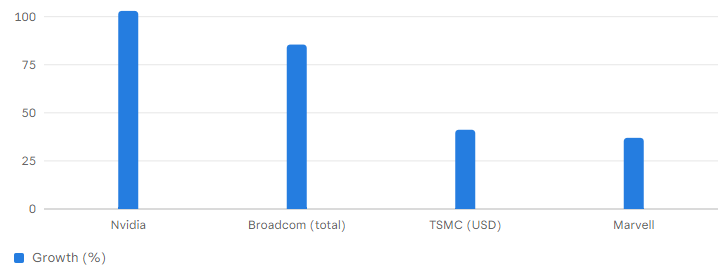
Three stocks that could gain in that scenario are Broadcom, TSMC and Marvell. The source article was not retrievable, so these are my picks. They are the same three names a Motley Fool writer grouped as a custom silicon basket in May 2026. Broadcom designs custom chips, TSMC manufactures nearly everyone's chips, and Marvell is a smaller custom silicon and connectivity player. Tom's Hardware says Broadcom and Marvell together control roughly 95% of the custom AI ASIC co-design market. Do not confuse a scenario with the present. Nvidia just reported third-quarter revenue of $115.8 billion, up 103% from a year earlier. My reading is that commoditization is a risk to Nvidia's future pricing and share, not something that shows up in its latest results.
Key takeaway: Nvidia is the stock most exposed if AI chips become interchangeable, but it is still growing very fast today. The three stocks that could gain are not simple bets against Nvidia, because two of them also work with it.
Big customers are also signing real deals. Anthropic committed to up to one million Google TPUs, and Meta entered talks about multi-billion-dollar TPU deployments, according to Tom's Hardware. The Motley Fool, writing in December 2025, noted that the Meta report was "just a possibility" at that point. Commoditization is a spectrum, not a switch. In my inference, the first place chips become fungible is the repetitive, well-understood work, which sources describe as inference, rather than the cutting edge of model training. Here is a framework of signals I would watch.
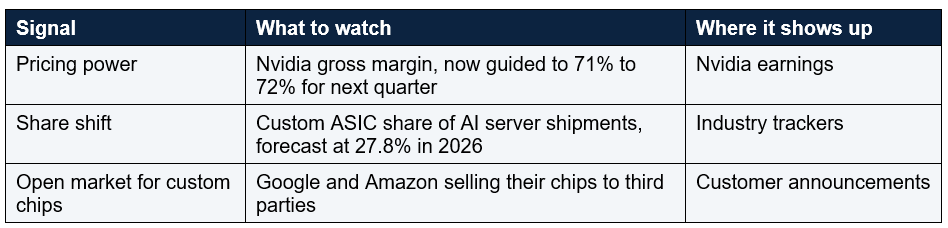
Signals are my framework. Margin guidance is from 24/7 Wall St; the shipment share forecast is from Tom's Hardware; the third-party sales point is from Bloomberg via Advisor Perspectives.
The customer mix is interesting. AI cloud, industrial and enterprise customers contributed $47.5 billion, with year-over-year growth of 195%, versus 71% growth for hyperscale customers. That group was about 44% of Data Center revenue [5], so by my calculation hyperscalers were roughly 56%. In my inference, Nvidia's fastest growth is coming from buyers other than the giants with the strongest incentive to build their own chips. That helps Nvidia's case, at least for now. How much of the market does Nvidia hold? It depends on who you ask and what is counted.
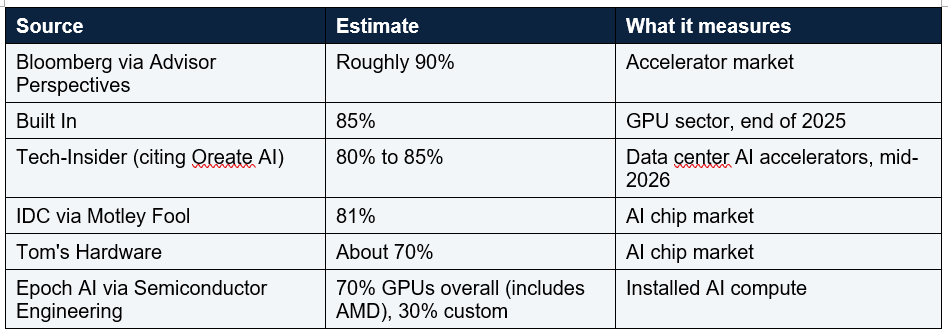
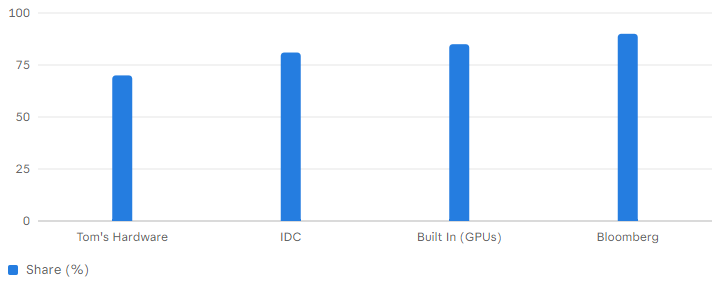
The numbers differ because definitions differ: some count only GPUs, some include custom chips, and installed capacity differs from yearly sales. Why does this matter? Because the 70% to 90% spread is itself a warning. In my inference, the lower figures count custom silicon and the higher ones do not. Semiconductor Engineering reports that in 2023 Nvidia had 90% share and Google 10%, while custom compute took 20 points of share over three years.
The shipment data supports the direction. TrendForce, cited by Tom's Hardware, projects ASIC-based AI server shipments will reach 27.8% of the market in 2026, the highest since 2023, with custom ASIC shipments growing 44.6% year over year versus 16.1% for merchant GPUs. That is nearly three times the growth rate, though from a smaller base.
There are cost claims too, and they deserve skepticism. Tom's Hardware reports a claimed total cost of ownership advantage of up to 65% for inference, and Google's claim of about 44% lower cost per Ironwood chip than a GB200 server, from its own procurement perspective. These come from vendors and their sources, so I treat them as claims, not proof.
The trade-off, as the Motley Fool puts it, is lower price and higher performance for less flexibility. For a large operator running a few huge, stable workloads, flexibility may be worth less than savings.
Why Nvidia in particular? Because of concentration. About 93% of its revenue is Data Center, and by my calculation roughly 56% of that comes from hyperscalers, the customers building rival chips. A price squeeze would therefore land on almost the whole business. Compared with Nvidia, a custom-chip designer or a foundry sells to many programs at once.
Careful: Nvidia's guided gross margin drop to 71% to 72% is described by 24/7 Wall St. as linked to the Vera Rubin ramp. The sources I found do not say it reflects commoditization, so I would not read it that way yet.
Fourth, the ecosystem. Gabelli analyst Hendi Susanto told Bloomberg that Nvidia has a strong ecosystem. Fifth, supply is tight for everyone. TSMC's CEO said AI demand remains above its ability to supply it. In my inference, when demand exceeds supply, buyers take whatever they can get, which delays commoditization. Sixth, the pie is growing. AMD CEO Lisa Su expects the total market for AI accelerators to reach $1.4 trillion by 2030. Share can fall while revenue rises. My illustration, not a forecast: If the market doubled and Nvidia's share fell from 80% to 60%, its revenue would still rise about 50%, because 60% of twice the market is 1.5 times 80% of today's. The shares are made up to show the arithmetic. That is why "Nvidia loses share" and "Nvidia stock falls" are different claims.
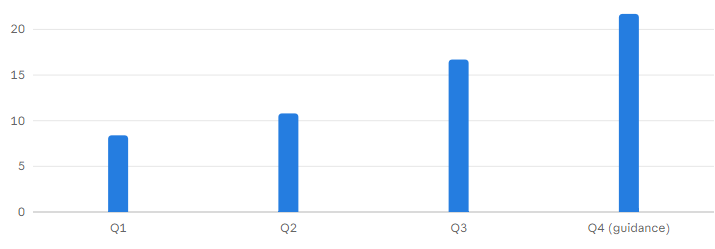
Total revenue rose 85.5% to $29.59 billion, and Broadcom raised its fiscal 2026 AI semiconductor revenue guidance to $58 billion, up 186%. For the fourth quarter, it guides to $21.7 billion in AI semiconductor revenue, which by my calculation is about 30% above the third quarter.
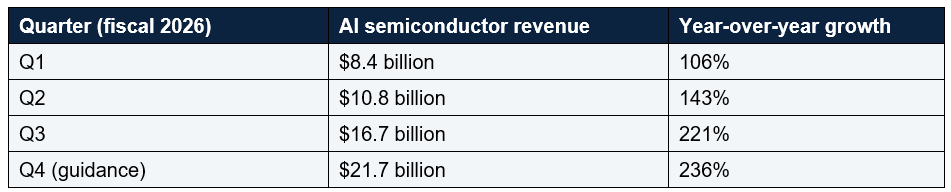
Looking further out, Hock Tan has said the company has line of sight to AI revenue from chips in excess of $100 billion in 2027. One lower-quality source, Crypto Briefing, reports a path to $115 billion in fiscal 2027. I could not verify that figure against Broadcom's own materials, so treat it with care. Why does Broadcom gain from commoditization? Alphabet pays the chip designer for every TPU it buys, so growing TPU demand, including outside sales, helps Broadcom. The more companies design their own accelerators, the more work flows to a handful of co-design partners.
The catch is concentration. Broadcom has said its five largest custom AI chip customers are progressing well, which also means a small number of customers matter a lot. If one program slips or moves in-house, the impact would be large. I did not check whether this growth is already reflected in Broadcom's share price.
Packaging is the real chokepoint. Tom's Hardware reports CoWoS allocation of about 60% for Nvidia, 15% for Broadcom and 11% for AMD, and describes advanced packaging, not wafer fabrication, as the more binding constraint. In my inference, that allocation shows TSMC's role as neutral ground. There are catches. Gross margin fell from 67.7% in the second quarter, and Futurum points to margin dilution from the N2 node and overseas fabs. And because Nvidia holds the largest CoWoS allocation, TSMC does not gain much from commoditization if the extra volume comes only at Nvidia's expense. In my inference, TSMC is the lowest-conviction commoditization bet and the highest-conviction "AI keeps growing" bet. The final risk is general knowledge, not from a source I retrieved: TSMC's manufacturing is concentrated in Taiwan, which exposes it to geopolitical risk.
Management raised its fiscal 2027 revenue outlook to about $12 billion, implying roughly 45% growth, from nearly $11.5 billion given in May. AlphaSense highlights a landmark warrant agreement with Google. Here is a conflict to flag. Tom's Hardware says Marvell projects up to $11 billion in AI ASIC revenue for 2026. That does not line up with Marvell's own custom figures above, and the $11 billion is close to the company's whole-company revenue outlook. I rely on the company-based numbers and treat the $11 billion as unreliable.
Marvell also hedges. Zacks notes an expanded partnership with Nvidia linking Marvell's custom silicon and optical networking with NVLink Fusion. Futurum says the next phase will hinge on converting a larger custom silicon pipeline into production revenue, and describes Marvell as increasingly tied to AI infrastructure buildouts rather than a balanced semiconductor cycle.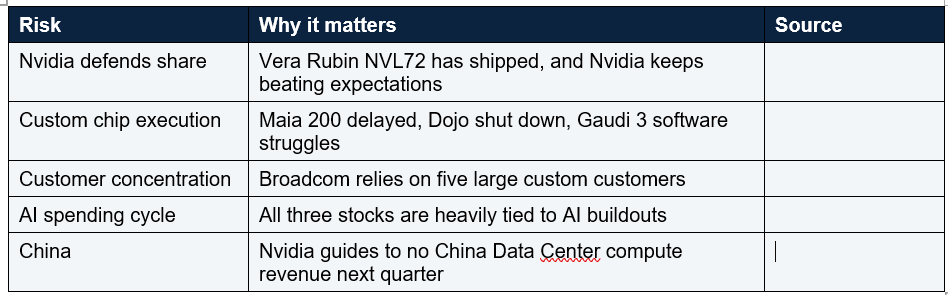
There are also items I did not research. 24/7 Wall St. notes that Colette Kress is serving as interim CEO and that a board investigation remains open. I have not looked into the details, so I cannot say how material it is. The biggest gap is valuation. I did not retrieve current prices or valuation multiples for Nvidia, Broadcom, TSMC or Marvell. A great business can be a poor investment if the price already assumes the best outcome. Before acting, check valuations from a current source.
Finally, the three stocks are not clean opposites of Nvidia. TSMC manufactures Nvidia's chips, and Marvell has a partnership with Nvidia. If Nvidia keeps winning, both still participate. That is a feature if you want balance, and a flaw if you wanted a pure hedge.
Then there are the chip builders themselves. The Motley Fool suggested Alphabet's Gemini 3 launch made it the most serious threat to Nvidia's dominance. Alphabet, Amazon, Meta and Microsoft are all designing chips. In my inference, they gain twice if commoditization works: lower chip costs and the option to sell capacity. They also carry design and execution costs, so it is not free. Intel, once the biggest name in chips, has tried to sell its own accelerators with limited success so far.
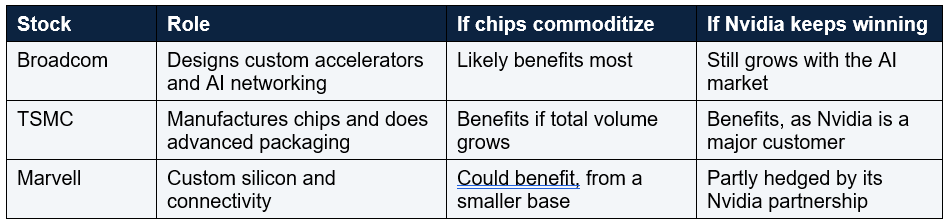
Third, think about position size. Many investors already own Nvidia through index funds, which is general knowledge and not from a source I retrieved. Adding three more AI-linked chip stocks may increase your concentration in the same theme rather than diversify it. Fourth, track the signals in section 2 each quarter, and revisit your view when earnings or customer announcements change the facts. A qualified financial adviser can help you apply this to your own goals.
A few common mistakes are worth avoiding. The first is treating share loss as revenue loss, as the illustration above shows. The second is trusting vendor claims, such as cost advantages of 44% or 65%, without checking who made them. The third is mixing definitions of market share. A 70% figure and a 90% figure can both be right if they count different things. The fourth is assuming the three stocks are anti-Nvidia bets, when TSMC and Marvell both work with Nvidia. The fifth is ignoring valuation and position size, which this post does not cover. And the sixth is trading on headlines. The sources cited here include company reports, analyst commentary and opinion pieces, and the opinion pieces are written to make a case.
It means buyers could treat chips from different vendors as interchangeable and compete mostly on price. Today, Bloomberg says Nvidia's margins are about 75%, roughly 20 points wider than its nearest rivals, so a price-led market would hit it hardest.
Is Nvidia losing AI chip market share?
Estimates range from about 70% to roughly 90%, depending on what is counted . Custom ASIC shipments are forecast to grow 44.6% in 2026 versus 16.1% for merchant GPUs, but Nvidia's revenue rose 103% last quarter.
Which three stocks could benefit?
My picks are Broadcom, TSMC and Marvell, because the source article's list was not retrievable. Broadcom's AI revenue rose 221% last quarter, TSMC's HPC was 68% of sales, and Marvell's data center growth was 46%.
Are these stocks safe if Nvidia keeps winning?
Not automatically. TSMC makes Nvidia chips and Marvell partners with Nvidia, so they may still participate. But Broadcom depends on a few large custom customers, and I did not check valuations.
Should I buy these stocks now?
This post cannot answer that, because it is not personal advice and I did not retrieve current prices or valuations. Use the framework, check a current source for valuations, and consult a qualified financial adviser.
Table of Contents
- What "commoditized" would mean for AI chips
- Where Nvidia stands today
- Why Nvidia has the most to lose
- The case that Nvidia holds its ground
- Stock 1: Broadcom, the custom chip designer
- Stock 2: TSMC, the toll collector
- Stock 3: Marvell, the smaller custom play
- Risks to the thesis
- Others that could gain or lose
- A simple way to think about it
- Conclusion
- FAQ
Estimates of Nvidia's AI chip share (definitions differ)
% of market by Sources: Tom's Hardware, Motley Fool/IDC, Built In, Advisor Perspectives
Broadcom AI semiconductor revenue, fiscal 2026
$ billions by Sources: Broadcom 8-K, Nasdaq, Yahoo Finance. Q4 is a company forecast
Latest-quarter revenue growth, year over year
% growth by Sources: Nvidia, Zacks, CRN Asia, Futurum. Quarters end Aug to Oct 2026The idea behind the headline is simple. If AI chips become commoditized, meaning one vendor's accelerator can be swapped for another's with little loss, the company charging the most has the most to lose. That is Nvidia. Bloomberg's reporting, republished by Advisor Perspectives, says Nvidia charges about $30,000 per chip for its high-end accelerators and that its profit margins have expanded to a remarkable 75%, roughly 20 points wider than those of its nearest rivals.
Three stocks that could gain in that scenario are Broadcom, TSMC and Marvell. The source article was not retrievable, so these are my picks. They are the same three names a Motley Fool writer grouped as a custom silicon basket in May 2026. Broadcom designs custom chips, TSMC manufactures nearly everyone's chips, and Marvell is a smaller custom silicon and connectivity player. Tom's Hardware says Broadcom and Marvell together control roughly 95% of the custom AI ASIC co-design market. Do not confuse a scenario with the present. Nvidia just reported third-quarter revenue of $115.8 billion, up 103% from a year earlier. My reading is that commoditization is a risk to Nvidia's future pricing and share, not something that shows up in its latest results.
Key takeaway: Nvidia is the stock most exposed if AI chips become interchangeable, but it is still growing very fast today. The three stocks that could gain are not simple bets against Nvidia, because two of them also work with it.
What "commoditized" would mean for AI chips
A commodity is a product buyers treat as interchangeable, so competition shifts to price. For AI chips, that would require software, performance and supply to be similar enough that a cloud provider can switch vendors without much pain. We are not there. But several forces are pushing in that direction. Tom's Hardware says every major hyperscaler now designs its own AI silicon, and the collective investment is accelerating. Bloomberg describes two pressures on Nvidia: existing chip competitors and a growing group of upstarts on one side, and AI labs and hyperscalers designing their own chips on the other. The article adds that moves such as Amazon and Google suddenly selling their own chips to others have been unpredictable, with one executive saying "that came on us relatively fast".Big customers are also signing real deals. Anthropic committed to up to one million Google TPUs, and Meta entered talks about multi-billion-dollar TPU deployments, according to Tom's Hardware. The Motley Fool, writing in December 2025, noted that the Meta report was "just a possibility" at that point. Commoditization is a spectrum, not a switch. In my inference, the first place chips become fungible is the repetitive, well-understood work, which sources describe as inference, rather than the cutting edge of model training. Here is a framework of signals I would watch.
Signals are my framework. Margin guidance is from 24/7 Wall St; the shipment share forecast is from Tom's Hardware; the third-party sales point is from Bloomberg via Advisor Perspectives.
Where Nvidia stands today
Start with how big Nvidia is. For the quarter ended 25 October 2026, revenue was $115.8 billion, up 20% from the previous quarter and up 103% from a year ago [3]. Data Center revenue was $107.6 billion, up 110%, which works out to roughly 93% of total revenue. GAAP net income was $65.3 billion. Management guided next quarter's revenue to $130 billion, plus or minus 3%, assuming no Data Center compute revenue from China, with gross margin guided down to 71% to 72% as the Vera Rubin ramp begins. The company has beaten expectations for six straight quarters. By my calculation, the guidance implies roughly 12% sequential growth from $115.8 billion.The customer mix is interesting. AI cloud, industrial and enterprise customers contributed $47.5 billion, with year-over-year growth of 195%, versus 71% growth for hyperscale customers. That group was about 44% of Data Center revenue [5], so by my calculation hyperscalers were roughly 56%. In my inference, Nvidia's fastest growth is coming from buyers other than the giants with the strongest incentive to build their own chips. That helps Nvidia's case, at least for now. How much of the market does Nvidia hold? It depends on who you ask and what is counted.
The numbers differ because definitions differ: some count only GPUs, some include custom chips, and installed capacity differs from yearly sales. Why does this matter? Because the 70% to 90% spread is itself a warning. In my inference, the lower figures count custom silicon and the higher ones do not. Semiconductor Engineering reports that in 2023 Nvidia had 90% share and Google 10%, while custom compute took 20 points of share over three years.
Why Nvidia has the most to lose
Nvidia's strength is also its exposure. The 75% margin and roughly $30,000 per chip price give customers a large incentive to find alternatives. Barchart says custom chips are designed for a narrow set of tasks, improving power efficiency and letting hyperscalers get chips at prices below Nvidia's market-leading products, and that cost is the most important reason they are turning to them.The shipment data supports the direction. TrendForce, cited by Tom's Hardware, projects ASIC-based AI server shipments will reach 27.8% of the market in 2026, the highest since 2023, with custom ASIC shipments growing 44.6% year over year versus 16.1% for merchant GPUs. That is nearly three times the growth rate, though from a smaller base.
There are cost claims too, and they deserve skepticism. Tom's Hardware reports a claimed total cost of ownership advantage of up to 65% for inference, and Google's claim of about 44% lower cost per Ironwood chip than a GB200 server, from its own procurement perspective. These come from vendors and their sources, so I treat them as claims, not proof.
The trade-off, as the Motley Fool puts it, is lower price and higher performance for less flexibility. For a large operator running a few huge, stable workloads, flexibility may be worth less than savings.
Why Nvidia in particular? Because of concentration. About 93% of its revenue is Data Center, and by my calculation roughly 56% of that comes from hyperscalers, the customers building rival chips. A price squeeze would therefore land on almost the whole business. Compared with Nvidia, a custom-chip designer or a foundry sells to many programs at once.
Careful: Nvidia's guided gross margin drop to 71% to 72% is described by 24/7 Wall St. as linked to the Vera Rubin ramp. The sources I found do not say it reflects commoditization, so I would not read it that way yet.
The case that Nvidia holds its ground
The bull case for Nvidia is strong, and an honest post has to say so. First, custom chips are mostly for inference. Tom's Hardware reports that Meta says its MTIA chip is not a replacement for Nvidia GPUs, and that Nvidia still handles frontier model training. Second, custom chips are close, not clearly better. Google's Ironwood is listed at 4,614 FP8 teraflops versus roughly 5,000 for Blackwell, although SemiAnalysis estimates higher sustained utilization for TPUs. Third, execution is hard: Microsoft's Maia 200 was delayed about six months, Tesla shut down Dojo, and Intel's Gaudi 3 has struggled with software maturit.Fourth, the ecosystem. Gabelli analyst Hendi Susanto told Bloomberg that Nvidia has a strong ecosystem. Fifth, supply is tight for everyone. TSMC's CEO said AI demand remains above its ability to supply it. In my inference, when demand exceeds supply, buyers take whatever they can get, which delays commoditization. Sixth, the pie is growing. AMD CEO Lisa Su expects the total market for AI accelerators to reach $1.4 trillion by 2030. Share can fall while revenue rises. My illustration, not a forecast: If the market doubled and Nvidia's share fell from 80% to 60%, its revenue would still rise about 50%, because 60% of twice the market is 1.5 times 80% of today's. The shares are made up to show the arithmetic. That is why "Nvidia loses share" and "Nvidia stock falls" are different claims.
6. Stock 1: Broadcom, the custom chip designer
Broadcom is the clearest custom-silicon play. It designs custom AI accelerators, which it calls XPUs, for large customers. In the third quarter of fiscal 2026, AI semiconductor revenue grew 221% year over year, and 54% sequentially, to $16.7 billion, which was 56% of total company revenue. XPUs were 73% of AI revenue, and AI networking revenue more than 2.5 times higher than a year earlier.Total revenue rose 85.5% to $29.59 billion, and Broadcom raised its fiscal 2026 AI semiconductor revenue guidance to $58 billion, up 186%. For the fourth quarter, it guides to $21.7 billion in AI semiconductor revenue, which by my calculation is about 30% above the third quarter.
Looking further out, Hock Tan has said the company has line of sight to AI revenue from chips in excess of $100 billion in 2027. One lower-quality source, Crypto Briefing, reports a path to $115 billion in fiscal 2027. I could not verify that figure against Broadcom's own materials, so treat it with care. Why does Broadcom gain from commoditization? Alphabet pays the chip designer for every TPU it buys, so growing TPU demand, including outside sales, helps Broadcom. The more companies design their own accelerators, the more work flows to a handful of co-design partners.
The catch is concentration. Broadcom has said its five largest custom AI chip customers are progressing well, which also means a small number of customers matter a lot. If one program slips or moves in-house, the impact would be large. I did not check whether this growth is already reflected in Broadcom's share price.
Stock 2: TSMC, the toll collector
TSMC is the toll collector. It does not design chips under its own brand. It fabricates them for customers, and Tom's Hardware says it makes chips for all five hyperscalers and for Broadcom. The Motley Fool makes the point directly: if Nvidia's dominance slips and Broadcom's custom units take off, TSMC benefits just the same. The numbers are strong. Third-quarter 2026 revenue was $46.72 billion, up 41.2% year over year, with high-performance computing at 68% of sales. Gross margin was 66.4%, with operating margin 58.7%. Fourth-quarter revenue is guided to between $52.3 billion and $54.3 billion, and full-year 2026 growth is now expected at about 44% in US dollar terms. The midpoint implies roughly 14% sequential growth by my calculation.Packaging is the real chokepoint. Tom's Hardware reports CoWoS allocation of about 60% for Nvidia, 15% for Broadcom and 11% for AMD, and describes advanced packaging, not wafer fabrication, as the more binding constraint. In my inference, that allocation shows TSMC's role as neutral ground. There are catches. Gross margin fell from 67.7% in the second quarter, and Futurum points to margin dilution from the N2 node and overseas fabs. And because Nvidia holds the largest CoWoS allocation, TSMC does not gain much from commoditization if the extra volume comes only at Nvidia's expense. In my inference, TSMC is the lowest-conviction commoditization bet and the highest-conviction "AI keeps growing" bet. The final risk is general knowledge, not from a source I retrieved: TSMC's manufacturing is concentrated in Taiwan, which exposes it to geopolitical risk.
Stock 3: Marvell, the smaller custom play
Marvell is smaller and more nuanced. Second-quarter fiscal 2027 revenue was $2.739 billion, up 37% year over year, with Data Center revenue growth accelerating to 46%. In the first quarter, Data Center was 76% of revenue. Custom silicon is the commoditization angle. CEO Matt Murphy said Marvell scaled from zero revenue to $1.5 billion in custom revenue in fiscal 2026, a year in which total revenue was $8.195 billion [20], so by my calculation custom was roughly 18% of sales. Marvell expects custom revenue to grow more than 20% in fiscal 2027 and to more than double in fiscal 2028.Management raised its fiscal 2027 revenue outlook to about $12 billion, implying roughly 45% growth, from nearly $11.5 billion given in May. AlphaSense highlights a landmark warrant agreement with Google. Here is a conflict to flag. Tom's Hardware says Marvell projects up to $11 billion in AI ASIC revenue for 2026. That does not line up with Marvell's own custom figures above, and the $11 billion is close to the company's whole-company revenue outlook. I rely on the company-based numbers and treat the $11 billion as unreliable.
Marvell also hedges. Zacks notes an expanded partnership with Nvidia linking Marvell's custom silicon and optical networking with NVLink Fusion. Futurum says the next phase will hinge on converting a larger custom silicon pipeline into production revenue, and describes Marvell as increasingly tied to AI infrastructure buildouts rather than a balanced semiconductor cycle.
Risks to the thesis
There are also items I did not research. 24/7 Wall St. notes that Colette Kress is serving as interim CEO and that a board investigation remains open. I have not looked into the details, so I cannot say how material it is. The biggest gap is valuation. I did not retrieve current prices or valuation multiples for Nvidia, Broadcom, TSMC or Marvell. A great business can be a poor investment if the price already assumes the best outcome. Before acting, check valuations from a current source.
Finally, the three stocks are not clean opposites of Nvidia. TSMC manufactures Nvidia's chips, and Marvell has a partnership with Nvidia. If Nvidia keeps winning, both still participate. That is a feature if you want balance, and a flaw if you wanted a pure hedge.
Others that could gain or lose
Other companies belong in the conversation. AMD is the second-largest maker of GPUs, and its data center revenue more than doubled in a recent quarter to $6.7 billion. It is a merchant GPU seller, so commoditization would hit it too, although it may take share from Nvidia. Lisa Su's $1.4 trillion forecast for 2030 appears in the Bloomberg piece, while an earlier IBTimes article cites $1 trillion [30]. The figures differ, and I could not tell which is newer.Then there are the chip builders themselves. The Motley Fool suggested Alphabet's Gemini 3 launch made it the most serious threat to Nvidia's dominance. Alphabet, Amazon, Meta and Microsoft are all designing chips. In my inference, they gain twice if commoditization works: lower chip costs and the option to sell capacity. They also carry design and execution costs, so it is not free. Intel, once the biggest name in chips, has tried to sell its own accelerators with limited success so far.
A simple way to think about it
A simple approach, as a framework and not advice. First, decide how far you believe in commoditization. Total commoditization looks unlikely soon given the sources above. Partial commoditization, concentrated in inference, looks plausible. Second, match each stock to a role. Broadcom is the most direct beneficiary of custom chips, TSMC is the neutral toll collector, and Marvell is the smaller, higher-variance custom and connectivity play. This table is my judgment, not a ranking.Third, think about position size. Many investors already own Nvidia through index funds, which is general knowledge and not from a source I retrieved. Adding three more AI-linked chip stocks may increase your concentration in the same theme rather than diversify it. Fourth, track the signals in section 2 each quarter, and revisit your view when earnings or customer announcements change the facts. A qualified financial adviser can help you apply this to your own goals.
A few common mistakes are worth avoiding. The first is treating share loss as revenue loss, as the illustration above shows. The second is trusting vendor claims, such as cost advantages of 44% or 65%, without checking who made them. The third is mixing definitions of market share. A 70% figure and a 90% figure can both be right if they count different things. The fourth is assuming the three stocks are anti-Nvidia bets, when TSMC and Marvell both work with Nvidia. The fifth is ignoring valuation and position size, which this post does not cover. And the sixth is trading on headlines. The sources cited here include company reports, analyst commentary and opinion pieces, and the opinion pieces are written to make a case.
13. Conclusion
If AI chips become commoditized, Nvidia has the most to lose, because it earns the highest margins, about 75% according to Bloomberg, and nearly all its revenue comes from Data Center. Custom chips are growing faster than merchant GPUs, with a forecast of 44.6% against 16.1% in 2026. But the scenario has not arrived. Nvidia's latest revenue was up 103%, custom chips are mainly used for inference, and supply is tight for everyone. Broadcom, TSMC and Marvell could gain if the shift happens, and Broadcom's AI revenue growth of 221% shows it has started. Yet two of the three also work with Nvidia. So the honest summary is this: the risk to Nvidia is real, the gains for the three stocks are plausible, and valuations are the missing piece. Treat this as a framework, check current prices, and speak with a qualified adviser before acting.FAQ
What does it mean if AI chips become commoditized?It means buyers could treat chips from different vendors as interchangeable and compete mostly on price. Today, Bloomberg says Nvidia's margins are about 75%, roughly 20 points wider than its nearest rivals, so a price-led market would hit it hardest.
Is Nvidia losing AI chip market share?
Estimates range from about 70% to roughly 90%, depending on what is counted . Custom ASIC shipments are forecast to grow 44.6% in 2026 versus 16.1% for merchant GPUs, but Nvidia's revenue rose 103% last quarter.
Which three stocks could benefit?
My picks are Broadcom, TSMC and Marvell, because the source article's list was not retrievable. Broadcom's AI revenue rose 221% last quarter, TSMC's HPC was 68% of sales, and Marvell's data center growth was 46%.
Are these stocks safe if Nvidia keeps winning?
Not automatically. TSMC makes Nvidia chips and Marvell partners with Nvidia, so they may still participate. But Broadcom depends on a few large custom customers, and I did not check valuations.
Should I buy these stocks now?
This post cannot answer that, because it is not personal advice and I did not retrieve current prices or valuations. Use the framework, check a current source for valuations, and consult a qualified financial adviser.
0 Comments
Be the first to share your thoughts on this article.