

Investing
Why Broadcom Stock Could Double by 2030: Bull Case and Risks

Broadcom stock is lower this year even as its AI chip revenue just tripled. Here is the case for a doubling by 2030, and what could get in the way. AI chip revenue $16.7B in Q3 (up 221%), Q4 guide: $34.8B revenue, $21.7B AI, FY2026 AI guide $58B, Management: about $115B FY2027 and about $230B FY2028 AI revenue, Stock fell about 12% on 20 Nov, Redburn target $398 (from $595).
Broadcom is one of those rare stocks where the business and the share price have gone in opposite directions. In its fiscal third quarter, AI semiconductor revenue grew 221% year over year to $16.7 billion. That is roughly a tripling (my calculation: growth of 221% means 3.2 times the prior level). Yet the stock closed at $304.41 on 20 November, according to the excerpt you shared, and sits more than a third below its 52-week high.
One correction to the excerpt is worth making up front. The stock did not drift lower this year in a quiet way. It fell more than 12% in a single day on 20 November, closing around $304.65 on one report and down $42 from the previous session. The trigger was a report that Google had cut its planned 2027 orders for Broadcom-designed chips by about 20%. I come back to that in the risk section.
Can the stock double by 2030? My honest answer is that it is possible, and it is not a safe bet. Doubling from about $304 means roughly $609 a share (my calculation). Management's own targets point to AI revenue of about $115 billion in fiscal 2027 and about $230 billion in fiscal 2028. If even most of that arrives, earnings could grow a lot. But the plan leans on a few large customers, some of whom Broadcom is helping to finance.
Key takeaway: The bull case is real and backed by strong numbers. So are the risks. A doubling needs both the AI build-out to continue and a handful of big customers to pay their way.
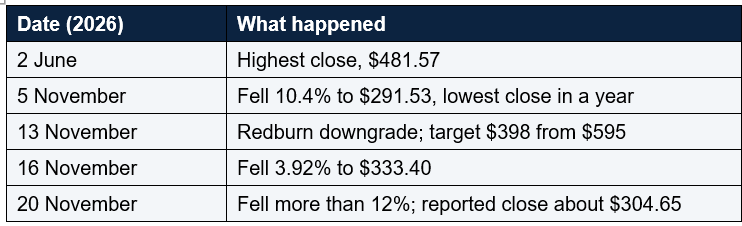
On 5 November, Broadcom fell 10.4% to $291.53, its lowest close in a year, compared with a highest close of $481.57 on 2 June. The sell-off followed the midterm elections, when chip stocks slid on fears of a slowdown in data-center construction. One analysis said Broadcom had fallen 15.5% in the week to 5 November with no news of its own, after Intel gave a weak outlook.
On 13 November, Rothschild & Co Redburn cut Broadcom to Neutral from Buy and lowered its price target to $398 from $595. The shares fell about 7% that morning from a prior close of about $364. Redburn's concern was customer concentration and the rising reliance on AI start-ups OpenAI and Anthropic.
On 16 November, the stock fell 3.92% to $333.40. Financial media tied the drop to tighter US rules on advanced chip exports as well as the Redburn call.
On 20 November, it fell more than 12%. 24/7 Wall St. reported the stock lost about $191 billion of market value, headed for its worst day since June and sitting 36% below its record.
Source note: the excerpt you shared gives a 20 November close of $304.41 while GuruFocus reports $304.65. The small gap may come from data timing. Reports also differ on how far the Nasdaq fell that day (about 3.6% at 1:30 p.m. on one site, over 5% in another). I could not reconcile these.
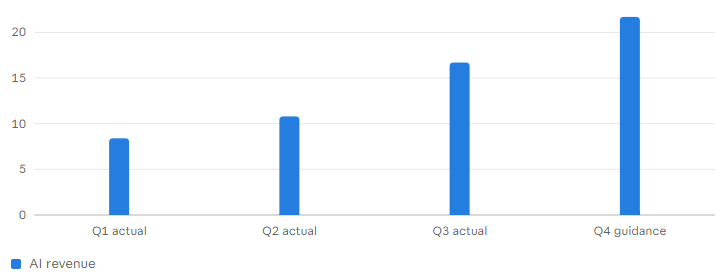
Management's guidance for the fourth quarter is for consolidated revenue of about $34.8 billion, up 93%, including AI semiconductor revenue of $21.7 billion, up more than 236%. Add the four quarters together and fiscal 2026 AI revenue comes to about $58 billion (my calculation: 8.4 + 10.8 + 16.7 + 21.7), which matches management's raised full-year view. Total revenue would be about $106 billion for the year (my calculation), versus roughly $64 billion in fiscal 2025.
Two other points help explain the story. Meta's custom MTIA accelerator was expected to enter production shipments in the fourth quarter, and Broadcom shipped OpenAI's first-generation custom accelerator. That shows the customer list broadening beyond a single buyer, though the largest accounts still dominate. Margins are the quiet worry. In December 2025, Hock Tan said the AI business carries lower gross margins than other segments, so a bigger AI mix would weigh on overall margins. That is not new, but it is why earnings can grow more slowly than revenue.
Customer detail is useful too. TIKR's summary says management expects Anthropic to add 10 gigawatts of capacity in fiscal 2028 and OpenAI to add more than 5 gigawatts. Those are very large numbers, and they explain both the upside and the concentration worry. To put the scale in context, one Motley Fool piece noted that AMD has forecast a $1 trillion market for AI accelerators in 2030, and that Nvidia has estimated AI data-center spending of $3 trillion to $4 trillion by 2030. Those are other companies' estimates, and they have an interest in being optimistic. I treat them as context, not evidence.
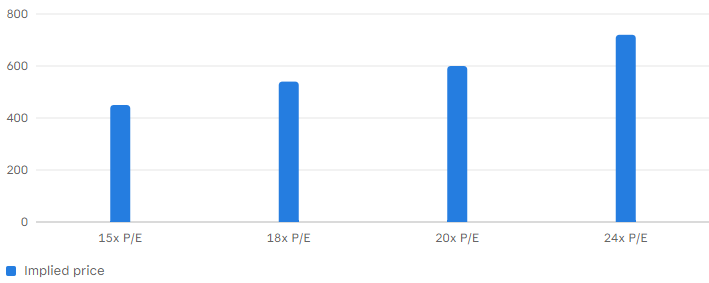
How might that happen? There are two levers: earnings and the multiple investors pay. A Motley Fool article from October said Hock Tan has indicated Broadcom could exceed $30 of earnings per share in fiscal 2028. If earnings were $30 and the stock traded at 20 times, that would be $600 (my calculation), close to the doubling mark. The same author suggested that $40 of earnings by fiscal 2030, with a similar multiple, could push the stock toward about $900. The sensitivity is the point. If earnings reach $30 but investors pay only 15 times, the price is $450. If they pay 24 times, the five-year average multiple, the price is $720 (my calculation). A doubling therefore does not need a heroic multiple. It does need the earnings to show up.

My illustration: EPS x P/E. The $30 EPS is a figure management has floated per, not a consensus number. A doubling from $304.41 is about $609.
The worry has a specific shape. Broadcom has guaranteed financing for some customers. The Motley Fool says the company is backstopping financing for some of its biggest customers, that OpenAI is its second-largest custom chip customer, and that Anthropic is expected to surpass Alphabet as the largest buyer of its custom chips.
The size of the exposure is not agreed. TS2 Tech reports a maximum $43 billion residual-value backstop disclosed in October. TIKR says Broadcom backstops up to about $29 billion of Anthropic's leases and may lend Anthropic up to $42 billion. Another report cites a $42 billion lending exposure. I could not reconcile these figures, which may measure different things, so please treat the range as roughly $29 billion to $43 billion and check the company's filings.
Here is how I think about it. If AI labs keep raising money and growing revenue, the backstops are never used and look like clever salesmanship. If funding dries up, the same guarantees could become losses at exactly the moment demand slows. That is a classic concentration risk (my inference), and it is why the bear case is not silly.
Worth knowing: Broadcom's CEO has said demand for custom AI accelerators remains very strong, and TIKR's author chose to hold through the drop. A risk can be real without being fatal. The question is how much of it you are comfortable owning.
Second, export rules. On 16 November, the US Commerce Department issued an interim final rule limiting remote access to advanced AI chips and requiring licences for advanced chip shipments to Indonesia, Malaysia, Singapore, Thailand and Brazil. Commerce used its authority to impose the changes without prior notice and comment. The sources I found focus on Nvidia and AMD. How much this affects Broadcom's custom chips is not clear from them, so I would call it a sentiment risk more than a measured earnings risk (my inference).
Third, data-center delays. Trefis reported that after the Democratic midterm win, new governors in Texas, Ohio and Georgia, all major AI data-center states, were promising construction moratoriums. TIKR argues that because customer commitments are firm, new permitting rules would hit future orders more than current ones. That fits the point earlier: the outlook is only as good as the sites being built. Add the stock's own volatility to the list. It has a beta of about 1.5, and it fell 10.4% on 5 November and about 12% on 20 November. If big swings keep you up at night, size the position accordingly.
Analysts are also cutting targets, not abandoning the stock. Goldman Sachs lowered its target from $540 to $460 while keeping a Buy rating, because it cut the multiple it applies from 30 times to 25 times, citing lower peer multiples across semiconductors. Redburn moved to Neutral with a $398 target. Both targets sit above the recent price and below the $495 52-week high.
The dividend is small. StockAnalysis lists $2.60 a year, a yield of about 0.8% at the price then shown. This is a growth stock, not an income stock.
The company reports next on 9 December. Benzinga lists consensus estimates of $3.76 EPS and $34.9 billion of revenue, in line with management's guidance of about $34.8 billion.
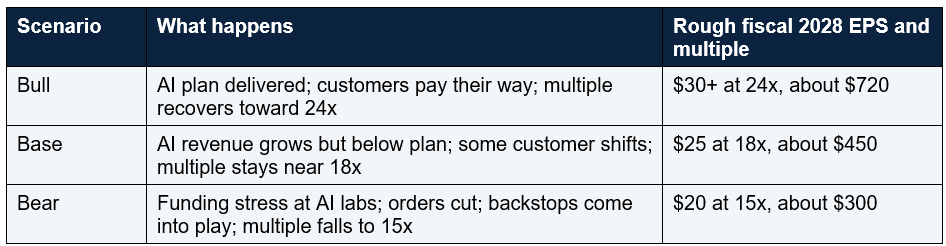
In my illustration, the base case still sits above today's price, and the bear case is roughly where the stock is now (my calculation). That is partly why some analysts think the sell-off has gone far. It is also why others stay cautious: the bear case is not far away. These EPS numbers are my assumptions for illustration only. I did not find a consensus fiscal 2028 EPS figure, only the revenue consensus of $275 billion. Please do your own work before relying on any of them.
It may not suit you if you need the money within a few years, if sharp falls would push you to sell at the worst time, or if you already hold a lot of AI-linked stocks. Many diversified portfolios already own Broadcom through index funds (general knowledge), so adding more can raise concentration without you noticing.
If you do want to build a position, consider spreading purchases over several months instead of buying all at once. That does not remove risk, but it softens the effect of buying right before a big move.
Next is any company comment on the Google report, which I did not find. Then the financing exposure: look for updates in the company's filings on the size and terms of backstops and loans. Finally, watch export-rule details and state-level data-center rules.
Here is a practical way to decide, again as a framework and not advice. Step one: write down why you want Broadcom. If it is the 2030 AI story, be clear about which assumptions you are making, such as revenue near $230 billion in fiscal 2028. Step two: pick a price range you consider reasonable using the table in section 5, then decide how much you would buy at each level. Step three: decide your risk limit. If a 12% day would force you to sell, the position is too big.
Step four: set review dates after the 9 December report and after any news on customer financing. If the facts change, your view should change too.
But it is not a sure thing. The stock fell about 12% on a single report about Google, a respected analyst has raised concerns about financing and customer concentration, and tighter export rules and possible data-center moratoriums add uncertainty. The stock is volatile, and the outlook relies on a few very large customers.
If you believe the AI build-out continues and can hold through big swings, the current price is lower than it was a few weeks ago. If you cannot, there is no rush. This post is general education, and I am not a financial adviser. Please check live prices, read the company's filings, and consider talking with a qualified professional before you act.
Mostly because of worries about AI financing, customer concentration, data-center delays and export rules, plus a 12% one-day fall on 20 November after a report that Google cut 2027 orders . The business itself is growing quickly, with Q3 AI revenue up 221%.
Can Broadcom stock really double by 2030?
It is possible but not assured. Doubling from about $304 means about $609. If earnings reach about $30 a share, as management has floated, a multiple of about 20 times would give roughly $600 (my calculation). Everything depends on the AI plan being delivered.
What did Redburn say about Broadcom?
Redburn cut Broadcom to Neutral from Buy, lowering its target to $398 from $595, and said AI labs need to become self-financing, which is unlikely to happen quickly.
What is the Google chip report?
Analyst Ming-Chi Kuo said Google cut its planned 2027 TPU 8i shipments by about one million units, roughly 20%. It is a supply-chain report, not a company announcement.
When does Broadcom report earnings next?
9 December 2026, with consensus estimates of $3.76 EPS and $34.9 billion of revenue. Dates can change, so confirm with the company.
Table of Contents
- What happened to the stock this month
- The business behind the headlines
- What management says about 2027 and 2028
- What "double by 2030" would take
- Risk one: financing and customer concentration
- Risk two: Google, export rules and data-center delays
- Valuation: cheaper than it was, still not cheap
- Bull, base and bear: my illustration
- Who this stock suits, and who it does not
- What to watch next
- Conclusion
- FAQ
Broadcom is one of those rare stocks where the business and the share price have gone in opposite directions. In its fiscal third quarter, AI semiconductor revenue grew 221% year over year to $16.7 billion. That is roughly a tripling (my calculation: growth of 221% means 3.2 times the prior level). Yet the stock closed at $304.41 on 20 November, according to the excerpt you shared, and sits more than a third below its 52-week high.
One correction to the excerpt is worth making up front. The stock did not drift lower this year in a quiet way. It fell more than 12% in a single day on 20 November, closing around $304.65 on one report and down $42 from the previous session. The trigger was a report that Google had cut its planned 2027 orders for Broadcom-designed chips by about 20%. I come back to that in the risk section.
Can the stock double by 2030? My honest answer is that it is possible, and it is not a safe bet. Doubling from about $304 means roughly $609 a share (my calculation). Management's own targets point to AI revenue of about $115 billion in fiscal 2027 and about $230 billion in fiscal 2028. If even most of that arrives, earnings could grow a lot. But the plan leans on a few large customers, some of whom Broadcom is helping to finance.
Key takeaway: The bull case is real and backed by strong numbers. So are the risks. A doubling needs both the AI build-out to continue and a handful of big customers to pay their way.
Broadcom AI semiconductor revenue by quarter, fiscal 2026 (US$ billions)
US$ billions by Source: Broadcom 8-Ks (Q1, Q2) and Q3 earnings call coverage. Q4 is management guidance, not a result.
What happened to the stock this month
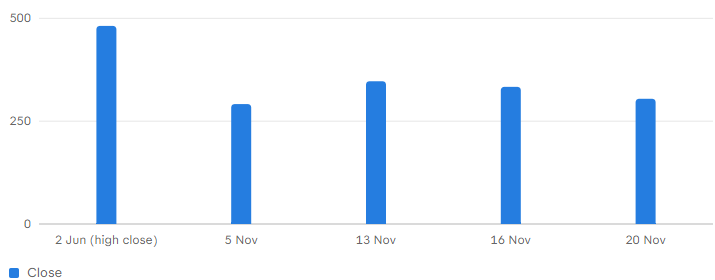
The stock has had a rough month, and much of it was not about Broadcom's own results. Here is the sequence, using close prices where I found them.On 5 November, Broadcom fell 10.4% to $291.53, its lowest close in a year, compared with a highest close of $481.57 on 2 June. The sell-off followed the midterm elections, when chip stocks slid on fears of a slowdown in data-center construction. One analysis said Broadcom had fallen 15.5% in the week to 5 November with no news of its own, after Intel gave a weak outlook.
On 13 November, Rothschild & Co Redburn cut Broadcom to Neutral from Buy and lowered its price target to $398 from $595. The shares fell about 7% that morning from a prior close of about $364. Redburn's concern was customer concentration and the rising reliance on AI start-ups OpenAI and Anthropic.
On 16 November, the stock fell 3.92% to $333.40. Financial media tied the drop to tighter US rules on advanced chip exports as well as the Redburn call.
On 20 November, it fell more than 12%. 24/7 Wall St. reported the stock lost about $191 billion of market value, headed for its worst day since June and sitting 36% below its record.
Source note: the excerpt you shared gives a 20 November close of $304.41 while GuruFocus reports $304.65. The small gap may come from data timing. Reports also differ on how far the Nasdaq fell that day (about 3.6% at 1:30 p.m. on one site, over 5% in another). I could not reconcile these.
The business behind the headlines
Behind the share price, the numbers are hard to fault. Revenue has accelerated every quarter this fiscal year. In the first quarter, AI revenue was $8.4 billion, up 106%, on total revenue of $19.3 billion. In the second quarter, AI revenue was $10.8 billion, up 143%, and total revenue was $22.2 billion, up 48%. In the third quarter, AI revenue was $16.7 billion, up 221% and 54% higher than the prior quarter, making up 56% of total revenue, compared with 49% a quarter earlier. Total third-quarter revenue rose 85.5% to $29.59 billion.Management's guidance for the fourth quarter is for consolidated revenue of about $34.8 billion, up 93%, including AI semiconductor revenue of $21.7 billion, up more than 236%. Add the four quarters together and fiscal 2026 AI revenue comes to about $58 billion (my calculation: 8.4 + 10.8 + 16.7 + 21.7), which matches management's raised full-year view. Total revenue would be about $106 billion for the year (my calculation), versus roughly $64 billion in fiscal 2025.
Two other points help explain the story. Meta's custom MTIA accelerator was expected to enter production shipments in the fourth quarter, and Broadcom shipped OpenAI's first-generation custom accelerator. That shows the customer list broadening beyond a single buyer, though the largest accounts still dominate. Margins are the quiet worry. In December 2025, Hock Tan said the AI business carries lower gross margins than other segments, so a bigger AI mix would weigh on overall margins. That is not new, but it is why earnings can grow more slowly than revenue.
What management says about 2027 and 2028
This is the heart of the bull case. On the September earnings call, management said it had secured supply for roughly $115 billion of AI semiconductor revenue in fiscal 2027, and that customer demand exceeds that figure. TIKR reports management expects about $230 billion of AI revenue in fiscal 2028, with analysts putting fiscal 2028 total revenue at $275 billion. Invezz also reports the roughly $230 billion figure. Management also said it based its fiscal 2028 outlook on which data-center sites its customers already have ready. That is an honest and important caveat. The outlook depends on buildings, power and permits as much as on chips.Customer detail is useful too. TIKR's summary says management expects Anthropic to add 10 gigawatts of capacity in fiscal 2028 and OpenAI to add more than 5 gigawatts. Those are very large numbers, and they explain both the upside and the concentration worry. To put the scale in context, one Motley Fool piece noted that AMD has forecast a $1 trillion market for AI accelerators in 2030, and that Nvidia has estimated AI data-center spending of $3 trillion to $4 trillion by 2030. Those are other companies' estimates, and they have an interest in being optimistic. I treat them as context, not evidence.
Broadcom (AVGO) closing prices, selected dates in 2026 (US$)
US$ per share by Sources: Trefis, Gotrade, user-supplied excerpt (20 Nov; GuruFocus shows $304.65).
What "double by 2030" would take
Let us do the maths on what "double by 2030" means. These are my calculations, and they are simple on purpose. Starting at $304.41, a doubling is about $609 a share. With roughly 4.77 billion shares outstanding, that is a market value of about $1.45 trillion today and about $2.9 trillion at double (my calculation). If the stock reached that level by the end of 2030, about four years from now, that would be around 18% a year (my calculation), well above the market's long-run average.How might that happen? There are two levers: earnings and the multiple investors pay. A Motley Fool article from October said Hock Tan has indicated Broadcom could exceed $30 of earnings per share in fiscal 2028. If earnings were $30 and the stock traded at 20 times, that would be $600 (my calculation), close to the doubling mark. The same author suggested that $40 of earnings by fiscal 2030, with a similar multiple, could push the stock toward about $900. The sensitivity is the point. If earnings reach $30 but investors pay only 15 times, the price is $450. If they pay 24 times, the five-year average multiple, the price is $720 (my calculation). A doubling therefore does not need a heroic multiple. It does need the earnings to show up.
My illustration: EPS x P/E. The $30 EPS is a figure management has floated per, not a consensus number. A doubling from $304.41 is about $609.
Risk one: financing and customer concentration
Now the part Wall Street is focused on. Redburn's argument is that Broadcom's growth depends on its biggest AI customers becoming financially self-sufficient. It said the frontier labs "need to establish sustained primacy over open models and become self-financing in short order," and that clearing those hurdles is appreciable but "unlikely to occur quickly".The worry has a specific shape. Broadcom has guaranteed financing for some customers. The Motley Fool says the company is backstopping financing for some of its biggest customers, that OpenAI is its second-largest custom chip customer, and that Anthropic is expected to surpass Alphabet as the largest buyer of its custom chips.
The size of the exposure is not agreed. TS2 Tech reports a maximum $43 billion residual-value backstop disclosed in October. TIKR says Broadcom backstops up to about $29 billion of Anthropic's leases and may lend Anthropic up to $42 billion. Another report cites a $42 billion lending exposure. I could not reconcile these figures, which may measure different things, so please treat the range as roughly $29 billion to $43 billion and check the company's filings.
Here is how I think about it. If AI labs keep raising money and growing revenue, the backstops are never used and look like clever salesmanship. If funding dries up, the same guarantees could become losses at exactly the moment demand slows. That is a classic concentration risk (my inference), and it is why the bear case is not silly.
Worth knowing: Broadcom's CEO has said demand for custom AI accelerators remains very strong, and TIKR's author chose to hold through the drop. A risk can be real without being fatal. The question is how much of it you are comfortable owning.
Illustration: implied share price at $30 of fiscal 2028 EPS (US$)
US$ per share by My illustration (EPS x P/E). $30 EPS is a figure management has floated, not consensus. Doubling from $304.41 is about $609.
Risk two: Google, export rules and data-center delays
Three other headwinds have hit the stock this month. First, the Google report. Analyst Ming-Chi Kuo said Google cut its planned 2027 shipments of Broadcom-designed TPU 8i chips by about one million units, roughly 20%, concentrated in the higher-priced 8i Max. Reports also said Google increased orders for a MediaTek chip because of data-center power constraints. This is a supply-chain report, not a company announcement, and I did not find a Broadcom response. It matters because Google is a major customer. It is also a reminder that one customer's shift can move the numbers.Second, export rules. On 16 November, the US Commerce Department issued an interim final rule limiting remote access to advanced AI chips and requiring licences for advanced chip shipments to Indonesia, Malaysia, Singapore, Thailand and Brazil. Commerce used its authority to impose the changes without prior notice and comment. The sources I found focus on Nvidia and AMD. How much this affects Broadcom's custom chips is not clear from them, so I would call it a sentiment risk more than a measured earnings risk (my inference).
Third, data-center delays. Trefis reported that after the Democratic midterm win, new governors in Texas, Ohio and Georgia, all major AI data-center states, were promising construction moratoriums. TIKR argues that because customer commitments are firm, new permitting rules would hit future orders more than current ones. That fits the point earlier: the outlook is only as good as the sites being built. Add the stock's own volatility to the list. It has a beta of about 1.5, and it fell 10.4% on 5 November and about 12% on 20 November. If big swings keep you up at night, size the position accordingly.
Valuation: cheaper than it was, still not cheap
Valuation has improved, but it is not a bargain by the usual measures. On 12 November, TIKR said Broadcom ended the day at 21 times forward earnings, versus a five-year average of 24 times. StockAnalysis lists a forward P/E of 18.91, though that page is undated and may reflect a different price. After the 20 November fall, the multiple is lower still (my inference).Analysts are also cutting targets, not abandoning the stock. Goldman Sachs lowered its target from $540 to $460 while keeping a Buy rating, because it cut the multiple it applies from 30 times to 25 times, citing lower peer multiples across semiconductors. Redburn moved to Neutral with a $398 target. Both targets sit above the recent price and below the $495 52-week high.
The dividend is small. StockAnalysis lists $2.60 a year, a yield of about 0.8% at the price then shown. This is a growth stock, not an income stock.
The company reports next on 9 December. Benzinga lists consensus estimates of $3.76 EPS and $34.9 billion of revenue, in line with management's guidance of about $34.8 billion.
Bull, base and bear: my illustration
Here is a simple scenario table. It is my illustration, not a forecast, and the probabilities are not estimated. Its purpose is to show what each world would look like.In my illustration, the base case still sits above today's price, and the bear case is roughly where the stock is now (my calculation). That is partly why some analysts think the sell-off has gone far. It is also why others stay cautious: the bear case is not far away. These EPS numbers are my assumptions for illustration only. I did not find a consensus fiscal 2028 EPS figure, only the revenue consensus of $275 billion. Please do your own work before relying on any of them.
Who this stock suits, and who it does not
This is a suggestion, not advice. Think about whether Broadcom fits what you are trying to do. It may suit you if you have a long horizon, can tolerate a stock that moves 10% in a day, and want exposure to AI infrastructure through custom chips and networking, not just through GPUs. It may also suit you if you believe the AI build-out continues, and you are comfortable that a few large customers drive the story.It may not suit you if you need the money within a few years, if sharp falls would push you to sell at the worst time, or if you already hold a lot of AI-linked stocks. Many diversified portfolios already own Broadcom through index funds (general knowledge), so adding more can raise concentration without you noticing.
If you do want to build a position, consider spreading purchases over several months instead of buying all at once. That does not remove risk, but it softens the effect of buying right before a big move.
What to watch next
Several signals will tell you whether the bull case is intact. The 9 December earnings report is the first. It will show whether Broadcom hit its $21.7 billion AI revenue target and how the next guidance treats the data-center build-out. Look for confirmation of the roughly $115 billion fiscal 2027 AI outlook.Next is any company comment on the Google report, which I did not find. Then the financing exposure: look for updates in the company's filings on the size and terms of backstops and loans. Finally, watch export-rule details and state-level data-center rules.
Here is a practical way to decide, again as a framework and not advice. Step one: write down why you want Broadcom. If it is the 2030 AI story, be clear about which assumptions you are making, such as revenue near $230 billion in fiscal 2028. Step two: pick a price range you consider reasonable using the table in section 5, then decide how much you would buy at each level. Step three: decide your risk limit. If a 12% day would force you to sell, the position is too big.
Step four: set review dates after the 9 December report and after any news on customer financing. If the facts change, your view should change too.
Conclusion
So, could Broadcom stock double by 2030? Yes, it could. The business is growing faster than almost any company of its size, AI revenue just tripled, and management has pointed to roughly $115 billion of AI revenue in fiscal 2027 and $230 billion in fiscal 2028. If earnings approach the $30 a share that management has floated, a doubling needs only a reasonable multiple (my calculation).But it is not a sure thing. The stock fell about 12% on a single report about Google, a respected analyst has raised concerns about financing and customer concentration, and tighter export rules and possible data-center moratoriums add uncertainty. The stock is volatile, and the outlook relies on a few very large customers.
If you believe the AI build-out continues and can hold through big swings, the current price is lower than it was a few weeks ago. If you cannot, there is no rush. This post is general education, and I am not a financial adviser. Please check live prices, read the company's filings, and consider talking with a qualified professional before you act.
FAQ
Why is Broadcom stock down this year if AI revenue tripled?Mostly because of worries about AI financing, customer concentration, data-center delays and export rules, plus a 12% one-day fall on 20 November after a report that Google cut 2027 orders . The business itself is growing quickly, with Q3 AI revenue up 221%.
Can Broadcom stock really double by 2030?
It is possible but not assured. Doubling from about $304 means about $609. If earnings reach about $30 a share, as management has floated, a multiple of about 20 times would give roughly $600 (my calculation). Everything depends on the AI plan being delivered.
What did Redburn say about Broadcom?
Redburn cut Broadcom to Neutral from Buy, lowering its target to $398 from $595, and said AI labs need to become self-financing, which is unlikely to happen quickly.
What is the Google chip report?
Analyst Ming-Chi Kuo said Google cut its planned 2027 TPU 8i shipments by about one million units, roughly 20%. It is a supply-chain report, not a company announcement.
When does Broadcom report earnings next?
9 December 2026, with consensus estimates of $3.76 EPS and $34.9 billion of revenue. Dates can change, so confirm with the company.
0 Comments
Be the first to share your thoughts on this article.