
Investing
Palantir Stock May Finish 2026 Down: Which Losing Year Fits?

Which of the AI software company's two down years does 2026 look more like? A look at 2021, 2022 and 2023 against today. Down about 10% in 2026, Q3 revenue $2.313B, up 96%, 2026 guidance $8.53B, up 91%, 2022 fall about 65%, 2023 gain about 167%, Closing range $107.27 to $209.05.
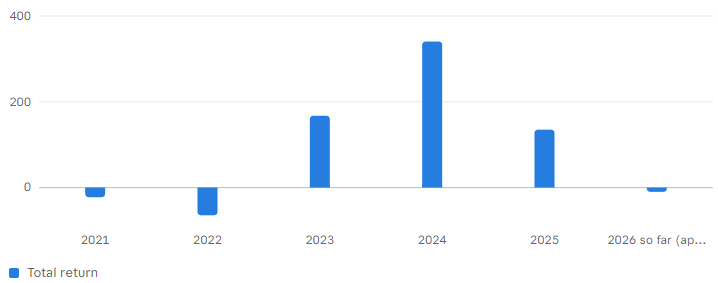
Palantir has ended only two calendar years in the red since it started trading in September 2020. Those were 2021 and 2022, and they could hardly have ended more differently. The stock lost roughly 23% in 2021, then about 65% in 2022, and then gained around 167% in 2023. Now 2026 might become the third. At about $160, the shares sit roughly 10% under the $177.75 they closed 2025 at. So which old year does this one resemble? My short answer is that it looks more like 2021, a year of shrinking valuation, than like 2022, a year when the business itself disappointed. That is my reading, not a forecast, and I will show you why.
Key takeaway: In 2022 the stock fell and the company's story weakened. In 2026 the stock has fallen while revenue growth has accelerated and guidance has gone up three times. That is a very different setup, though it does not guarantee a happy ending.
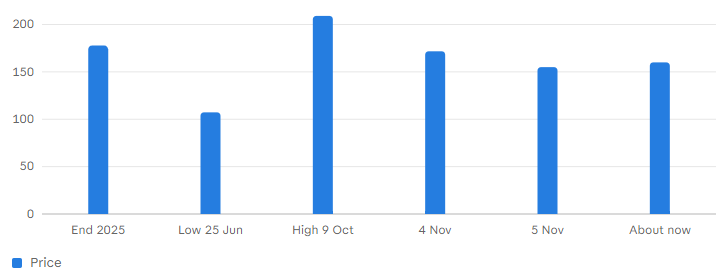
The year has been a rollercoaster. The stock closed as low as $107.27 on 25 June 2026, then reached a record close of $209.05 on 9 October. That is a rise of about 95% in under four months (my calculation). Then came the slide: seven straight losing days to 4 November, when it closed at $171.70, and a fall of about 10% on 5 November alone.
It started the year badly, too. By early February, before the fourth-quarter report, Bloomberg noted the shares were down more than 15% for the year. So the year began with a loss, then swung to a record in October before sliding again. Reported year-to-date numbers vary because pages were written on different days. Trefis showed minus 3.4% on 5 November and minus 12.8% a day later, while a Motley Fool article from 18 November said down 5%. Please check a live quote before relying on any of these.
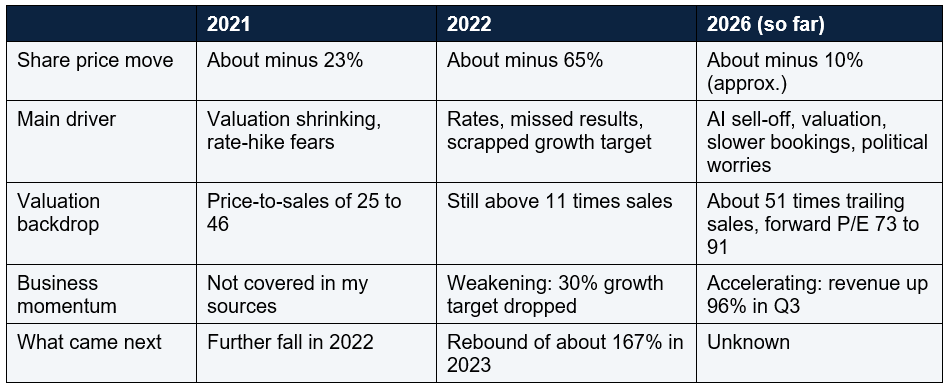
Read across the table, the 2026 column does not match 2022 well. Revenue growth is speeding up, not slowing down. It matches 2021 better on the valuation side: a very expensive stock being pushed to a lower multiple. That is why I lean toward 2021 as the closer comparison. But 2026 also has differences from 2021, including a far larger business and real profits, so the match is partial at best.
Guidance went up again. The full-year revenue outlook is now $8.530 billion to $8.534 billion, with fourth-quarter revenue of $2.649 billion to $2.653 billion. Adjusted free cash flow guidance is $4.8 billion to $5.0 billion, and the company still expects GAAP operating income and net income each quarter this year.
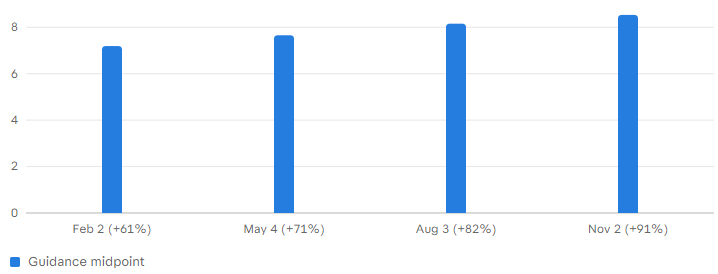
Look at how guidance has crept up through the year. In February the range was $7.18 billion to $7.20 billion, or 61% growth. It rose in May, then in August, and then to about $8.53 billion in November, or 91% growth. Three raises, one after another, and still the shares fell. That gap between results and price is the heart of this story.
A second reason is slowing bookings. Third-quarter total contract value rose only 6%, and management blamed shorter sovereign AI contracts. U.S. commercial remaining deal value grew just 4% from the second quarter. Revenue is a looking-back number, and investors may be paying more attention to what new deals signal about next year. Third is politics and budgets. TIKR pointed to fears that a Democratic sweep in Congress could mean a smaller defense budget, and noted that U.S. government work was 41% of third-quarter revenue.
Fourth is competition and price. A Motley Fool writer said the stock is dropping for two reasons: the threat of competition as AI spreads, and its premium price tag. Axios put it more bluntly, saying the roughly 2,000% rise over four years had far outpaced the company's fundamentals.
For comparison, Axios put the S&P 500 at about 18.5 times forward earnings and 3.1 times forward sales. Even at 73 times, Palantir is roughly four times the market multiple (my calculation). Analysts remain positive. The TIKR piece shows a mean price target of $222, and Phillip Securities raised its target to $248 from $215 with a Buy rating. Targets are opinions, and they have been wrong before, so I would not lean on them.
Third, watch contract value and remaining deal value. If those start to climb again, the slowing-bookings worry fades. If not, the stock may keep trading at a lower multiple. Fourth, watch the AI sentiment backdrop. Palantir has traded with AI stocks recently, so a recovery or a deeper slide in the group may move it regardless of company news. Finally, remember that the year is not over. With less than six weeks left, a swing of 10% either way would be unremarkable for this stock, which moved from $107.27 to $209.05 in four months.
That does not make it safe. The stock is still priced at many times the market, bookings growth slowed, government exposure is large, and AI sentiment can swing it by 10% in a day. The 2023 rebound came with a new product and a cheaper multiple. Whether 2027 brings something similar is unknown.
If you hold Palantir, decide in advance what would change your mind and size the position for big swings. If you are thinking of buying, remember that a year can end slightly down and still hide huge moves in between. This post is general education, and I am not a financial adviser. Please check live prices and the company's filings before making any decision.
Yes, twice since it began trading in 2020: 2021, down roughly 23%, and 2022, down about 65%. Every other full year so far has been positive.
What happened after Palantir's 2022 loss?
It rebounded about 167% in 2023 on a total-return basis, helped by the launch of AIP, profitable quarters and a lower valuation. That does not mean a repeat is likely.
Why is Palantir stock down in 2026 if sales are surging?
Mostly valuation and sentiment. Revenue rose 96% in the third quarter, but the stock fell with AI shares, slower bookings growth and political worries, and it was priced for perfection.
Is Palantir overvalued?
It is expensive by most measures: forward P/E of 73 to 91 and price-to-sales of about 51 to 59, depending on source. Whether that is justified depends on growth lasting. I cannot say.
What is the next big event for Palantir?
The fourth-quarter report in early February, with first 2027 guidance. Consensus expects about $13.1 billion in 2027 revenue.
Table of Contents
- Where Palantir stands today
- The first losing year: 2021
- The second losing year: 2022
- The rebound that followed: 2023
- 2026 side by side with 2021 and 2022
- The business in 2026: a record quarter
- Why the stock fell anyway
- Valuation: still rich, but less so
- What to watch before and after year-end
- Conclusion
- FAQ
Palantir has ended only two calendar years in the red since it started trading in September 2020. Those were 2021 and 2022, and they could hardly have ended more differently. The stock lost roughly 23% in 2021, then about 65% in 2022, and then gained around 167% in 2023. Now 2026 might become the third. At about $160, the shares sit roughly 10% under the $177.75 they closed 2025 at. So which old year does this one resemble? My short answer is that it looks more like 2021, a year of shrinking valuation, than like 2022, a year when the business itself disappointed. That is my reading, not a forecast, and I will show you why.
Key takeaway: In 2022 the stock fell and the company's story weakened. In 2026 the stock has fallen while revenue growth has accelerated and guidance has gone up three times. That is a very different setup, though it does not guarantee a happy ending.
Where Palantir stands today
Start with the price. Your headline puts shares near $160. A TIKR article from 17 November says the stock is down about 10% in 2026 and roughly 25% below its October high. Working backwards from its price targets, that suggests a price near $160, though the article gives no exact quote. I could not pull a live quote, so treat $160 as approximate.The year has been a rollercoaster. The stock closed as low as $107.27 on 25 June 2026, then reached a record close of $209.05 on 9 October. That is a rise of about 95% in under four months (my calculation). Then came the slide: seven straight losing days to 4 November, when it closed at $171.70, and a fall of about 10% on 5 November alone.
It started the year badly, too. By early February, before the fourth-quarter report, Bloomberg noted the shares were down more than 15% for the year. So the year began with a loss, then swung to a record in October before sliding again. Reported year-to-date numbers vary because pages were written on different days. Trefis showed minus 3.4% on 5 November and minus 12.8% a day later, while a Motley Fool article from 18 November said down 5%. Please check a live quote before relying on any of these.
Palantir calendar-year returns (%)
% return by Source: ChartRow, AJ Bell; 2026 approximate, per headline and TIKR. Price-only figures differ slightly
The first losing year: 2021
Palantir started trading on 30 September 2020 through a direct listing. It rose strongly that first year, and StatMuse shows a gain of 135.5% for 2020. Then 2021 arrived. The stock fell roughly 23% in 2021. The exact figure depends on the source: StatMuse shows minus 23.84% on price, while AJ Bell and ChartRow show about minus 22.7% on a total-return basis. The difference is small, but it is a good reminder to check how a number was measured. What went wrong? Mostly valuation. In 2021, Palantir's price-to-sales ratio rarely fell below 25 and reached a high of 46 in January of that year. Expectations of interest-rate rises built through 2021 and into 2022, which hit richly valued tech stocks. One analysis at the time called the move more a valuation adjustment than a sign of deteriorating fundamentals. That matters for today. A fall driven by a shrinking multiple is not the same as a fall driven by a weakening business, and the difference shaped what came after.The second losing year: 2022
2022 was much harder. The stock lost about 65% over the year, according to StatMuse, AJ Bell and ChartRow. A Motley Fool piece said that from the market peak on 3 January 2022, holders were down 65%. At one point late in the year, the stock was down about 85% from its peak. Here the business story weakened too. Palantir shares fell sharply in May after first-quarter results missed Wall Street expectations. During 2022 the company scrapped an earlier target of 30% sales growth well into the future, which took away momentum. The same article pointed to heavy reliance on stock-based pay, a practice that had fallen out of favor as share prices dropped. Even after the fall, the stock still traded at more than 11 times sales in mid-2022. So 2022 had three ingredients together: a higher-rate world, a disappointing business update, and a valuation that was still high. Take any one away and the year might have looked different. One data note: one StatMuse page shows a different 2022 figure, minus 50.42%, but it appears to cover a different date range, so I rely on the three sources that agree at about minus 65%.2026 revenue guidance midpoint, by raise ($B)
$ billion by Source: Palantir 8-Ks via SEC, TIKR. Midpoints are my calculation; growth in brackets
The rebound that followed: 2023
Then came the rebound. Palantir gained roughly 167% in 2023 on a total-return basis, or about 161% on StatMuse's price-only figure. By June 2023, the shares were up 138% for the year, nearly ten times the S&P 500's 14%. What changed? Two things stand out. First, the company launched its Artificial Intelligence Platform, or AIP. By October 2023 it had been adopted by more than 100 organizations, with talks under way with 300 more. The stock rose by as much as 170% between early May and early August. Second, Palantir began posting profits. It had reported a second profitable quarter in a row by May. Valuation also reset. By May 2023 the price-to-sales ratio was about 10, against a high of 46 in January 202. In other words, the stock had been cut down to a more reasonable size before the rebound began. From the December 2022 low, the stock had risen almost 2,500% by early September 2026. The lesson is not that every dip is followed by a rise. It is that the rebound came with a new product, real profits and a cheaper multiple, not with luck alone. Those were things the company could point to.2026 side by side with 2021 and 2022
Here is a simple side-by-side. Treat the 2026 column as a snapshot, because the year is not over.Read across the table, the 2026 column does not match 2022 well. Revenue growth is speeding up, not slowing down. It matches 2021 better on the valuation side: a very expensive stock being pushed to a lower multiple. That is why I lean toward 2021 as the closer comparison. But 2026 also has differences from 2021, including a far larger business and real profits, so the match is partial at best.
The business in 2026: a record quarter
If you judge by the third-quarter report alone, this does not look like a company in trouble. Revenue was $2.313 billion, up 96% from a year earlier and the first time quarterly revenue passed $2 billion. Analysts had expected about $2.18 billion. The mix is changing, too. U.S. commercial revenue grew 148% to $984 million and overtook U.S. government revenue, which grew 96% to $953 million, for the first time. Adjusted earnings were 44 cents a share against 41 cents expected. Palantir also said its Rule of 40 score, a mix of growth and profit margin, reached 158%.Guidance went up again. The full-year revenue outlook is now $8.530 billion to $8.534 billion, with fourth-quarter revenue of $2.649 billion to $2.653 billion. Adjusted free cash flow guidance is $4.8 billion to $5.0 billion, and the company still expects GAAP operating income and net income each quarter this year.
Look at how guidance has crept up through the year. In February the range was $7.18 billion to $7.20 billion, or 61% growth. It rose in May, then in August, and then to about $8.53 billion in November, or 91% growth. Three raises, one after another, and still the shares fell. That gap between results and price is the heart of this story.
Palantir closing price points, 2025-2026 ($)
$ per share by Source: headline, Trefis, Blofin. 'About now' is approximate, not a live quote
Why the stock fell anyway
So why did the stock fall? There is no single answer, and several of these are explanations from commentators, not facts. One reason is the broader AI sell-off. Palantir fell nearly 10% on 5 November even though the company released no news that day, as shares of AI-linked companies dropped together. A Motley Fool article on 16 November attributed more weakness to a sell-off after a report that Nvidia's chief executive had resigned, plus worries about chip export rules. I have not confirmed that report independently, so treat it with care. The same author noted that Palantir has close to zero China business.A second reason is slowing bookings. Third-quarter total contract value rose only 6%, and management blamed shorter sovereign AI contracts. U.S. commercial remaining deal value grew just 4% from the second quarter. Revenue is a looking-back number, and investors may be paying more attention to what new deals signal about next year. Third is politics and budgets. TIKR pointed to fears that a Democratic sweep in Congress could mean a smaller defense budget, and noted that U.S. government work was 41% of third-quarter revenue.
Fourth is competition and price. A Motley Fool writer said the stock is dropping for two reasons: the threat of competition as AI spreads, and its premium price tag. Axios put it more bluntly, saying the roughly 2,000% rise over four years had far outpaced the company's fundamentals.
Valuation: still rich, but less so
Palantir is still one of the most expensive stocks on the market, but it is cheaper than it was. The forward price-to-earnings ratio peaked at about 255 times in November 2025 and was above 100 well into this year. The forward price-to-sales multiple topped 90 times in the same month. Today's figures depend on who you ask. TIKR says the forward P/E is 73, against a five-year average of 102. Blofin, using the 5 November close of $154.99 and 2026 earnings per share of $1.70, shows a forward P/E of 91.2, a trailing P/E of 108.4 and a price-to-sales ratio of 51.2. The Motley Fool says 118 times trailing earnings and 59 times trailing sales, making it the most expensive S&P 500 stock on sales. These differ because of earnings definitions and dates, and I cannot say which is right.For comparison, Axios put the S&P 500 at about 18.5 times forward earnings and 3.1 times forward sales. Even at 73 times, Palantir is roughly four times the market multiple (my calculation). Analysts remain positive. The TIKR piece shows a mean price target of $222, and Phillip Securities raised its target to $248 from $215 with a Buy rating. Targets are opinions, and they have been wrong before, so I would not lean on them.
What to watch before and after year-end
The first thing to watch is the price against $177.75. From about $160 the shares need a rise of roughly 11% to end the year flat (my calculation). A fall to match 2021's roughly 23% loss would mean a price near $135 (my calculation). Neither is a prediction. The second is the early-February report, when Palantir gives its first 2027 outlook. TIKR calls it the next big test: consensus expects revenue of about $13.1 billion in 2027, with growth slowing to 53% from 91%. A guide below that, or more weak contract signings, could hurt the bull case.Third, watch contract value and remaining deal value. If those start to climb again, the slowing-bookings worry fades. If not, the stock may keep trading at a lower multiple. Fourth, watch the AI sentiment backdrop. Palantir has traded with AI stocks recently, so a recovery or a deeper slide in the group may move it regardless of company news. Finally, remember that the year is not over. With less than six weeks left, a swing of 10% either way would be unremarkable for this stock, which moved from $107.27 to $209.05 in four months.
Conclusion
So which losing year does 2026 resemble? On the evidence I found, it looks more like 2021 than 2022. Then, as now, a very highly valued stock was being repriced. In 2022, the business also stumbled, the growth target was dropped and rates were rising. In 2026, revenue grew 96% in the latest quarter, guidance rose three times and the company expects profits in every quarter.That does not make it safe. The stock is still priced at many times the market, bookings growth slowed, government exposure is large, and AI sentiment can swing it by 10% in a day. The 2023 rebound came with a new product and a cheaper multiple. Whether 2027 brings something similar is unknown.
If you hold Palantir, decide in advance what would change your mind and size the position for big swings. If you are thinking of buying, remember that a year can end slightly down and still hide huge moves in between. This post is general education, and I am not a financial adviser. Please check live prices and the company's filings before making any decision.
FAQ
Has Palantir ever finished a year lower before?Yes, twice since it began trading in 2020: 2021, down roughly 23%, and 2022, down about 65%. Every other full year so far has been positive.
What happened after Palantir's 2022 loss?
It rebounded about 167% in 2023 on a total-return basis, helped by the launch of AIP, profitable quarters and a lower valuation. That does not mean a repeat is likely.
Why is Palantir stock down in 2026 if sales are surging?
Mostly valuation and sentiment. Revenue rose 96% in the third quarter, but the stock fell with AI shares, slower bookings growth and political worries, and it was priced for perfection.
Is Palantir overvalued?
It is expensive by most measures: forward P/E of 73 to 91 and price-to-sales of about 51 to 59, depending on source. Whether that is justified depends on growth lasting. I cannot say.
What is the next big event for Palantir?
The fourth-quarter report in early February, with first 2027 guidance. Consensus expects about $13.1 billion in 2027 revenue.
0 Comments
Be the first to share your thoughts on this article.