
Investing
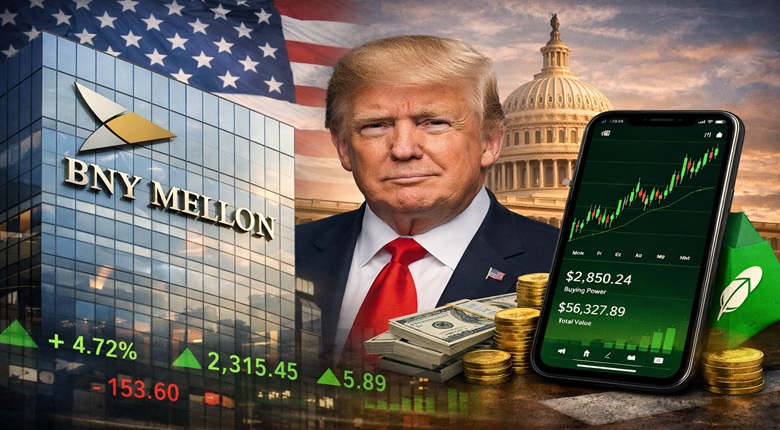
BNY & Robinhood Win Contract to Run Trump Accounts

Table of Contents
- A New Financial Institution Is Born
- Who Won the Contract — and Why These Two?
- What Are Trump Accounts? A Complete Guide
- How the App and Infrastructure Will Work
- The $1,000 Seed Money: Who Gets It and When
- Private Contributions: Dell, Employers, and Beyond
- The Business Case: Why Wall Street Wanted This Contract
- Criticisms and Limitations of Trump Accounts
- Conclusion: A New Chapter in American Investing
- Frequently Asked Questions
- External References and Further Reading
A New Financial Institution Is Born
On the morning of April 6, 2026, two of the most recognisable names in American finance made a joint announcement on CNBC’s Squawk on the Street that would be heard in nurseries, board rooms, and congressional offices alike. The US Department of the Treasury had designated The Bank of New York Mellon — BNY — as the financial agent for Trump Accounts, with Robinhood Markets named as the brokerage and initial trustee. The partnership would build and operate the infrastructure behind one of the most talked-about provisions of the One Big Beautiful Bill Act (OBBBA): a government-seeded investment account for every eligible American child.By the time the announcement was made, more than 4 million children had already been signed up for Trump Accounts, according to IRS data as of March 31. Over 1 million of those were eligible for the Treasury’s $1,000 pilot program contribution. The infrastructure to manage those accounts — securely, at scale, and in time for a July 4, 2026 launch — needed to be built. BNY and Robinhood won the right to build it.
This blog post explains what that means: who BNY and Robinhood are and why they won, how Trump Accounts work, what the app will look like, who qualifies for the government’s seed money, how private contributions from employers and philanthropists fit in, and what the strategic and political significance of this contract really is.
Who Won the Contract — and Why These Two?
Bank of New York Mellon (BNY)
BNY is the oldest bank in the United States, founded in 1784 by Alexander Hamilton. Today it is one of the world’s largest custodian banks, managing over $50 trillion in assets under custody. Its role as a financial agent is not new — the Treasury has longstanding statutory authorities to designate qualified financial institutions as financial agents to perform services in a fiduciary capacity. BNY has been part of the US financial system’s plumbing for over two centuries.Robin Vince, BNY’s CEO, framed the selection in patriotic terms: “BNY has been part of the fabric of the US financial system since our country’s founding, and through this landmark initiative, will help more Americans invest in our economy, strengthen US capital markets, and give more children a foundation for long-term financial security.” BNY had also already pledged, alongside several other large employers, to match the Treasury’s $1,000 seed money for children of US employees — a signal of early commitment that may have helped its candidacy.
Robinhood Markets
Robinhood’s selection is the more surprising — and strategically significant — half of the partnership. Founded in 2013, Robinhood democratised retail investing by eliminating commission fees, building a mobile-first interface, and attracting a generation of younger investors who had never owned a brokerage account before. Its brand is synonymous with accessible, tech-forward finance.Vlad Tenev, Robinhood’s chairman and CEO, described the selection as “a historic milestone for our mission to democratise finance for all.” The company will serve as brokerage and initial trustee for Trump Accounts, developing the technology platform and providing customer service. Critically, the app it builds will be a custom white-label product for the Treasury without BNY or Robinhood branding — the government retains ownership and control of the app and operations for the initial accounts.
Key fact: The contract’s financial terms were not disclosed. The app will carry the Treasury’s branding, not Robinhood’s or BNY’s.
What Are Trump Accounts? A Complete Guide
Trump Accounts — formally known as Section 530A accounts under the Internal Revenue Code — are a new category of tax-advantaged investment account for children, created by the One Big Beautiful Bill Act (OBBBA) signed into law on July 4, 2025. The concept is straightforward: give every American child a stake in the US stock market from birth, seeded by the federal government, with growth compounding tax-deferred over 18 years.They function as a hybrid of a traditional IRA and a 529 college savings plan, with some features from the “baby bond” concept that has circulated in progressive policy circles for decades. Despite the capitalist-facing branding and Republican legislative vehicle, the underlying mechanism — universal seed money to democratise wealth-building — has deep roots in cross-partisan policy thinking.
| Feature | Detail |
| Eligibility | Any US child under age 18 with a valid Social Security number |
| Government seed contribution | $1,000 for US citizen children born Jan 1, 2025 – Dec 31, 2028 |
| Private contribution limit | $5,000 per year (indexed for inflation after 2027) |
| Employer contribution | Up to $2,500/year per employee (counts toward $5,000 cap) |
| Investment restrictions | Low-cost mutual funds or ETFs tracking S&P 500 or broad US equity index; expense ratio ≤0.1% |
| Withdrawals before 18 | Generally prohibited (exceptions: rollovers, excess contributions, death) |
| Tax treatment | Contributions after-tax; growth tax-deferred; withdrawals taxed as ordinary income |
| At age 18 | Account converts to a traditional IRA with standard IRA rules |
| Account launch | July 4, 2026 |
| Enrolment method | IRS Form 4547 (with 2025 tax return) or TrumpAccounts.gov |
One feature that distinguishes Trump Accounts from 529 plans and Roth IRAs is their investment restriction. Funds must be invested exclusively in mutual funds or ETFs that track the S&P 500 or another broad US equity index, with an annual expense ratio cap of 0.10%. Account holders cannot pick individual stocks, sector funds, bonds, or alternative investments. The logic is deliberate: minimise fees, eliminate speculation, and maximise long-term passive growth.
The IRS describes a Trump Account as a type of individual retirement account. Before January 1 of the year the child turns 18, funds cannot be withdrawn. After that, the account converts to a traditional IRA, subject to standard early withdrawal rules — including the 10% penalty for withdrawals before age 59½ unless specific exemptions apply, such as qualified education expenses, a first home purchase, or job training.
How the App and Infrastructure Will Work
The Trump Accounts app will be built by Robinhood in collaboration with BNY and the Treasury’s National Design Studio. The result will be a custom, white-label product designed exclusively for the Treasury — meaning families will interact with a government-branded platform, not a Robinhood or BNY product. The Treasury retains full control over the app and its operations for the initial phase.Robinhood will roll out the authentication process in May 2026, with the full platform and seed money delivery set for July 4, 2026 — America’s 250th birthday, a date chosen by the Trump administration to underscore the programme’s patriotic branding. Contributions from private parties cannot begin before that date.
The interface is being designed to be intuitive for families who may have little prior investment experience. The Treasury has described the goal as ensuring that “families can explore their Trump Accounts with confidence and ease.” For Robinhood, whose entire brand proposition has been built on making investing accessible to first-time investors, this alignment is natural.
How to enrol: Parents or guardians can sign up now by filing IRS Form 4547 with their 2025 tax return. An online portal at TrumpAccounts.gov is expected to go live in July 2026. There is a limit of one Trump Account per child.
The $1,000 Seed Money: Who Gets It and When
The most headline-grabbing feature of Trump Accounts is the federal government’s one-time $1,000 pilot program contribution. But the eligibility rules are specific, and not every child qualifies.Who Is Eligible for the $1,000
- Children must be US citizens.
- Children must have been born between January 1, 2025, and December 31, 2028.
- An election must be made on behalf of the child — typically by a parent or guardian via Form 4547 or the online portal.
- Children born outside this window can still open a Trump Account but will not receive the federal seed money.
The Long-Term Value of $1,000
The government’s seed contribution is modest in isolation, but its potential over 18 years of compound growth is significant. The S&P 500 has averaged approximately 10% annual returns over the long term. If a $1,000 deposit grows at that rate without any additional contributions, it would be worth roughly $5,560 by the time a child born in 2025 reaches 18. If a family also contributes the maximum $5,000 per year throughout childhood, the account value at 18 could exceed $250,000. These are projections, not guarantees — markets fluctuate, and past performance does not predict future results — but they illustrate why the concept of early, low-fee index fund investing is so compelling.Key distinction: Children born before 2025 who are under 18 can still open a Trump Account — they simply do not qualify for the $1,000 federal deposit. They may, however, qualify for the $250 contribution from the Dell Foundation.
Private Contributions: Dell, Employers, and Beyond
The federal government’s $1,000 contribution is only the beginning of the capital that philanthropists and employers are pledging to flow into Trump Accounts.The Dell Family’s $6.25 Billion Pledge
In December 2025, Michael and Susan Dell — the CEO of Dell Technologies and his wife — announced a $6.25 billion donation to expand access to Trump Accounts for children who do not qualify for the federal seed money. The Dell pledge targets children aged 10 and under who were born before January 1, 2025 (and therefore too old to receive the $1,000 government contribution), live in ZIP codes where the median household income is $150,000 or less, and have not yet turned 11. Each eligible child would receive a $250 contribution, potentially reaching up to 25 million American children.Other philanthropists have followed. Dalio Philanthropies pledged to provide $250 deposits for eligible children in Connecticut. Several other charitable organisations and state governments are exploring similar contributions. Some states are examining whether to tie additional deposits to financial literacy programme participation.
Employer Contributions
Employers are permitted to contribute up to $2,500 per year per employee to Trump Accounts belonging to the employee or the employee’s dependants. These employer contributions are not counted as taxable income to the employee, functioning similarly to employer contributions to dependent care assistance plans. BNY was among the first major employers to pledge matching the federal $1,000 for children of US employees, signalling the programme’s early corporate adoption.The employer contribution channel is expected to become a competitive element of benefits packages, particularly as the programme scales. Companies offering meaningful Trump Account contributions will have a new tool to attract younger workers who are starting families.
The Business Case: Why Wall Street Wanted This Contract
The competition to serve as the financial infrastructure for Trump Accounts was intense, and for good reason. The contract is not primarily about the fees earned from managing relatively small initial balances. It is about what those accounts become.As one analyst at eMarketer framed it, the Trump Accounts contract is a “tactical benefit, with a nearly immediate boost” for BNY as custodian and Robinhood as app infrastructure provider — but it is “even more valuable strategically as account holders reach the age of majority and roll over their accounts.”
When a Trump Account converts to a traditional IRA at age 18, the account holder gains the ability to choose where that IRA is held. Robinhood, as the platform with which every account holder has interacted since childhood, will be the natural first choice for most. The millions of children enrolling in Trump Accounts in 2026 represent, in 18 years, millions of young adults with IRAs to roll over. Robinhood will be “first in line as competition for customers intensifies as brokerages pitch rollovers.”
For BNY, the custodial relationship established through Trump Accounts positions it as the institutional backbone of a programme that could eventually encompass tens of millions of accounts. Treasury Secretary Scott Bessent described Trump Accounts in July 2025 as a “back door for privatising Social Security” — a politically loaded phrase that signals just how significant the programme’s long-term ambition is, regardless of one’s views on that framing.
The estimated cost to the Treasury through 2034 is $15 billion, according to the Congressional Joint Committee on Taxation. The amount of private capital expected to flow alongside it is a multiple of that figure.
Criticisms and Limitations of Trump Accounts
Trump Accounts have attracted both enthusiasm and scepticism, and it is worth engaging with the legitimate criticisms seriously.Tax Treatment Compared to Better Alternatives
Unlike a 529 college savings plan, where qualified education withdrawals are tax-free, Trump Account withdrawals are always taxed as ordinary income. Unlike a Roth IRA, where contributions are post-tax and qualified withdrawals are tax-free, Trump Accounts do not offer tax-free growth on exit. The Wikipedia description is pointed: Trump Accounts “have more restrictions and fewer tax benefits than some other investment accounts such as 529 accounts, traditional and Roth individual retirement accounts, health savings accounts, 401(k) accounts, and 403(b) accounts.”For families who have the financial means to fully fund a Roth IRA or 529 plan for their child, those vehicles may well deliver better tax outcomes than maximising a Trump Account. Financial professionals and tax advisers broadly recommend evaluating Trump Accounts as a complement to, not a replacement for, other tax-advantaged savings tools.
Enrolment Gaps and Equity Concerns
Professor Jin Huang, co-director of the Center for Social Development at Washington University in St. Louis, has warned that without automatic enrolment, millions of eligible children will likely miss out. The programme’s reliance on parents or guardians filing a form means that the families with the least access to financial literacy and tax preparation resources — often the lowest-income families who would benefit most — may be disproportionately absent from the programme.The requirement for a Social Security number also effectively excludes children of undocumented immigrants, even those born in the United States who are US citizens by birth, if the child’s parents face documentation barriers to the enrolment process.
Investment Restrictions
The requirement that all funds be invested in broad US equity index funds means families have no ability to customise the portfolio for their circumstances, risk tolerance, or values. A family that would prefer conservative exposure as the child nears 18 — when the account converts to an IRA and becomes accessible — cannot adjust the allocation. All funds remain in US equities until conversion.Important note: The programme’s detailed regulations are still being finalised. Families should monitor IRS and Treasury guidance at IRS.gov/newsroom and TrumpAccounts.gov before making contribution decisions.
Conclusion
The selection of BNY and Robinhood to build and run the Trump Accounts infrastructure is a moment that matters beyond the immediate news cycle. It represents the US government’s most significant direct intervention in capital market participation since the introduction of the 401(k) — and it does so by pairing one of the oldest institutions in American banking with one of the most disruptive.For families, the practical takeaway is clear: if you have a child born between 2025 and 2028, or under 18, you have a new financial tool available. The $1,000 federal seed contribution is free money for eligible children, and the structure of index-fund investing over an 18-year compounding horizon is financially sound. The tax treatment is less favourable than a Roth IRA for families who can fund both, but for families who cannot, a Trump Account is a meaningful starting point.
For markets, the announcement signals something broader: the explicit use of government infrastructure to grow retail investing participation at scale, starting at birth. Over 4 million signups before a single dollar has been deposited or a single trade placed is a remarkable indicator of demand. BNY and Robinhood now have the task — and the opportunity — of converting that demand into a generation of investors.
Whether Trump Accounts fulfil their potential will depend on enrolment reach, regulatory clarity, long-term programme continuity, and whether the families who need them most are able to access them. The infrastructure is being built. What gets built inside it, and for whom, remains the more important question.
Frequently Asked Questions
What is a Trump Account?
A Trump Account (formally a Section 530A account) is a new type of tax-advantaged investment account for children under age 18, created by the One Big Beautiful Bill Act (OBBBA) signed into law on July 4, 2025. Funds are invested in low-cost US equity index funds and grow tax-deferred. At age 18, the account converts to a traditional IRA.Who won the contract to manage Trump Accounts?
The US Department of the Treasury designated BNY (Bank of New York Mellon) as financial agent and BNY has partnered with Robinhood Markets, which will serve as brokerage and initial trustee. Together they are building the Trump Accounts app, launching July 4, 2026.
Which children qualify for the $1,000 government deposit?
US citizen children born between January 1, 2025, and December 31, 2028, who have a valid Social Security number are eligible for the one-time $1,000 pilot program contribution from the Treasury. An election must be made by a parent or guardian via IRS Form 4547 or TrumpAccounts.gov.Can children born before 2025 open a Trump Account?
Yes. Any child under age 18 with a Social Security number can open a Trump Account. However, children born before 2025 do not qualify for the $1,000 federal deposit. Children aged 10 and under who live in qualifying low-income ZIP codes may be eligible for a $250 contribution from the Michael & Susan Dell Foundation.How much can I contribute to a Trump Account?
Parents, family members, friends, and other individuals can contribute a combined total of up to $5,000 per year per child. Employers can contribute up to $2,500 per year per employee (which counts toward the $5,000 cap). The federal $1,000 seed money does not count toward the annual limit. The $5,000 limit is indexed for inflation after 2027.What investments are allowed in a Trump Account?
Funds must be invested in mutual funds or ETFs that track the S&P 500 or another broad US equity index. The fund’s annual expense ratio must be 0.10% or lower. No individual stocks, bonds, crypto, sector-specific funds, or alternative investments are permitted.When will the app be available?
Robinhood is rolling out the authentication process in May 2026. The full app and seed money delivery are scheduled for July 4, 2026. An online portal at TrumpAccounts.gov is expected to launch at the same time. Parents who filed Form 4547 with their 2025 tax return will already be in the system.Are Trump Accounts better than a 529 plan or Roth IRA?
Not necessarily for all families. Trump Accounts have less favourable tax treatment than Roth IRAs (where qualified withdrawals are tax-free) and 529 plans (where education withdrawals are tax-free). For families who can fund both, a Roth IRA or 529 may be a better primary vehicle. For families who cannot, the free $1,000 seed money and tax-deferred growth make Trump Accounts a valuable starting point. Consult a financial adviser for your specific situation.What happens to the account when the child turns 18?
The Trump Account converts to a traditional IRA, subject to standard IRA rules. The account holder can choose where to hold the IRA. Withdrawals before age 59½ are subject to ordinary income tax and potentially a 10% penalty, unless exceptions apply (education, first home purchase, job training, or business formation, among others).How is the app branded? Will it say Robinhood or BNY?
No. The app is a custom white-label product designed exclusively for the US Treasury. It will not carry Robinhood or BNY branding. The Treasury retains control over the app and its operations. Families will interact with a government-branded interface.External References and Further Reading
US Treasury — BNY Designated as Financial Agent for Trump Accounts (Official Press Release), BNY — BNY Named Financial Agent for Trump Accounts (Official Statement), Robinhood — Robinhood Tapped as Brokerage for Trump Accounts (Official Statement), CNBC — BNY Will Officially Manage Initial Accounts; Robinhood to Build the App, IRS — One Big Beautiful Bill Act Provisions (Trump Accounts Section), IRS — Treasury and IRS Issue Guidance on Trump Accounts (Notice 2025-68), Britannica Money — What Are Trump Accounts? Eligibility, Seed Money, and How They Work, Warren Averett — One Big Beautiful Bill Act Breakdown: Trump Accounts, Chase — Trump Accounts for Kids: Considerations and Key Rules for Parents, Benzinga — Robinhood, BNY Win Trump Accounts Contract as Signups Reach 4 Million, Wikipedia — Trump Account (Section 530A, OBBBA), Elder Law Answers — Jump-Starting Savings with Trump Accounts
0 Comments
Be the first to share your thoughts on this article.