

Taxes
California Prop 40: Billionaire Wealth Tax Guide 2026

California voters will decide on November 3, 2026 whether to impose a one-time 5% tax on the net worth of approximately 200 to 250 billionaires. Supporters collected 1.6 million signatures. Opponents raised $118 million — the most expensive referendum battle in state history. The Legislative Analyst’s Office projects tens of billions in near-term revenue and a possible ongoing decline in income tax collections. Google’s Sergey Brin contributed $102 million to fight it and moved to Nevada. This is a guide to every dimension of the debate.

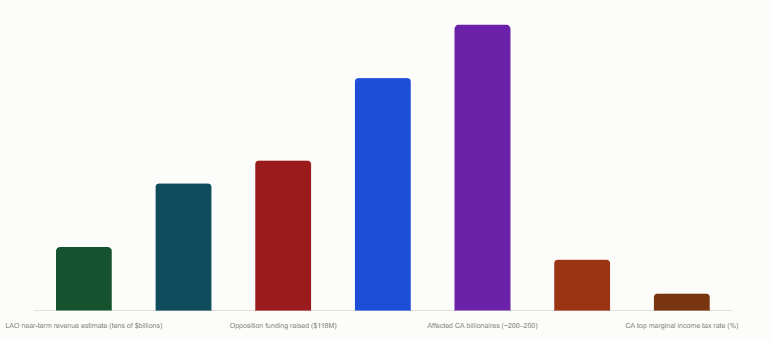
The campaign surrounding Proposition 40 has already become the most expensive referendum battle in California history. The opposition group Building a Better California, co-founded by Google’s Sergey Brin and former Google CEO Eric Schmidt, had raised more than $118 million by late August 2026, with Brin alone contributing $102 million. The group reserved $87 million in advertising for the final weeks before the election. On the other side, SEIU United Healthcare Workers West (the initiative’s sponsor) collected 1.6 million signatures by April 2026 — nearly double the 874,641 required to qualify for the ballot. The California Secretary of State certified 980,438 valid signatures on June 17, 2026.
The debate touches simultaneously on tax fairness, healthcare funding, the constitutional limits of retroactive taxation, the structural risk to California’s revenue base, and the relationship between the state’s innovation economy and its public services. This guide covers every significant dimension, drawing on the Legislative Analyst’s Office’s nonpartisan fiscal analysis, academic research, legal analysis from major law firms, and the arguments from both campaigns.
Prop 40 ballot date: November 3, 2026. Tax: one-time 5% on net worth > $1 billion. ~200–250 affected taxpayers. LAO: 'tens of billions' in near-term revenue; possible ongoing income tax decline < $1bn/year. Opposition raised $118M; Brin alone: $102M. SEIU collected 1.6M signatures (double required). Certified: 980,438 valid signatures (June 17, 2026, CA Secretary of State).
Medi-Cal — California’s version of Medicaid — provides health coverage to approximately 15 million low-income Californians, including children, seniors, and people with disabilities. The federal reduction in matching funds created a gap that threatened cuts to coverage, benefits, or provider reimbursement rates. SEIU-UHW framed Proposition 40 as a direct response: the revenue from a one-time wealth tax on California’s billionaires would be sufficient to replace the lost federal funding and stabilise the programme.
The 90/10 revenue allocation — 90 percent to healthcare, 10 percent to education and food assistance — reflects this specific framing. The initiative was explicitly designed to address a healthcare funding emergency rather than to establish a permanent wealth tax infrastructure. This ‘one-time’ framing is both a political strategy (making the ask seem bounded) and a genuine structural feature (the tax base is defined by a fixed date, January 1, 2026 residency, not an ongoing annual obligation).
Key characteristics of the affected taxpayer population:
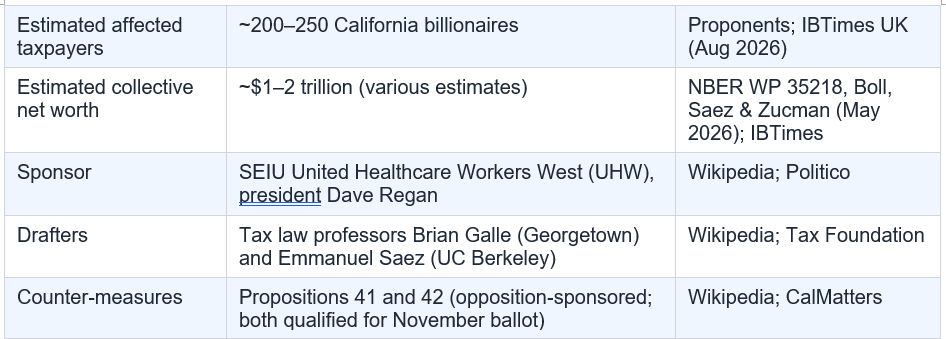
Affected taxpayers: ~200–250 California billionaires (Foley & Lardner; proponents). Collective net worth estimate: ~$1–2 trillion. Revenue estimate (proponents, NBER WP 35218): ~$100 billion one-time. LAO estimate: 'tens of billions spread over several years.' Dominant sector: technology. Primary asset type: publicly traded securities (principally tech company shares). Residency lock-in date: January 1, 2026.
Documented or reported departures include:
The legal significance of these departures is contested. The initiative’s drafters argue that the January 1, 2026 residency determination is legally valid and that individuals who left after that date remain subject to the tax. The Baker Botts analysis (December 2025) notes that this ‘bright-line rule is unusual compared to income tax residency analysis, which often evaluates domicile and time-spent factors over a longer period,’ and that the legal standing of the residency determination for those who have since relocated will certainly face litigation.
The residency exodus illustrates the fundamental behavioural challenge of high-marginal-rate taxation on mobile capital: the individuals with the largest wealth are also the individuals with the most resources, the most options, and the most sophisticated advisers available to minimise their exposure. The tax may be designed to capture those who were present on January 1, 2026 — but proving residency for billionaires who maintain multiple homes across multiple states will be a legal contest, not an administrative formality.
The specific problem identified by the Tax Foundation involves the treatment of trusts:
Under the initiative as written, ‘net worth shall for all purposes include the value of property held by any trust (other than a grantor trust or tax-exempt trust) to which the individual transfers property in 2026, and seventy-five percent of the value of such property transferred in 2025.’
The Tax Foundation’s interpretation: the language captures the entire value of any trust to which assets are transferred in 2026, not just the value of the transfer itself. As an example: a taxpayer who transfers $50 million to a trust in 2026 and holds a trust that contains $500 million may find that the full $500 million trust value is included in their net worth for tax purposes — not just the $50 million transfer. This could expose the entire trust to taxation as if it were the taxpayer’s individual wealth, even if the trust contains assets belonging to multiple beneficiaries.
The Tax Foundation concludes: ‘Due to aggressive design choices and possible drafting errors, the actual rate on taxpayers’ net worth could be dramatically higher [than 5%].’ Supporters of the measure dispute this interpretation and argue the language achieves the intended effect of preventing trust-based avoidance without producing an unintended over-inclusion.
Opponents argue: If the Tax Foundation's reading of the trust language is correct, the effective rate could be multiples of the stated 5% for any affected taxpayer who has used trust structures — which includes virtually all ultra-high-net-worth individuals. This would both increase the legal vulnerability and produce a measure that substantially differs from what was presented to voters. Either interpretation invites litigation that could delay or eliminate revenue collection.
The counter-ballot strategy reflects an established California political tactic: placing competing or conflicting measures on the same ballot to create voter uncertainty, dilute enthusiasm for the primary measure, or provide a legal mechanism to override it if it passes. The specific structure of Propositions 41 and 42 — which had qualified for the November ballot as of the time of writing — is designed to give voters who oppose Proposition 40 a ‘yes’ vote to cast that counteracts their ‘no’ on 40.
CalMatters describes the dynamic: ‘Since opponents placed two offsetting measures on the ballot, CalMatters asked guest authors to argue for the vote combinations that would either fully approve or fully nullify Proposition 40.’ The existence of multiple related measures on the same ballot creates a complex decision environment for voters and a significant legal question about how conflicting approved measures interact if all three pass with majorities.
Supporters argue: Voters who support Proposition 40 should vote Yes on 40 and No on 41 and 42. The counter-measures are funded by the same billionaires who are trying to avoid paying the wealth tax and are designed to prevent Californians from directing their state to invest in healthcare.
Opponents argue: Voters who oppose Proposition 40 should vote No on 40 and Yes on 41 and 42. The counter-measures represent alternative, more sustainable approaches to healthcare funding that do not carry the constitutional risk, the billionaire exodus risk, or the structural dependency on a one-time revenue event.
What is not in dispute: California has a significant healthcare funding gap. California’s ~200 to 250 billionaires hold extraordinary wealth. The affected individuals have the resources and sophistication to respond to the tax through relocation, restructuring, and legal challenge. The LAO estimates near-term revenue in the tens of billions and a possible ongoing income tax decline if billionaires leave. The opposition campaign is the most generously funded in California ballot history. The supporter coalition collected signatures at nearly twice the required pace.
What voters must assess is the balance of competing risks: the immediate risk of a healthcare funding crisis affecting 15 million Medi-Cal recipients, weighed against the structural risk of a one-time revenue event that does not solve the ongoing funding gap and may erode the state’s long-term revenue base. The international precedent suggests that wealth taxes on mobile capital require careful design to avoid producing exactly the outcome their opponents warn about. Whether Proposition 40’s one-time structure, retroactive design, and the specific drafting choices around trusts and residency have achieved that careful balance is what November 3, 2026 will decide.
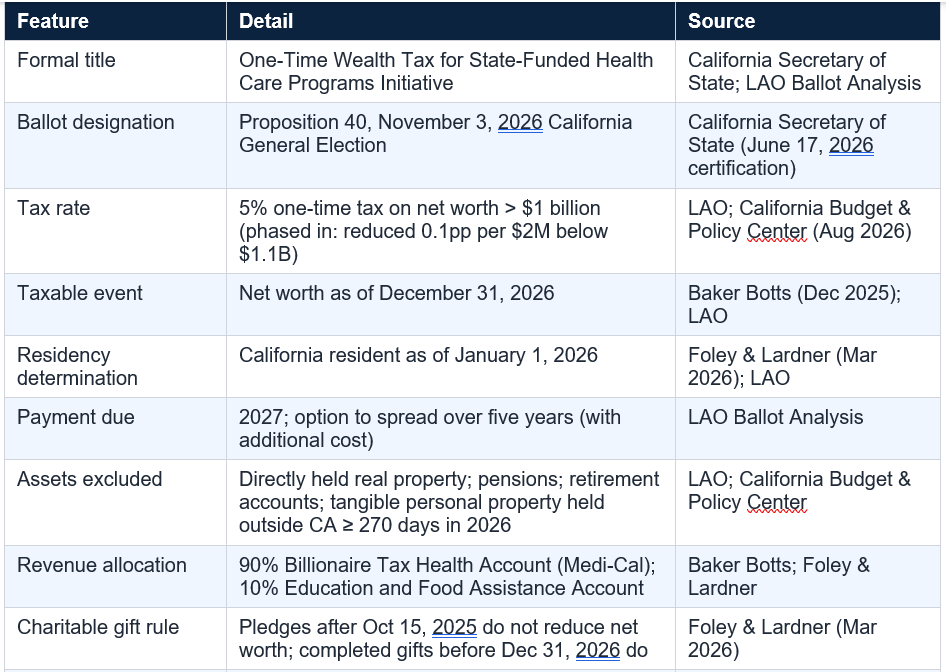
Proposition 40 is a combined initiated constitutional amendment and state statute on the November 3, 2026 California general election ballot. If approved by a majority of voters, it would impose a one-time 5% tax on the net worth of California residents worth more than $1 billion who were residents of the state as of January 1, 2026. The tax would be assessed on December 31, 2026 and due in 2027 (with an option to spread payments over five years). Revenue would go primarily (90%) to healthcare programmes including Medi-Cal and secondarily (10%) to education and food assistance. Real property, pensions, and retirement accounts are excluded. The measure was sponsored by SEIU United Healthcare Workers West and drafted by tax law professors Brian Galle (Georgetown) and Emmanuel Saez (UC Berkeley).
How much revenue would Proposition 40 generate?
The estimates vary significantly. Supporters, drawing on NBER Working Paper 35218 (Boll, Saez, and Zucman, May 2026), project approximately $100 billion in one-time revenue. The nonpartisan Legislative Analyst's Office (LAO), in its official ballot analysis, estimates 'temporary revenue increase of tens of billions of dollars spread over several years' — a more conservative range that accounts for the payment-spreading option. The LAO also notes 'possible ongoing decrease of less than $1 billion per year in state income tax revenue' if billionaires relocate. The wide range reflects genuine uncertainty about both the size of the tax base (affected by how many billionaires successfully establish non-California residency and contest the tax) and the behavioural responses of affected individuals.
Is Proposition 40 constitutional?
This is deeply contested. Major law firms including Baker Botts (December 2025) and Foley & Lardner (March 2026) have identified multiple potential constitutional challenges: retroactivity concerns (the residency determination date was set before voters could approve the measure); bill of attainder risk (a law targeting ~200 specifically identifiable individuals with a financial penalty without trial); interstate commerce and worldwide asset taxation issues; and due process claims. Initiative drafters argue the measure was carefully designed to withstand each challenge. The ultimate determination will be made by California courts and, almost certainly, the federal courts as well. Significant litigation is anticipated if the measure passes.
Why have some progressive organizations opposed Proposition 40?
In June 2026, Planned Parenthood and the California Medical Association issued a joint statement criticising the wealth tax's 'ambiguity' and describing it as a 'flawed response' to healthcare cuts. The California Teachers Association stated that the billionaire tax 'will not provide the sustainable and long-lasting' funding the healthcare system needs. These organisations are not opposed to higher taxes on wealthy individuals in principle — they are concerned that this specific measure, due to legal vulnerability and its one-time revenue structure, may not reliably deliver the healthcare funding it promises and could actually produce worse long-term outcomes for the programmes it aims to fund if litigation delays or eliminates revenue collection.
What are Propositions 41 and 42?
Propositions 41 and 42 are counter-ballot measures qualified for the November 2026 California ballot by the Building a Better California opposition group (co-founded by Sergey Brin and Eric Schmidt). They are designed to either offset or nullify Proposition 40 if it passes. The precise mechanism varies: the opposition presents 41 and 42 as 'commonsense measures' that address healthcare funding through more sustainable means; supporters of Proposition 40 describe them as measures funded by the billionaires who are trying to avoid the wealth tax. California voters will face three related ballot measures simultaneously, creating a complex decision environment. If all three pass with majorities, the legal interaction among them will require adjudication.
How does Proposition 40 affect me if I am not a billionaire?
Proposition 40 does not directly affect the income, assets, or tax liability of any individual with a net worth below $1 billion. The effects on non-billionaire Californians are indirect: if the tax generates the projected revenue and it is successfully spent on Medi-Cal, approximately 15 million low-income Californians benefit from maintained or improved healthcare coverage. If the tax triggers a significant departure of high-earning residents and businesses, the long-term state income tax base may contract, potentially affecting the state's ability to fund other public services. If the measure faces successful legal challenge and revenue collection is delayed or prevented, neither the healthcare benefit nor the revenue risk materialises. The IBTimes UK analysis notes that the signal Proposition 40 sends about California's business climate potentially affects a much wider group of business owners and investors than the ~200 directly targeted taxpayers.
Table of Contents
- The Most Expensive Ballot Battle in California History
- What Is Proposition 40? The Full Mechanics of the Tax
- The Medi-Cal Context: Why Now?
- Who Would Actually Pay? Profiling the ~200 Affected Billionaires
- How Much Revenue Would Proposition 40 Generate?
- The Case for Proposition 40: Arguments from Supporters
- The Case Against Proposition 40: Arguments from Opponents
- The Residency Exodus: Billionaires Who Left Before January 1, 2026
- The Legal Challenges: Is Proposition 40 Constitutional?
- The Tax Foundation’s Warning: Is the Rate Actually 5%?
- Propositions 41 and 42: The Counter-Ballot Strategy
- What California’s Structural Revenue Risk Looks Like
- The International Precedent: What Wealth Taxes Have Done Elsewhere
- Conclusion: A Decision with Consequences for All Californians
- Frequently Asked Questions
Revenue, Funding And California's Revenue Concentration Risk
The Debate: Key Arguments For And Against Proposition 40
The Most Expensive Ballot Battle in California History
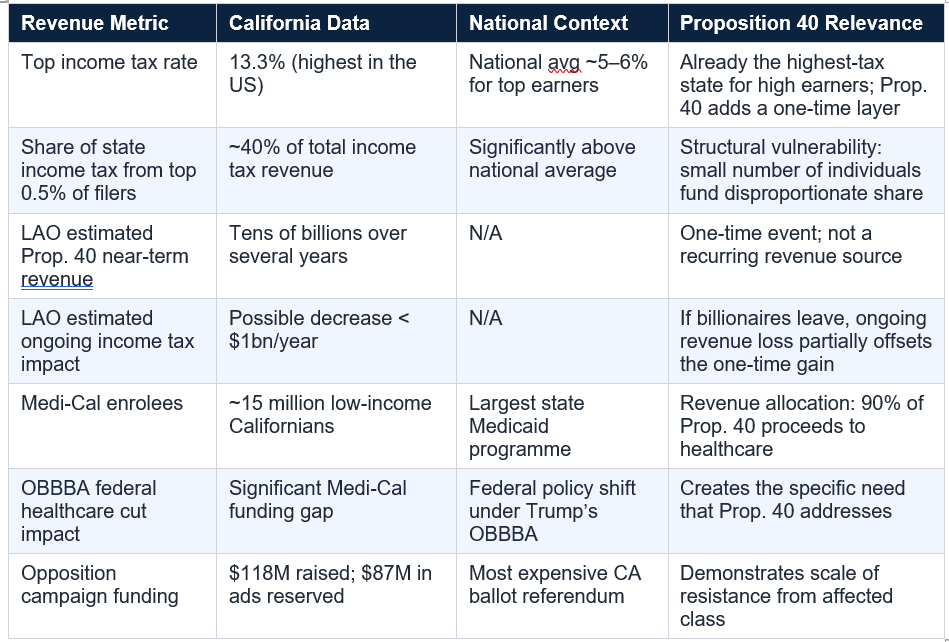
California voters will decide on November 3, 2026 whether to enact what would be the first state-level billionaire wealth tax in United States history. Proposition 40 — formally titled the One-Time Wealth Tax for State-Funded Health Care Programs Initiative — would impose a single 5 percent tax on the accumulated net worth of California billionaires who were residents of the state as of January 1, 2026. The revenue would primarily fund Medi-Cal and other healthcare programmes.The campaign surrounding Proposition 40 has already become the most expensive referendum battle in California history. The opposition group Building a Better California, co-founded by Google’s Sergey Brin and former Google CEO Eric Schmidt, had raised more than $118 million by late August 2026, with Brin alone contributing $102 million. The group reserved $87 million in advertising for the final weeks before the election. On the other side, SEIU United Healthcare Workers West (the initiative’s sponsor) collected 1.6 million signatures by April 2026 — nearly double the 874,641 required to qualify for the ballot. The California Secretary of State certified 980,438 valid signatures on June 17, 2026.
The debate touches simultaneously on tax fairness, healthcare funding, the constitutional limits of retroactive taxation, the structural risk to California’s revenue base, and the relationship between the state’s innovation economy and its public services. This guide covers every significant dimension, drawing on the Legislative Analyst’s Office’s nonpartisan fiscal analysis, academic research, legal analysis from major law firms, and the arguments from both campaigns.
Prop 40 ballot date: November 3, 2026. Tax: one-time 5% on net worth > $1 billion. ~200–250 affected taxpayers. LAO: 'tens of billions' in near-term revenue; possible ongoing income tax decline < $1bn/year. Opposition raised $118M; Brin alone: $102M. SEIU collected 1.6M signatures (double required). Certified: 980,438 valid signatures (June 17, 2026, CA Secretary of State).
What Is Proposition 40? The Full Mechanics of the Tax
Proposition 40 is both an initiated constitutional amendment and a state statute — meaning it would amend the California Constitution as well as state law, requiring a simple majority of voters to pass. The full mechanics of the tax are more complex than the headline “5% on billionaires” suggests.
The Medi-Cal Context: Why Now?
Proposition 40 did not emerge from an abstract debate about wealth inequality. It emerged from a specific and urgent fiscal crisis in California’s healthcare system. The One Big Beautiful Bill Act (OBBBA), signed by President Trump in 2025, significantly reduced federal healthcare funding. For California, this translated into a substantial Medi-Cal funding gap that the state budget could not readily absorb.Medi-Cal — California’s version of Medicaid — provides health coverage to approximately 15 million low-income Californians, including children, seniors, and people with disabilities. The federal reduction in matching funds created a gap that threatened cuts to coverage, benefits, or provider reimbursement rates. SEIU-UHW framed Proposition 40 as a direct response: the revenue from a one-time wealth tax on California’s billionaires would be sufficient to replace the lost federal funding and stabilise the programme.
The 90/10 revenue allocation — 90 percent to healthcare, 10 percent to education and food assistance — reflects this specific framing. The initiative was explicitly designed to address a healthcare funding emergency rather than to establish a permanent wealth tax infrastructure. This ‘one-time’ framing is both a political strategy (making the ask seem bounded) and a genuine structural feature (the tax base is defined by a fixed date, January 1, 2026 residency, not an ongoing annual obligation).
Who Would Actually Pay? Profiling the ~200 Affected Billionaires
One of the most contested empirical questions in the Proposition 40 debate is the composition of the approximately 200 to 250 California billionaires who would be subject to the tax. NBER Working Paper 35218 (Boll, Saez, and Zucman, May 2026) — compiled using Forbes’ Real-Time Billionaires list with California-specific data — provides the most detailed academic analysis.Key characteristics of the affected taxpayer population:
- The group is heavily concentrated in the technology sector. Silicon Valley billionaires represent a disproportionate share of both the number of affected individuals and the aggregate net worth.
- Much of the wealth is held in publicly traded securities (primarily tech company shares), which creates both valuation clarity (stock prices are observable) and liquidity complexity (selling billions of dollars of stock quickly can move markets and trigger significant tax consequences beyond the wealth tax itself).
- A meaningful share of the wealth is held in trusts and complex structures, the tax treatment of which under Proposition 40 is both contested and potentially broader than intended (see Section 10).
- The residency determination date of January 1, 2026 was set approximately 14 months before the November 3, 2026 vote, giving affected individuals advance notice of the tax if the initiative qualified for the ballot. This window produced the relocation activity described in Section 8.
Affected taxpayers: ~200–250 California billionaires (Foley & Lardner; proponents). Collective net worth estimate: ~$1–2 trillion. Revenue estimate (proponents, NBER WP 35218): ~$100 billion one-time. LAO estimate: 'tens of billions spread over several years.' Dominant sector: technology. Primary asset type: publicly traded securities (principally tech company shares). Residency lock-in date: January 1, 2026.
How Much Revenue Would Proposition 40 Generate?
The revenue projections for Proposition 40 span a very wide range, reflecting genuine uncertainty about both the size of the tax base and the behavioural responses of the affected individuals.- Proponents’ estimate (based on NBER Working Paper 35218, Boll, Saez, and Zucman, May 2026): approximately $100 billion in one-time revenue. This estimate assumes the full tax base of approximately $2 trillion in billionaire wealth, with a 5% rate, minus the excluded real estate and retirement assets.
- Legislative Analyst’s Office (nonpartisan): ‘temporary revenue increase of tens of billions of dollars spread over several years’ from the wealth tax on billionaires. The LAO notes a ‘possible ongoing decrease of less than $1 billion per year in state income tax revenue collected from billionaires’ if billionaires choose to leave. The spread-over-several-years qualifier reflects the payment option: taxpayers may elect to pay over five years rather than in a single 2027 payment.
- The LAO explicitly notes that the payment-spreading option means revenues would flow into state coffers over multiple years rather than as a single lump sum, affecting how the revenue can be programmed into the state’s budget cycle.
- The ongoing income tax impact: California’s state income tax collections are structurally dependent on the state’s top earners. The top 0.5 percent of filers account for approximately 40 percent of state income tax revenue. If a significant number of billionaires leave the state permanently as a result of Proposition 40’s passage, the ongoing income tax loss to the state could reach hundreds of millions of dollars per year according to the LAO — though the estimate is characterised as ‘less than $1 billion per year.’
The Case for Proposition 40: Arguments from Supporters
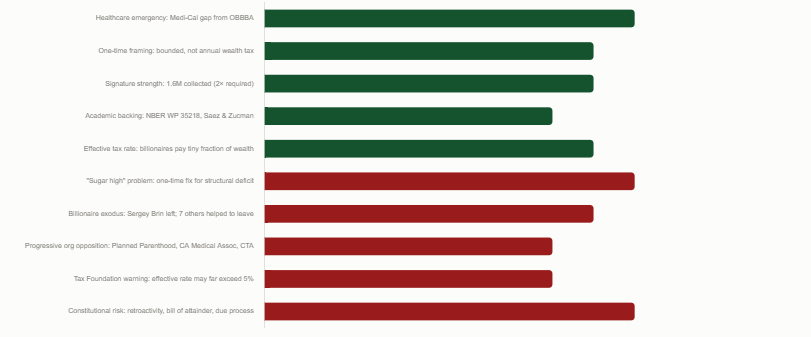
SEIU-UHW and the broader coalition supporting Proposition 40 make several distinct arguments:- Addressing genuine healthcare emergency: the Medi-Cal funding gap created by federal healthcare cuts requires immediate action. A one-time contribution from California’s wealthiest residents represents a proportionate, targeted response that protects vulnerable residents. Supporters point to the 1.6 million signatures collected as evidence of broad public support for this priority.
- The effective tax rate argument: supporters contend that California’s billionaires have historically paid very low effective tax rates relative to their wealth accumulation. The 2021 ProPublica analysis (cited by the California Federation of Teachers in its support statement) documented that the richest 25 Americans paid a tiny fraction of their wealth in taxes annually, primarily because unrealised capital gains — the appreciation of stock and property that has not been sold — are not subject to income tax until realisation. Proposition 40 addresses this by taxing net worth rather than income.
- The ‘one-time’ proportionality: the affected billionaires’ collective wealth has grown by hundreds of billions of dollars in recent years. A 5% one-time tax on this accumulated wealth is, in the supporters’ framing, a modest ask compared with both the scale of the wealth and the public benefit it would fund.
- Economic stimulus for healthcare: the revenue from Proposition 40 would fund Medi-Cal, which provides healthcare services delivered by California workers through California-based providers. This spending has a local economic multiplier effect that partially offsets the wealth extraction from the top of the income distribution.
- Legal design: the initiative’s drafters — including UC Berkeley Professor Emmanuel Saez, one of the foremost academic experts on wealth taxation — argue that the measure was carefully designed to withstand constitutional challenges. The residency-based approach, the exclusion of real property, and the one-time rather than ongoing structure were all chosen to address anticipated legal objections.
The Case Against Proposition 40: Arguments from Opponents
The opposition to Proposition 40 includes an unusual alignment of tech billionaires, business associations, and, strikingly, some progressive organisations including Planned Parenthood and the California Medical Association.- The ‘sugar high’ problem: the CalMatters opinion piece from a business association head (July 29, 2026) captures the LAO’s analysis: Prop. 40 ‘would produce an uptick of tens of billions of dollars in near-term revenue. But this is a sugar high. The LAO also projects an ongoing decrease in state income-tax collections of hundreds of millions of dollars or more each year if taxpayers leave California.’ A one-time fix for a structural problem is not a solution — it is a deferral.
- Business and innovation signal: a wealth tax signals to entrepreneurs, investors, and founders that California treats accumulated wealth as a resource for the state rather than as the property of the individual who built it. The IBTimes UK analysis notes the risk to small and medium-sized businesses from the reputational effect on California’s business climate, even though Proposition 40 directly targets only ~200 individuals.
- Constitutional and legal risks: major law firms — including Baker Botts (December 2025) and Foley & Lardner (March 2026) — have identified multiple constitutional challenges including: retroactivity concerns (the residency date was set before the vote, effectively imposing a tax on people who could not have known their residency decision would be legally significant); bill of attainder risk (a law targeting a specific, identifiable group of ~200 individuals with a financial penalty without trial); and due process concerns.
- Progressive healthcare organisation opposition: both Planned Parenthood and the California Medical Association expressed opposition in June 2026, criticising the wealth tax’s ‘ambiguity’ and describing it as a ‘flawed response’ to healthcare cuts. The California Teachers Association stated that Prop. 40 ‘will not provide the sustainable and long-lasting’ funding needed. These organisations are not opposed to wealth taxation in principle but question whether this specific measure is well-designed to address the healthcare funding problem.
- Propositions 41 and 42 as alternative: opponents have qualified two counter-measures for the same ballot, framing them as more sustainable approaches to healthcare funding that do not carry the constitutional risk, behavioural uncertainty, and structural funding cliff that Proposition 40 involves.
The Residency Exodus: Billionaires Who Left Before January 1, 2026
One of the most extensively covered dimensions of Proposition 40 is the pre-emptive departure of California billionaires ahead of the January 1, 2026 residency determination date. When the initiative became public and began collecting signatures in late 2025, high-net-worth individuals facing potential nine-figure tax bills had both the means and the incentive to relocate.Documented or reported departures include:
- Sergey Brin (Google co-founder, estimated net worth $100+ billion): relocated residency to Nevada according to campaign finance filings, reportedly purchasing a home on the Nevada side of Lake Tahoe and transferring business assets before the January 1, 2026 snapshot. Brin subsequently contributed $102 million to the opposition campaign.
- Larry Page (Google co-founder): reportedly relocated to Florida.
- Peter Thiel (Palantir co-founder, venture capitalist): relocated to Nevada.
- Travis Kalanick (Uber co-founder): posted video of his move to Texas.
- David Sacks (venture capitalist, White House AI czar): was among those who preemptively relocated.
The legal significance of these departures is contested. The initiative’s drafters argue that the January 1, 2026 residency determination is legally valid and that individuals who left after that date remain subject to the tax. The Baker Botts analysis (December 2025) notes that this ‘bright-line rule is unusual compared to income tax residency analysis, which often evaluates domicile and time-spent factors over a longer period,’ and that the legal standing of the residency determination for those who have since relocated will certainly face litigation.
The residency exodus illustrates the fundamental behavioural challenge of high-marginal-rate taxation on mobile capital: the individuals with the largest wealth are also the individuals with the most resources, the most options, and the most sophisticated advisers available to minimise their exposure. The tax may be designed to capture those who were present on January 1, 2026 — but proving residency for billionaires who maintain multiple homes across multiple states will be a legal contest, not an administrative formality.
The Legal Challenges: Is Proposition 40 Constitutional?
If Proposition 40 passes, it will face immediate legal challenges. Baker Botts and Foley & Lardner have identified the most significant constitutional vulnerabilities:- Retroactivity / due process: the initiative imposes a tax on individuals based on their residency status as of January 1, 2026 — a date that was set while the initiative was still being circulated for signatures, before it appeared on the ballot, and well before voters could pass it. Baker Botts notes that ‘taxpayers could argue that the retroactive aspect of the proposed Billionaire Tax would be violative of due process given that California does not have and has never had a wealth tax.’ The retroactive element also extends to the 75% inclusion of property transferred to trusts in 2025.
- Bill of attainder: the US Constitution (Article I, Section 10) prohibits states from enacting bills of attainder — laws that single out specific individuals or groups, impose punishment without trial. Baker Botts identifies a credible bill-of-attainder challenge: the initiative targets approximately 200 specifically identifiable individuals, imposes a significant financial penalty on them, and does not provide a trial or hearing to adjudicate the tax. Whether the wealth tax constitutes ‘punishment’ in the constitutional sense is the key contested question.
- Interstate commerce and mobility: the initiative imposes a tax on worldwide net worth, including assets held outside California. Constitutional limitations on a state’s authority to tax the worldwide wealth of a former or part-year resident, and the interaction with other states’ tax claims, will be contested.
- Apportionment: the initiative provides an ‘alternative apportionment method’ that cannot reduce the taxpayer’s California share below 25 percent, except when required by the Constitution or federal law. The constitutionality of this floor apportionment — and whether it properly accounts for the multi-state nature of some taxpayers’ wealth accumulation — will be litigated.
The Tax Foundation’s Warning: Is the Rate Actually 5%?
One of the most technically significant analyses of Proposition 40 is the Tax Foundation’s April 30, 2026 review, which identified drafting concerns that could make the effective rate on some taxpayers substantially higher than 5 percent.The specific problem identified by the Tax Foundation involves the treatment of trusts:
Under the initiative as written, ‘net worth shall for all purposes include the value of property held by any trust (other than a grantor trust or tax-exempt trust) to which the individual transfers property in 2026, and seventy-five percent of the value of such property transferred in 2025.’
The Tax Foundation’s interpretation: the language captures the entire value of any trust to which assets are transferred in 2026, not just the value of the transfer itself. As an example: a taxpayer who transfers $50 million to a trust in 2026 and holds a trust that contains $500 million may find that the full $500 million trust value is included in their net worth for tax purposes — not just the $50 million transfer. This could expose the entire trust to taxation as if it were the taxpayer’s individual wealth, even if the trust contains assets belonging to multiple beneficiaries.
The Tax Foundation concludes: ‘Due to aggressive design choices and possible drafting errors, the actual rate on taxpayers’ net worth could be dramatically higher [than 5%].’ Supporters of the measure dispute this interpretation and argue the language achieves the intended effect of preventing trust-based avoidance without producing an unintended over-inclusion.
Opponents argue: If the Tax Foundation's reading of the trust language is correct, the effective rate could be multiples of the stated 5% for any affected taxpayer who has used trust structures — which includes virtually all ultra-high-net-worth individuals. This would both increase the legal vulnerability and produce a measure that substantially differs from what was presented to voters. Either interpretation invites litigation that could delay or eliminate revenue collection.
Propositions 41 and 42: The Counter-Ballot Strategy
One of the most unusual features of the November 2026 California ballot is the presence of Propositions 41 and 42 — two measures sponsored by the Building a Better California opposition group specifically designed to either neutralise or offset the effects of Proposition 40 if it passes.The counter-ballot strategy reflects an established California political tactic: placing competing or conflicting measures on the same ballot to create voter uncertainty, dilute enthusiasm for the primary measure, or provide a legal mechanism to override it if it passes. The specific structure of Propositions 41 and 42 — which had qualified for the November ballot as of the time of writing — is designed to give voters who oppose Proposition 40 a ‘yes’ vote to cast that counteracts their ‘no’ on 40.
CalMatters describes the dynamic: ‘Since opponents placed two offsetting measures on the ballot, CalMatters asked guest authors to argue for the vote combinations that would either fully approve or fully nullify Proposition 40.’ The existence of multiple related measures on the same ballot creates a complex decision environment for voters and a significant legal question about how conflicting approved measures interact if all three pass with majorities.
Supporters argue: Voters who support Proposition 40 should vote Yes on 40 and No on 41 and 42. The counter-measures are funded by the same billionaires who are trying to avoid paying the wealth tax and are designed to prevent Californians from directing their state to invest in healthcare.
Opponents argue: Voters who oppose Proposition 40 should vote No on 40 and Yes on 41 and 42. The counter-measures represent alternative, more sustainable approaches to healthcare funding that do not carry the constitutional risk, the billionaire exodus risk, or the structural dependency on a one-time revenue event.
What California’s Structural Revenue Risk Looks Like
The structural concern about Proposition 40 — and about California’s broader fiscal posture toward high-earning residents — is illustrated by the state’s exceptional dependence on top-income earners for its tax revenues.
The International Precedent: What Wealth Taxes Have Done Elsewhere
California’s Proposition 40 would be the first state-level wealth tax in the United States, but wealth taxes have been implemented and then repealed in numerous European countries. The international experience is informative, though the comparison must be made carefully — a one-time wealth tax differs from the annual wealth taxes that most European countries implemented.- France: implemented an annual wealth tax (ISF), then repealed it in 2017 under President Macron. The official French government analysis found the tax produced capital flight — approximately 10,000 high-net-worth individuals left France annually in the years before repeal. The tax was eventually replaced with a narrower tax on real property wealth only.
- Sweden: abolished its wealth tax in 2007 after finding it contributed to capital outflows, particularly among entrepreneurs and business owners who held illiquid stakes in private companies.
- Norway: maintains an annual wealth tax and has seen high-profile departures of billionaires to Switzerland, which has lower effective tax burdens. In 2022–2023 a wave of Norwegian billionaires moved to Switzerland following wealth tax increases.
- Switzerland: has a cantonal-level wealth tax but combines it with very low effective rates on other income. The Swiss model is often cited as a wealth tax that coexists with a favourable business climate.
Conclusion
Proposition 40 presents California voters with one of the most consequential fiscal decisions in the state’s history. The arguments on both sides are made by intelligent people in good faith, and the uncertainty about key empirical questions — the actual revenue, the legal durability, the behavioural response of the affected billionaires — is genuine rather than manufactured.What is not in dispute: California has a significant healthcare funding gap. California’s ~200 to 250 billionaires hold extraordinary wealth. The affected individuals have the resources and sophistication to respond to the tax through relocation, restructuring, and legal challenge. The LAO estimates near-term revenue in the tens of billions and a possible ongoing income tax decline if billionaires leave. The opposition campaign is the most generously funded in California ballot history. The supporter coalition collected signatures at nearly twice the required pace.
What voters must assess is the balance of competing risks: the immediate risk of a healthcare funding crisis affecting 15 million Medi-Cal recipients, weighed against the structural risk of a one-time revenue event that does not solve the ongoing funding gap and may erode the state’s long-term revenue base. The international precedent suggests that wealth taxes on mobile capital require careful design to avoid producing exactly the outcome their opponents warn about. Whether Proposition 40’s one-time structure, retroactive design, and the specific drafting choices around trusts and residency have achieved that careful balance is what November 3, 2026 will decide.
Frequently Asked Questions
What exactly is California Proposition 40?Proposition 40 is a combined initiated constitutional amendment and state statute on the November 3, 2026 California general election ballot. If approved by a majority of voters, it would impose a one-time 5% tax on the net worth of California residents worth more than $1 billion who were residents of the state as of January 1, 2026. The tax would be assessed on December 31, 2026 and due in 2027 (with an option to spread payments over five years). Revenue would go primarily (90%) to healthcare programmes including Medi-Cal and secondarily (10%) to education and food assistance. Real property, pensions, and retirement accounts are excluded. The measure was sponsored by SEIU United Healthcare Workers West and drafted by tax law professors Brian Galle (Georgetown) and Emmanuel Saez (UC Berkeley).
How much revenue would Proposition 40 generate?
The estimates vary significantly. Supporters, drawing on NBER Working Paper 35218 (Boll, Saez, and Zucman, May 2026), project approximately $100 billion in one-time revenue. The nonpartisan Legislative Analyst's Office (LAO), in its official ballot analysis, estimates 'temporary revenue increase of tens of billions of dollars spread over several years' — a more conservative range that accounts for the payment-spreading option. The LAO also notes 'possible ongoing decrease of less than $1 billion per year in state income tax revenue' if billionaires relocate. The wide range reflects genuine uncertainty about both the size of the tax base (affected by how many billionaires successfully establish non-California residency and contest the tax) and the behavioural responses of affected individuals.
Is Proposition 40 constitutional?
This is deeply contested. Major law firms including Baker Botts (December 2025) and Foley & Lardner (March 2026) have identified multiple potential constitutional challenges: retroactivity concerns (the residency determination date was set before voters could approve the measure); bill of attainder risk (a law targeting ~200 specifically identifiable individuals with a financial penalty without trial); interstate commerce and worldwide asset taxation issues; and due process claims. Initiative drafters argue the measure was carefully designed to withstand each challenge. The ultimate determination will be made by California courts and, almost certainly, the federal courts as well. Significant litigation is anticipated if the measure passes.
Why have some progressive organizations opposed Proposition 40?
In June 2026, Planned Parenthood and the California Medical Association issued a joint statement criticising the wealth tax's 'ambiguity' and describing it as a 'flawed response' to healthcare cuts. The California Teachers Association stated that the billionaire tax 'will not provide the sustainable and long-lasting' funding the healthcare system needs. These organisations are not opposed to higher taxes on wealthy individuals in principle — they are concerned that this specific measure, due to legal vulnerability and its one-time revenue structure, may not reliably deliver the healthcare funding it promises and could actually produce worse long-term outcomes for the programmes it aims to fund if litigation delays or eliminates revenue collection.
What are Propositions 41 and 42?
Propositions 41 and 42 are counter-ballot measures qualified for the November 2026 California ballot by the Building a Better California opposition group (co-founded by Sergey Brin and Eric Schmidt). They are designed to either offset or nullify Proposition 40 if it passes. The precise mechanism varies: the opposition presents 41 and 42 as 'commonsense measures' that address healthcare funding through more sustainable means; supporters of Proposition 40 describe them as measures funded by the billionaires who are trying to avoid the wealth tax. California voters will face three related ballot measures simultaneously, creating a complex decision environment. If all three pass with majorities, the legal interaction among them will require adjudication.
How does Proposition 40 affect me if I am not a billionaire?
Proposition 40 does not directly affect the income, assets, or tax liability of any individual with a net worth below $1 billion. The effects on non-billionaire Californians are indirect: if the tax generates the projected revenue and it is successfully spent on Medi-Cal, approximately 15 million low-income Californians benefit from maintained or improved healthcare coverage. If the tax triggers a significant departure of high-earning residents and businesses, the long-term state income tax base may contract, potentially affecting the state's ability to fund other public services. If the measure faces successful legal challenge and revenue collection is delayed or prevented, neither the healthcare benefit nor the revenue risk materialises. The IBTimes UK analysis notes that the signal Proposition 40 sends about California's business climate potentially affects a much wider group of business owners and investors than the ~200 directly targeted taxpayers.
0 Comments
Be the first to share your thoughts on this article.